
Self-Guided Walking Tour in Santa Marta

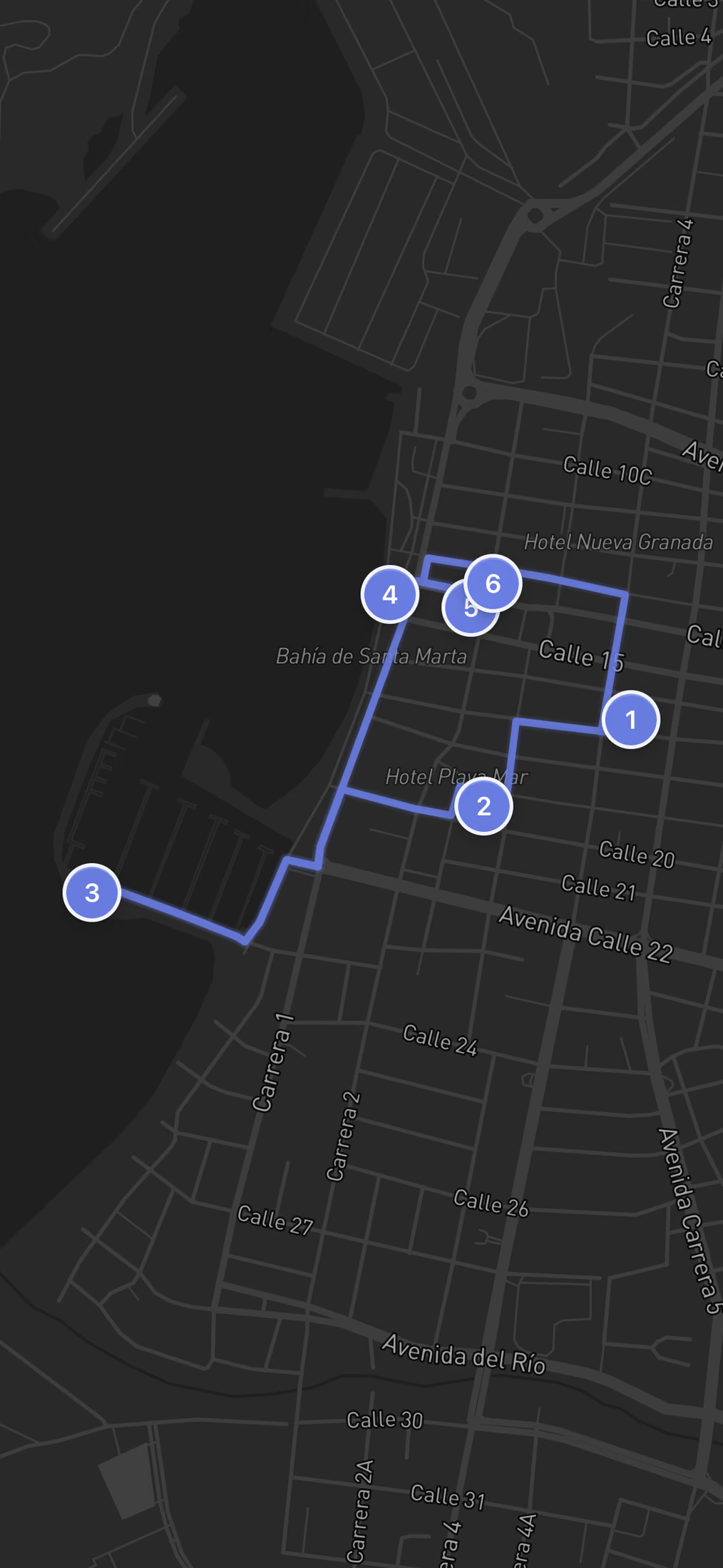
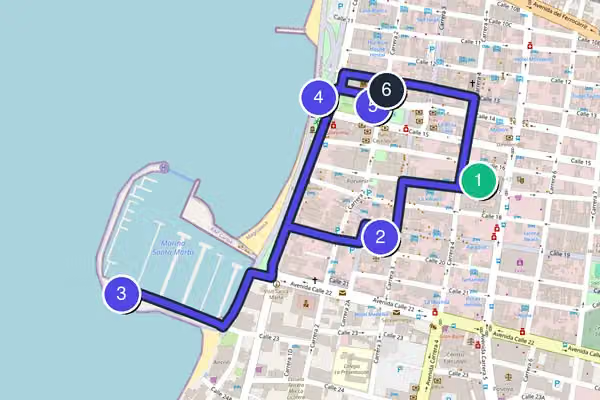
A compact 2.9 km walk through Santa Marta's old town, six stops from the Catedral Basílica down to the water and the free Museo del Oro Tairona. This page gives you the map, the walking time for every leg, real hours and prices, and shorter versions if you want less.

6 Stops2.9 km~1 hours walking2–3 hours with stops
What you get with AI Tourguide
Full GPS navigationInteractive AI guidePersonalized to youWorks in your browser
Try this tour with Alex

Santa Marta Walking Tour at a Glance

This route is built for anyone who thinks Santa Marta is just a bus stop on the way to Tayrona or Minca. It links the six things in the Centro Histórico actually worth your time, and every interior is optional: the cathedral and the Gold Museum are the only stops with a door, and both are free. The rest is open street and seafront, so you set the pace and skip whatever you like.

StartCathedral of Santa Marta (Catedral Basílica de Santa Marta)
FinishMuseo del Oro Tairona
Route typeA near-linear west-then-north walk, not a loop: you start inland at the cathedral, drop to the bay, then follow the seafront north to finish two blocks from where you began. Almost no backtracking.
Realistic timeTwo to three hours is realistic with stops. The walking alone is barely 40 minutes across 2.9 km; the time goes into the Gold Museum and the malecón, not your feet.
DifficultyEasy and flat. Under 3 km total on a numbered grid of paved, sometimes uneven colonial streets plus tiled promenade. No hills, but little shade, so heat is the real effort, not terrain.
Cost to followFree to follow. Every stop is free, including the Museo del Oro Tairona (run by the Banco de la República) and the cathedral, where a donation is optional. Your only spend is a cold drink along the way.
Best for:

First-time visitors who want the history, the bay, and the Tairona gold culture in one afternoon on foot, without a taxi or a guided group tying up their morning.

The Route

Free Walking Tour Map of Santa Marta

6 stops2.9 kmabout 1 hours
Loading the interactive map…The complete walking route will appear here.
Want the route to guide you while you walk?Open the route with navigation and a personal guide for the history, stories and questions that matter to you.
Open route + AI guide

The 6 stops along this route

  1. Cathedral of Santa Marta (Catedral Basílica de Santa Marta) in Santa Marta, stop 1 on the self-guided walking tour
    1Cathedral of Santa Marta (Catedral Basílica de Santa Marta)
  2. Boyfriend's park (Parque de Los Novios) in Santa Marta, stop 2 on the self-guided walking tour
    2Boyfriend's park (Parque de Los Novios)
  3. Santa Marta Bay (Bahía de Santa Marta) in Santa Marta, stop 3 on the self-guided walking tour
    3Santa Marta Bay (Bahía de Santa Marta)
  4. Missing required field: waypoints[3].image
    4Camellon Rodrigo de Bastidas (Malecon)
  5. Plaza de Bolivar (Plaza de Bolívar) in Santa Marta, stop 5 on the self-guided walking tour
    5Plaza de Bolivar (Plaza de Bolívar)
  6. Missing required field: waypoints[5].image
    6Museo del Oro Tairona
  7. That's the complete route.

    If you want more than the map and text, add live navigation and a conversational AI guide while you walk.

    Open route + AI guide
    You made it
Stop 1 of 6
Swipe →

Your Santa Marta Walking Tour, Stop by Stop

  1. 1

    Cathedral of Santa Marta (Catedral Basílica de Santa Marta)

    Cathedral of Santa Marta (Catedral Basílica de Santa Marta) in Santa Marta, stop 1 on the self-guided walking tour

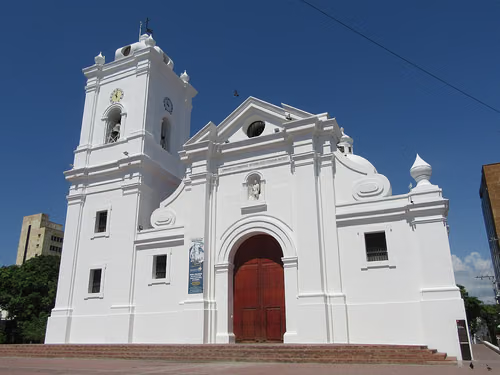
    The white bulk of the cathedral closes off the end of the street before you reach it, a plain Renaissance-style block rather than anything ornate. This is the spatial anchor of the old town and worth knowing why: it was the first church built in an ecclesiastical jurisdiction in all of South America, and since 1953 it has held the remains of Rodrigo de Bastidas, the man who founded the city in 1525. For twelve years in the 1800s it also held the bones of Simón Bolívar before they were moved to Caracas. Worth knowing the honest part too: despite the local pride, the actual oldest church in Colombia is San Francisco in Bogotá. Inside is cool, quiet, and free, though donations are accepted. Time it right, because it shuts midday and reopens at 4:30pm Monday through Saturday. Five to ten minutes inside is plenty. From the main door, head southwest down toward Carrera 3 to reach Parque de los Novios.
    Hours
    Mon-Sat: 11:30 AM – 1:00 PM, 4:30 – 6:00 PM | Sun: 6:30 AM – 1:00 PM, 4:30 – 6:00 PM
    Price
    Free (active worship temple, donations accepted)
  2. 2

    Boyfriend's park (Parque de Los Novios)

    Boyfriend's park (Parque de Los Novios) in Santa Marta, stop 2 on the self-guided walking tour

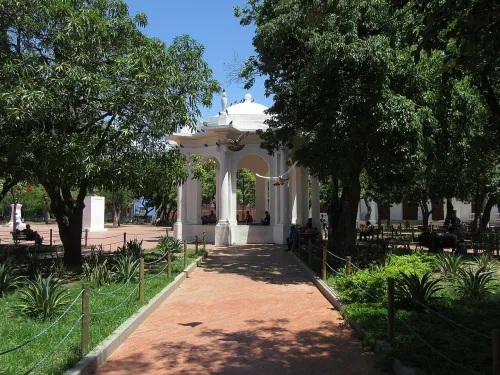
    After the hush of the cathedral, this square is where the town exhales. Pigeons, restored colonial facades, the neoclassical Palacio de Justicia on one side, and a ring of outdoor cafes that spill tables onto the pedestrian street. It is the gastronomic and social heart of the Centro Histórico, and it has two completely different personalities depending on the hour. In daylight it is calm, a place to sit with a juice and watch locals cross. After dark it fills, every restaurant lights up, and this becomes the place to eat in Santa Marta. If you are doing this walk in the afternoon, clock it now and come back tonight. It is open around the clock and free, since it is just a public square. Grab a cold limonada de coco at one of the cafes if you need a break. When you are ready, leave the square heading west and downhill toward the sea, aiming for Bahía de Santa Marta.

    Hours
    Open 24/7
    Price
    Free
  3. 3

    Santa Marta Bay (Bahía de Santa Marta)

    Santa Marta Bay (Bahía de Santa Marta) in Santa Marta, stop 3 on the self-guided walking tour

    The street opens and suddenly there is the water, a wide horseshoe bay with the dark hump of El Morro islet sitting offshore. Locals call this the most beautiful bay in the Americas, which is a big claim, but the setting earns some of it: this is the second-largest Caribbean port in Colombia, and the Sierra Nevada rises straight up behind the city, the highest coastal mountain range in the world. On a clear day you can see snow on peaks while standing in Caribbean heat. The bay itself is for looking, not really for swimming given the port traffic, so treat this as the view stop. It is the natural setting that defines the whole city and the reason it exists at all. Free, open, always there. Now turn north and walk up onto the paved promenade that runs the length of the water, the Camellón Rodrigo de Bastidas.

    Hours
    Open 24/7
    Price
    Free
  4. 4

    Camellon Rodrigo de Bastidas (Malecon)

    Missing required field: waypoints[3].image

    Now you are walking the seafront proper, palms on one side, the bay on the other, monuments and benches spaced along the way. This promenade carries the name of the city's founder and it is the spine that links the old town to the water. It runs the full length of the bay, so you set your own pace. This is the stretch to slow down on near sunset, when the whole malecón fills with families, vendors selling cut mango and arepas, and couples claiming the seawall. The marina sits at the northern end, and across the water El Morro catches the last light. It is open and free, an open-air public space with no ticket desk. Honest note: keep your phone in your pocket after dark on the quieter sections and stick to where the crowd is. Follow the promenade north and then turn inland one block to reach the open civic square of Plaza de Bolívar.

  5. 5

    Plaza de Bolivar (Plaza de Bolívar)

    Plaza de Bolivar (Plaza de Bolívar) in Santa Marta, stop 5 on the self-guided walking tour

    This is the front door of the Centro Histórico if you arrive from the sea, a formal open square that runs from Carrera 1 to Carrera 3 between Calles 14 and 15. The statue of Bolívar stands at the center, the bay opens off one end, and the colonial Casa de la Aduana sits on its edge. It is the main public space of the city and it has a different feel from Parque de los Novios: more civic, more open, less about eating and more about standing where the city's official life happens. Free and open at all hours. Spend a few minutes here reading the square, then look toward the old custom house on the corner, because that building is your final stop. Walk to the Casa de la Aduana on the edge of the plaza, the entrance to the Museo del Oro Tairona.

    Hours
    Open 24/7
    Price
    Free (open-air public square)
  6. 6

    Museo del Oro Tairona

    Missing required field: waypoints[5].image

    Save the best for last. The Gold Museum sits inside the Casa de la Aduana, the old colonial custom house on Calle 14, and it is run by the Banco de la República, which means one excellent thing: it is completely free. Inside is Tairona goldwork, pre-Columbian pottery, and a scale model of Ciudad Perdida, the terraced ancient city up in the Sierra Nevada that the indigenous Kogi never actually considered lost. If you are not trekking to Ciudad Perdida itself, this is where you understand the culture that built it, and it is genuinely the most rewarding stop on this whole walk. The catch is the schedule: closed Mondays, open Tuesday to Saturday 9am to 5pm, and Sunday 10am to 3pm. Give it 45 minutes to an hour. After this, you are one block from Plaza de Bolívar and the malecón, perfectly placed to catch the sunset and circle back to Parque de los Novios for dinner.

How Long Does This Walking Tour Really Take?

Plan two to three hours with stops. The legs are short, so nearly all the time lands in two places: 45 minutes to an hour vanishes inside the Museo del Oro Tairona, and the malecón rewards anyone who sits on the seawall near sunset. March it without stopping and you could do 2.9 km in well under an hour.

Plan on two to three hours if you stop and look, less if you march. The walking itself is under 3 kilometers and the legs between stops are short, so the time goes into the stops, not the feet. The two places that deserve real minutes are the Gold Museum, where 45 minutes to an hour disappears fast, and the malecón, which rewards anyone who sits still near sunset.

The natural break point is Parque de los Novios. Roughly a third of the way in, ringed with cafes, it is the obvious spot to drop into a chair, order a limonada de coco or a coffee, and let your feet rest before the walk down to the water. If you would rather break with the sea in front of you, the seawall along the Camellón Rodrigo de Bastidas has benches the whole way, and any of them works as a free front-row seat for the light going down over El Morro.

Full Route, Shorter Walk or Two-Day Version?

The full walk is short enough that most people just do all six stops. But the old town's compact grid makes it easy to trim or split, so here are three ways to run it depending on your time and the heat.

The Short Version

Squares, sea and museum, no long legs

Stops 1, 2, 4, 5, 6, roughly 2 km, 60–90 minutes

Skip the dedicated bay viewpoint (stop 3) and the two longer legs on either side of it. Walk the cathedral and Parque de los Novios, cut straight to the malecón, then Plaza de Bolívar and the Gold Museum. You still see the water from the promenade, just without the 830 m and 880 m detour to the viewpoint.

The Easy Split

Two short outings around the midday heat

Stops 1–3 first, stops 4–6 later, split at the bay

Do the inland half in the morning: cathedral, Parque de los Novios, and down to the bay (stops 1–3). Break for lunch and the worst of the sun, then come back for the seafront half in the late afternoon: malecón, Plaza de Bolívar, and the Museo del Oro Tairona (stops 4–6), landing you on the water for sunset.

You can run this backwards, starting at the Museo del Oro Tairona and ending at the cathedral, and it works fine on such a small grid. The given direction is recommended so you finish at the free Gold Museum and the malecón for sunset, rather than opening on a museum that closes at 5pm.

Is This Santa Marta Walking Tour Right for You?

This is a short, flat, low-commitment walk in a compact old town, which makes it a good fit for some travellers and an easy one to adapt for others. Here is who it suits and how to bend it.

A good fit if you…

  • First-timers who want the whole Centro Histórico in one afternoon without a taxi or a tour group
  • Anyone short on time, since the walking is under 3 km on an easy numbered grid
  • Travellers heading to Ciudad Perdida or Tayrona who want the Tairona-gold context first, free, at the museum
  • People who prefer to set their own pace, linger on the seawall, and skip any interior they are not feeling

Adapt the route if you…

  • It's midday and hot: split the walk in two and do the seafront half after 4pm, when the heat breaks
  • It's a Monday: the Museo del Oro Tairona is closed, so save this route for another day or accept a museum-free version
  • You want to swim: the bay here is a working port, so treat stop 3 as a view and plan beach time for Tayrona instead
  • You only have an hour: run the short version, cutting the bay viewpoint and its two long legs

Tickets & Skip-the-Line in Santa Marta

There is genuinely no line to skip on this route: every stop is free and none needs a booking. What matters here is timing, since the two indoor stops keep limited hours. Here is what to know before you go.

Cathedral of Santa Marta (Catedral Basílica de Santa Marta)Free entry (active worship temple, donations accepted). Watch the midday closure: open Mon to Sat 11:30 AM–1:00 PM and 4:30–6:00 PM, and Sun 6:30 AM–1:00 PM and 4:30–6:00 PM. No ticket, just time it right.
Museo del Oro TaironaFree, run by the Banco de la República. Closed Mondays; open Tue to Sat 9:00 AM–5:00 PM and Sun 10:00 AM–3:00 PM. No booking needed, but give it 45 minutes to an hour and mind the early close. official ticket site ↗
Everything elseParque de los Novios, the Bahía de Santa Marta, the Camellón Rodrigo de Bastidas malecón, and Plaza de Bolívar are all free open-air public spaces, open 24/7 with no ticket desk.
Optional upgrade
+2
The same 6-stop route,
now with navigation and a guide.
Optional AI experience

You already have the route.
The AI guide brings it to life.

Standing in Parque de los Novios or down on the malecón near El Morro? The AI guide walks this exact loop with you, talking through the cathedral, the bay, and the Tairona gold as you go, and adapting to where you are and what you ask. Start it in your browser, no download, and let it lead you stop to stop.

Livenavigation13languagesAnyquestionYourinterests
Open this route with the AI guide

Try it in your browser · No app or download required

Tips for Walking in Santa Marta

  • Timing: start around 4pm. The cathedral reopens at 4:30pm after its midday closure (Mon-Sat), the heat breaks, and you finish on the malecón at sunset. The Gold Museum closes at 5pm Tuesday to Saturday, so visit it first if you start later, or do this loop earlier and save the museum for its open hours.
  • Terrain and shoes: the Centro Histórico is flat with paved and sometimes uneven colonial streets, plus tiled promenade along the malecón. Flat shoes or sandals are fine. There are no hills on this route, but there is little shade, so a hat matters more than good boots.
  • Restrooms: the Museo del Oro Tairona inside the Casa de la Aduana is free to enter and has clean facilities, making it the reliable restroom stop near the end. Cafes around Parque de los Novios are the other option if you buy a drink.
  • Food and drink: stop at a cafe on Parque de los Novios for a limonada de coco, a coconut limeade that is the local default in the heat. For dinner, come back to this same square after dark when every restaurant around it opens up. It is the eating-and-drinking heart of the old town.
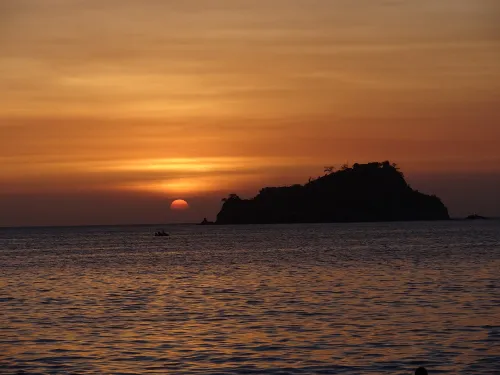
  • Photo: stand on the malecón near El Morro at sunset and face west across the bay. The dark islet sits against the orange water and the Sierra Nevada rises behind the city. Late afternoon, roughly 5:30 to 6pm depending on season, is the window.

Why Walk This Route?

Santa Marta gets treated as a bus station with a beach attached, a place you sleep before catching a jeep to Tayrona or Minca. That is a mistake. The Centro Histórico is small, flat, and packed tight against the Caribbean, which means you can see the whole historic core on foot in an afternoon without a single taxi. The streets run on a grid of numbered carreras and calles, the old town is maybe ten blocks square, and the sea is always downhill toward the west. You genuinely cannot get lost here.

This particular loop works because it strings together the six things actually worth your time and skips the rest. You start inland at the cathedral, the founder's resting place and the oldest stone in town, then drop through Parque de los Novios where the city eats and drinks at night. From there you walk down to the water, follow the malecón along the bay, and finish at the Gold Museum, which is free and the single best hour you will spend in Santa Marta. The whole thing is under 3 kilometers.

Do this in the late afternoon. The midday sun on the Caribbean coast is brutal and the old town has little shade, but by 4pm the light goes gold, the cathedral reopens after its lunch closure, and you can end on the malecón watching the sun drop behind El Morro. One walk, no entry fees except an optional church donation, and you will understand this city better than most people who stay a week.

Common Questions

Is Santa Marta safe to walk around?

The Centro Histórico is fine to walk by day and busy enough to walk in the evening when the squares and malecón are full. Use normal city sense: keep your phone away on the quieter stretches of the seafront after dark, do not flash valuables, and stick to where the crowds are. The route here stays in the well-trafficked old town and along the lit promenade. Avoid wandering into empty side streets late at night, and ignore anyone pushing drugs or unofficial tours.

What if it rains during my Santa Marta tour?

Caribbean rain tends to come in short hard bursts rather than all-day drizzle, so often you just wait it out under a cafe awning on Parque de los Novios. If it sets in, the indoor stops on this route are the cathedral and the Museo del Oro Tairona, both free and both good places to spend half an hour while it passes. The museum especially can absorb a full hour without you noticing the weather.

What's the best time of day for this walking tour?

Late afternoon, starting around 4pm. Midday on this coast is genuinely punishing and the old town has little shade, so you want the sun already dropping. Starting at 4pm gets you into the cathedral right after its 4:30pm reopening, walks you down to the water as the light turns gold, and lands you on the malecón for sunset. Just check the Gold Museum hours first, since it closes at 5pm most days, and slot it in earlier if needed.

Take this route with you

Open this exact tour with navigation and your personal AI guide.

Start GPS Navigation + AI Guide
AI Tourguide
Researched and curated by the AI Tourguide teamWe plan and quality-check every route, then research and verify the opening hours, prices, and practical tips for each stop along it.
▶ Open route with AI guideNavigation, stories and your questions