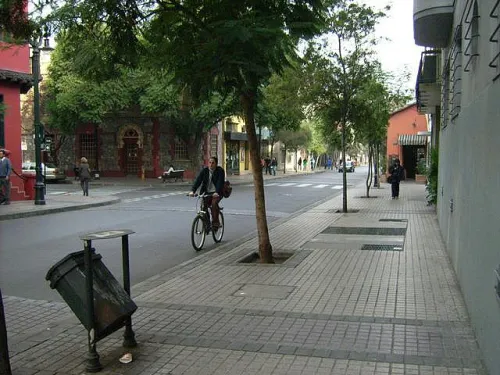
Self-Guided Walking Tour in Santiago de Chile

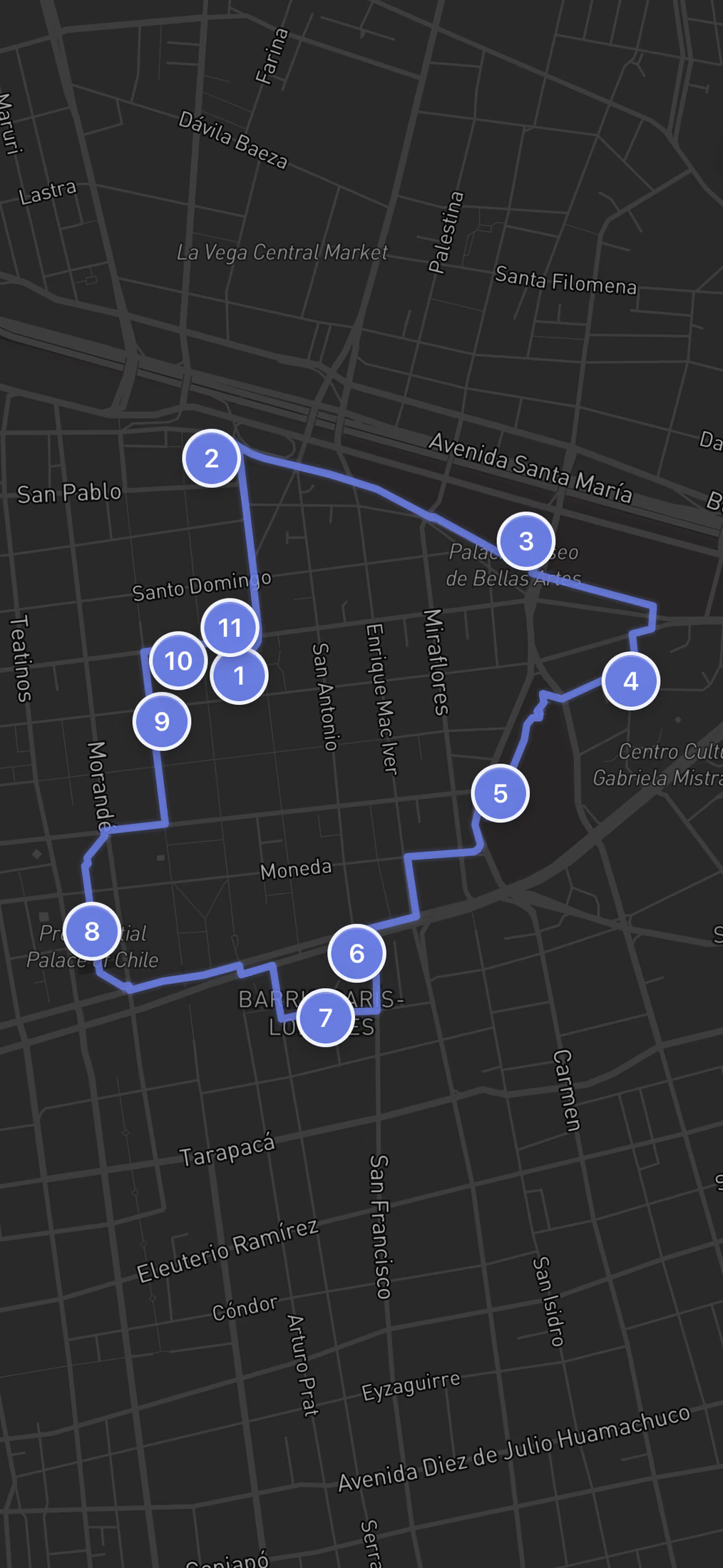
A 5.3 km loop through the old center of Santiago, from Plaza de Armas out to Mercado Central and Cerro Santa Lucia, then back past La Moneda and three museums on the square. This page gives you the map, exact leg-by-leg walking times, real prices and opening hours, and shorter versions if you are tight on time.

11 Stops5.3 km~3 hours walking3–4 hours with stops
What you get with AI Tourguide
Full GPS navigationInteractive AI guidePersonalized to youWorks in your browser
Try this tour with Alex

Santiago de Chile Walking Tour at a Glance

This route is built for travellers who want the real center of Santiago on foot, not a metro dash between stations. It links 11 sights in a tight loop, and every interior is optional: you can walk the whole thing for free and step inside only the museums that pull you in. You set the pace, choose which doors to open, and skip the rest without missing the thread of the walk.

StartPlaza de Armas (Plaza de Armas de Santiago)
FinishChilean National History Museum (Museo Histórico Nacional)
Route typeA closed loop that starts and ends on Plaza de Armas, running north to the market and river, east into Lastarria, then south and west to La Moneda before circling back to the square. Almost no backtracking.
Realistic timeTwo hours if you mostly walk and look from outside, three to four hours if you actually go inside the market and the museums. The Pre-Columbian museum and Cerro Santa Lucia are the two big time sinks.
DifficultyEasy overall. The old center is a flat grid, but Cerro Santa Lucia is a real climb on steep, uneven stone stairs, and Lastarria and Paris-Londres are genuine cobblestones, so wear closed shoes with grip.
Cost to followThe walk itself is free, and most stops cost nothing. The only tickets you might buy are the Museo Chileno de Arte Precolombino (CLP 3,000 for residents, CLP 10,000 for foreign visitors) and the colonial art museum at San Francisco (CLP 3,000).
Best for:

First-time visitors who want the founding square, the market, the best free viewpoint and the political heart of Chile in one flat, walkable half day, with world-class museums along the way.

The Route

Free Walking Tour Map of Santiago de Chile

11 stops5.3 kmabout 3 hours
Loading the interactive map…The complete walking route will appear here.
Want the route to guide you while you walk?Open the route with navigation and a personal guide for the history, stories and questions that matter to you.
Open route + AI guide

The 11 stops along this route

  1. Plaza de Armas (Plaza de Armas de Santiago) in Santiago de Chile, stop 1 on the self-guided walking tour
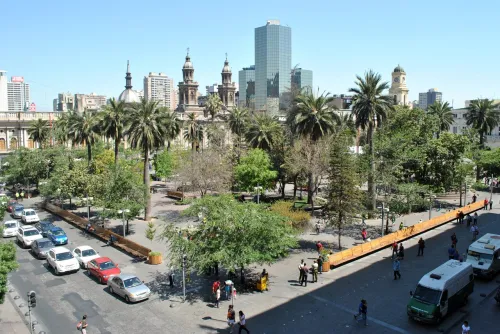
    1Plaza de Armas (Plaza de Armas de Santiago)
  2. Mercado Central de Santiago in Santiago de Chile, stop 2 on the self-guided walking tour
    2Mercado Central de Santiago
  3. Chilean National Museum of Fine Arts (Museo Nacional de Bellas Artes) in Santiago de Chile, stop 3 on the self-guided walking tour
    3Chilean National Museum of Fine Arts (Museo Nacional de Bellas Artes)
  4. Lastarria (Barrio Lastarria) in Santiago de Chile, stop 4 on the self-guided walking tour
    4Lastarria (Barrio Lastarria)
  5. Santa Lucía Hill (Cerro Santa Lucía) in Santiago de Chile, stop 5 on the self-guided walking tour
    5Santa Lucía Hill (Cerro Santa Lucía)
  6. San Francisco Church, Santiago de Chile (Iglesia de San Francisco) in Santiago de Chile, stop 6 on the self-guided walking tour
    6San Francisco Church, Santiago de Chile (Iglesia de San Francisco)
  7. Barrio París-Londres in Santiago de Chile, stop 7 on the self-guided walking tour
    7Barrio París-Londres
  8. Palacio de La Moneda in Santiago de Chile, stop 8 on the self-guided walking tour
    8Palacio de La Moneda
  9. Chilean Museum of Pre-Columbian Art (Museo Chileno de Arte Precolombino) in Santiago de Chile, stop 9 on the self-guided walking tour
    9Chilean Museum of Pre-Columbian Art (Museo Chileno de Arte Precolombino)
  10. Santiago Metropolitan Cathedral (Catedral Metropolitana de Santiago) in Santiago de Chile, stop 10 on the self-guided walking tour
    10Santiago Metropolitan Cathedral (Catedral Metropolitana de Santiago)
  11. Chilean National History Museum (Museo Histórico Nacional) in Santiago de Chile, stop 11 on the self-guided walking tour
    11Chilean National History Museum (Museo Histórico Nacional)
  12. That's the complete route.

    If you want more than the map and text, add live navigation and a conversational AI guide while you walk.

    Open route + AI guide
    You made it
Stop 1 of 11
Swipe →

Your Santiago de Chile Walking Tour, Stop by Stop

  1. 1

    Plaza de Armas (Plaza de Armas de Santiago)

    Plaza de Armas (Plaza de Armas de Santiago) in Santiago de Chile, stop 1 on the self-guided walking tour

    Start where the city started. This square is the exact spot Pedro de Valdivia paced out in 1541, and it still functions as the living room of central Santiago. Office workers cut across it, old men play chess under the palms, a guy with a parrot will try to charge you for a photo, and street preachers compete with caricaturists. It is loud and a little chaotic, which is the point. The Metro runs directly beneath you, with the Plaza de Armas station serving Line 5 since 2000 and Line 3 since 2019, so this is the easiest place in the city to arrive at. Spend ten minutes here just watching before you start. Three of your later stops sit on the edges of this same square, so you will be back. For now, head north toward the river on Paseo Puente, the pedestrian shopping street running off the northwest corner.
    Hours
    Open 24/7 (public square)
    Price
    Free
  2. 2

    Mercado Central de Santiago

    Mercado Central de Santiago in Santiago de Chile, stop 2 on the self-guided walking tour

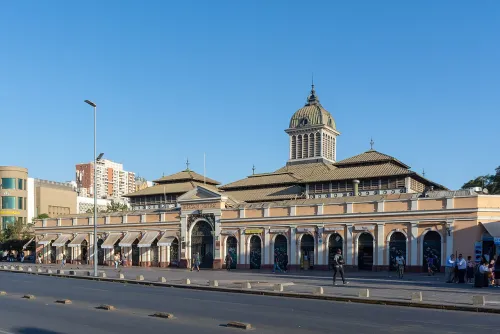
    You smell it before you see it: ice, fish, lemon. Step under the wrought-iron roof and the noise doubles. Vendors call out the day's catch, waiters wave menus at you, and somewhere a fish gets cleaned every few seconds. The cast-iron structure went up between 1869 and its opening on 23 August 1872, and National Geographic once ranked it the fifth-best market in the world. It is a working food market, free to walk through, open Monday to Friday from 6 AM, Saturday from 7 AM, and Sunday from 9 AM, all closing at 5 PM. Here is the honest tip: the big sit-down restaurants in the center under the dome are tourist-priced and pushy. Eat at the small stalls around the edges instead, where locals get a ceviche or a fried fish for a fraction of the price. Come before noon to dodge the lunch crush. Leave by the south side and cross toward the river, then walk east along Ismael Valdes Vergara into Parque Forestal toward the Fine Arts Museum.

    Hours
    Mon-Fri: 6:00 AM – 5:00 PM | Sat: 7:00 AM – 5:00 PM | Sun: 9:00 AM – 5:00 PM
    Price
    Free (public food market, no entry fee)
  3. 3

    Chilean National Museum of Fine Arts (Museo Nacional de Bellas Artes)

    Chilean National Museum of Fine Arts (Museo Nacional de Bellas Artes) in Santiago de Chile, stop 3 on the self-guided walking tour

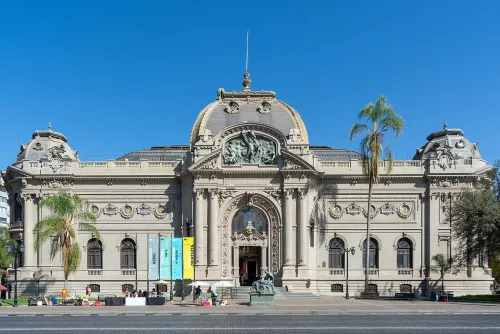
    After the chaos of the market, the green calm of Parque Forestal lands like a deep breath. The trees open and there it is: a glass-domed palace that looks like it was lifted out of Paris. It was, more or less. Architect Emile Jequier modeled it on the Petit Palais and finished it in 1910 for Chile's centennial. This is the first art museum in Latin America, founded in 1880, and it holds more than 3,000 works including the best collection of Chilean sculpture anywhere. Entry is free. It closes Mondays and runs Tuesday to Sunday, 10 AM to 6:30 PM. Even if you skip the galleries, walk into the central glass-roofed hall for the light. Give it 45 minutes if Chilean painting interests you, ten if you just want the architecture. When you leave, walk east and slightly south out of the park toward Jose Miguel de la Barra, which feeds straight into the cobbled lanes of Lastarria.

    Hours
    Mon: Closed | Tue-Sun: 10:00 AM – 6:30 PM
    Price
    Free (national museum, free admission)
    Website
    mnba.cl ↗
  4. 4

    Lastarria (Barrio Lastarria)

    Lastarria (Barrio Lastarria) in Santiago de Chile, stop 4 on the self-guided walking tour

    The asphalt turns to cobblestones and the pace drops. Lastarria is the neighborhood Santiago is proud of, a wedge of bookshops, cafes, wine bars and antique stalls between Parque Forestal and Cerro Santa Lucia. A Spanish newspaper put it on a list of the world's coolest neighborhoods in 2018, and it has been a protected heritage zone since 1996. The little Plaza Mulato Gil de Castro hides the MAVI visual arts museum, which costs CLP 1,000, is free for under-12s, over-65s and on the last Sunday of the month, and closes Mondays. This is the place to stop for a coffee or an early glass of Chilean wine before the climb ahead. Wander the side streets, there is no wrong turn here. When you are ready, head south to where the cobbles meet the base of the green hill that has been looming over you. That hill is the next stop.

    Hours
    Open 24/7 (public neighborhood)
    Price
    Free (public neighborhood)
  5. 5

    Santa Lucía Hill (Cerro Santa Lucía)

    Santa Lucía Hill (Cerro Santa Lucía) in Santiago de Chile, stop 5 on the self-guided walking tour

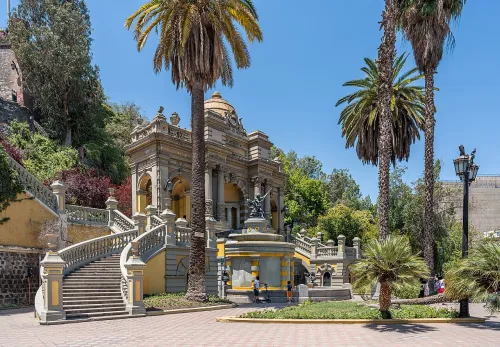
    This is the climb, and it is worth it. The hill the Mapuche called Huelen rises 68 meters straight out of the flat grid, the spot where Valdivia founded the city in 1541. Today it is a landscaped park of stone staircases, fountains and terraces, free to enter, open sunrise to sunset. Take your time on the way up because the steps are steep and uneven in places. Near the top sits the Castillo Hidalgo, a fort built in 1816 during the Spanish reconquest, now an events venue rather than a museum. The reason you came is the view: from the upper terraces the whole city spreads out with the Andes wall behind it, and on a clear day it is the best free panorama in central Santiago. Watch your bag and your phone up here, it gets quiet in corners. Come down the western side toward Alameda, the big avenue, and turn right. A few blocks down you reach the oldest building in the country.

    Hours
    sunrise-sunset
    Price
    Free
  6. 6

    San Francisco Church, Santiago de Chile (Iglesia de San Francisco)

    San Francisco Church, Santiago de Chile (Iglesia de San Francisco) in Santiago de Chile, stop 6 on the self-guided walking tour

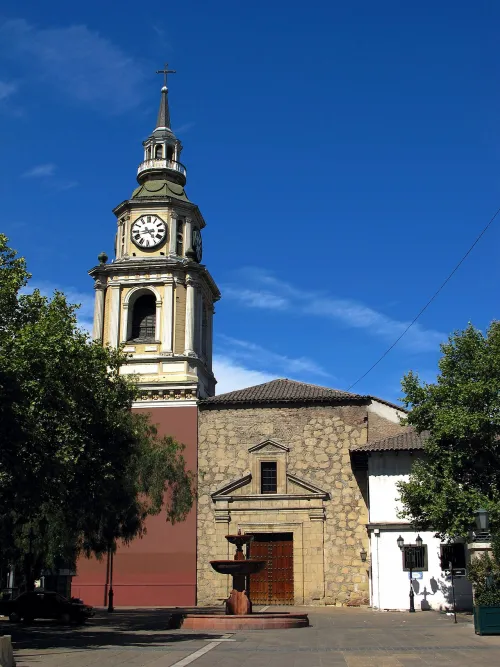
    Set back from the roar of the Alameda, this squat stone church is older than almost everything else in Chile. The current structure was completed in 1618 on the site of an earlier church the 1583 earthquake destroyed, and its stone walls make it the oldest building in Santiago and the country with a known construction date. It survived the great 1647 quake that flattened nearly everything around it, which is why it stands alone as the one surviving example of the city's first architecture. The church is free to enter; check the posted hours, since it opens in short windows through the day rather than straight through. The adjoining colonial art museum, the Museo San Francisco in the old convent, charges CLP 3,000 and holds the largest colonial art collection on the continent, worth it if you like religious painting. Step inside the church for five minutes of cool quiet, then walk a short way west. Just behind the church, a tiny knot of curving cobbled streets waits.

    Hours
    Mon: 8:30 – 10:00 AM | Tue-Fri: 8:00 – 9:00 AM, 10:00 – 11:00 AM, 12:00 – 1:00 PM, 2:00 – 7:00 PM, 7:30 – 8:30 PM | Sat: 8:00 – 9:00 AM, 10:00 – 11:00 AM, 12:00 – 1:00 PM, 2:00 – 6:00 PM, 7:30 – 8:30 PM | Sun: 9:00 – 10:00 AM, 10:30 – 11:30 AM, 12:00 – 12:55 PM
    Price
    Free (church entry; adjoining Museo de Arte Colonial San Francisco has paid/donation admission)
  7. 7

    Barrio París-Londres

    Barrio París-Londres in Santiago de Chile, stop 7 on the self-guided walking tour

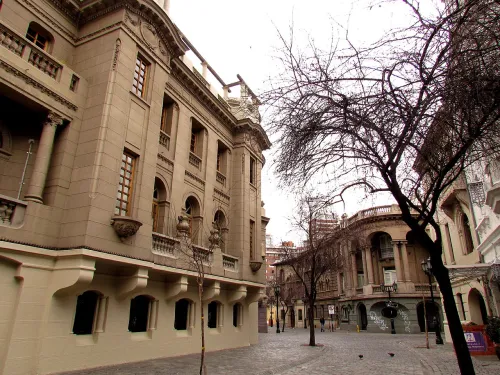
    Two minutes from San Francisco and you could be in a different country. Barrio Paris-Londres is a pocket-sized maze of curving, narrow cobbled streets lined with European-style townhouses, laid out in the 1920s by the architects Ernesto Holzmann, father and son. There is no ticket, no gate, just two streets named Paris and London that bend into each other in a way the rest of the grid never does. It takes ten minutes to walk the whole thing, and it photographs better than almost anywhere else downtown because the buildings curve and the light pools in the lane. This is a quick, deliberate detour, not a long stop. The neighborhood also carries a darker history as a detention site under the dictatorship, marked discreetly on the pavement if you look. When you have your photos, head west and north toward the government quarter. Aim for the long gray facade of the presidential palace a few blocks away.

    Hours
    Open 24/7
    Price
    Free (public historic street, open-air, no ticket desk)
  8. 8

    Palacio de La Moneda

    Palacio de La Moneda in Santiago de Chile, stop 8 on the self-guided walking tour

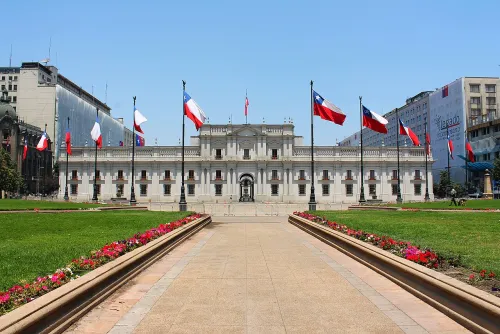
    The building in front of you is the most politically charged spot in Chile. La Moneda is the seat of government and the place where, on 11 September 1973, the air force bombed the palace during the coup that ended Salvador Allende's presidency. Today it sits calm between two open plazas, Plaza de la Constitucion to the north and Plaza de la Ciudadania to the south, both free and open to the public daily from 6 AM to 11 PM. You cannot wander into the palace itself without a booked tour, but you can stand in the courtyards and watch the guard. The real find is underground: beneath Plaza de la Ciudadania sits the Centro Cultural La Moneda, a free cultural center with strong rotating exhibitions, open daily 10 AM to 7 PM. Duck in even just to cool off. From here, walk back northeast toward the cathedral, taking Morande or Bandera. Your next stop is a museum many visitors call the best in the city.

    Hours
    Daily: 6:00 AM – 11:00 PM
    Price
    Free (government palace; exterior Plaza de la Constitución open to public, free Centro Cultural Palacio de La Moneda underground)
  9. 9

    Chilean Museum of Pre-Columbian Art (Museo Chileno de Arte Precolombino)

    Chilean Museum of Pre-Columbian Art (Museo Chileno de Arte Precolombino) in Santiago de Chile, stop 9 on the self-guided walking tour

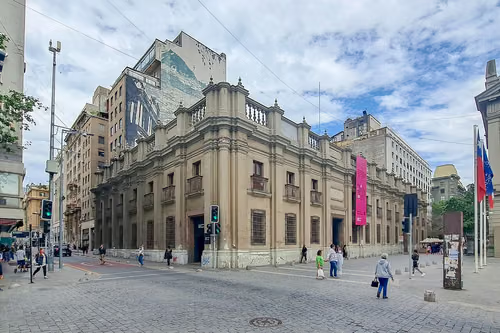
    If you visit one paid museum in Santiago, make it this one. The Museo Chileno de Arte Precolombino sits in the handsome former Royal Customs House on Bandera, a short walk from the cathedral, and it lays out thousands of years of indigenous art from across the Americas with a clarity most museums never manage. Founded in 1981, it runs Tuesday to Sunday, 10 AM to 6 PM, closed Mondays. Admission is CLP 3,000 for Chileans and residents and CLP 10,000 for foreign non-residents, which is the steepest ticket on this walk but genuinely earns it. Give it at least an hour. The textiles and the Andean ceramics alone justify the price. The building itself, all stone arches and a quiet inner courtyard, is a relief after the busy streets. When you finish, walk a couple of minutes northeast and the bulk of the cathedral comes into view on the west edge of Plaza de Armas.

    Hours
    Tu-Su 10:00-18:00
    Price
    CLP 3000 (nationals/residents) / CLP 10000 (foreign non-residents)
  10. 10

    Santiago Metropolitan Cathedral (Catedral Metropolitana de Santiago)

    Santiago Metropolitan Cathedral (Catedral Metropolitana de Santiago) in Santiago de Chile, stop 10 on the self-guided walking tour

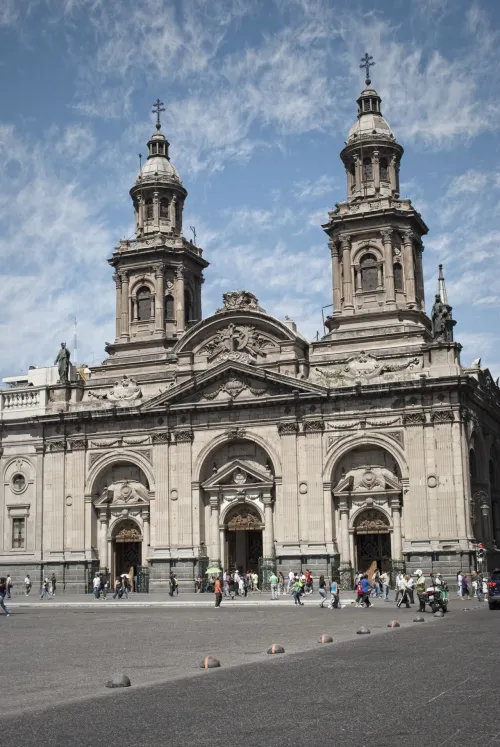
    You are back at the square where you started, and the cathedral fills its entire west side. This neoclassical pile is the principal Catholic church in Chile and the seat of the archbishop, and it is the fifth church built on this same spot, the others lost to earthquakes over the centuries. Entry is free. It opens Monday to Friday 10 AM to 6 PM, but note the shorter weekend hours: Saturday 10 AM to 1:30 PM and Sunday 9 AM to 1:30 PM, so time your visit if it is the weekend. Inside, the nave is long and surprisingly bright, with ornate side chapels and a quiet that contrasts hard with the square outside. Ten minutes is plenty unless a service is on. Step back out into Plaza de Armas and turn toward the north side of the square. The last stop is the long colonial building with the clock tower, just a minute away.

    Hours
    Mon-Fri: 10:00 AM – 6:00 PM | Sat: 10:00 AM – 1:30 PM | Sun: 9:00 AM – 1:30 PM
    Price
    Free (cathedral + museum; special tower tours may charge)
  11. 11

    Chilean National History Museum (Museo Histórico Nacional)

    Chilean National History Museum (Museo Histórico Nacional) in Santiago de Chile, stop 11 on the self-guided walking tour

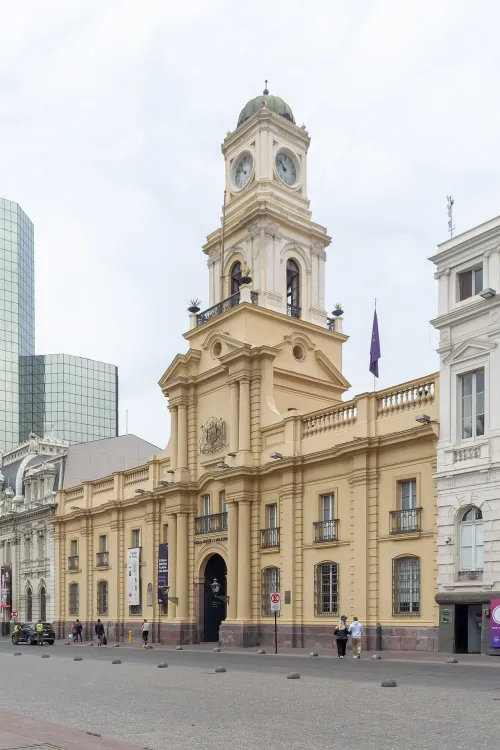
    End the loop where the country's whole story is laid out under one roof. The National History Museum occupies the old Palacio de la Real Audiencia on the north side of Plaza de Armas, a colonial building dating from 1808 that also served as the Palace of Independence. The museum has been here since 1982, and it is one of only three institutions in the city to hold national rank, alongside Fine Arts and Natural History. Entry is free. It closes Mondays and opens Tuesday to Sunday, 10 AM to 5:30 PM. This is the smart place to finish because it ties together everything you have just walked past: the founding of the city, the colonial churches, the move to independence, the modern political turmoil at La Moneda. Give it 45 minutes and you will leave understanding the route you just did. From the door you are standing right back on Plaza de Armas, with the Metro entrance a few steps away whenever you are ready to move on.

    Hours
    Mon: Closed | Tue-Sun: 10:00 AM – 5:30 PM
    Price
    Free

How Long Does This Walking Tour Really Take?

At 5.3 km the walking alone runs about 70 minutes end to end. Add the outdoor stops, the market and the hill, and you are near three hours. Go inside the three serious museums and it stretches to a full four-hour day. The Pre-Columbian museum wants an hour on its own, Cerro Santa Lucia easily 40 minutes.

Budget three to four hours if you actually go inside things, closer to two if you mostly walk and look. The route is 5.3 km and flat apart from the hill. The stops that eat the most time are the three serious museums: the Pre-Columbian museum deserves a full hour, the National History Museum about 45 minutes, and the Fine Arts Museum 30 to 45 if Chilean art interests you. Cerro Santa Lucia is the other time sink, and the right kind: between the climb, the terraces and the view, you can easily spend 40 minutes up there.

The natural break point is the middle of the walk. Do the market early, before noon, and eat there at one of the edge stalls, a ceviche or a fried fish with a cold drink. If you would rather hold off, Lastarria is the better place to sit: grab a coffee or an early glass of Carmenere at one of the cafes around Calle Lastarria before you tackle the hill. On the second half, the underground Centro Cultural La Moneda has benches, air conditioning and restrooms if you need to reset before the final museum stretch back at Plaza de Armas.

Full Route, Shorter Walk or Two-Day Version?

The full loop is 5.3 km with 11 stops, but it splits cleanly. Because it starts and ends on the same square, you can cut the far western leg, or break it into two easy halves without ever doubling back. Here are three ways to run it depending on your time and energy.

The Short Version

Skip the western La Moneda detour

Stops 1 to 6, then straight to stops 9, 10 and 11, about 3.9 km, roughly 2 to 2.5 hours

Cut the two longest western legs to Paris-Londres and La Moneda (stops 7 and 8) and jump from San Francisco back toward the square. You keep the market, the hill, the churches and all three museums, and drop about 1.4 km and the government quarter.

The Two-Day Split

Break at Cerro Santa Lucia

Day one stops 1 to 5, day two stops 6 to 11, each half about 2 to 2.5 hours

Do the northern half first: square, market, Fine Arts, Lastarria and the climb up Santa Lucia, ending on the terrace for the view. Come back another day for San Francisco, Paris-Londres, La Moneda and the three museums clustered around Plaza de Armas. Ideal if you want to linger in each museum.

You can run this loop in reverse, from the National History Museum back around to Mercado Central, and it still works because it circles the same square. The given direction is recommended so you hit Mercado Central before the noon lunch crush and reach Cerro Santa Lucia in the late-afternoon light over the Andes.

Is This Santiago de Chile Walking Tour Right for You?

This is a flat-center walk with one real hill and a handful of world-class museums. It suits some travellers perfectly and asks a little adapting from others. Here is who it fits and how to adjust it.

A good fit if you…

  • First-time visitors who want the founding square, the market and the political heart of Chile in one compact loop
  • Museum lovers, since three of South America's best sit within a few blocks and most are free
  • Budget travellers, because you can walk the entire 5.3 km for the price of one or two museum tickets
  • Anyone who prefers a flat, gridded city center where you rarely get lost and can skip stops freely

Adapt the route if you…

  • You have limited mobility: Cerro Santa Lucia is steep, uneven stone stairs, so admire it from below and stay on the flat grid
  • You are travelling on a Monday, when the Pre-Columbian, Fine Arts and National History museums all close, so lean on the market, churches and hill instead
  • You only have two hours: take the Short Version and drop the western La Moneda detour
  • It has rained: save Cerro Santa Lucia for a dry day, since the stone steps get slick, and fill the time in the roofed market and indoor museums

Tickets & Skip-the-Line in Santiago de Chile

Most of this route is free open space with nothing to book. Only two stops charge admission, and one government palace has a booking system worth knowing about. Here is what actually costs money and how to handle each.

Chilean Museum of Pre-Columbian Art (Museo Chileno de Arte Precolombino)The steepest ticket on the walk, and the one most visitors say is worth it: CLP 3,000 for Chilean nationals and residents, CLP 10,000 for foreign non-residents. Open Tuesday to Sunday 10:00 to 18:00, closed Mondays. No advance booking needed, just buy at the door.
San Francisco Church, Santiago de Chile (Iglesia de San Francisco)The church itself is free but opens only in short windows through the day (broadly from around 8:00, with breaks, into the evening; shorter on Sunday). The adjoining Museo de Arte Colonial San Francisco charges a paid or donation admission of about CLP 3,000. Tickets at the door. official ticket site ↗
Palacio de La MonedaFree, but you cannot enter the palace itself without a booked patrimonial tour arranged in advance through the presidency; the exterior plazas and the free underground Centro Cultural are open to walk-ins daily 6:00 to 23:00. official ticket site ↗
Santa Lucía Hill (Cerro Santa Lucía)Free to enter, open sunrise to sunset, no ticket required. Check the park's own page for seasonal hours and any closures before you climb. official ticket site ↗
Everything elseAll remaining stops are free open spaces or free-entry sights: Plaza de Armas, Mercado Central, the Fine Arts Museum, Barrio Lastarria, Barrio Paris-Londres, the Metropolitan Cathedral and the National History Museum. No tickets, no booking.
Optional upgrade
+7
The same 11-stop route,
now with navigation and a guide.
Optional AI experience

You already have the route.
The AI guide brings it to life.

Standing on Plaza de Armas with the cathedral on one side and no idea where to start? Open the AI guide and it will walk this whole loop with you, from the fish stalls of Mercado Central to the view from Cerro Santa Lucia, telling you the story at each stop and answering whatever you ask. It runs right in your browser, so there is nothing to download before you take the first step.

Livenavigation13languagesAnyquestionYourinterests
Open this route with the AI guide

Try it in your browser · No app or download required

Tips for Walking in Santiago de Chile

  • Start at the Plaza de Armas Metro station (Line 3 or Line 5). Aim to be at Mercado Central before noon, when the fish stalls are busy but the lunch crowd has not filled the restaurants yet. The market and both museum-heavy stops are best in the morning.
  • The center is flat and easy, but Cerro Santa Lucia is genuine climbing on steep, uneven stone stairs, and Lastarria and Paris-Londres are real cobblestones. Wear closed shoes with grip, not sandals. The hill steps get slick if it has rained.
  • The cleanest reliable restrooms on the route are inside the free Centro Cultural La Moneda, underground beneath Plaza de la Ciudadania, open daily 10 AM to 7 PM. The Fine Arts Museum and the National History Museum also have facilities if you are visiting them.
  • Eat lunch at Mercado Central, but skip the big pushy restaurants under the central dome. Go to the small stalls around the market's edges where locals eat, where a ceviche or fried fish costs a fraction of the tourist tables. The market is free to enter.
  • For the best photo, climb to the upper terraces of Cerro Santa Lucia and face east toward the Andes. Late afternoon light, roughly an hour before sunset, lights up the mountains and the city below. Keep your phone in hand, not on a ledge.

Why Walk This Route?

Santiago hides its best parts inside about a square kilometer, and almost all of it is flat. The old center is a grid Pedro de Valdivia laid out in 1541, which means streets meet at right angles and you rarely get lost for long. That grid is the whole reason a walking tour beats the metro here. You could ride three stops underground, but you would miss the fish vendors shouting in Mercado Central, the cobbles of Lastarria, and the way Cerro Santa Lucia suddenly rises out of nowhere with the Andes behind it. This route covers 5.3 km and connects eleven sights that you genuinely cannot appreciate from a car window.

What makes this loop work is the rhythm. It starts and ends at Plaza de Armas, swings north to the market and the river, climbs the one hill worth climbing, then drops back down through the colonial churches and the government quarter before circling home past three free museums clustered around the square. You get a market, a viewpoint, a presidential palace charged with history, and some of the best museums in South America, several of them free. Most cost nothing to enter.

Go on a Tuesday through Saturday if you can. Two of the best museums on this walk close on Mondays, and the cathedral keeps shorter hours on weekends. Bring water, wear shoes you can climb a hill in, and do not rush the middle section. The hill and the market are where the day actually happens.

Common Questions

Is Santiago de Chile safe to walk around?

Central Santiago in daylight is fine, and this whole route stays in busy, public areas. The real risk is petty theft, not violence. Pickpockets work the crowded spots, especially Plaza de Armas, the Metro, and the quiet corners of Cerro Santa Lucia. Keep your phone and wallet zipped away, do not flash a camera around the square, and ignore anyone who offers an unsolicited photo with a parrot or tries to clean a 'stain' off your jacket. Both are common distraction scams. After dark the center empties out and feels less comfortable, so do this walk during the day.

What if it rains during my Santiago de Chile tour?

Santiago rarely rains hard, but when it does this route has good cover. Lean into the indoor stops: the Pre-Columbian museum, the Fine Arts Museum, the National History Museum and the underground Centro Cultural La Moneda are all on the route and all either free or cheap. Mercado Central is fully roofed, so you can take a long lunch there. The one stop to save for dry weather is Cerro Santa Lucia, since the stone stairs get slippery and the whole point is the view.

What's the best time of day for this walking tour?

Start mid-morning, around 10 AM, when the museums open and the market is in full swing. That timing lets you hit Mercado Central before the noon lunch rush, see the free museums during their open hours, and reach Cerro Santa Lucia in the late afternoon for the best light over the Andes. Avoid Mondays: the Pre-Columbian museum, the Fine Arts Museum, the National History Museum and MAVI are all closed that day, which guts the cultural half of the walk.

Take this route with you

Open this exact tour with navigation and your personal AI guide.

Start GPS Navigation + AI Guide
AI Tourguide
Researched and curated by the AI Tourguide teamWe plan and quality-check every route, then research and verify the opening hours, prices, and practical tips for each stop along it.
▶ Open route with AI guideNavigation, stories and your questions