
Self-Guided Walking Tour in Schaffhausen

14 Stops 3.2 km ~2.5 hours
Try This Tour
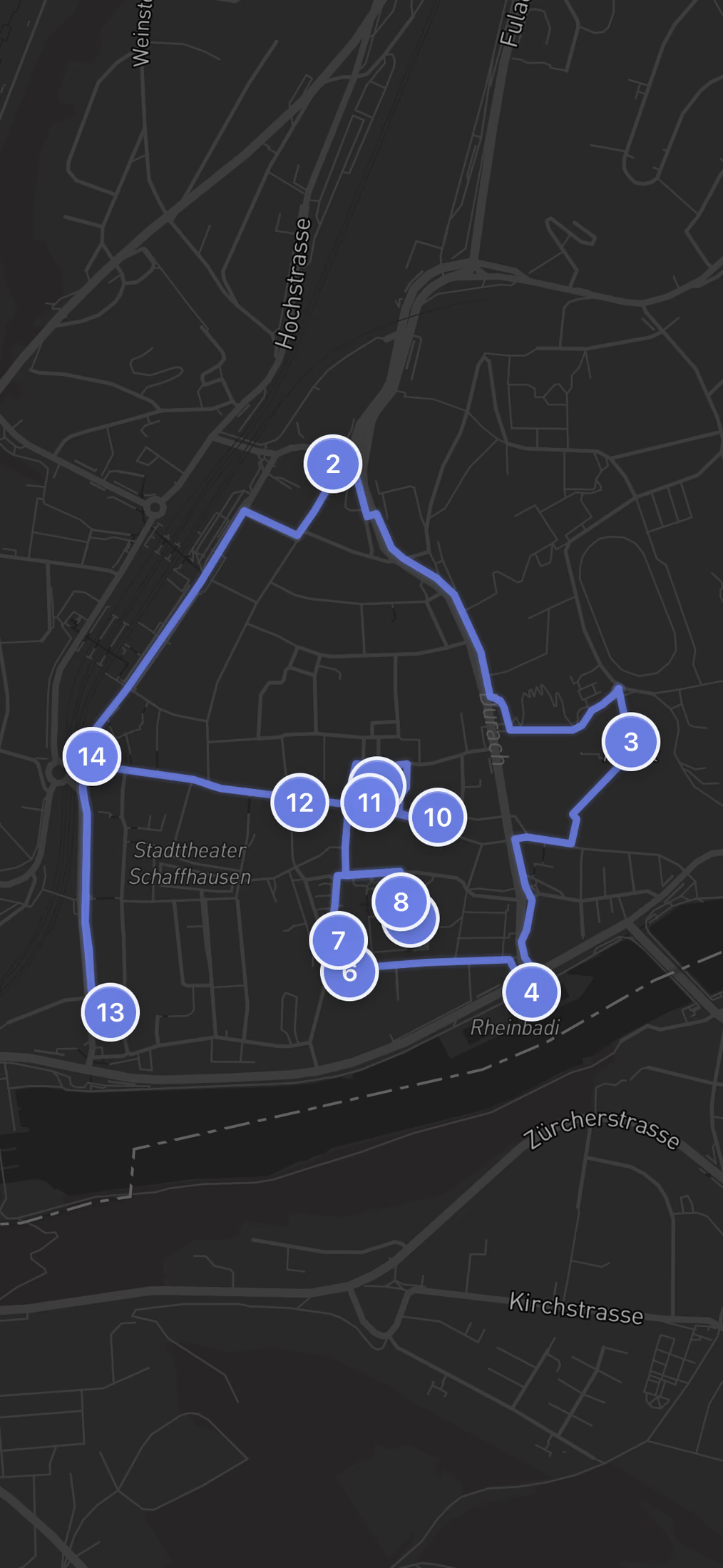
Walking tour route map of Schaffhausen
Try This Tour

Why Walk Schaffhausen? A Self-Guided Tour

Schaffhausen is small enough to walk end to end in twenty minutes, which is exactly why so many people get it wrong. They rush off to the Rhine Falls four kilometres south and skip the old town entirely. That is a mistake. This is one of the best-preserved medieval town centres in Switzerland, and almost no one is here. The streets are pedestrian, the buildings carry painted facades and projecting oriel windows on nearly every corner, and you can lean against a Renaissance fountain without a single tour bus in sight.

This route is a round trip. It starts and ends at the Obertorturm, the oldest surviving piece of the city wall, and loops through the two medieval gates, up to the Munot fortress for the view, down to the Rhine, and back through the painted houses of the Vordergasse. It is built so you climb the Munot early while your legs are fresh, then spend the rest of the walk on flat cobblestone admiring frescoes and ducking into churches. Everything on this list except two museums is free.

Why walk it instead of wandering? Schaffhausen looks like a grid but it is not. The fresco houses are scattered, the best fountains hide on side streets, and the Munot ramp is easy to miss. Follow this order and you see the whole story, fortifications, faith, money, art, in the right sequence, without backtracking. Then, if you still have an afternoon, the Rhine Falls is a short train ride away.

The Route: 14 Stops

Swipe through images or scroll names below

Scroll to explore →
1. Obertorturm
2. Schwabentor
3. Munot Fortress
4. Rhybadi
5. Schillerglocke
6. Hallen für Neue Kunst
7. All Saints Abbey Museum
8. Schaffhausen Minster
9. St. Johann Church
10. Tellenbrunnen
11. Saturday Market
12. Haus zum Ritter
13. Diebsturm
14. Obertorturm

Route Map

Tap to load interactive map
AI Tourguide
Walk this exact route with a private AI guide.
Full GPS navigation, interactive stories, and a guide that answers all your questions. A private guide experience for just €5/hour.
Try This Tour

Your Schaffhausen Walking Tour, Stop by Stop

  1. 1

    Obertorturm

    Obertorturm in Schaffhausen, stop 1 on the self-guided walking tour

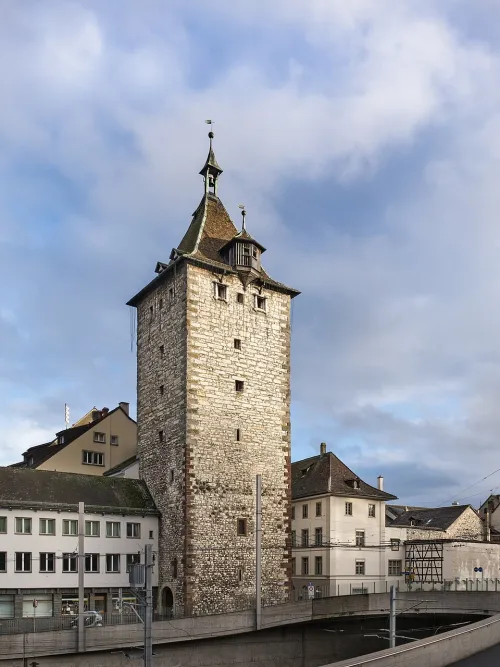
    Start where the old town starts. The Obertorturm is the western gate tower and the oldest surviving building of the city fortifications, first mentioned in 1273 as "zem obern tor." Look at the corner stones: the lower, differently coloured blocks mark the original height before the tower was raised to its present 47 metres in 1513. Every cargo barge coming down the Rhine from Lake Constance had to unload here, because the rapids and the Rhine Falls downstream made the river impassable. Goods were carted up the Vordergasse and out through this gate. That detour is the reason Schaffhausen exists and grew rich. The pedestrian passage you walk through was only cut in 1939. Hours: open 24/7, free, exterior and passage only. Tip: stand back on the western side and look up at the two late-Gothic oriels on the roofline. They set the visual theme for the whole walk, you will see dozens more of these projecting bay windows in the next two hours.

    Hours
    Open 24/7
    Price
    Free

    5-minute walk

  2. 2

    Schwabentor

    Schwabentor in Schaffhausen, stop 2 on the self-guided walking tour

    Head north up through the lanes and you reach the second medieval gate, the Schwabentor, first recorded in 1361 as the "Neuturm." This was the town's northern seal, facing Swabia and the German lands, where the other tower faced the river trade. At 32 metres it is shorter than the Obertorturm but it has the better surviving context: on its western flank a genuine stretch of the old town wall still stands, complete with the covered wallwalk and the Finsterwald corner tower. Walk to that side to see it. Pass through the gate and you step into the Vorstadt, the medieval suburb that grew up outside the wall. Hours: open 24/7, free, exterior only. Tip: read the painted inscription on the gate's town-side face. It is a Schaffhausen dialect rhyme about leaving and returning home, one of those small local touches the rushing crowds never stop to notice. From here you double back and aim for the hill to the east.

    Hours
    Open 24/7
    Price
    Free

    9-minute walk

  3. 3

    Munot Fortress

    Munot Fortress in Schaffhausen, stop 3 on the self-guided walking tour

    The climb is the only real effort on this walk, and it is worth doing early. A vine-covered ramp leads up the Emmersberg hill to the Munot, the circular fortress that is the city's emblem. It was built through the 16th century out of local Malm limestone, and here is the joke locals love: it was barely finished before military engineers decided the design was already obsolete, and it was only ever used in anger once, in 1799, covering the French retreat from the Austrians. Walk the broad circular battlement for the best panorama in town, the old-town roofs, the Rhine bend, the vineyards across the water. The vaulted casemate inside is dim and atmospheric. Hours: May to September 8:00 to 20:00, October to April 9:00 to 17:00. Free entry. Tip: a watchman still rings the Munot bell every evening at 21:00, a tradition kept since the days when it signalled the closing of the town gates. Come back at dusk if you can. Then take the stairs down toward the river.

    Hours
    May-Sep: 8:00 AM - 8:00 PM | Oct-Apr: 9:00 AM - 5:00 PM
    Price
    Free
    Website
    munot.ch ↗

    4-minute walk

  4. 4

    Rhybadi

    Rhybadi in Schaffhausen, stop 4 on the self-guided walking tour

    Down at the water you hit the Rhybadi, a wooden public Rhine bath strung out along the riverbank, built in the 19th century and still in daily use. After the stone of the fortress this is all warm timber, cabins and decks and ladders straight into the green current. In summer locals swim here in the open river, drifting with the flow and climbing out downstream. It is the most everyday, unmonumental stop on this route and that is the point: this is where Schaffhausen actually lives, not where it poses for photos. Hours: always open as a riverside structure, free to walk along and look; the actual bathing season runs through the warm months with its own opening times posted on site. Tip: even if you are not swimming, walk out onto the deck for the cleanest low-angle view back up at the Munot rising over the rooftops. On a hot day, bring a swimsuit, the Rhine here is clean and the locals will think you are one of them.

    Hours
    Always open
    Price
    Free

    3-minute walk

  5. 5

    Schillerglocke

    Walk back up off the riverbank into the lanes and you come to the Schillerglocke, a fountain crowned with a bell. The reference is to Friedrich Schiller's 1799 poem "Das Lied von der Glocke," the Song of the Bell, long one of the most quoted poems in the German language. Schaffhausen claims a direct link: the bell-casting that is said to have inspired Schiller's verses is tied to a local foundry tradition, and the town put up this fountain to mark it. It is a quick stop, a minute or two, but it is a neat hinge in the walk, you are leaving the river behind and entering the cultural quarter around the old abbey. Hours: always open, free. Tip: this whole cluster of stops, the bell fountain, the art halls, the abbey museum and the Minster, sits within a two-minute radius. Slow down here. You have just covered the fortifications and the river, and now the next four stops are all about what the town did with its money: art and faith, packed into one block.

    Hours
    Always open
    Price
    Free

    2-minute walk

  6. 6

    Hallen für Neue Kunst

    Hallen für Neue Kunst in Schaffhausen, stop 6 on the self-guided walking tour

    A few steps on stands the Kammgarn, a former cotton-spinning mill that became the Hallen für Neue Kunst, for years one of the most serious contemporary art spaces in the country, showing large permanent installations of minimal and conceptual art in raw industrial halls. It is a striking pivot in the walk: medieval stone one minute, bare concrete and steel the next. Be aware the institution's programming and opening arrangements have changed over the years, so check the current situation before counting on going inside. Treat it here as the architectural and cultural marker of the old Kammgarn complex, which is now a wider cultural venue. Hours and price: confirm current details on site or online before you visit, as access has varied. Tip: the Kammgarn courtyard and its bar-restaurant are open in the evenings as an event and nightlife spot, so if you are doing this loop later in the day, this is your candidate for a drink. By day, just take in the contrast of the brick mill against the church towers and move next door.

    Hours
    UNKNOWN_NEEDS_MANUAL
    Price
    UNKNOWN_NEEDS_MANUAL

    1-minute walk

  7. 7

    All Saints Abbey Museum

    All Saints Abbey Museum in Schaffhausen, stop 7 on the self-guided walking tour

    Right beside it, set inside the cloister of the former Allerheiligen Benedictine monastery, is the Museum zu Allerheiligen, the main museum for the whole region. The setting alone earns the ticket: you walk through genuine Romanesque cloister arcades and a herb garden to reach galleries that run from archaeology and medieval art through the Renaissance to local industrial history. It is large, so do not try to see all of it. Pick the medieval and Renaissance rooms and the cloister itself if your time is short. Hours: Tuesday to Sunday 11:00 to 17:00, closed Mondays. Admission CHF 8. Tip: the entrance to the cloister and herb garden is part of the museum complex and is one of the quietest corners in the old town, a genuine pause after the busy fountains. Build in at least 45 minutes if you go in. When you leave, the Minster is the next door over, the two share the same ancient monastery footprint.

    Hours
    Tue-Sun 11 AM - 5 PM
    Price
    CHF 8

    2-minute walk

  8. 8

    Schaffhausen Minster

    Schaffhausen Minster, stop 8 on the self-guided walking tour

    The Minster grows straight out of the same monastery. First built in 1064 as a Romanesque basilica for the Benedictine Kloster Allerheiligen, it became the Reformed church of the city in 1524. The interior is austere in the way Reformed churches are, plain walls, heavy round Romanesque arches, almost no ornament, and that severity is exactly what makes it powerful after the painted facades outside. Step into the cloister courtyard to find the famous Schillerglocke's ancestor: the great Allerheiligen bell, cast in 1486, carrying the Latin inscription that is widely held to have given Schiller the motto for his poem. Hours: daily 9:00 to 17:00, free. Tip: stand in the centre of the nave and look up at the bare stone vaulting. This is one of the purest pieces of Romanesque architecture in Switzerland, and unlike grander cathedrals you will likely have it almost to yourself. From the Minster, head north toward the next church, St. Johann, the town's other great medieval house of worship.

    Hours
    Daily 9 AM - 5 PM
    Price
    Free

    3-minute walk

  9. 9

    St. Johann Church

    St. Johann Church in Schaffhausen, stop 9 on the self-guided walking tour

    St. Johann is the old town's second great church, begun around the year 1000 and rebuilt repeatedly into the late-Gothic hall church you see today. Where the Minster is the monastery church, St. Johann was the church of the townspeople, and the difference shows: it is taller, lighter, more vertical inside. Its last full restoration was completed in 1990. It is also one of the most important organ venues in the region, with a large instrument that draws concert audiences, so if you see a recital posted, it is worth your evening. Hours: daily 9:00 to 18:00, free. Tip: the exterior is easy to walk past because it sits tight against the surrounding houses, look up to pick out the steep roof and tower over the rooflines. Inside, the acoustics are remarkable even when empty, so step in for a quiet minute. From here you drop back toward the Vordergasse, the painted-house spine of the town, starting with its Wilhelm Tell fountain.

    Hours
    Daily: 9:00 AM – 6:00 PM
    Price
    Free

    2-minute walk

  10. 10

    Tellenbrunnen

    Tellenbrunnen in Schaffhausen, stop 10 on the self-guided walking tour

    Back on the Vordergasse you meet the Tellenbrunnen, the Wilhelm Tell fountain, marking the eastern end of the town's great axis of painted facades. The column is topped by a figure of Tell, the crossbow-carrying folk hero of Swiss independence, and like most old-town fountains in Switzerland it was a working public water source long before it was a monument. This one orients you: from here the Vordergasse and Fronwagplatz run west, lined with the best of the oriel windows and frescoes, ending at the Haus zum Ritter. Hours: always open, free, running drinking water (it is potable, Swiss fountain water almost always is). Tip: treat the Tellenbrunnen as the start line for the facade walk and look down the street rather than just at the statue, you are looking at one continuous run of decorated merchant houses. Refill your water bottle here for free before you carry on. The next stop is the square where the whole town has gathered for centuries.

    Hours
    Always open
    Price
    Free

    1-minute walk

  11. 11

    Saturday Market

    A few steps on the street opens into Fronwagplatz, the broad central square that is the social heart of the old town and the site of the Saturday market. The square is anchored by the Mohrenbrunnen fountain and framed by tall painted townhouses, and it is where Schaffhausen has bought and sold and gossiped for centuries. If you can time your walk for a Saturday morning, do it: stalls of vegetables, cheese, flowers and bread fill the square and the whole place comes alive in a way no monument can match. Hours: market runs Saturdays roughly 7:00 to 12:00, free to wander. Tip: this is the best food stop on the route. Grab regional cheese and bread from a market stall, or if it is not market day, the cafes around the square have outdoor tables, expect to pay around CHF 5 to 6 for a coffee, Swiss old-town prices. Eat here, then walk the last short stretch west to the painted house everyone comes to see.

    Hours
    Saturday 7 AM - 12 PM
    Price
    Free entry

    1-minute walk

  12. 12

    Haus zum Ritter

    Haus zum Ritter in Schaffhausen, stop 12 on the self-guided walking tour

    This is the one. The Haus zum Ritter carries the most important Renaissance facade fresco in Switzerland, painted by Tobias Stimmer in the 1560s and covering the entire front of the merchant house with mythological and historical figures. What you are looking at on the building today is a faithful reconstruction, the badly weathered original fragments were removed for protection and are kept in the Museum zu Allerheiligen, the museum you passed earlier. That is the smart move on this walk: see the surviving originals in the museum, then stand here and read the full composition as it was meant to be seen on the wall. Hours: always visible, free, exterior only. Tip: cross to the far side of the narrow street and look up, the facade is tall and you cannot take it in standing directly underneath. Morning light hits it best. This is the photo of Schaffhausen, so give it the few minutes it deserves before you make the final leg back toward the gate where you started.

    Hours
    Always open (exterior view)
    Price
    Free

    4-minute walk

  13. 13

    Diebsturm

    Diebsturm in Schaffhausen, stop 13 on the self-guided walking tour

    Head southwest off the main drag toward the edge of the old town and you find the Diebsturm, the surviving "thieves' tower" of the western fortifications. There were originally two of these round towers with polygonal pointed roofs; only this lower one remains. The name is literal: it served for many years as the town prison. At 21 metres it is squat and blunt compared to the gate towers, and that plainness is the point, this was a working tower of confinement, not a showpiece. It sits in a quieter, more residential corner of the old town that most visitors never reach, which makes it a calm last sight before you close the loop. Hours: open 24/7, free, exterior only. Tip: this stop is genuinely off the tourist path, so use it as a breather. The lanes around it show you a plainer, lived-in side of medieval Schaffhausen away from the painted main street. From here it is a short walk north back up to the Obertorturm to complete the circuit.

    Hours
    Open 24/7
    Price
    Free

    Loop complete, back at the start

  14. 14

    Obertorturm

    Obertorturm in Schaffhausen, stop 14 on the self-guided walking tour

    Start where the old town starts. The Obertorturm is the western gate tower and the oldest surviving building of the city fortifications, first mentioned in 1273 as "zem obern tor." Look at the corner stones: the lower, differently coloured blocks mark the original height before the tower was raised to its present 47 metres in 1513. Every cargo barge coming down the Rhine from Lake Constance had to unload here, because the rapids and the Rhine Falls downstream made the river impassable. Goods were carted up the Vordergasse and out through this gate. That detour is the reason Schaffhausen exists and grew rich. The pedestrian passage you walk through was only cut in 1939. Hours: open 24/7, free, exterior and passage only. Tip: stand back on the western side and look up at the two late-Gothic oriels on the roofline. They set the visual theme for the whole walk, you will see dozens more of these projecting bay windows in the next two hours.

    Hours
    Open 24/7
    Price
    Free
AI Tourguide
Walk this exact route with a private AI guide.
Full GPS navigation, interactive stories, and a guide that answers all your questions. A private guide experience for just €5/hour.
Try This Tour

Self-Guided Tour vs. Group Tour in Schaffhausen

Doing this self-guided is the obvious call, and not just because it is cheaper. Almost everything here is free, the two gate towers, the Munot, the churches, the fountains, the Haus zum Ritter facade, all of it costs nothing. The only paid stop is the Museum zu Allerheiligen at CHF 8, which is fair for what is the region's main museum and the place that holds the original Haus zum Ritter frescoes. So your entire walk, museum included, runs under CHF 10 plus whatever you eat.

Guided walking tours of the Schaffhausen old town are run by the local tourist office, typically as group walks at a fixed time for a per-person fee, with private bookings costing considerably more. For a town this compact and this well signposted, a fixed-time group tour mostly buys you a guide's commentary, which is the one thing this page and a phone in your pocket already replace. If you specifically want a live human and a set departure, book through Schaffhauserland Tourismus and check their current schedule and prices.

The honest verdict: walk it yourself. The route is flat apart from the Munot ramp, the distances are tiny, and the facts that make the buildings interesting are exactly the kind of thing you want delivered as you stand in front of them, not memorised in advance. Save the guided-tour money for a raclette and a train ticket to the Rhine Falls.

Group Tour AI Self-Guided
Price €25–€50 per person €5/hour or €20 all-inclusive
Flexibility Fixed schedule Start anytime, skip stops
Languages 1–2 languages 11 languages
Pace Group pace Your own pace

How Long Does This Schaffhausen Tour Take?

Our route covers 3.2 km with 14 stops and takes approximately 2.5 hours at a relaxed pace.

The full loop is 3.2 km. Pure walking time is well under an hour, the stops are what fill the day. Allow roughly 2.5 hours for a relaxed version that includes the climb up the Munot and a proper look at the painted facades, and longer if you go inside the Museum zu Allerheiligen, which deserves 45 minutes to an hour on its own.

The Munot is where to spend real time: do the full circuit of the battlement and let the view sink in, that is 20 to 30 minutes well spent. The churches need only a few minutes each unless a concert is on. For a break, the cafes around Fronwagplatz are the natural midpoint, with outdoor tables facing the painted townhouses and the Mohrenbrunnen fountain. If the weather is warm, the better pause is the deck of the Rhybadi down on the river, where you can sit with the water moving past and the Munot above you, the single most pleasant bench on the whole route.

Tips for Walking in Schaffhausen

  • Arrive by train: Schaffhausen station sits just north of the Schwabentor, a 5-minute walk to the old town. Frequent direct trains run from Zürich (about 40 minutes) and Winterthur. Start the loop mid-morning so the Museum zu Allerheiligen is open (it opens at 11:00) by the time you reach it.
  • Wear flat, grippy shoes. The old town is cobblestone throughout and the Munot is reached by a vine-covered ramp and stairs. Smooth-soled shoes slip on the polished stone, especially when wet.
  • Restrooms: the Museum zu Allerheiligen has clean public toilets (with admission), and there are public WCs near the railway station and around Fronwagplatz. Plan a stop at the museum, as facilities along the route are otherwise limited.
  • Food and drink: time it for the Saturday morning market on Fronwagplatz and buy regional cheese and fresh bread from the stalls. Off market days, the square's cafes have outdoor tables, with coffee around CHF 5 to 6. Every old-town fountain, including the Tellenbrunnen, gives free, drinkable water, refill your bottle there.
  • Best photo: the Haus zum Ritter facade on the Vordergasse. Cross to the opposite side of the narrow street and shoot upward in morning light, when the sun is on the painted wall. You cannot frame it standing directly beneath it.
  • Stay for the Munot bell at 21:00, rung every evening by the resident watchman as it has been for centuries to mark the old curfew. Climbing back up at dusk gives you the town lights and the river bend as a bonus.
  • Bolt on the Rhine Falls: it is about 4 km southwest, reached in minutes by train to Schloss Laufen am Rheinfall or Neuhausen. The northern banks are free to access; the Schloss Laufen viewing platforms cost CHF 5 (CHF 3 for children 6 to 15). Best as a separate half-day, not squeezed into this loop.
AI Tourguide
Walk this exact route with a private AI guide.
Full GPS navigation, interactive stories, and a guide that answers all your questions. A private guide experience for just €5/hour.
Try This Tour

AI Audio Guide for This Tour

Standing under the Haus zum Ritter or catching your breath on the Munot battlement, you do not want to read a wall of text off a screen. The AI Tourguide runs right in your browser, no app, no download, and the moment you start the walk a voice-first guide greets you and starts talking, in your language. It tells you the story behind the painted facade in front of you, asks what you want to see more of, remembers your answer, and shapes the rest of the loop around it, a real conversation as you walk, not a recorded audioguide and not a question box. You stay in charge of your own pace, route and coffee stops; the guide just walks with you and keeps the stories coming.

AI Audio Guide Stories, history and fun facts narrated as you walk. No earpiece rental needed.
GPS Navigation Turn-by-turn directions so you never get lost between stops.
Ask Anything Curious about a building you pass? Ask your AI guide on the spot.
11 Languages Switch language anytime. No separate tour needed.
Try This Tour

Common Questions

Is Schaffhausen safe to walk around?

Yes, very. Schaffhausen is a small, prosperous Swiss town with low crime and a pedestrian old town that feels comfortable day and night. There are no tourist-scam hotspots here. The only real hazards are practical: cobblestones underfoot, the Munot ramp and stairs, and the open Rhine current at the Rhybadi, where you should only swim if you are a confident swimmer comfortable in flowing water.

What if it rains during my Schaffhausen tour?

The town handles rain well because the best wet-weather stops are on this exact route. Duck into the Museum zu Allerheiligen (CHF 8) for an hour, and spend time inside the Minster and St. Johann, both free and dry. The old-town lanes also offer cover under the projecting oriel windows and arcades. Save the Munot battlement and the Rhybadi for when it clears, those are the open-air parts.

What's the best time of day for this walking tour?

Start around 10:00 to 11:00. That way the Museum zu Allerheiligen is open when you reach it, the morning light is on the Haus zum Ritter facade for photos, and on Saturdays the Fronwagplatz market is in full swing before it packs up around noon. If you can stay into the evening, return to the Munot at dusk for the 21:00 bell and the lit-up town.

Can I combine this walk with the Rhine Falls?

Yes, and most people should, but as two separate outings on the same day rather than one continuous walk. The Rhine Falls is about 4 km southwest of the old town, too far to fold into this loop on foot. Do the old-town walk in the morning, then take a short train to Schloss Laufen or Neuhausen in the afternoon. The northern banks are free; the Schloss Laufen platforms cost CHF 5.

How much does the Schaffhausen old town walk cost?

Almost nothing. The two gate towers, the Munot fortress, both churches, every fountain, and the Haus zum Ritter facade are all free. The only paid attraction on the route is the Museum zu Allerheiligen at CHF 8, which also holds the original Haus zum Ritter frescoes. Budget under CHF 10 for sights, plus food and any train to the Rhine Falls.

Is the Munot fortress worth climbing?

Yes. It is the one real climb on the route and it pays off with the best panorama in town, the old-town roofs, the Rhine bend and the vineyards across the water. Entry is free, the circular battlement is open to walk, and the vaulted casemate inside is worth a look. Hours are 8:00 to 20:00 from May to September and 9:00 to 17:00 from October to April.

Do I need to book the walking tour in advance?

No booking needed. This self-guided tour is available anytime. Open the route on your phone and start walking. The AI audio guide works instantly, no reservation required.

What languages is the audio guide available in?

The AI audio guide is available in 11 languages: English, German, French, Spanish, Italian, Japanese, Chinese, Portuguese, Danish, Norwegian, and Swedish.

Can I skip stops or change the route?

Yes. Skip any stop, spend extra time at places you like, or start the route from any point. You can also ask the AI to suggest a shorter route.
AI Tourguide
Curated by AI Tourguide GPS-verified routes, reviewed and updated regularly.
Last verified June 2026
▶ Try This Tour No app · try it instantly from your couch