Self-Guided Walking Tour in Seville

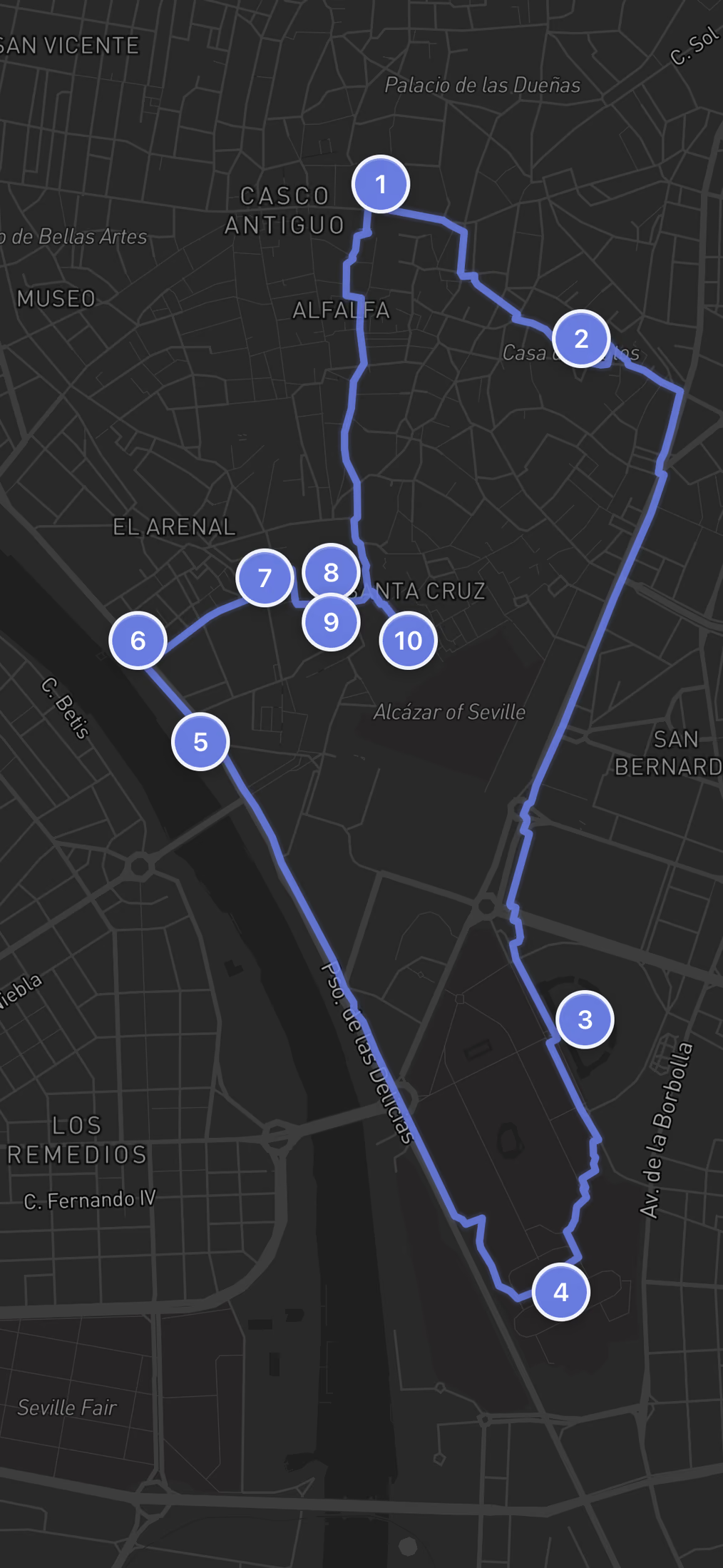
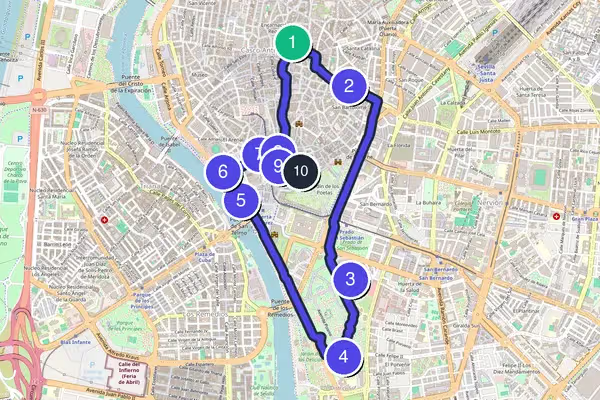
A self-guided walking route through central Seville: 10 stops over 7.4 km, starting at the modern Metropol Parasol and finishing at the Royal Alcázar. This page gives you the full route map, walking time for every leg, real admission prices and opening hours, and shorter versions if your day is tight.

10 Stops7.4 km~3 hours walking5–6 hours with stops
What you get with AI Tourguide
Full GPS navigationInteractive AI guidePersonalized to youWorks in your browser
Try this tour with Alex

Seville Walking Tour at a Glance

This route is built for walkers who want the whole historic core in one clean line, with every interior left optional. You follow 10 stops from the Metropol Parasol down to Plaza de España, along the Guadalquivir, and into the cathedral district, going inside only where you actually want to. The walking is the tour; the tickets are your choice.

StartMetropol Parasol
FinishReales Alcázares
Route typeA point-to-point walk that runs broadly south, then loops north-west along the river before finishing in the tight cathedral quarter. There is no real backtracking: each stop feeds naturally into the next.
Realistic timeAbout 3 hours of pure walking across the 7.4 km. Add the outdoor stops and you are closer to 4 hours; go inside the cathedral and the Alcázar and it becomes a comfortable full day.
DifficultyEasy and flat throughout. Seville has no hills on this route, but the old center is paved with uneven cobblestones and much of the middle section is exposed to sun, so pace yourself in summer.
Cost to followThe outdoor walk itself is free. Interiors that charge: Metropol Parasol rooftop €4, Casa de Pilatos €10, Torre del Oro €3 (free Mondays), Seville Cathedral €5, and the Royal Alcázar €14. The parks, plazas and the Archive of the Indies cost nothing.
Best for:

Independent travelers who would rather set their own pace and skip the guided herd, and anyone who wants Seville's landmarks stitched into one flat, walkable line instead of scattered taxi hops.

The Route

Free Walking Tour Map of Seville

10 stops7.4 kmabout 3 hours
Loading the interactive map…The complete walking route will appear here.
Want the route to guide you while you walk?Open the route with navigation and a personal guide for the history, stories and questions that matter to you.
Open route + AI guide

The 10 stops along this route

  1. Metropol Parasol in Seville, stop 1 on the self-guided walking tour
    1Metropol Parasol
  2. Casa de Pilatos in Seville, stop 2 on the self-guided walking tour
    2Casa de Pilatos
  3. Plaza de España in Seville, stop 3 on the self-guided walking tour
    3Plaza de España
  4. Parque de María Luisa in Seville, stop 4 on the self-guided walking tour
    4Parque de María Luisa
  5. Torre del Oro in Seville, stop 5 on the self-guided walking tour
    5Torre del Oro
  6. Plaza de toros de la Maestranza (Plaza de toros de la Real Maestranza) in Seville, stop 6 on the self-guided walking tour
    6Plaza de toros de la Maestranza (Plaza de toros de la Real Maestranza)
  7. Plaza del Cabildo in Seville, stop 7 on the self-guided walking tour
    7Plaza del Cabildo
  8. Seville Cathedral (Catedral de Santa María de la Sede de Sevilla) in Seville, stop 8 on the self-guided walking tour
    8Seville Cathedral (Catedral de Santa María de la Sede de Sevilla)
  9. General Archive of the Indies (Archivo General de Indias) in Seville, stop 9 on the self-guided walking tour
    9General Archive of the Indies (Archivo General de Indias)
  10. Reales Alcázares in Seville, stop 10 on the self-guided walking tour
    10Reales Alcázares
  11. That's the complete route.

    If you want more than the map and text, add live navigation and a conversational AI guide while you walk.

    Open route + AI guide
    You made it
Stop 1 of 10
Swipe →

Your Seville Walking Tour, Stop by Stop

  1. 1

    Metropol Parasol

    Metropol Parasol in Seville, stop 1 on the self-guided walking tour

    You start in Plaza de la Encarnacion, where a massive wooden structure blocks out the sky. Locals call it Las Setas because it looks like giant mushrooms. Completed in 2011, the 150-meter-long canopy stands 26 meters high over the excavated remains of a Roman colony below. You pay 4 EUR to ride the elevator to the rooftop walkway. The path winds over the curved top and gives you a clear view across the city, from the Giralda tower to the green line of the Guadalquivir. Go up if the line is short. The late afternoon light up there is excellent. Otherwise, walk underneath and look up at the honeycomb wooden grid. The basement level has the Antiquarium, a display of Roman and Moorish archaeological remains found during construction. A small market operates on the ground level in the mornings. Open daily 9:30 AM to 11:45 PM. From here, walk southeast through the winding streets toward the Alfalfa neighborhood.

    Hours
    Daily: 9:30 AM – 11:45 PM
    Price
    €4
  2. 2

    Casa de Pilatos

    Casa de Pilatos in Seville, stop 2 on the self-guided walking tour

    You approach a plain stone facade that hides one of the most beautiful courtyards in Seville. Construction began in 1483 for the Dukes of Medinaceli, and the palace earned its name because the distance from here to a local church matched the distance Pontius Pilate walked to Calvary. Step inside and Islamic plasterwork meets Italian Renaissance marble in every direction. Busts of Roman emperors watch from the corners of the gallery. The walls display over 150 different 16th-century tile patterns. The interior is absolutely worth the admission of 10 EUR. The crowds are thin compared to the Alcazar, and the air is cool inside. Open daily 9:00 AM to 6:00 PM. You can easily spend forty minutes looking at the ceilings and sitting by the fountain in the small gardens. Exit the main door and turn left down the narrow street. Walk south toward the cathedral district, passing through quiet residential blocks where laundry hangs overhead.

    Hours
    Daily: 9:00 AM – 6:00 PM
    Price
    €10
  3. 3

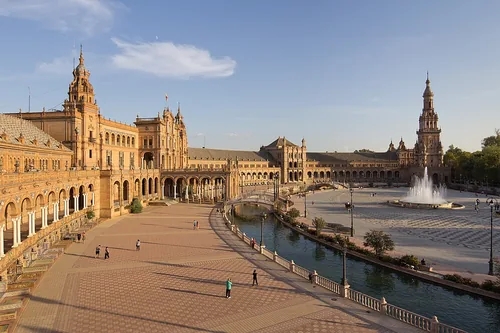
    Plaza de España

    Plaza de España in Seville, stop 3 on the self-guided walking tour

    You enter the park and suddenly face a massive brick semicircle. Plaza de Espana is free and open from 8:00 AM until midnight. Built for the 1929 Ibero-American Exposition, the 50,000-square-meter plaza features 48 tiled alcoves along the curved wall, each representing a Spanish province with a ceramic bench, a map, and a historical scene. A moat with rental boats runs along the front, crossed by four ceramic bridges symbolizing the old kingdoms of Spain. The scale is difficult to process until you stand in the center. The brick glows red in the late afternoon. Walk the shaded upper gallery to escape the crowd at ground level. The plaza gets hot in the afternoon sun because there is no shade in the middle. Go early if you want photos without people. Turn around and walk into the trees right behind you.

    Hours
    Daily: 8:00 AM – 12:00 AM
    Price
    Free
  4. 4

    Parque de María Luisa

    Parque de María Luisa in Seville, stop 4 on the self-guided walking tour

    The hot sun disappears under massive elm and palm trees. This 34-hectare park is free and open around the clock. Donated to the city in 1893 by the Infanta Maria Luisa Fernanda, it opened to the public in 1914. Wide dirt paths wind past ceramic fountains, ornamental ponds, and dense plantings of orange and jasmine. You will hear horse carriages on the gravel. Find the small hill called Monte Gurugu for a quick climb and a view over the canopy. The paths do not follow a strict grid. You can wander until you find a quiet bench near the duck ponds, which is the best place to rest your feet before the second half of the route. Budget 20 to 30 minutes of wandering, or more if the heat makes you want to stay in the shade. From here, head north along the river toward the Torre del Oro.

    Hours
    Open 24/7
    Price
    Free
  5. 5

    Torre del Oro

    Torre del Oro in Seville, stop 5 on the self-guided walking tour

    A 36-meter dodecagonal stone tower sits right on the edge of the Guadalquivir River. The Almohads built it between 1220 and 1221 to control river traffic. A massive iron chain once stretched from the tower's base across the river to block enemy ships. Today it holds a small naval museum. The exhibits are basic, mostly maps and ship models, but the reason to go inside is the rooftop terrace. The wind off the water feels good up there, and the view of the river bending toward the Triana bridge is excellent. Admission is 3 EUR, and Mondays are free. Open Monday to Friday 9:30 AM to 7:00 PM, weekends 10:30 AM to 7:00 PM. Budget 15 to 20 minutes. Walk past the palm-lined promenade and the tour boat docks, heading north along the riverbank.

    Hours
    Mon-Fri: 9:30 AM – 7:00 PM | Sat-Sun: 10:30 AM – 7:00 PM
    Price
    3 EUR (Mon free)
  6. 6

    Plaza de toros de la Maestranza (Plaza de toros de la Real Maestranza)

    Plaza de toros de la Maestranza (Plaza de toros de la Real Maestranza) in Seville, stop 6 on the self-guided walking tour

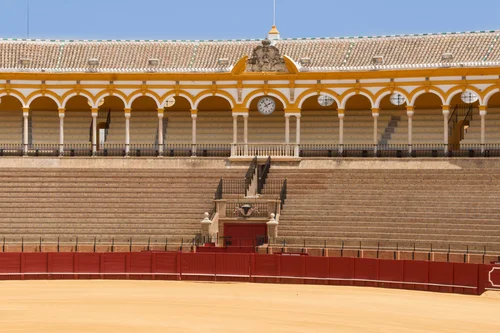
    The bright yellow and white walls of the bullring curve along the street, facing the river. Workers spent 132 years building this arena, finally reaching its 12,000-seat capacity in 1881. Due to the gradual construction, the central sand ring ended up oval rather than perfectly round, which is something you can appreciate from the exterior arches. The architecture is striking against the blue sky as you approach from the riverfront. Walk around the perimeter and take in the main gate with its large iron doors and detailed stonework. Bronze statues of famous matadors stand near the entrance. The sand inside comes from local riverbanks. You will smell roasted nuts from the street vendors nearby. The baroque facade has a distinctive golden color in the afternoon light that photographs well from the riverside promenade. From the bullring, turn inland and walk east through the narrow streets. The next stop is hiding behind a nearly invisible entrance that most people walk straight past.

  7. 7

    Plaza del Cabildo

    Plaza del Cabildo in Seville, stop 7 on the self-guided walking tour

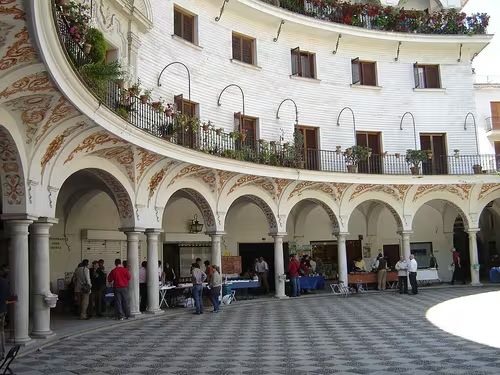
    You step through a short tunnel and the city noise drops away completely. This hidden semicircular plaza is free and open 24 hours a day. Built in the mid-20th century on land formerly occupied by the Colegio de San Miguel, it incorporates a preserved segment of the original 12th-century Almohad city wall. Painted arches wrap around a quiet central fountain. It feels completely private and removed from the tourist chaos just 50 meters away. Most people walk right past the entrance without noticing it. During the week, you will only see locals visiting the small stamp and antique shops. A busy collectors market takes over on Sunday mornings. The marble columns keep the space cool even at midday. The El Torno shop here sells sweets made by local nuns. This is the perfect midpoint pause. Rest on a bench, then leave through the southern passage toward the cathedral.

    Hours
    Open 24/7
    Price
    Free
  8. 8

    Seville Cathedral (Catedral de Santa María de la Sede de Sevilla)

    Seville Cathedral (Catedral de Santa María de la Sede de Sevilla) in Seville, stop 8 on the self-guided walking tour

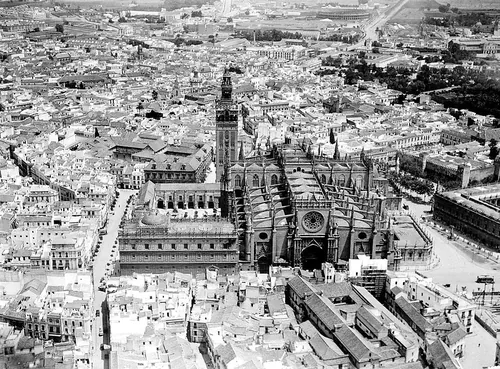
    The cathedral fills your entire field of view as you approach. Certified as the world's largest Gothic cathedral in 1988, it occupies the former site of a 12th-century Almohad mosque. Admission is 5 EUR. Open Monday to Saturday 11:00 AM to 6:00 PM, Sunday 2:30 to 7:00 PM. The interior is vast and deliberately dark, designed to overwhelm. The Giralda bell tower is the star: instead of stairs, 34 gently sloped ramps lead to the top. Horsemen originally rode up these ramps to call the prayer. The 94-meter climb rewards you with a panoramic view over every rooftop in the city. Walk around the exterior to see the stone carvings and the Patio de los Naranjos, the courtyard of orange trees that survives from the original mosque. You will hear horse carriages clattering on the pavement below. Budget 45 minutes to an hour if you go inside, or 15 minutes to appreciate the exterior and courtyard.

    Hours
    Mon-Sat: 11:00 AM – 6:00 PM | Sun: 2:30 – 7:00 PM
    Price
    €5
  9. 9

    General Archive of the Indies (Archivo General de Indias)

    General Archive of the Indies (Archivo General de Indias) in Seville, stop 9 on the self-guided walking tour

    This severe square building sits quietly next to the cathedral. Established by King Charles III in 1785, it centralizes 43,000 files and 80 million pages documenting Spain's colonial administration across the Americas. Columbus's personal letters, Magellan's expedition logs, and the original maps that redrew the world are stored inside. The building originally functioned as a 16th-century merchants' exchange designed by Juan de Herrera, the same architect behind El Escorial near Madrid. Free to enter. Open Tuesday to Saturday 9:30 AM to 4:30 PM, Sunday 10:00 AM to 1:30 PM, closed Monday. You walk up a massive stone staircase to see rotating exhibits of old maps and handwritten colonial correspondence. The marble floors echo loudly, and the reading rooms upstairs feel like stepping into a painting. The building provides a cool and quiet break from the sun outside. Twenty minutes is enough to appreciate the architecture and see the current exhibition. Walk straight out the front doors and turn left toward the Alcazar.

    Hours
    Mon: Closed | Tue-Sat: 9:30 AM – 4:30 PM | Sun: 10:00 AM – 1:30 PM
    Price
    Free
  10. 10

    Reales Alcázares

    Reales Alcázares in Seville, stop 10 on the self-guided walking tour

    You will see the line before you see the entrance. The Royal Alcazar is the oldest royal residence still in active use across Europe, declared a UNESCO World Heritage Site in 1987. Admission is free. Open daily 9:30 AM to 5:00 PM. You enter a complex of courtyards and gardens built for Castilian and Moorish kings. The 14th-century Mudejar palace features plaster walls that look like lace when the sun hits them. The Ambassador's Hall has a golden dome made of interlocking wooden pieces. The sunken gardens and reflecting pools are meticulously detailed. Book your time slot online in advance, because even with free admission the queues can stretch around the block. The interior gets overwhelmingly crowded by midday, so the first morning slot is ideal. The gardens alone deserve 30 minutes of wandering. Budget 60 to 90 minutes total for the full complex.

    Hours
    Daily: 9:30 AM – 7:00 PM
    Price
    €14

How Long Does This Walking Tour Really Take?

Plan on roughly 3 hours of walking for the 7.4 km if you barely pause. Realistically, with the parks, the river and a couple of interiors, most people spend 5 to 6 hours, and the Royal Alcázar alone can swallow 60 to 90 minutes, so a full day is the honest number if you want to see everything.

This 7.4 km walking tour takes about 3 hours of actual walking. With stops inside the major sites, expect 5 to 6 hours for the full route. The Royal Alcazar alone needs 60 to 90 minutes. The Cathedral takes 45 minutes if you climb the Giralda. Plan for a full day if you want to see everything at a relaxed pace.

The natural break point is Plaza del Cabildo, which sits right in the middle of the route. The bench by the fountain is a good place to sit quietly before tackling the cathedral district. For a longer rest, the benches under the trees in Parque de Maria Luisa are ideal for tired legs. Stop for tapas at any bar on the side streets between the Torre del Oro and the Cathedral. The neighborhood around Calle Garcia de Vinuesa has excellent choices without the tourist markup.

Full Route, Shorter Walk or Two-Day Version?

The full walk is one continuous line, but it splits cleanly if you have less time or want to spread it over two days. Here are three ways to run it, using the real stop numbers and leg distances.

Short Version

Cathedral core without the southern loop

Stops 1–2, then jump to stops 5–10, roughly 4 km, about 2.5–3 hours

Skip the two longest legs south to Plaza de España and back (the 1,840 m and 1,560 m stretches around the park). You still get the Parasol, Casa de Pilatos, the river, the bullring and the entire cathedral quarter, trimming close to 3.4 km of walking.

Two-Day Split

River-and-parks day, then monuments day

Day 1: stops 1–5. Day 2: stops 6–10. Split at Torre del Oro / the bullring

End day one at the Torre del Oro on the river, after the Parasol, Casa de Pilatos, Plaza de España and María Luisa park. Start day two at the bullring, only 280 m on, and finish through Plaza del Cabildo, the Cathedral, the Archive and the Alcázar with fresh legs for the big interiors.

You can walk it in reverse from the Royal Alcázar up to the Metropol Parasol, but the given direction is better: you start with an easy overview from the Parasol rooftop, spend the hot midday hours in the shaded park and by the river, and save the Cathedral and Alcázar crowds for a booked afternoon slot.

Is This Seville Walking Tour Right for You?

This is a flat, city-center walk with plenty of shade in the middle and optional interiors at both ends. It suits some travelers better than others, so here is who it fits and how to adjust it.

A good fit if you…

  • Walkers comfortable with about 7.4 km of flat pavement spread across a half or full day
  • Independent travelers who want to choose which interiors are worth paying for
  • Anyone interested in the layered history, from Roman ruins under the Parasol to the Moorish Alcázar
  • Photographers who want the river, Plaza de España and the cathedral quarter in one loop

Adapt the route if you…

  • Traveling in the June-to-September heat: start by 9:00 AM and use the park and river for the midday hours
  • Short on time: take the Short Version and cut the 1,840 m and 1,560 m southern legs
  • Tired legs or mobility limits: use the Two-Day Split and rest at Plaza del Cabildo, the natural midpoint
  • You mainly want the big monuments: book the Alcázar (€14) and Cathedral (€5) slots first and shorten the outdoor stops

Tickets & Skip-the-Line in Seville

Only a handful of stops on this route charge admission, and the rest are free open-air spaces, so you only need to plan ahead for a few.

Metropol Parasol (Las Setas)4 EUR for the rooftop-walkway elevator. Open daily 9:30 AM to 11:45 PM; late afternoon light on top is the best. Walking underneath the wooden canopy is free.
Casa de Pilatos10 EUR, and worth it for the courtyard and 16th-century tilework. Open daily 9:00 AM to 6:00 PM, with far thinner crowds than the Alcazar.
Torre del Oro3 EUR, and free on Mondays. Open Monday to Friday 9:30 AM to 7:00 PM, weekends 10:30 AM to 7:00 PM; the rooftop river view is the reason to go up.
Seville Cathedral (Catedral de Santa María de la Sede de Sevilla)5 EUR, including the ramped climb up the Giralda. Open Monday to Saturday 11:00 AM to 6:00 PM, Sunday 2:30 to 7:00 PM; timed tickets sell out in spring and summer, so book online ahead.
Reales AlcázaresBook a timed entry slot online in advance, because the queue stretches around the block even at opening. Open daily 9:30 AM to 5:00 PM; take the first morning slot before it fills up.
Everything else is free and outdoorsPlaza de Espana, Parque de Maria Luisa, Plaza del Cabildo, the exterior of the Real Maestranza bullring, and the Archive of the Indies all cost nothing to enter, so no tickets or lines to worry about.
Optional upgrade
+6
The same 10-stop route,
now with navigation and a guide.
Optional AI experience

You already have the route.
The AI guide brings it to life.

Standing under the wooden mushrooms of Las Setas right now? Open AI Tourguide in your browser, no app, no download, and a voice guide walks the whole route with you, greeting you, telling the story from Plaza de España to the Torre del Oro on the river, then asking what you most want to see and adapting as you go. A real conversation built into the walk, not a recording. Start with 100 free credits.

Livenavigation13languagesAnyquestionYourinterests
Open this route with the AI guide

Try it in your browser · No app or download required

Tips for Walking in Seville

  • Start at the Metropol Parasol around 9:00 AM to beat the worst heat. Take the T1 tram to the Plaza Nueva stop and walk a few blocks north to begin. In summer (June to September), the afternoon heat is brutal and you will want to be indoors or in the park by 1:00 PM.
  • Wear sturdy shoes with rubber soles. The old center has uneven cobblestones that will destroy thin sandals and hurt your feet after two hours. The stone ramps inside the Giralda can be slippery.
  • Use the clean, free restrooms inside the Archive of the Indies. They are easy to access and usually have no line. The Cathedral and Royal Alcazar also have facilities for visitors.
  • The best tapas near this route are on the side streets between the bullring and the cathedral. Try a plate of carrillada (slow-braised pork cheek) with a glass of manzanilla sherry. Avoid eating on the main plazas, where the food quality drops and prices double.
  • For the best photo on this route, stand on the Puente de San Telmo bridge at sunset and look back toward the Torre del Oro. The golden light hits the tower and the water simultaneously. At Plaza de Espana, shoot from the upper gallery looking down into the moat for a composition that avoids the crowds.

Where to Eat Along the Route

The best food in Seville is not on the plazas your route crosses. The bars ringing the Cathedral and Avenida de la Constitucion run photo menus in five languages and charge a premium for microwaved croquetas, so walk two or three streets off any monument, or cross the Guadalquivir into Triana, before you sit down.

  • Triana, across the Puente de Isabel II, is the gritty working-class heart of the city where flamenco and ceramics were born and the tapas stay local and cheap.
  • Alameda de Hercules, a long plaza fringed with bars, is where young Sevillanos actually eat and drink, budget-friendly and free of tour groups.
  • San Lorenzo, a little off the beaten path north of the center, hides some of the best tapas in Seville around Espacio Eslava and the old grocery-store bars.
  • Macarena and the Mercado de Feria area trade tourist crowds for craft-beer spots, market seafood stalls, and traditional bars full of neighbors.
El Rinconcillo⌖The oldest bar in Seville, open since 1670 on Calle Gerona, with jamon hanging from the ceiling and your bill chalked straight onto the wooden bar. Order the espinacas con garbanzos and stand at the bar for tapa portions.
Las Teresas⌖A tiny standing-room bar on Calle Santos in Santa Cruz, repeatedly named the single best tapas stop if you only have time for one. Try the solomillo al whisky under the hanging hams.
Bodega Santa Cruz (Las Columnas)⌖The cheap-eats anchor of the Mateos Gago tapas crawl a couple of blocks from the Cathedral, with tapas around 2 to 3 EUR. Go for the montadito de pringa, expect to eat standing on the street.
Taberna Alvaro Peregil⌖The home of vino de naranja (orange wine) on Calle Mateos Gago, packed with local office workers at lunch. A glass of the sweet orange wine with a montadito de pringa, and you will not be overcharged.

Do not order paella here (it is a Valencian dish and a tourist-trap tell near the monuments), and skip the pre-mixed sangria; drink a tinto de verano or a glass of vino de naranja instead.

Tourist Traps to Avoid in Seville

Seville is not as predatory as Barcelona or Venice, and most of its traps are financial rather than dangerous, clustered tightly around the Cathedral and Santa Cruz.

  • The rosemary scam: near the Cathedral and Alcazar entrances, women press a sprig of rosemary on you as a "gift," then grab your hand to read your palm and demand 5 to 10 EUR. Say "No, gracias" and keep walking, do not take the sprig.
  • Terraza pricing: outdoor terrace prices run 20 to 30 percent above the bar counter for the same coffee or beer. Order standing at the barra to pay the real price.
  • Bread, olives, and water dropped on your table unasked can be billed at 5 to 8 EUR per person. Wave them away or say "sin pan, por favor" before you order.
  • Factory flamenco: big 35 to 55 EUR shows sold by hotel concierges and street touts run two or three times a night and feel staged. Choose an intimate venue like Casa de la Memoria or La Carboneria instead.
  • Horse-drawn carriages at 40 to 50 EUR for 45 minutes are poor value and raise real animal-welfare concerns in the summer heat; you see more on foot.
  • Souvenir shops right beside the Cathedral and Alcazar sell the same ceramics at two to three times the price of Triana's tile district. Buy your azulejos on Calle Alfareria instead.

Why Walk This Route?

Seville is flat, compact, and built for walking. The entire historic center fits inside a loop you can cover in a morning, but the density of what you pass is extraordinary. This self-guided walking tour of Seville connects 10 stops across 7.4 km, starting at the modern wooden canopy of Metropol Parasol, winding through a Renaissance ducal palace, sweeping past the grand semicircle of Plaza de Espana, following the Guadalquivir River north past the Torre del Oro and the bullring, ducking into one of the city's best-hidden plazas, then finishing at the cathedral, the Archive of the Indies, and the Royal Alcazar. You walk through 2,000 years of Seville in about 3 hours.

What makes this route work is the contrast. You start at something aggressively modern, then move backward through time with every stop. Roman ruins sit beneath the Parasol. Moorish arches fill the cathedral. Islamic plasterwork lines the Alcazar walls. The river ties the middle section together, giving you open sky and a breeze before you plunge back into the narrow streets of the cathedral district. No backtracking, no dead ends, no wasted steps.

Common Questions

Is Seville safe to walk around?

Yes, very safe for a walking tour. Watch out for pickpockets near the Cathedral and the Alcazar ticket lines. Ignore people offering you rosemary branches near the monuments, as they will demand money. The riverside promenade is well-lit and busy in the evening. The neighborhoods on this route are all central and well-trafficked.

What if it rains during my Seville walking tour?

Go inside the Archive of the Indies (free, covered) or the Cathedral (5 EUR). Casa de Pilatos has covered arcades around the main courtyard. Rain in Seville is uncommon from May to September but can be heavy in winter months. The narrow streets in the cathedral district provide some natural shelter.

What's the best time of day for this walking tour?

Start at 9:00 AM. You get cooler temperatures and empty streets for the first few stops. The afternoon heat is brutal from June to September, often above 40 degrees Celsius. If visiting in summer, plan to be indoors or in the park between 1:00 and 5:00 PM. Spring (March, April) and autumn (October, November) are the ideal months for walking Seville.

Take this route with you

Open this exact tour with navigation and your personal AI guide.

Start GPS Navigation + AI Guide
AI Tourguide
Researched and curated by the AI Tourguide teamWe plan and quality-check every route, then research and verify the opening hours, prices, and practical tips for each stop along it.
▶ Open route with AI guideNavigation, stories and your questions