
Siena to San Gimignano Day Trip: The Bus Done Right
The direct Autolinee Toscane bus 130 runs from Siena to the medieval tower town of San Gimignano in about 1h10, with fares from roughly €3 one way, dropping you a short walk from the gates. Here is the honest day plan, plus a free, self-guided walking tour that takes the planning off your hands the moment you step off the coach.
The Quick Answer: Siena to San Gimignano
The best way from Siena to San Gimignano for a day trip is the direct Autolinee Toscane bus 130, and for most travellers without a car it is not a close call. The 130 covers the ~40 km run northwest through Chianti country in about 1h10 direct, fares are a flat €3 to €5 one way, and it drops you at Piazzale Montemaggio, a two-minute walk from the southern gate of the walled town. No transfer in Poggibonsi, no ZTL fine for driving into a medieval centre by mistake, no panic about parking. You step off the coach and the towers are above you.
The honest caveat is frequency. The 130 runs only every few hours, Monday to Saturday, with limited or no Sunday service depending on the season. That schedule is workable for a full day out (morning bus over, evening bus back), but it does not give you the rolling flexibility of the Siena to Florence corridor. Check at-bus.it for the live timetable on your date before you commit.
| Question | Answer |
|---|---|
| Fastest public journey | ~1h05 to 1h15 direct on bus 130 (Autolinee Toscane) |
| Frequency | Roughly every 3 to 4 hours, Mon to Sat. Sunday service is limited |
| Price from | €3 to €5 one way, buy onboard or at the AT ticket point |
| Operator / how | Autolinee Toscane (AT), bus line 130, from Siena (Via Tozzi / Piazza Antonio Gramsci area) |
| Arrival point | Piazzale Montemaggio, San Gimignano, a 2-minute walk to Porta San Giovanni |
| Worth it as a day trip? | Yes, with realistic expectations. A half-day town by nature, 3 to 4 useful hours on the ground is plenty |
Is the Siena to San Gimignano Day Trip Worth It?
The honest verdict: yes, San Gimignano is worth a day out of Siena, and yes, the town is smaller than its reputation. Both are true at once.
The best of San Gimignano, stop by stop


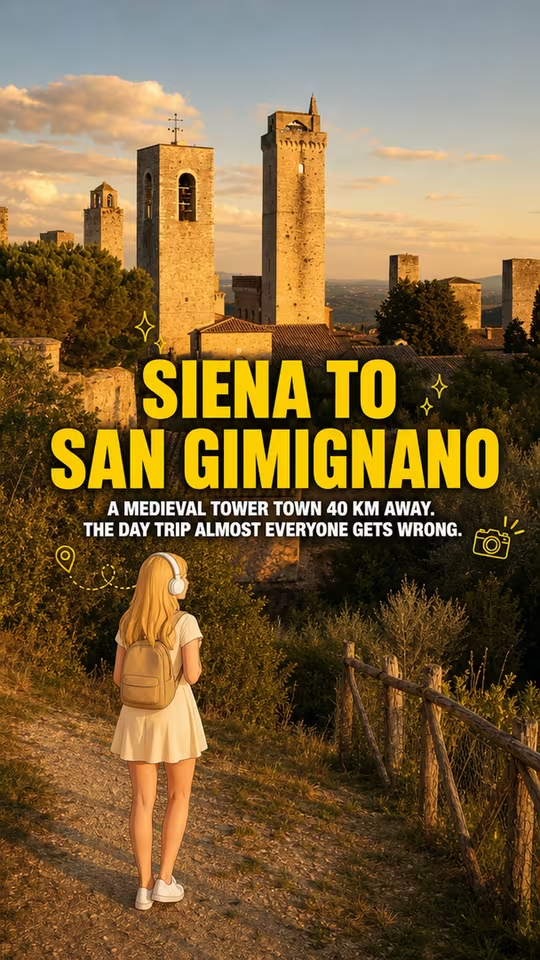
The "absolutely go" case is the silhouette. Fourteen medieval stone towers, the survivors of a 13th-century skyline of 72, rising above the Val d'Elsa on a hilltop the Romans already knew about. From a distance the place looks like a rumour of Tuscany, and from inside the walls the steep limestone streets, the herringbone-paved well square and the bare-Romanesque cathedral frescoed floor to ceiling genuinely deliver on the postcard. UNESCO listed, walkable end to end in fifteen minutes, and an entirely different scale of place from monumental Siena. As a counterpoint to a few days in the Palio city, it is hard to beat for the money.
A compact medieval tower town, an iconic well square, a climbable tower with the defining view, all 40 km from Siena on a €3 bus. The effort-to-reward ratio is excellent.
The "give it more time" case is the depth. San Gimignano is a 2 to 3 hour town seen properly. Once you have walked the spine from Porta San Giovanni up to the Rocca, climbed the Torre Grossa, sat on the well with a gelato and stepped inside the Collegiata, you have essentially done it. Day-trippers who arrive at midday expecting a full day's worth of museums and churches tend to feel short-changed. The other half of the experience is the surrounding countryside, the Vernaccia di San Gimignano DOCG wineries, the cypress roads in, and those need a car or a guided tour to reach.
If you want depth, museums, or a slow full day in one place, San Gimignano is too small. Stay in Siena, or pair it with an afternoon wine tasting nearby.
Our call: if a half-day out of Siena is what you want, take it. The bus schedule actually forces the right rhythm: a late-morning arrival, three or four hours on the ground, and an early-evening return. That is exactly what the town rewards. Just do not try to bolt on Monteriggioni, Volterra and a Chianti winery in the same day. The winding roads will punish it.
Good fit if you...
- Are based in Siena and want a half-day escape to a different scale of medieval town
- Want the iconic tower-skyline photograph and the climb that explains it
- Are happy with the highlights: gate, well square, cathedral frescoes, tower climb, Rocca view
- Are travelling on a budget (€6 return bus, everything else optional)
Skip it (save the day) if you...
- Already plan to visit other hill towns like Montepulciano, Montalcino, Pienza or Volterra
- Want depth or a full day of museums, that is Siena, not San Gimignano
- Only have one or two days in Tuscany total, spend them in Siena itself
- Expect to escape the crowds, this is one of the most visited hill towns in Italy
How to Get from Siena to San Gimignano by Bus
You can get from Siena to San Gimignano four realistic ways. The bus wins for any day-tripper who is not already in a hire car, and it wins for a single blunt reason: it is direct, cheap, and drops you at the gate.

| Mode | Time | Price | Verdict |
|---|---|---|---|
| Direct bus 130 (Autolinee Toscane) | ~1h05 to 1h15 direct | €3 to €5 one way | WINNER. Direct, cheap, drops you at Piazzale Montemaggio, a 2-minute walk to Porta San Giovanni |
| Car (via Raccordo Siena-Firenze + SP to San Gimignano) | ~42 min | fuel €27 to €39 + parking ~€2/hour outside walls | Fastest on paper. The ZTL inside both town walls makes it a real headache for a day trip |
| Bus 131 to Poggibonsi + bus 130 onward | ~1h10 plus transfer | ~€6 total | Adds a connection and risk. Only useful if the 130 timing does not work |
| Train Siena to Poggibonsi + bus 130 | ~50 min plus transfer | €13 to €22 train + €3 bus | Most flexible on paper, but the transfer eats the time saving. Strictly second-best |
| Taxi | ~42 min | €210 to €260 one way | Not a realistic day-trip option unless you are splitting it four ways |
The reason the bus wins is the last kilometre, the same logic that picks the bus on the Rome to Siena corridor in reverse. San Gimignano's historic centre is closed to non-resident cars (ZTL, camera-enforced, the fine arrives months later), and the public parking lots all sit outside the medieval walls. The 130 rolls in on the autostrada, pulls into Piazzale Montemaggio, and you step out two minutes from Porta San Giovanni with no map, no parking meter, no stress. For a day-tripper counting hours and not wanting a traffic-ticket surprise on the credit card two months later, that single fact decides it.

Plan your timing
The Bus in Detail
The workhorse operator on this route is Autolinee Toscane (AT), the consolidated Tuscan regional bus company, on line 130. This is a local interurban service, not a FlixBus-style coach, so expectations should match: a modern Iveco or Mercedes midibus, air-conditioning, no onboard toilet, no reserved seats, no luggage hold to speak of. You bring what you carry.
Where you board in Siena. The 130 picks up along the city-centre stops around Via Tozzi / Piazza Antonio Gramsci, the same transport hub where the long-distance buses from Rome let you off. Some departures also call at the Siena FS railway station forecourt. Check the exact boarding point on the at-bus.it journey planner or the AT mobile app for your travel date, because the line has a few variants.
Where you arrive in San Gimignano. Almost all services pull into Piazzale Montemaggio, the bus and car-park square just outside the southwestern corner of the walls. From there it is a two-minute walk up to Porta San Giovanni, the principal southern gate, where the historic town actually begins. A handful of services call at Piazzale Martiri di Montemaggio or the lower car parks instead. Confirm the stop when you board.
Tickets. Buy at an AT ticket point in Siena (the tabacchi shops around Piazza Gramsci and the station sell them), through the AT mobile app, or, in a pinch, onboard from the driver at a small surcharge. Validate paper tickets in the machine at the back of the bus. The €3 to €5 one-way fare is a flat zonal fare, not dynamic pricing, so there is no early-booking bonus to chase.
Frequency and the Sunday problem
| Service pattern | What it means for a day trip |
|---|---|
| Mon to Sat, roughly every 3 to 4 hours | Workable. Catch a late-morning bus over, take the early-evening bus back. Roughly 5 to 6 hours on the ground |
| Sunday and public holidays | Service drops sharply or pauses entirely. Verify on at-bus.it before committing to a Sunday trip |
| Last return from San Gimignano | Typically around 19:00 to 20:00, seasonally variable. Pin the exact time the moment you arrive, the bus back is the day's hard constraint |
The single biggest rookie move is treating the 130 like a metro. It is not. Schedules shift seasonally, the gap between buses is real, and missing the last service back means an €80 taxi ride or an unplanned overnight. The right rhythm is: pick the day's two fixed buses first (the one over, the one back), then plan what happens between them.
Booking Strategy
Unlike the dynamic FlixBus/Itabus corridor from Rome, bus 130 uses a flat zonal fare with no early-booking bonus. The strategy is therefore not about price, it is about timing and ticket mechanics.
Look up the day's two buses the night before. Open the at-bus.it journey planner, plug in Siena to San Gimignano for your date, and screenshot the two departures you plan to take. Service frequency changes by season, and printed timetables age fast.
Buy a return ticket in Siena. AT ticket points (tabacchi shops around Piazza Gramsci and Siena FS) sell one-way and return fares. Buying return in advance saves you hunting for an open tabacchi inside the walls in the late afternoon, when most of them are shut for the post-lunch pause.
Carry the QR code offline. Cell signal inside the medieval walls is patchy. Screenshot the ticket in the AT app before you leave Siena, so the driver can scan it regardless.
Validate paper tickets. Italian regional buses require a stamp in the onboard machine. An unvalidated ticket is treated as no ticket and the fine is real.
Booking checklist
- Plug your date into at-bus.it the night before. Screenshot the outbound and return 130 departures you plan to take.
- Buy a return ticket in Siena (a tabacchi near Piazza Gramsci or Siena FS), about €6 total, to avoid the late-afternoon ticket hunt inside the walls.
- Confirm the Siena boarding point (Via Tozzi / Gramsci area or FS forecourt) and the San Gimignano arrival stop (Piazzale Montemaggio is the one you want, two minutes from Porta San Giovanni).
- Pin the exact time of the last return bus to your phone the moment you arrive in San Gimignano. Treat it as the day's hard deadline.
- Avoid Sundays and Italian public holidays unless the timetable confirms service. The 130 thins or pauses entirely on those days.
San Gimignano in One Day
Here is the part most day-trip guides bury, and it is the whole point: you do not need to plan a route. You step off the 130 at Piazzale Montemaggio, walk two minutes up to Porta San Giovanni, and open our free self-guided San Gimignano tour right there. It runs in your browser, no app, no download, and a voice guide walks the whole route with you, stop by stop, leading a real conversation as you go. No map-squinting, no wondering which way the cathedral is. The town is small, the route is logical, and the guide takes the planning off your hands so the climb from the gate up to the Rocca becomes the day itself rather than a logistics puzzle.

The time math
Catch a late-morning 130 from Via Tozzi (around 10:30 to 11:30 is the realistic sweet spot given the schedule) and you are stepping under Porta San Giovanni before noon, right as the morning-only coach groups from Florence start to clear. The last 130 back to Siena typically leaves Piazzale Montemaggio between 19:00 and 20:00 depending on the season. That gives you roughly six to seven useful hours on the ground, or four to five once you subtract a long lunch, a gelato stop and a sit-down in the Rocca park. Lock in the two time-bound things first, the Torre Grossa ticket counter (closes 19:30, last entry around 19:00) and the Collegiata (closes 19:30 weeknights), then let the rest of the day drift.
What you'll see
Here is what a day-tripper should not miss, with the practical reality attached:
- Porta San Giovanni (free, open 24/7): the 13th-century southern gate, your entry point and threshold moment. Walk through it and the modern world drops behind you.
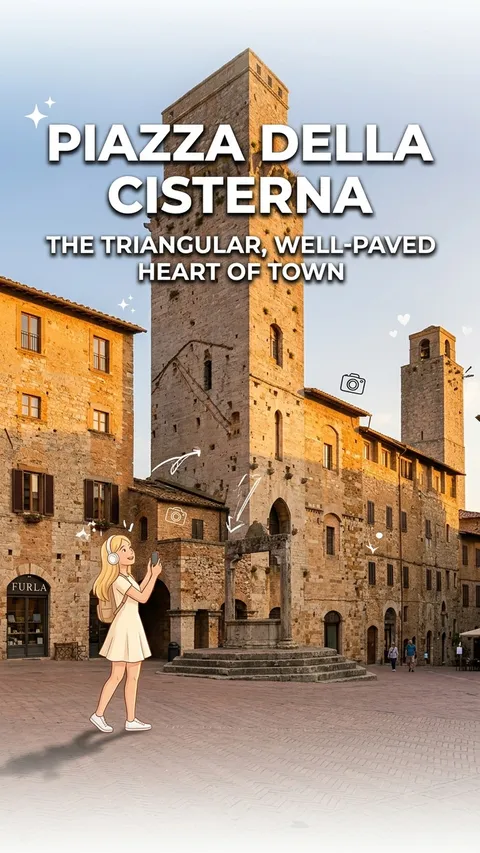
- Piazza della Cisterna (free, open 24/7): the triangular, herringbone-paved postcard square, named for the 1287 cistern still at its centre. The social heart of town and where Gelateria Dondoli lives.
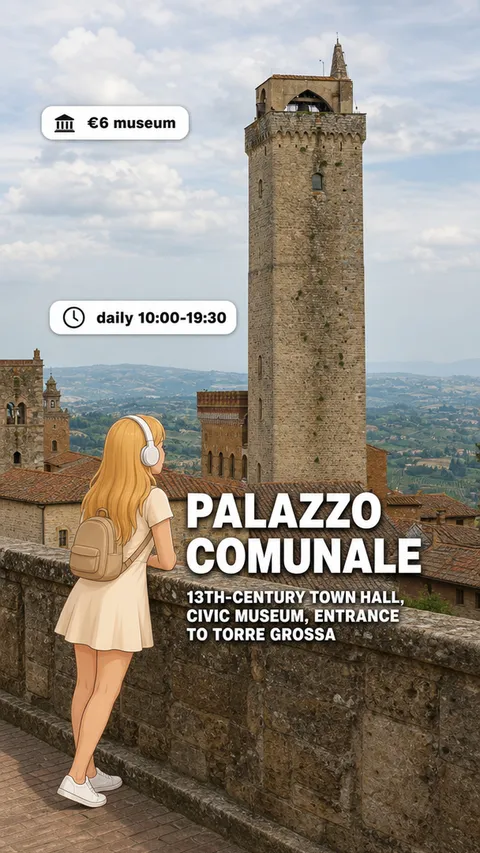
- Palazzo Comunale + Civic Museum (€6; daily 10:00 to 19:30): the 13th-century town hall on Piazza del Duomo. The reason to go inside is the Pinacoteca (Coppo di Marcovaldo, Benozzo Gozzoli, Filippino Lippi) and the entrance to Torre Grossa, sold at the same counter.
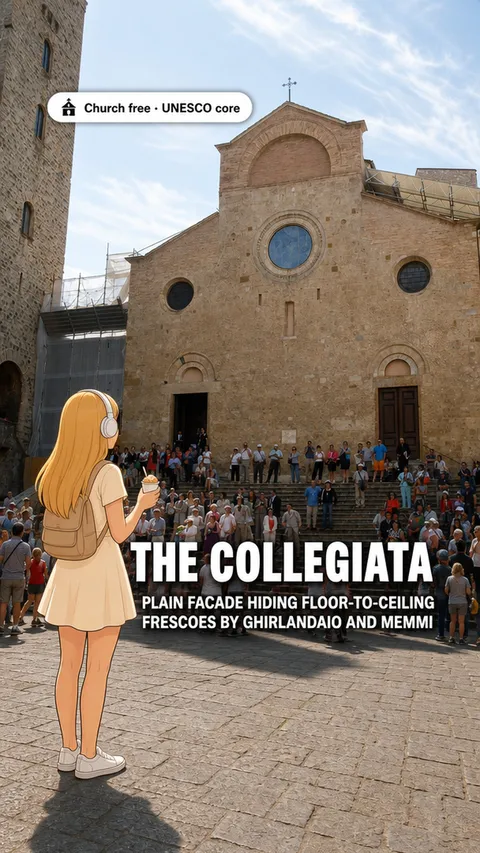
- Collegiate Church of Santa Maria Assunta (church free, chapels vary; Mon to Fri 10:00 to 19:30, Sat to 17:00, Sun from 12:30): a plain Romanesque facade hiding one of the few completely frescoed churches in Italy. Bartolo di Fredi, Lippo Memmi, Ghirlandaio's Santa Fina chapel.
- Torre Grossa (€5, or €9 combined with the museum; daily 10:00 to 19:30): at 54 m the tallest of the surviving towers and the only one you can climb. The definitive rooftop panorama over the so-called Manhattan of the Middle Ages.
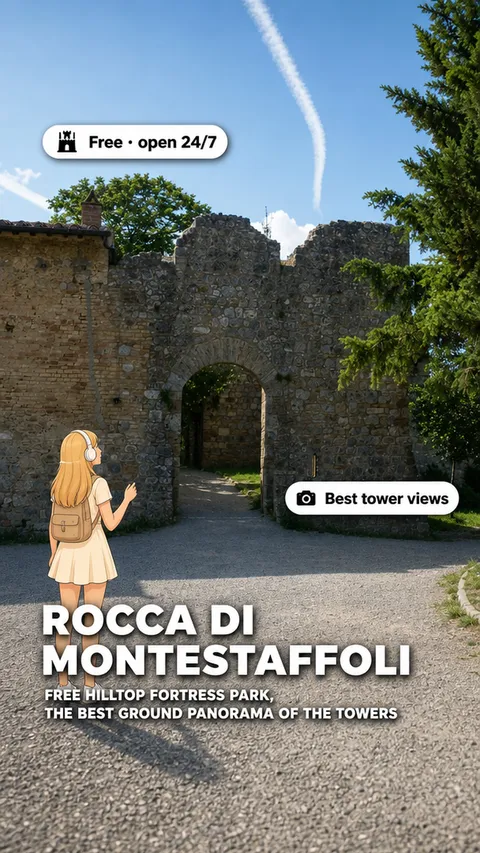
- Rocca di Montestaffoli (free, open 24/7): the ruined 14th-century fortress above the Collegiata, now a shaded public park. The best free ground-level panorama of the towers and the Val d'Elsa, often with a small wine bar pouring Vernaccia inside the walls.
The route the tour walks with you
Instead of a generic "see the squares, then the towers" list, you walk one efficient line from the southern gate up to the old fortress, and the tour walks it with you. Because it can be launched from any of its stops, you never backtrack to find an official start, you just begin where you stand. This is the six-stop order, starting at the gate and finishing at the free panorama above the town:
- 1Porta San Giovanni Free · your entry
The principal southern gate in the 13th-century walls and the moment the medieval town begins. Buses and car parks sit just outside, so you pass under the pointed arch and the modern world drops behind you. Pause here before the climb up Via San Giovanni. The lane is lined with shops selling cured meats, ceramics and the local Vernaccia, plus a lot of forgettable souvenir junk. Do not shop on the way up. The good stuff is higher.
- 2Piazza della Cisterna Free · social heart
Via San Giovanni opens out and you are on the postcard. The triangular, herringbone-paved well square ringed by medieval tower-houses leaning in on every side. Sit on the steps of the 1287 cistern, because the framing of towers from here is the image you came for. Gelateria Dondoli sits on the square, open daily 09:00 to 22:00, a multiple world-champion gelateria with genuine lines. Order the saffron-and-pine-nut or the rosemary-raspberry sorbet, around €3 for a small cup. Then walk the few steps northwest into the second, more monumental square.
- 3Palazzo Comunale (Palazzo del Popolo) €6 museum
Step from the well square into Piazza del Duomo and the mood shifts from social to civic. The 13th-century town hall, seat of civic authority for seven centuries. Inside is the Civic Museum and Pinacoteca, open daily 10:00 to 19:30, ticket €6, with Coppo di Marcovaldo, Lippo Memmi, Benozzo Gozzoli and Filippino Lippi. Give the museum 45 minutes. Crucially, the same counter here is your entrance to Torre Grossa, so buy the combined ticket and skip a second queue.
- 4Collegiate Church of Santa Maria Assunta (Duomo) Free church
Across the square, up a wide flight of steps, a church that hides everything behind a blank face. Consecrated in 1148, the Romanesque facade is bare stone. Step inside and the walls are covered: Old Testament scenes by Bartolo di Fredi, New Testament by Lippo Memmi, the small Santa Fina chapel painted by Ghirlandaio. The artistic high point of the walk and part of the UNESCO core. Hours Mon to Fri 10:00 to 19:30, Saturday until 17:00, Sunday from 12:30. Cover shoulders and knees. Give it 20 minutes minimum and look up constantly.
- 5Torre Grossa €5 · the climb
Back at the Palazzo Comunale, the climb. At 54 m, the tallest of San Gimignano's surviving towers and the only one you are allowed to go up. Open daily 10:00 to 19:30, €5 alone or the smart combined ticket with the museum. The stairs are steep and narrow toward the top, a mix of stone and metal steps with low headroom. What you get at the top is the definitive view: the cluster of stone towers below you, terracotta roofs, the Val d'Elsa rolling out in every direction. This is the panorama that explains the whole town in one glance.
- 6Rocca di Montestaffoli Free · earned finish
End the walk where the crowds thin. Just above the Collegiata, a short uphill lane leads to the ruined 14th-century fortress, now a free public park open at all hours. After paying to climb Torre Grossa, this is the free counterpoint: a single surviving tower you can climb a few steps up, grassy ramparts, olive trees inside the old walls. The ground-level view of the towers from here is the best in town for photography, lower and wider than the rooftop panorama, with the full skyline lined up against the Tuscan hills. Quiet, shaded, often a small wine bar pouring local Vernaccia. The natural place to sit and finish the day.
It runs in your browser, no app and no download. A voice guide walks the loop with you and leads a real conversation as you go: it greets you, tells the story between stops, asks what you actually want to see, and adapts. It is not a recording and not an audioguide. The map and step-by-step navigation get you from each stop to the next.
That whole line is our free, self-guided San Gimignano walking tour, and because it can be launched from any of its stops, you do not backtrack to find a start, you just begin where you are. You open it the moment you step through Porta San Giovanni and walk the route at your own pace. It runs in your browser, with no app and no download. A voice guide walks the route with you and leads a real conversation as you go: it greets you, tells the story between stops, asks what you actually want to see, and adapts to your answers. It is not a recording and not an audioguide. The map and step-by-step navigation get you from the gate to the well square to the tower to the Rocca without staring at Google Maps. See the full route on the San Gimignano walking tour page, and you get 100 free credits to try it.
Insider Tips for the San Gimignano Day Trip
The single biggest rookie move on this route is treating San Gimignano as a full-day destination. It is not. It is a 2 to 3 hour town done properly, and the rest of the day should be either a long lunch with a glass of Vernaccia, an afternoon wine tasting in the surrounding DOCG zone, or simply a slow wander along the wall walkway. The second biggest move is arriving at midday on a summer Saturday, when the coach tours from Florence turn the well square into a queue.
Do
- Take the direct bus 130 from Via Tozzi, not the train. Direct, cheap, no transfer
- Go early or late. Before 10:00 or after 16:00 the lanes are quiet and the light is the one you came for
- Buy the combined museum + Torre Grossa ticket at the Palazzo Comunale counter. Saves a second queue
- Order the saffron-and-pine-nut gelato at Dondoli, not the chocolate. That is what the championship was won on
- Try Vernaccia di San Gimignano, the local DOCG white. Crisp, mineral, unique to the sandstone hills around the town
- Walk the wall walkway near the Rocca for valley views most day-trippers miss
Don't
- Don't drive into the historic centre. The ZTL is camera-enforced and the fine arrives months later
- Don't expect a full day of museums. San Gimignano is a half-day town, plan accordingly
- Don't stack it with Volterra, Monteriggioni and Chianti in one day. The winding roads will punish it
- Don't miss the Collegiata interior. The bare facade hides one of the few completely frescoed churches in Italy
- Don't trust a printed bus timetable. The 130 shifts seasonally, verify on at-bus.it the night before
If you are prone to car sickness, the bus ride from Poggibonsi up to San Gimignano is winding. The 130 takes the same hill road cars do. Sit near the front, look at the horizon, and skip reading on this leg. The same applies tenfold if you are driving yourself.
More day trips from Siena
Out in the morning, back in time for dinner. Every route here fits in one full day.
What the Siena to San Gimignano Journey Feels Like
This is the part no timetable can give you. San Gimignano hits most people harder than they expect, because the town does not announce itself until the very last moment. The 130 rolls out of Siena past the brick outskirts, drops into the valley of the Merse, climbs back onto the Chianti hills through Poggibonsi, and the view from the window is the Tuscan postcard you came for, cypress avenues, rolled hayfields, stone farmhouses on the ridges. Then the road turns a final corner and the towers appear, a cluster of medieval stone shafts rising out of the olive groves above the Val d'Elsa. The first time you see the skyline you understand why they call it the Manhattan of the Middle Ages.
The medieval time-capsule thing is real. San Gimignano was a stopping point on the Via Francigena, the medieval pilgrim road from Canterbury to Rome, and by the 13th century it was rich enough that its merchant families competed by building towers. At the peak there were 72 of them, conspicuous consumption in stone, and 14 still stand. Walking under Porta San Giovanni and up Via San Giovanni is genuinely like crossing a threshold out of the modern world. The limestone is worn, the lanes are narrow, the towers lean overhead. There is barely a flat street in town.
And the bus itself is the quiet luxury of this trip. No transfers, no white-knuckle drive, no ZTL fine, no parking fee. You sit on a regional bus for an hour ten, the road climbs, the countryside slowly turns into the towered skyline, and then the bus pulls into Piazzale Montemaggio and you step out two minutes from the gate. It is the easiest arrival you will ever have in a town this dramatic. Sit on the well with a Dondoli gelato in the late afternoon, watch the coach groups clear out, and the lanes go quiet in a way that feels impossible given how busy they were at lunch.
Siena to San Gimignano: Your Questions Answered
Can you do San Gimignano as a day trip from Siena?
Yes. The direct Autolinee Toscane bus 130 takes about 1h10, runs several times a day Monday to Saturday, and drops you at Piazzale Montemaggio, a two-minute walk from Porta San Giovanni. With a late-morning departure you get roughly six to seven useful hours inside the walls, which is more than enough to walk the spine, climb the tower, see the frescoes and have a long lunch.
How long is the bus from Siena to San Gimignano?
About 1h05 to 1h15 direct on the Autolinee Toscane line 130. It is a local interurban service rather than a long-distance coach, so there are no reserved seats and no luggage hold, but it is direct, no transfer in Poggibonsi.
How much does the bus cost?
A flat €3 to €5 one way. Buy at an AT ticket point in Siena (tabacchi shops around Piazza Gramsci or Siena FS), through the AT app, or onboard from the driver at a small surcharge. Validate paper tickets in the machine at the back of the bus.
Where does the bus leave from in Siena?
Most services pick up along Via Tozzi / Piazza Antonio Gramsci, the same transport hub where the long-distance coaches from Rome arrive. Some also call at the Siena FS railway station forecourt. Check the at-bus.it journey planner for the exact stop on your date.
Where does the bus drop me in San Gimignano?
Almost all services arrive at Piazzale Montemaggio, the bus and car-park square just outside the southwestern walls. From there it is a two-minute walk up to Porta San Giovanni, the principal southern gate. A few services call at the lower car parks instead, confirm the stop when you board.
Bus or car from Siena to San Gimignano?
For a day trip without a car already lined up, the bus. The 130 is direct, cheap and drops you at the gate. The car is faster on paper (~42 minutes vs ~1h10), but the historic centre of San Gimignano is closed to non-resident cars (ZTL, camera-enforced) and parking is in paid lots outside the walls. The bus removes the entire parking-and-fine headache.
What about the train?
There is no train station inside the walls of San Gimignano. The rail option is Siena to Poggibonsi by train (about 23 minutes, hourly) and then bus 130 up to San Gimignano (about 25 minutes). It works, but the transfer eats the time saving and the direct bus 130 from Siena is simpler. Take the train only if the 130 schedule on your date does not fit.
Do I need to book the bus in advance?
No. The 130 uses a flat zonal fare with no dynamic pricing and no reserved seats. You cannot book early for a cheaper price. The only thing to do in advance is check the timetable on at-bus.it the night before, because service frequency changes seasonally and drops sharply on Sundays.
Should I drive from Siena to San Gimignano?
Only if San Gimignano is one stop on a wider Tuscan road trip that also takes in Volterra, Monteriggioni or a Chianti winery. For a straight day trip, the bus wins. The historic centre is closed to non-resident cars, the parking is in paid lots outside the walls, and the wrong turn into the ZTL produces a fine that arrives months later. Take the 130 and skip the stress.
What should I not miss in one day?
Piazza della Cisterna, the Collegiata frescoes, the Torre Grossa climb, the Rocca di Montestaffoli panorama, and a gelato at Gelateria Dondoli on the well square. They sit within a ten-minute walk of each other along one straight line from gate to fortress. One focused half-day covers all five.
When is the best time to visit?
Spring (April to June) and early autumn (September to October) for mild weather and the best light on the stone. Summer is hot, unshaded and the most crowded, with coach tours peaking between 11:00 and 16:00. Avoid the busiest days by going on a weekday morning bus. Winter is quiet and atmospheric, but verify the 130 schedule, service thins out of season.
Plan Your San Gimignano Day Trip
The bus is the whole logistics puzzle, and you have it sorted. Now make the hours in the medieval tower town count with our free, self-guided San Gimignano walking tour: open it the moment you step through Porta San Giovanni and walk the six-stop line up to the Rocca. It runs in your browser with 100 free credits, no app and no download. See the full route on the San Gimignano walking tour page.
