Self-Guided Walking Tour in Soest

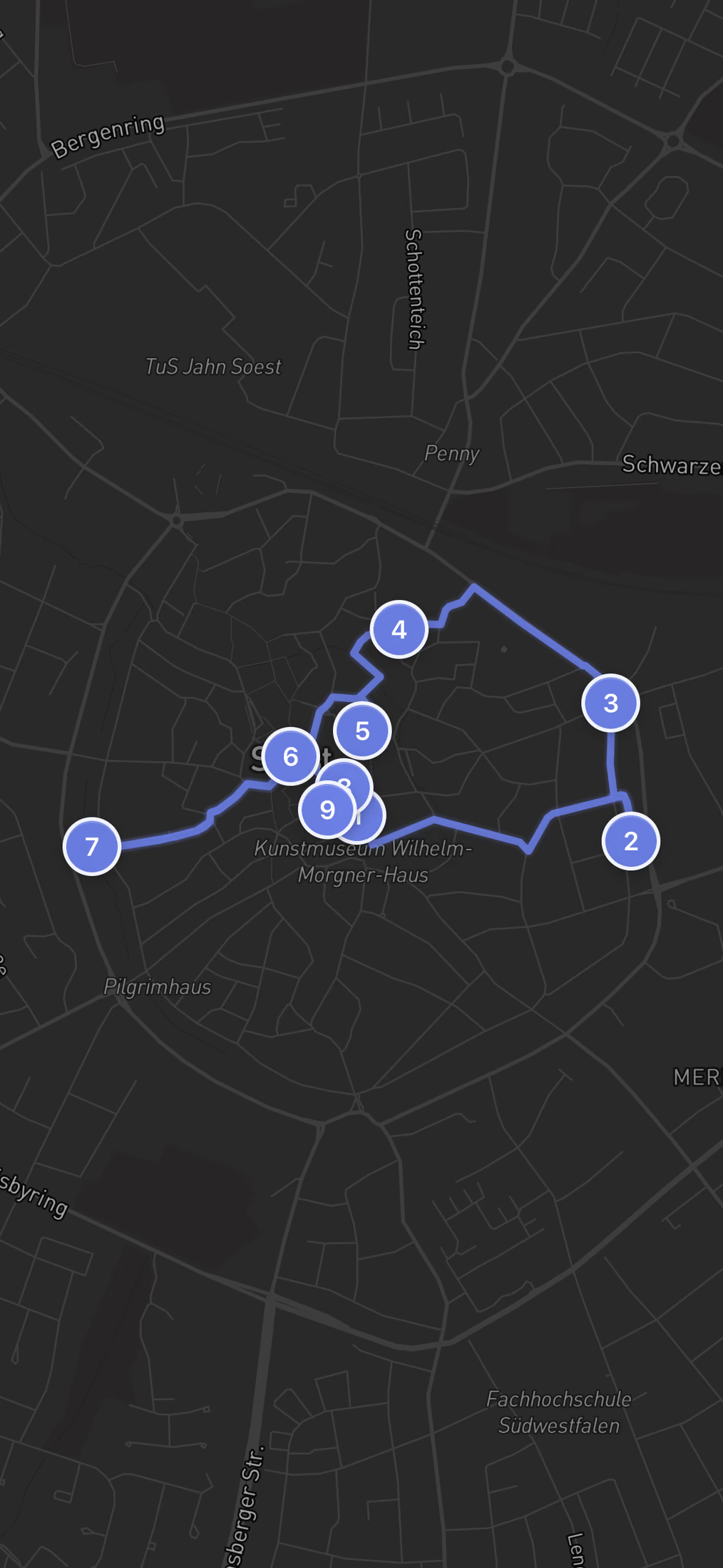
A 3.6 km loop through Soest's compact old town, 9 stops from the St.-Patrokli-Dom to St. Petri, taking in the Gothic Wiesenkirche, the last surviving town gate and the postcard duck pond. This page gives you the map, walking time for every leg, real opening hours and the good news that almost nothing here costs a cent to enter.

9 Stops3.6 km~2 hours walking3–3.5 hours with stops
What you get with AI Tourguide
Full GPS navigationInteractive AI guidePersonalized to youWorks in your browser
Try this tour with Alex

Soest Walking Tour at a Glance

This route is built for anyone who wants to see the whole of Soest's old town on foot without backtracking. It links the two churches that own the skyline, the Romanesque Dom and the Gothic Wiesenkirche, with the surviving gate, the wall, the market and the pond. Every interior on the walk is optional and free, so you set the pace and decide which doors you open.

StartSt. Patrokli, Soest (St.-Patrokli-Dom)
FinishSt. Petri
Route typeA near-complete loop inside the ring of ramparts, running roughly clockwise from the Dom out east to the gate, west past the churches and pond, then back east to finish beside where you started. Almost no backtracking.
Realistic timePure walking is just over an hour across 3.6 km, but with time inside the two big churches and one real break, plan for three to three and a half hours end to end.
DifficultyEasy and flat. The 3.6 km run over cobbles, uneven green-sandstone paving and a soft earthen path on the rampart, so cushioned flat shoes matter more than fitness here.
Cost to followFree to follow and free at almost every door. The Dom, Wiesenkirche, St. Petri, the Rathaus loggia, the Osthofentor museum, the ramparts, the wall and the pond all cost nothing to enter.
Best for:

Travellers who like compact medieval towns, church architecture and slow walking over big-ticket sights, and anyone who values a route where the money stays in your pocket.

The Route

Free Walking Tour Map of Soest

9 stops3.6 kmabout 2 hours
Loading the interactive map…The complete walking route will appear here.
Want the route to guide you while you walk?Open the route with navigation and a personal guide for the history, stories and questions that matter to you.
Open route + AI guide

The 9 stops along this route

  1. St. Patrokli, Soest (St.-Patrokli-Dom) in Soest, stop 1 on the self-guided walking tour
    1St. Patrokli, Soest (St.-Patrokli-Dom)
  2. City walls (Stadtbefestigung Soest) in Soest, stop 2 on the self-guided walking tour
    2City walls (Stadtbefestigung Soest)
  3. Osthofentor in Soest, stop 3 on the self-guided walking tour
    3Osthofentor
  4. Wiesenkirche (St. Maria zur Wiese) in Soest, stop 4 on the self-guided walking tour
    4Wiesenkirche (St. Maria zur Wiese)
  5. Großer Teich in Soest, stop 5 on the self-guided walking tour
    5Großer Teich
  6. Marktplatz in Soest, stop 6 on the self-guided walking tour
    6Marktplatz
  7. Stadtmauer in Soest, stop 7 on the self-guided walking tour
    7Stadtmauer
  8. Rathaus Soest in Soest, stop 8 on the self-guided walking tour
    8Rathaus Soest
  9. St. Petri in Soest, stop 9 on the self-guided walking tour
    9St. Petri
  10. That's the complete route.

    If you want more than the map and text, add live navigation and a conversational AI guide while you walk.

    Open route + AI guide
    You made it
Stop 1 of 9
Swipe →

Your Soest Walking Tour, Stop by Stop

  1. 1

    St. Patrokli, Soest (St.-Patrokli-Dom)

    St. Patrokli, Soest (St.-Patrokli-Dom) in Soest, stop 1 on the self-guided walking tour

    The squat green-sandstone tower of the Dom is the first thing you orient yourself by, a blunt Romanesque westwork that looks more like a fortress than a church. This is the building people mean when they call Soest the home of Westphalian Romanesque. The collegiate church goes back to a chapter founded in the 10th century, and the stone has that pale olive cast you will see everywhere on this walk. Step inside. It is free and open Monday to Saturday 10:00 to 17:30, Sundays from 12:00. The interior is heavier and darker than the Gothic churches you will hit later, which is the point: it shows you where Soest's architecture started before the light flooded in. Give it 15 to 20 minutes. When you leave, keep the tower at your back and head east along the lanes toward the green belt that rings the town.
    Hours
    Mon-Sat: 10:00 AM – 5:30 PM | Sun: 12:00 – 5:30 PM
    Price
    Free
  2. 2

    City walls (Stadtbefestigung Soest)

    City walls (Stadtbefestigung Soest) in Soest, stop 2 on the self-guided walking tour

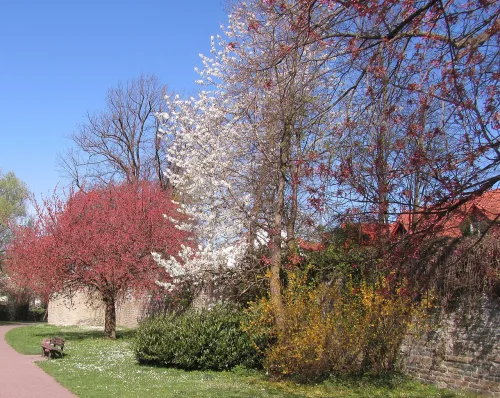
    After the stone weight of the Dom, the Wallanlagen feel like an exhale. This is the green rampart promenade that loops the entire old town, grass and old trees planted over the earthworks where the medieval defences once stood. It is open all the time and costs nothing, and it is the single best way to understand the shape of Soest: a near-perfect ring with the churches poking up inside it. Locals jog and walk dogs here at all hours. You only need to walk a short stretch of it for this tour, but it tells you instantly how the town was laid out and how it defended itself. The path is soft and shaded, easy underfoot. Follow the rampart north and you will see a stone tower rising ahead of you, the one gate that survived.

  3. 3

    Osthofentor

    Osthofentor in Soest, stop 3 on the self-guided walking tour

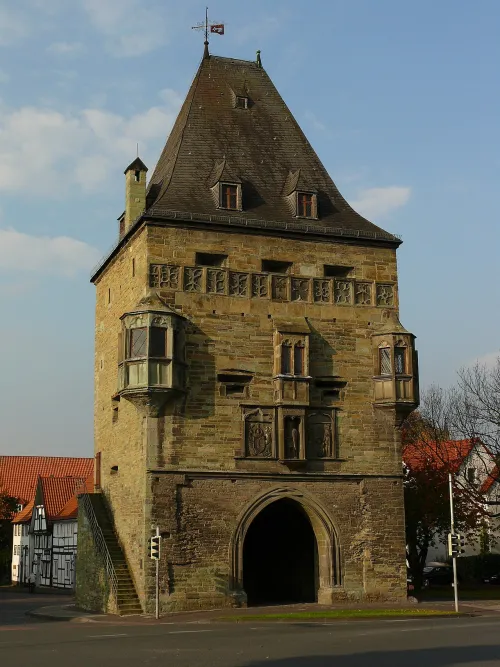
    The Osthofentor stops you. It is the last of what were once eight main gates and two side gates in Soest's walls, the only one left standing, built in green sandstone between 1523 and 1526 by Porphyrius von Neuenkirchen, the same master who worked on the Wiesenkirche you are about to see. When the railway expanded in 1890 most of the wall around it came down, which is why the gate now stands free, reached by a side staircase. Inside is the Osthofentormuseum, covering the town's development and medieval defensive technology. Mind the hours: it opens Wednesday 14:00 to 16:00, Saturday 13:00 to 16:00, and Sunday 11:00 to 17:00, closed the rest of the week, and entry is free. If your day does not line up, the exterior is the real draw anyway. From here, turn back west toward the twin spires you can already see.

    Hours
    Mon-Tue: Closed | Wed: 2:00 – 4:00 PM | Thu-Fri: Closed | Sat: 1:00 – 4:00 PM | Sun: 11:00 AM – 5:00 PM
    Price
    Free
    Website
    soest.de ↗
  4. 4

    Wiesenkirche (St. Maria zur Wiese)

    Wiesenkirche (St. Maria zur Wiese) in Soest, stop 4 on the self-guided walking tour

    This is the one to slow down for. Where the Dom is dark and solid, the Wiesenkirche is the opposite: a high-Gothic hall church whose interior reads almost as a pure wall of glass, the slender bundled pillars holding up windows that drop nearly to the floor in the choir. The foundation stone went down in 1313 on the site of an older Romanesque church, and the twin spires that define the skyline were only added in the second half of the 19th century. Look for the Westphalian Last Supper window, where the meal is laid out with regional ham, beer, and pumpernickel. Entry is free. Hours run April to October Tuesday to Saturday 10:00 to 18:00 and Sunday 11:00 to 18:00, with shorter winter hours from January to March (Tuesday to Sunday 10:00 to 16:00). Spend 20 minutes here, more if the light is good. Then head back toward the centre and the pond.

    Hours
    Jan-Mar: Tue-Sun 10:00 AM - 4:00 PM | Apr-Oct: Tue-Sat 10:00 AM - 6:00 PM, Sun 11:00 AM - 6:00 PM
    Price
    Free
  5. 5

    Großer Teich

    Großer Teich in Soest, stop 5 on the self-guided walking tour

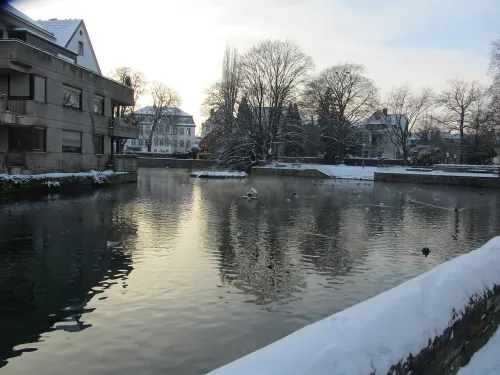
    The Großer Teich is the breather everyone takes, the pond locals just call the Ententeich, the duck pond, sitting inside the ramparts in the middle of the old town. It is fed by springs on the edge of the Haarstrang ridge and drains into the Soestbach. There is no ticket and no gate; it is simply always open. This is the postcard shot of Soest, green sandstone houses reflected in still water with the church towers behind. Sit on a bench for a few minutes, watch the ducks, and let the churches you have just seen line up across the water. It is a good halfway point to check your feet and your phone before the second half of the loop. When you are ready, walk west into the lanes toward the market.

    Hours
    Always open
    Price
    Free
  6. 6

    Marktplatz

    Marktplatz in Soest, stop 6 on the self-guided walking tour

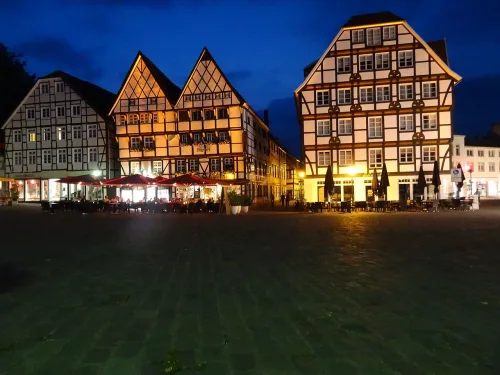
    The lanes open out and you are on the Marktplatz, the social centre of the old town and the spot where Soest actually feels lived in rather than preserved. This is where the town gathers, ringed by cafes and the same green stone facades. If you are here on a Tuesday, Thursday, or Saturday morning between 7:00 and 13:00, the weekly market sets up nearby with regional produce, and it is worth timing your walk for it. The square is free and always open. This is your best bet for a coffee or a quick bite before the quieter western edge of the loop. Grab a seat, then head west and slightly downhill toward the surviving line of the old wall.

  7. 7

    Stadtmauer

    Stadtmauer in Soest, stop 7 on the self-guided walking tour

    On the western side you reach a real surviving stretch of the Stadtmauer, the medieval city wall, in the same green sandstone that runs through this entire town. Most of the ring is gone, lost to the railway and to time, so this length matters: it is the actual fabric of the fortifications, not a reconstruction. You can walk right up to it and put your hand on stone that has been holding this town's edge for centuries. It is open all the time and free. This is the quietest stop on the route, away from the church crowds, and it pairs naturally with the Wallanlagen you walked earlier to complete the picture of how Soest was sealed off. From here, turn back east toward the centre and the town hall facing the Dom.

  8. 8

    Rathaus Soest

    Rathaus Soest in Soest, stop 8 on the self-guided walking tour

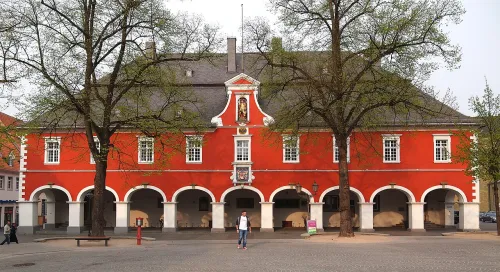
    The Rathaus catches you off guard because it is Baroque, not medieval, one of the few proper Baroque buildings in a town that is otherwise all green stone and Gothic. The symmetrical wing with its nine-arched arcaded loggia is the part people stop for, the west side of a four-winged complex whose other parts went up in different centuries. The town council and administration still work here, so this is a functioning office, not a museum. You can step into the loggia and look across to the Dom, which is the framing everyone photographs. The offices are open Monday to Wednesday 8:30 to 12:30 and 14:00 to 16:00, Thursday until 17:30, Friday mornings only, closed weekends, and there is no charge. The loggia and exterior are the draw regardless of timing. The last stop is right beside you.

    Hours
    Mon-Wed: 8:30 AM – 12:30 PM, 2:00 – 4:00 PM | Thu: 8:30 AM – 12:30 PM, 2:00 – 5:30 PM | Fri: 8:30 AM – 12:30 PM | Sat-Sun: Closed
    Price
    Free
    Website
    soest.de ↗
  9. 9

    St. Petri

    St. Petri in Soest, stop 9 on the self-guided walking tour

    You finish at St. Petri, standing almost shoulder to shoulder with the Dom across a small square, which makes for an easy comparison to close the loop. This is the oldest parish church in Soest, and it keeps medieval frescoes worth a few minutes inside. After the grandeur of the Dom and the glass of the Wiesenkirche, St. Petri is the human-scale third church, the local one. Entry is free. Check the hours before you commit: closed Monday, Tuesday to Friday 9:30 to 12:00 and 14:00 to 17:30, Saturday 9:30 to 12:00 and 14:00 to 16:30, Sunday afternoons 14:00 to 17:00. Stand in the square between the two churches at the end and you have the whole walk in one view, the Romanesque tower and the older parish church facing each other across green sandstone. That is Soest in a single frame.

How Long Does This Walking Tour Really Take?

Just over an hour of pure walking across 3.6 km, but the two churches are the time sinks: give the Wiesenkirche a proper 20 to 25 minutes for the glass and the Dom another 15 to 20. With one real break at the pond or market, three to three and a half hours is the honest number.

The full loop is about 3.6 km and the pure walking time is just over an hour, but that is not how you should plan it. With unhurried stops inside the churches and a real break, give it three to three and a half hours. The two big time sinks are the Wiesenkirche, where the glass deserves a proper 20 to 25 minutes, and the Dom, worth 15 to 20.

The natural break point is exactly halfway, at the Großer Teich. Grab a bench on the pond's edge, rest your feet, and watch the ducks while the church towers reflect in the water. If you would rather sit down properly with a drink, push on the extra few minutes to the Marktplatz, where the cafes ring the square and you can refuel before the quieter western half of the walk. Mornings are calmer; the square fills up by midday.

Full Route, Shorter Walk or Two-Day Version?

The nine stops sit close together, so you can walk the whole thing or trim it without losing the shape of the town. Here are three ways to run it depending on how much time and energy you have.

Short version

The churches and the pond, no far corners

Stops 1 to 5, then jump to 8 and 9, about 2.5 km, under two hours

Skips the western Stadtmauer (stop 7) and the Marktplatz detour to save the longest legs on the far side of the loop. You still get both churches, the gate, the pond and the Rathaus, which is the essential Soest in a tighter circle.

Two easy halves

Split the loop at the pond

Morning: stops 1 to 5 to the Großer Teich. Later: stops 6 to 9 back to the Dom

For a relaxed day, break at the Großer Teich (stop 5), the natural midpoint. Do the eastern churches and gate in the morning while they open, take a long lunch on the Marktplatz, then finish the western wall, Rathaus and St. Petri afterwards.

The loop works in either direction, but the given order from the Dom to St. Petri is recommended because it opens with the town's orientation point, saves the intimate St. Petri as a quiet finish beside where you began, and reaches both big churches during their morning opening hours.

Is This Soest Walking Tour Right for You?

This is a short, flat town walk with almost nothing to pay for, which makes it forgiving. Here is who it suits best and how to bend it to your day.

A good fit if you…

  • First-timers who want the whole old town in one afternoon without hunting for the next sight
  • Anyone drawn to church architecture, from heavy Romanesque to glass-walled Gothic
  • Budget travellers, since every interior on the route is free to enter
  • Slow walkers who would rather linger on a bench by the pond than rush between tickets

Adapt the route if you…

  • You have half a day only: run the short version and skip the western wall and market detour
  • You want a relaxed pace: split the loop into two halves at the Großer Teich
  • You are visiting on a weekend or Monday: check the Osthofentor and Rathaus hours, since both close on those days
  • It rains: weight your time toward the three churches and the Osthofentor museum, which are all roofed and free

Tickets & Skip-the-Line in Soest

Soest is the rare walking tour where there is no line to skip: entry is free at every stop that has a door. The only thing to plan around is opening hours, because two of the stops keep short or office-style hours. Here is what to know before you go.

St. Patrokli, Soest (St.-Patrokli-Dom)Free entry. Open Monday to Saturday 10:00 to 17:30 and Sunday from 12:00 to 17:30. Give it 15 to 20 minutes for the heavy Romanesque interior.
OsthofentorFree entry to the Osthofentormuseum, but the hours are narrow: Wednesday 14:00 to 16:00, Saturday 13:00 to 16:00 and Sunday 11:00 to 17:00, closed the rest of the week. If your day does not line up, the green-sandstone gate is worth seeing from outside anyway. official ticket site ↗
Wiesenkirche (St. Maria zur Wiese)Free entry. April to October Tuesday to Saturday 10:00 to 18:00 and Sunday 11:00 to 18:00; shorter winter hours January to March Tuesday to Sunday 10:00 to 16:00. Worth a proper 20 to 25 minutes for the glass, including the Westphalian Last Supper window. official ticket site ↗
Rathaus SoestFree. The loggia and exterior are the draw and are open regardless. If you want inside, the offices run Monday to Wednesday 8:30 to 12:30 and 14:00 to 16:00, Thursday until 17:30, Friday mornings only, closed weekends.
Everything elseThe Wallanlagen ramparts, the Großer Teich duck pond and the surviving stretch of Stadtmauer are open-air, always open and free. No tickets, no hours to plan around.
Optional upgrade
+5
The same 9-stop route,
now with navigation and a guide.
Optional AI experience

You already have the route.
The AI guide brings it to life.

Standing under the green-sandstone tower of the Dom, or by the ducks on the Großer Teich? Open AI Tourguide in your browser, no app, no download, and a voice guide walks the whole old town with you, greeting you, telling the story of the Wiesenkirche and the Osthofentor gate, then asking what you want to see and adapting as you thread the lanes. A real conversation built into the walk, not a recording. Start with 100 free credits.

Livenavigation13languagesAnyquestionYourinterests
Open this route with the AI guide

Try it in your browser · No app or download required

Tips for Walking in Soest

  • Soest's main station (Soest Bahnhof) sits just north of the old town, a 7 to 10 minute walk to the Dom, with regional trains from Dortmund and Paderborn. Start the loop by 10:00 to catch the churches as they open.
  • The old town is a tangle of narrow lanes with cobbles and some uneven green-sandstone paving, plus the soft earthen path on the Wallanlagen rampart. Wear flat, cushioned shoes, not smooth soles or heels.
  • Public toilets are not on every corner. Your most reliable bet on the route is around the Marktplatz, where the cafes and central facilities are; use them at the halfway point rather than counting on the churches.
  • Time your walk for the weekly market on Tuesday, Thursday, or Saturday morning (7:00 to 13:00) near the Marktplatz, then sit down for coffee and regional pumpernickel, the dark Westphalian bread the town is known for.
  • For the classic Soest photo, stand on the west bank of the Großer Teich in late afternoon and face east-northeast: green-stone houses and the church towers reflect in the still water with the lower sun behind you.

Why Walk This Route?

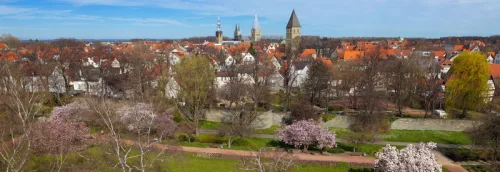
Soest is one of those Westphalian towns that most tourists drive straight past on their way to somewhere bigger, and that is exactly why it works so well on foot. The whole old town is compact, ringed by an intact green rampart, and built from a soft local green sandstone that gives every wall and church the same olive-grey glow. You can walk the entire historic core in an afternoon without ever feeling like you are missing the next thing, because the next thing is always two streets over.

This route is a loop, roughly 3.6 km, and it is built around the two churches that define the skyline: the Romanesque Dom and the Gothic Wiesenkirche. Between them you get the only surviving town gate, a duck pond that ends up on every postcard, the market square where locals actually shop, and a stretch of the medieval wall you can still touch. Nothing here is ticketed, which is rare. Almost every door on this walk is free to open.

Walking beats wandering here for one reason: Soest's old town is a knot of crooked, narrow lanes with no grid, and the sights hide behind unassuming corners. Follow this order and the two big churches, the gate, and the wall connect into one continuous arc instead of a series of backtracks. Bring it up on your phone and just walk.

Common Questions

Is Soest safe to walk around?

Yes. Soest is a small, quiet Westphalian town with very low crime and no tourist-scam culture to speak of. The old town is calm even after dark, and the main thing to watch is your footing on uneven cobbles and the unlit rampart path at night, not other people.

What if it rains during my Soest tour?

Duck into the churches, which is where you want to spend time anyway. The Dom, the Wiesenkirche, and St. Petri are all free and roofed, and the Wiesenkirche's glass actually looks dramatic under grey skies. The Osthofentor museum and a Marktplatz cafe cover the rest. The pond and rampart are the only stops that really need dry weather.

What's the best time of day for this walking tour?

Start around 10:00 when the churches open and the morning light is still soft on the green sandstone. You will beat the midday cafe crowds on the Marktplatz, and you will finish at the Großer Teich and Dom with good late-afternoon light for photos if you walk it slowly.

Take this route with you

Open this exact tour with navigation and your personal AI guide.

Start GPS Navigation + AI Guide
AI Tourguide
Researched and curated by the AI Tourguide teamWe plan and quality-check every route, then research and verify the opening hours, prices, and practical tips for each stop along it.
▶ Open route with AI guideNavigation, stories and your questions