Self-Guided Walking Tour in Strasbourg

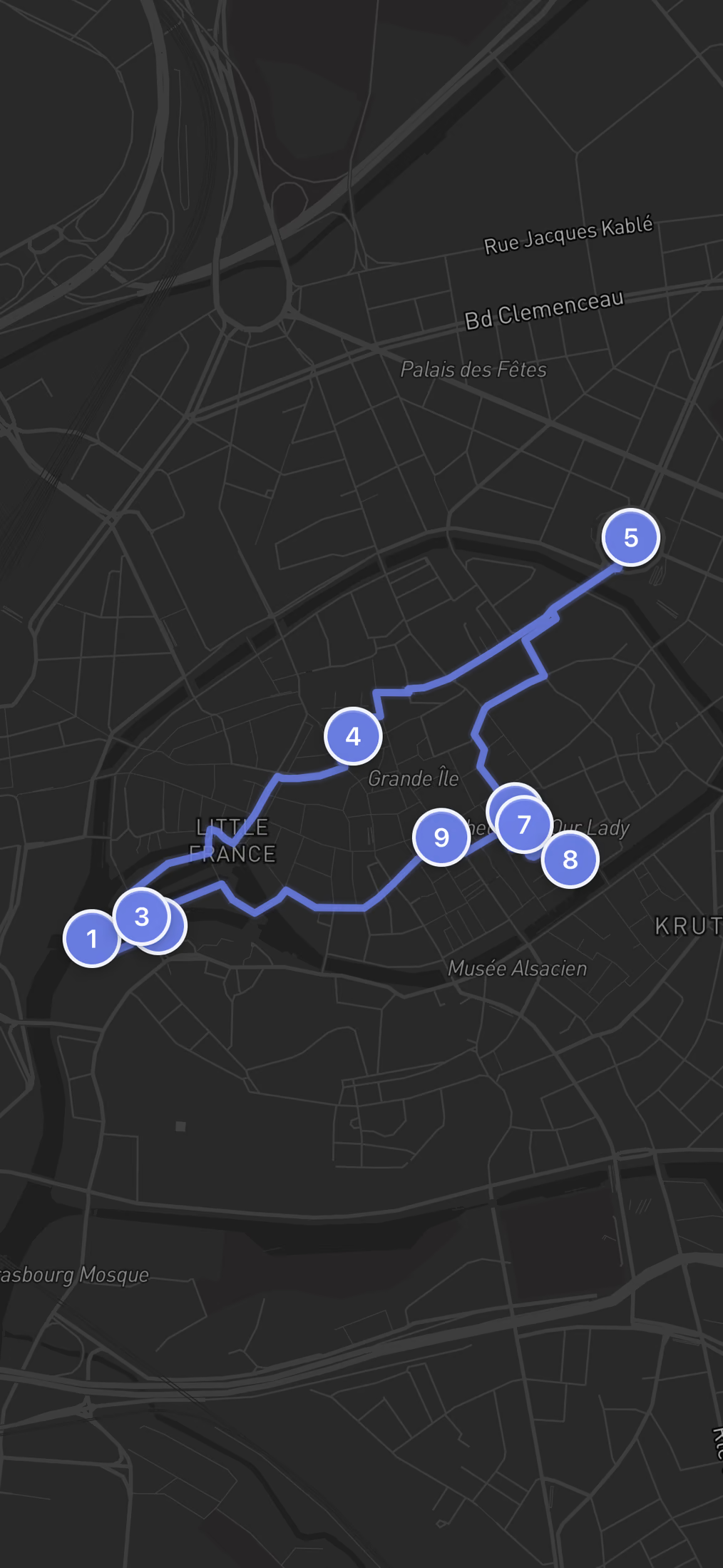
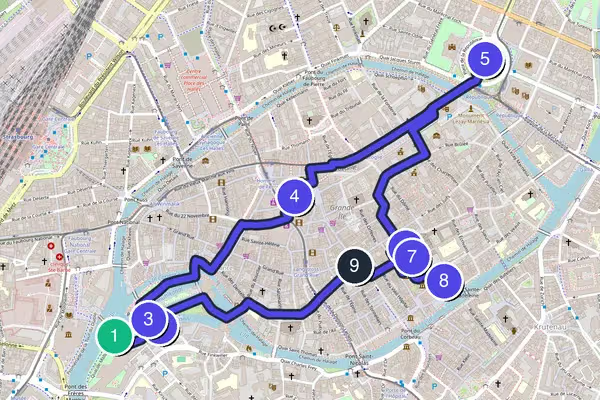
A 4.4 km self-guided route through Strasbourg, from the Barrage Vauban across the Grande Ile to Place Gutenberg, taking in nine stops. This page gives you the map, the walking time between each stop, real opening hours and prices for the interiors, and shorter versions when you are pressed for time.

9 Stops4.4 km~2 hours walking2–3 hours with stops
What you get with AI Tourguide
Full GPS navigationInteractive AI guidePersonalized to youWorks in your browser
Try this tour with Alex

Strasbourg Walking Tour at a Glance

This route is built for anyone who wants to see the heart of Strasbourg on foot in a half day, at their own pace. It links nine stops through the Grande Ile and the Neustadt, and every interior along the way, the dam terrace, the cathedral platform, the Palais Rohan museums, is optional. Follow the whole thing or peel off whenever you like.

StartBarrage Vauban
FinishPlace Gutenberg
Route typeA mostly linear point-to-point walk running broadly west to east across the river island, then looping back south. There is a little backtracking near the cathedral cluster, but no long repeated stretches.
Realistic timeAbout 2 to 2.5 hours at a comfortable pace for the full 4.4 km. Add 30 to 60 minutes if you climb the cathedral platform, tour a Palais Rohan museum, or stop for a coffee.
DifficultyEasy and almost entirely flat, since the old town sits on a river island. Expect cobblestones through Petite France and around the cathedral, so wear comfortable shoes.
Cost to followThe outdoor route itself is free. Paid interiors are optional: the Barrage Vauban terrace is 7 EUR, the cathedral platform 8 EUR, and a Palais Rohan museum 6 EUR.
Best for:

First-time visitors who want the essential Strasbourg, French half-timbered lanes and German imperial boulevards, in one manageable flat walk without joining a group.

The Route

Free Walking Tour Map of Strasbourg

9 stops4.4 kmabout 2 hours
Loading the interactive map…The complete walking route will appear here.
Want the route to guide you while you walk?Open the route with navigation and a personal guide for the history, stories and questions that matter to you.
Open route + AI guide

The 9 stops along this route

  1. Barrage Vauban in Strasbourg, stop 1 on the self-guided walking tour
    1Barrage Vauban
  2. Maison des tanneurs in Strasbourg, stop 2 on the self-guided walking tour
    2Maison des tanneurs
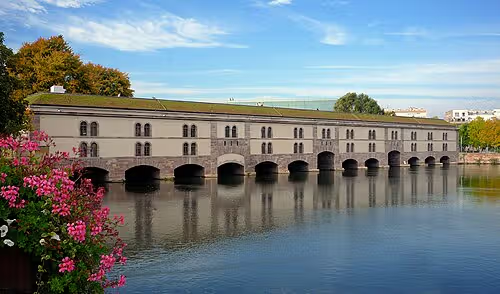
  3. Ponts Couverts, Strasbourg (Ponts couverts) in Strasbourg, stop 3 on the self-guided walking tour
    3Ponts Couverts, Strasbourg (Ponts couverts)
  4. Place Kléber in Strasbourg, stop 4 on the self-guided walking tour
    4Place Kléber
  5. Place de la République in Strasbourg, stop 5 on the self-guided walking tour
    5Place de la République
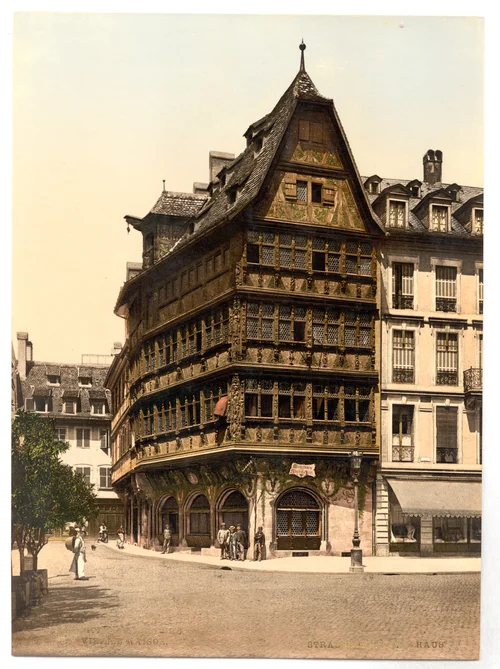
  6. Kammerzell House (Maison Kammerzell) in Strasbourg, stop 6 on the self-guided walking tour
    6Kammerzell House (Maison Kammerzell)
  7. Strasbourg Cathedral organ (Orgue de tribune de la cathédrale Notre-Dame de Strasbourg) in Strasbourg, stop 7 on the self-guided walking tour
    7Strasbourg Cathedral organ (Orgue de tribune de la cathédrale Notre-Dame de Strasbourg)
  8. Palais Rohan in Strasbourg, stop 8 on the self-guided walking tour
    8Palais Rohan
  9. Place Gutenberg in Strasbourg, stop 9 on the self-guided walking tour
    9Place Gutenberg
  10. That's the complete route.

    If you want more than the map and text, add live navigation and a conversational AI guide while you walk.

    Open route + AI guide
    You made it
Stop 1 of 9
Swipe →

Your Strasbourg Walking Tour, Stop by Stop

  1. 1

    Barrage Vauban

    Barrage Vauban in Strasbourg, stop 1 on the self-guided walking tour

    The walk begins at Vauban's 120-meter sandstone dam, completed in 1690 as a military defense that could flood the entire southern approach to the city by raising the River Ill behind it. The engineering is grimly practical: by blocking the water flow, the French garrison could turn the surrounding fields into an impassable swamp within hours. Today the interior corridor functions as a gallery space, but the real draw is the rooftop terrace. Climb to the top for a panoramic view that takes in the Ponts Couverts towers, the Petite France quarter, and the cathedral spire rising above the rooftops. Open daily from 7:15 AM to 9:00 PM. Admission is 7 EUR. Come early in the morning when the terrace is nearly empty and the light on the canal is at its best.

    Hours
    Daily: 7:15 AM – 9:00 PM
    Price
    €7
  2. 2

    Maison des tanneurs

    Maison des tanneurs in Strasbourg, stop 2 on the self-guided walking tour

    This striking half-timbered building from 1572 was the guildhall of Strasbourg's tanners, who used the open wooden galleries on the upper floors to dry animal hides in the breeze off the river. The tanning quarter occupied this stretch of the Ill because the industry required enormous quantities of running water and produced a stench that kept it banished to the city's edge. The building's overhanging upper stories, flower-covered balconies, and timber-frame geometry make it one of the most photographed facades in Alsace. Today it houses a restaurant specializing in choucroute and tarte flambee. Even if you do not eat here, stop to study the construction: the timber framing is original 16th-century work, with the diagonal bracing patterns characteristic of Alsatian guild architecture.

    Hours
    Mon: Closed | Tue-Sat: 12:00 – 2:00 PM, 7:00 – 9:30 PM | Sun: Closed
    Price
    Free (entry)
  3. 3

    Ponts Couverts, Strasbourg (Ponts couverts)

    Ponts Couverts, Strasbourg (Ponts couverts) in Strasbourg, stop 3 on the self-guided walking tour

    Despite the name ("Covered Bridges"), the wooden roofs that once sheltered defending soldiers were demolished in 1784, and what remains are three stone bridges connecting four massive square towers from the 13th-century fortifications. The towers served as prisons and guard posts for centuries, and their thick walls and narrow arrow-slit windows still project medieval menace. The view from the bridges looking back toward the Barrage Vauban, with the canal splitting around the Petite France island, is a postcard standard. Free and open 24 hours. The bridges are a natural transition point between the Petite France quarter and the broader city center, and from here the route heads northeast toward the main squares.

    Hours
    Open 24/7
    Price
    Free
  4. 4

    Place Kléber

    Place Kléber in Strasbourg, stop 4 on the self-guided walking tour

    Strasbourg's largest square is named for Jean-Baptiste Kleber, a Napoleonic general born in the city who was assassinated in Cairo in 1800. His remains are buried beneath the bronze monument erected here in 1840. The square functions as the commercial center of the city, ringed by department stores and the monumental Aubette building, a 1765 military barracks that now houses shops and a cinema. During December, this becomes the site of Strasbourg's famous Christmas market, which draws over 2 million visitors annually and has been running since 1570. Outside the holiday season, the square is a transit hub and meeting point. The tramway crosses through, cafe terraces fill the edges, and the scale of the open space provides a visual break after the narrow lanes of Petite France.

    Hours
    Open 24/7
    Price
    Free
  5. 5

    Place de la République

    Place de la République in Strasbourg, stop 5 on the self-guided walking tour

    Crossing the canal east of the historic island brings you into the Neustadt, the German imperial quarter built after the 1871 annexation of Alsace. Place de la Republique is the centerpiece: a circular square anchored by the Neo-Renaissance Palais du Rhin, built between 1884 and 1889 as the residence of the German Emperor. The architecture shifts dramatically here from medieval timber to Wilhelmine grandeur, with wide boulevards, stone facades, and the kind of monumental scale Berlin and Munich were building in the same era. The central park contains several rare Ginkgo trees and a war memorial. The entire Neustadt district was inscribed as a UNESCO World Heritage site in 2017, the first time a German-era urban plan in France received that recognition. Free and open 24 hours.

    Hours
    Open 24/7
    Price
    Free
  6. 6

    Kammerzell House (Maison Kammerzell)

    Kammerzell House (Maison Kammerzell) in Strasbourg, stop 6 on the self-guided walking tour

    Widely considered the finest medieval merchant house in Strasbourg, the Maison Kammerzell combines a stone ground floor from 1427 with intricately carved timber-framed upper levels added in 1589. The facade features 75 leaded glass windows and elaborate woodwork depicting zodiac signs, mythological figures, and biblical scenes. The level of sculptural detail in the timber is extraordinary, and every visit reveals carvings you missed before. The building now operates as a hotel and restaurant, but you can walk into the ground-floor dining room to see the interior without a reservation. The location is directly beside the cathedral square, and the Kammerzell's dark timber frames provide a dramatic contrast to the pale pink sandstone of the cathedral next door.

  7. 7

    Strasbourg Cathedral organ (Orgue de tribune de la cathédrale Notre-Dame de Strasbourg)

    Strasbourg Cathedral organ (Orgue de tribune de la cathédrale Notre-Dame de Strasbourg) in Strasbourg, stop 7 on the self-guided walking tour

    The cathedral dominates the city. Rising 142 meters in pink Vosges sandstone, this was the tallest building in the world for 227 years until 1874. Construction began in 1015 and continued for centuries, which is why the facade has only one completed spire (the south tower was never built). Inside, the 14th-century astronomical clock performs a mechanical procession of the apostles daily at 12:30 PM. A localized wind swirls permanently in the cathedral forecourt, which local legend attributes to the devil waiting outside for souls. The viewing platform at 66 meters offers sweeping views of the city, the Rhine plain, and on clear days the Black Forest. Entry to the cathedral is free. The platform costs 8 EUR and requires climbing 332 steps. Open Monday through Saturday 8:30 to 11:15 AM and 12:45 to 5:45 PM, Sundays 2:00 to 5:15 PM.

    Hours
    Mon-Sat: 8:30 – 11:15 AM, 12:45 – 5:45 PM | Sun: 2:00 – 5:15 PM
    Price
    Free (platform: 8 EUR)
  8. 8

    Palais Rohan

    Palais Rohan in Strasbourg, stop 8 on the self-guided walking tour

    Directly behind the cathedral, this Baroque palace was designed by Robert de Cotte between 1732 and 1742 as the residence for the prince-bishops of the powerful House of Rohan. The building hosted Marie-Antoinette on her journey from Vienna to Paris in 1770 and later served as Napoleon's Strasbourg headquarters. Today it houses three separate museums: the Archaeological Museum in the basement (Roman and prehistoric Alsace), the Museum of Decorative Arts on the ground floor (lavishly furnished period rooms), and the Fine Arts Museum upstairs (Rubens, El Greco, Goya). A single ticket covers one museum for 6 EUR. Closed Tuesdays. Open Monday 10:00 AM to 1:00 PM and 2:00 to 6:00 PM, Wednesday through Friday same hours, Saturday and Sunday 10:00 AM to 6:00 PM.

    Hours
    Mon: 10:00 AM – 1:00 PM, 2:00 – 6:00 PM | Tue: Closed | Wed-Fri: 10:00 AM – 1:00 PM, 2:00 – 6:00 PM | Sat-Sun: 10:00 AM – 6:00 PM
    Price
    €6
  9. 9

    Place Gutenberg

    Place Gutenberg in Strasbourg, stop 9 on the self-guided walking tour

    The tour ends at the square dedicated to Johannes Gutenberg, who lived in Strasbourg from 1434 to 1444 while developing the mechanical principles that would become his movable-type printing press. The central bronze statue was cast in 1840 by David d'Angers and shows Gutenberg holding a freshly printed page. The surrounding buildings include the 16th-century Chamber of Commerce with its ornate Renaissance facade. The square hosts a regular book market and sits at the intersection of several pedestrian shopping streets, making it a natural dispersal point after the walk. Free and open 24 hours. From here, the tram station and the main shopping streets of the Grande Ile are all within a two-minute walk.

    Hours
    Open 24/7
    Price
    Free

How Long Does This Walking Tour Really Take?

Pure walking between the nine stops is roughly one hour across 4.4 km of flat ground. Adding time to linger at the outdoor squares and bridges brings it to around 2 to 2.5 hours, and factoring in the cathedral climb or a museum visit pushes the day toward three hours.

Allow 2 to 2.5 hours for the full route at a comfortable pace. The walking distance is 4.4 kilometers on flat ground. If you climb the cathedral platform (332 steps), visit a museum at the Palais Rohan, or sit for a coffee at Place Kleber, add 30 to 60 minutes.

Full Route, Shorter Walk or Two-Day Version?

The full walk is nine stops, but it splits cleanly depending on how much time you have and whether the German-era Neustadt interests you. Here are three ways to run it, using the stop numbers from the route.

Old town core

Skip the Neustadt detour

Stops 1 to 4, then jump to stops 6 to 9, cutting stop 5, about 3 km and 1.5 hours

Dropping Place de la Republique (stop 5) removes the two longest legs, roughly 870 m out and 860 m back. You keep Petite France, Place Kleber, the cathedral and Palais Rohan, and lose only the imperial quarter.

Two-part split

An easy break at Place Kléber

Part one stops 1 to 4 (Petite France to Place Kleber), part two stops 5 to 9 (Neustadt and cathedral)

Place Kleber (stop 4) sits at the natural midpoint with trams and cafes all around. Do the western half one morning and the Neustadt-and-cathedral half another, or pause here for lunch before continuing.

You can walk it in reverse, starting at Place Gutenberg and ending at the Barrage Vauban. The given direction is recommended because it saves the towering cathedral and its terrace for the middle-to-late stretch, and leaves you finishing among the shopping streets of the Grande Ile rather than out at the dam.

Is This Strasbourg Walking Tour Right for You?

This is a short, flat city walk with a lot packed into a small area. It suits most people, but a few specifics are worth knowing before you set out.

A good fit if you…

  • First-time visitors who want Strasbourg's essential sights in one compact loop
  • Walkers who prefer flat ground, since the whole island center is level
  • Anyone curious about the French-German mix, from timbered guildhalls to the imperial Neustadt
  • Travelers with only half a day who still want to see what matters

Adapt the route if you…

  • You use a stroller or wheelchair: the squares and bridges are step-free, but the cathedral platform's 332 steps have no elevator
  • You dislike cobblestones: Petite France and the cathedral area are paved in uneven stone
  • You are short on time: cut stop 5 to drop the two longest legs
  • You visit in December: the stretch from Place Kleber to the cathedral fills with Christmas market crowds

Tickets & Skip-the-Line in Strasbourg

Only three stops on this route charge admission, and none needs a timed ticket, so you can pay at the door.

Barrage VaubanAdmission 7 euros for the rooftop terrace, open daily 7:15 AM to 9:00 PM. Come early when the terrace is nearly empty.
Strasbourg Cathedral organ (Orgue de tribune de la cathédrale Notre-Dame de Strasbourg)Entering the cathedral is free. Climbing the 66-meter platform costs 8 euros (332 steps). Open Mon-Sat 8:30 to 11:15 AM and 12:45 to 5:45 PM, Sun 2:00 to 5:15 PM.
Palais Rohan6 euros covers one of the three museums. Closed Tuesdays. Open Mon and Wed-Fri 10 AM to 1 PM and 2 to 6 PM, Sat-Sun 10 AM to 6 PM.
Everything elseMaison des Tanneurs, Ponts Couverts, Place Kleber, Place de la Republique, Maison Kammerzell and Place Gutenberg are all free and outdoors. You can walk into the Kammerzell and Tanneurs dining rooms to see the interiors without a reservation.
Optional upgrade
+5
The same 9-stop route,
now with navigation and a guide.
Optional AI experience

You already have the route.
The AI guide brings it to life.

Standing in the half-timbered lanes of Petite France, or under the pink sandstone cathedral? Open AI Tourguide in your browser, no app, no download, and a voice guide walks the whole route with you, greeting you, telling the story from the Barrage Vauban to the German-era Neustadt, then asking what you want to hear more about and adapting as you go. A real conversation built into the walk, not a recording. Start with 100 free credits.

Livenavigation13languagesAnyquestionYourinterests
Open this route with the AI guide

Try it in your browser · No app or download required

Tips for Walking in Strasbourg

  • Time your cathedral visit to arrive before 12:30 PM if you want to see the astronomical clock's daily mechanical procession. The crowd gathers early, so aim to be inside by 12:00 PM.
  • The Barrage Vauban terrace is best in the morning when the sun lights up the Petite France rooftops from the east. By afternoon, the buildings cast shadows over the canals.
  • Strasbourg's tram network is excellent and covers the entire city center. Tram lines A and D both stop near the cathedral if you want to skip ahead or return to the station quickly.
  • If visiting during December, expect the streets between Place Kleber and the cathedral to be packed with Christmas market stalls and visitors. The market runs from late November through December 24.
  • Try a tarte flambee (flammekueche) for lunch at one of the restaurants along Rue du Maroquin near the cathedral. The thin Alsatian flatbread with creme fraiche, onions, and lardons is the regional specialty and costs 8 to 12 EUR.

Where to Eat Along the Route

Strasbourg's best food sits a block or two off the tourist spine that runs from the Cathedral through Place Broglie into Petite France. The restaurants immediately facing the Cathedral and along the main drag charge a premium for average plates, so step off the postcard streets to eat well.

  • Krutenau, just east of Petite France and a few steps from the Grande Ile, is where locals actually eat: less foot traffic, more neighborhood winstubs and small kitchens.
  • One block off the Cathedral square: skip the terraces staring at the facade and duck into the side lanes, where 14th-century wine cellars still serve the real choucroute.
  • Petite France is genuinely pretty but leans touristy. Come for the waterfront terraces and the historic timbered dining rooms, not for a cheap meal.
  • Near the train station and the southern end of the island: quieter, non-touristed streets with natural wine bars and quick bites before a Colmar train.
Au Pont du Corbeau⌖A 30-year family winstub on Quai Saint-Nicolas with tables packed tight and generous choucroute garnie. Dishes run 15 to 20 euros, lunch formula around 13.50 euros. Reserve, walk-ins get turned away.
Binchstub⌖The city's consensus pick for tarte flambee, crisp homemade bases at 10 to 20 euros. Locals line up for flammekueche and wine, so expect to wait or book.
Le Gurtlerhoft⌖A 14th-century wine cellar on Place de la Cathedrale, cozy despite the touristy address, doing some of the best choucroute in the city for 20 to 30 euros. Open 11:45 AM to 2 PM and 6:45 to 10 PM.
La Cloche a Fromage⌖A cheese lover's institution on Rue des Tonneliers for raclette, fondue and boards, 25 to 35 euros. Book well ahead, it fills up.

Do not eat at the restaurants directly facing the Cathedral without checking reviews first, and skip the all-you-can-eat flammekueche chains where the bases come out heavy and bland.

Tourist Traps to Avoid in Strasbourg

Strasbourg is a genuinely low-scam city, so the real traps here are money-wasting mistakes and a handful of France-wide cons rather than anything the city is known for.

  • Validate your tram ticket in the machine on board. Buying it is not enough, and fines for an unvalidated ticket run around 33 euros.
  • Skip the restaurants directly on the Cathedral square. Prices are roughly the same citywide, so a tourist-adjacent spot charges the same as a good place a block away for worse food.
  • If the EU Parliament is in session, hotels spike and vanish. Check the sitting schedule and book well ahead.
  • The gold-ring, friendship-bracelet, fake-petition and shell-game cons exist across France and can happen wherever tourists cluster. Do not stop or engage, just walk on.
  • During the Christmas market (late November to December 24) the streets between Place Kleber and the Cathedral are packed. Go early morning or evening for a calmer walk.
  • Do not try to see all of Strasbourg in a single rushed day. The center is small, and the charm is in slowing down once the day-trippers leave.

Why Walk This Route?

This 4.4-kilometer walking tour covers 9 stops across Strasbourg in roughly 2 hours, from the military engineering of the Barrage Vauban through the half-timbered lanes of Petite France, past the towering pink sandstone cathedral, and into the grand German-era Neustadt district. Strasbourg is the city where France and Germany overlap, and this walk tracks that dual identity through every stop: French medieval timbered houses beside German imperial boulevards, Alsatian dialect on cafe menus, and a cathedral that spent centuries switching between French and German hands. The route follows the River Ill through the historic island center before crossing into the wider boulevards of the 19th-century extension.

Common Questions

Can I do this walk with a stroller or wheelchair?

The route is flat and most streets are paved or cobblestoned. The Barrage Vauban terrace has elevator access. The cathedral platform requires 332 steps and has no elevator. The Palais Rohan has limited ground-floor accessibility. All squares and bridges are step-free.

Is Strasbourg walkable from the train station?

Yes. The Gare de Strasbourg is a 15-minute walk or a 5-minute tram ride from the Grande Ile. Tram lines A, C, and D connect the station directly to the city center. The tour route begins at the Barrage Vauban, which is a 20-minute walk from the station or accessible via Tram A to Porte de l'Hopital.

What is the best time of year for this walk?

Spring (April to June) and early autumn (September to October) offer the best combination of pleasant weather and manageable crowds. December is magical for the Christmas markets but extremely busy. Summer can be hot, and the narrow Petite France lanes trap the heat.

Take this route with you

Open this exact tour with navigation and your personal AI guide.

Start GPS Navigation + AI Guide
AI Tourguide
Researched and curated by the AI Tourguide teamWe plan and quality-check every route, then research and verify the opening hours, prices, and practical tips for each stop along it.
▶ Open route with AI guideNavigation, stories and your questions