
Self-Guided Walking Tour in Wengen

A self-guided loop through car-free Wengen, from the train station to the cliff-edge promenade, both village churches, the Sir Arnold Lunn memorial and the Männlichen cable car base. The page gives you the route map, per-leg walking times, real prices and hours, and shorter versions if time or weather is tight.

6 Stops1.7 km~1 hours walking75–90 minutes with stops
What you get with AI Tourguide
Full GPS navigationInteractive AI guidePersonalized to youWorks in your browser
Try this tour with Alex

Wengen Walking Tour at a Glance

This loop is built for anyone who wants to understand Wengen, not just photograph it. The route is short and every stop is close, so you can take it at your own pace and skip anything that does not grab you. Every interior along the way is optional: the churches are free to step into, but the village itself is the experience. Treat the Männlichen cable car at the end as a yes-or-no decision based on the sky, not as a required stop.

StartWengen Train Station
FinishMännlichen Cable Car Base Station
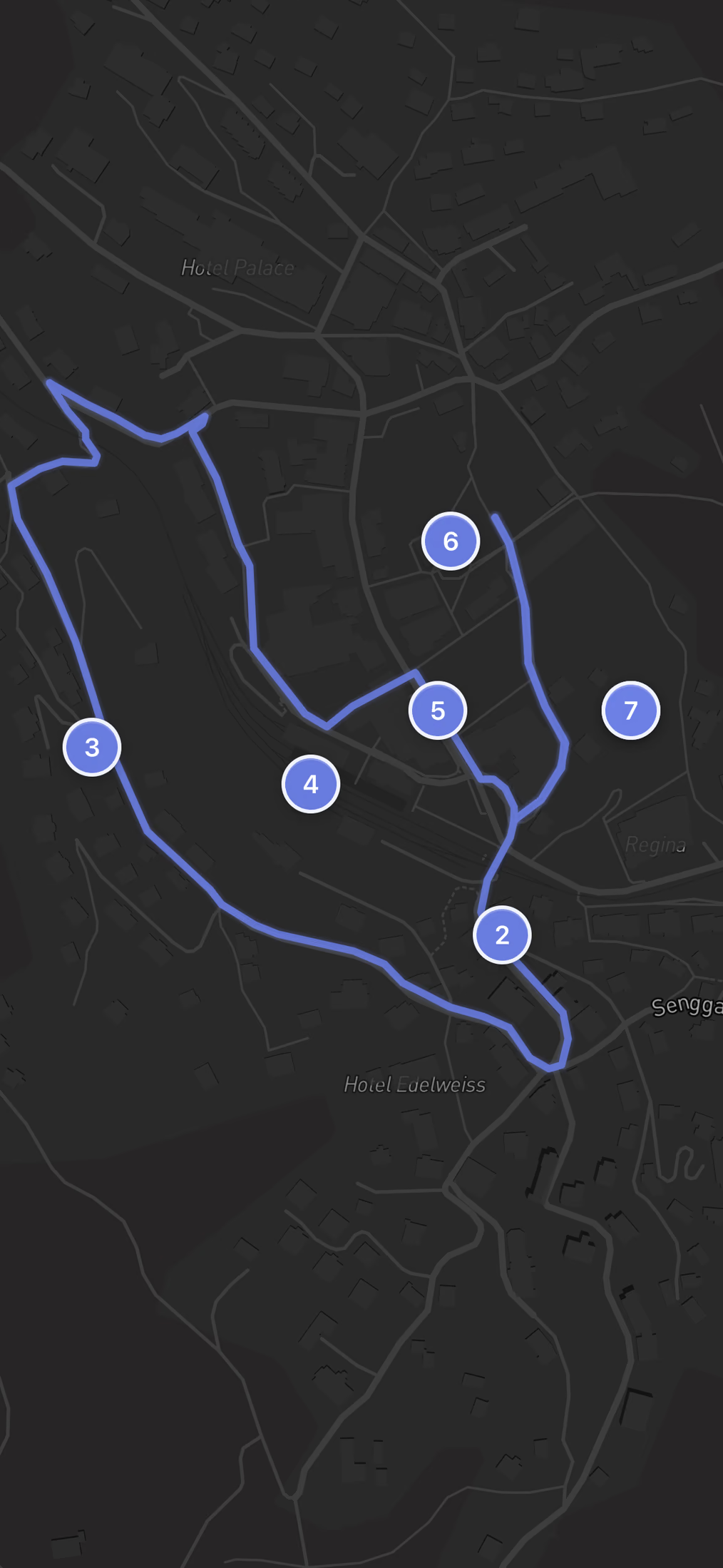
Route typeA loop of about 1.7 km that starts and ends at Wengen Train Station. It drops south-west to the cliff-edge promenade, loops north-west and east through the village lanes, then returns south-east to the station. No backtracking.
Realistic timeAbout 25–30 minutes of pure walking, but plan on 75–90 minutes once you stop properly at the promenade and the churches. Add one to four hours if you ride the Männlichen cable car at the end.
DifficultyShort distance on paved village lanes, but the route tilts: the cliff promenade sits well below the upper streets, so expect real elevation change between stops. You are at roughly 1,270 metres, so the altitude slows you more than the distance suggests. Trainers are fine; hiking boots only matter if you continue onto mountain trails.
Cost to followThe outdoor route is entirely free. The only paid element is the Männlichen cable car at the final stop, around CHF 29 one-way or CHF 58 return for an adult.
Best for:

Travellers who want the famous Eiger, Mönch and Jungfrau view without committing to a full hike, photographers chasing low light on the peaks, and anyone curious how a farming hamlet quietly became a British ski resort.

The Route

Free Walking Tour Map of Wengen

6 stops1.7 kmabout 1 hours
Loading the interactive map…The complete walking route will appear here.
Want the route to guide you while you walk?Open the route with navigation and a personal guide for the history, stories and questions that matter to you.
Open route + AI guide

The 6 stops along this route

  1. Missing required field: waypoints[0].image
    1Wengen Train Station
  2. Missing required field: waypoints[1].image
    2Mountain View Promenade
  3. Missing required field: waypoints[2].image
    3Mary Queen of Peace Catholic Church
  4. Wengen railway station (Bahnhof Wengen) in Wengen, stop 4 on the self-guided walking tour
    4Wengen railway station (Bahnhof Wengen)
  5. Missing required field: waypoints[4].image
    5Sir Arnold Lunn Memorial
  6. Männlichen Cable Car Base Station in Wengen, stop 6 on the self-guided walking tour
    6Männlichen Cable Car Base Station
  7. That's the complete route.

    If you want more than the map and text, add live navigation and a conversational AI guide while you walk.

    Open route + AI guide
    You made it
Stop 1 of 6
Swipe →

Your Wengen Walking Tour, Stop by Stop

  1. 1

    Wengen Train Station

    Missing required field: waypoints[0].image

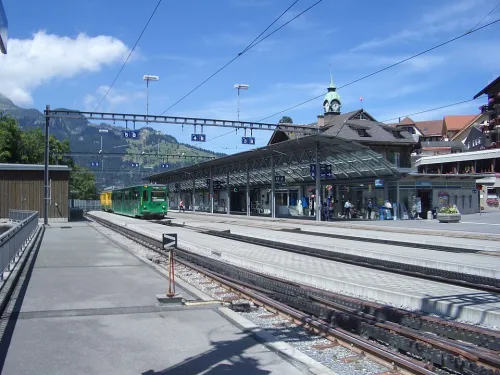
    You arrive the only way anyone can, by rack railway. The Wengernalp train hauls itself up from Lauterbrunnen in about 12 minutes, and the moment the doors open you are standing in the center of a car-free village at roughly 1,270 metres. The station opened in 1893 and it is still the hub: shops, the post office, the bus turnaround, and the departure point for trains onward to Kleine Scheidegg. Station access is free, and trains run roughly hourly year-round (summer service around late May to late October, winter mid-December to early April). Take a minute here before walking off. This is where the whole village logic clicks into place: no engines, no traffic, just electric luggage carts and people on foot. Practical tip: if you are continuing higher later, the train onward to Kleine Scheidegg is covered by a Jungfrau pass, so do not buy a separate ticket without checking. Now walk south, downhill toward the village edge, following signs for the viewpoint.
  2. 2

    Mountain View Promenade

    Missing required field: waypoints[1].image

    This is the view people travel here for, and the station view does not prepare you for it. Walk to the cliff-edge promenade on the southern rim of the village and the ground simply drops. The Lauterbrunnen Valley floor sits about 400 metres straight below, and across it the Jungfrau, Mönch and Eiger stand in a row. On a clear morning it is one of the great free sights in the Alps. The promenade is open all the time and costs nothing. Give it more time than you think, at least 15 minutes, and walk a little along the path rather than stopping at the first railing, because the angle on the Eiger improves as you go. Tip: come back here in the early morning or just before sunset. Midday light flattens the faces of the peaks, while low light picks out every ridge and the valley below glows. Bring a layer too, the wind off the cliff is colder than the village lanes behind you. From here head back up and west into the village toward the Catholic chapel.

  3. 3

    Mary Queen of Peace Catholic Church

    Missing required field: waypoints[2].image

    After the open drama of the cliff, this small chapel on the western edge of the village feels deliberately quiet. Mary Queen of Peace was built in 1959 in a plain modernist alpine style, low and simple, nothing like the heavy churches you find down in the valley towns. It was put up for the visiting climbers and skiers who came through Wengen in the post-war years, many of them British and Italian, and it still serves the Catholic congregation today. It is open and free to enter, though there is not much inside beyond a calm, light interior. This is a two-minute stop, not a long one. Step in if the door is open, mostly to feel the contrast with the noise and views outside. Tip: it sits slightly off the main pedestrian flow, so it is one of the few corners of central Wengen where you will likely be alone, a good spot to catch your breath at altitude. From here walk back east along the main pedestrian street toward the village heart.

  4. 4

    Wengen railway station (Bahnhof Wengen)

    Wengen railway station (Bahnhof Wengen) in Wengen, stop 4 on the self-guided walking tour

    Back on the main pedestrian street you reach the building that anchors the village. The Reformed church has stood here since 1922, and you will spot it from a distance by its single onion-dome bell tower, an unusual shape for the Bernese Oberland and the closest thing Wengen has to a landmark. It is the center of village life, the place that appears in most photos taken along the main street. The exterior is always accessible and there is no charge. You do not need long, five minutes is plenty, but the spot around the church is worth lingering in because this is the social heart of Wengen, with cafes and shops a few steps in either direction. Tip: frame the bell tower with the Jungfrau massif behind it from the street to the south of the church. That combination, alpine onion dome and snow peaks, is the most distinctly Wengen photo you can take and almost nobody bothers to line it up. From here it is a very short walk to the Lunn memorial.

  5. 5

    Sir Arnold Lunn Memorial

    Missing required field: waypoints[4].image

    This is the stop that explains why Wengen matters far beyond its size, and most visitors walk straight past it. The memorial honors Sir Arnold Lunn, the British skier who organized the first modern slalom race here in 1922. That makes Wengen one of the birthplaces of alpine ski racing as we know it, and the famous Lauberhorn downhill, run on the slopes above the village every January, descends directly from that history. The memorial is an outdoor plaque, always accessible and free. It takes two minutes to read, but it is the single best piece of context on the whole walk: the quiet farming village you have been crossing quietly became a global ski destination because of races started right here. Tip: stand here and look up toward the slopes. If you visit in summer you are seeing the same terrain that becomes the Lauberhorn course in winter, the longest and one of the most dangerous downhill races in the world. From here walk north and slightly uphill to the cable car base station.

  6. 6

    Männlichen Cable Car Base Station

    Männlichen Cable Car Base Station in Wengen, stop 6 on the self-guided walking tour

    The walk ends, or pauses, at the lower terminal of the Wengen-Männlichen cable car. This gondola climbs about 1,000 metres up to the Männlichen ridge at 2,342 metres, a 6.2 km ride that is among the longest in Switzerland. From the top you get a ridge-walk panorama over both the Lauterbrunnen and Grindelwald valleys, with the Eiger, Mönch and Jungfrau spread out in front of you. The cable car runs roughly 09:00 to 17:00 in season (summer late May to late October, winter mid-December to early April), departing about every 20 minutes. Fares are around CHF 29 one-way and CHF 58 return for an adult; children under 6 ride free, and the rooftop "Royal Ride" platform costs about CHF 5 extra. This is the big decision point of the day. If the sky is clear, go up, it is the natural extension of this walk and far more worthwhile than another lap of the village. If clouds are sitting on the peaks, save your money and your time. Tip: check the summit webcam at the base station before buying, the village can be sunny while the ridge is fogged in. From here it is a short, level walk back to the station where you started.

How Long Does This Walking Tour Really Take?

Walking the loop takes about 25–30 minutes, but realistic stop time pushes that to 75–90 minutes before any cable car ride.

The pure walking distance is about 1.7 km, which is roughly 25 to 30 minutes of actual movement at an easy pace on village lanes. But the realistic total is closer to 75 to 90 minutes once you stop properly at the promenade and the churches, and that is before any cable car ride. The stops that deserve real time are the Mountain View Promenade (give it at least 15 minutes, more if the light is good) and the Männlichen base station, where the decision to ride up can add anywhere from one to four hours to your day. If you want to break, do it at the Reformed Church in the village center: there are cafes within a few steps of the bell tower, and it is the natural midpoint of the loop. A coffee on a terrace facing the valley, then back out to finish the walk, is the right rhythm here.

Full Route, Shorter Walk or Two-Day Version?

Three ways to do this route depending on your time and the weather. The full loop is short enough that most visitors can do the whole thing, but the cliff promenade alone justifies the trip if that is all you have time for.

Short version

Cliff and church only

Stops 1, 2, 4 and 7, about 40–50 minutes

Skip the upper village. Walk to the Mountain View Promenade for the Jungfrau view, cut across to the Reformed Church bell tower, then loop back. The two stops that define Wengen.

Village and summit

Loop with the Männlichen ascent

Stops 1 to 7 plus the cable car, half day to full day

Do the village loop, then ride the Männlichen cable car at stop 6 for the ridge panorama over both valleys. Only worth it on a clear day, so check the summit webcam first.

The loop works in either direction, but starting at the station and dropping to the cliff first is recommended. The promenade view is the reason most people come to Wengen, and getting it under your belt early means you can relax into the village lanes afterwards. Starting at the cable car base instead means an uphill finish.

Is This Wengen Walking Tour Right for You?

This is a short, paved village walk with one big variable: the Männlichen cable car at the end. Use this checklist to decide if it suits your day.

A good fit if you…

  • Visitors who want the famous Eiger, Mönch and Jungfrau view without committing to a full mountain hike
  • Photographers chasing early morning or pre-sunset low light on the peaks from the cliff-edge promenade
  • Travellers curious about how a car-free Alpine hamlet became a British ski resort in the 1920s
  • Anyone with a free morning between train connections at Wengen station

Adapt the route if you…

  • Short on time: do stops 1, 2, 4 and 7 only, the promenade and the Reformed Church, in under an hour
  • Cloud sitting on the peaks: skip the Männlichen cable car entirely and stay down in the village
  • Reduced mobility: the cliff promenade and upper streets involve real elevation change, so allow extra time and use sticks if you normally do
  • Travelling in shoulder season: confirm rack railway and cable car dates before you commit, service is reduced between the summer and winter schedules

Tickets & Skip-the-Line in Wengen

Most of this walk is free, including every outdoor viewpoint along the cliff-edge promenade. The only stop with ticket decisions is the train station, where the Wengernalp rack railway connects you to and from Lauterbrunnen.

Wengen Train StationStation access is free. Trains on the Wengernalp rack railway run roughly hourly year-round, with summer service roughly late May to late October and winter service mid-December to early April. Fares on the BLM line are covered by a Jungfrau pass if you hold one, so check before buying singles.
All other outdoor stopsThe Mountain View Promenade, both village churches and the Sir Arnold Lunn memorial are free open spaces with no tickets required and no queues to skip.
Optional upgrade
+4
The same 6-stop route,
now with navigation and a guide.
Optional AI experience

You already have the route.
The AI guide brings it to life.

Standing at the station or out on the promenade with the Eiger in front of you? Open AI Tourguide right in your browser, no app and no download, and a voice guide walks Wengen with you: it greets you, tells the story of how a quiet farming hamlet became a British ski resort, points out what to notice at the church and the Lunn memorial, then asks what you are curious about and remembers your answers as you go. A real conversation, not an audioguide. Start with 100 free credits.

Livenavigation13languagesAnyquestionYourinterests
Open this route with the AI guide

Try it in your browser · No app or download required

Tips for Walking in Wengen

  • Getting here: the only access is the Wengernalp rack railway from Lauterbrunnen, about 12 minutes uphill, running roughly hourly. There is no road. Park in Lauterbrunnen and take the train up; the last evening departures are early by city standards, so check the return timetable before you head into the mountains.
  • Terrain and shoes: the village lanes are paved but tilted, and the walk involves real elevation change between the cliff promenade and the upper streets. You are at roughly 1,270 metres, so take it slower than you would at sea level. Trainers are fine for the village loop; you only need hiking boots if you continue onto mountain trails.
  • Restrooms: use the facilities at Wengen Train Station before you set off. It is the most reliable public toilet on the route, and the Männlichen base station has them too if you ride up.
  • Food and drink: the cafes clustered around the Reformed Church in the village center are your best bet mid-walk. Expect Swiss mountain-resort prices (a coffee easily CHF 5 or more), so this is a treat-yourself stop rather than a cheap one. Order a coffee or a slice of cake on a valley-facing terrace and use it as your halfway break.
  • Photo: the standout shot is from the Mountain View Promenade, facing south across the Lauterbrunnen Valley to the Eiger, Mönch and Jungfrau. Shoot it in early morning or the hour before sunset, when low light defines the peaks and the valley below glows. The flat midday sun washes the faces out.
  • Weather check: Wengen at village level can be clear while the Männlichen ridge is buried in cloud. Look at the summit webcam at the cable car base station before buying a return ticket, and do not pay to ride into fog.
  • When to walk: summer (roughly late May to late October) gives you green slopes, open trails and the falls in the valley; winter turns Wengen into a ski village built around the Lauberhorn course. Both work, but the cable car and trains run on seasonal schedules with a gap in spring and late autumn, so confirm dates if you travel in the shoulder months.

Why Walk This Route?

Wengen is the rare alpine village where walking is the only option, because there is no other choice. No cars reach it. The road stops down in Lauterbrunnen, and the only way up is the Wengernalp rack railway, a roughly 12-minute climb that has run since 1893. So when you step off the train, you are already in a place built entirely for feet. That changes everything about how it feels to wander here.

This route is short on paper, about 1.7 km, but that number is misleading. You are at roughly 1,270 metres, the air is thin, the lanes tilt, and you will keep stopping to look across the valley at the Eiger, Mönch and Jungfrau lined up like a wall on the far side. The loop starts and ends at the station, takes in the cliff-edge promenade with the famous view, both village churches, a quiet memorial to the man who invented modern slalom racing here, and the base of one of the longest gondola rides in Switzerland. It is a real village walk, not a museum trail.

Why do this instead of just drifting? Because Wengen rewards knowing where to look. The best view is not the first one you see from the station, the most interesting building is a small church most people walk past, and the most surprising fact in the whole village hangs on a plaque near the cable car. Walk it in order and the place tells a story: a farming hamlet that became a British ski resort and stayed car-free on purpose.

Common Questions

Is Wengen safe to walk around?

Wengen is one of the safest places you could walk anywhere. It is a small, car-free Swiss village, so there is no traffic and effectively no crime to speak of. The only real hazards are natural ones: the cliff-edge promenade has drops of around 400 metres to the valley floor, so keep to the path and watch children near railings, and the altitude can leave you short of breath faster than you expect. There are no tourist scams here. Watch your footing on tilted lanes in wet or icy weather instead.

What if it rains during my Wengen tour?

The village walk is largely outdoors, but the stops are close together so a short shower is manageable. Duck into the Reformed Church or the Mary Queen of Peace chapel, both free and open, or take cover in a cafe near the church center. If the peaks are socked in, skip the Männlichen cable car entirely, you will pay to ride into grey cloud and see nothing. A wet day is better spent down in Lauterbrunnen, where the Staubbach Falls (free, open daily 8:00 to 20:00) and the Trümmelbach Falls give you something to see regardless of the sky.

What's the best time of day for this walking tour?

Start in the early morning, ideally not long after 9:00. The light on the Eiger, Mönch and Jungfrau from the promenade is at its best early, the village is quiet before the day-trippers arrive on the trains, and you keep the whole afternoon free to ride up to Männlichen if the sky stays clear. The late afternoon, the hour before sunset, is the other strong window for the promenade view specifically. Avoid flat midday light if photos matter to you.

How do I actually get to Wengen?

There is no road into Wengen. You drive or take a train to Lauterbrunnen, leave the car there, and ride the Wengernalp rack railway up, about a 12-minute climb that has run since 1893. Trains go roughly hourly year-round, with seasonal summer and winter schedules and reduced service in the shoulder months. The fare is covered by a Jungfrau pass if you have one, so check before buying singles.

Is it worth riding the Männlichen cable car after the walk?

On a clear day, yes, it is the best extension of this walk. The gondola climbs about 1,000 metres over 6.2 km to a ridge at 2,342 metres, with the three big peaks laid out in front of you. Fares are around CHF 29 one-way and CHF 58 return for an adult, children under 6 free. On a cloudy day, do not bother. Check the summit webcam at the base station first.

Can I do this walk in winter?

Yes, but it changes character. In winter Wengen is a ski village and the famous Lauberhorn downhill, descending from the racing history marked at the Sir Arnold Lunn Memorial, runs above the village in January. The lanes can be snowy and icy, so wear grippy footwear and take the cliff promenade carefully. The cable car and trains run on a winter schedule, roughly mid-December to early April.

Take this route with you

Open this exact tour with navigation and your personal AI guide.

Start GPS Navigation + AI Guide
AI Tourguide
Researched and curated by the AI Tourguide teamWe plan and quality-check every route, then research and verify the opening hours, prices, and practical tips for each stop along it.
▶ Open route with AI guideNavigation, stories and your questions