Things to Do in Brussels - Top Attractions, Hidden Gems & Must-See Sights

Discover the best things to do in Brussels. Complete guide to must-see sights, popular attractions, hidden gems, museums, food markets and parks.

31 Attractions 6 Categories Travel Guide

Table of Contents

Brussels Overview

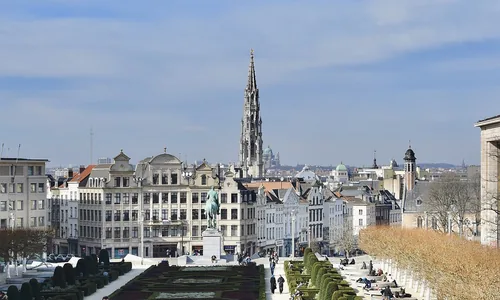
Brussels rewards visitors who look beyond its reputation as a bureaucratic capital. The historic center packs UNESCO-listed grandeur into the Grand Place, where guild houses compete for attention with gold leaf and baroque ornamentation. The Atomium rises from the northern suburbs as a relic of 1950s optimism, while Manneken Pis reminds everyone not to take the city too seriously. Art lovers find world-class collections at the Royal Museums of Fine Arts and the dedicated Magritte Museum. Art Nouveau architecture reaches its peak in Victor Horta's buildings, open for tours in the Horta Museum and the Comic Strip Center. The city's food culture ranges from chocolate shops in the Sablon to North African markets at Midi, with the Wednesday evening market at Place du Châtelain offering a social scene as much as a shopping opportunity. Parks provide green relief: the formal Brussels Park connects palace and parliament, while Bois de la Cambre extends ancient forest into the southern suburbs. The Marolles district preserves working-class character with its daily flea market, and hidden alleys like Rue de la Cigogne offer glimpses of the medieval city that survived the 19th-century demolitions. Brussels operates in multiple languages—Dutch, French, and increasingly English—reflecting its position at the crossroads of Europe. The European Parliament brings international institutions, but the city retains a distinctly Belgian sense of humor and a taste for the good life measured in beer, fries, and chocolate.

Must-See Attractions in Brussels

  • Grand Place - UNESCO World Heritage square with ornate guild houses
  • Atomium - 102-meter steel structure from the 1958 World's Fair
  • Manneken Pis - iconic small bronze statue embodying Brussels humor
  • Magritte Museum - world's largest collection of the surrealist's work
  • Horta Museum - Art Nouveau masterpiece by Victor Horta
🏛️ Must-See ⭐ Sights 💎 Hidden Gems 🎨 Museums 🍕 Food & Markets 🌳 Parks & Views

🏛️ Must-See Attractions in Brussels

These iconic landmarks and must-see sights are essential stops for any visitor to Brussels.

Atomium

1. Atomium

The Atomium rises from the Heysel plateau like a giant steel molecule caught mid-spin. Built for the 1958 World's Fair, this 102-meter structure represents an iron crystal magnified 165 billion times. Nine spheres connected by tubes form the iconic shape, with escalators running through the narrow connectors between them. The top sphere houses a restaurant with panoramic views stretching to the city center on clear days. Inside, exhibitions trace the history of the structure and the Expo that birthed it. The surrounding area includes Mini-Europe and the Bruparck entertainment complex. The Atomium captures Belgium's post-war optimism and its faith in science and progress. At night, the spheres light up in shifting colors, turning the structure into a beacon visible across the northern suburbs. It remains one of the most photographed landmarks in the country.
Hours Daily: 10:00 AM – 6:00 PM
Price €18
Website www.atomium.be/
Location 50.895, 4.34139
Insider TipBuy tickets online to skip the queue, and visit at sunset when the light hits the spheres from the west.
European Parliament

2. European Parliament

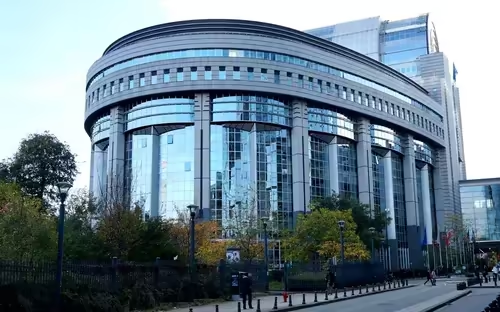
The European Parliament complex in Brussels represents the democratic voice of 450 million people across 27 countries. The glass-and-steel buildings of the Espace Léopold quarter house parliamentary committees, political groups, and the offices of 720 Members of the European Parliament. While full plenary sessions meet in Strasbourg, Brussels handles the bulk of legislative work. Visitors can tour the Hemicycle debating chamber, follow the parliamentary process through interactive exhibits, and attend sessions when parliament sits. The complex sits near Leopold Park, creating an odd juxtaposition of formal politics and leafy recreation. The Parliament's presence has transformed this corner of Brussels into a hub of international institutions, with lobbyists, journalists, and diplomats filling nearby cafes. The building's modern architecture contrasts sharply with the 19th-century townhouses that still surround it.

Hours Mon-Thu: 9:00 AM – 5:00 PM | Fri: 9:00 AM – 1:00 PM | Sat-Sun: Closed
Price Free
Location Maps
Insider TipRegister online for a free guided tour, or check the calendar to attend a live parliamentary session in the Hemicycle.
Grand Place

3. Grand Place

The Grand Place sits at the heart of Brussels like a jewel box of gold and stone. This UNESCO World Heritage square gathers some of the finest guild houses in Europe, their facades dripping with baroque ornamentation that catches the morning light. The Town Hall anchors the space with its Gothic tower rising 96 meters, while the King's House (Broodhuis) stands opposite with its stepped gables. Victor Hugo called it the most beautiful square in the world, and it is easy to see why. The cobblestones have witnessed centuries of history: Protestant martyrs burned here in 1523, the counts of Egmont and Hornes beheaded in 1568, and French artillery reducing most buildings to rubble in 1695. What you see today dates largely from the reconstruction that followed, when Brussels guilds competed to build the most impressive facades. Come early morning before the tour groups arrive, or return after dark when the buildings glow under floodlights.

Hours Open 24/7
Price Free
Insider TipVisit at 8 AM when the square is nearly empty, or catch the flower carpet event in August when the entire square gets covered in begonias.
Manneken Pis

4. Manneken Pis

A small bronze boy stands on a fountain corner near the Grand Place, forever urinating into the basin below. Manneken Pis measures just 55 centimeters tall, yet he has become the symbol of Brussels itself. The statue embodies the city's sense of humor—what locals call the zwanze—and their stubborn independence. The original, cast in 1619, now lives in the City Museum for safekeeping; the one you see is a copy. The little figure has survived theft, kidnapping by British soldiers, and countless costume changes. His wardrobe contains over 1,000 outfits, from Elvis costumes to traditional folk dress, changed several times a week according to a published schedule. Tourists crowd around him daily, some disappointed by his size, others charmed by his irreverence. He reminds visitors that Brussels does not take itself too seriously.

Hours Open 24/7
Price Free
Insider TipCheck the costume schedule online before visiting, and look for his lesser-known sister Jeanneke Pis nearby on Impasse de la Fidélité.
Royal Palace of Brussels

5. Royal Palace of Brussels

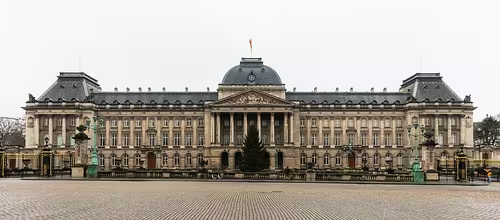
The Royal Palace faces Brussels Park with a neoclassical facade that stretches 50 percent longer than Buckingham Palace. Though the Belgian royal family lives at Laeken Castle, this building serves as their administrative headquarters and reception venue. Construction spanned from the Austrian period through 1934, resulting in interiors that mix neo-Louis XVI grandeur with earlier Dutch and Austrian elements. The throne room, the Empire room, and the marble room open to visitors during summer months. The palace sits opposite the Parliament building, a deliberate architectural statement about Belgium's constitutional monarchy. State rooms display tapestries, chandeliers, and furniture accumulated over centuries of royal history. The palace belongs not to the king but to the Belgian state, which makes it available for royal use. The changing of the guard ceremony draws crowds on summer afternoons.

Hours Tue-Sun: 10:30 AM – 5:00 PM (Jul-Sep only)
Price Free
Insider TipThe palace opens to visitors only from late July through September; arrive early in the morning to avoid lines.
Get Your Own Private Tour with AI Guide
AI Guide
  • Personalized tour tailored to your interests
  • Your AI guide tells stories, shares facts, and cracks jokes
  • Turn-by-turn GPS navigation
  • Available in your language — no download needed
Try for Free

💎 Hidden Gems in Brussels - Off the Beaten Path

Beyond the tourist crowds, Brussels hides remarkable treasures waiting to be discovered.

Bois de la Cambre

1. Bois de la Cambre

Bois de la Cambre extends the ancient Forest of Soignes right into the city, creating 122 hectares of woodland that feels miles from urban life. The park centers on a large lake where visitors can rent rowboats in summer or watch the Sunday parade of riders from the nearby equestrian club. Walking paths thread through beech and oak woods, some trees dating back centuries. The park attracts runners, cyclists, and families seeking fresh air without leaving Brussels. At the lake's center, a small island holds a mock-Gothic tower that once served as an observation point. The southern edge of the park touches the university district, while the northern end connects to the more formal Avenue Louise. On weekends, the main paths fill with strollers and cyclists, but quieter corners remain for those willing to venture deeper into the woods.

Hours Open 24/7
Price Free
Insider TipRent a rowboat on the lake in summer, or walk to the less crowded southern sections for a true forest experience.
Duden Park

2. Duden Park

Duden Park climbs a hillside in the commune of Forest, offering views across the Senne valley to the towers of central Brussels. The park covers 24 hectares of varied terrain, rising from 55 meters at its lowest point to 90 meters at the summit. An old castle from the Royal Donation now houses two of Belgium's oldest film schools, giving the park a creative atmosphere. The Stade Joseph Marien, home to Royale Union Saint-Gilloise football club, sits within the park boundaries and hosted Olympic events in 1920. Locals know Duden as a place for serious exercise: the steep paths challenge runners and cyclists, while the flat areas near the top suit more relaxed recreation. The park connects to the smaller Forest Park to the north, creating a green corridor through this residential neighborhood. It remains largely undiscovered by tourists.

Hours Open 24/7
Price Free
Location 50.817, 4.331
Insider TipClimb to the highest point for panoramic views of Brussels, or visit during a Union Saint-Gilloise match to experience local football culture.
Forest Park

3. Forest Park

Forest Park occupies 13 hectares on the slope above the Senne valley, entirely artificial yet convincingly natural. Unlike neighboring Duden Park, which follows the terrain's natural contours, Forest Park was constructed from scratch in the 19th century with imported earth, planted trees, and excavated ponds. The result feels like a piece of English countryside dropped into Brussels. Paths wind through varied landscapes: open lawns for picnics, wooded areas for shade, and a small lake with ducks and geese. The park sits on the border between Forest and Saint-Gilles, serving both residential communities. A bandstand hosts summer concerts, and the playground draws families on weekends. The park connects to Duden Park, allowing for long walks through green space without leaving the city. It remains a local secret, rarely appearing in guidebooks.

Hours Open 24/7
Price Free
Location 50.82278, 4.3375
Insider TipCombine with Duden Park for a longer walk, or bring a picnic to enjoy on the lawns near the lake.
La Fleur en Papier Doré

4. La Fleur en Papier Doré

The oldest pub in central Brussels occupies a narrow building on Rue des Alexiens, its walls soaked in centuries of conversation and smoke. La Fleur en Papier Doré opened around 1843 and became a gathering place for artists, writers, and revolutionaries. The Surrealists drank here, as did members of the CoBrA movement, leaving behind drawings and poems that still cover the walls. The name translates to The Golden Paper Flower, a reference to a historical event involving a paper flower and a romantic gesture. The interior remains deliberately unrenovated, with dark wood, low ceilings, and memorabilia accumulating in every corner. Regulars mix with curious tourists, and the atmosphere encourages lingering over a beer or jenever. The pub opens at noon and stays busy until closing, especially on weekends when the cramped space fills with conversation in multiple languages.

Hours Mon-Sat: 12:00 PM – 12:00 AM | Sun: 12:00 – 10:00 PM
Price $$
Insider TipOrder a jenever, the local spirit, and take time to read the inscriptions and drawings covering the walls.
Rue de la Cigogne

5. Rue de la Cigogne

A narrow alley barely 70 meters long, Rue de la Cigogne preserves a fragment of old Brussels that escaped the grand boulevards and urban renewal. The entrance on Rue Rempart des Monks passes through a stone gateway dated 1780, topped with a small shrine to Saint Roch that once protected against plague. The alley dead-ends at a locked gate, giving it the feel of a private courtyard. One house has been restored by artists and serves as an exhibition space, but the street otherwise retains its working-class character despite the gentrification of the surrounding Dansaert district. The name refers to a stork that once nested nearby. The alley offers a glimpse of how Brussels looked before the 19th-century demolitions, when narrow passages like this connected the dense network of streets within the city walls. Few tourists find their way here.

Hours Open 24/7
Price Free
Website N/A
Insider TipLook for the 1780 gateway with its Saint Roch shrine, and check if the artist house has an exhibition open to visitors.
Get Your Own Private Tour with AI Guide
AI Guide
  • Personalized tour tailored to your interests
  • Your AI guide tells stories, shares facts, and cracks jokes
  • Turn-by-turn GPS navigation
  • Available in your language — no download needed
Try for Free

🎨 Best Museums & Galleries in Brussels

World-class museums and galleries that make Brussels a cultural treasure.

Autoworld

1. Autoworld

Over 300 vehicles fill the vast southeast hall of the Cinquantenaire complex, tracing the history of the automobile from early steam carriages to modern sports cars. The collection emphasizes Belgian makes like Minerva and Imperia, luxury brands that once competed with Rolls-Royce. Several limousines from the royal family sit behind velvet ropes, including vehicles used for state occasions. The building itself, constructed for the 1880 exhibition, provides a grand setting with its arched roof and natural light. Temporary exhibitions rotate through the space, covering topics from racing history to concept cars. The museum appeals to serious car enthusiasts and casual visitors alike, with enough variety to hold interest across the collection. The sheer scale of the space, and the polished chrome reflecting from every angle, creates an atmosphere of industrial grandeur. Autoworld celebrates both the machine and the culture that grew around it.

Hours Mon-Fri: 10:00 AM – 5:00 PM | Sat-Sun: 10:00 AM – 6:00 PM
Price €17
Insider TipLook for the royal limousines and the collection of Belgian-made Minerva cars, and visit during special exhibitions for themed displays.
Belgian Comic Strip Center

2. Belgian Comic Strip Center

Belgium claims comic strips as high art, and this museum celebrates the medium in a building worthy of the subject. Victor Horta designed the former Waucquez textile store in 1906, creating one of his finest surviving commercial interiors with cast-iron columns and skylights. The museum opened in 1989, converting the space into galleries that trace the history of Belgian comics from Tintin and the Smurfs to contemporary artists. Original drawings, scripts, and models show how comic pages come together. The building itself competes for attention with the exhibits, as Horta's architecture demonstrates the same clarity and dynamism found in the best comic art. The museum shop stocks comics in multiple languages, and the restaurant occupies the former warehouse space. Belgium produces more comic artists per capita than any other country, and this museum explains why the form matters here.

Hours Mon: Closed | Tue-Sun: 10:00 AM – 6:00 PM
Price €12
Insider TipDon't miss the original Tintin drawings, and take time to appreciate the Horta architecture in the main hall.
Horta Museum

3. Horta Museum

Victor Horta's former home and studio in Saint-Gilles showcases the architect who defined Art Nouveau in Brussels. The building, constructed between 1898 and 1901, displays Horta's mastery of curved lines, natural forms, and innovative use of iron and glass. Every detail carries the Art Nouveau signature: whiplash curves in the banisters, floral mosaics on the floors, and stained glass that filters colored light into the interior. The house demonstrates how Horta designed not just buildings but complete environments, including furniture, textiles, and door handles. After falling into disrepair, the building was restored and opened as a museum in 1969. Visitors move through the living quarters, the studio where Horta worked, and the service areas that show how a bourgeois family lived at the turn of the century. The museum limits entry to small groups, preserving the intimate atmosphere of a private home.

Hours Mon: Closed | Tue-Fri: 2:00 – 5:30 PM | Sat-Sun: 11:00 AM – 5:30 PM
Price €14
Insider TipBook tickets in advance as entry is timed, and look closely at the door handles and light fixtures—Horta designed everything.
Magritte Museum

4. Magritte Museum

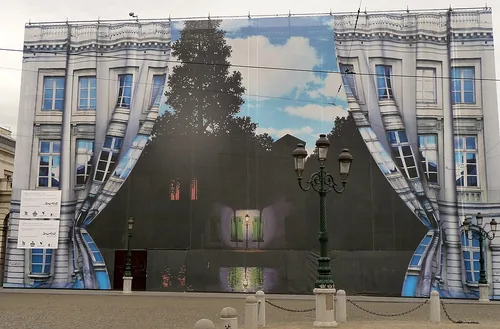
The world's largest collection of René Magritte's work occupies the Hôtel du Lotto, a neoclassical mansion on Place Royale. Over 200 paintings, drawings, and sculptures trace the surrealist's career from his early advertising work through his famous bowler-hat period to his later years. The museum opened in 2009 and immediately became one of Brussels' most popular attractions, drawing fans from around the world who come to see The Empire of Light and The Return. The collection includes personal photographs, letters, and even the artist's pipes and hats. Magritte lived most of his life in Brussels, and the museum captures his relationship with the city and its bourgeois conventions, which he so loved to subvert. Audio guides explain the symbolism and biographical context. The museum connects to the larger Royal Museums of Fine Arts complex but maintains its own distinct character.

Hours Mon: Closed | Tue-Fri: 10:00 AM – 5:00 PM | Sat-Sun: 11:00 AM – 6:00 PM
Price €10
Location 50.84242, 4.3588
Insider TipVisit on weekday mornings to avoid crowds, and look for the lesser-known early works that show Magritte's artistic development.
Musical Instrument Museum

5. Musical Instrument Museum

The Musical Instrument Museum occupies a spectacular Art Nouveau department store on Place Royale, its facade covered in gilded ironwork that catches the sun. Founded in 1877, the collection has grown to over 8,000 instruments from around the world, making it one of the largest of its kind. Visitors receive infrared headphones that automatically play recordings of the instruments they approach, creating an immersive experience as they move from African drums to Stradivarius violins to electronic synthesizers. The building, designed by Paul Saintenoy in 1899, features a rooftop restaurant with views across the city center. Four floors of galleries trace the history of musical instruments from ancient times to the present, with particularly strong collections of Belgian instruments and mechanical music devices. The museum attracts musicians, instrument makers, and curious visitors who leave with a new appreciation for how humans have made music.

Hours Mon: Closed | Tue-Fri: 9:30 AM – 5:00 PM | Sat-Sun: 10:00 AM – 5:00 PM
Price €15
Website www.mim.be/
Insider TipHave lunch or a drink at the rooftop restaurant for some of the best views in Brussels, and bring the infrared headphones throughout the entire visit.
Royal Belgian Institute of Natural Sciences

6. Royal Belgian Institute of Natural Sciences

Dinosaur skeletons dominate the main hall of this museum, drawing children and adults alike to gaze up at the massive bones. The institute houses one of the world's largest dinosaur collections, with 30 complete skeletons including several iguanodons discovered in Belgian coal mines in 1878. Beyond the dinosaurs, galleries cover minerals, insects, mammals, and human evolution. The museum also functions as a research institution, with scientists working behind the scenes on taxonomy, paleontology, and biodiversity studies. The building sits on the edge of Leopold Park, near the European Parliament, and attracts around 350,000 visitors annually. Interactive exhibits engage younger visitors while the scientific collections satisfy serious enthusiasts. The whale hall, with its suspended skeletons, creates a cathedral-like space that inspires awe. The museum balances entertainment with education, making it a favorite for families.

Hours Mon: Closed | Tue-Fri: 9:30 AM – 5:00 PM | Sat-Sun: 10:00 AM – 6:00 PM
Price €11
Insider TipGo straight to the dinosaur hall first before it fills with school groups, and don't miss the whale skeletons on the upper floor.
Royal Museum of the Armed Forces and Military History

7. Royal Museum of the Armed Forces and Military History

Aviation enthusiasts and history buffs find common ground in this massive museum occupying the northern wing of the Cinquantenaire complex. The collection spans twelve centuries of military history, from medieval armor to Cold War missiles. The aviation hall draws the most visitors, displaying over 130 aircraft including German World War I fighters, British Spitfires, and Belgian military planes. Tanks, artillery, and naval equipment fill other halls. The museum traces Belgium's often-tragic military history, from the colonial wars through two world wars to modern peacekeeping missions. The building itself, constructed for the 1880 anniversary exhibition, provides a grand setting with high ceilings and natural light streaming through arched windows. The museum became part of the War Heritage Institute in 2017, reflecting a shift toward understanding war's social impact rather than simply celebrating military achievements.

Hours Mon: Closed | Tue-Sun: 9:00 AM – 5:00 PM
Price €12
Website www.klm-mra.be/
Insider TipHead straight to the aviation hall on the upper floors, and climb to the top of the Cinquantenaire arch for panoramic views.
Royal Museums of Fine Arts of Belgium

8. Royal Museums of Fine Arts of Belgium

The Royal Museums of Fine Arts hold one of Europe's most underrated collections, spanning six centuries of painting and sculpture. The complex includes the Oldmasters Museum, the Magritte Museum, the Fin-de-Siècle Museum, and the Modern Museum, each occupying different wings of the neoclassical building on Place Royale. The Oldmasters collection features Flemish primitives including Rogier van der Weyden and Hans Memling, alongside Rubens and Bruegel. The Magritte Museum displays the world's largest collection of the surrealist's work. Together, the museums contain over 20,000 works, though only a fraction appears on the walls at any time. The building itself, designed in the early 20th century, provides a dignified setting with marble halls and skylit galleries. Visitors can easily spend a full day here, moving from medieval religious panels to abstract expressionism.

Hours Mon: Closed | Tue-Fri: 10:00 AM – 5:00 PM | Sat-Sun: 11:00 AM – 6:00 PM
Price €10
Insider TipBuy a combined ticket for all museums, and start with the Oldmasters collection before the crowds arrive.
Get Your Own Private Tour with AI Guide
AI Guide
  • Personalized tour tailored to your interests
  • Your AI guide tells stories, shares facts, and cracks jokes
  • Turn-by-turn GPS navigation
  • Available in your language — no download needed
Try for Free

🍕 Food Markets & Culinary Spots in Brussels

The best food markets, food halls, and culinary destinations in Brussels.

Foodmet

1. Foodmet

Foodmet occupies the modern hall at the center of the Anderlecht slaughterhouse complex, offering wholesale quantities of meat, fish, and produce to restaurants and serious home cooks. The market opens to the public on Thursday mornings and all day Friday through Sunday, when individual shoppers can browse the stalls alongside chefs placing orders for their kitchens. The scale impresses: whole fish laid out on ice, sides of beef hanging from hooks, crates of vegetables stacked to the ceiling. Prices run lower than retail markets, though quantities often require sharing with friends or freezing. The industrial setting, with concrete floors and high ceilings, keeps the focus on the merchandise. Foodmet represents the working side of Brussels' food culture, the supply chain that feeds the restaurants tourists visit. Visitors gain an appreciation for the scale of food distribution that supports a city of a million people.

Hours Mon-Wed: Closed | Thu: 8:00 AM – 2:00 PM | Fri-Sat: 7:00 AM – 2:00 PM | Sun: 7:00 AM – 2:30 PM
Price Free entry
Website N/A
Insider TipBring large bags and cash, and arrive early on Sunday morning when the selection is freshest and vendors are eager to sell.
Marché du Midi

2. Marché du Midi

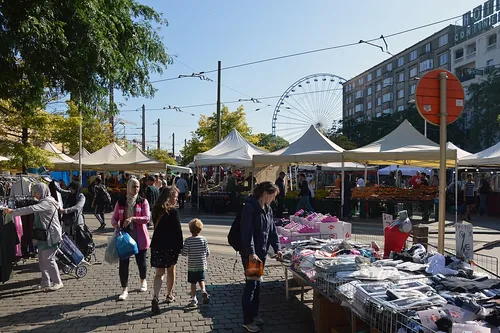
The Sunday market at Marché du Midi ranks among the largest in Europe, with vendors spreading across the square outside Brussels South Station. North African, Mediterranean, and African stalls dominate, selling fresh produce, spices, textiles, and prepared foods at prices lower than most city shops. The market opens early, with serious shoppers arriving before 8 AM for the best selection. By noon, the crowds thicken and bargaining becomes more difficult. Vendors call out their wares in French, Arabic, and Dutch, creating a babel of commerce that reflects Brussels' immigrant communities. The surrounding neighborhood has developed a distinctly North African character, with halal butchers and tea shops serving the market crowd. Sunday mornings here offer a completely different Brussels from the chocolate shops and beer bars of the Grand Place, revealing the city as a working port of entry for people and goods from across the Mediterranean.

Hours Sun: 6:00 AM – 1:00 PM
Price Free entry
Website N/A
Location 50.83737, 4.3395
Insider TipArrive before 9 AM for the best produce and easier bargaining, and bring cash as not all vendors accept cards.
Get Your Own Private Tour with AI Guide
AI Guide
  • Personalized tour tailored to your interests
  • Your AI guide tells stories, shares facts, and cracks jokes
  • Turn-by-turn GPS navigation
  • Available in your language — no download needed
Try for Free

🌳 Parks & Best Viewpoints in Brussels

Beautiful parks, gardens, and panoramic viewpoints for the best views of Brussels.

Brussels Park

1. Brussels Park

Brussels Park stretches between the Royal Palace and the Parliament building, a formal garden designed in the 1780s to link the new Place Royale with the existing palace complex. The neoclassical layout features symmetrical paths, statues of mythological figures, and a central fountain that serves as a meeting point. The park covers 13 hectares in the heart of the government district, surrounded by ministries and museums. Office workers lunch on benches during the week, while weekends bring families and tourists. The park has witnessed Belgian history: concerts, political rallies, and royal celebrations have filled its lawns. The allées provide shade in summer and turn golden in autumn. At night, the statues and pathways take on a romantic atmosphere, though the park officially closes at dusk. It functions as Brussels' front garden, a green space that connects the city's political and cultural institutions.

Hours Open 24/7
Price Free
Location 50.8446, 4.3637
Insider TipWalk through the park to connect the Royal Palace with the museums on Place Royale, or find a bench for lunch from a nearby sandwich shop.
Josaphat Park

2. Josaphat Park

Josaphat Park spreads across 20 hectares in the Schaerbeek commune, designed in 1904 by landscape architect Edmond Galoppin as a multi-purpose public space. The park contains a stadium, mini-golf course, municipal greenhouses, an archery range, a small zoo, and a chain of ponds connected by winding paths. Unlike the formal gardens of central Brussels, Josaphat follows English landscape principles with rolling terrain and varied plantings. The park grew in stages, with different areas added over decades, giving it a slightly eclectic character. Locals come for sports, picnics, and Sunday strolls, while the greenhouses display exotic plants year-round. Sculptures dot the landscape, and a former dairy building now serves as a cafe. Josaphat feels like several parks in one, with spaces for active recreation and quiet contemplation coexisting. It remains largely unknown to tourists, preserving an authentic neighborhood atmosphere.

Hours Daily: 7:30 AM – 10:00 PM
Price Free
Location 50.8625, 4.385
Insider TipVisit the municipal greenhouses for tropical plants, or bring sports gear for the mini-golf and archery range.
Leopold Park

3. Leopold Park

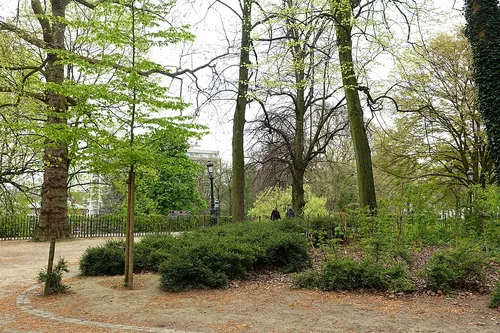
Leopold Park sits in the valley of the Maelbeek stream, a green oasis surrounded by the institutions of the European Union. The park predates the EU presence, created in the 19th century as part of a planned residential district. Today, the Natural History Museum and the European Parliament buildings share the space with lawns, ponds, and mature trees. The park connects to the larger Cinquantenaire grounds via a tree-lined avenue, creating a green corridor through the European quarter. Eurocrats walk here at lunch, speaking dozens of languages into their phones. The ponds attract ducks and the occasional heron, while the wooded areas provide shade on hot days. The park represents the overlap of local and European Brussels, a public space used by both residents and the international community that now dominates the neighborhood. It offers a peaceful escape from the glass office towers that surround it.

Hours Open 24/7
Price Free
Insider TipCombine with a visit to the Natural History Museum, or walk through on your way between the European Parliament and Cinquantenaire.
Parc d'Egmont

4. Parc d'Egmont

Parc d'Egmont offers a quiet retreat between the luxury shops of Avenue Louise and the European quarter, its 8 hectares of formal gardens and wooded areas largely ignored by tourists. The park surrounds the Egmont Palace, which houses the Belgian Foreign Ministry and hosts diplomatic receptions. The public areas include a rose garden, a pond with waterfowl, and tree-lined paths that fill with fallen leaves in autumn. The park closes at sunset, unlike many Brussels parks that stay open 24 hours. Office workers from nearby EU institutions lunch here in summer, spreading blankets on the grass. The formal entrance on Rue aux Laines features ornate gates that hint at the palace's diplomatic functions within. The park provides a transition between the commercial bustle of Louise and the institutional weight of the EU district, a space for breathing between meetings or shopping expeditions.

Hours Daily: 8:00 AM – 8:00 PM
Price Free
Insider TipBring a picnic lunch to enjoy on the lawns, or visit in May when the rose garden is in full bloom.
Get Your Own Private Tour with AI Guide
AI Guide
  • Personalized tour tailored to your interests
  • Your AI guide tells stories, shares facts, and cracks jokes
  • Turn-by-turn GPS navigation
  • Available in your language — no download needed
Try for Free

Explore with AI Guide

AI Guide App

Get personalized tours with our AI-powered guide. No download needed — works right in your browser.