Things to Do in Girona - Top Attractions, Hidden Gems & Must-See Sights

Discover the best things to do in Girona. Complete guide to must-see sights, popular attractions, hidden gems, museums, food markets and parks.

17 Attractions 6 Categories Travel Guide

Table of Contents

Girona Overview

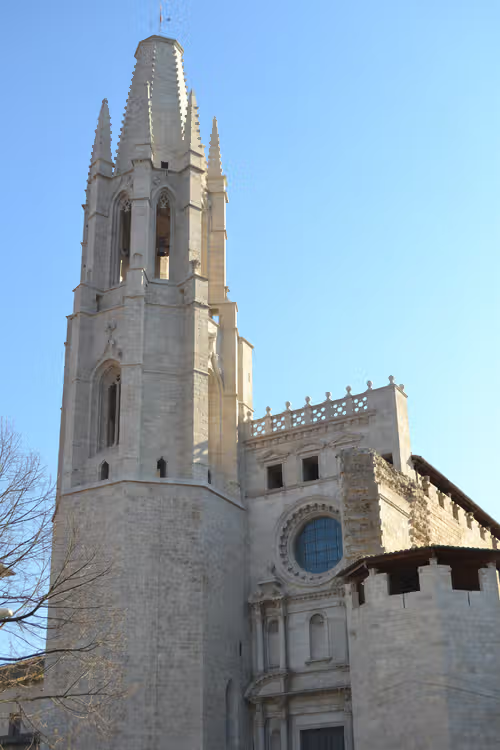
Girona feels like a fortress built into the hills, split by the Onyar River and its bright, hanging houses. The city is defined by its verticality; you’re constantly climbing stone steps or crossing metal bridges like the one designed by Gustave Eiffel. It’s small enough to explore entirely on foot, but the steep layout means you will want sturdy shoes for the walk up to the massive Girona Cathedral.

Beyond the Gothic spires, the narrow alleys of the old Jewish Quarter house the Museum of Jewish History, preserved with remarkable detail. For a better perspective, walk the Medieval City Walls at sunset. The elevated path runs from Torre Gironella along the eastern edge, providing a clear view over the terracotta rooftops toward the Pyrenees.

Must-See Attractions in Girona

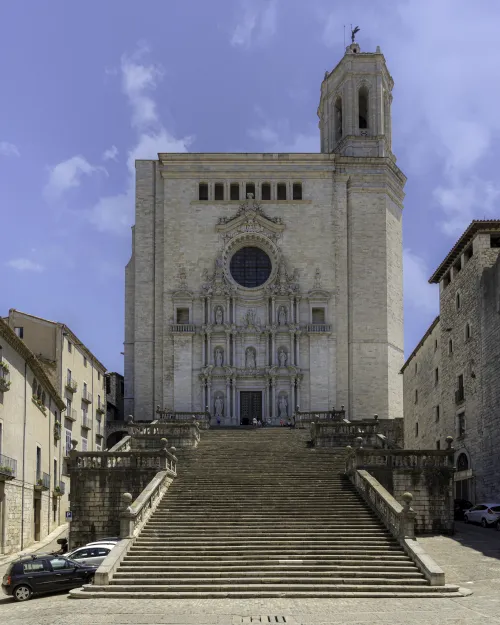
  • Girona Cathedral — A massive Gothic nave that dominates the skyline, reached by a wide flight of ninety stone steps.
  • Medieval City Walls — An elevated walkway offering views over the old town rooftops and the distant mountain ranges.
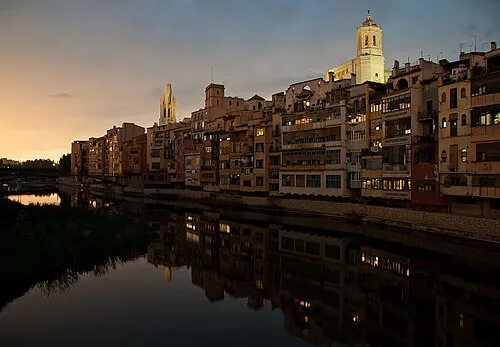
  • Onyar River Colorful Houses — Brightly painted facades that reflect in the water, best viewed from the red iron Eiffel Bridge.
  • Museum of Jewish History — Set within a former synagogue, this museum documents the complex history of the city's medieval Jewish community.
🏛️ Must-See ⭐ Sights 💎 Hidden Gems 🎨 Museums 🍕 Food & Markets 🌳 Parks & Views

🏛️ Must-See Attractions in Girona

These iconic landmarks and must-see sights are essential stops for any visitor to Girona.

Girona Cathedral

1. Girona Cathedral

Dominating the skyline, the Cathedral of Saint Mary is famous for a daring architectural gamble: it has the widest Gothic nave in the world. When you stand inside, the sheer emptiness of the space is disorienting. There are no columns breaking up the central area, just a single, massive stone vault stretching 23 meters across. Medieval architects were unsure if it would even stand, but it remains a testament to Catalan engineering audacity.

The approach is part of the experience. You climb the grand baroque staircase—90 steps that have appeared in major film productions—rising slowly towards the facade. Once inside, the contrast between the sun-baked stone outside and the cool, dark interior is sharp. Beyond the architecture, the treasury holds the Tapestry of Creation, an 11th-century embroidery that is as significant to textile history as the Bayeux Tapestry, depicting the genesis with rare Romanesque imagery.

Ranking high among Girona attractions, it commands attention from every angle of the city. However, do not just look up; look down at the floor tombs and the side chapels, which are often overlooked in favor of the nave. The cloister offers a different mood entirely, with trapezoidal shapes and carved capitals that tell biblical stories with surprising humor and monstrosity.

Hours Mon-Fri: 10:00 AM – 4:30 PM | Sat: 10:00 AM – 5:00 PM | Sun: 12:00 – 4:30 PM
Price €4
Location 41.9875, 2.82639
Insider TipThe audio guide is included in the price and is excellent; listen to track 12 about the 'Witch of the Cathedral' gargoyle before looking for it on the exterior.
Medieval City Walls

2. Medieval City Walls

The Passeig de la Muralla offers the best views in the city, period. These reconstructed Carolingian walls encircle the eastern side of the old town, allowing you to walk above the rooftops with the Pyrenees visible in the distance on a clear day. It is a physical experience; the path involves stairs, uneven stones, and changing elevations. You are walking the defensive spine of the city, looking down into the private gardens and courtyards that remain invisible from the street level.

The route is interrupted by watchtowers that you can climb for even higher vantage points. From up here, you see the distinct layout of the city: the chaotic, organic medieval quarter on one side and the orderly expansion on the other. It is exposed to the elements, so the sun can be brutal in the middle of the day, but the breeze is constant. It is a linear park in the sky, free to access and open to anyone willing to tackle the stairs.

While most lists of Girona attractions prioritize the churches, the walls give you the geography of the place. You can walk almost the entire length of the old quarter, exiting at various points if you get tired. It connects the Jardins dels Alemanys at the top with the Plaça de Catalunya at the bottom, acting as a scenic highway for pedestrians.

Hours Daily: 8:00 AM – 9:00 PM
Price Free
Location Maps
Insider TipStart at the Jardins dels Alemanys (high point) and walk down towards Plaça de Catalunya to save your knees and avoid a sweaty uphill hike.
Onyar River Colorful Houses

3. Onyar River Colorful Houses

These facades are the image of Girona. Hanging over the Onyar River, the houses form a patchwork of warm colors—ochre, sienna, copper, and cream—that reflect in the water below. Unlike the grey stone of the medieval quarter behind them, these buildings are Mediterranean and bright. They were built over the centuries on the remains of the old city wall, which explains why they seem to grow directly out of the riverbed without a bank or walkway in front of them.

You cannot enter these houses as they are private residences, but you can admire them from the city's bridges. The view changes with the weather and the water level. On a calm day, the reflection is mirror-perfect; after rain, the river rushes brown and fast, changing the mood entirely. The famous 'Casa Masó' is the only one painted white, standing out among the earth tones, and is the birthplace of the architect Rafael Masó.

While they are the most photographed of all Girona attractions, they are best appreciated as a texture rather than a single monument. They act as the colorful skin of the city. Crossing the Stone Bridge (Pont de Pedra) or the Eiffel Bridge gives you the best vantage points to see the gentle curve of the river and the way the buildings jostle for space.

Hours Open 24/7
Price Free
Location 41.9844, 2.82402
Insider TipFor the best photo, stand on the Pont de Sant Agustí rather than the Eiffel Bridge; the angle includes the Cathedral tower in the background.
Get Your Own Private Tour with AI Guide
AI Guide
  • Personalized tour tailored to your interests
  • Your AI guide tells stories, shares facts, and cracks jokes
  • Turn-by-turn GPS navigation
  • Available in your language — no download needed
Try for Free

💎 Hidden Gems in Girona - Off the Beaten Path

Beyond the tourist crowds, Girona hides remarkable treasures waiting to be discovered.

Passeig Arqueològic

1. Passeig Arqueològic

This promenade offers a quieter, greener alternative to the high city walls. It runs along the base of the fortifications, sandwiching you between the ancient stone defenses and the landscaped gardens that slope down towards the river Galligants. It is a path of shadows and stone, lined with cypress trees and ruins. The walkway connects the Cathedral area to the northern end of the old town, serving as a scenic connector that feels removed from the commercial bustle.

The route is scattered with archaeological fragments and quiet corners where you can sit. It feels more like a garden than a street. You pass the rear of the Cathedral, seeing the apse and the 'Charlemagne Tower' from a perspective that emphasizes their fortress-like construction. The path is relatively gentle compared to the stairs of the wall walk, making it a more accessible stroll for those with tired legs.

As a component of the broader Girona attractions, it offers atmosphere rather than specific exhibits. It is about the smell of pine, the texture of the old stones, and the lack of crowds. In the heat of summer, the high walls provide welcome shade for much of the day, making it a strategic route for crossing the city without melting.

Hours Open 24/7
Price €2
Website N/A
Location 41.9878, 2.82645
Insider TipLook for the small gate that leads into the 'Jardins dels Alemanys' near the top; it is often unlocked and leads to beautiful ruins used for outdoor concerts.
Torre Gironella

2. Torre Gironella

At the very highest point of the old city, behind the Cathedral and the gardens, lie the ruins of the Torre Gironella. This was once the citadel, the last line of defense for the Roman, and later medieval, city. Today, it is a ruin that offers a raw look at the destruction caused by centuries of sieges, particularly the Napoleonic attacks. It is not a polished monument; it is a broken tower surrounded by rubble and wildflowers.

The climb up here is steep, but the reward is a view that stretches over the entire valley. It is quiet, often empty, and feels removed from the tourist circuit below. You can see the layers of construction where the walls were patched up after each war. It sits within the Jardins dels Alemanys (German Gardens), named after the German mercenaries who were stationed here in the 19th century.

Among Girona attractions, this is for the contemplative traveler. It is the end of the line, the highest stone. It marks the point where the city stopped and the wild began. There is a melancholy beauty to the shattered walls that contrasts with the restored perfection of the Cathedral down the hill.

Hours Open 24/7
Price Free
Website N/A
Insider TipThis is the best spot for a sunset picnic; bring supplies from the market, as there are no cafes or vending machines this high up.
Get Your Own Private Tour with AI Guide
AI Guide
  • Personalized tour tailored to your interests
  • Your AI guide tells stories, shares facts, and cracks jokes
  • Turn-by-turn GPS navigation
  • Available in your language — no download needed
Try for Free

🎨 Best Museums & Galleries in Girona

World-class museums and galleries that make Girona a cultural treasure.

Cinema Museum

1. Cinema Museum

This is not just a rainy-day backup plan; it is one of the most comprehensive collections of pre-cinema history in Europe. Housed in the former Casa de les Aigües, the museum tracks the human obsession with moving images long before Hollywood existed. You start with shadow puppets and camera obscuras, moving through magic lanterns and zoetropes. The sheer mechanical ingenuity on display is fascinating, showing how inventors spent centuries trying to trick the human eye into seeing motion.

The collection, amassed by filmmaker Tomàs Mallol, is dense with objects. You are not just looking at screens; you are looking at the brass, wood, and glass machinery that paved the way for modern visual culture. It is tactile and surprisingly engaging even if you are not a film buff. The layout guides you chronologically, and by the time you reach the Lumière brothers and the first actual films, you understand the magnitude of that technological leap in a way that reading a textbook cannot convey.

If you have worked your way through the heavier historical Girona attractions, this offers a refreshing shift in focus. It is interactive enough to keep teenagers interested but detailed enough for serious history fans. The final sections cover amateur cinema and the evolution of the camera, reminding us that the urge to document our lives is nothing new.

Hours Mon: Closed | Tue-Sat: 10:00 AM – 6:00 PM | Sun: 10:00 AM – 2:00 PM
Price €4
Insider TipYour ticket is valid all day, so you can visit the morning exhibitions, go for lunch, and come back for the temporary displays without paying twice.
Girona Art Museum

2. Girona Art Museum

Located right next to the Cathedral in the former Episcopal Palace, this museum holds one of the most significant collections of Romanesque and Gothic art in the region. The building itself is part of the draw, with its heavy stone arches and courtyard stairs that feel like a fortress. Inside, the collection is intense and theological, filled with wooden sculptures, altar frontals, and liturgical objects that demonstrate the massive wealth and power of the church in this corner of Catalonia.

You do not need to be an art historian to appreciate the sheer craftsmanship of the medieval pieces. The detail in the 12th-century beam of the Cruïlles Monastery or the famous Martyrology of Usuard is staggering. The layout moves chronologically, eventually leading to 19th and 20th-century Catalan art, but the medieval sections are the heavyweight champions here. It is quieter than the Cathedral next door, allowing you to examine the works without being jostled by tour groups.

For travelers exploring Girona attractions, this museum provides the necessary context for the stone walls you see outside. It explains the visual language of the city's past. The Throne Room, used by the bishop to receive guests, is particularly imposing, reminding you that for centuries, the church was the governing authority here.

Hours Mon: Closed | Tue-Sat: 10:00 AM – 6:00 PM | Sun: 10:00 AM – 2:00 PM
Price €5
Insider TipBuy the 'Episcopal' combined ticket which includes the Cathedral, the Art Museum, and the Church of Sant Feliu to save about 30% compared to individual entries.
Girona City History Museum

3. Girona City History Museum

Housed in a sturdy 18th-century convent that was once a gothic mansion, this museum tells the story of the city from its Roman foundation to the present day. It is a dense, layered experience that rewards those who want to understand why Girona looks the way it does. You walk through rooms that cover the sieges, the industrialization, and the daily life of the citizens who built these walls. The building itself, with its cistern and remains of the cemetery of the convent of Sant Antoni, is a primary exhibit.

The collection is eclectic, featuring everything from Roman mosaic floors to the mechanism of the old city clock. It connects the dots between the different eras, explaining how a Roman fortress evolved into a medieval powerhouse. One particularly interesting section is dedicated to the 'Sardana', the Catalan national dance, grounding the history in local culture. It avoids the trap of being a dusty collection of pots by focusing on the narrative of the city's survival.

If you are checking off Girona attractions, this is the place to start your day. It gives you the timeline you need to make sense of the streets outside. The exhibits on the Napoleonic sieges are particularly gripping, detailing the suffering and resilience of the population during the 'Guerra del Francès'.

Hours Mon: Closed | Tue-Sat: 10:30 AM – 5:30 PM | Sun: 10:30 AM – 1:30 PM
Price Free
Insider TipLook for the room with the 'Vampire of Girona' legend—it offers a break from the dry history and explains some of the local superstition.
Museum of Jewish History

4. Museum of Jewish History

Located in the heart of the Call, Girona's medieval Jewish quarter, this museum does not just display artifacts; it reclaims a lost memory. For centuries, this network of streets was home to a thriving community and a major center of Kabbalistic study, until the expulsion in 1492. The museum occupies the site of the former synagogue and butcher shop, navigating the difficult history of coexistence, persecution, and eventual exile. The exhibits are somber and text-heavy, requiring you to slow down and read.

The collection includes gravestones, contracts, and everyday objects that humanize the history. It explains the specific contributions of Jewish scholars in Girona to science, philosophy, and astronomy. The courtyard is a standout feature—a peaceful, stone-enclosed patio with a Star of David inlay that invites reflection. It contrasts sharply with the narrow, dark alleys of the Call outside.

As one of the most poignant Girona attractions, it provides the missing piece of the city's identity. You cannot fully understand the labyrinthine streets of the old town without understanding the people who built and lived in them. It avoids melodrama, presenting the facts of the diaspora with dignity and academic rigor.

Hours Mon: 10:00 AM – 2:00 PM | Tue-Sat: 10:00 AM – 6:00 PM | Sun: 10:00 AM – 2:00 PM
Price Free
Insider TipVisit the 'Nahmanides' room to understand the Bonastruc ça Porta dispute; it gives crucial context to the theological debates that happened right in these streets.
Get Your Own Private Tour with AI Guide
AI Guide
  • Personalized tour tailored to your interests
  • Your AI guide tells stories, shares facts, and cracks jokes
  • Turn-by-turn GPS navigation
  • Available in your language — no download needed
Try for Free

🍕 Food Markets & Culinary Spots in Girona

The best food markets, food halls, and culinary destinations in Girona.

Mercat del Lleó

1. Mercat del Lleó

This is the working stomach of Girona. While tourists flock to the restaurants, locals are here at the Lion Market buying the raw ingredients. It is a covered market hall from the 1940s, functional and loud, filled with the smell of fresh fish, cured meats, and earth. The stalls are run by families who have often been there for generations, and the produce reflects the season strictly. You will see mounds of wild mushrooms in autumn and local artichokes in winter.

It is not a sanitised food court; it is a place of commerce. You watch grandmothers negotiating the price of cod and chefs from the city's high-end restaurants picking out vegetables. The energy is distinct from the slow pace of the old town. Here, everything is urgent and fresh. There are a few bars inside serving coffee and breakfast, where you can stand at the counter and watch the market wake up.

For travelers tired of standard Girona attractions, this offers unfiltered reality. It sits just outside the historic center, marking the transition to the modern city. Grab some local *fuet* (cured sausage), cheese, and bread here, then head to the nearby park for a lunch that costs a fraction of a restaurant meal and tastes twice as good.

Hours Mon-Sat: 7:00 AM – 2:00 PM | Sun: Closed
Price Free
Location 41.9794, 2.82259
Insider TipGo to the stall 'El Petit Obrador' for their homemade croquettes; they are ready to eat and make for the perfect walking snack.
Get Your Own Private Tour with AI Guide
AI Guide
  • Personalized tour tailored to your interests
  • Your AI guide tells stories, shares facts, and cracks jokes
  • Turn-by-turn GPS navigation
  • Available in your language — no download needed
Try for Free

🌳 Parks & Best Viewpoints in Girona

Beautiful parks, gardens, and panoramic viewpoints for the best views of Girona.

Devesa Park

1. Devesa Park

When the stone walls of the old quarter start to feel claustrophobic, this massive urban park is where you find air to breathe. It is the largest urban park in Catalonia, defined by more than 2,500 plane trees that grow unusually tall and narrow, creating a high, leafy cathedral ceiling that blocks out the summer intensity. Locals use this space as their backyard—joggers, dog walkers, and families occupy the wide dirt avenues that stretch between the rivers Ter, Onyar, and Güell.

The scale here is what surprises most visitors. It is not a manicured garden with flower beds; it is a forest grid planted in the 19th century. In autumn, the floor turns into a crunching carpet of leaves, and in summer, the shade reduces the ambient temperature noticeably. It sits just across the river from the historic center, acting as a natural buffer zone between the tourist circuit and the modern city.

While it might not be the first stop on a list of standard Girona attractions, it is essential for pacing your trip. After a morning of climbing cathedral stairs and ramparts, bringing a sandwich here offers a necessary reset. The park also hosts the weekly market, transforming the quiet avenues into a chaotic, noisy mix of shouting vendors and bargaining shoppers twice a week.

Hours Open 24/7
Price Free
Website N/A
Location 41.98694, 2.8175
Insider TipOn Tuesdays and Saturdays before 1:00 PM, the park hosts a huge market; go for cheap fruit and clothes, or avoid it completely if you want peace and quiet.
Parc del Migdia

2. Parc del Migdia

If Devesa is the forest, Parc del Migdia is the lawn. Located in the Eixample district, south of the old center, this is where the modern city lives. It is a large, open space centered around an artificial lake, surrounded by grass that is actually meant for sitting. You will not find many tourists here; instead, you will find students, office workers on lunch breaks, and parents pushing strollers. It is the functional green lung for the residents who live in the apartment blocks nearby.

The park features a cafe under a distinctively curved roof, which is a popular spot for a mid-afternoon coffee or beer. The design is contemporary, contrasting with the historic weight of the old town. There are remnants of an old barracks here, integrating the military history of the site into a leisure space. It is flat, accessible, and unpretentious.

For those exhausting the list of historic Girona attractions, this park offers a glimpse of normal, daily life. It is a good place to let kids run loose without worrying about traffic or crowds. The walk here takes you through the commercial shopping streets, showing you the Girona that exists outside the medieval walls.

Hours Open 24/7
Price Free
Website N/A
Insider TipThe cafe 'El Doll' inside the park is surprisingly good and affordable; it's a perfect spot to sit for an hour with a book while the city moves around you.
Get Your Own Private Tour with AI Guide
AI Guide
  • Personalized tour tailored to your interests
  • Your AI guide tells stories, shares facts, and cracks jokes
  • Turn-by-turn GPS navigation
  • Available in your language — no download needed
Try for Free

Explore with AI Guide

AI Guide App

Get personalized tours with our AI-powered guide. No download needed — works right in your browser.