Things to Do in Lisbon - Top Attractions, Hidden Gems & Must-See Sights

Discover the best things to do in Lisbon. Complete guide to must-see sights, popular attractions, hidden gems, museums, food markets and parks.

40 Attractions 6 Categories Travel Guide

Table of Contents

Lisbon Overview

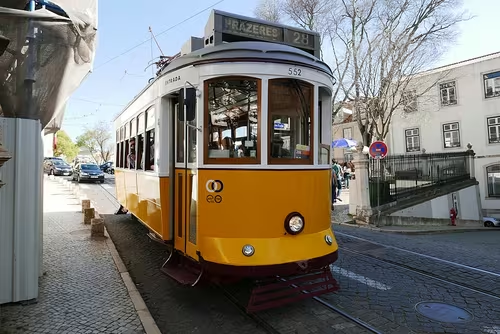
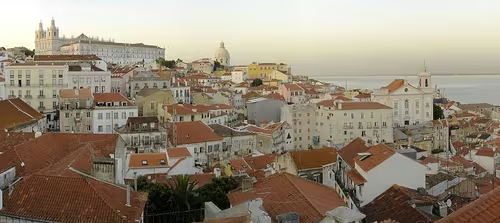
Lisbon's identity is defined by its steep, seven hills and the Atlantic light reflecting off limestone pavements. While the yellow Tram 28 rattles through the narrow alleys of Alfama and Mouraria, the city feels both ancient and experimental. You'll find 16th-century Manueline architecture at the Jeronimos Monastery and Belem Tower, contrasted with the industrial-cool galleries of the LX Factory.

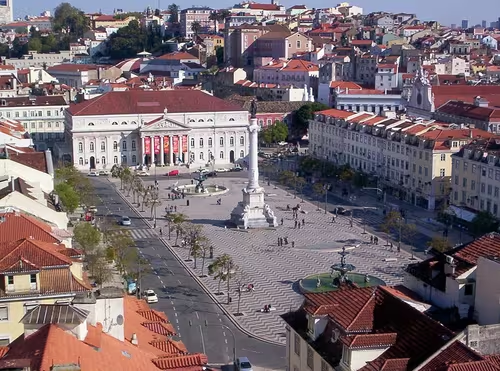
Navigating the city requires strong legs, as the verticality is constant and the pavements can be slippery. Miradouros like Senhora do Monte offer wide views across orange rooftops toward the Sao Jorge Castle. Between the hilltop viewpoints, life centers on squares like Praca do Comercio. It's a city of sharp inclines and sudden openings, where the smell of grilled sardines meets the modernist MAAT museum on the Tagus shore.

Must-See Attractions in Lisbon

  • Sao Jorge Castle — Moorish fortification providing the highest vantage point over the city's historic core and the Tagus River.
  • Jeronimos Monastery — Elaborate Manueline monastery in Belem that serves as the final resting place of explorer Vasco da Gama.
  • Tram 28 — Vintage wooden streetcar that navigates the steepest, narrowest streets between Estrela and the old Alfama district.
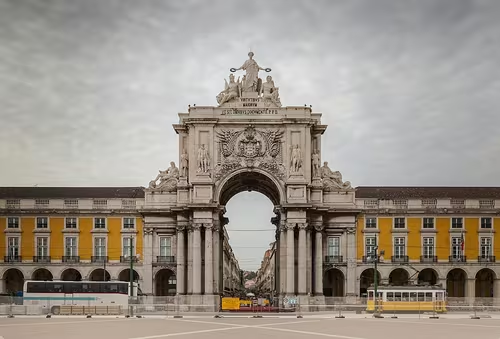
  • Praca do Comercio — Grand, riverside square framed by yellow arcades that once served as the formal gateway for seafaring trade.
  • Time Out Market — High-end food hall in the Cais do Sodre district where local chefs serve regional Portuguese specialties.
🏛️ Must-See ⭐ Sights 💎 Hidden Gems 🎨 Museums 🍕 Food & Markets 🌳 Parks & Views

🏛️ Must-See Attractions in Lisbon

These iconic landmarks and must-see sights are essential stops for any visitor to Lisbon.

Belem Tower

1. Belem Tower

Sitting in the river like a stone chess piece, this fortification has guarded the harbor entrance since the age of wooden caravels. The exterior is a riot of carved rope, armillary spheres, and rhinoceros heads, detailing the era when Portugal traded with the world. Tides rise and fall around its base, sometimes cutting off the walkway and reminding visitors that this was originally built on an island, not the riverbank.

Inside, the reality is starker: empty stone chambers, narrow spiral staircases, and often a crush of visitors trying to navigate the tight spaces. The queue to enter can stretch for hours in the sun, which often leads to disappointment for those expecting a furnished palace. The true value lies in its external silhouette and the history it represents rather than the bare interior rooms.

As one of the most recognizable Lisbon attractions, it demands a decision: wait in line for the view from the terrace, or admire it from the park with a gelato in hand. Most find that walking around the perimeter at low tide provides the best connection to its maritime purpose without the stress of the queue.
Hours 10am-5:30pm (closed Mon)
Price €8
Insider TipSkip the long line to go inside; the interior is empty and cramped. Instead, view it from the water on a cheap river ferry or a sailboat tour for the most majestic angle.
Jeronimos Monastery

2. Jeronimos Monastery

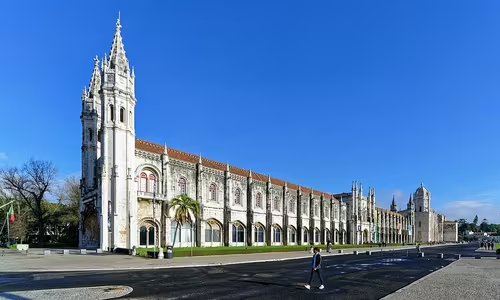
White stone carved into ropes, corals, and sea monsters defines this masterpiece of Manueline architecture. It stretches along the riverfront, a massive testament to the wealth that poured into Portugal during the Age of Discovery. The cloisters are the highlight, a two-story fantasy of honey-colored stone that glows warmly in the sunlight, with every column featuring unique nautical motifs.

The church inside is free to enter and holds the tomb of Vasco da Gama, resting on stone lions. The columns in the nave soar upward like palm trees, branching out into a vaulted ceiling that defies gravity. It is grand, imposing, and undeniably crowded, as it serves as the primary pilgrimage site for history lovers.

As one of the most visited Lisbon attractions, the line here is notorious. However, the scale of the building manages to absorb the crowds once you are inside the open courtyard. It connects directly to the maritime history of Belém, standing where sailors once prayed before facing the unknown ocean.

Hours Mon: Closed | Tue-Sun: 9:30 AM – 5:30 PM
Price €18
Insider TipIf you have the Lisboa Card, do not join the main ticket line; look for the separate, much shorter line for pass holders to the left of the main entrance.
Lisbon Cathedral

3. Lisbon Cathedral

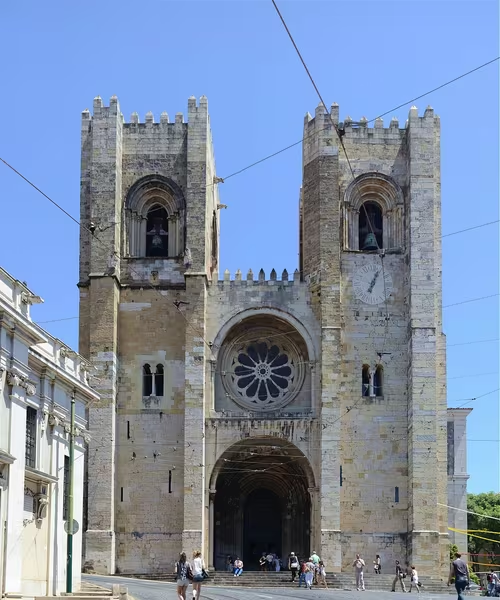
Known simply as the Sé, this fortress-like church has survived earthquakes and sieges since the 12th century. Its two castellated towers look more like a castle than a place of worship, reflecting its history as a defensive structure during uncertain times. The interior is dark and austere, stripped of much decoration by disasters and renovations, leaving a somber, Romanesque weightiness.

The rose window admits a colored light that breaks the gloom, highlighting the simple stone arches. It sits on a sharp bend in the road where the yellow trams screech past, creating the classic postcard image of the city. Behind the altar, the ambulatory contains several Gothic tombs and an excavated cloister revealing Roman and Moorish ruins beneath the foundations.

While exploring Lisbon attractions in Alfama, this is the anchor. It marks the transition from the downtown Baixa to the hill of the castle. It is worth a quick stop to feel the age of the city, even if you do not explore the paid sections like the treasury.

Hours Mon-Sat: 10:00 AM – 6:00 PM | Sun: Closed
Price €5
Insider TipThe cloister entrance fee is worth it to see the archaeological dig; you can see Roman street levels and shop foundations right under the medieval church.
Praca do Comercio

4. Praca do Comercio

Vast and open to the river, this square was the royal entrance to the city before the palace was destroyed. Bright yellow buildings with arcades surround three sides, while the fourth opens to the Tagus. In the center, King José I rides his horse, indifferent to the tourists and pigeons beneath him. It is one of the largest squares in Europe, designed to impress visitors arriving by boat.

The "Cais das Colunas," two marble columns rising from the water, marks the spot where dignitaries once disembarked. Today, people sit on the steps watching the ferries and the sunset. The restaurants under the arches are pricey, but the atmosphere of the square itself is free and grand.

This is the definitive starting point for exploring Lisbon attractions. It connects the river to the downtown grid through the triumphal arch. Whether filled with a concert crowd or empty at dawn, the sheer scale of the space commands respect.

Hours Open 24/7
Price Free
Insider TipSkip the restaurants on the square itself (tourist prices); instead, go to the Wines of Portugal tasting room in the western arcade for great wine by the glass at fair prices.
Sao Jorge Castle

5. Sao Jorge Castle

Walls of golden stone crown the highest hill, visible from almost everywhere in the city. This was a Moorish fortress, a royal palace, and a military barracks before becoming the monument it is today. The ramparts offer a walk along the battlements with a 360-degree view that is unmatched; the city spills away from your feet in every direction.

Inside, the grounds are surprisingly peaceful, filled with pine trees and a colony of peacocks that scream from the rooftops. There is little in the way of furnished rooms; the attraction is the structure itself and the archaeological site revealing layers of history from the Iron Age to the Islamic period. It feels like a park in the sky.

No tour of Lisbon attractions is complete without this lookout. It provides the context for the entire city layout. Sunset is particularly magical, as the sun drops behind the hills and the river glows, though they may close the gates before the final light in summer.

Hours Daily: 9:00 AM – 6:00 PM
Price €15
Insider TipThe line for tickets can be huge. Buy your ticket online in advance to skip the queue, or visit late in the afternoon when the morning rush has cleared.
Tram 28

6. Tram 28

This yellow wooden carriage is a time machine that shrieks and rattles through streets too narrow for buses. It climbs impossible gradients, brushes past walls, and offers a rolling tour of the city's most historic districts: Graca, Alfama, Baixa, and Estrela. The interior features polished wood, brass dials, and leather seats, smelling of electricity and old varnish.

It is technically public transport, but in reality, it is a moving attraction. The ride is jerky and often packed tight, but the views out the window are unbeatable. It connects the hills, saving your legs from the brutal climbs while providing a cinematic experience of the street life.

Listing Lisbon attractions without the number 28 is impossible. However, it is a victim of its own success. The queues at the starting points are long, and pickpockets are professional and present. Treat it as a ride, not a commute.

Hours 6am-10:30pm
Price €3.10
Website www.carris.pt/
Insider TipBoard at the Campo de Ourique terminus (Prazeres cemetery) instead of Martim Moniz; you are much more likely to get a seat and the line is shorter.
Get Your Own Private Tour with AI Guide
AI Guide
  • Personalized tour tailored to your interests
  • Your AI guide tells stories, shares facts, and cracks jokes
  • Turn-by-turn GPS navigation
  • Available in your language — no download needed
Try for Free

💎 Hidden Gems in Lisbon - Off the Beaten Path

Beyond the tourist crowds, Lisbon hides remarkable treasures waiting to be discovered.

Basilica da Estrela

1. Basilica da Estrela

A massive white dome marks the skyline of western Lisbon, visible from across the city but best appreciated up close where the twin bell towers loom over the square. The interior uses grey and pink marble in geometric patterns that create a cool, echoing grandeur, quite different from the gilded wood found in older churches. It stands as a late baroque promise fulfilled by Queen Maria I, whose tomb rests inside, forever watching over the space she commissioned.

Opposite the entrance, the tram tracks curve sharply, often creating a photogenic moment as the yellow carriage passes the white stone facade. Visitors can climb to the roof for a perspective that differs from the castle or river viewpoints; here, you look out over the prosperous Lapa district and the bridge. It feels removed from the tourist center, serving a quieter, wealthier residential area.

If you are checking off Lisbon attractions on the famous Tram 28 route, this is the perfect place to hop off. The church provides a moment of architectural awe, while the garden across the street offers an immediate, leafy counterpoint to the stone monument.

Hours Daily: 9:00 AM – 7:45 PM
Price Free
Insider TipPay the small fee to climb to the dome (zimbório); the walkway allows you to look down into the church nave from high above before stepping out for the city view.
Feira da Ladra

2. Feira da Ladra

Translating to the "Thief's Market," this twice-weekly sprawl of blankets and tables covers the Campo de Santa Clara with organized chaos. Vendors sell everything from chipped tiles and vintage cameras to used clothes and unidentifiable rusty metal. It is not a polished antique fair; it is a gritty, genuine flea market where digging through piles is part of the process.

The atmosphere is relaxed, with locals sipping beer at kiosks while haggling over prices. Behind the stalls, the dome of the National Pantheon provides a monumental backdrop to the commerce of small things. You might find a treasure worth hundreds or just walk away with a strange old postcard, but the hunt is the entertainment.

Unlike other polished Lisbon attractions, this market offers a slice of unfiltered local life. It operates only on Tuesdays and Saturdays, so timing is key. Even if you buy nothing, the visual texture of thousands of random objects laid out on the cobblestones is a photographer's dream.

Hours Mon: Closed | Tue: 9:00 AM – 5:00 PM | Wed-Fri: Closed | Sat: 9:00 AM – 6:00 PM | Sun: Closed
Price Free
Insider TipArrive by 9:00 AM for the best items; by 11:00 AM the tourists arrive and prices go up. Bargaining is expected, but be polite.
Jardim do Torel

3. Jardim do Torel

Hidden on a hilltop that most tourists never climb, this garden feels like a private balcony for the neighborhood. It looks west, meaning the view captures the downtown valley and the opposite hill of Bairro Alto bathed in afternoon sun. The atmosphere is resolutely local, with students reading on the grass and residents walking dogs, far removed from the tuk-tuks of the main viewpoints.

The lower terrace features a shaded cafe and a fountain that sometimes turns into a makeshift swimming pool for kids in August. It offers a quieter, greener alternative to the crowded famous miradouros. The incline to get here is steep, which naturally filters out the casual crowds.

Searching for peaceful Lisbon attractions often leads here. It is a perfect spot to watch the sunset without fighting for elbow room. The perspective allows you to see the city's geography clearly, tracing the line of the Avenida da Liberdade below.

Hours Daily: 8:00 AM – 8:00 PM
Price Free
Insider TipTake the Lavra Funicular (the oldest in the city) up from the street below; it drops you just a short walk away, saving your legs from the brutal climb.
LX Factory

4. LX Factory

An abandoned industrial complex under the bridge has been reborn as a village of creativity, filled with advertising agencies, quirky shops, and restaurants. The walls are covered in large-scale street art, and the vibe is intentionally unfinished and raw. It feels disconnected from the tile-and-stone aesthetic of the rest of the city, offering a gritty, Brooklyn-style alternative.

Weekends bring a street market where artisans sell handmade jewelry and vintage clothes along the main cobblestone strip. You can eat Mexican tacos, drink craft beer, or browse one of the most beautiful bookstores in the country, which occupies an old printing press space. The energy is young and design-focused.

For travelers tired of churches and palaces, this is one of the refreshing Lisbon attractions. It is a place to hang out rather than sightsee. The rumble of trains passing overhead on the bridge adds to the urban, rhythmic atmosphere that defines the space.

Hours Mon-Fri: 10:30 AM – 10:30 PM | Sat-Sun: 9:00 AM – 10:30 PM
Price Free
Insider TipVisit the bathroom in the bookstore (Ler Devagar); it sounds odd, but the eclectic art installations continue even there, and the bookstore itself is open late.
Mouraria

5. Mouraria

Older than the castle walls that shelter it, this neighborhood was the Moorish quarter after the Christian reconquest. It feels rawer and more multicultural than Alfama, with scents of curry and spices mixing with traditional grilled fish. It is the birthplace of Fado, a fact celebrated by portraits of singers printed on the walls of the narrow, winding alleys.

Tourism is just starting to find its way here, so the streets still belong to the residents. You will see laundry, community centers, and old men playing cards in small squares. The architecture is a jumble of medieval survival and neglected 19th-century buildings, offering a texture that is photogenic in its decay.

If you want to escape the polished version of Lisbon attractions, this is where to go. It offers a glimpse of the city's diverse reality. Walking from Martim Moniz square up towards the castle through these streets is a journey through the city's most complex social history.

Hours Always open
Price Free
Insider TipLook for the house of Severa (on Rua do Capelão), the first great Fado singer; the area around it has been renovated and features great outdoor photo exhibitions of Fado legends.
National Pantheon

6. National Pantheon

The white dome of Santa Engrácia dominates the Alfama skyline, a building that took roughly 300 years to finish, leading to a local saying about things that never end. Inside, the floor plan is a vast, echoing Greek cross paved in colored marble patterns. It houses the cenotaphs of national heroes, including explorers and Fado singer Amália Rodrigues.

Visitors can climb to the roof terrace for a panoramic view that is different from the others; it sits right in the middle of the riverfront, looking out over the busy port and the flea market below. The silence inside is heavy and respectful, contrasting with the noise of the city outside.

While hunting for Lisbon attractions, this monument offers architectural grandeur without the religious clutter of active churches. The symmetry and scale of the interior are the main draw, creating a photogenic, monumental space that feels like a temple to the nation rather than a god.

Hours Mon: Closed | Tue-Sun: 10:00 AM – 5:00 PM
Price €4
Location 38.715, -9.125
Insider TipCombine this with a visit to the Feira da Ladra flea market on a Tuesday or Saturday, as the market surrounds the building.
Get Your Own Private Tour with AI Guide
AI Guide
  • Personalized tour tailored to your interests
  • Your AI guide tells stories, shares facts, and cracks jokes
  • Turn-by-turn GPS navigation
  • Available in your language — no download needed
Try for Free

🎨 Best Museums & Galleries in Lisbon

World-class museums and galleries that make Lisbon a cultural treasure.

Berardo Collection Museum

1. Berardo Collection Museum

Located within the fortress-like walls of the Belém Cultural Center, this space (now transitioning into the MAC/CCB) houses a staggering collection of modern and contemporary art. The galleries are spacious and cool, allowing large-scale works by Warhol, Picasso, and Duchamp to breathe. It traces the chaotic evolution of 20th-century art movements without feeling cluttered or academic.

Visiting here offers a mental break from the heavy history of the surrounding monuments. Instead of stone carvings and kings, you face abstract expressionism and pop art that challenges the eye. The stark, minimalist interior architecture focuses all attention on the pieces, creating a contemplative atmosphere that feels miles away from the tour buses outside.

For art lovers exploring Lisbon attractions, this is the heavyweight champion. Even if you only have an hour, a quick walk through the permanent collection provides a world-class overview of modern art history that rivals museums in London or New York.

Hours Mon: Closed | Tue-Sun: 10:00 AM – 6:30 PM
Price €5
Insider TipAdmission is free on Sunday mornings until 1:00 PM, but arrive early as it can get busy with local families.
Calouste Gulbenkian Museum

2. Calouste Gulbenkian Museum

Low-slung concrete buildings nestled in a lush, purpose-built park house one of the world's finest private art collections. The experience is intimate; you walk through the personal taste of one man who collected everything from Egyptian cats to Lalique jewelry. Glass walls in the galleries integrate the gardens outside with the art inside, creating a serene dialogue between nature and human creation.

The collection is not overwhelming in size but perfect in quality, with every piece feeling like a masterpiece of its genre. You can see Rembrandt and Monet in one room and intricate Persian carpets in the next, yet the flow feels logical and calm. It is a place that respects the viewer's time, offering depth without exhaustion.

Among all Lisbon attractions, this stands out for its tranquility and curation. The surrounding gardens are just as important as the museum, filled with ducks, hidden paths, and locals reading on the grass, making it a full sensory escape from the city noise.

Hours 10:00–18:00, closed Tue
Price €10
Insider TipThe modern art collection is in a separate building across the garden; make sure your ticket covers both if you want to see the full range, but the Founder's Collection (the main building) is the essential one.
Fado Museum

3. Fado Museum

Located at the foot of the Alfama hill, this space decodes the melancholy soul of the city's unique music genre. It traces Fado from its roots in 19th-century sailor taverns to the polished concert halls of today. You can see the black shawls, the unique pear-shaped guitars, and listen to recordings that explain why this music makes people cry even if they do not speak Portuguese.

The exhibits are interactive and audio-focused, which is essential for a musical museum. It helps you understand that Fado is not just a song but a lifestyle and a way of processing fate and loss. The setting is modern and cool, providing context before you head out into the surrounding streets to hear the real thing over dinner.

If you plan to visit a Fado house later, seeing this first is one of the smartest moves among Lisbon attractions. It gives you the vocabulary to appreciate the performance, separating the tourist traps from the authentic houses. You leave understanding why the singer closes their eyes and why the audience demands silence.

Hours Mon: Closed | Tue-Sun: 10:00 AM – 6:00 PM
Price €5
Insider TipThe museum shop sells some of the best Fado records in the city, including rare recordings you won't find on streaming services.
MAAT

4. MAAT

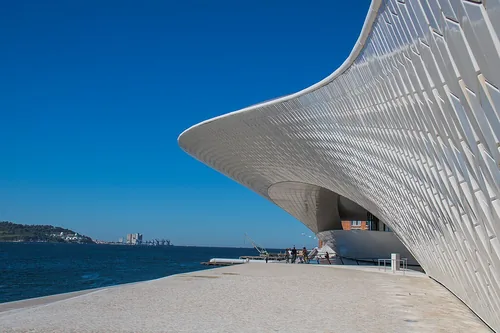
A low, swooping wave of white ceramic tiles rises from the riverbank, allowing visitors to walk over the roof of the museum as easily as they walk along the promenade. This Museum of Art, Architecture, and Technology is as much about the exterior form as the exhibitions inside. It reflects the light of the Tagus water, changing color from blinding white at noon to warm gold at sunset.

The complex includes the old red-brick power station next door, creating a dialogue between industrial history and futuristic design. The exhibitions are often experimental and large-scale, utilizing the cavernous spaces below ground. It pushes the definition of a museum, focusing on the intersection of disciplines rather than just hanging paintings on walls.

Walking along the waterfront, this stands out among Lisbon attractions as a symbol of the modern city. Even if you do not enter the galleries, walking over the roof offers a unique vantage point of the suspension bridge and the river traffic.

Hours Mon: 10:00 AM – 7:00 PM | Tue: Closed | Wed-Sun: 10:00 AM – 7:00 PM
Price €11
Website www.maat.pt/pt
Insider TipThe roof is free to walk on and is one of the best spots in the city for sunset photos with the bridge in the background.
Museum of the Orient

5. Museum of the Orient

Housed in a converted dried cod warehouse on the Alcântara docks, this museum explores the deep and often complex history of Portugal's presence in Asia. The collection includes exquisite Japanese screens, Indonesian puppets, and rare Chinese ceramics. The setting is dark and atmospheric, allowing the gold and lacquer of the artifacts to glow under dramatic lighting.

It tells a story of trade, religion, and navigation that complements the discoveries monuments in Belém but with more nuance and artistic focus. The building itself is massive and industrial, a reminder of the port's commercial heritage. It rarely feels crowded, allowing for a contemplative visit.

For those interested in the "why" behind the city's wealth, this is one of the essential Lisbon attractions. It connects the local history with Macau, Goa, and Timor. The top floor restaurant offers a surprisingly good buffet with views over the working docks and the river.

Hours Mon: Closed | Tue-Thu: 10:00 AM – 6:00 PM | Fri: 10:00 AM – 8:00 PM | Sat-Sun: 10:00 AM – 6:00 PM
Price €6
Insider TipVisit on Friday evenings (6:00 PM to 8:00 PM) when admission is free; it is a perfect start to a night out in the nearby LX Factory area.
National Coach Museum

6. National Coach Museum

This collection of royal carriages is surprisingly one of the most visited sites in the country, and for good reason: the vehicles are spectacular. Gilded wood, red velvet, and allegorical statues on wheels show the absurd luxury of the Portuguese court. The collection is split between the old royal riding arena and a stark modern concrete building across the street.

The contrast between the ornate 18th-century coaches and the minimalist architecture of the new museum highlights the craftsmanship of the past. You can see vehicles that carried popes and kings, some weighing tons and requiring teams of horses to move. It offers a tangible connection to the monarchy that paintings often fail to convey.

Even if you are not a "car person," this ranks high among Lisbon attractions for its visual impact. The sheer excess of the Ocean Coach, with its golden figures connecting the continents, is a masterpiece of baroque propaganda on wheels.

Hours Mon: Closed | Tue-Sun: 10:00 AM – 6:00 PM
Price €8
Insider TipYour ticket usually includes both the new museum and the old Royal Riding Hall (Picadeiro Real); do not skip the old hall, as the painted ceiling and arena architecture are as impressive as the coaches.
National Museum of Ancient Art

7. National Museum of Ancient Art

This is the country's national gallery, housed in a palace overlooking the river. It holds the "Temptation of St. Anthony" by Bosch and the obsession-inducing Panels of St. Vincent, which portray 15th-century Lisbon society in cryptic detail. The collection spans centuries, from medieval religious sculpture to Japanese Namban screens depicting the arrival of the big-nosed Portuguese barbarians.

The museum feels endless but rewarding, with creaky wooden floors and high ceilings. It is less crowded than the Belém sites, allowing for an unhurried appreciation of the art. The narrative of Portugal's global reach is told here through objects—Afro-Portuguese ivories and Indian furniture—rather than just text.

Among cultural Lisbon attractions, this is the heavyweight. After viewing the art, the museum's garden at the back is a hidden sanctuary with a cafe that offers a stunning view of the river and bridge, usually shared only with locals and art students.

Hours 10:00–18:00, closed Mon
Price €10
Insider TipGo straight to the third floor to see the famous St. Vincent panels first while your energy is high, then work your way down to the decorative arts.
National Tile Museum

8. National Tile Museum

Located in a former convent slightly outside the center, this museum is dedicated to the azulejo, the tile art form that defines Portugal. It traces the history from rough Moorish geometric patterns to the blue-and-white storytelling panels of the 18th century. The highlight is a massive panorama of Lisbon made of tiles before the earthquake, showing a city that no longer exists.

The building itself is part of the exhibit, with a magnificent baroque church integrated into the tour. The cloisters are lined with tiles, showing how they were used to cool and decorate architectural spaces. It is a visual overload of pattern and color that explains why every building in town looks the way it does.

This is often voted the favorite among travelers visiting Lisbon attractions because it is unique to the culture. It is not just art on a wall; it is the fabric of the city explained. The cafeteria in the garden is a lovely place for lunch among the greenery.

Hours 10am-5pm (closed Mon)
Price €8
Insider TipThe museum is a bit isolated from the metro; take a taxi or rideshare to get there, but you can easily walk back towards Santa Apolonia station along the river.
Get Your Own Private Tour with AI Guide
AI Guide
  • Personalized tour tailored to your interests
  • Your AI guide tells stories, shares facts, and cracks jokes
  • Turn-by-turn GPS navigation
  • Available in your language — no download needed
Try for Free

🍕 Food Markets & Culinary Spots in Lisbon

The best food markets, food halls, and culinary destinations in Lisbon.

Mercado de Campo de Ourique

1. Mercado de Campo de Ourique

This neighborhood market balances traditional produce stalls with modern food kiosks, offering a similar concept to the famous Time Out Market but on a smaller, more intimate scale. Locals still come here to buy fish and vegetables in the morning, while the center tables fill up with people eating gourmet burgers, sushi, and petiscos (tapas) at lunch and dinner. It feels communal and cozy.

The noise level is a happy hum rather than a roar, and you are more likely to sit next to a Portuguese family than a tour group. The quality of food is high, and the prices are slightly friendlier than the downtown tourist hubs. It sits in a residential plateau that feels like a separate town within the city.

If you want the food hall experience without the chaos of the riverfront, this is one of the top Lisbon attractions for dining. It provides a genuine taste of how the city's middle class eats and socializes. The tram ride to get here is part of the charm.

Hours Mon-Thu: 10:00 AM – 11:00 PM | Fri-Sat: 10:00 AM – 1:00 AM | Sun: 10:00 AM – 11:00 PM
Price Free
Insider TipTry the 'prego' (steak sandwich) here; it is often cited by locals as one of the best in town and pairs perfectly with a cold beer.
Time Out Market

2. Time Out Market

The historic Ribeira market hall has been transformed into a temple of gastronomy. One half is still a traditional market selling fish and flowers; the other is a massive food hall curated by magazine editors. The best chefs in the city have outposts here, serving everything from tuna tartare and black pork ham to traditional custard tarts.

The energy is frantic. It is loud, crowded, and finding a seat at the communal wooden tables is a competitive sport. However, the food is consistently excellent and offers a "greatest hits" of the local dining scene in one room. It is a social hub where tourists and office workers mix over glasses of wine.

If you are hungry and indecisive while touring Lisbon attractions, this solves the problem. You can sample three or four different dishes from different stalls. It is great for groups where no one can agree on what to eat.

Hours Daily: 10:00 AM – 12:00 AM
Price $$
Insider TipIf the main hall is too full and noisy, grab your food and head outside to the terrace tables, or visit in the late afternoon (around 4:00 PM) for a calmer experience.
Get Your Own Private Tour with AI Guide
AI Guide
  • Personalized tour tailored to your interests
  • Your AI guide tells stories, shares facts, and cracks jokes
  • Turn-by-turn GPS navigation
  • Available in your language — no download needed
Try for Free

🌳 Parks & Best Viewpoints in Lisbon

Beautiful parks, gardens, and panoramic viewpoints for the best views of Lisbon.

Miradouro da Graca

1. Miradouro da Graca

Pine trees frame a view that captures the castle on the left and the river on the right, with the city spilling down the hill in between. This terrace is the living room of the Graça neighborhood, where a kiosk serves coffee and wine to a mix of students, artists, and weary travelers. The atmosphere is relaxed, with the sound of the tram grinding up the hill in the background.

It requires a climb or a ride on Tram 28 to reach, but the reward is a perspective that feels close to the action yet elevated above the noise. The late afternoon light hits the castle walls perfectly from this angle. Behind the viewpoint, the convent and church add a white, baroque backdrop to the scene.

Among the many Lisbon attractions offering views, this one strikes the best balance between scenery and comfort. It is not the highest point, but it feels the most welcoming. You can sit for an hour with a drink and watch the city turn from day to night.

Hours Daily: 6:00 AM – 10:00 PM
Price Free
Insider TipWalk around the corner to the church of Graça; the interior is beautiful and often empty, and there is a secondary, quieter viewpoint just past the main terrace.
Miradouro da Senhora do Monte

2. Miradouro da Senhora do Monte

From the highest point in the city, the view is absolute; you can see the castle, the bridge, the river, and the grid of the downtown valley laid out like a map. It is a further climb up from Graça, which used to keep it quiet, though its reputation has spread. A small chapel sits under the pine trees, and an old tile panel explains the panorama.

The distance from the center makes the city look peaceful, a sea of terracotta roofs and white walls. Lovers congregate here at sunset, and occasionally a musician will play guitar, using the acoustics of the stone wall. It feels wilder and less manicured than the lower terraces.

When you are compiling a list of Lisbon attractions with the best photo opportunities, this is the winner. The wide angle allows you to capture the entire sweep of the capital in a single frame. It is the place to go to understand the geography of the seven hills.

Hours Open 24/7
Price Free
Insider TipTuk-tuks clutter the entrance now, so walk a few meters past the main railing to the side wall for an unobstructed view and a bit of personal space.
Miradouro das Portas do Sol

3. Miradouro das Portas do Sol

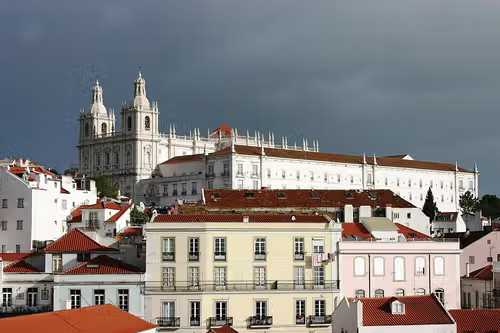
This balcony hangs directly over the medieval labyrinth of Alfama, offering a view of the red rooftops cascading down to the blue river. It is the classic image of the city, with the white dome of the Pantheon and the towers of the monastery breaking the skyline. The light here is intense, reflecting off the water and the white buildings.

A statue of St. Vincent holding a boat stands as a silent guardian of the view. Tram 28 squeezes through the narrow gap between the viewpoint and the buildings behind, adding a flash of yellow to the scene. It is a transit point as much as a destination, busy with people moving between the castle and the cathedral.

For immediate visual impact among Lisbon attractions, this spot delivers without requiring a steep climb from the tram stop. It is the perfect place to survey the route you are about to walk down into the old quarter. The contrast between the broad river and the tight alleyways below is striking.

Hours Open 24/7
Price Free
Insider TipInstead of eating at the expensive terrace right on the viewpoint, take the stairs down into Alfama (Beco de Santa Helena) to find cheaper, more authentic taverns just two minutes away.
Miradouro de Santa Catarina

4. Miradouro de Santa Catarina

Known locally as "Adamastor" after the stone giant statue facing the river, this terrace has a rebellious, youthful energy. It is a popular gathering spot for musicians, students, and locals watching the sunset with a beer from the kiosk. The view focuses on the bridge and the harbor activity rather than the castle, giving it a maritime, industrial edge.

The atmosphere is less polished than other viewpoints, often filled with the smell of cannabis and the sound of acoustic guitars. It sits at the bottom of the Bairro Alto hill, serving as a chill-out zone before the night begins. The pavement features the wavy black and white cobblestone pattern that typifies the city.

While some Lisbon attractions are about quiet contemplation, this one is about social life. It captures the laid-back, bohemian spirit of the city. You come here to feel part of the local scene rather than just to look at the scenery.

Hours Mon: 7:30 AM – 10:45 PM | Tue-Sun: 7:30 AM – 11:30 PM
Price Free
Website N/A
Insider TipThe kiosk here serves simple drinks, but for a proper meal with the same view, the Noobai Cafe located on the lower terrace offers tables right on the edge of the hill.
Miradouro de Sao Pedro de Alcantara

5. Miradouro de Sao Pedro de Alcantara

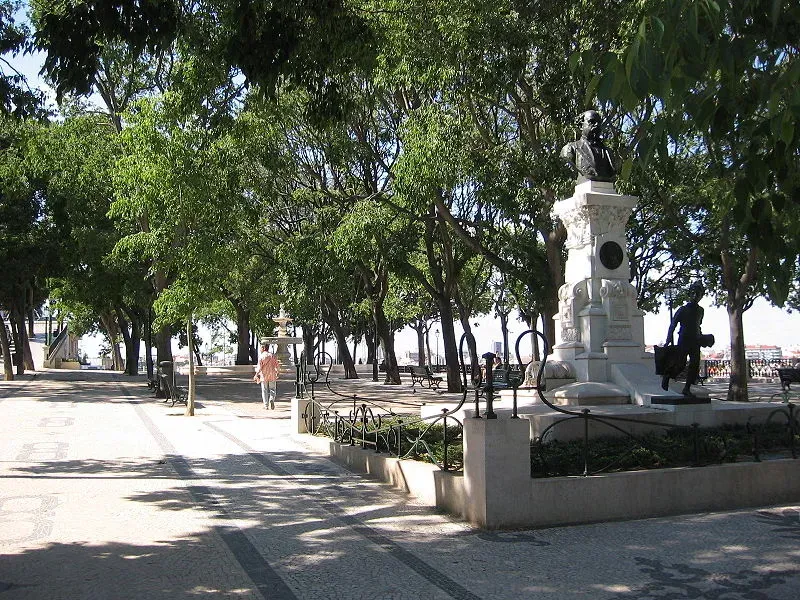
This grand, two-level garden terrace offers the definitive profile view of the castle across the valley. It is landscaped with geometric flower beds, busts of historical figures, and a fountain, feeling more like a palace garden than a simple lookout. The map made of tiles helps you identify the buildings you are seeing on the opposite hill.

At night, the castle lights up, floating in the darkness, while the garden itself becomes a romantic spot with dimmed lamps. A market often occupies the upper level, selling crafts and sangria. It sits at the top of the Glória funicular, making it an easy reward after a ride up from the downtown avenue.
This is one of the most sophisticated Lisbon attractions for a pause. The lower garden, often missed by those who stay by the railing, offers benches in the shade of trees, providing a quiet escape from the busy Bairro Alto streets nearby.
Hours Open 24/7
Price Free
Insider TipWalk to the far end of the garden to find the stairs leading down to the lower level; it is usually much emptier and has plenty of benches in the shade.
Parque Eduardo VII

6. Parque Eduardo VII

This massive green wedge slopes down towards the river, providing a corridor of open space in the dense city center. It is formal and geometric, with clipped box hedges and patterned walkways rather than wild forests. At the top, a monumental flag and a brutalist sculpture mark a viewpoint that looks straight down the Avenida da Liberdade to the water.

The park hides two treasures: the Estufa Fria (Cold Greenhouse), a magical jungle of ferns and palms created in an old quarry, and the Estufa Quente for cacti. These enclosed gardens feel miles away from the traffic roaring on the park's perimeter. It is a place where runners jog and book fairs are held.

For a breath of fresh air among Lisbon attractions, this is the main lung. The walk down through the park towards the city center gives you a sense of arrival, with the river framing the buildings ahead. It is grand, imposing, and undeniably refreshing.

Hours Always open
Price Free
Website Wikipedia
Insider TipPay the small entry fee for the Estufa Fria; it is a hidden tropical oasis that feels completely different from the manicured lawns outside.
Get Your Own Private Tour with AI Guide
AI Guide
  • Personalized tour tailored to your interests
  • Your AI guide tells stories, shares facts, and cracks jokes
  • Turn-by-turn GPS navigation
  • Available in your language — no download needed
Try for Free

Explore with AI Guide

AI Guide App

Get personalized tours with our AI-powered guide. No download needed — works right in your browser.