Things to Do in Santiago de Compostela - Top Attractions, Hidden Gems & Must-See Sights

Discover the best things to do in Santiago de Compostela. Complete guide to must-see sights, popular attractions, hidden gems, museums, food markets and parks.

18 Attractions 4 Categories Travel Guide

Table of Contents

Santiago de Compostela Overview

Santiago de Compostela is the final stop for thousands of pilgrims, but the city’s identity extends far beyond its religious roots. It is a dense, granite-carved town where the frequent Atlantic rain gives the stone a distinctive silver sheen. Life revolves around the Plaza del Obradoiro, the massive square where the Santiago de Compostela Cathedral dominates the skyline.

The entire central area is compact and easily explored on foot, though the medieval Old Town’s narrow streets can be steep. A short walk leads to the Mercado de Abastos, a traditional market that remains the best place to find local Galician produce like Tetilla cheese and octopus.

For a different perspective, the Galicia Contemporary Art Center offers modern architecture that contrasts with the nearby Museum of the Galician People. The adjacent Parque de San Domingos de Bonaval provides a quiet retreat with views overlooking the stone roofs.

Must-See Attractions in Santiago de Compostela

  • Santiago de Compostela Cathedral — The Romanesque masterpiece that marks the end of the Camino de Santiago pilgrimage.
  • Mercado de Abastos — A granite-built market hall where you can sample fresh Galician seafood and local cheeses.
  • Plaza del Obradoiro — The monumental heart of the city, surrounded by its most significant historical buildings.
  • Museum of the Galician People — Set in a former convent, this museum houses a unique triple spiral staircase and exhibits on local culture.
  • Parque de San Domingos de Bonaval — A converted cemetery and park that offers a peaceful escape and elevated views of the old city.
🏛️ Must-See ⭐ Sights 💎 Hidden Gems 🎨 Museums

🏛️ Must-See Attractions in Santiago de Compostela

These iconic landmarks and must-see sights are essential stops for any visitor to Santiago de Compostela.

Mercado de Abastos

1. Mercado de Abastos

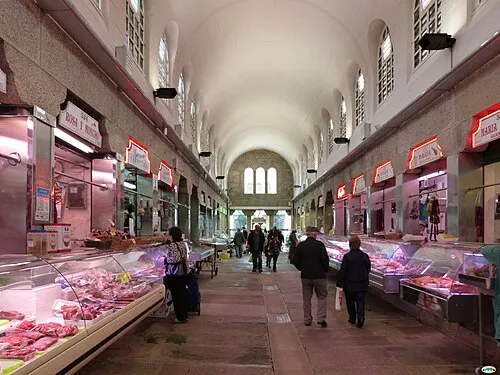
This is the engine room of the city. Housed in a series of granite halls that look like Romanesque chapels, the market is where the Atlantic ocean arrives every morning in crates of barnacles, octopus, and hake. The smell is a briny, earthy mix of fresh fish, tetilla cheese, and damp stone. Unlike other sanitized food halls in Europe, this remains a working market where grandmothers haggle with fishmongers who have held their stalls for generations.

Rain or shine, the activity here is relentless. It offers a glimpse of local life that is completely stripped of religious performance. If you are looking for Santiago de Compostela attractions that feed the body rather than the soul, this is the place. You will see crates of 'pimientos de Padrón' in season and huge loaves of Galician bread with crusts as hard as wood and interiors as soft as clouds.

The surrounding alleys are packed with tiny wine bars and pulperías that utilize the market's bounty. It is best to visit mid-morning when the stalls are fully stocked and the energy is at its peak. By early afternoon, the shutters come down and the scrubbing begins, so timing is everything.

Hours Mon-Sat: 7:00 AM – 4:00 PM | Sun: Closed
Price Free
Insider TipBuy fresh shellfish at the stalls and take it to the bar in the central aisle (Nave 5); for a small fee, they will cook it for you right there.
Old Town

2. Old Town

The historic center is not just a collection of monuments; it is a unified organism built of granite. The streets are paved with great slabs of stone that gleam black when it rains, reflecting the yellow streetlights in a way that feels almost cinematic. Walking here means navigating a maze of 'rúas' (streets) and 'correderas' (lanes) that follow a medieval logic, ignoring modern grid systems.

Every archway seems to frame a view of a bell tower or a hidden garden. The shops here tend to be small, selling silverware, jet stone (azabache), and almond cakes, continuing trades that have existed for centuries. Among all Santiago de Compostela attractions, the town itself is the most immersive; you don't visit it, you inhabit it. The soundscape is dominated by church bells and the clatter of footsteps.

It is crucial to wander away from the main arteries. Just one street over from the souvenir shops, you find silent squares with fountains that have been running for 500 years. The uniformity of the architecture—granite walls, glazed balconies, tiled roofs—creates a powerful sense of place that few other European cities can match.

Hours Open 24/7
Price Free
Website Wikipedia
Insider TipWear shoes with good grip; the granite paving stones become incredibly slippery when wet, which is roughly half the time.
Plaza del Obradoiro

3. Plaza del Obradoiro

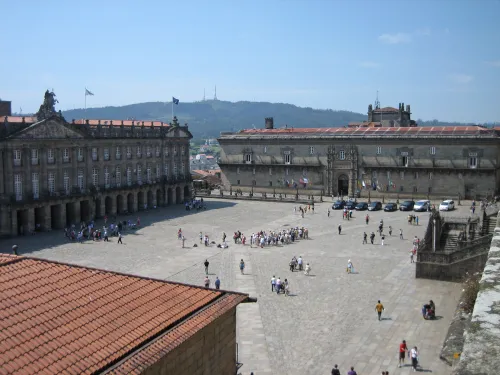
This is the emotional and physical center of the city, the 'Km 0' where all Camino routes terminate. It is a vast, open expanse paved in stone, bordered by buildings representing the four pillars of the city: religion (Cathedral), education (College of San Xerome), health (Hostal dos Reis Católicos), and administration (Pazo de Raxoi). The sheer scale of the square is designed to make you feel small, yet the atmosphere is one of triumph.

On any given morning, you will see pilgrims arriving, dropping their backpacks, and lying on the ground to gaze up at the cathedral towers. It is a theater of human emotion—tears, embraces, and quiet relief. Unlike other Santiago de Compostela attractions that are about viewing, this square is about feeling. The name 'Obradoiro' refers to the workshop of stone masons that once occupied this space during the cathedral's construction.

The lack of cafes or commercial clutter in the center of the square preserves its dignity. It is a windy, open stage where the weather dictates the mood. In the rain, it reflects the buildings like a mirror; in the sun, the granite sparkles. It is the inevitable destination of everyone who enters the city.

Hours Open 24/7
Price Free
Website Wikipedia
Insider TipVisit the square late at night, after 11 PM. The crowds vanish, and the silence allows you to hear the wind whistling through the cathedral towers.
Santiago de Compostela Cathedral

4. Santiago de Compostela Cathedral

This is the magnet that draws millions across a continent. The facade is a baroque explosion of moss and granite, rising into the mist, but the core is pure Romanesque strength. Entering through the Portico de la Gloria (when accessible) brings you face-to-face with one of the finest collections of medieval sculpture in Europe, a stone sermon that has greeted travelers for 800 years.

Inside, the nave is dim and immense, smelling of incense and damp coats. The ritual of hugging the Apostle's statue behind the main altar remains the defining moment for many. If you are lucky or attend a high mass, you might witness the Botafumeiro, the giant thurible swinging through the transept at terrifying speeds, a spectacle originally designed to mask the scent of unwashed pilgrims. It is the undisputed king of Santiago de Compostela attractions.

The cathedral is a complex organism of chapels, crypts, and towers. It is not just a church; it is a reliquary on a massive scale. The wear on the stone floors, eroded by centuries of footsteps, tells the story better than any guidebook. It is a place where art, faith, and history are fused into a single, overwhelming structure.

Hours Daily: 7:00 AM – 9:00 PM
Price Free
Insider TipThe line to hug the Apostle is longest in the morning. Go during the lunch hour (2:00 PM - 3:30 PM) when Spanish visitors are eating for a much shorter wait.
Get Your Own Private Tour with AI Guide
AI Guide
  • Personalized tour tailored to your interests
  • Your AI guide tells stories, shares facts, and cracks jokes
  • Turn-by-turn GPS navigation
  • Available in your language — no download needed
Try for Free

💎 Hidden Gems in Santiago de Compostela - Off the Beaten Path

Beyond the tourist crowds, Santiago de Compostela hides remarkable treasures waiting to be discovered.

Capela de Ánimas

1. Capela de Ánimas

Standing slightly apart from the medieval core, this neoclassical facade commands attention not with towering spires, but with a dramatic relief depicting souls burning in purgatory. It is a stark, arresting image that halts many passersby on their way to the old town, contrasting sharply with the Romanesque gentleness found elsewhere in the city. The exterior columns are massive and impose a sense of weight, fitting for a temple dedicated to prayers for the deceased.

Inside, the atmosphere shifts from architectural grandeur to theatrical devotion. Unlike the gold-leafed baroque altars typical of other Santiago de Compostela attractions, the altarpiece here features polychrome terracotta statues illustrating the Passion of Christ. These life-sized figures have an intense, almost operatic quality that makes the space feel intimate and emotionally charged, rather than distant and ceremonial.

Because it sits just outside the usual tourist circuit, the chapel often remains quiet, offering a space for genuine reflection. The light here tends to be softer, filtering in to illuminate the expressive faces of the statues. It serves as a reminder of the city's deep-rooted relationship with the afterlife, distinct from the celebratory nature of the pilgrim's arrival.

Hours 10am-2pm, 4pm-8pm
Price €2
Insider TipAttend the evening mass if you can; the lighting on the terracotta figures during the service creates a visual experience you cannot get during the day.
Parque de Belvís

2. Parque de Belvís

Occupying a natural depression or small valley just east of the medieval walls, this park is a green lung for the city. It is less manicured than other gardens, defined by a large grassy meadow that locals use for dog walking, picnics, and sports. The slope of the terrain creates natural seating areas, and a stream runs through the bottom, adding a layer of rural sound to the urban setting.

From the upper paths, the views looking back toward the convent and the seminary are striking. It offers a profile of the city that feels lived-in and domestic rather than monumental. If you are cycling through Santiago de Compostela attractions, this park often serves as a transit point or a rest stop away from the stone corridors of the center.

Three days a week, a small organic market is held here, selling produce directly from local gardens. It feels distinct from the main tourist hubs—a place where you are more likely to hear conversations about vegetable prices than pilgrimage routes. It is the backyard of Santiago.

Hours Open 24/7
Price Free
Website N/A
Insider TipGo to the 'Mirador de Belvís' at the top of the park at sunset; the sun drops behind the city towers, creating a silhouette effect that is less crowded than other viewpoints.
Parque de San Domingos de Bonaval

3. Parque de San Domingos de Bonaval

Architect Álvaro Siza and landscape architect Isabel Aguirre took a derelict Dominican cemetery and transformed it into a space of profound serenity. The park climbs the hill behind the Bonaval convent, using the old stone walls and oak groves to frame specific views of the cathedral towers and the city rooftops. It is a masterpiece of subtle intervention, where the mossy retaining walls and ancient trees are the stars.

The acoustics here are unique; the city noise fades away, replaced by the sound of wind in the oaks and the crunch of gravel. It is widely considered one of the most atmospheric Santiago de Compostela attractions, perfect for reading or solitary walking. The old cemetery niches remain, empty now, but adding a melancholic beauty to the lower terraces.

As you ascend, the park becomes wilder. The upper levels feel like a Galician forest, while the lower levels are structured gardens. It is a place that rewards slow movement. The contrast between the sun-warmed stone of the niches and the cool shade of the oak grove captures the dual nature of the Galician landscape.

Hours Daily: 8:00 AM – 11:00 PM
Price Free
Website N/A
Insider TipPack a sandwich and sit on the grassy ramps facing west; it is the best free lunch spot with a view in the entire city.
Get Your Own Private Tour with AI Guide
AI Guide
  • Personalized tour tailored to your interests
  • Your AI guide tells stories, shares facts, and cracks jokes
  • Turn-by-turn GPS navigation
  • Available in your language — no download needed
Try for Free

🎨 Best Museums & Galleries in Santiago de Compostela

World-class museums and galleries that make Santiago de Compostela a cultural treasure.

Galicia Contemporary Art Center

1. Galicia Contemporary Art Center

Designed by Álvaro Siza, this angular granite structure is a bold dialogue with history. It sits directly next to the ancient convent of San Domingos de Bonaval, creating a confrontation between the baroque past and the rationalist present. The building does not try to mimic the old styles; instead, it uses the same local stone to create clean lines and light-filled voids that feel surprisingly at home in the rainy climate.

Inside, the spaces are fluid and unpredictable, designed to challenge the way you look at art. Exhibitions change regularly and focus on modern international and Galician artists, offering a mental palate cleanser after days of viewing Romanesque religious art. Among Santiago de Compostela attractions, this is the one that proves the city is not just a mausoleum for the middle ages but a living cultural capital.

The rooftop terrace, when accessible, and the geometric courtyard offer rigorous, photogenic perspectives. The way the light hits the smooth granite walls here is different from the mossy, weathered stone of the cathedral, making it a favorite spot for photographers looking for abstraction rather than ornamentation.

Hours Mon: Closed | Tue-Sun: 11:00 AM – 8:00 PM
Price €5
Website cgac.xunta.gal/
Insider TipEntry is free, and the building has clean, accessible restrooms—a practical luxury when spending a full day walking the city.
Museum of Pilgrimage and of Santiago

2. Museum of Pilgrimage and of Santiago

Located in the former Bank of Spain building at the edge of Plaza de Platerías, this museum provides the necessary context for understanding the Camino. It does not just display dusty artifacts; it explains the sociology, the routes, and the sheer human scale of the pilgrimage phenomenon. The modern renovation of the building has created bright, airy galleries that allow the exhibits to breathe.

You will find everything from medieval scallop shells to interactive maps showing the web of routes crossing Europe. It answers the 'why' and 'how' that often gets lost when you are just looking at old stones. As you check off Santiago de Compostela attractions, this museum acts as the narrator, tying together the disparate sights of the cathedral, the hospitals, and the walls into a coherent story.

The top floor offers a surprising view through a large window that frames the cathedral's clock tower perfectly. It is a quiet vantage point that lets you study the architectural details of the bell tower eye-to-eye, without the neck strain of looking up from the square below.

Hours Mon: Closed | Tue-Fri: 9:30 AM – 8:30 PM | Sat: 11:00 AM – 7:30 PM | Sun: 10:15 AM – 2:45 PM
Price 5€
Insider TipThe third-floor window offers one of the best rain-protected views of the cathedral towers—perfect for photos when the weather is bad.
Museum of the Galician People

3. Museum of the Galician People

Housed within the walls of the San Domingos de Bonaval convent, this museum explores the identity of Galicia beyond the church. The exhibits focus on the anthropology of the region: fishing boats, traditional agricultural tools, basketry, and costumes. It is a celebration of the rural and maritime culture that sustained this corner of Spain while the cathedral attracted the world.

The presentation is respectful and extensive, giving dignity to the everyday objects of peasant life. You walk through rooms that smell faintly of old wood and stone, seeing the evolution of Galician life from the Iron Age to the 20th century. For travelers tired of religious iconography, this is one of the most grounding Santiago de Compostela attractions, shifting the focus to the people who actually lived here.

The experience is inseparable from the building itself. You move between exhibit halls via ancient stone corridors and the famous triple spiral staircase. It connects the high culture of the architecture with the folk culture of the exhibits, suggesting that both are essential to understanding the region.

Hours Mon: Closed | Tue-Sat: 11:00 AM – 6:00 PM | Sun: 11:00 AM – 2:00 PM
Price 2€
Insider TipDo not miss the section on traditional musical instruments; seeing the evolution of the 'gaita' (bagpipe) explains the soundtrack you hear on the city streets.
Natural History Museum of USC

4. Natural History Museum of USC

Owned by the University of Santiago de Compostela, this museum is a tribute to the scientific curiosity that has thrived alongside the city's theology. Located in a contemporary building surrounded by a park, it feels worlds away from the granite heaviness of the Old Town. The collection includes taxidermy, botanical models, and mineral specimens that have been used for teaching since the 19th century.

It is a quiet, orderly space that appeals to families and those needing a break from crowds. The displays are old-school in the best way, showcasing the diversity of Galician flora and fauna as well as exotic specimens brought back by researchers. While it may not headline lists of Santiago de Compostela attractions, it offers a necessary glimpse into the academic prestige of the university.

The surrounding Parque de Vista Alegre provides a green context that suits the biological theme. It is a place to look at the intricate details of a beetle's wing or a quartz crystal, shifting your perspective from the monumental to the microscopic.

Hours Mon: Closed | Tue-Sat: 10:00 AM – 2:00 PM, 4:30 – 8:00 PM | Sun: 11:00 AM – 2:00 PM
Price $$
Insider TipThis is an excellent rainy-day option for kids, as it is never crowded and the biodiversity displays are visual and accessible without needing much reading.
Get Your Own Private Tour with AI Guide
AI Guide
  • Personalized tour tailored to your interests
  • Your AI guide tells stories, shares facts, and cracks jokes
  • Turn-by-turn GPS navigation
  • Available in your language — no download needed
Try for Free

Explore with AI Guide

AI Guide App

Get personalized tours with our AI-powered guide. No download needed — works right in your browser.