Things to Do in Segovia - Top Attractions, Hidden Gems & Must-See Sights

Discover the best things to do in Segovia. Complete guide to must-see sights, popular attractions, hidden gems, museums, food markets and parks.

16 Attractions 5 Categories Travel Guide

Table of Contents

Segovia Overview

Segovia is defined by its massive granite engineering and a skyline shaped like a ship. The Roman Aqueduct cuts right through the center at Plaza del Azoguejo, while the Alcázar sits at the "bow" overlooking the valley. It is a city where Roman, Moorish, and Christian history overlap in a compact, walkable space.

Walking from the Roman Aqueduct through the Old Jewish Quarter leads to the Gothic Segovia Cathedral on Plaza Mayor. Beyond the medieval city walls, the Royal Palace of La Granja de San Ildefonso offers a grander contrast with its formal gardens. Expect plenty of steep climbs and narrow alleys that require sturdy shoes.

Must-See Attractions in Segovia

  • Roman Aqueduct — An engineering marvel of 167 granite arches held together without mortar, still dominating the city center.
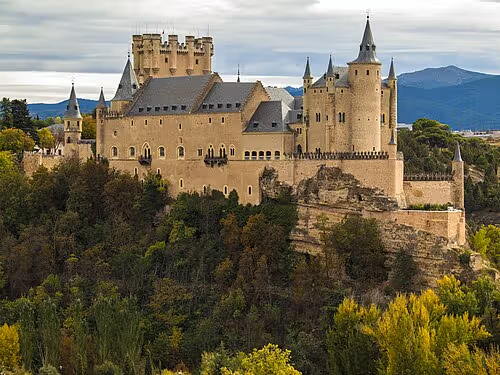
  • Alcázar of Segovia — A medieval fortress that looks like a storybook castle, perched on a rocky crag where two rivers meet.
  • Segovia Cathedral — The "Lady of Cathedrals" standing at the city's highest point, known for its elegant late-Gothic spires.
  • Old Jewish Quarter — A quiet maze of stone streets and courtyards that preserves the medieval layout of the city's Sephardic history.
  • Royal Palace of La Granja de San Ildefonso — A short trip from the center leads to these expansive gardens and fountains modeled after Versailles.
🏛️ Must-See ⭐ Sights 💎 Hidden Gems 🎨 Museums 🌳 Parks & Views

🏛️ Must-See Attractions in Segovia

These iconic landmarks and must-see sights are essential stops for any visitor to Segovia.

Alcázar of Segovia

1. Alcázar of Segovia

Rising from a rocky crag shaped like a ship's bow, this fortress is often cited as the inspiration for Disney’s castle, but the reality is far more formidable and military than fairytale. It dominates the Eresma Valley with slate-capped towers that gleam when it rains, marking the western tip of the old city. Inside, you walk through the Hall of Kings, where a frieze of seated monarchs watches you from the ceiling, a reminder of when this was the favored residence of Castile's rulers before the court moved to Madrid. It feels less like a ruin and more like a working palace that just happens to be centuries old.

The climb up the Tower of Juan II is tight and steep, consisting of 152 spiraling steps that will test your knees. The payoff is a view that explains exactly why the castle sits here: you can see the enemy coming from miles away across the Castilian plain. Looking down, the geometry of the city reveals itself, with the cathedral in the center and the green belt of the river valley wrapping around the base. It’s a windy, exposed spot that gives you a better sense of the geography than any map.

While this is one of the busiest Segovia attractions, most visitors rush through the armory and skip the artillery college archives, which is a mistake if you like military history. The audioguide is actually helpful here, providing context to the empty spaces that might otherwise just look like cold stone rooms. Try to time your exit to walk down the hill towards the river at sunset, when the golden stone turns a deep, bruised purple.

Hours Daily: 10:00 AM – 6:00 PM
Price Free
Location 40.9525, -4.1325
Insider TipThe ticket office often has a long queue; buy online to skip the first line, but arrive right at opening (10 AM) if you want the Tower of Juan II to yourself.
Roman Aqueduct

2. Roman Aqueduct

There is no preparing for the sheer size of it. Even if you’ve seen photos, standing under the double tier of arches at the Plaza del Azoguejo is a physical experience. Built around the 1st century AD to carry water from the mountains, it stands without a single drop of mortar, held together only by the perfect balance of forces and the weight of the granite blocks. It cuts through the city like a stone scar, defining the layout of the streets around it.

You should see it from two angles: from the bottom to feel small, and from the top of the stairs at the Postigo del Consuelo to understand its path. From above, you can see the water channel that fed the city for centuries. It’s not just a ruin; it was a functioning utility until surprisingly recently. The stone is rough, pitted by weather and pollution, but unyielding. Birds nest in the crevices, adding life to the cold gray structure.

It is the most famous of all Segovia attractions, so expect it to be the background of a thousand selfies. To really appreciate it, walk along the upper section where it enters the city walls—the arches are lower there, bringing the engineering down to eye level. It’s a reminder that Roman infrastructure was built to last forever, and in this case, it basically has.

Hours Open 24/7
Price Free
Location 40.948, -4.1177
Insider TipWalk along the aqueduct away from the city center (opposite direction of the tourist flow) for about 10 minutes to see the stone desander and the arches getting lower and lower.
Segovia Cathedral

3. Segovia Cathedral

Known as 'The Lady of Cathedrals,' this was the last Gothic cathedral built in Spain, constructed when the rest of Europe had already moved on to the Renaissance. The result is a refined, elegant structure with a waist-like tapering of the pillars and intricate rib vaulting that feels lighter than earlier Gothic styles. It sits on the highest point of the Plaza Mayor, its tower visible from almost anywhere in the province. The interior is vast, illuminated by stained glass that casts colorful pools of light on the stone floor.

The chapels lining the nave are mini-museums of art, but the cloister is the highlight. It was actually moved stone-by-stone from the old cathedral that was destroyed during the Revolt of the Comuneros, a feat of recycling that preserved a piece of history. The museum in the basement holds gold and silver monstrances that are blindingly ornate, showing the wealth of the church in the 16th century.

It dominates the skyline of Segovia attractions, but inside it feels spacious and calm. You can climb the tower for a view that rivals the Alcázar’s, giving you a look at the roof structure and the bells. It’s a place to see the transition of architectural styles frozen in stone, grand yet surprisingly delicate in its details.

Hours Mon-Sat: 9:30 AM – 6:30 PM | Sun: 12:30 – 6:30 PM
Price Free
Insider TipThe tower tour has a separate schedule and limited capacity; book it as soon as you arrive at the cathedral to secure a slot for later in the day.
Get Your Own Private Tour with AI Guide
AI Guide
  • Personalized tour tailored to your interests
  • Your AI guide tells stories, shares facts, and cracks jokes
  • Turn-by-turn GPS navigation
  • Available in your language — no download needed
Try for Free

💎 Hidden Gems in Segovia - Off the Beaten Path

Beyond the tourist crowds, Segovia hides remarkable treasures waiting to be discovered.

Zuloaga Museum

1. Zuloaga Museum

Housed in the deconsecrated church of San Juan de los Caballeros, this museum is dedicated to the Zuloaga family of ceramicists who revived the art form in Spain. The setting is as interesting as the collection; the Romanesque church was bought by Daniel Zuloaga in 1905 and converted into his workshop and home. You can still see the kilns and the living quarters mixed in with the ancient stone arches. It’s a fascinating blend of medieval architecture and early 20th-century artisan life.

The ceramics on display capture the faces and landscapes of Castile—peasants, fields, and village scenes painted on tiles and vases. It’s earthy and realistic, very different from the royal portraits in the Alcázar. The museum is slightly off the main tourist track, located near the Plaza del Conde de Cheste, so it’s rarely crowded. The silence of the old church amplifies the presence of the artwork.

Distinct among Segovia attractions, it focuses on craft and labor rather than war or religion. It’s a personal, intimate space that tells the story of a family who fell in love with the city and made it their subject. If you like Arts and Crafts movements or industrial design, this is the spot for you.

Hours Mon: Closed | Tue-Sat: 10:00 AM – 2:00 PM, 4:00 – 7:00 PM | Sun: 10:00 AM – 2:00 PM
Price €3
Insider TipCheck the opening hours carefully as they take a long lunch break (siesta) and are closed on Mondays. The surrounding square is full of palaces and worth a walk on its own.
Get Your Own Private Tour with AI Guide
AI Guide
  • Personalized tour tailored to your interests
  • Your AI guide tells stories, shares facts, and cracks jokes
  • Turn-by-turn GPS navigation
  • Available in your language — no download needed
Try for Free

🎨 Best Museums & Galleries in Segovia

World-class museums and galleries that make Segovia a cultural treasure.

Casa de la Moneda (Royal Mint Museum)

1. Casa de la Moneda (Royal Mint Museum)

Down by the river, far below the city walls, sits this industrial complex that King Felipe II built to mechanize the coining of money in Spain. It feels completely different from the religious and military architecture up on the hill; it is functional, engineered, and powered by the water of the Eresma River. You can see the reconstructed waterwheels churning, which once drove the massive rollers that flattened silver bars into coins. It’s a rare surviving example of 16th-century industrial heritage that shows the technical side of the Spanish Empire’s wealth.

The museum inside explains the evolution of currency without getting too bogged down in numismatic jargon. You walk through the actual workshops where the noise must have been deafening centuries ago, though now it’s just the sound of rushing water. It’s a cool, damp respite from the summer heat that bakes the upper city, and the surrounding garden feels like a private park. The architecture is sharp and slate-roofed, clearly influenced by the German technicians brought in to run the machinery.

Because it sits in the valley, it pairs perfectly with a walk along the riverbank after visiting the Alcázar. While most Segovia attractions are clustered tightly within the walls, this requires a steep walk down, which filters out the casual day-trippers. You get a sense of the city’s economic engine here, rather than just its ceremonial face.

Hours Mon-Tue: Closed | Wed-Sat: 10:00 AM – 2:00 PM, 4:00 – 6:00 PM | Sun: 10:00 AM – 2:00 PM
Price €4
Insider TipWednesday is free entrance day for EU citizens, but the real tip is the riverside path behind the building—it leads directly to a great view of the Alcázar from below.
Didactic Center of the Jewish Quarter

2. Didactic Center of the Jewish Quarter

Housed in the former home of Abraham Senior, a prominent financier of the Catholic Monarchs, this center offers a window into the Sephardic history that was erased in 1492. The building itself is a lesson in integration, built directly into the city wall, with a courtyard that feels private and protected. The exhibits rely heavily on holograms and projections to explain the customs, holidays, and eventual expulsion of the Jewish community, which can feel a bit high-tech for such an old space, but the information is solid.

It serves as the interpretative key for the surrounding streets of the Judería. Without visiting here, the narrow alleys and hidden courtyards of the quarter are just pretty scenery; after seeing the maps and history, you understand the boundaries and the pressure this community lived under. You can see the original gate mechanisms where the quarter was locked at night, a physical reminder of the segregation that defined medieval life.

While many Segovia attractions focus on the Christian conquest and royal splendor, this center provides the necessary counter-narrative. It’s small enough to see in thirty minutes but dense with context. The shop sells books on Sephardic history that are hard to find elsewhere, making it a good resource if you want to read deeper into the subject.

Hours Mon-Sat: 10:00 AM – 1:00 PM, 4:00 – 6:00 PM | Sun: 10:00 AM – 1:00 PM
Price Free
Insider TipAsk for the code to the side gate if you want to exit directly onto the path along the city walls—it saves you walking all the way back around.
Museum of Contemporary Art Esteban Vicente

3. Museum of Contemporary Art Esteban Vicente

Tucked away in the Renaissance palace of Enrique IV, this museum is a startlingly modern intervention in a medieval city. It is dedicated to Esteban Vicente, the only Spanish member of the New York School of Abstract Expressionism. The galleries are white, airy, and flooded with light, displaying vibrant splashes of color that contrast sharply with the beige stone exterior. It’s a quiet, contemplative space that feels more like a gallery in SoHo than a museum in Castile.

The renovation of the palace is brilliant, preserving the wooden coffered ceilings while creating modern exhibition spaces. The central courtyard is a peaceful garden with sculptures and ivy, a perfect place to escape the noise of the street. It’s never crowded, allowing you to stand before the large-scale paintings without anyone jostling you. The collection rotates, often bringing in other contemporary works that dialogue with Vicente's legacy.

For art lovers, this is a necessary break from the romanesque heavy-hitters that dominate the list of Segovia attractions. It proves the city isn't just a fossilized relic but has a connection to 20th-century avant-garde movements. The juxtaposition of abstract art inside a 15th-century royal palace captures the city's ability to adapt and survive.

Hours Mon: Closed | Tue-Fri: 11:00 AM – 2:00 PM, 4:00 – 7:00 PM | Sat: 11:00 AM – 8:00 PM | Sun: 11:00 AM – 3:00 PM
Price €4
Insider TipEntry is free on Thursdays. Even if you don't like abstract art, the garden in the courtyard is open to visitors and is one of the quietest spots in the center.
Museum of Segovia

4. Museum of Segovia

Located in the 'Casa del Sol,' a fortress-like building perched on the city wall, this museum holds the physical memory of the province. The collection is eclectic, ranging from prehistoric boar sculptures (verracos) to intricate Roman mosaics and Visigothic jewelry. It’s the kind of place where you can see the layers of occupation that built Segovia, object by object. The building itself is part of the draw, with a defensive position that offers great views over the valley.

The layout is chronological and manageable, not overwhelming like the national museums in Madrid. You’ll find pieces of the aqueduct that fell or were replaced, letting you see the granite masonry up close. The section on the industrial era, including wool production, explains how the city made its fortune before tourism took over. It’s quiet, often empty, and staffed by locals who are happy to explain a weird artifact if you ask.

It provides the backstory for all the other Segovia attractions you visit. Seeing the Roman glass and daily tools makes the Aqueduct feel like part of a living city rather than just a stone bridge. It’s a good rainy-day option, but worth an hour even in good weather to ground your visit in historical fact.

Hours Mon: Closed | Tue-Sat: 10:00 AM – 2:00 PM, 4:00 – 7:00 PM | Sun: 10:00 AM – 2:00 PM
Price Free
Insider TipDon't miss the collection of 'verracos' (Celtic granite boars) in the courtyard—they are the oldest and most mysterious symbols of the region's pre-Roman identity.
Get Your Own Private Tour with AI Guide
AI Guide
  • Personalized tour tailored to your interests
  • Your AI guide tells stories, shares facts, and cracks jokes
  • Turn-by-turn GPS navigation
  • Available in your language — no download needed
Try for Free

🌳 Parks & Best Viewpoints in Segovia

Beautiful parks, gardens, and panoramic viewpoints for the best views of Segovia.

Royal Palace of La Granja de San Ildefonso

1. Royal Palace of La Granja de San Ildefonso

Located about 15 minutes by car from the city, this palace is the Versailles of Spain, built by Philip V who missed his French childhood. It sits at the foot of the Guadarrama mountains, surrounded by massive formal gardens and fountains that rely on gravity—not pumps—to shoot water sky-high. The palace itself is a baroque jewel box, filled with tapestries, frescoes, and lamps that scream royal excess. It’s a summer residence, designed to be cool and airy, a retreat from the baking Castilian plateau.

The gardens are the real star, stretching out into the forest with statuary and hidden corners. You can walk for hours here without seeing the same fountain twice. The layout forces you to slow down and wander, contrasting with the dense, vertical nature of Segovia city. The air feels cleaner and cooler here, smelling of pine and damp earth.

While it requires a short trip away from central Segovia attractions, it is essential for understanding the Bourbon dynasty's impact on the region. It’s grander and more polished than the Alcázar, reflecting a different era of monarchy. If you go, plan for at least half a day, as the grounds are extensive and the palace tour is lengthy.

Hours Mon: Closed | Tue-Sun: 10:00 AM – 6:00 PM
Price Free
Insider TipThe fountains are only turned on during specific times in spring and summer (usually 5:30 PM on certain days). Check the official schedule before you go, or you'll see them dry.
Get Your Own Private Tour with AI Guide
AI Guide
  • Personalized tour tailored to your interests
  • Your AI guide tells stories, shares facts, and cracks jokes
  • Turn-by-turn GPS navigation
  • Available in your language — no download needed
Try for Free

Explore with AI Guide

AI Guide App

Get personalized tours with our AI-powered guide. No download needed — works right in your browser.