Things to Do in Úbeda - Top Attractions, Hidden Gems & Must-See Sights

Discover the best things to do in Úbeda. Complete guide to must-see sights, popular attractions, hidden gems, museums, food markets and parks.

18 Attractions 4 Categories Travel Guide

Table of Contents

Úbeda Overview

Must-See Attractions in Úbeda

  • Plaza Vázquez de Molina
  • Synagogue of the Water
🏛️ Must-See ⭐ Sights 💎 Hidden Gems 🎨 Museums

🏛️ Must-See Attractions in Úbeda

These iconic landmarks and must-see sights are essential stops for any visitor to Úbeda.

Plaza Vázquez de Molina

1. Plaza Vázquez de Molina

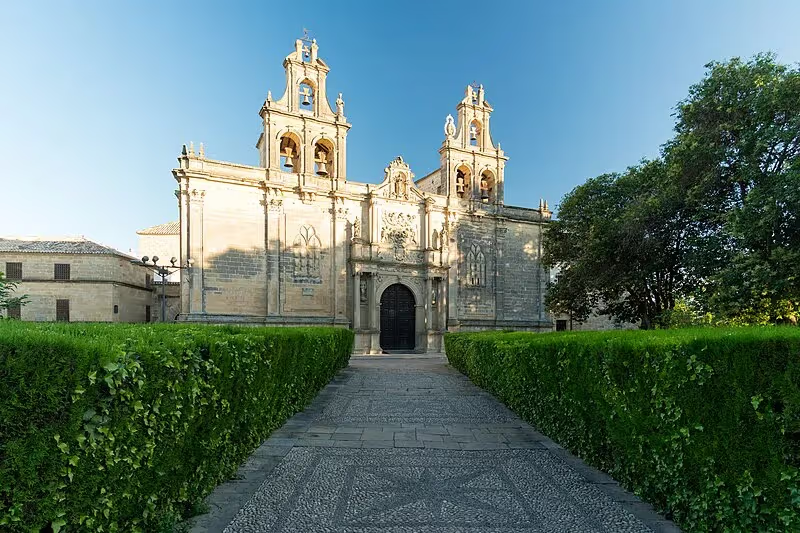
This is the moment the city has been building up to. Walking into this L-shaped plaza can be overwhelming; it is an open-air theater of stone where every building competes for dominance. There is no commercial clutter here—no neon signs, no traffic, just a sweeping expanse of pavement bordered by the Sacra Capilla, the Parador, and the City Hall. It is widely considered one of the finest Renaissance spaces in Europe, and the silence here is heavy with history.

The lack of trees or benches is intentional; the space was designed for processions and spectacles, not for lounging. The scale makes humans feel small, which was exactly the point of the powerful men who commissioned these structures. You can stand in the center and turn 360 degrees, seeing a complete timeline of the city's golden age without a single modern intrusion.

No list of Úbeda attractions exists without this square at the top. It is the connector that ties the individual palaces together into a coherent statement of power. Visit it twice: once to see the architectural details in the harsh daylight, and again at night when the floodlights turn the stone into a dramatic, golden stage set.

Hours Open 24/7
Price Free
Website Wikipedia
Insider TipStand near the fountain in the center to get the best photo angle that captures the Sacra Capilla and the Palace of Chains in a single frame.
Synagogue of the Water

2. Synagogue of the Water

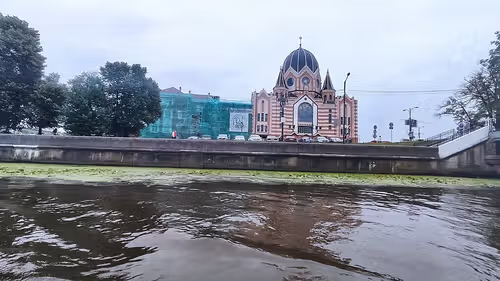
This is the city's most surprising discovery. For centuries, it was hidden behind the walls of a nondescript house, forgotten until a developer stumbled upon it during a renovation. It is a series of subterranean rooms that include a Mikveh (ritual bath) carved directly into the bedrock. The water in the bath wells up naturally from the groundwater, pristine and clear, giving the site its name.

The atmosphere is entirely different from the Christian monuments above ground. It is dark, mystical, and connected to the earth. The spaces are small and cavernous, evoking the secrecy that eventually surrounded the Jewish community here. The discovery of the synagogue reshaped the understanding of Úbeda's history, proving the existence of a thriving Jewish quarter that had been erased from the map.

Unlike other Úbeda attractions that shout their grandeur, this one requires you to descend and listen. During the summer solstice, the sun aligns perfectly to illuminate the water in the Mikveh, a feat of engineering that suggests a sophisticated understanding of astronomy by its builders.

Hours Tue-Fri 09:30-13:30, 16:00-19:00; Sat 10:00-14:00; Sun 12:00-14:00
Price €2.50
Insider TipIf you visit in June around the solstice, book months in advance for the 'Magic of the Solstice' event to see the light phenomenon in the ritual bath.
Get Your Own Private Tour with AI Guide
AI Guide
  • Personalized tour tailored to your interests
  • Your AI guide tells stories, shares facts, and cracks jokes
  • Turn-by-turn GPS navigation
  • Available in your language — no download needed
Try for Free

💎 Hidden Gems in Úbeda - Off the Beaten Path

Beyond the tourist crowds, Úbeda hides remarkable treasures waiting to be discovered.

Alfarería Tito

1. Alfarería Tito

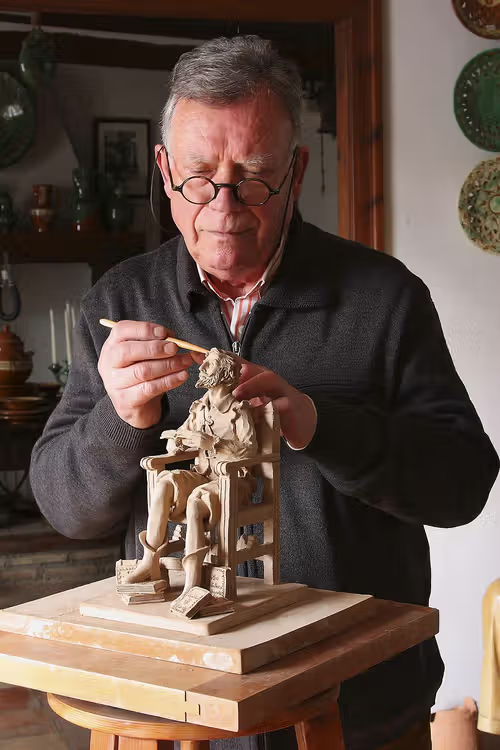
Pottery isn't just a souvenir trade in Úbeda; it is a centuries-old obsession, and this workshop is its beating heart. Stepping inside feels less like entering a retail space and more like stumbling into a living museum where the smell of wet clay and wood smoke hangs heavy in the air. The walls are stacked floor-to-ceiling with the region's signature green-glazed ceramics, fired in Arab-style kilns that have been roaring for generations.

You can watch the potters at work, their hands moving with a speed that betrays decades of muscle memory. They are usually happy to explain the difference between the decorative pieces and the utilitarian cookware that locals still use for stews. Unlike the mass-produced ceramics found in tourist shops near the main square, everything here carries the imperfections and weight of manual labor.

If you have already toured the stone palaces that dominate most Úbeda attractions, this workshop offers a necessary shift in perspective. It connects you to the earth of the region rather than its aristocracy. The intricate lattice-work pieces are impressive, but the simple water jugs and plates often make the most enduring reminders of the city's artisan roots.

Hours Mon-Fri: 9:30 AM – 2:00 PM, 5:00 – 8:30 PM | Sat: 10:30 AM – 2:00 PM, 5:30 – 9:00 PM | Sun: 10:30 AM – 2:00 PM, 5:30 – 8:30 PM
Price €2.00
Location Maps
Insider TipAsk to see the 'Moorish oven' (horno moruno) in the back; if they are firing that day, the heat and process are a spectacle in themselves.
Casa Museo Andalusí

2. Casa Museo Andalusí

Tucked away from the grand plazas, this private museum offers a sensory plunge into the domestic life of the city's Jewish and Moorish past. Unlike the stone-cold emptiness of the large palaces, this house is cluttered with the textures of life: ceramics, textiles, ironwork, and furniture arranged to look as if the inhabitants just stepped out. The smell of incense and the sound of running water from the fountains create an atmosphere that feels deliberately suspended in time.

The owners have dedicated themselves to preserving a narrative often overshadowed by the Christian conquest. You move through small, tile-lined rooms and intimate courtyards that reveal how the Sephardic community maintained their traditions behind closed doors. It is a tactile experience, where you are often closer to the artifacts than in a state-run institution.

As you navigate the list of Úbeda attractions, this stop provides a necessary corrective to the dominant Renaissance narrative. It reminds you that before the Italian architects arrived, this was a city of narrow alleys, private patios, and three distinct cultures living in tense proximity.

Hours Tue-Sun 09:30-13:30, 16:30-20:00
Price €3.00
Insider TipCheck their schedule for evening visits or storytelling sessions; the house takes on a completely different, magical quality after dark.
Church of San Nicolás de Bari

3. Church of San Nicolás de Bari

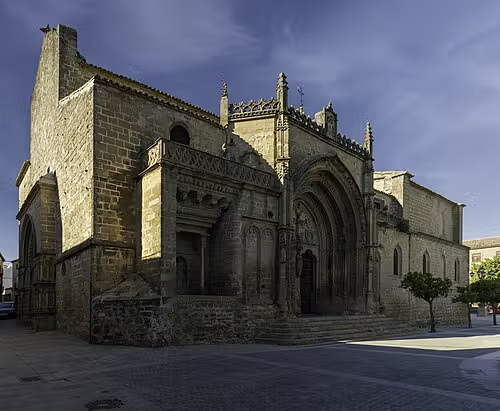
This church is a gothic survivor in a Renaissance city. Its dark, serious stone facade stands in sharp contrast to the bright, open rationality of the later buildings nearby. The southern portal is the main draw, a beautiful example of the transition period with its pointed arches and slightly archaic sculptural details. It feels older and more organic than the mathematically perfect temples that would follow a century later.

Inside, the space is divided by heavy clustered columns that pull the eye upward to the ribbed vaults. It is often quieter here than in the major basilicas, serving as a functioning parish church where locals actually go to pray. The Chapel of the Dean has an intricate iron grille that is a masterpiece of local metalwork, a craft for which the city is still famous.

If you are overwhelmed by the Italianate perfection of other Úbeda attractions, San Nicolás offers a darker, medieval palate cleanser. It represents the city as it was before the immense wealth of the 16th century transformed the skyline, grounding you in a deeper, more spiritual past.

Hours Mon-Fri: 7:15 – 8:00 PM | Sat: Closed | Sun: 12:00 PM – 1:00 AM
Price Free
Website N/A
Insider TipLook for the tiny, almost grotesque carvings of human faces and animals hidden in the capitals of the doorway columns.
Get Your Own Private Tour with AI Guide
AI Guide
  • Personalized tour tailored to your interests
  • Your AI guide tells stories, shares facts, and cracks jokes
  • Turn-by-turn GPS navigation
  • Available in your language — no download needed
Try for Free

🎨 Best Museums & Galleries in Úbeda

World-class museums and galleries that make Úbeda a cultural treasure.

Archaeological Museum of Úbeda

1. Archaeological Museum of Úbeda

While most visitors look up at the facades, this museum invites you to look closely at what lies beneath. Housed in a Mudéjar-style house that is an architectural survivor in its own right, the collection feels intimate rather than exhausting. The building itself, with its central patio and original wooden ceilings, provides a domestic context that the grander palaces lack, making it easier to imagine daily life here five hundred years ago.

The exhibits trace a timeline that predates the Renaissance glory everyone comes to see, showcasing Iberian pottery and Roman artifacts found in the surrounding olive groves. It is a quiet, contemplative space that often escapes the larger tour groups, allowing you to examine the detailing on a Roman mosaic or a prehistoric tool without being jostled.

For those methodically checking off Úbeda attractions, this stop provides the foundational history that explains why this hill was settled in the first place. The transition from the prehistoric displays to the Islamic-era artifacts offers a clear narrative of how the city's layers were built, one conquest at a time.

Hours Mon: Closed | Tue-Sat: 9:00 AM – 9:00 PM | Sun: 9:00 AM – 3:00 PM
Price €1.50
Insider TipPay attention to the 'alfarje' (wooden ceiling) in the main hall; the geometric patterns are original 14th-century craftsmanship.
Olive Oil Interpretation Centre

2. Olive Oil Interpretation Centre

In a province that produces more olive oil than entire countries, this center is essential for understanding the landscape you drove through to get here. Located in the 'Casa de la Tercia,' an old silo, the space combines industrial history with modern sensory education. It is not just a museum of rusty presses; it is a school for your palate, teaching you to distinguish between picual and arbequina varietals.

The lower level displays the massive wooden beams and stone wheels used for centuries to crush olives, giving you a sense of the sheer physical effort behind the 'liquid gold.' Upstairs, the focus shifts to chemistry, health, and gastronomy. The staff are evangelical about quality, dispelling myths about acidity and color that most consumers blindly believe.

While most Úbeda attractions focus on stone and nobility, this center focuses on the agricultural wealth that paid for them. You leave with a new respect for the gnarled trees surrounding the city and, inevitably, a few bottles of premium oil that make the supermarket versions back home taste bland.

Hours Mon: Closed | Tue-Sat: 10:00 AM – 2:00 PM, 5:00 – 7:30 PM | Sun: 10:00 AM – 2:00 PM
Price €2.00
Insider TipPay the extra few euros for the guided tasting (cata); learning the official technique to warm the glass and smell the oil changes how you taste food forever.
Get Your Own Private Tour with AI Guide
AI Guide
  • Personalized tour tailored to your interests
  • Your AI guide tells stories, shares facts, and cracks jokes
  • Turn-by-turn GPS navigation
  • Available in your language — no download needed
Try for Free

Explore with AI Guide

AI Guide App

Get personalized tours with our AI-powered guide. No download needed — works right in your browser.