Self-Guided Walking Tour in Dijon

A 3 km, 7-stop walk through the flat, pedestrian heart of Dijon, from Jardin Darcy by the train station to the thousand-year-old crypt under Cathédrale Saint-Bénigne. This page gives you the full map, walking time for every leg, real hours and prices for each stop, and shorter versions.

7 Stops3.0 km~2 hours walking2–3 hours with stops
What you get with AI Tourguide
Full GPS navigationInteractive AI guidePersonalized to youWorks in your browser
Try this tour with Alex

Dijon Walking Tour at a Glance

This route is built for anyone who wants to see the best of Dijon's old town on foot without a group or a fixed schedule. It links seven landmarks across a compact, flat center, and every interior is optional: you can walk the whole thing for free and step inside only the churches, courtyards or the museum that interest you.

StartDarcy's garden (Jardin Darcy)
FinishDijon Cathedral (Cathédrale Saint-Bénigne de Dijon)
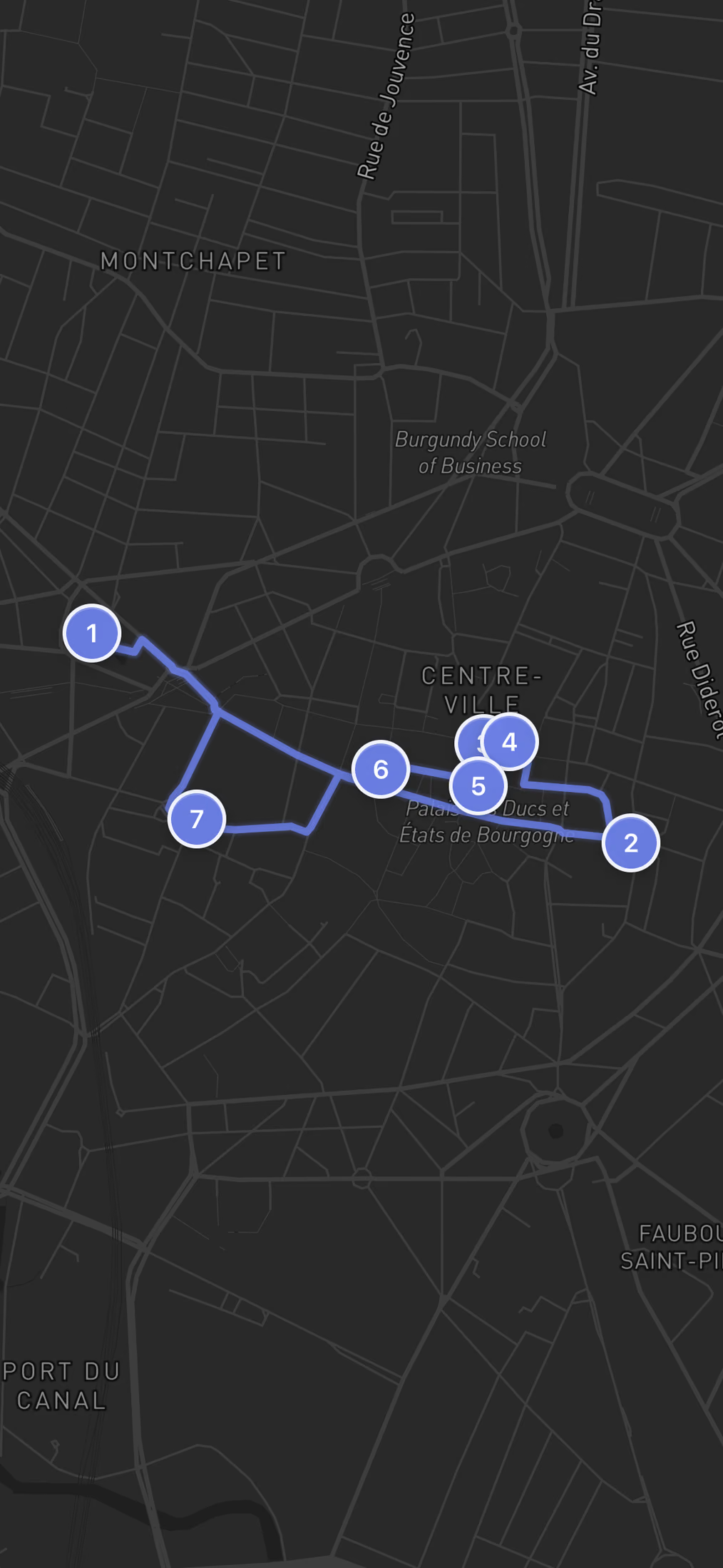
Route typeA tight loop that begins and ends within 300 metres of each other near the train station. It runs east first to Saint-Michel Church, then doubles back west through the historic core, so the outbound stretch is the only real walking and the rest is a slow drift between clustered sights.
Realistic timePure walking is about 35 minutes across 3 km. Add the outdoor stops, the churches and the courtyards and you land at 2 to 3 hours. Factor in the free Fine Arts Museum and it becomes a half day.
DifficultyEasy. The whole route stays flat over smooth cobblestone and paved pedestrian streets, with no hills and no stairs on the main path. Comfortable shoes are plenty; the only climbs, the cathedral crypt and the Philippe le Bon tower, are optional.
Cost to followThe walk itself is free, and so are both churches, the cathedral, Place François Rude and the Musée des Beaux-Arts. The only paid extra is a guided interior tour of Hôtel de Vogüé at roughly €3 to €5.
Best for:

First-time visitors and day-trippers who want Dijon's ducal architecture, Gothic churches and café squares at their own pace, on an easy flat walk that never leaves the pedestrian center.

The Route

Free Walking Tour Map of Dijon

7 stops3.0 kmabout 2 hours
Loading the interactive map…The complete walking route will appear here.
Want the route to guide you while you walk?Open the route with navigation and a personal guide for the history, stories and questions that matter to you.
Open route + AI guide

The 7 stops along this route

  1. Darcy's garden (Jardin Darcy) in Dijon, stop 1 on the self-guided walking tour
    1Darcy's garden (Jardin Darcy)
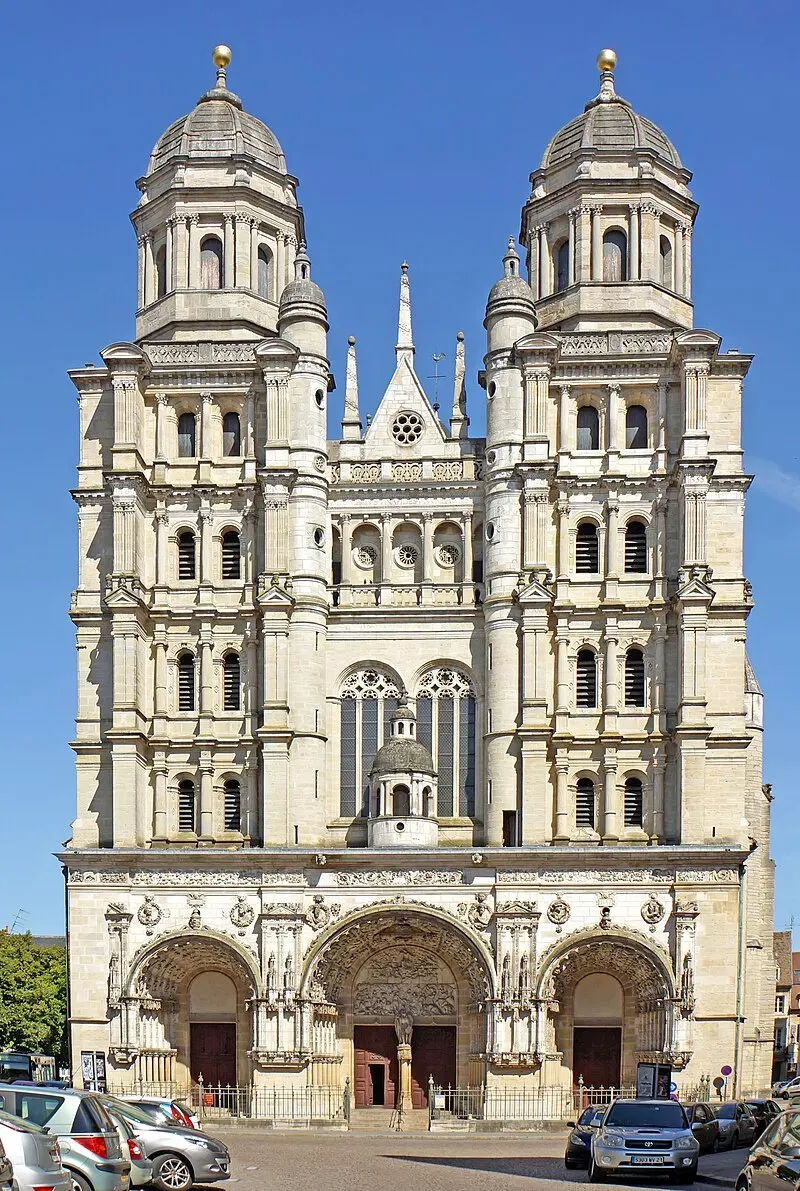
  2. Saint-Michel church (Église Saint-Michel) in Dijon, stop 2 on the self-guided walking tour
    2Saint-Michel church (Église Saint-Michel)
  3. Church of Notre-Dame of Dijon (Église Notre-Dame de Dijon) in Dijon, stop 3 on the self-guided walking tour
    3Church of Notre-Dame of Dijon (Église Notre-Dame de Dijon)
  4. Hôtel de Vogüé in Dijon, stop 4 on the self-guided walking tour
    4Hôtel de Vogüé
  5. Palace of the Dukes of Burgundy (Palais des ducs de Bourgogne) in Dijon, stop 5 on the self-guided walking tour
    5Palace of the Dukes of Burgundy (Palais des ducs de Bourgogne)
  6. François-Rude square (Place François-Rude) in Dijon, stop 6 on the self-guided walking tour
    6François-Rude square (Place François-Rude)
  7. Dijon Cathedral (Cathédrale Saint-Bénigne de Dijon) in Dijon, stop 7 on the self-guided walking tour
    7Dijon Cathedral (Cathédrale Saint-Bénigne de Dijon)
  8. That's the complete route.

    If you want more than the map and text, add live navigation and a conversational AI guide while you walk.

    Open route + AI guide
    You made it
Stop 1 of 7
Swipe →

Your Dijon Walking Tour, Stop by Stop

  1. 1

    Darcy's garden (Jardin Darcy)

    Darcy's garden (Jardin Darcy) in Dijon, stop 1 on the self-guided walking tour

    A bronze polar bear greets you at the entrance. This is a reproduction of a sculpture by Dijon-born artist Francois Pompon, and it has become the city's unofficial mascot. The original marble version sits inside the Fine Arts Museum at the Ducal Palace, which you will reach later on this route. The park itself sits on top of a 19th-century water reservoir designed by Henry Darcy, the hydraulic engineer who formulated Darcy's Law of fluid dynamics. The garden is small, manicured, and shaded by mature trees. Locals use it as a transitional space between the train station and the old town. Free to enter, open daily 7:30 AM to 7:00 PM. Grab a bench, check your map, and get your bearings before diving into the pedestrian zone. The real city starts just beyond the southern exit, where the streets narrow and the stone facades begin to close in overhead.
    Hours
    Daily: 7:30 AM – 7:00 PM
    Price
    Free
  2. 2

    Saint-Michel church (Église Saint-Michel)

    Saint-Michel church (Église Saint-Michel) in Dijon, stop 2 on the self-guided walking tour

    The walk here takes you through quieter residential streets east of the center, and the square in front of Saint-Michel feels calm compared to the tourist core. The facade is the puzzle: the lower portion is pure Renaissance, with classical columns and round arches, while the nave behind it is Gothic with pointed arches. Construction took so long that the architectural style changed halfway through, leaving a building beautifully split between two eras. The twin towers are capped with rounded cupolas instead of spires, giving the silhouette a profile unlike any other church in Burgundy. Free to enter, open Monday to Saturday 8:00 AM to 7:00 PM and Sunday from 9:00 AM. Walk around to the side to see the exact seam where Gothic stonework ends and the Renaissance facade was grafted on. Inside, the light is warm and the space is calmer than Notre-Dame will be. Take 10 to 15 minutes here.

    Hours
    Mon-Sat: 8:00 AM – 7:00 PM | Sun: 9:00 AM – 7:00 PM
    Price
    Free
  3. 3

    Church of Notre-Dame of Dijon (Église Notre-Dame de Dijon)

    Church of Notre-Dame of Dijon (Église Notre-Dame de Dijon) in Dijon, stop 3 on the self-guided walking tour

    The flat Gothic facade bristles with rows of false gargoyles. Unlike functional gargoyles that drain rainwater, these are purely decorative: dozens of musicians, monsters, and beasts glaring down from three tiers of stone. The church was built between roughly 1220 and 1250, and the facade is one of the finest examples of 13th-century Gothic architecture in France. Free to enter, open Monday to Saturday 8:00 AM to 6:00 PM, Sunday from 9:00 AM. Walk around to the north wall on Rue de la Chouette and find the small stone owl carved into the exterior. Touch it with your left hand, right hand on your heart, and make a wish. Centuries of palms have worn the owl almost smooth. Above the west facade, the Jacquemart clock has a mechanical family of four figures that strike the bells throughout the day. The clock was brought from Courtrai in Belgium in 1382 as war loot and has been keeping time here ever since.

    Hours
    Mon-Sat: 8:00 AM – 6:00 PM | Sun: 9:00 AM – 6:00 PM
    Price
    Free
  4. 4

    Hôtel de Vogüé

    Hôtel de Vogüé in Dijon, stop 4 on the self-guided walking tour

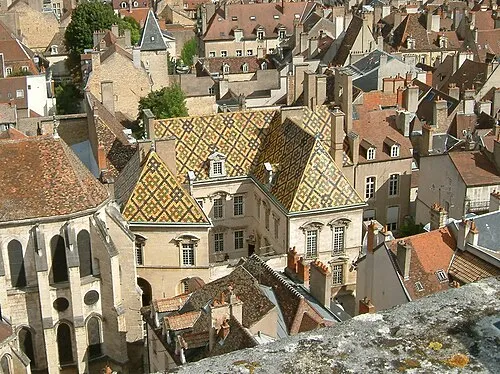
    After the crowds around the owl, this stop feels like a private find. The 17th-century parliamentary mansion sits just one block from Notre-Dame, but most visitors walk right past it. The roof catches your eye first: glazed polychrome tiles in geometric patterns that glow orange and green depending on the angle of the light. This is the classic Burgundian tile pattern you will see repeated across the region. Push through the heavy wooden doors if they are open. The Renaissance courtyard behind them is quiet, elegant, and occasionally hosts temporary exhibitions. Free exterior viewing at any time; guided tours of the interior are offered periodically for around 3 to 5 EUR. Stone carvings frame the windows with a precision that shows this mansion was built to impress other parliamentarians, not the public. The stop takes five minutes unless you find the courtyard open and linger.

    Hours
    Limited visiting hours (Varies)
    Price
    Free exterior viewing, €3-5 for tours
    Website
    dijon.fr ↗
  5. 5

    Palace of the Dukes of Burgundy (Palais des ducs de Bourgogne)

    Palace of the Dukes of Burgundy (Palais des ducs de Bourgogne) in Dijon, stop 5 on the self-guided walking tour

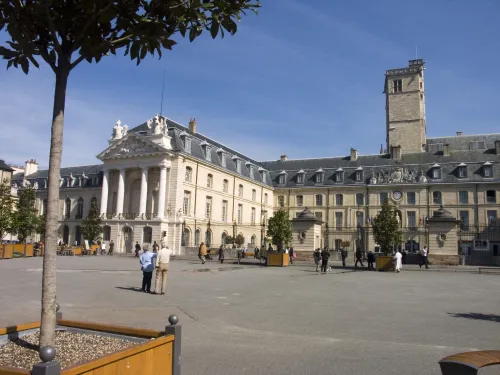
    The creamy limestone facade fills your entire field of vision as you step onto Place de la Liberation, the semicircular square designed by Jules Hardouin-Mansart. The Palace is several centuries stacked together: medieval ducal kitchens and defensive towers from the 14th century on one side, polished classical wings from the 17th and 18th centuries on the other. It still houses both City Hall and the Musee des Beaux-Arts. The museum is free for its permanent collection and open every day except Tuesday, 9:00 AM to 6:00 PM. It underwent a decade-long renovation completed in 2019 and the result is one of France's finest regional art museums. The ducal tombs in the Guard Room, with their procession of small alabaster mourner figures, are the centerpiece and genuinely moving. For the aerial view, book a climb up the Tour Philippe le Bon, the medieval tower that offers the only way to see Dijon's colored-tile rooftops from above. Free admission to the museum makes this one of the best value stops in all of Burgundy.

    Hours
    Mon: 9:00 AM – 6:00 PM | Tue: Closed | Wed-Sun: 9:00 AM – 6:00 PM
    Price
    Free
  6. 6

    François-Rude square (Place François-Rude)

    François-Rude square (Place François-Rude) in Dijon, stop 6 on the self-guided walking tour

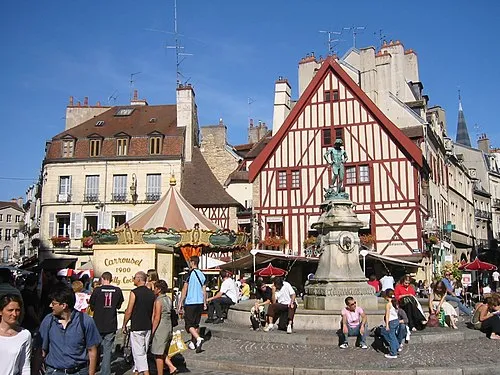
    The noise picks up as you approach. Cafe chairs scrape on stone, a carousel spins near the center, and conversation fills the air from every direction. Locals call this Place du Bareuzai, after the bronze grape-treader statue on the central fountain. Francois Rude sculpted the famous Marseillaise relief on the Arc de Triomphe in Paris, and this square honors him, though most people come for the atmosphere rather than the art history. Half-timbered buildings around the edges create a cozy, enclosed feel that the grander Place de la Liberation lacks. This is where several pedestrian shopping streets converge, so you will cross it repeatedly during your visit. Free, open 24 hours. Skip the overpriced cafe terraces if you are on a budget. Instead, grab a fresh gaufre from the window vendor near the carousel for about 4 EUR and sit on the fountain steps. Half the price, and you are right in the middle of the action.

    Hours
    Open 24/7
    Price
    Free
  7. 7

    Dijon Cathedral (Cathédrale Saint-Bénigne de Dijon)

    Dijon Cathedral (Cathédrale Saint-Bénigne de Dijon) in Dijon, stop 7 on the self-guided walking tour

    The polychrome tile roof catches your eye first, that classic Burgundian pattern of glazed geometric shapes you have now seen on every major building in town. The cathedral dates to the 13th century but became Dijon's official cathedral only in 1792. Free to enter. Open Monday to Friday 9:00 AM to 12:00 PM and 2:00 to 6:30 PM, with slightly shorter Saturday and Sunday hours closing at 6:00 PM. The nave is stark, tall, and largely bare, which lets the medieval stained glass do all the work. But the real reason to stop here is underground. The Romanesque crypt beneath the floor dates to around the year 1000 and has a circular rotunda layout you will not find anywhere else in France. The columns spiral downward into a dark, cool, completely silent space. The stairs are steep, so watch your footing. Ending this walking tour underground, in a thousand-year-old crypt, is the right way to close a day in a city that layers history this quietly.

    Hours
    Mon-Fri: 9:00 AM – 12:00 PM, 2:00 – 6:30 PM | Sat-Sun: 9:00 AM – 12:00 PM, 2:00 – 6:00 PM
    Price
    Free

How Long Does This Walking Tour Really Take?

Thirty-five minutes of actual walking, but plan for 2 to 3 hours so you can go inside the churches, touch the owl on Notre-Dame, push into courtyards and photograph the gargoyles. Add another hour or two if you tour the free Fine Arts Museum in the Ducal Palace.

The walking distance is 3.0 km, so pure walking time is about 35 minutes at a relaxed pace. Budget 2 to 3 hours if you want to step inside the churches, touch the owl, poke into courtyards, and photograph the gargoyles properly. If you add the free Fine Arts Museum inside the Ducal Palace, add at least another hour, possibly two if you linger at the ducal tombs and the Flemish painting collection. The natural break point is Place Francois Rude at the midpoint. In summer, the fountain steps at Place de la Liberation make a good resting spot with children playing in the splash jets around you.

Full Route, Shorter Walk or Two-Day Version?

The route works as one continuous walk, but it splits cleanly if you have less time or want to spread it out. Here are three ways to run it, using the real stop numbers and the per-leg walking times from the map.

The Short Core

Skip the long eastern leg to Saint-Michel

Stops 1, 3–7, about 2 km and 1.5–2 hours with stops

Drop Saint-Michel Church and its 14-minute detour east, and go straight from Jardin Darcy into the tightly clustered center. Stops 3 through 7 sit within a few minutes of each other, so this version keeps every headline sight while cutting the only real stretch of walking.

The Two-Part Split

Break at Place François Rude and finish later

Part one stops 1–6, part two stop 7, split at the midpoint

Walk stops 1 through 6, ending at the café-lined Place François Rude for lunch or a break, then tackle the Palace museum and the cathedral crypt on a second pass. A gentle option for families or anyone pairing the walk with a long Burgundian meal.

You can run this in reverse from Cathédrale Saint-Bénigne back to Jardin Darcy, since the start and end sit only a few blocks apart. The given direction is recommended because it starts at Jardin Darcy, a two-minute walk from Dijon-Ville station, and saves the quiet thousand-year-old crypt as the closing note.

Is This Dijon Walking Tour Right for You?

This is a short, flat, low-effort walk through a pedestrian center, which makes it a good fit for most people but not ideal for everyone. Here is who it suits and how to bend it if your day looks different.

A good fit if you…

  • Day-trippers arriving by TGV who want a route starting right by Dijon-Ville station
  • Anyone who prefers flat, cobblestone walking with no hills or stairs on the main path
  • Architecture lovers drawn to Gothic churches, Renaissance mansions and the ducal palace
  • Budget travelers, since the walk plus both churches and the Fine Arts Museum are free

Adapt the route if you…

  • You have only an hour: run the Short Core version and skip the eastern leg to Saint-Michel
  • You are traveling with children: break at Place François Rude, where a carousel and fountain steps sit at the midpoint
  • It is raining: lean on the free indoor stops, the two churches, the cathedral and the Fine Arts Museum
  • You want the rooftop view: add the optional climb up the Tour Philippe le Bon at the Palace of the Dukes

Tickets & Skip-the-Line in Dijon

Almost every stop on this route is free to enter, so there is little to book in advance. Here is the one paid interior, plus the practical hours you need for the two stops with their own visiting rules.

Hôtel de VogüéThe exterior and the roofline are free to view any time. Guided tours of the Renaissance interior are offered only periodically, on limited and varying hours, for roughly €3 to €5. Check locally at the tourist office, as there is no online booking.
Palace of the Dukes of Burgundy (Palais des ducs de Bourgogne)Entry to the Musée des Beaux-Arts and its permanent collection is free. Open 9:00 AM to 6:00 PM every day except Tuesday, when it is closed. The optional climb up the Tour Philippe le Bon for the rooftop view is ticketed separately. official ticket site ↗
Dijon Cathedral (Cathédrale Saint-Bénigne de Dijon)Free to enter, including the Romanesque crypt. Open Monday to Friday 9:00 AM to 12:00 PM and 2:00 to 6:30 PM, with slightly shorter weekend hours closing at 6:00 PM. Mind the midday break before planning your visit. official ticket site ↗
Everything elseJardin Darcy, Saint-Michel Church, Notre-Dame de Dijon and Place François Rude are all free, open public spaces or churches with no ticket needed.
Optional upgrade
+3
The same 7-stop route,
now with navigation and a guide.
Optional AI experience

You already have the route.
The AI guide brings it to life.

Standing near the polar bear in Jardin Darcy wondering where the famous owl is? Open AI Tourguide in your browser, no app, no download, and a voice guide walks the whole route through the pedestrian center to the Ducal Palace and Place François Rude with you, telling the story behind each church and courtyard, asking what you want to see and adapting as you go. A real conversation built into the walk, not a recording. Start with 100 free credits.

Livenavigation13languagesAnyquestionYourinterests
Open this route with the AI guide

Try it in your browser · No app or download required

Tips for Walking in Dijon

  • Start at Dijon-Ville train station, served by TGV from Paris Gare de Lyon in 1 hour 35 minutes. Jardin Darcy is directly across Place Darcy, a 2-minute walk from the station exit. The entire route stays within the flat pedestrian center.
  • The streets are flat cobblestone and smooth paving throughout. No hills, no stairs on the main route. The cathedral crypt and the Philippe le Bon tower are optional climbs. Comfortable walking shoes are enough; you do not need hiking boots for Dijon.
  • Public restrooms are available inside the Musee des Beaux-Arts (free entry, inside the Ducal Palace). The cafes on Place Francois Rude will let you use theirs if you buy a coffee.
  • For a proper Burgundian lunch, try a plat du jour at one of the small bistros on Rue Amiral Roussin near the Halles market, around 12 to 15 EUR. The covered Halles market itself, designed by Gustave Eiffel's firm, is worth a detour on Tuesday, Thursday, Friday, or Saturday mornings for cheese, mustard, and charcuterie.
  • The best photo of the Ducal Palace facade is from the center of Place de la Liberation in late afternoon, when the limestone glows pink and gold. For Notre-Dame's gargoyles, stand across Rue Musette and shoot upward with the three tiers stacked in frame.

Why Walk This Route?

This walking tour through Dijon covers 7 stops across 3.0 km in about 1.6 hours, threading through the flat, pedestrianized historic center of Burgundy's capital. You start at Jardin Darcy near the train station, loop southeast through two remarkable churches, pass the city's most photographed Renaissance mansion, cross the grand Place de la Liberation in front of the Ducal Palace, pause at the liveliest square in town, and finish at the cathedral whose underground crypt dates to the year 1000. The entire route follows smooth cobblestone and paved streets with no hills. Dijon was built for walking: the city even embedded brass owl plaques into the sidewalks to guide you between landmarks. Follow the owls, or follow this route. Either way, you cannot get lost.

Common Questions

Is Dijon worth a day trip from Paris?

Yes. The TGV takes 1 hour 35 minutes from Paris Gare de Lyon. You arrive at Dijon-Ville station, walk two minutes to Jardin Darcy, and the entire route fits comfortably into an afternoon. You can see the major sights, eat a Burgundian lunch, visit the free Fine Arts Museum, and catch a train back by evening. If you have more time, stay overnight and add a half-day trip to the Burgundy vineyards south of the city.

What if it rains during my Dijon tour?

This route has excellent indoor options. The Musee des Beaux-Arts inside the Ducal Palace is free and could fill two hours easily. Both churches are free to enter and provide shelter with their own architectural rewards. The covered Halles market, a short detour west of Place Francois Rude, keeps you dry while browsing food stalls under an Eiffel-designed iron roof.

What is the best time of day for this walking tour?

Start between 9:00 and 10:00 AM. The churches are open, the streets are quiet enough to photograph without crowds, and you beat the lunch rush at the cafes. By noon the pedestrian center fills up considerably. Late afternoon, around 4:00 to 5:00 PM, is the second-best window: the light on the Ducal Palace is at its warmest, the crowds thin, and you can catch the Jacquemart clock striking on Notre-Dame. Avoid starting at lunchtime when many shops close for the traditional 12:00 to 2:00 PM break.

Take this route with you

Open this exact tour with navigation and your personal AI guide.

Start GPS Navigation + AI Guide
AI Tourguide
Researched and curated by the AI Tourguide teamWe plan and quality-check every route, then research and verify the opening hours, prices, and practical tips for each stop along it.
▶ Open route with AI guideNavigation, stories and your questions