
Florence to Lucca Day Trip: Train Times & Costs
The regional train wins this one, dropping you a five-minute walk from the south wall while the car leaves you hunting for a lot outside the gates. Here is the honest day plan, plus a free, self-guided walking tour for the hours inside the walls.
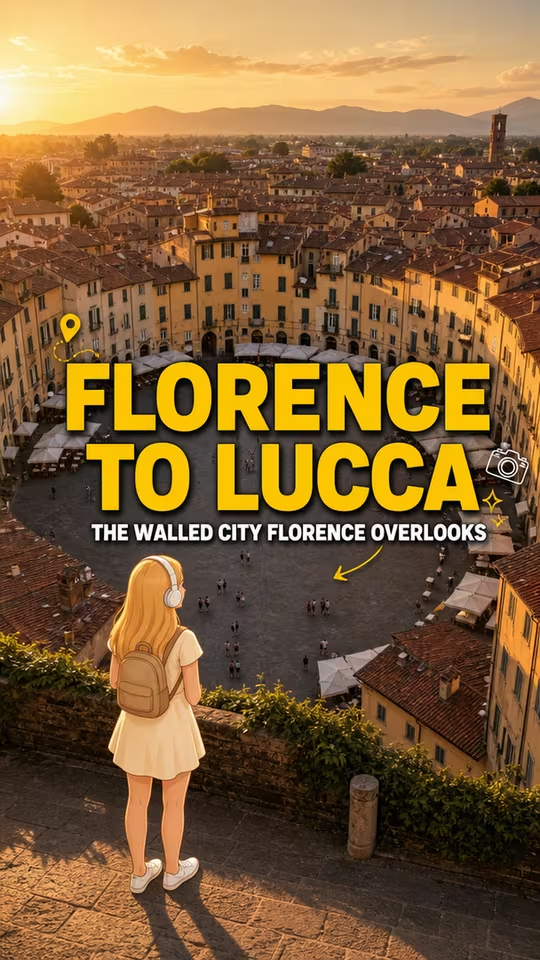
The Quick Answer: Florence to Lucca
The smart way from Florence to Lucca is the regional train, and for once the obvious choice is also the right one. Trenitalia runs direct regional services from Firenze Santa Maria Novella (SMN) to Lucca in about 1 hour 20 minutes, roughly every 30 to 60 minutes, for €7 to €10 one way with no reservation and no dynamic pricing. The trains are basic regional stock, and the reason the train wins is geography: Lucca's station sits on Piazza Ricasoli, hard against the southern wall, so you step off the platform and walk into the historic centre in about five minutes. Skip the car. As a day trip Lucca is one of the easiest and most rewarding things you can do from Florence, and unlike most Tuscan day trips, almost nobody comes home wishing they had stayed in Florence instead.
| Question | Answer |
|---|---|
| Fastest journey time | ~1h20 on direct regional trains. Avoid the ~1h45 services that change at Pisa unless you want to stop there |
| Frequency | Roughly 43 trains a day, about every 30 to 60 min. First around 5 a.m., last back after 10 p.m. |
| Price from | €7 to €10 one way, round trip under €20. Fixed regional fare, no dynamic pricing |
| Operators / how | Trenitalia regional only, no high-speed. Depart Firenze Santa Maria Novella (SMN), arrive Lucca station |
| First / last | First departure around 5 a.m., last back from Lucca after 10 p.m. Reduced service on weekends and holidays |
| Worth it as a day trip? | Yes, and a full day, not a half-day add-on. The station is at the walls and the centre is car-free |
Is the Florence to Lucca Day Trip Worth It?
Here is our honest verdict up front: yes, and Lucca is one of the few Tuscan day trips that almost nobody regrets. The usual day-trip complaint, that a city deserves more than a day, barely applies here, because a compact, car-free centre means a focused day genuinely delivers the place. The only real question is a practical one: how much of a full day to give it, and whether to bolt Pisa onto the same trip.
The best of Lucca, stop by stop


People talk about Lucca the way they talk about a place they did not expect to love. Most travellers in Tuscany never make it here, which is exactly why those who do tend to remember it as the day that surprised them: a picture-perfect walled town with the texture of an ordinary Italian city rather than a stage set.
Calm, car-free, lived-in. The Tuscan day trip people are happiest they made.
The closest thing to a counter-argument is not "do not go," it is "do not rush it." Lucca rewards a full day, not a half-day squeezed in beside Pisa. A half-day each across both cities covers the highlights but does neither justice, and a full day in Lucca alone is more rewarding than a split across the two.
Do not cram it into a half-day after Pisa. That split shortchanges both cities.
Our call: if you have a spare day in Florence and can get an early start, go, and give Lucca the whole day. The walls, the towers, the amphitheatre piazza and the churches all sit within that compact, car-free centre, so a focused day works. The only people who should hesitate are those who refuse to choose between Lucca and Pisa on a single half-day.
Good fit if you...
- Want a calm, car-free, lived-in Tuscan city after the crowds of Florence
- Like cycling, walking, slow lunches, and atmosphere over big-ticket monuments
- Are happy filling a day with walls, towers, churches, and food
- Want a day trip where the station is at the door of the old town
Skip it (or rethink the plan) if you...
- Only have a half-day and refuse to choose between Lucca and Pisa
- Need a single must-see tower photo and do not care about ambience (Pisa fits better)
- Are visiting during Lucca Comics & Games (Halloween week), when the city is unwalkable
- Hate regional trains with no reserved seats during commuter rush hours
How to Get from Florence to Lucca by Train
You can reach Lucca from Florence six realistic ways across the roughly 70 to 76 km between them, and the surprise is that there is no surprise: the obvious option, the regional train, is also the right one. The bus is cheaper but too infrequent, FlixBus runs at the wrong time of day, and the car turns a relaxed day into a parking hunt.

| Mode | Time | Price | Verdict |
|---|---|---|---|
| Regional train (Trenitalia) | ~1h20 direct | €7 to €10 one way | WINNER. Cheap, frequent, drops you at the walls, no parking. The clear right call |
| Autolinee Toscane bus | ~55 min | €5 to €7 | Cheaper and slightly faster, but runs only every 2 to 3 hours. Awkward for a day trip |
| FlixBus | ~1h5 | from ~€8 | Twice daily, and the first bus is at 7:10 p.m. Useless for day-tripping |
| Car (A11 autostrada) | ~45 to 50 min | toll ~€5 + fuel + parking | Fastest in theory, worst in practice. No cars in the centre, and the lots outside the walls fill up |
| BlaBlaCar rideshare | ~1h16 | ~€5 | Cheap, four times daily, but you depend on a stranger's schedule |
| Train via Pisa | ~1h45+ | €7 to €10 | Only worth it if you actually want to see Pisa on the way |
The train wins for one geographic reason nothing else can match: Lucca's station sits on Piazza Ricasoli, right against the southern wall, so you step off the platform and walk into the historic centre in about five minutes. The car has the opposite problem. Cars cannot enter the historic centre, so you leave the car in a paid lot outside the walls, and those lots fill up fast on busy days.
The verdict is about as clear as travel logistics get: take the train. The one thing to get right is to pick a direct service, because some trains take around 1 hour 45 minutes and change at Pisa Centrale for the same fare.
The Train in Detail
There is no high-speed option on this route and you do not need one. Trenitalia runs regional trains from Firenze Santa Maria Novella (SMN), with some also stopping at Firenze Rifredi, to Lucca station on the southern edge of the walls. The direct journey is about 1 hour 20 minutes. Some services take around 1 hour 45 minutes or require a change at Pisa Centrale, so check the timetable and pick a direct train unless you specifically want a Pisa stop.
A few things about regional trains surprise first-timers. There are no reserved seats: it is first come, first served, and commuters use these trains daily, so during morning and evening rush the carriages can be full. Booking ahead buys you a ticket, not a seat. The fare is fixed with no dynamic pricing, so booking weeks ahead saves you nothing on price. You can buy at the station up to five minutes before departure, or on the Trenitalia app. Frequency runs to about 43 trains a day, roughly every 30 minutes at peak and hourly off-peak, with thinner weekend and holiday service. And validation matters: paper tickets must be stamped in the green and yellow platform machines before boarding, while mobile tickets are validated via the confirmation email.
Direct or via Pisa, which to book?
Book the direct train. A service that changes at Pisa Centrale costs the same fixed regional fare but adds 25 minutes or more, so it only makes sense if you genuinely want the Leaning Tower on the way. Lucca and Pisa sit about 30 minutes apart by train, so a Pisa-in-the-morning, Lucca-in-the-afternoon plan is doable, but the honest caveat is that a half-day each does neither city justice.
| Compare | Direct regional | Via Pisa Centrale |
|---|---|---|
| Time | ~1h20 | ~1h45+ |
| Changes | None | One change at Pisa Centrale |
| Price | €7 to €10 | €7 to €10 (same fare) |
| Best for | Straight to Lucca, a full day | Bolting on the Leaning Tower |
| Verdict | Best for a day trip | Only if you want Pisa too |
Booking Strategy
This is the easiest booking section you will ever read, because there is almost nothing to optimise. The regional fare is fixed at roughly €7 to €10 one way, so there is no "book early, save big" game to play. A few moves still save hassle.
Buy a return in Florence. A round trip lands under €20, and buying both legs at SMN saves you the queue at Lucca for the way back.
Use the Trenitalia app. Mobile tickets and live train tracking spare you the station queue and the platform validation machine.
Skip third-party resellers. There is no discount to chase on a fixed regional fare, so book direct with Trenitalia.
Pick a direct train, not the cheapest-looking one. A service that changes at Pisa costs the same but adds 25 minutes or more, so filter for direct unless Pisa is part of your plan.
That is the whole strategy. The savings on this route come from how you spend the day, not how you buy the ticket: the walls are free, a bike rental is the best-value activity in town, and lunch off the main piazza is cheaper and usually better than on it.
Booking checklist
- Buy a round-trip regional ticket at Firenze Santa Maria Novella, or on the Trenitalia app.
- Confirm it is a direct ~1h20 service, not the ~1h45 one that changes at Pisa.
- Validate a paper ticket in the green and yellow platform machine before boarding.
- Check the last sensible train back before you commit to a late afternoon, since weekend service thins out.
- Aim for the second-to-last train home rather than the very last.
Lucca in One Day
Here is the part most day-trip guides bury, and it is the whole point: you do not need to plan a route. You step off the train at Lucca station, walk five minutes north through Porta San Pietro, and the cathedral is right there to greet you. Open our free self-guided Lucca tour and start it from wherever you are standing, and the voice guide takes the planning off your hands and walks the city with you, stop by stop. The short stroll in from the platform becomes the first beat of the day rather than a logistics problem. No parking hunt, no shuttle, no printed map. That short walk in is exactly why the train beats the car, and it is the reason a day here actually works.

The time math
Take an early train, around 8 a.m. from SMN, and you are walking through Porta San Pietro by about 9:20 a.m. Catch the second-to-last sensible train back, roughly 7 to 8 p.m., and you get a full, unhurried day inside the walls. Lucca's compact, car-free centre means almost none of that time is lost to logistics, so you can spend it on the walls, the towers and a long lunch rather than on transfers. Lock in the one timed thing, the Torre Guinigi climb, around its 10:00 a.m. opening, then let yourself drift.
What you'll see
Here is what a day-tripper should not miss, with the practical reality attached:
- Cycle or walk the city walls (free; bike rental €3 to €5 per hour, €10 to €15 per day): the 4.2 km circuit on top of the Renaissance ramparts is flat, tree-lined, and the defining thing to do in Lucca. It is the best-value activity in town.
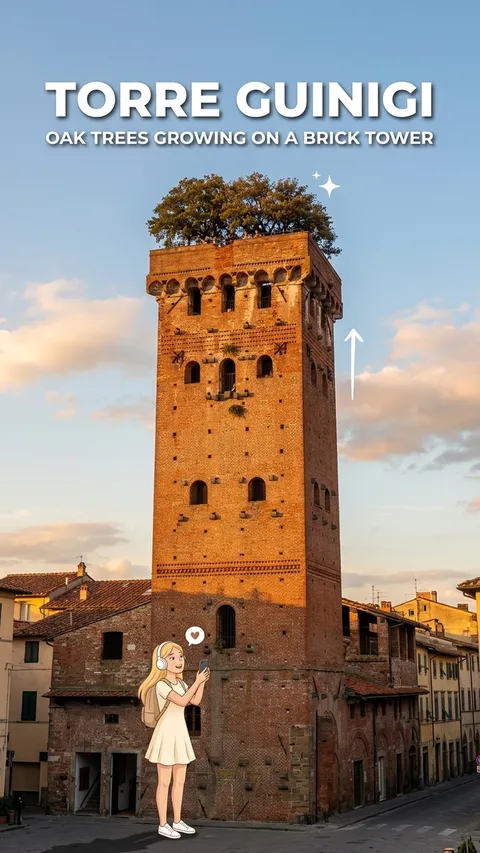
- Torre Guinigi (around €8; daily 10:00 a.m. to 6:30 p.m.): 230 steps to a rooftop garden of holm oaks growing out of the stone, and the most photographed landmark in the city.
- Piazza dell'Anfiteatro (free, open 24/7): the oval piazza built over a Roman amphitheatre, the most distinctive space in the city. Eat just off it for better food at lower prices.
- Duomo di San Martino (€5; Mon to Sat 9:30 a.m. to 6:00 p.m., Sun 11:30 a.m. to 5:00 p.m.): the Romanesque cathedral that holds the Volto Santo relic and Jacopo della Quercia's marble tomb of Ilaria del Carretto.
- Basilica di San Frediano (free; Mon to Sat from 9:00 a.m., Sun to 6:00 p.m.): a golden 12th-century facade mosaic and the mummified body of Santa Zita in a glass reliquary.
- Via Fillungo and buccellato from Taddeucci (street free): the 700-metre medieval shopping spine, with the anise-and-raisin ring cake the city has baked since 1881.
The route the tour walks with you
Instead of a generic "see the cathedral, then the walls" list, you walk one efficient loop and the tour walks it with you. This is the nine-stop order, a 3.3 km circuit starting at the cathedral by Porta San Pietro and finishing at the Torre Guinigi just off Via Fillungo:
- 1Lucca Cathedral (Duomo di San Martino) €5 · your start
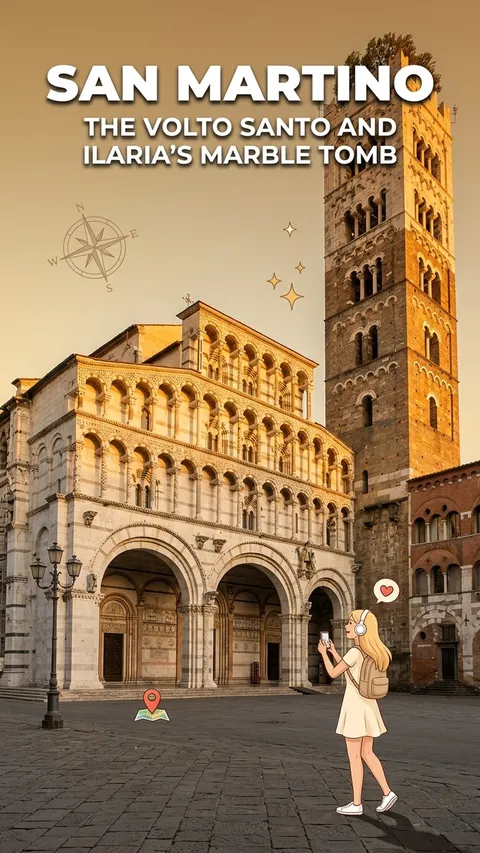
Five minutes in from the station through Porta San Pietro, the Romanesque cathedral is your entry point. Inside are the Volto Santo, the wooden crucifix Lucca venerates, and Jacopo della Quercia's marble tomb of Ilaria del Carretto, one of the loveliest funerary sculptures in Italy.
- 2Piazza San Michele & San Michele in Foro Free
The old Roman forum square, dominated by the dramatic tiered marble facade of San Michele in Foro topped by its winged archangel. This is the geographic and social heart of the city.
- 3Lucca City Walls Free
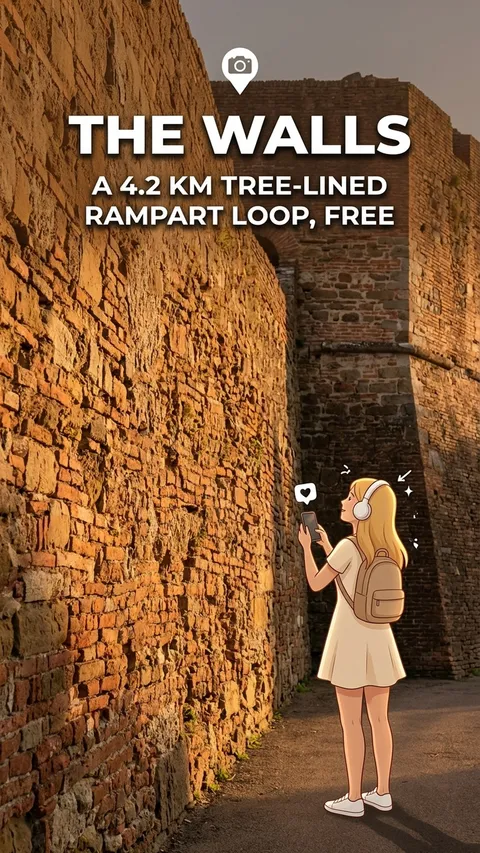
Climb up onto the fully intact Renaissance ramparts, the tree-lined 4.2 km loop that encircles the town and is Lucca's defining icon. Walk a stretch here to feel the shape of the place from above.
- 4Puccini's Birthplace (Casa Natale di Giacomo Puccini) €5
Lucca is Puccini's hometown, and his birthplace on Piazza Cittadella is a core first-timer stop, with the composer's letters, instruments and the piano he used for Turandot.
- 5Via Fillungo Free
The 700-metre medieval main street, the shopping and strolling spine of the centre, lined with old shopfronts and the clock tower, linking San Michele to the towers and the amphitheatre.
- 6Palazzo Pfanner €6
The baroque palace famed for its statue-and-fountain garden set against the city walls, the north-western turning point of the loop and a green pause before the churches.
- 7Basilica di San Frediano Free
The great basilica with its golden 13th-century mosaic facade just north of the amphitheatre, holding the glass reliquary of Santa Zita and an extraordinary Romanesque baptismal font.
- 8Piazza dell'Anfiteatro Free
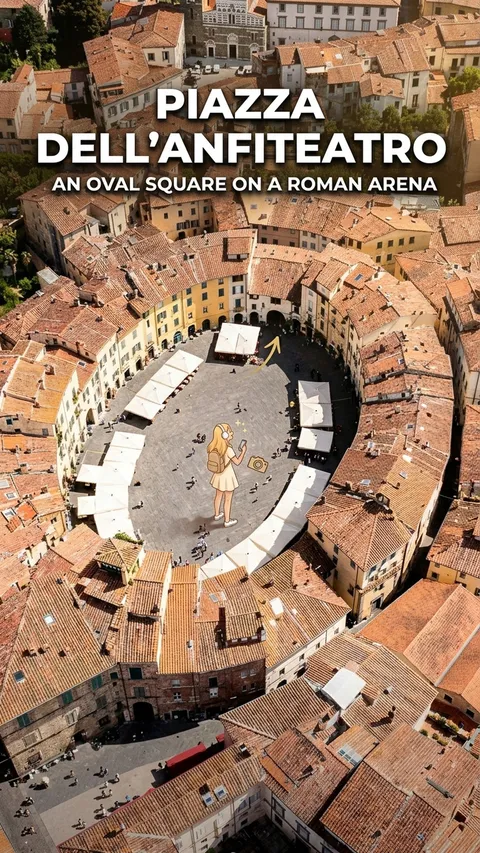
The elliptical square built directly on the ruins of the Roman amphitheatre, Lucca's signature postcard image, ringed by ochre houses and cafe tables. The natural spot to stop for lunch off to one side.
- 9Torre Guinigi Climb · €8
The brick tower crowned with holm oaks growing from its roof, 230 steps to the best rooftop view in Lucca and the city's most photographed landmark, just off Via Fillungo.
It runs in your browser, no app and no download. A voice guide walks the loop with you and leads a real conversation as you go: it greets you, tells the story between stops, asks what you actually want to see, and adapts. It is not a recording and not an audioguide. The map and step-by-step navigation get you from each stop to the next.
That whole loop is our free, self-guided Lucca walking tour, and because it can be launched from any of its stops, you do not backtrack to find an official start, you just begin where you are. You open it the moment you walk in through Porta San Pietro and enter the loop at the cathedral. It runs in your browser, with no app and no download. A voice guide walks the route with you and leads a real conversation as you go: it greets you, tells the story between stops, asks what you actually want to see, and adapts to your answers. It is not a recording and not an audioguide. The map and step-by-step navigation get you from the cathedral to the walls to the amphitheatre without squinting at Google Maps. See the full route on the Lucca walking tour page, and you get 100 free credits to try it.
Insider Tips for the Lucca Day Trip
The mistakes on this route are small and entirely avoidable. The big ones are about the ticket, the calendar, and the heat.
Do
- Validate your paper ticket in the platform machine before boarding
- Take the earliest train you can stomach to bank more daylight
- Pick a direct ~1h20 train, not the Pisa-change service
- Cycle the walls early or in the evening in summer
- Bring some cash for small vendors and the odd booth
- Wear sturdy shoes, because Lucca is a walking city
Don't
- Don't assume a booked ticket means a reserved seat, because there are none
- Don't tack Lucca onto a half-day after Pisa if you can avoid it
- Don't accidentally book the ~1h45 train that changes at Pisa
- Don't cycle the exposed walls at midday in July or August
- Don't visit during Lucca Comics & Games, when the city is gridlocked
- Don't plan a Monday and expect everything open, since some sites close
One small warning that catches people out: inspectors on these regional trains are strict about validation, so a stamped or properly activated ticket is not optional.
The one date to genuinely avoid is Lucca Comics & Games, the week around Halloween, when the festival fills the city for almost a week and ordinary sightseeing gets difficult. Hotels across the whole area up to Pisa book up well ahead, so check the calendar before you set a date in late October.
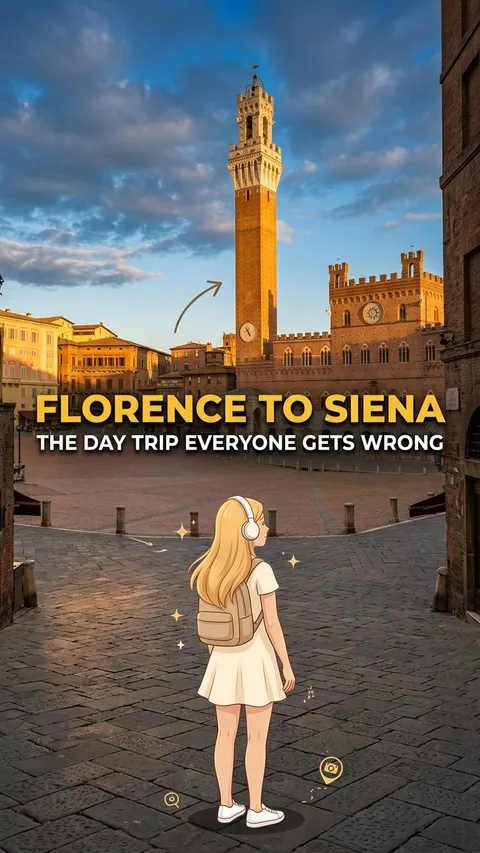
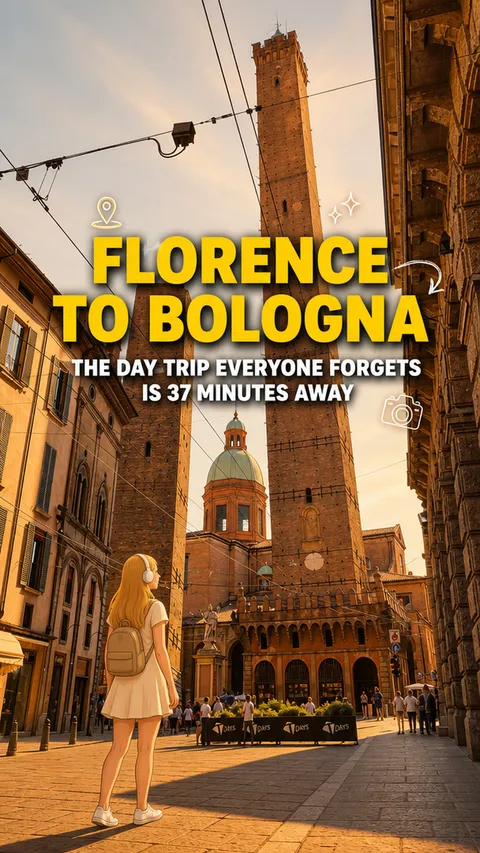
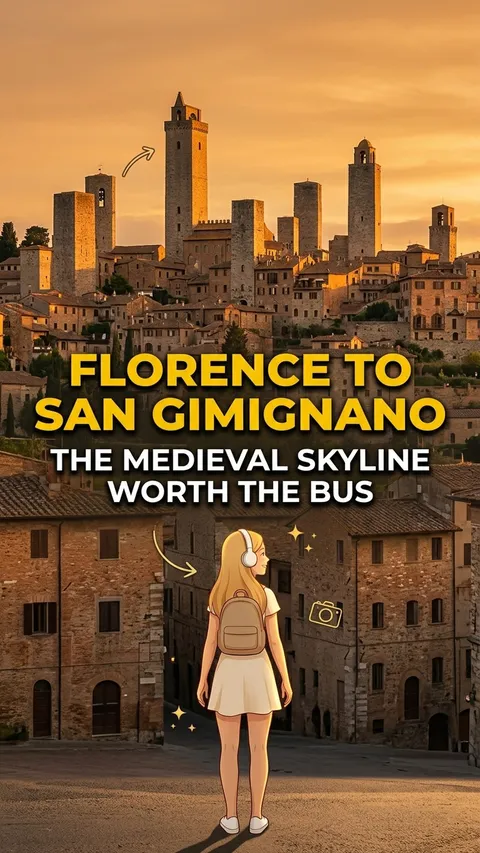
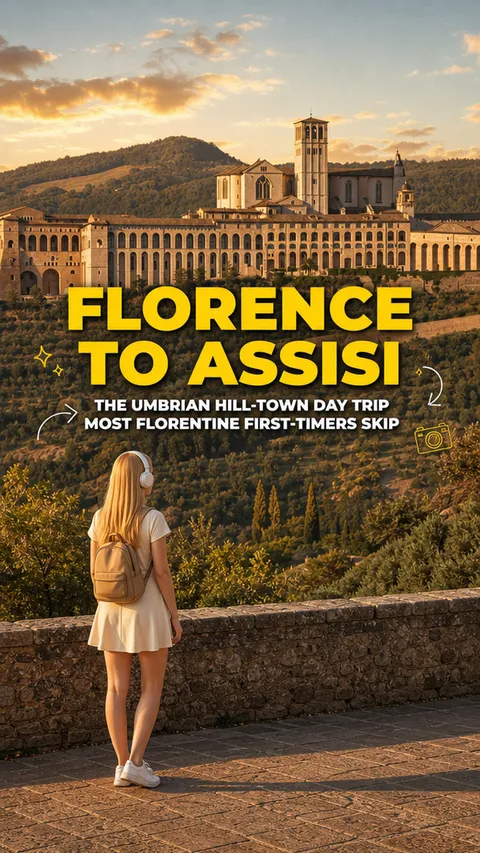
More day trips from Florence
Out in the morning, back in time for dinner. Every route here fits in one full day.
What the Florence to Lucca Journey Feels Like
This is the part no timetable captures. Lucca's appeal is texture, not headline sights, and there is one word for it: lived-in. Venture past the cathedral into the old city and what strikes you is how little of it is staged. Very little branding, very few souvenir racks, and fruit-and-veg vendors still trading with regulars in the morning. Unlike Siena or San Gimignano, Lucca does not feel designed for tourism. People actually live and work inside the walls, and that ordinariness is the whole point.
The walls are the heart of it, a long park on top of a fortress where the entire town comes to walk, run and cycle, and the amphitheatre piazza is the moment most people do not expect. The houses form a near-perfect elliptical ring around the open oval, the footprint of the Roman arena that once stood there, and stepping in through one of its low archways is the photograph everyone takes home.
The other thing people remember is lunch, eaten slowly at a family-run place a few steps off the main piazza, where fresh pasta costs less and tastes better than anything on the tourist drag. That is the rhythm Lucca rewards: walk the walls, climb a tower, sit down, let the afternoon run long. It is the kind of day that has talked more than a few visitors into wishing they could stay.
Florence to Lucca: Your Questions Answered
Can you do Florence to Lucca as a day trip?
Yes, easily. It is about 1 hour 20 minutes each way on a direct regional train, the station sits right at the city walls, and the historic centre is small and car-free. We would give it a full day rather than a rushed half-day, but the logistics are about as simple as Tuscan day trips get.
How long does the train take, and how often does it run?
The direct regional train takes about 1 hour 20 minutes. There are roughly 43 trains a day, about every 30 to 60 minutes, with the first around 5 a.m. and the last back from Lucca after 10 p.m. Avoid services that take around 1 hour 45 minutes and change at Pisa unless you want to stop there. Weekend and holiday service is reduced.
How much does it cost?
A one-way regional ticket is roughly €7 to €10, and a round trip comes in under €20. The fare is fixed with no dynamic high-speed pricing, so booking ahead saves you nothing on price. Buy at the station or on the Trenitalia app.
Which is better, the train or the bus?
Take the Trenitalia train. The Autolinee Toscane bus is slightly cheaper at €5 to €7 and a touch faster at around 55 minutes, but it runs only every 2 to 3 hours, and FlixBus runs at impractical evening times for day trips. The train is the clear pick for day-tripping.
Should I drive instead?
No. The car is fastest on paper at around 45 to 50 minutes on the A11 with a toll of about €5, but cars cannot enter the historic centre, so you park outside the walls in lots that frequently fill up. The train is the better call almost every time.
Do I need to book in advance or validate the ticket?
No reservation is needed, since regional trains have no assigned seats. But you must validate a paper ticket in the green and yellow platform machine before boarding, while mobile tickets validate via the confirmation email. Inspectors are strict.
Should I combine Lucca with Pisa in one day?
Only if you are pressed for time. Lucca and Pisa are about 30 minutes apart by train, around €4, every 30 minutes, and the standard plan is Pisa in the morning, arriving before 9 a.m. for the Leaning Tower, then Lucca in the afternoon. The honest caveat is that a half-day each covers the highlights but does neither city justice, and a full day in Lucca alone is more rewarding than a split across both.
What is the one thing I shouldn't miss?
Cycling or walking the 4.2 km loop on top of the Renaissance walls. It is free, flat and tree-lined, and it is the single best thing to do in Lucca.
When should I avoid going?
Halloween week, when Lucca Comics & Games takes over the entire city and sightseeing becomes impossible. Also skip midday on the exposed walls in high summer, and note that some shops and sites close on Monday mornings.
Plan Your Lucca Day Trip
You have the train sorted, and that is the part most people get wrong. Now make the hours on the ground count. The nine-stop loop above is our free, self-guided Lucca walking tour, and it starts from any stop, so you launch it the second you walk in through Porta San Pietro. Open it and start walking with 100 free credits.
Planning the wider trip:
- Best time to visit Lucca: the season-by-season guide covers why spring and autumn beat the exposed-wall summer heat, and which weeks to dodge.
- More Tuscan day trips: Pisa, Siena and San Gimignano all pair naturally with a Florence base.
