Self-Guided Walking Tour in Gniezno

Five stops through Poland's first capital, from the Museum of the Origins of the Polish State up Lech Hill to the Old Market Square, about 1.8 km end to end. This page maps the route, times every leg, and lists the real prices and opening hours for the museums and the cathedral.

5 Stops1.8 km~1 hours walkingAbout 3 hours with stops
What you get with AI Tourguide
Full GPS navigationInteractive AI guidePersonalized to youWorks in your browser
Try this tour with Alex

Gniezno Walking Tour at a Glance

This route is built for anyone who wants Poland's founding story on foot without a group or a fixed schedule. It runs from the origins museum to the market square in five stops, and every interior along the way is optional: the cathedral is free, the two museums cost a few zloty, and you decide on the spot which doors to open. The whole thing is self-guided and easy to follow in a town this compact.

StartMuseum of the Polish State Origins (Muzeum Początków Państwa Polskiego)
FinishMarket square (Rynek)
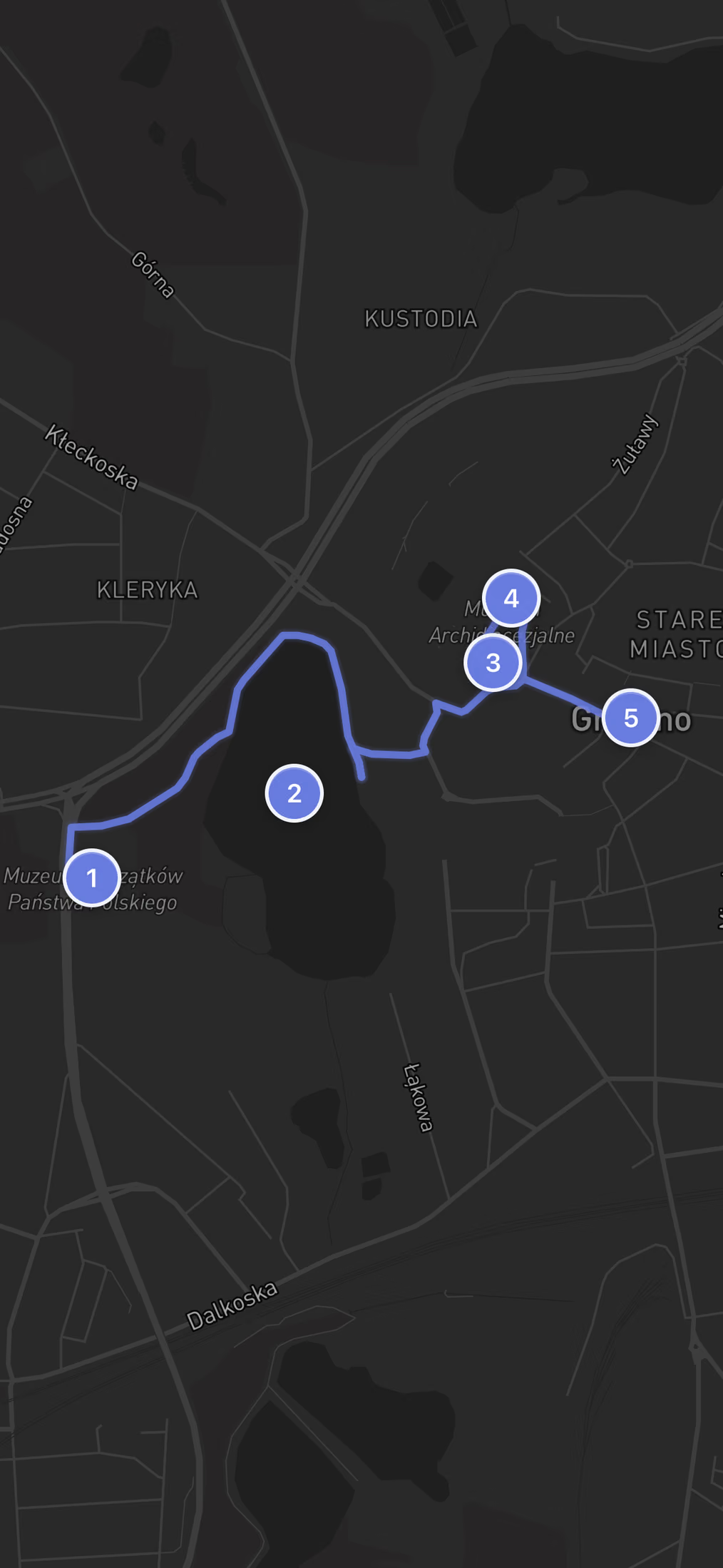
Route typeA short point-to-point walk heading broadly north-east and uphill, from the lakeside museum up Lech Hill to the cathedral cluster, then a few steps south-east to the market square. No backtracking, no loop.
Realistic timeUnder half an hour of pure walking across roughly 1.8 km, but plan about three hours once you factor in two museums and time inside the cathedral. Outdoor-only, you could do it in an hour.
DifficultyEasy and short at about 1.8 km, with one gentle climb up Lech Hill from the lake to the cathedral. Surfaces mix pavement, cobbles near the cathedral, and a packed path by the water.
Cost to followFollowing the outdoor route costs nothing. Two interiors charge admission: the Museum of the Origins of the Polish State at zł 18 and the Archdiocese of Gniezno Museum at zł 15. The cathedral, the lake and the square are all free.
Best for:

Day-trippers from Poznan, history-minded travellers, and anyone who wants the founding story of Poland in a calm half day rather than a crowded big-city rush.

The Route

Free Walking Tour Map of Gniezno

5 stops1.8 kmabout 1 hours
Loading the interactive map…The complete walking route will appear here.
Want the route to guide you while you walk?Open the route with navigation and a personal guide for the history, stories and questions that matter to you.
Open route + AI guide

The 5 stops along this route

  1. Museum of the Polish State Origins (Muzeum Początków Państwa Polskiego) in Gniezno, stop 1 on the self-guided walking tour
    1Museum of the Polish State Origins (Muzeum Początków Państwa Polskiego)
  2. Lake Jelonek in Gniezno, stop 2 on the self-guided walking tour
    2Lake Jelonek
  3. Gniezno Cathedral Library in Gniezno, stop 3 on the self-guided walking tour
    3Gniezno Cathedral Library
  4. Museum of Archdiocese (Muzeum Archidiecezjalne) in Gniezno, stop 4 on the self-guided walking tour
    4Museum of Archdiocese (Muzeum Archidiecezjalne)
  5. Market square (Rynek) in Gniezno, stop 5 on the self-guided walking tour
    5Market square (Rynek)
  6. That's the complete route.

    If you want more than the map and text, add live navigation and a conversational AI guide while you walk.

    Open route + AI guide
    You made it
Stop 1 of 5
Swipe →

Your Gniezno Walking Tour, Stop by Stop

  1. 1

    Museum of the Polish State Origins (Muzeum Początków Państwa Polskiego)

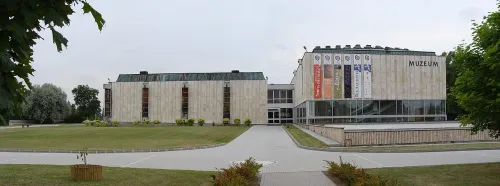
    Museum of the Polish State Origins (Muzeum Początków Państwa Polskiego) in Gniezno, stop 1 on the self-guided walking tour

    Start here, in the low modern building at the foot of Lech Hill. This museum exists for one reason: to explain why a town this size was once a country's capital. The permanent exhibition, opened in 1983, walks you through the rise of the Polish state in the 10th century under Mieszko I and his son Boleslaw the Brave, with archaeology dug up from the surrounding hills. Spend the time to read the panels on the early Piast dynasty, because the next three stops will mean far more once you have. Entry is zl 18, and it is open daily 9:00 to 18:00, so you cannot get the timing wrong. Plan on 45 minutes to an hour. There is an audiovisual film worth catching if it is running. Skip nothing inside, but do not linger past an hour, the hills are calling.

    Hours
    Daily: 9:00 AM – 6:00 PM
    Price
    zł 18
  2. 2

    Lake Jelonek

    Lake Jelonek in Gniezno, stop 2 on the self-guided walking tour

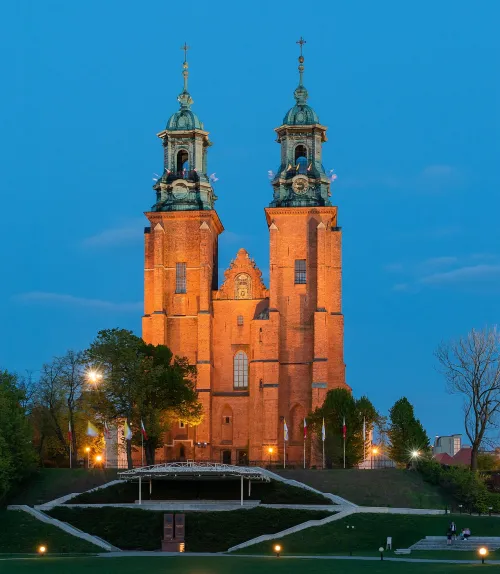
    Step outside and the lake is right there. Jelonek is small, more pond than lake, but its job is the view. Walk to the water's edge and look back up at Lech Hill: the twin towers of the cathedral rise straight out of the trees, and on a still day they double in the reflection. This is the postcard shot of Gniezno, the one on every fridge magnet in town. It costs nothing and is open at all hours, so there is no reason to rush past it. Use it as a breather between the dim museum and the climb ahead. The path around the near shore is short and flat. Benches face the water if you want five minutes. Photographers, this is your spot, and the light is best when the sun is behind you in the afternoon.

  3. 3

    Gniezno Cathedral Library

    Gniezno Cathedral Library in Gniezno, stop 3 on the self-guided walking tour

    Now the climb pays off. The Primatial Basilica of St. Adalbert is the anchor of the whole town, a Gothic giant where Boleslaw the Brave was crowned Poland's first king in 1025, followed by four more coronations here. Inside lies the tomb of St. Adalbert, the martyred bishop whose relics made Gniezno a pilgrimage site. Do not leave without finding the bronze Gniezno Doors in the south porch: cast in the 12th century, they show the life of St. Adalbert in 18 relief scenes and are among the finest Romanesque bronze work in Europe. Entry to the cathedral is free, open daily 7:00 to 19:00. The doors keep their own hours, roughly Mon-Fri 7:00-18:00 and Sat 8:00-14:00, closed Sunday, so a weekday morning is your safest bet to see them properly. Give it 45 minutes.

    Hours
    Daily: 7:00 AM – 7:00 PM
    Price
    Free
  4. 4

    Museum of Archdiocese (Muzeum Archidiecezjalne)

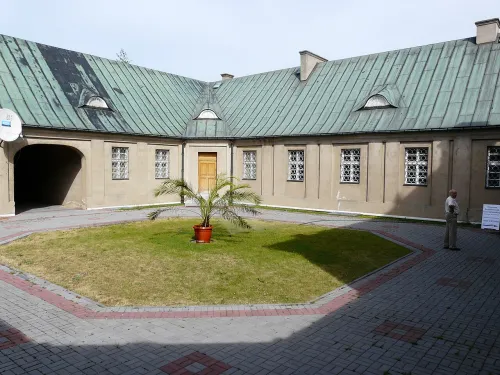
    Museum of Archdiocese (Muzeum Archidiecezjalne) in Gniezno, stop 4 on the self-guided walking tour

    Tucked right beside the cathedral on ul. Kolegiaty, barely a hundred metres from the nave, this is the cathedral's treasury made public. It opened in 1991 and holds the church silver, vestments, manuscripts and reliquaries that a thousand years of being Poland's premier diocese accumulates. If the medieval and baroque liturgical art does nothing for you, this is the one stop on the route you can skip without guilt. But if the cathedral left you curious, the treasury is the payoff, and at zl 15 it is cheap. The catch is the hours: Monday to Saturday 9:00 to 17:00, and closed all day Sunday. So if you come on a Sunday, the museum and the Gniezno Doors are both shut, which is worth planning around. Half an hour covers it.

    Hours
    Mon-Sat: 9:00 AM – 5:00 PM | Sun: Closed
    Price
    zł 15
  5. 5

    Market square (Rynek)

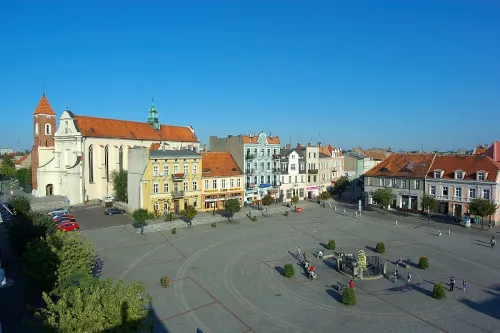
    Market square (Rynek) in Gniezno, stop 5 on the self-guided walking tour

    Down off the cathedral hill, the Rynek sits on Wzgorze Panienskie, one of Gniezno's seven hills, and marks the secular heart of the old town after all that sacred weight. This is where you stop walking and start sitting. The square is open and free at any hour, ringed with townhouses and a few cafes where a coffee costs a fraction of what you would pay in Krakow's main square. Order one, take an outside table, and watch a small Polish town go about its day, locals crossing with shopping bags rather than selfie sticks. It is an honest place to end, no big monument demanding attention, just the spot where the town actually lives. If you still have energy, the side streets off the square are worth a short loop before you head back to the station.

    Hours
    Open 24/7
    Price
    Free

How Long Does This Walking Tour Really Take?

The walking itself is under 30 minutes across about 1.8 km, so the clock is really set by what you go inside. Budget roughly an hour at the origins museum, 45 minutes in the cathedral with the bronze doors, and half an hour in the treasury, which adds up to about three hours door to door.

Budget about three hours door to door, even though the actual walking is under half an hour. The two museums eat the time: an hour at the Museum of the Origins of the Polish State and half an hour at the Archdiocese treasury, with another 45 minutes inside the cathedral. The cathedral is where you should slow down most, give the Gniezno Doors real attention rather than a glance, and walk the ambulatory past St. Adalbert's tomb.

The natural break is the end. Save your sit-down for the Old Market Square, where a cafe coffee is cheap and the outdoor tables let you watch the town. If you need a pause earlier, the benches at Lake Jelonek facing the cathedral reflection are the better spot than anything indoors. With kids or a slower pace, you could stretch the whole thing to a relaxed half day without ever feeling rushed.

Full Route, Shorter Walk or Two-Day Version?

The full walk is only five stops and barely 1.8 km, so most people do all of it. But the two paid museums are where the time goes, and if you are short on hours or arriving on a Sunday when the treasury is closed, there are sensible ways to trim.

The Short Version

Cathedral and square in about 90 minutes

Stops 2 to 5, about 900 m, roughly 90 minutes, skipping the origins museum.

If you already know the Piast backstory or you are tight on time, skip stop 1 and start at Lake Jelonek for the reflection view. Walk up to the cathedral and the bronze doors, decide on the spot whether the treasury is worth zł 15, then end on the market square. You keep the two icons and lose only the museum hour.

The Easy Half-Day

Two calm halves split at the cathedral

Stops 1 to 3, then a break, then stops 4 to 5. About 3 to 4 relaxed hours.

Do the origins museum, the lake and the cathedral, then take a proper break, ideally coffee before you tackle the treasury. Pick the second half back up at the Archdiocese Museum and drift down to the market square. Best for a slower pace, for families, or if you want to linger over the Gniezno Doors without watching the clock.

You can walk it in reverse from the Old Market Square down to the museum, but the given direction is better: it saves the uphill for after the origins museum has explained why the cathedral matters, and it ends you on the square where the cafes are, not back at a lakeside museum.

Is This Gniezno Walking Tour Right for You?

This is one of the gentler routes we map, short and flat apart from one hill, but it suits some visitors better than others. Here is who it fits and how to bend it to your day.

A good fit if you…

  • Day-trippers from Poznan, which is roughly 30 to 40 minutes away by frequent regional train
  • History-minded travellers who want the origin story of the Polish state told in the right order
  • Anyone who prefers a quiet, uncrowded town over the tour-group crush of Krakow or Warsaw
  • Slower walkers and families, since the whole route is under 1.8 km with only one modest climb

Adapt the route if you…

  • You are visiting on a Sunday: the Archdiocese Museum is closed and the bronze doors keep short hours, so plan around it
  • You have less than two hours: use the short version and skip the origins museum, keeping the cathedral and square
  • Rain is forecast: lean on the two indoor museums and the covered cathedral, and keep the lake and square brief
  • You care most about the cathedral interior: consider arranging a guide there rather than for the whole compact town

Tickets & Skip-the-Line in Gniezno

Gniezno has no ticket queues to speak of, so there is nothing to book in advance here. What matters instead is opening hours, especially on Sundays. Two stops charge admission and two of the highlights are closed or restricted on Sunday, so this is timing guidance more than a line-skipping trick.

Museum of the Polish State Origins (Muzeum Początków Państwa Polskiego)Admission zł 18. Open daily 9:00 AM to 6:00 PM, so timing is easy. Buy at the door; no advance booking needed. Budget about an hour inside and use it as your first stop.
Gniezno Cathedral LibraryFree entry, open daily 7:00 AM to 7:00 PM. The bronze Gniezno Doors keep shorter hours and are hard to see properly on a Sunday, so a weekday morning is safest. official ticket site ↗
Museum of Archdiocese (Muzeum Archidiecezjalne)Admission zł 15. Open Monday to Saturday 9:00 AM to 5:00 PM, closed all day Sunday. Pay at the door. If you come on a Sunday you will find this treasury shut, so plan a weekday visit.
Everything elseLake Jelonek and the Old Market Square are free, open 24/7 outdoor spaces with nothing to book. Just walk in whenever you arrive.
Optional upgrade
+1
The same 5-stop route,
now with navigation and a guide.
Optional AI experience

You already have the route.
The AI guide brings it to life.

Standing at the foot of Lake Jelonek looking up at the cathedral towers? Open AI Tourguide in your browser, nothing to install, and a voice guide walks the whole route up Lech Hill with you, telling the story of the coronation site of Poland's first kings and the 12th-century bronze doors, asking what you want to see and shaping the walk around your answers. A real conversation that walks with you, not a recording. Start with 100 free credits.

Livenavigation13languagesAnyquestionYourinterests
Open this route with the AI guide

Try it in your browser · No app or download required

Tips for Walking in Gniezno

  • Gniezno's train station is about a 10 to 15 minute walk southeast of the route. Frequent regional trains run from Poznan in roughly 30 to 40 minutes, making this an easy day trip; aim to arrive mid-morning so you finish the museums before they tire you.
  • The walk is short but it climbs Lech Hill from the lake to the cathedral. Surfaces are a mix of pavement, cobbles around the cathedral, and a packed path by the water. Flat comfortable shoes are plenty, no need for hiking boots.
  • Restrooms are reliable inside the Museum of the Origins of the Polish State, your first stop, so use them before the climb. There are no public toilets at the lake or in the cathedral.
  • End at a cafe on the Old Market Square for coffee and cake at small-town prices, well under what Krakow charges. A Polish szarlotka (apple cake) with your coffee is the order to make.
  • For the classic Gniezno photo, stand at the west shore of Lake Jelonek and face back toward the cathedral towers; afternoon light with the sun behind you gives the cleanest reflection on a calm day.

Why Walk This Route?

Gniezno is small, and that is the point. Poland's first capital fits into an afternoon on foot, with the whole story packed onto one cluster of low hills above a lake. This route is barely 1.7 km end to end, but it covers a thousand years: the museum that explains why this town mattered, the lake that gives you the famous cathedral reflection, the cathedral itself where the first Polish kings were crowned, the treasury beside it, and the old market square where you finally sit down. You can walk the whole thing in under half an hour of actual walking. Give it three hours with the stops.

Why this exact order? It builds. Most people arrive knowing Gniezno is "the first capital" without knowing what that means. So you start at the Museum of the Origins of the Polish State to get the backstory of Mieszko I and Boleslaw the Brave, then walk up to see the places those names belong to. Wandering on your own here is easy, the town is tiny and signposted, but you would walk past the bronze Gniezno Doors without knowing they are one of the most important Romanesque objects in Europe. This route makes sure you do not.

Gniezno also rewards low expectations. It is not Krakow. There is no crush of tour groups, no overpriced ticket queues. You will share the cathedral with a handful of pilgrims and locals, and the market square with people buying bread. That quiet is the experience. Come for half a day, treat it as a pilgrimage to where Poland started, and leave before you run out of things to do.

Common Questions

Is Gniezno safe to walk around?

Yes, very. It is a quiet, small Polish town with little crime and almost no tourist-targeted scams. The route stays in the compact historic core around Lech Hill, which is calm by day. Normal common sense around the train station after dark is all you need.

What if it rains during my Gniezno tour?

You are in luck, because two of the five stops are indoor museums. Stretch your time at the Museum of the Origins of the Polish State and the Archdiocese treasury, and the cathedral itself is a large covered space. Only the lake and the market square leave you exposed, and both are quick. A half-day here works fine in bad weather.

What's the best time of day for this walking tour?

Mid-morning on a weekday, ideally Monday to Saturday. The Archdiocese Museum and the Gniezno Doors are closed on Sundays, so a Sunday visit loses two highlights. Starting around 10:00 lets you do both museums and the cathedral, then reach the market square for a late lunch.

Take this route with you

Open this exact tour with navigation and your personal AI guide.

Start GPS Navigation + AI Guide
AI Tourguide
Researched and curated by the AI Tourguide teamWe plan and quality-check every route, then research and verify the opening hours, prices, and practical tips for each stop along it.
▶ Open route with AI guideNavigation, stories and your questions