Self-Guided Walking Tour in Wroclaw

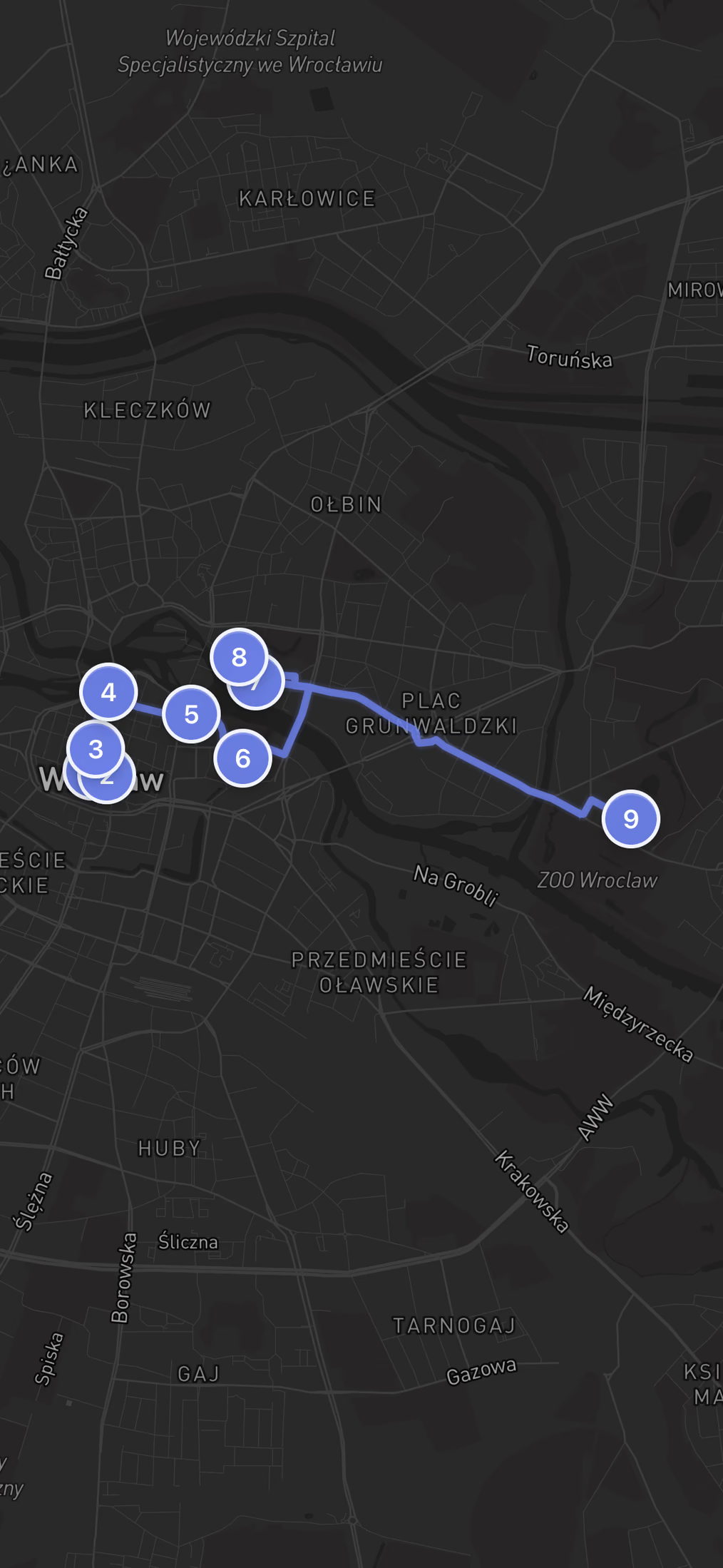
9 Stops 6.2 km ~2.6 hours
Start This Tour Free
Walking tour route map of Wroclaw
Start This Tour Free

Why Walk Wroclaw? A Self-Guided Tour

Wroclaw is a walking city in the way few places are. The Old Town is flat, compact, and almost entirely pedestrian, and the river quarter sits a short stroll east of the Rynek, so you can cover the genuine highlights on foot without ever touching a tram. The cobbles change underfoot from the square to the cathedral island, but nothing is steep and nothing is far apart until the very last stop.

This route runs west to east, from the giant Market Square through the university quarter, past the 1908 market hall, into the museums, then across the Odra onto Ostrow Tumski, the oldest corner of the city. It ends out at Centennial Hall, the one stop where you should take a tram rather than walk. The order matters. You start in the loud, colourful centre, hunt the bronze dwarfs along the way, then slow down on the gas-lit cathedral island as the day winds down.

Wandering Wroclaw at random works, but you will miss things. The dwarfs are easy to walk past, the Panorama needs a timed ticket, and the cathedral tower closes earlier than you think. This route puts them in an order that makes sense and warns you what to book ahead.

The Route: 9 Stops

Swipe through images or scroll names below

Scroll to explore →
1. Wroclaw Market Square
2. Old Town Hall
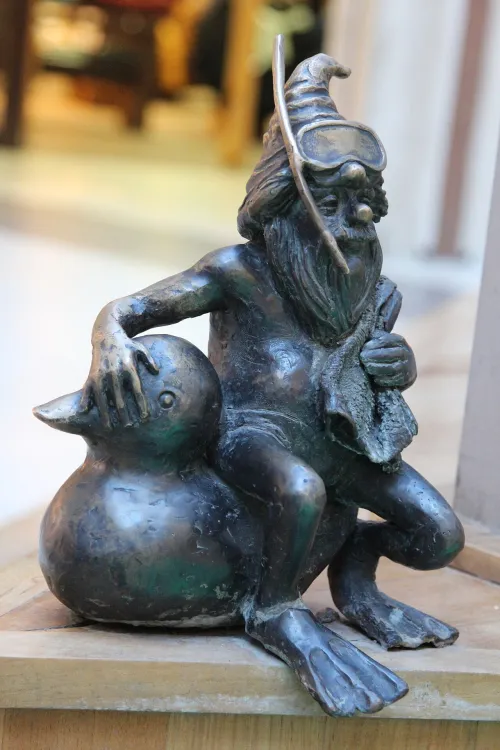
3. Wroclaw Dwarfs
4. Wroclaw University
5. Hala Targowa
6. Panorama of the Battle of Raclawice
7. Cathedral of St. John the Baptist
8. Ostrow Tumski
9. Centennial Hall

Route Map

Tap to load interactive map
AI Tourguide
Walk this exact route with a private AI guide.
Full GPS navigation, interactive stories, and a guide that answers all your questions. A private guide experience for just €5/hour.
Start This Tour

Your Wroclaw Walking Tour, Stop by Stop

  1. 1

    Wroclaw Market Square

    Wroclaw Market Square, stop 1 on the self-guided walking tour

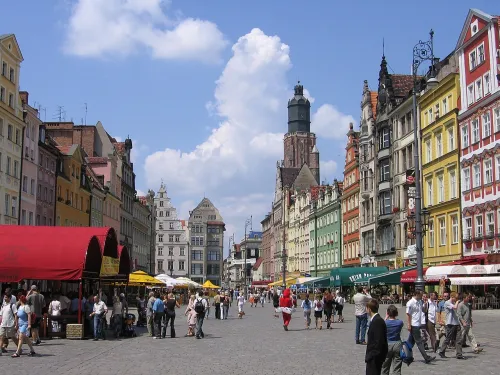
    You step out of a narrow street and the square just opens up in front of you, far bigger than you expect. This is one of the largest medieval market squares in Europe, ringed on all four sides by tall burgher houses painted in mustard, pink, green and blue. Ten streets feed into it, two at each corner, and the middle is filled by a block of buildings rather than left empty. It is free, open, and the natural place to begin. Grab a coffee at one of the cafe terraces and just orient yourself before the walking starts. Note the Sunday-only food stalls if you are here on a weekend morning. The square is busiest in the evening when the terraces fill, so an earlier visit gives you cleaner photos of the house facades without crowds in front of them.
    Hours
    Mon-Sat: Closed | Sun: 6:00 AM – 3:00 PM
    Price
    Free

    2 min walk to next stop

  2. 2

    Old Town Hall

    Old Town Hall in Wroclaw, stop 2 on the self-guided walking tour

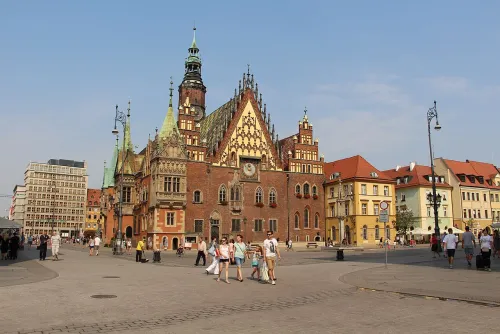
    Turn toward the centre of the square and the Old Town Hall rises out of the building block in the middle, all Gothic spikes, an astronomical clock and a steep tiled roof. It took centuries to build and shows it, with each section in a slightly different style. For a long time this was the seat of the city authorities and the court, until a New Town Hall was built alongside it in the 19th century. From the outside it is free and open around the clock, so circle it slowly and look at the carved stonework and the gilded clock face on the east side. Inside is a museum branch if you want it, but most people are happy with the exterior. The eastern facade catches morning light best. Behind the building, look down: the first dwarf statues start appearing right here.

    Hours
    Open 24/7
    Price
    Free

    3 min walk to next stop

  3. 3

    Wroclaw Dwarfs

    Wroclaw Dwarfs, stop 3 on the self-guided walking tour

    Once you start looking down, you cannot stop. Small bronze dwarfs are dotted all over the Old Town, perched on ledges, climbing drainpipes, pushing tiny carts. The first five were placed by sculptor Tomasz Moczek in August 2005, and the count has kept growing ever since, well past 600 now. They trace back to the Orange Alternative, an 1980s protest movement that mocked the communist system with chalk dwarfs. Hunting them is free and genuinely fun, especially with kids. You will not find them all, nobody does, but the cluster around the Rynek and the streets north of it is dense. Tourist offices sell a dwarf map for a few zloty if you want to make a game of it. Look low: most sit at ankle or knee height, by doorways, fountains and shop entrances. The ones near the Hala Targowa and the university appear later on this walk.

    Hours
    Open 24/7
    Price
    Free

    5 min walk to next stop

  4. 4

    Wroclaw University

    Wroclaw University, stop 4 on the self-guided walking tour

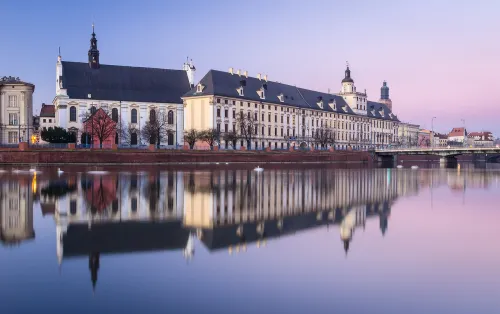
    Head north up Kuznicza and the streets get quieter and more academic. The main university building sits on the river side, a long Baroque block founded in 1702 as the Academia Leopoldina by Emperor Leopold I. This is the oldest university in the city, with over 23,000 students today. The reason to go in is the Aula Leopoldina, a ceremonial hall upstairs covered in frescoes, gilding and sculpture, one of the finest Baroque interiors in Poland. Entry is 20 zl, and from May to September it opens 10:00 to 17:00 most days, with longer weekend hours, though it closes on Wednesdays, so do not plan this stop for a Wednesday. The same ticket usually includes the Mathematical Tower with a rooftop view over the rooftops and the Odra. Allow 30 to 45 minutes if you go inside.

    Hours
    May-Sep: Mon-Fri (except Wed): 10:00 AM – 5:00 PM | Sat-Sun: 10:00 AM – 6:00 PM
    Price
    zł 20

    6 min walk to next stop

  5. 5

    Hala Targowa

    Hala Targowa in Wroclaw, stop 5 on the self-guided walking tour

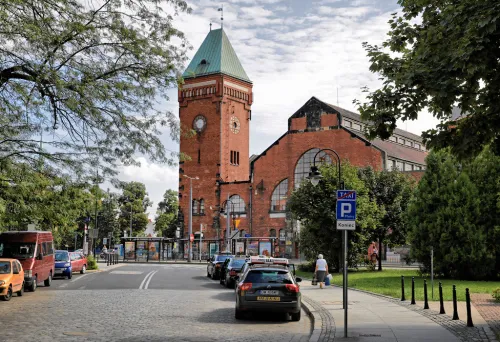
    Cross back toward the river and duck into the Hala Targowa, a working market hall from 1908 that most tourists walk straight past. Push through the doors and look up: the ceiling is a row of huge parabolic concrete arches, an engineering showpiece for its day, designed by Richard Pluddemann and Heinrich Kuster. Below it, two floors of stalls sell fruit, flowers, cheese, bread and cheap lunches. It is free to enter and open Monday to Saturday, 8:00 to 18:30, but closed all day Sunday, so time it for a weekday. This is the spot to grab a pierogi plate or fresh fruit for far less than the square charges. Buy something, eat standing up, and use the toilets here before the river crossing. The arches photograph best from the upper gallery looking down the length of the hall.

    Hours
    Mon-Sat: 8:00 AM – 6:30 PM | Sun: Closed
    Price
    Free

    4 min walk to next stop

  6. 6

    Panorama of the Battle of Raclawice

    Panorama of the Battle of Raclawice in Wroclaw, stop 6 on the self-guided walking tour

    A short walk east brings you to a low rotunda that hides one of the most unusual sights in Poland. Inside is the Panorama Raclawicka, a 360-degree painting of the 1794 Battle of Raclawice, where Kosciuszko's forces beat the Russians. Painted in 1893 to 1894 by a team led by Jan Styka and Wojciech Kossak, it wraps the whole room and blends into a foreground of real terrain so the edge between paint and floor disappears. The canvas came from Lwow and has hung here since 1980. Tickets are 50 zl and it runs daily 8:30 to 19:30, but slots are timed and sell out, so book ahead online through the National Museum. The visit, with the audio guide, takes about 30 minutes. Photography is allowed without flash. It is worth the ticket; there is genuinely nothing else like it on this route.

    Hours
    Daily: 8:30 AM – 7:30 PM
    Price
    zł 50
    Website
    mnwr.pl ↗

    5 min walk to next stop

  7. 7

    Cathedral of St. John the Baptist

    Cathedral of St. John the Baptist in Wroclaw, stop 7 on the self-guided walking tour

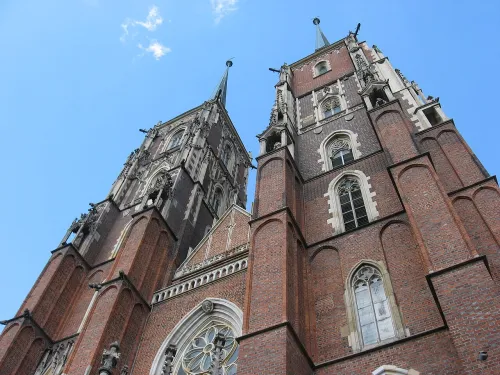
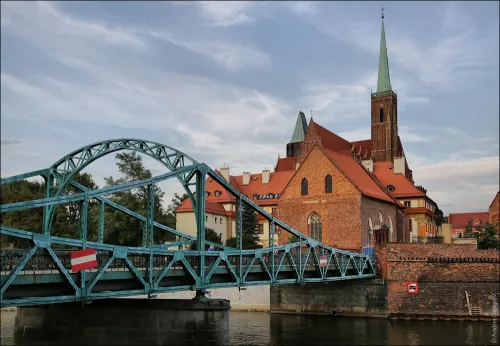
    Cross the Tumski bridge and the twin Gothic spires of the cathedral pull you the rest of the way. This is the heart of Ostrow Tumski, a brick Gothic church whose towers dominate the island skyline. Inside, the nave is free to enter, open Monday to Saturday 6:00 to 19:00 and Sunday from 6:30. The thing to pay for is the tower: a lift takes you up to a viewing platform for a view over the river, the spires and the red roofs of the Old Town you just crossed. Tower entry is 25 zl. Go up late afternoon when the light turns the brick warm, but check the closing time, because the tower shuts before the church does. Dress respectfully if a service is on. The cathedral square out front, with its Madonna statue, is the classic island photo.

    Hours
    Mon-Sat: 6:00 AM – 7:00 PM | Sun: 6:30 AM – 7:30 PM
    Price
    zł 25

    2 min walk to next stop

  8. 8

    Ostrow Tumski

    Ostrow Tumski in Wroclaw, stop 8 on the self-guided walking tour

    Step away from the cathedral and let the island itself slow you down. Ostrow Tumski is the oldest part of Wroclaw, settled on what was once a true island in the Odra before the side channels were filled. The streets are cobbled and quiet, lined with churches, the bishop's buildings and old brick walls. The thing to wait for is dusk. Every evening a lamplighter in a long coat walks the island lighting the gas street lamps by hand, one of the few places in Europe that still does this. It is free to wander and open all hours, so there is no ticket and no rush. Cross the small bridges, look back at the cathedral lit up, and find the love-padlock railings on the Tumski bridge. This is the calmest, most atmospheric stop on the whole walk; give it time rather than treating it as a passage through.

    Hours
    Open 24/7
    Price
    Free

    40 min walk to next stop

  9. 9

    Centennial Hall

    Centennial Hall in Wroclaw, stop 9 on the self-guided walking tour

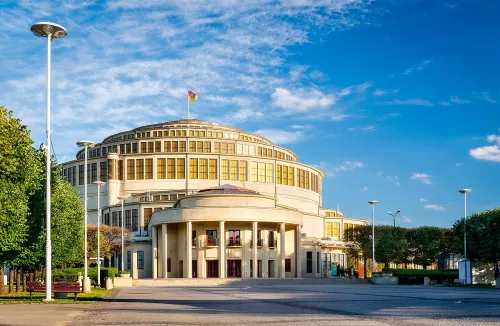
    This last stop sits a few kilometres east, so do not walk it. Hop on a tram heading toward the zoo and you will reach a vast concrete dome set in parkland. Centennial Hall, built 1911 to 1913 to a design by Max Berg, was an engineering leap when it opened: a reinforced-concrete dome wider than anything before it, an early-modern landmark that earned UNESCO World Heritage status in 2006. It still hosts concerts and events. The interactive Visitor Centre is open daily 10:00 to 18:00 and costs 30 zl. Around it sit the Pergola with its multimedia fountain, a Japanese garden and the zoo, so this end of the route easily fills an afternoon. The fountain shows run on a schedule in the warmer months, worth timing if you can. Even from outside the scale of the dome is the point; circle the building before deciding whether to go in.

    Hours
    Daily: 10:00 AM – 6:00 PM
    Price
    zł 30
AI Tourguide
Walk this exact route with a private AI guide.
Full GPS navigation, interactive stories, and a guide that answers all your questions. A private guide experience for just €5/hour.
Start This Tour

Self-Guided Tour vs. Group Tour in Wroclaw

You can do this entire route self-guided for very little. The square, the Old Town Hall exterior, the dwarfs and Ostrow Tumski are all free. The only paid stops are the ones genuinely worth paying for: the Aula Leopoldina at the university (20 zl), the Panorama Raclawicka (50 zl), the cathedral tower (25 zl) and the Centennial Hall Visitor Centre (30 zl). Add it all up and the full ticket cost is around 125 zl per person if you do everything, and you can easily skip a couple.

Guided walking tours of the Old Town run regularly, with paid group tours commonly in the 80 to 130 zl range and private guides higher. There are also free walking tours that work on tips, where a fair tip lands around 30 to 50 zl. A guide is useful for the dwarf history and the layered German-Polish past, which is not obvious from the buildings alone. But the route is short and the signage is decent, so most people do fine on their own.

The honest split: walk it yourself with this guide, and spend the money you save on the Panorama, which is the one stop where a ticket buys you something you cannot see anywhere else.

Group Tour AI Self-Guided
Price €25–€50 per person €5/hour or €20 all-inclusive
Flexibility Fixed schedule Start anytime, skip stops
Languages 1–2 languages 11 languages
Pace Group pace Your own pace

How Long Does This Wroclaw Tour Take?

Our route covers 6.2 km with 9 stops and takes approximately 2.6 hours at a relaxed pace.

Done properly, this is a half to full day. The walkable core from the Market Square to Ostrow Tumski takes about two hours of pure walking and looking, but the Panorama (30 min plus your booked slot) and the university interior (30 to 45 min) add real time, and you should not rush the cathedral island. Budget three to four hours for everything up to and including Ostrow Tumski.

Centennial Hall is a separate decision. With the tram ride out, the dome, and the surrounding park, fountain and gardens, it is an extra two to three hours, which is why many people make it a second outing rather than tacking it on tired. For a mid-walk break, the Hala Targowa is the best stop: cheap food, a bench, toilets and the arched ceiling overhead. Otherwise the cafe terraces on the Rynek are the obvious pause, just pricier.

Tips for Walking in Wroclaw

AI Tourguide
Walk this exact route with a private AI guide.
Full GPS navigation, interactive stories, and a guide that answers all your questions. A private guide experience for just €5/hour.
Start This Tour

AI Audio Guide for This Tour

Standing in the Rynek looking up at the Old Town Hall spires? Open the app and let it walk you stop by stop from here to the dwarfs, the Panorama and across to the cathedral island, with live directions and the real opening hours and prices for each. No guessing which dwarf is which, no missed timed tickets.

AI Audio Guide Stories, history and fun facts narrated as you walk. No earpiece rental needed.
GPS Navigation Turn-by-turn directions so you never get lost between stops.
Ask Anything Curious about a building you pass? Ask your AI guide on the spot.
11 Languages Switch language anytime. No separate tour needed.
Start This Tour Free

Common Questions

Yes, very. The Old Town, university quarter and Ostrow Tumski are calm and well-used day and night. Normal city sense applies: watch your bag in the crowded Rynek terraces and on busy trams, and around Swiebodzki and the train stations after dark. There are no notable tourist scams beyond occasionally inflated cafe prices on the square, so check the menu before sitting down.
This route has good indoor cover. The Panorama Raclawicka, the Aula Leopoldina at the university, the Hala Targowa market hall and the Centennial Hall Visitor Centre are all indoors and easily fill a wet afternoon. The cathedral interior is free and dry. Save the dwarf hunt and the open square for the breaks between showers.
Start mid-morning, around 10:00, so the university, Panorama and market hall are all open, and aim to reach Ostrow Tumski toward dusk. That timing lets you finish on the island as the gas lamps are lit by hand, the most atmospheric moment of the day. Early starts also mean emptier square photos before the terraces fill.
No booking needed. This self-guided tour is available anytime. Open the route on your phone and start walking. The AI audio guide works instantly, no reservation required.
The AI audio guide is available in 11 languages: English, German, French, Spanish, Italian, Japanese, Chinese, Portuguese, Danish, Norwegian, and Swedish.
Yes. Skip any stop, spend extra time at places you like, or start the route from any point. You can also ask the AI to suggest a shorter route.
AI Tourguide
Curated by AI Tourguide GPS-verified routes, reviewed and updated regularly.
Last verified June 2026