Self-Guided Walking Tour in Gorlitz

11 Stops 3.5 km ~2.3 hours
Start This Tour Free
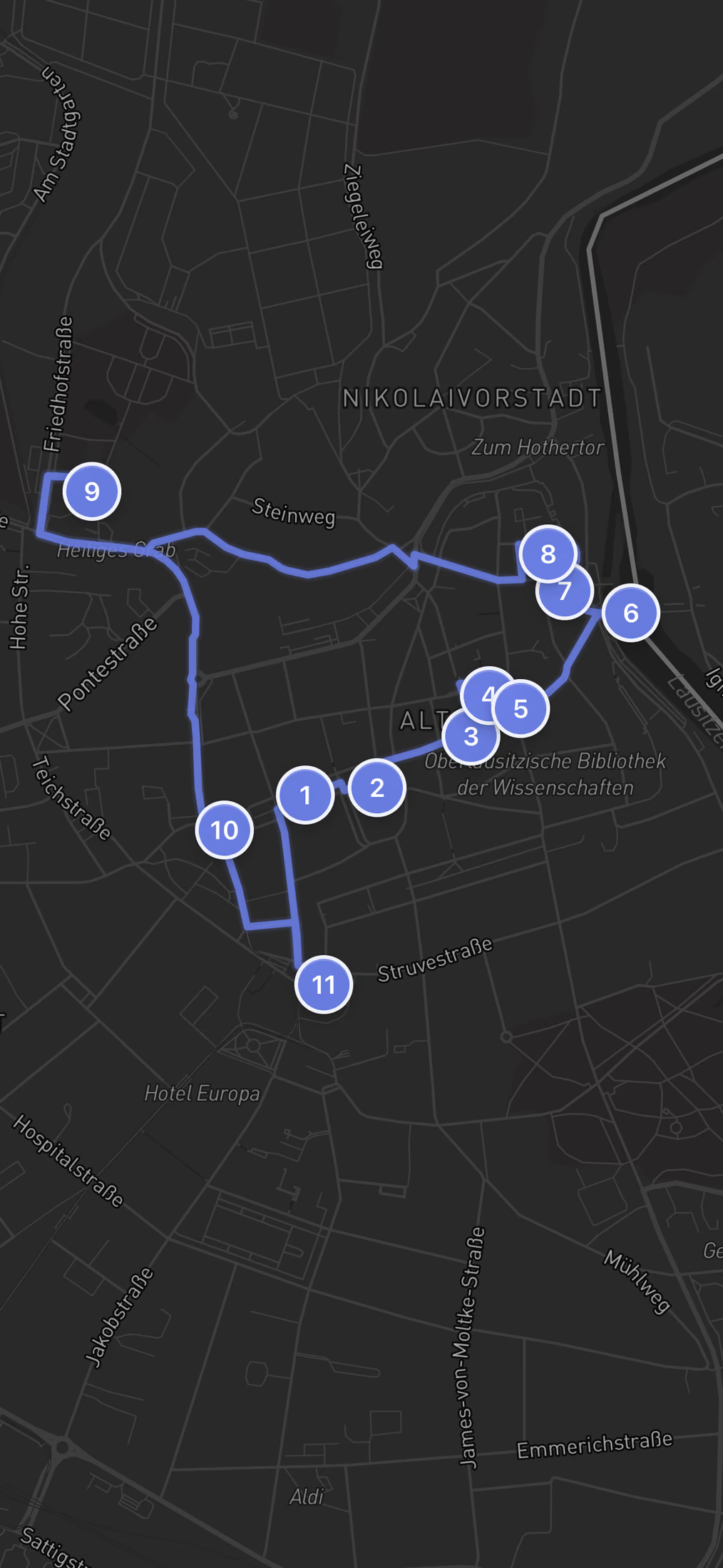
Walking tour route map of Gorlitz
Start This Tour Free

Why Walk Gorlitz? A Self-Guided Tour

Görlitz is the rare German old town that the war forgot. No bombs fell here, so roughly 4,000 listed buildings survive across Gothic, Renaissance, Baroque, and Art Nouveau. Film crews call it Görliwood for a reason: The Grand Budapest Hotel, Inglourious Basterds, and The Reader were all shot in these streets. Everything sits within a few hundred metres, the centre is almost entirely pedestrian, and you can walk from a medieval watchtower to the Polish border in fifteen minutes. This is a town built for feet, not cars.

This route runs the length of the old town from west to east and back, about 3.5 km. It starts on the wide Obermarkt, drops down through the two market squares where the merchant houses are stacked tightest, crosses the Neisse into Poland on a footbridge, climbs to the Gothic church on the river bluff, then loops back via the medieval Holy Sepulchre and the last manned watchtower. You finish at the Jugendstil department store that became the lobby of a fictional grand hotel.

Why follow a line instead of wandering? Because Görlitz rewards order. The squares only make sense when you read them upper to lower, the way merchants did. The border crossing hits hardest after you have already understood the German side. And the museum tickets here come as combos that only pay off if you plan which towers and houses you actually enter. Wander and you will double back; follow this and you will not.

The Route: 11 Stops

Swipe through images or scroll names below

Scroll to explore →
1. Obermarkt
2. Holy Trinity Church (Dreifaltigkeitskirche)
3. Schönhof (Silesian Museum)
4. Untermarkt
5. Barockhaus (Neißstraße 30)
6. Old Town Bridge (Altstadtbrücke)
7. Waidhaus
8. St. Peter and Paul Church (Peterskirche)
9. Holy Sepulchre (Heiliges Grab)
10. Reichenbacher Turm
11. Görlitzer Kaufhaus (Jugendstil-Warenhaus)

Route Map

Tap to load interactive map
AI Tourguide
Walk this exact route with a private AI guide.
Full GPS navigation, interactive stories, and a guide that answers all your questions. A private guide experience for just €5/hour.
Start This Tour

Your Gorlitz Walking Tour, Stop by Stop

  1. 1

    Obermarkt

    Obermarkt in Gorlitz, stop 1 on the self-guided walking tour

    Start where the old town begins. The Obermarkt is a long rectangle, about 250 metres east to west, ringed by merchant houses spanning every era from Gothic to the 19th century. It feels less crowded than the squares ahead, which makes it the right place to get your bearings before the streets narrow. Look at the rooflines: no two facades match, because the town grew house by house over five centuries and nothing was ever flattened. This is the gateway, not the destination, so don't linger too long. The square is open around the clock and free, and the cafes along the north side are calmer than anything you'll find at the Untermarkt. Face east toward the squat church tower at the far end. That leaning tower is your next stop, and the whole walk runs in that direction. Head straight across the cobbles toward it.

    Hours
    Open 24 hours
    Price
    Free

    1 min walk to next stop

  2. 2

    Holy Trinity Church (Dreifaltigkeitskirche)

    Holy Trinity Church (Dreifaltigkeitskirche) in Gorlitz, stop 2 on the self-guided walking tour

    The leaning tower you spotted from the square belongs to this Franciscan church, built between 1234 and 1245 as the monastery church on the Obermarkt. Locals call the crooked spire the Mönchskirchturm, the monk's church tower, and yes, it really does tilt. The monastery became a school in 1564, and the church has served the parish since 1712. Step inside: it's an open church, free, with donations welcome, and the Gothic interior is darker and plainer than the showpiece church later on the route. Hours are Monday to Saturday 10:00 to 18:00, and Sunday from 12:00. Five minutes inside is enough unless a service is on. The point here is the contrast it sets up for the Peterskirche later, so note the simplicity now. Walk east along the square's southern edge and into Brüderstraße, where the houses press in and the facades get richer.

    Hours
    Mon-Sat: 10:00 AM – 6:00 PM | Sun: 12:00 – 6:00 PM
    Price
    Free (open church; donations welcome)

    2 min walk to next stop

  3. 3

    Schönhof (Silesian Museum)

    Schönhof (Silesian Museum) in Gorlitz, stop 3 on the self-guided walking tour

    As Brüderstraße tightens, the cream-coloured house at number 8 stops you. This is the Schönhof, the oldest Renaissance building in Germany, raised in 1526 right after the great town fire of 1525 by the city architect Wendel Roskopf the Elder. It had served as a princely guest house since the 14th century, which is partly why it survived intact: people knew its worth early. Today it holds the Silesian Museum, telling the story of a region split across borders. Entry is 7 € (reduced 5 €, free under 16 and every first Sunday of the month). It's open Tuesday to Thursday 10:00 to 17:00 and Friday to Sunday 10:00 to 18:00, closed Mondays. Budget 60 to 90 minutes if you go in, or just admire the original 1526 sgraffito facade in the glass-roofed courtyard. Carry on east and the street opens onto the main square.

    Hours
    Mon: Closed | Tue-Thu: 10:00 AM – 5:00 PM | Fri-Sun: 10:00 AM – 6:00 PM (houses the Schlesisches Museum; Q1 winter hours shorter)
    Price
    7 € (reduced 5 €; special exhibition 3 €/2,50 €; free under 16 and every 1st Sunday/month) — entry via Schlesisches Museum

    2 min walk to next stop

  4. 4

    Untermarkt

    Untermarkt in Gorlitz, stop 4 on the self-guided walking tour

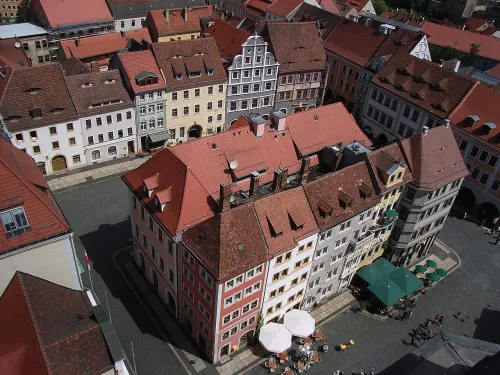
    Now the town shows off. The Untermarkt is the heart of the old town, a square split down the middle by a block of buildings so the Rathaus and a row of arcaded merchant houses, the Lauben, face each other across two halves. Stand under the arcades and you understand how trade worked here: goods moved in the covered walkways while business was done at the staircase tower of the town hall. This is the most filmed square in town, the Grand Budapest Hotel set dressing, and it's busiest at midday. The square never closes and costs nothing. Find a bench on the quieter southern half if you want to sit and read the facades. The colours run from ochre to deep red, every house a different century. Walk to the southeast corner and turn into Neißstraße, sloping down toward the river.

    Hours
    Open 24 hours
    Price
    Free

    1 min walk to next stop

  5. 5

    Barockhaus (Neißstraße 30)

    Barockhaus (Neißstraße 30) in Gorlitz, stop 5 on the self-guided walking tour

    A few doors down Neißstraße, the grand Baroque merchant house at number 30 breaks the medieval rhythm with its taller, statelier front. Built as a combined trading and living house in the Baroque era, it has been part of the city's cultural-history museum since 1951. Inside you'll find period rooms and the Oberlausitzische Bibliothek der Wissenschaften, a scholarly library worth seeing for the hall alone. Entry is 6 € (reduced 4 €, free under 18 and the first Sunday of the month), open Tuesday to Thursday 10:00 to 17:00 and Friday to Sunday 10:00 to 18:00, closed Mondays. Here's the money tip: a 9 € combo ticket covers the Barockhaus, the Kaisertrutz, and the Reichenbacher Turm, valid for two days. If you plan to climb the tower later, buy it here. Keep heading down Neißstraße toward the water; the street ends near the riverbank.

    Hours
    Mon: Closed | Tue-Thu: 10:00 AM – 5:00 PM | Fri-Sun: 10:00 AM – 6:00 PM
    Price
    6 € (reduced 4 €; free under 18; free 1st Sunday/month). Combo ticket Kaisertrutz + Barockhaus + Reichenbacher Turm 9 € (valid 2 days)

    4 min walk to next stop

  6. 6

    Old Town Bridge (Altstadtbrücke)

    Old Town Bridge (Altstadtbrücke) in Gorlitz, stop 6 on the self-guided walking tour

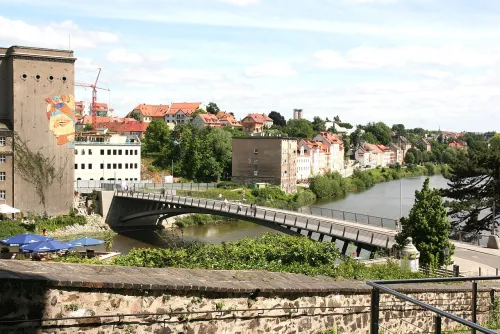
    The street delivers you to the Neisse, and across it is Poland. The Altstadtbrücke is a footbridge with an 80-metre span, and the far bank is Zgorzelec, the Polish half of what was one town until 1945. The original bridge was blown up just before the end of the Second World War, and the river became the border. For nearly sixty years only the stone abutments remained. This reconstruction opened in 2004 as a symbol of a Europe growing back together. Walk to the middle and you stand over the dividing line, then cross fully into Poland if you like; no checkpoint, no passport, just keep your ID on you. The bridge is open day and night and free. It's the emotional centre of the walk, so give it more than a glance. When you're done, come back to the German side and turn upstream toward the church looming on the bluff.

    Hours
    Open 24/7
    Price
    Free

    2 min walk to next stop

  7. 7

    Waidhaus

    Waidhaus in Gorlitz, stop 7 on the self-guided walking tour

    Climbing up from the river toward the great church, you pass a heavy stone building tucked beside it. This is the Waidhaus, the oldest surviving secular building in Görlitz, also called the Renthaus. Its name comes from its days storing woad, the dye plant that made medieval Görlitz rich; merchants traded the blue dye across Europe and the profits paid for much of what you've just walked through. The house has been rebuilt many times over the centuries and now serves as a craft and heritage training centre, so the interior is closed to the public. You're here for the exterior, which is free and viewable any time. It takes two minutes, but it's the missing link that explains the town's wealth. Stand back to take in the sheer mass of the walls. The church entrance is just above you, a short climb up the steps.

    Hours
    Open 24 hours (exterior viewing; interior is a craft/heritage training centre, not open to the public)
    Price
    Free (exterior only)

    1 min walk to next stop

  8. 8

    St. Peter and Paul Church (Peterskirche)

    St. Peter and Paul Church (Peterskirche) in Gorlitz, stop 8 on the self-guided walking tour

    This is the one. The Peterskirche sits on the Neisse bluff with five naves, a vast Gothic hall that dwarfs everything else on the route, and its draw is the Sonnenorgel, the Sun Organ, named for the gilded sun-shaped pipework above the loft. The interior is free, donations welcome, open Monday to Saturday 10:00 to 18:00 and Sunday from 11:30. Time your visit for the organ recital around noon, which is also free; sit in the nave and let the sound fill the hall, because hearing it played is the whole reason to be here. Compare this scale to the plain Trinity church at the start and you grasp how much the woad trade bought. Spend 30 minutes minimum. When you leave, head west away from the river, back across the upper old town toward a walled garden ensemble on the northwestern edge.

    Hours
    Mon-Sat: 10:00 AM – 6:00 PM | Sun & holidays: 11:30 AM – 6:00 PM
    Price
    Free (donations welcome). Sun Organ (Sonnenorgel) recitals ~12:00 noon (free)

    10 min walk to next stop

  9. 9

    Holy Sepulchre (Heiliges Grab)

    Holy Sepulchre (Heiliges Grab) in Gorlitz, stop 9 on the self-guided walking tour

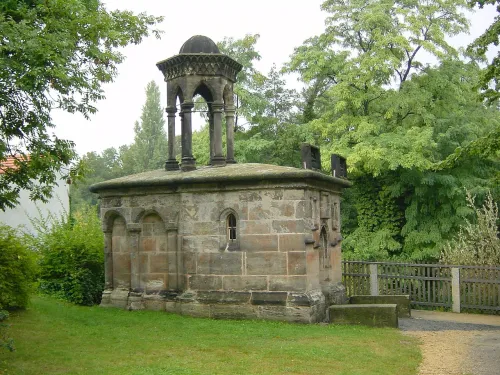
    After the grandeur of the Peterskirche, this quiet walled complex on the town's edge feels like a secret. The Heiliges Grab, the Görlitz Jerusalem, is a 15th-century replica of the Holy Sepulchre in Jerusalem, built after mayor Georg Emmerich made the actual pilgrimage to the Holy Land. It's the most accurate copy of its kind in Germany, deliberately set into a garden landscape with chapels you walk between, the way pilgrims once did. Entry is 3 € (5 € with audio guide or a guided tour, or a 4,50 € combo with the Nikolaikirche). Open Monday and Tuesday and Thursday to Sunday 10:00 to 16:00, closed Wednesdays, so don't come midweek without checking. Give it 30 minutes; the calm is the point. This is the furthest stop from the centre, so from here you turn back south and east toward the watchtower marking the old town wall.

    Hours
    Mon-Tue: 10:00 AM – 4:00 PM | Wed: Closed | Thu-Sun: 10:00 AM – 4:00 PM
    Price
    3 € (5 € with audio guide or guided tour; combo ticket Heiliges Grab + Nikolaikirche 4,50 €)

    5 min walk to next stop

  10. 10

    Reichenbacher Turm

    Reichenbacher Turm in Gorlitz, stop 10 on the self-guided walking tour

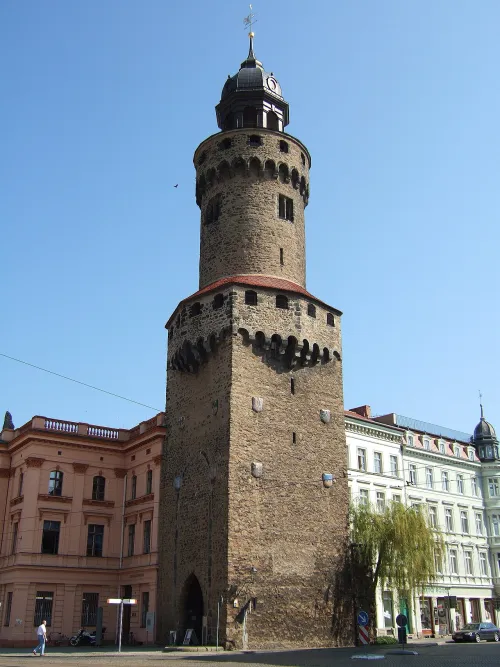
    Back near the edge of the old town stands the Reichenbacher Turm, the last watchtower of the medieval fortifications that was still manned, with a tower keeper living up top into the 19th century. It's one of the town's emblems and you can climb it, in season. Open April to October only, Tuesday to Thursday 10:00 to 17:00 and Friday to Sunday 10:00 to 18:00, closed Mondays and shut entirely November to March. Entry is 3 € (reduced 2 €, free under 18), and tickets are sold at the Kaisertrutz museum directly opposite. If you bought the 9 € combo back at the Barockhaus, this is where it pays off. The climb up the narrow stair earns you a rooftop view over every facade you've walked past. Allow 20 minutes. From here it's a short stroll south to the final stop on the Demianiplatz.

    Hours
    Apr-Oct: Mon Closed | Tue-Thu: 10:00 AM – 5:00 PM | Fri-Sun: 10:00 AM – 6:00 PM. Closed Nov-Mar. Tickets at the Kaisertrutz museum opposite
    Price
    3 € (reduced 2 €; free under 18). Combo ticket Kaisertrutz + Barockhaus + Reichenbacher Turm 9 € (valid 2 days)

    3 min walk to next stop

  11. 11

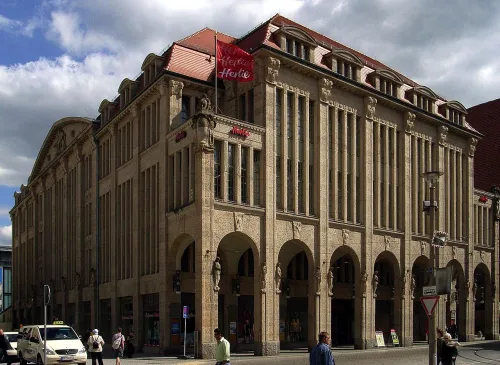
    Görlitzer Kaufhaus (Jugendstil-Warenhaus)

    Görlitzer Kaufhaus (Jugendstil-Warenhaus) in Gorlitz, stop 11 on the self-guided walking tour

    End on the showstopper. The Görlitzer Kaufhaus opened on 30 September 1913 as the Jugendstil department store Zum Strauss, built in just nine months as a steel-frame building behind a sandstone facade, modelled on the Wertheim store in Berlin. It's the only department store of its era still standing in its original form, and its colossal interior, a glass-roofed atrium ringed by galleries, became the lobby of the fictional Grand Budapest Hotel. The exterior is viewable any time and free. The catch: the interior only opens on a handful of announced days each month, so check the website before you count on getting inside. If your timing lines up, the atrium is the single most photographed interior in town. If not, the facade on the Demianiplatz still closes the walk well. You've now crossed the old town twice and stood in two countries, all on foot.

    Hours
    Exterior viewable any time; interior only on select announced open days (a few dates per month, see website)
    Price
    Free (interior open days; donations/fee for guided groups at operator's discretion)
AI Tourguide
Walk this exact route with a private AI guide.
Full GPS navigation, interactive stories, and a guide that answers all your questions. A private guide experience for just €5/hour.
Start This Tour

Self-Guided Tour vs. Group Tour in Gorlitz

Görlitz is one of the easiest towns in Germany to do without a guide. Everything is signposted, the old town is tiny, and the route here strings the sights in a logical line. A self-guided walk costs you nothing for the squares, bridge, and churches, and the optional interiors are cheap by German standards: 7 € for the Silesian Museum, 6 € for the Barockhaus, 3 € each for the Reichenbacher Turm and the Heiliges Grab. The smart move is the 9 € combo ticket covering the Kaisertrutz, Barockhaus, and Reichenbacher Turm, valid two days, which saves a couple of euros if you enter all three.

Guided walking tours run from the tourist information on the Obermarkt and typically cost around 8 to 12 € per person for the standard old-town round, with themed film-location tours priced higher. They're genuinely good if you want the Görliwood backstory, who filmed what and where, since that's hard to piece together alone. But for the history and the layout, this route plus the cheap museum entries gives you the same ground at your own pace. Take a guide for the film stories; skip it if you just want to see the town.

Group Tour AI Self-Guided
Price €25–€50 per person €5/hour or €20 all-inclusive
Flexibility Fixed schedule Start anytime, skip stops
Languages 1–2 languages 11 languages
Pace Group pace Your own pace

How Long Does This Gorlitz Tour Take?

Our route covers 3.5 km with 11 stops and takes approximately 2.3 hours at a relaxed pace.

The walking itself is about 3.5 km and runs comfortably in two hours with stops. Add interiors and you can fill a full day. The Peterskirche and the Heiliges Grab each deserve a real 30 minutes, and the Silesian Museum in the Schönhof can eat 90 minutes if you read everything. The longest single stretch is the 10-minute walk from the Peterskirche back across town to the Heiliges Grab, a good moment to slow down.

For a break, the Untermarkt arcades have the most cafes, but they're also the busiest. For something quieter, sit on a bench on the southern half of the Untermarkt away from the Rathaus tower, or pause on the Altstadtbrücge itself, where you can watch the Neisse run between two countries. If you time the noon organ recital at the Peterskirche, build your morning around it and break for lunch afterward near the Untermarkt.

Tips for Walking in Gorlitz

AI Tourguide
Walk this exact route with a private AI guide.
Full GPS navigation, interactive stories, and a guide that answers all your questions. A private guide experience for just €5/hour.
Start This Tour

AI Audio Guide for This Tour

Standing on the Untermarkt under the Rathaus tower, or out on the footbridge looking across to Poland? Open the app and it picks up exactly where you are on the route, with the next stop and the story behind every facade in your pocket. No signal needed once it's loaded.

AI Audio Guide Stories, history and fun facts narrated as you walk. No earpiece rental needed.
GPS Navigation Turn-by-turn directions so you never get lost between stops.
Ask Anything Curious about a building you pass? Ask your AI guide on the spot.
11 Languages Switch language anytime. No separate tour needed.
Start This Tour Free

Common Questions

Yes, very. It's a small, calm town with low crime and the old town is pedestrian, so traffic is the main thing to watch on the few streets that allow cars. Crossing the footbridge into Zgorzelec, Poland, is routine; there's no checkpoint, but carry your passport or ID since it's an international border. There are no notable tourist scams here, unlike bigger cities.
You have good cover on this route. Duck into the Silesian Museum in the Schönhof (7 €) or the Barockhaus (6 €), both with substantial indoor exhibits, or shelter in the Peterskirche and the Trinity church, both free. The Untermarkt arcades, the Lauben, were built as covered walkways and keep you dry between the squares. Save the towers and the open-air Heiliges Grab for a clear spell.
Start around 10:00 when the museums and the Reichenbacher Turm open, and aim to be at the Peterskirche near noon for the free Sun Organ recital. Late afternoon light is best for photos on the Untermarkt, with the sun catching the western facades. Avoid midday if you dislike crowds; the squares are busiest then.
No booking needed. This self-guided tour is available anytime. Open the route on your phone and start walking. The AI audio guide works instantly, no reservation required.
The AI audio guide is available in 11 languages: English, German, French, Spanish, Italian, Japanese, Chinese, Portuguese, Danish, Norwegian, and Swedish.
Yes. Skip any stop, spend extra time at places you like, or start the route from any point. You can also ask the AI to suggest a shorter route.
AI Tourguide
Curated by AI Tourguide GPS-verified routes, reviewed and updated regularly.
Last verified May 2026