Self-Guided Walking Tour in Hallstatt

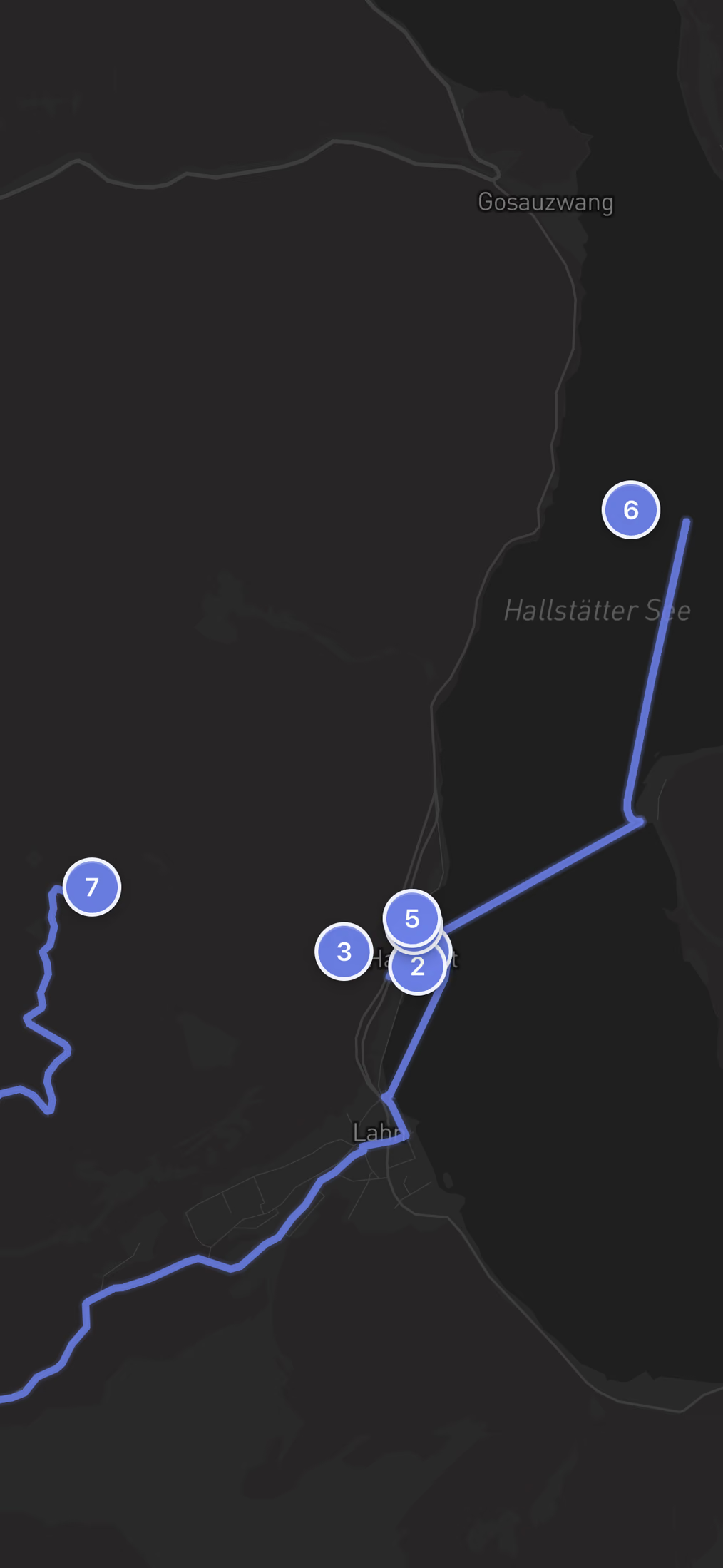
A self-guided route through Hallstatt, from the Market Square down to the lakefront and up to the salt mine, seven stops in all. The page gives you the map, walking time for every leg, real prices and hours for the museum, ossuary and mine, and shorter versions if you only have a half day.

7 Stops12.9 km~4 hours walking2–3 hours, or a full day with the salt mine
What you get with AI Tourguide
Full GPS navigationInteractive AI guidePersonalized to youWorks in your browser
Try this tour with Alex

Hallstatt Walking Tour at a Glance

This route is built for anyone who wants Hallstatt in the right order rather than the day-tripper's single lakeshore photo. It threads the compact village core first, then sends you out to the lake and up to the mine, and every paid interior on it is optional. You walk it at your own pace, and the page tells you exactly what each stop costs and when it is worth your time.

StartHallstatt Market Square
FinishHallstatt - Salt mine (Salzbergwerk Hallstatt)
Route typeA roughly linear route: a tight cluster of village stops, then a stretch out to the lake and a long climb up to the salt mine, with little backtracking.
Realistic timeAbout 2 to 3 hours for the village and lakefront, or a full day once you add the salt mine's funicular and underground tour.
DifficultyUnder 3 km on foot through the village core, plus cobbles, stone stairs and a short steep climb to the parish church. Grippy shoes help after rain.
Cost to followThe route itself is free to walk. Paid interiors are the Museum Hallstatt at €12, the ossuary at €2, and the salt mine at €49 if you choose to go up.
Best for:

First-time visitors who want the full village and lake in a logical sequence, plus the freedom to skip any indoor stop and time the walk around the crowds.

The Route

Free Walking Tour Map of Hallstatt

7 stops12.9 kmabout 4 hours
Loading the interactive map…The complete walking route will appear here.
Want the route to guide you while you walk?Open the route with navigation and a personal guide for the history, stories and questions that matter to you.
Open route + AI guide

The 7 stops along this route

  1. Hallstatt Market Square in Hallstatt, stop 1 on the self-guided walking tour
    1Hallstatt Market Square
  2. Hallstatt Museum (Museum Hallstatt) in Hallstatt, stop 2 on the self-guided walking tour
    2Hallstatt Museum (Museum Hallstatt)
  3. Muhlbach Waterfall in Hallstatt, stop 3 on the self-guided walking tour
    3Muhlbach Waterfall
  4. Catholic parish church Hallstatt (Katholische Pfarrkirche Hallstatt) in Hallstatt, stop 4 on the self-guided walking tour
    4Catholic parish church Hallstatt (Katholische Pfarrkirche Hallstatt)
  5. Ossuary (Karner, Michaelskapelle) in Hallstatt, stop 5 on the self-guided walking tour
    5Ossuary (Karner, Michaelskapelle)
  6. Hallstätter See in Hallstatt, stop 6 on the self-guided walking tour
    6Hallstätter See
  7. Hallstatt - Salt mine (Salzbergwerk Hallstatt) in Hallstatt, stop 7 on the self-guided walking tour
    7Hallstatt - Salt mine (Salzbergwerk Hallstatt)
  8. That's the complete route.

    If you want more than the map and text, add live navigation and a conversational AI guide while you walk.

    Open route + AI guide
    You made it
Stop 1 of 7
Swipe →

Your Hallstatt Walking Tour, Stop by Stop

  1. 1

    Hallstatt Market Square

    Hallstatt Market Square in Hallstatt, stop 1 on the self-guided walking tour

    Start in Marktplatz, the small triangular square that anchors the old center. It is open and free, ringed by pastel houses with wooden balconies and a plague column in the middle, and it works as your orientation point: the lake is downhill, the church is up the stairs behind you. This is where the famous photos get taken, so it fills fast. Come before 11am and you might have it nearly to yourself; by midday it is shoulder to shoulder with tour groups funneling through. There are a couple of cafes and a small shop or two around the edges, fine for a coffee but priced for tourists. Do not linger here expecting it to be the highlight. It is the front door, not the main room. Get your bearings, note where the church steps are, then move on while the morning light is still soft.
  2. 2

    Hallstatt Museum (Museum Hallstatt)

    Hallstatt Museum (Museum Hallstatt) in Hallstatt, stop 2 on the self-guided walking tour

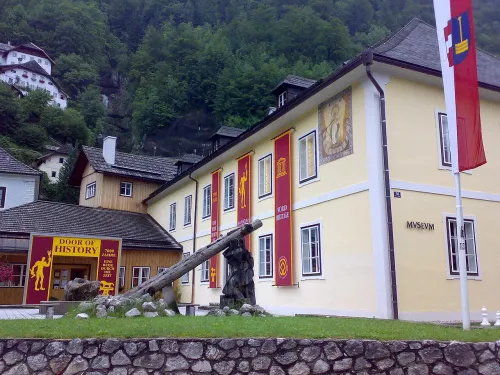
    A few steps off the square sits the town museum, and it is the one indoor stop that earns its keep. The collection lays out 7,000 years of human life around this lake, built almost entirely on what came out of the salt mine: tools, textiles, and burials so distinctive that archaeologists named an entire Iron Age period the Hallstatt culture after them. Entry is €12 and it is open daily from 10am to 6pm. Give it 45 minutes to an hour. If you only do one paid attraction in the village and you are not climbing to the mine, do this one, because it explains why a remote alpine hamlet matters far beyond its size. The displays are compact and well labeled, with enough real excavated objects to feel substantial rather than touristy. Skip it only if your time is genuinely tight or the weather is perfect and you would rather be outside.

    Hours
    Daily: 10:00 AM – 6:00 PM
    Price
    €12
  3. 3

    Muhlbach Waterfall

    Muhlbach Waterfall in Hallstatt, stop 3 on the self-guided walking tour

    Head to the western edge of the village and the noise reaches you before the water does. The Mühlbach falls straight down the rock face into the heart of the houses, and a small bridge crosses right in front of it. This is the kind of sight that costs nothing and takes ten minutes but gives you a completely different Hallstatt from the postcard square: wet stone, moss, the sound of falling water bouncing off the cliff. It is free and open all day. After heavy rain or spring snowmelt it roars; in a dry late summer it can be modest, so adjust expectations. The footbridge in front is the obvious photo spot and it gets crowded at peak hours, but turnover is quick because nobody stays long. A genuine small-town sight that most rushed visitors walk straight past on their way to the next thing.

  4. 4

    Catholic parish church Hallstatt (Katholische Pfarrkirche Hallstatt)

    Catholic parish church Hallstatt (Katholische Pfarrkirche Hallstatt) in Hallstatt, stop 4 on the self-guided walking tour

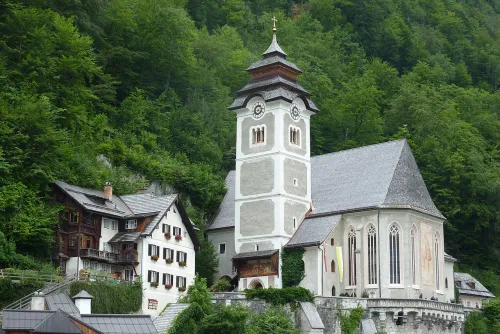
    Now you climb. A set of stone stairs leads up from the village to the parish church of the Assumption, known locally as Maria am Berg, perched on a terrace above the rooftops. The walk up is short but steep, a couple of minutes of real effort. The reward is the best free panorama in Hallstatt: the whole village laid out below, the lake stretching north, mountains closing the far side. The church itself is open daily 9am to 5pm and entry is free. Step inside for the late-Gothic winged altars, then spend your time in the graveyard terrace outside, which is where the view is. The cemetery here is famously small and reused over generations, which is precisely the reason for the next stop. Photographers: this terrace at golden hour is the shot people travel for, and it is free.

    Hours
    Daily: 9:00 AM – 5:00 PM
    Price
    Free
  5. 5

    Ossuary (Karner, Michaelskapelle)

    Ossuary (Karner, Michaelskapelle) in Hallstatt, stop 5 on the self-guided walking tour

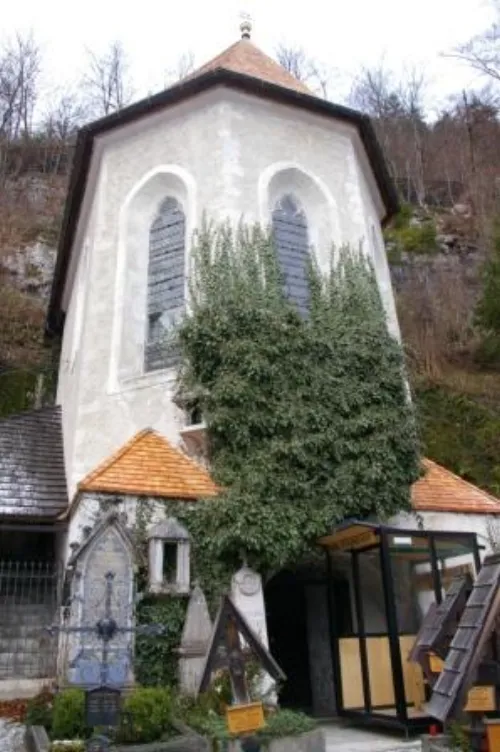
    Tucked beside the church, a low stone chapel holds the single strangest thing in the village. Because the hillside cemetery ran out of room centuries ago, bodies were exhumed after years in the ground and the bones moved here. Over 600 skulls are stacked inside, and around half are painted: names, dates, garlands of flowers, even ivy and oak leaves identifying the family. The custom faded in the twentieth century, with the most recent painted skull dated 1995. It is small, quiet, and not at all gruesome up close. Entry is just €2 and it is open daily 10am to 6pm, making it the best-value stop on the whole route. Give it ten or fifteen minutes. Do not skip this thinking it is morbid filler. The bone house is the most singular sight Hallstatt has, and almost nowhere else in Europe shows the practice so intimately. Bring small change for the donation box.

    Hours
    Daily: 10:00 AM – 6:00 PM
    Price
    €2
  6. 6

    Hallstätter See

    Hallstätter See in Hallstatt, stop 6 on the self-guided walking tour

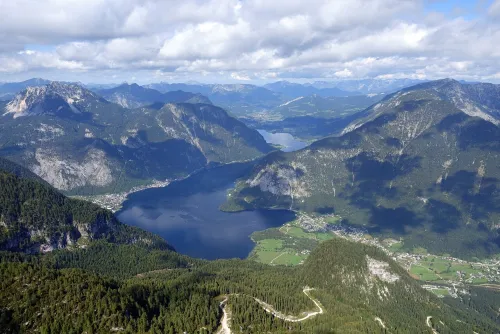
    Come back down and walk out to the water. The Hallstätter See sits at 508 meters, fed and drained by the river Traun, and together with the village it forms the UNESCO World Heritage cultural landscape. This is the defining feature, the reason the place exists and the reason it is on every screensaver. The lakefront is free and open at all hours, and the classic view, with the church spire rising above the houses against the mountain wall, is from the northern promenade looking back south. Walk the waterfront path, sit on a bench, watch the light move on the water. If you want more, boat trips and the lake ferry leave from here. Early morning often brings mist sitting on the surface, which is the quietest and most atmospheric time to stand here, long before the day buses arrive at the square.

    Hours
    Open 24/7
    Price
    Free
  7. 7

    Hallstatt - Salt mine (Salzbergwerk Hallstatt)

    Hallstatt - Salt mine (Salzbergwerk Hallstatt) in Hallstatt, stop 7 on the self-guided walking tour

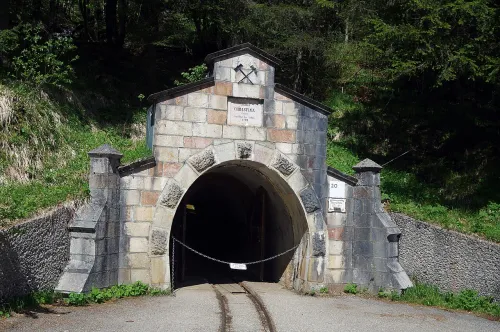
    The finale is up the mountain, and you have a choice to make. Salzwelten Hallstatt bills itself as the world's oldest salt mine, worked for some 7,000 years, and it is the namesake of the entire Hallstatt culture you saw explained in the museum. The catch is logistics and price. It sits high above the village, reached by a funicular, and the full experience runs €49 with the mine open daily 9am to 6pm. Budget two to three hours including the ride up, the guided tour underground, and the wooden miners' slides. Worth it if you have a half day and want the headline experience; honestly skippable if you are on a tight day-trip and have already done the museum, which tells much of the same story for €12. Decide based on time and weather. The view from the funicular alone is close to the church panorama, and that one was free.

    Hours
    Daily: 9:00 AM – 6:00 PM
    Price
    €49

How Long Does This Walking Tour Really Take?

Without the salt mine this is a comfortable half day, roughly two to three hours with the museum and a slow lakefront break, because the village is so small the walking barely counts. Add the mine and it becomes a full day, since the funicular ride and underground tour alone run two to three hours.

Without the salt mine, this route is a comfortable half day: roughly two to three hours including the museum and a slow walk along the lakefront. The village core is so compact that the walking itself barely registers. Add the salt mine and you are looking at a full day, because the funicular ride and underground tour alone eat two to three hours.

The stops that deserve real time are the museum (an hour), the church terrace and ossuary together (half an hour, and worth every minute), and the lakefront, where you should just sit. Take your break at the lake: grab something from a cafe near the market square beforehand, then carry it down to a bench on the northern promenade where the famous view is. That is the spot to slow down. The climb to the church is the only part that asks anything of your legs, so do it before you tire, not after.

Full Route, Shorter Walk or Two-Day Version?

The village stops sit within a few minutes of each other, so the real planning question is how far out you go: just the lake, or all the way up to the salt mine. Here are three ways to run it depending on how much time you have.

Half-Day Village

Village and Lake, Skip the Mine

Stops 1 to 6, Market Square to the lakefront, 2–3 hours

Everything except the long haul up to the salt mine. You keep the museum, waterfall, church terrace, ossuary and lakefront, which many visitors rate as the best of Hallstatt, and finish for under €15 in tickets.

Two-Part Split

Core First, Mine on a Second Trip

Stops 1 to 5 one visit, then 6 and 7 another, split at the ossuary

Do the tight village cluster (stops 1 to 5) as a relaxed morning, then save the lake (stop 6) and the salt mine (stop 7) for a fresh half day. Good if you are staying overnight or want the mine without rushing.

You can walk it in reverse, from the Salt Mine back down to the Market Square, but the recommended direction climbs to the church and ossuary while your legs are fresh and saves the lake and mine for last, so you decide on the €49 ticket only after you have seen the free highlights.

Is This Hallstatt Walking Tour Right for You?

Hallstatt is one of the easiest places to walk self-guided, but the terrain and the crowds still shape who gets the most from this particular route. Here is where it fits and how to bend it.

A good fit if you…

  • First-time visitors who want the whole village and lake in a sensible order, not just the one famous photo
  • Anyone deciding on the spot whether the €49 salt mine is worth it after seeing the free sights first
  • Travellers who prefer a compact, mostly flat core with only one short steep climb to the church
  • Budget-minded visitors, since the square, waterfall, church terrace and lakefront all cost nothing

Adapt the route if you…

  • You have only a couple of hours: run the Half-Day Village version and drop the mine entirely
  • You are here in the 11am to 3pm crush: do the square, waterfall and lakefront early, then the indoor stops midday
  • Rain sets in: lean on the museum, ossuary and underground mine, all weather-proof, and save the terrace for a dry window
  • Stairs are hard for you: skip the climb to the parish church and ossuary and stay along the flat lakefront

Tickets & Skip-the-Line in Hallstatt

Hallstatt has only three paid stops on this route, and none of them needs a rushed queue strategy. Here is what each costs, when it is open, and where to book so you are not caught out on arrival.

Hallstatt Museum (Museum Hallstatt)Entry €12, open daily 10:00 AM to 6:00 PM. The one indoor stop that reliably earns its keep; you can buy at the door, and its website has current hours and any seasonal changes. official ticket site ↗
Ossuary (Karner, Michaelskapelle)Entry just €2, open daily 10:00 AM to 6:00 PM, paid at a donation box, so bring small change. The best-value stop on the whole route. official ticket site ↗
Hallstatt - Salt mine (Salzbergwerk Hallstatt)Full experience €49, mine open daily 9:00 AM to 6:00 PM, reached by funicular above the village. Budget two to three hours for the ride, guided underground tour and slides; booking ahead online is smart on busy days. official ticket site ↗
Everything elseThe Market Square, Mühlbach Waterfall, Hallstatt Parish Church and the Hallstätter See are all free, open outdoor spaces with no ticket needed.
Optional upgrade
+3
The same 7-stop route,
now with navigation and a guide.
Optional AI experience

You already have the route.
The AI guide brings it to life.

Standing on the market square, or down by the lakefront in Hallstatt? Open AI Tourguide in your browser, nothing to install, and a voice guide walks you through the village in order, from the museum to the painted skulls in the bone house up by the parish church, telling each story and asking what you most want to see before the buses arrive. A real conversation built into the walk, not a recording. Start with 100 free credits.

Livenavigation13languagesAnyquestionYourinterests
Open this route with the AI guide

Try it in your browser · No app or download required

Tips for Walking in Hallstatt

  • Timing: the village core jams between roughly 11am and 3pm when the day buses arrive. Walk the square, waterfall and lakefront before 11am or after the coaches leave, and Hallstatt is a different, quieter place.
  • Terrain: cobbles, stone stairs and steep short climbs, especially up to the parish church. Wear shoes with grip. After rain the steps near the Mühlbach waterfall get slick.
  • Restrooms: there are paid public toilets near the market square and the central parking and ferry area. Carry a few coins, as some require payment and small shops do not always let you use theirs.
  • Food: cafes around the market square serve coffee and cake at tourist prices. For something more memorable, the lakeside spots do fresh fish from the Hallstätter See. Order the Reinanke (whitefish) if it is on the menu.
  • Photo: the classic shot is from the northern lakefront promenade looking south toward the church spire and houses against the mountain. Go at sunrise for mist on the water and almost no crowds.

Why Walk This Route?

Hallstatt is tiny. The whole village strings along a thin shelf between a steep wall of forest and the lake, and you can walk from one end to the other in under fifteen minutes. That is exactly why a walking route beats wandering here: the streets are so narrow there is no other way to see it, cars are mostly kept out of the core, and the good stuff is stacked almost on top of itself. A square, a museum, a waterfall, a hilltop church, a room full of painted skulls, the lake, and the salt mine that gave its name to an entire Iron Age culture. Seven stops, all reachable on foot.

The trick most day-trippers miss is sequencing. They pile out of the bus, photograph the postcard view from the lakeshore, and leave having seen one angle. This route walks you through the village first, climbs to the church and the bone house while your legs are fresh, then drops you back to the water and points you up to the mine last so you can decide on the spot whether the €49 ticket is worth it.

Go early or go late. Between roughly 11am and 3pm the lane through the center genuinely jams with people, and a village this small has no overflow space. Walk it before the buses or after they leave, and Hallstatt becomes the quiet mountain place it actually is.

Common Questions

Is Hallstatt safe to walk around?

Very. It is a tiny, low-crime alpine village and the main hazards are physical, not personal: slick cobbles and steep stairs after rain, and narrow lanes where the occasional car or delivery vehicle still passes. The lakefront has unfenced edges, so watch children near the water. The only real annoyance is the midday crush of crowds in the center, not any danger.

What if it rains during my Hallstatt tour?

Two of the best stops are indoors and weather-proof: the Museum Hallstatt (€12, daily 10am to 6pm) and the ossuary beside the parish church (€2, daily 10am to 6pm). The salt mine is also underground and unaffected by weather. Rain actually makes the Mühlbach waterfall more dramatic. Save the lakefront and church terrace for any dry window.

What's the best time of day for this walking tour?

Early morning, ideally before 10am. The day buses from Salzburg and Vienna roll in mid-morning and the village clogs until mid-afternoon. Arrive early and you get the market square, the lakefront mist and the church terrace nearly to yourself, with the museum and ossuary opening at 10am to fill out the rest.

Take this route with you

Open this exact tour with navigation and your personal AI guide.

Start GPS Navigation + AI Guide
AI Tourguide
Researched and curated by the AI Tourguide teamWe plan and quality-check every route, then research and verify the opening hours, prices, and practical tips for each stop along it.
▶ Open route with AI guideNavigation, stories and your questions