Self-Guided Walking Tour in Weimar

A 5.1 km self-guided loop through the heart of Weimar Classicism, from Goethe's front door on the Frauenplan to the cemetery vault where he and Schiller are buried. Fourteen stops link the writers' houses, the Bauhaus, the Rococo library and the Park an der Ilm. This page gives you the map, every walking leg, real prices and hours, and shorter versions.

14 Stops5.1 km~3 hours walkingHalf a day to a full day with stops
What you get with AI Tourguide
Full GPS navigationInteractive AI guidePersonalized to youWorks in your browser
Try this tour with Alex

Weimar Walking Tour at a Glance

This route is built for anyone who wants Weimar's cultural story in the right order rather than a random wander. It runs Goethe's House first and the grave where he lies last, a clean arc from house to vault. Every interior along the way is optional: the whole outdoor walk is free, and you decide door by door which of the museum houses are worth the ticket.

StartGoethe House (Goethes Wohnhaus)
FinishHistorical Cemetery, Weimar (Historischer Friedhof Weimar)
Route typeA compact one-way arc, effectively a loop: it starts in the northern old town, works through the central squares, then drops south into the Park an der Ilm and ends on a hill in the southwest, about a ten-minute walk back to where you began.
Realistic timeWalked without stopping the 5.1 km takes roughly 75 to 90 minutes. With outdoor stops and photos, plan a half day; with the big interiors like Goethe's House and the library, plan a full day.
DifficultyEasy and mostly flat through the old town, on cobblestones that get slippery when wet. The only real effort is the gentle climb through the park up to the Roman House and the cemetery at the end.
Cost to followFollowing the route costs nothing. The squares, church, Markt, park and Roman House are all free. Paid interiors are optional: Goethe's House 14 €, Schiller's Residence 10 €, the Anna Amalia Library 10 €, the Bauhaus-Museum 11 € and the ducal vault 7 €.
Best for:

Anyone curious about Goethe, Schiller, the Bauhaus and Weimar Classicism who wants a flat, walkable route and the freedom to choose which houses to enter.

The Route

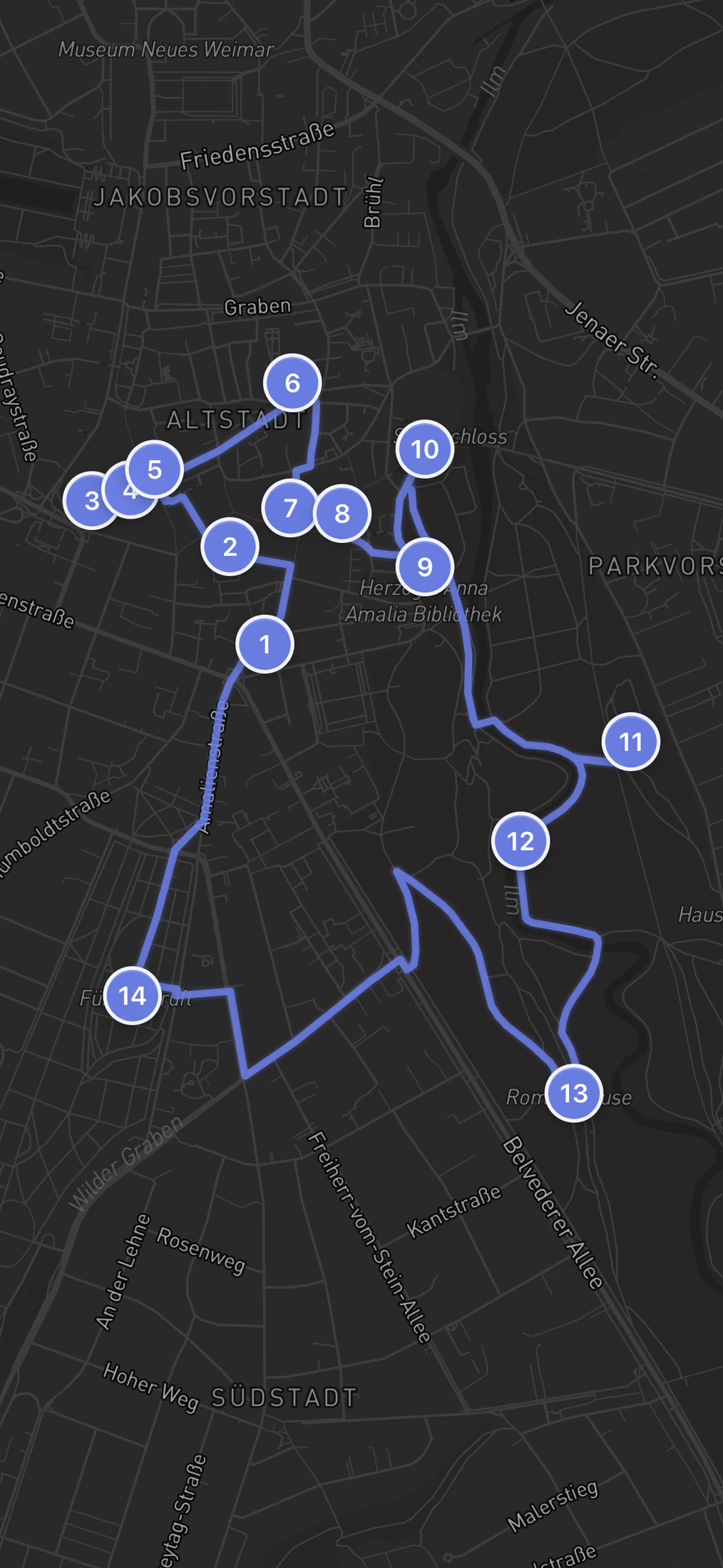
Free Walking Tour Map of Weimar

14 stops5.1 kmabout 3 hours
Loading the interactive map…The complete walking route will appear here.
Want the route to guide you while you walk?Open the route with navigation and a personal guide for the history, stories and questions that matter to you.
Open route + AI guide

The 14 stops along this route

  1. Goethe House (Goethes Wohnhaus) in Weimar, stop 1 on the self-guided walking tour
    1Goethe House (Goethes Wohnhaus)
  2. Schillerhaus Weimar in Weimar, stop 2 on the self-guided walking tour
    2Schillerhaus Weimar
  3. Deutsches Nationaltheater und Staatskapelle Weimar in Weimar, stop 3 on the self-guided walking tour
    3Deutsches Nationaltheater und Staatskapelle Weimar
  4. Goethe–Schiller Monument (Goethe-Schiller-Denkmal) in Weimar, stop 4 on the self-guided walking tour
    4Goethe–Schiller Monument (Goethe-Schiller-Denkmal)
  5. Bauhaus Museum, Weimar (Bauhaus-Museum) in Weimar, stop 5 on the self-guided walking tour
    5Bauhaus Museum, Weimar (Bauhaus-Museum)
  6. St. Peter und Paul (Herderkirche/Stadtkirche St. Peter und Paul) in Weimar, stop 6 on the self-guided walking tour
    6St. Peter und Paul (Herderkirche/Stadtkirche St. Peter und Paul)
  7. Markt in Weimar, stop 7 on the self-guided walking tour
    7Markt
  8. Cranachhaus in Weimar, stop 8 on the self-guided walking tour
    8Cranachhaus
  9. Duchess Anna Amalia Library (Herzogin Anna Amalia Bibliothek) in Weimar, stop 9 on the self-guided walking tour
    9Duchess Anna Amalia Library (Herzogin Anna Amalia Bibliothek)
  10. Schloss Weimar (Weimarer Stadtschloss) in Weimar, stop 10 on the self-guided walking tour
    10Schloss Weimar (Weimarer Stadtschloss)
  11. Goethes Gartenhaus in Weimar, stop 11 on the self-guided walking tour
    11Goethes Gartenhaus
  12. Park an der Ilm in Weimar, stop 12 on the self-guided walking tour
    12Park an der Ilm
  13. Römisches Haus, Weimar (Römisches Haus) in Weimar, stop 13 on the self-guided walking tour
    13Römisches Haus, Weimar (Römisches Haus)
  14. Historical Cemetery, Weimar (Historischer Friedhof Weimar) in Weimar, stop 14 on the self-guided walking tour
    14Historical Cemetery, Weimar (Historischer Friedhof Weimar)
  15. That's the complete route.

    If you want more than the map and text, add live navigation and a conversational AI guide while you walk.

    Open route + AI guide
    You made it
Stop 1 of 14
Swipe →

Your Weimar Walking Tour, Stop by Stop

  1. 1

    Goethe House (Goethes Wohnhaus)

    Goethe House (Goethes Wohnhaus) in Weimar, stop 1 on the self-guided walking tour

    Start at the yellow facade on the Frauenplan, an unassuming front for the house where Johann Wolfgang von Goethe lived from 1782 until his death in 1832. Behind it sits the Goethe-Nationalmuseum, and the interior is the real draw: his study, the bed he died in, his rock and mineral collections, the staircase he designed himself. This is the single most important address in the city and worth the full ticket. Adults pay 14 €, reduced 10 €. Open Tuesday to Sunday 9:30 AM to 6:00 PM, closed Mondays. Come right at opening if you want the rooms to yourself; by late morning the narrow corridors back up with groups. Allow at least an hour inside. When you leave, turn up Seifengasse toward Schillerstraße. It is a two-minute stroll between the two writers who defined the place.

    Hours
    Mon: Closed | Tue-Sun: 9:30 AM – 6:00 PM
    Price
    Erwachsene 14 €, ermäßigt 10 € (Goethe-Nationalmuseum mit Goethes Wohnhaus)
  2. 2

    Schillerhaus Weimar

    Schillerhaus Weimar in Weimar, stop 2 on the self-guided walking tour

    A short walk north and the pale facade on Schillerstraße belongs to Friedrich Schiller, who bought the house in 1802 and died here in 1805. After Goethe's crowded rooms this one feels quieter and more domestic. The top-floor study, where he wrote Wilhelm Tell, is the emotional center. Adults 10 €, reduced 7 €, open Tuesday to Sunday 10:00 AM to 6:00 PM, closed Mondays. If you only have appetite for one writer's house, Goethe's is the heavier hitter, but the two together make the Classicism story land properly. A practical note: the combination tickets from the Klassik Stiftung cover both houses and several later stops, so decide early if you plan to go inside more than two sites. From here walk west down to the open square that opens onto the theatre.

    Hours
    Mon: Closed | Tue-Sun: 10:00 AM – 6:00 PM
    Price
    Erwachsene 10 €, ermäßigt 7 €
  3. 3

    Deutsches Nationaltheater und Staatskapelle Weimar

    Deutsches Nationaltheater und Staatskapelle Weimar in Weimar, stop 3 on the self-guided walking tour

    The square opens up and the neoclassical front of the Deutsches Nationaltheater faces you across Theaterplatz. The current Großes Haus was built in 1906/1907 by Max Littmann, but the institution carries far older weight: Goethe and Schiller both directed here, and in 1919 the National Assembly met inside to adopt the constitution that gave the Weimar Republic its name. You do not go in during the day unless you have a ticket. Performances in the Großes Haus run roughly 15 to 42 €, with reductions for students. The box office keeps Monday to Friday 10:00 AM to 6:00 PM and Saturday 11:00 AM to 6:00 PM, closed Sunday. For most walkers the building is a facade stop. Stay on the square, because the statue in front of it is the thing everyone actually photographs.

    Hours
    Mon-Fri: 10:00 AM – 6:00 PM | Sat: 11:00 AM – 6:00 PM | Sun: Closed
    Price
    Vorstellungsabhängig, Großes Haus ca. 15–42 € (Ermäßigungen für Studierende, Schüler, Schwerbehinderte)
  4. 4

    Goethe–Schiller Monument (Goethe-Schiller-Denkmal)

    Goethe–Schiller Monument (Goethe-Schiller-Denkmal) in Weimar, stop 4 on the self-guided walking tour

    Right in front of the theatre stands the bronze you have probably already seen on postcards: Goethe and Schiller side by side, sharing a laurel wreath. Ernst Rietschel designed it and it was unveiled in 1857, commissioned by Grand Duke Carl Alexander. It is the visual shorthand for the whole idea of Weimar Classicism, two writers cast as a single cultural unit. It is free and out in the open 24/7, so there is no ticket and no queue. The catch is everyone wants the same shot. For a clean frame with the theatre columns behind the figures, stand back toward the center of the square and shoot in the morning when the light hits the bronze from the east. Then cross the square diagonally and head a minute downhill to the long modernist block.

    Hours
    Open 24/7
    Price
    Free
  5. 5

    Bauhaus Museum, Weimar (Bauhaus-Museum)

    Bauhaus Museum, Weimar (Bauhaus-Museum) in Weimar, stop 5 on the self-guided walking tour

    The mood shifts hard here. After all the 18th-century facades, a blunt concrete cube announces the 20th. This is where the city tells its other big story: the Bauhaus was founded in Weimar in 1919, and this purpose-built museum opened on the centenary, on 5 April 2019. Inside are the earliest Bauhaus objects, the founding collection assembled by Walter Gropius himself. If you care at all about design history, go in. Adults 11 €, reduced 8 €. Hours are 10:00 AM to 6:00 PM, and watch the unusual schedule: it is open Mondays but closed on Tuesdays, the reverse of the Goethe houses. Budget 45 minutes to an hour. Leaving the museum, walk east a few minutes toward the spire rising over the old town. You are heading for the church.

    Hours
    Mon: 10:00 AM – 6:00 PM | Tue: Closed | Wed-Sun: 10:00 AM – 6:00 PM
    Price
    Erwachsene 11 €, ermäßigt 8 €
  6. 6

    St. Peter und Paul (Herderkirche/Stadtkirche St. Peter und Paul)

    St. Peter und Paul (Herderkirche/Stadtkirche St. Peter und Paul) in Weimar, stop 6 on the self-guided walking tour

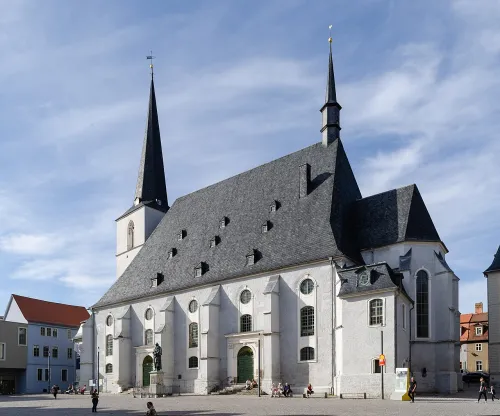
    The lane opens onto Herderplatz and the tall church the locals call the Herderkirche, though its real name is Stadtkirche St. Peter und Paul. Go inside. The reason is the winged altarpiece begun by Lucas Cranach the Elder and finished by his son in 1555, one of the most important Reformation paintings in Germany, with Luther and Cranach himself worked into the scene. Johann Gottfried Herder preached here, which gave the church its popular name. Entry is free, donations welcome. Open Monday to Saturday 10:00 AM to 6:00 PM; on Sundays it splits into 11:00 AM to noon and 2:00 to 6:00 PM, so time a Sunday visit around the service gap. It is cool and quiet inside, a good pause after the open squares. From the church, head south a couple of minutes down into the market square.

    Hours
    Mon-Sat: 10:00 AM – 6:00 PM | Sun: 11:00 AM – 12:00 PM, 2:00 – 6:00 PM
    Price
    Free (Eintritt frei; Spenden willkommen)
    Website
    ekmd.de ↗
  7. 7

    Markt

    Markt in Weimar, stop 7 on the self-guided walking tour

    The Markt is the natural center of town, ringed by gabled facades with the Renaissance-era town hall on one side. On market days the square fills with produce and Thüringer Rostbratwurst stands, and a grilled sausage in a roll for a couple of euros is the honest local lunch here. It is open ground, free, no opening hours to worry about. This is the spot to stand still for a minute and get your bearings: the church behind you, the palace ahead, the library tucked just off the southeast corner. The square also frames the Cranach House, which is the next stop and sits right on the eastern side. Do not rush off; grab a coffee at one of the cafes under the arcades and look up at the painted facades before moving the few steps east.

    Hours
    Open 24/7
    Price
    Free
  8. 8

    Cranachhaus

    Cranachhaus in Weimar, stop 8 on the self-guided walking tour

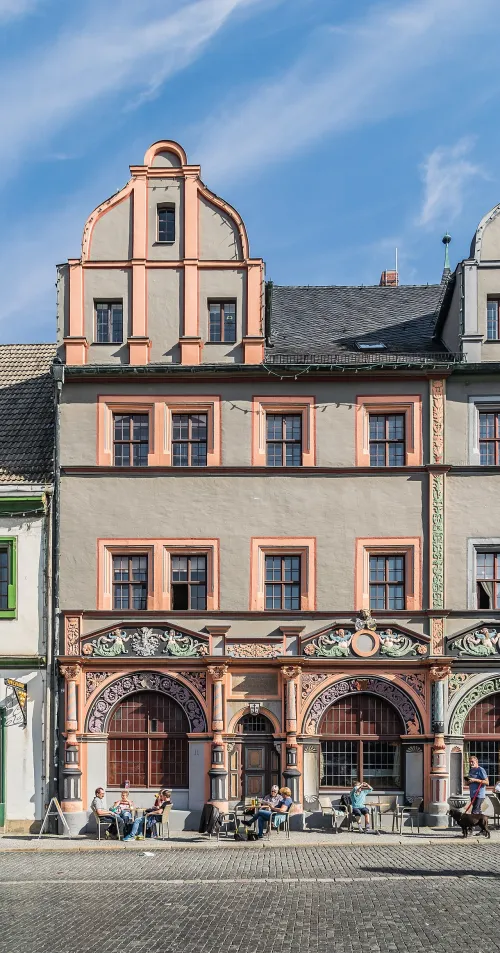
    On the eastern edge of the Markt, directly opposite the town hall, stand two near-identical Renaissance houses with elaborate gabled fronts. The left one is the Cranachhaus, where Lucas Cranach the Elder lived in his final year before his death in 1553, at Markt 11 and 12. The facade is the attraction, and it is free to admire from the square at any hour. The interior is not a public museum, so do not go hunting for a ticket desk; the only way inside is a performance at the small Theater im Gewölbe in the cellar, tickets sold per show. For most walkers this is a two-minute look-up-and-photograph stop. Late afternoon light catches the carved stonework best. From here, leave the Markt by its southeast corner and walk a couple of minutes toward the next door, which hides one of the finest interiors in Germany.

    Hours
    Fassade am Markt jederzeit von außen zu besichtigen; Innenräume nicht öffentlich (Theater im Gewölbe nur zu Vorstellungsterminen)
    Price
    Free (Außenansicht); Theater im Gewölbe Karten vorstellungsabhängig
  9. 9

    Duchess Anna Amalia Library (Herzogin Anna Amalia Bibliothek)

    Duchess Anna Amalia Library (Herzogin Anna Amalia Bibliothek) in Weimar, stop 9 on the self-guided walking tour

    This is the one to plan ahead for. The Herzogin-Anna-Amalia-Bibliothek, founded in 1691 and UNESCO World Heritage since 1998, hides its showpiece behind a plain exterior: the oval Rococo Hall, three storeys of white-and-gold balconies wrapped around old books, one of the most beautiful library interiors in the country. Adults 10 €, reduced 7 €, open Tuesday to Sunday 9:30 AM to 6:00 PM, closed Mondays. Here is the catch that trips up most visitors: the Rococo Hall limits how many people are inside at once, so tickets are timed and sell out, especially in summer. Book a slot online in advance through the Klassik Stiftung site, do not just turn up at the door expecting entry. It deserves a slow 30 to 40 minutes. Step back out and walk a minute north to the big four-winged palace on the river side.

    Hours
    Mon: Closed | Tue-Sun: 9:30 AM – 6:00 PM
    Price
    Erwachsene 10 €, ermäßigt 7 € (Rokokosaal)
  10. 10

    Schloss Weimar (Weimarer Stadtschloss)

    Schloss Weimar (Weimarer Stadtschloss) in Weimar, stop 10 on the self-guided walking tour

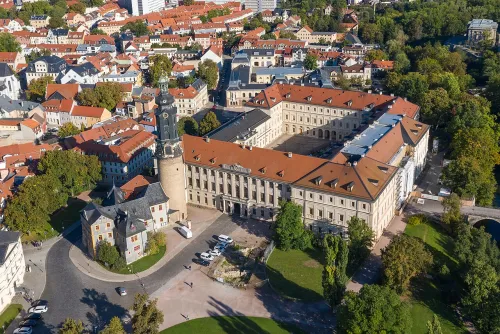
    The Residenzschloss is the four-winged classical pile by the Ilm that served as the seat of the dukes and grand dukes of Saxe-Weimar-Eisenach, rebuilt from 1789 under Duke Carl August. It joined the UNESCO list with the rest of Classical Weimar in 1998. Inside are the Dichterzimmer (rooms honoring the poets), the ballroom, and the chapel. Be aware the main palace has been under long-term restoration, so check what is currently open before counting on a full visit. The nearby Wittumspalais runs 8 € for adults, 6 € reduced, open Tuesday to Sunday 10:00 AM to 6:00 PM, closed Mondays. For many walkers the exterior and the Burgplatz are enough. From here the route changes character completely: cross the river and drop south into the park, following the path toward Goethe's first home in the city.

    Hours
    Mon: Closed | Tue-Sun: 10:00 AM – 6:00 PM
    Price
    Erwachsene 8 €, ermäßigt 6 € (Wittumspalais)
  11. 11

    Goethes Gartenhaus

    Goethes Gartenhaus in Weimar, stop 11 on the self-guided walking tour

    Now you are in the green. The path through the Park an der Ilm leads to a modest house with a steep roof, the Gartenhaus that was Goethe's first Weimar home after Duke Carl August gave it to him in 1776. He lived and worked here before moving to the grand house on the Frauenplan, and he kept it as a retreat for the rest of his life. It is UNESCO-listed and far more intimate than the town house. Adults 8 €, reduced 6 €, open Tuesday to Sunday 10:00 AM to 6:00 PM, closed Mondays. The setting does half the work: meadows, the river below, the slope of the Horn behind. Even if you skip the interior, the garden and the view are worth the detour. From the house, simply keep walking the park paths south along the water.

    Hours
    Mon: Closed | Tue-Sun: 10:00 AM – 6:00 PM
    Price
    Erwachsene 8 €, ermäßigt 6 €
  12. 12

    Park an der Ilm

    Park an der Ilm in Weimar, stop 12 on the self-guided walking tour

    You are already in it, but this is where you slow down and let the park be the point. The Park an der Ilm is Weimar's largest landscape garden, laid out from the 18th century with Goethe's direct involvement, and barely altered since, which makes it one of the best-preserved Classical-Romantic parks in Germany. Look for the sightlines, the bridges over the river bends, the scattered follies and old trees, some brought from overseas. It is free and open 24/7, the green core of the UNESCO ensemble. This is the natural place for a long pause. Find a bench by the river near the bridge below the Garden House and just sit; on a warm day this is the nicest break on the whole route. When you are ready, follow the path uphill on the western side toward a small temple-like building above the valley.

    Hours
    Open 24/7
    Price
    Free
  13. 13

    Römisches Haus, Weimar (Römisches Haus)

    Römisches Haus, Weimar (Römisches Haus) in Weimar, stop 13 on the self-guided walking tour

    Climbing the western slope of the park you reach a building that looks transplanted from Italy: the Römisches Haus, built between 1791 and 1798 as a garden retreat for Duke Carl August, modeled on a Roman temple. Goethe brought the idea back from his Italian journey and oversaw the early construction himself. It is an early example of classicism in Germany and part of the UNESCO ensemble. Today it houses a permanent exhibition on the history of the Ilm park, and from its raised position you get a wide view over the valley. Best of all, entry is free. Open Tuesday to Sunday 10:00 AM to 6:00 PM, closed Mondays. A quick 15 minutes does it. From here, leave the park on its western edge and climb a short way up to the cemetery, the final stop and the one that closes the story.

    Hours
    Mon: Closed | Tue-Sun: 10:00 AM – 6:00 PM
    Price
    Free (Eintritt frei)
  14. 14

    Historical Cemetery, Weimar (Historischer Friedhof Weimar)

    Historical Cemetery, Weimar (Historischer Friedhof Weimar) in Weimar, stop 14 on the self-guided walking tour

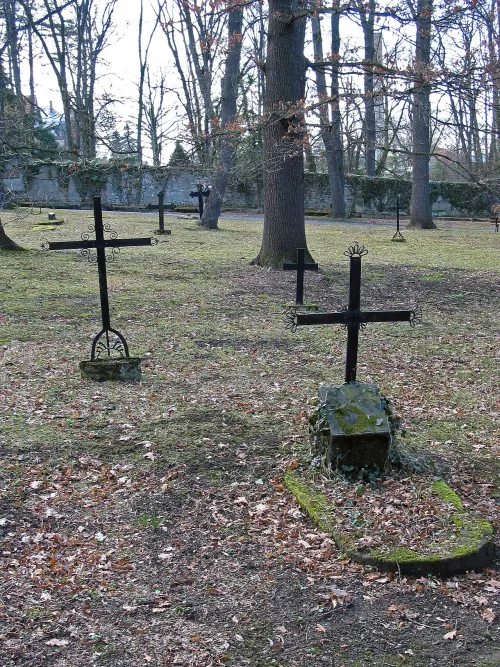
    The walk ends on a hill in the southwest, at one of the most visited cemeteries in Germany. The Historischer Friedhof opened in 1818 and is laid out as a park, full of old trees and the graves of Weimar notables. The reason you climb up here is the Fürstengruft, the ducal vault that holds the coffins of Goethe and Schiller side by side, the literal resting place of the two men whose houses you started at this morning. The grounds are free and open daily 8:00 AM to 6:00 PM. The vault itself costs 7 € for adults, 5 € reduced. It is a quiet, slightly solemn note to finish on, and the symmetry is the point: house to grave, the whole story of Weimar Classicism walked in a single loop. From here the town center is about a ten-minute walk back north.

    Hours
    Daily: 8:00 AM – 6:00 PM
    Price
    Friedhof frei; Fürstengruft Erwachsene 7 €, ermäßigt 5 €

How Long Does This Walking Tour Really Take?

The pure walk is 75 to 90 minutes, but nobody does it that way. Goethe's House alone eats a full hour with the queues, and the Anna Amalia Library ties you to a timed 30 to 40 minute slot. Add the Bauhaus-Museum for design lovers and you have a full, satisfying day; skip the interiors and it is a relaxed half day.

Walked without stopping, the 5.1 km loop takes around 75 to 90 minutes. Nobody does it that way. Plan for half a day at minimum, a full day if you go inside the big houses. The two stops that eat the most time are Goethe's House (a full hour with the queues) and the Anna Amalia Library (30 to 40 minutes, plus you are tied to a booked entry slot). The Bauhaus-Museum adds another hour if design is your thing.

The Park an der Ilm is the obvious place to break. After the dense first half through the old town, the green stretch from the Garden House southward is where you should slow down: find a bench by the river near the bridge below Goethe's Garden House and rest there. For coffee and a sit-down before you head into the park, the cafes under the arcades on the Markt are the convenient choice, and the square doubles as your lunch stop on market days. Save the cemetery for last; the climb is gentler if your legs are fresh from a park break rather than straight off the pavement.

Full Route, Shorter Walk or Two-Day Version?

The 14 stops split cleanly into a dense old-town first half and a green park second half, which makes it easy to shorten or spread across two days. Here are three ways to walk it depending on your time and legs.

Old-town core

The classic centre without the park

Stops 1 to 9, Goethe's House to the Anna Amalia Library, about 1.6 km, two to three hours

The tight, mostly flat first half. It keeps both writers' houses, the theatre and monument, the Bauhaus-Museum, the Herder Church, the Markt and the Rococo library, all within a compact grid. Cutting stops 10 to 14 drops the long 720 m and 1250 m park legs and the cemetery climb, ideal if you have a morning only or tired feet.

Two-day split

Old town one day, park the next

Day one stops 1 to 10 in the centre, day two stops 11 to 14 through the park to the cemetery

The gentlest way to do everything without rushing. Day one covers the museum houses, squares, library and City Palace in the old town. Day two starts fresh at Goethe's Garden House and follows the Ilm south through the park and Roman House to the ducal vault, so you never combine a full morning of interiors with the afternoon climb.

You can walk it in reverse, starting at the Historic Cemetery and finishing at Goethe's House, but the given direction is recommended: it opens at Goethe's front door and closes at his grave, which is the story the city is built on, and it saves the flat old-town stops for tired legs at the start rather than after the park climb.

Is This Weimar Walking Tour Right for You?

This is one of the easiest German cities to do well on your own: short, flat and so compact that a guide saves you almost no navigation. Whether it suits you depends less on fitness than on what you want out of the day.

A good fit if you…

  • Literature and history travellers who want Goethe, Schiller, Herder and the Weimar Republic in one connected walk
  • Design fans, since the Bauhaus-Museum sits right on the route among the 18th-century facades
  • Walkers who prefer a short, flat 5.1 km loop over a sprawling city hike
  • Anyone who wants to pick and choose interiors rather than pay for a fixed guided package

Adapt the route if you…

  • You have only a morning: walk the old-town core, stops 1 to 9, and skip the park and cemetery
  • You want every interior without rushing: split the route across two days at stop 10
  • You visit on a Monday: most museum houses are closed, but the Bauhaus-Museum is open (it closes Tuesdays instead)
  • You have limited mobility: the old-town half is flat, so save the gravel park slopes and cemetery climb for a fresh day or skip them

Tickets & Skip-the-Line in Weimar

Most of Weimar's big interiors are run by the Klassik Stiftung Weimar, so a combination ticket pays off fast if you plan to enter more than two or three. The one stop to book ahead is the Anna Amalia Library, whose Rococo Hall uses timed, capacity-limited slots that sell out in summer. Everything below carries the real per-site price and hours; the outdoor stops are free.

Goethe House (Goethes Wohnhaus)Adults 14 €, reduced 10 € (Goethe-Nationalmuseum with Goethe's residence). Open Tue-Sun 9:30 AM to 6:00 PM, closed Mondays. Come right at opening to beat the group crowds in the narrow corridors; allow a full hour inside. official ticket site ↗
Schillerhaus WeimarAdults 10 €, reduced 7 €. Open Tue-Sun 10:00 AM to 6:00 PM, closed Mondays. Covered by the Klassik Stiftung combination tickets alongside Goethe's House and several later stops. official ticket site ↗
Deutsches Nationaltheater und Staatskapelle WeimarA daytime facade stop for most walkers; you only go in with a performance ticket. Großes Haus performances run roughly 15 to 42 € with reductions for students, pupils and severely disabled visitors. Box office Mon-Fri 10:00 AM to 6:00 PM, Sat 11:00 AM to 6:00 PM, closed Sunday.
Bauhaus Museum, Weimar (Bauhaus-Museum)Adults 11 €, reduced 8 €. Open 10:00 AM to 6:00 PM, and watch the unusual schedule: open Mondays but closed Tuesdays, the reverse of the Goethe houses. Budget 45 minutes to an hour. official ticket site ↗
Duchess Anna Amalia Library (Herzogin Anna Amalia Bibliothek)Adults 10 €, reduced 7 € for the Rococo Hall. Open Tue-Sun 9:30 AM to 6:00 PM, closed Mondays. The hall is capacity-limited with timed slots that sell out in summer, so book online in advance rather than turning up at the door. Allow 30 to 40 minutes. official ticket site ↗
Schloss Weimar (Weimarer Stadtschloss)The nearby Wittumspalais is 8 € for adults, 6 € reduced. Open Tue-Sun 10:00 AM to 6:00 PM, closed Mondays. The main palace has been under long-term restoration, so check what is currently open before counting on a full visit. official ticket site ↗
Goethes GartenhausAdults 8 €, reduced 6 €. Open Tue-Sun 10:00 AM to 6:00 PM, closed Mondays. Even if you skip the interior, the garden and river view are worth the detour into the park. official ticket site ↗
Römisches Haus, Weimar (Römisches Haus)Free entry. Open Tue-Sun 10:00 AM to 6:00 PM, closed Mondays. Houses a permanent exhibition on the history of the Ilm park; a quick 15 minutes does it. official ticket site ↗
Historical Cemetery, Weimar (Historischer Friedhof Weimar)The grounds are free and open daily 8:00 AM to 6:00 PM. The Fürstengruft, the ducal vault holding the coffins of Goethe and Schiller, costs 7 € for adults, 5 € reduced. official ticket site ↗
Everything elseThe Goethe-Schiller Monument, Herder Church, Market Square, Cranach House facade and the Park an der Ilm are all free, open outdoor spaces with no tickets. The Herder Church welcomes donations; the Cranach House interior is not a public museum.
Optional upgrade
+10
The same 14-stop route,
now with navigation and a guide.
Optional AI experience

You already have the route.
The AI guide brings it to life.

Standing in front of the Goethe-Schiller Monument or about to walk into the Park an der Ilm? Open AI Tourguide in your browser, no app and no download, and a voice guide walks the tight loop with you from Goethe's House to the Bauhaus-Museum, greeting you, telling the story along the way and asking what you are curious about so it can adapt as you go. A real conversation built into the walk, not a recording. Start with 100 free credits.

Livenavigation13languagesAnyquestionYourinterests
Open this route with the AI guide

Try it in your browser · No app or download required

Tips for Walking in Weimar

  • Most museum houses close Mondays (Goethe's House, Schiller's Residence, the library, the City Palace, Garden House and Roman House all closed Mon). The Bauhaus-Museum is the exception: open Monday, closed Tuesday. Plan your interior visits around this split.
  • Wear shoes with grip. The old town runs on cobblestones and the Park an der Ilm has unpaved gravel and grass paths that get muddy after rain, especially on the slope up to the Roman House and the cemetery.
  • Free, clean restrooms are easiest to find inside the ticketed Klassik Stiftung sites and around the Markt. There are public facilities near the market square; use them before heading into the park, where options thin out.
  • For lunch, the Thüringer Rostbratwurst stands on the Markt are the local move: a grilled sausage in a roll for a couple of euros, mustard not ketchup. On non-market days the cafes under the arcades serve coffee and cake all day.
  • For the classic Goethe-Schiller Monument shot, stand back toward the center of Theaterplatz with the theatre columns behind the figures and shoot in the morning, when the light hits the bronze from the east.

Why Walk This Route?

Weimar is small enough to cross on foot in twenty minutes, yet it carried more weight in German cultural history than cities ten times its size. Goethe lived here for nearly 50 years. Schiller spent his final years a few hundred meters away. The Bauhaus was founded here in 1919, the same year the Weimar Republic got its name and constitution in the local theatre. You do not need a car, a tram, or even a map app to connect these places. They sit within a tight loop around the old town and the park along the Ilm river.

This route runs roughly 5.1 km and starts where it should: at Goethe's front door on the Frauenplan. From there it threads through the theatre square, the medieval Markt, the UNESCO-listed library, the ducal palace, then drops into the green Park an der Ilm before climbing back up to the cemetery where Goethe and Schiller are buried. It is a clean arc from house to grave, which is a fitting shape for a city built on two writers.

Wandering Weimar randomly works fine, the center is that compact. But you would miss the logic. Walked in order, the route tells the story of Weimar Classicism from the inside out, and most of the big interiors belong to the same operator (the Klassik Stiftung Weimar), so a combination ticket pays off fast. Note one thing before you set off: most museum houses here close on Mondays.

Common Questions

Is Weimar safe to walk around?

Yes, Weimar is a small, quiet town and one of the safer places you will walk in Germany, day or night. The whole route stays in the well-kept historic center and park. There are no notable scams or no-go areas. The only real hazards are uneven cobblestones and, after dark, the unlit park paths, so do the Park an der Ilm and the cemetery in daylight.

What if it rains during my Weimar tour?

Weimar handles rain better than most because the best stops are indoor museum houses, and they cluster tightly. Duck into Goethe's House, Schiller's Residence, the Bauhaus-Museum (open Mondays), the Anna Amalia Library, or the free, dry Herder Church. The exposed parts (Theaterplatz, the Markt, and the long park stretch from the Garden House to the Roman House) are where you will get wet, so save the park for a dry window and front-load the interiors.

What's the best time of day for this walking tour?

Start at 9:30 AM when Goethe's House and the library open. The first hour buys you the major interiors before tour groups arrive and before the timed library slots fill, then you hit the open squares and the park through midday and finish at the cemetery in the afternoon. If you only have a half day, a morning start is clearly better than an afternoon one, because the museum houses all shut at 6:00 PM and the queues build steadily after 11.

Take this route with you

Open this exact tour with navigation and your personal AI guide.

Start GPS Navigation + AI Guide
AI Tourguide
Researched and curated by the AI Tourguide teamWe plan and quality-check every route, then research and verify the opening hours, prices, and practical tips for each stop along it.
▶ Open route with AI guideNavigation, stories and your questions