Things to Do in Alicante - Top Attractions, Hidden Gems & Must-See Sights

Discover the best things to do in Alicante. Complete guide to must-see sights, popular attractions, hidden gems, museums, food markets and parks.

18 Attractions 6 Categories Travel Guide

Table of Contents

Alicante Overview

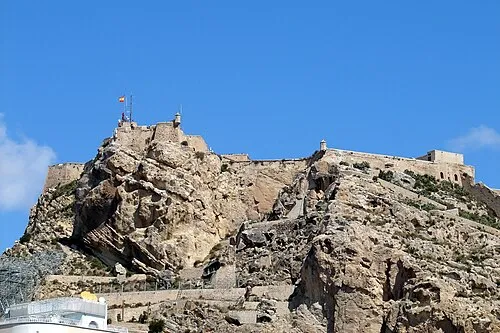
Alicante centers on the massive limestone outcrop of Monte Benacantil, where the Castillo de Santa Bárbara looms over the Mediterranean. It’s a city defined by the contrast between its steep, historic slopes and the flat, sea-level promenade of the Explanada de España. Most of the central sights are walkable, though the climb to the fortress requires stamina or the elevator across from Playa del Postiguet.

Beyond the sand, the city reveals its character through the tiled floors of the Mercado Central, where locals shop for salt-cured fish and local produce. A short walk leads to the blue-domed Concatedral de San Nicolás, tucked away in the narrow streets of the old quarter. For a different pace, the boat ride to Isla de Tabarca offers a glimpse of Spain’s first marine reserve, far from the urban rhythm of the Port of Alicante.

Must-See Attractions in Alicante

  • Castillo de Santa Bárbara — Massive fortress atop Monte Benacantil offering panoramic views of the coastline and the city below.
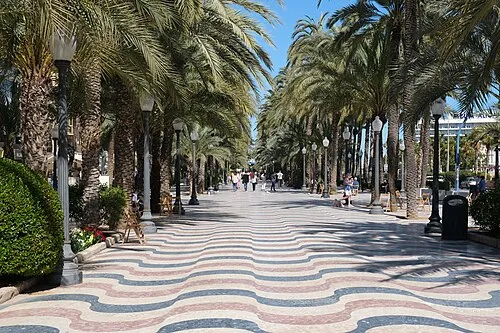
  • Explanada de España — Famous promenade paved with 6.5 million marble tiles in a wave pattern, shaded by rows of palm trees.
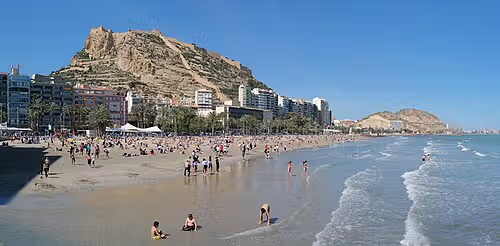
  • Playa del Postiguet — The city's main urban beach, sitting directly at the foot of the castle and adjacent to the marina.
  • Mercado Central de Alicante — A grand modernist building where you can find the best local seafood, cheeses, and produce from the surrounding region.
  • Isla de Tabarca — A small inhabited island and protected marine reserve accessible by boat, known for its clear waters and historical village.
🏛️ Must-See ⭐ Sights 💎 Hidden Gems 🎨 Museums 🍕 Food & Markets 🌳 Parks & Views

🏛️ Must-See Attractions in Alicante

These iconic landmarks and must-see sights are essential stops for any visitor to Alicante.

Castillo de Santa Bárbara

1. Castillo de Santa Bárbara

Domination is the only word for how this fortress relates to the city below. Perched on the barren rock of Mount Benacantil, it doesn’t just overlook the bay; it dictates the skyline. Walking the ramparts offers a history lesson written in stone, from ninth-century Arab foundations to Renaissance modifications, but the real pull is the sheer vertical drop and the sweep of the Mediterranean. It is windy, exposed, and absolutely commands your attention, offering a perspective on the city layout that you cannot get from street level.

Getting up here tests your commitment if you choose the walk, a steep, sun-baked hike through pine trees that feels longer than it looks. Most locals skip the heroics and take the lift hidden inside the rock face opposite Postiguet Beach, especially in summer when the heat radiates off the limestone. Once at the top, the different levels reveal themselves: the highest and oldest enclosure, the intermediate barracks, and the lower defensive bastions. Among Alicante attractions, this is the one that physically defines the city's geography.

Sunset transforms the stone from blinding white to a bruised gold, and this is when the crowds thin out. You aren't here for the museum exhibits inside, which are serviceable but dry; you are here to watch the city lights flicker on as the port fades into twilight. It is one of the few places where the noise of the traffic completely disappears, replaced by the sound of flags snapping in the wind.
Hours Check locally
Price Check locally
Location 38.349, -0.478
Insider TipSkip the hike during the day. Take the elevator from Avenida de Juan Bautista Lafora, but walk back down through Parque de la Ereta to catch the views of the old town rooftops.
Explanada de España

2. Explanada de España

Six and a half million marble tiles create the tricolor wave pattern that makes this promenade impossible to mistake for anywhere else. Flanked by four rows of date palms, it runs parallel to the port, acting as the city's living room where families, buskers, and tourists intersect. The floor is slippery-smooth, polished by decades of shoe soles, and the acoustic environment is a mix of rustling palm fronds and the murmur of hundreds of conversations. It is grand without being pretentious, a place designed purely for the act of walking.

The cafes lining the edge are prime territory for people-watching, though you pay a premium for the view. In the mornings, elderly locals claim the benches to argue about football and politics; by evening, the demographic shifts to couples and families taking the traditional *paseo*. Unlike other Alicante attractions that require tickets or queues, the Explanada is simply there to be used, a connector between the sea and the city that pulses with activity until late at night.

Don't expect profound cultural insights here; this is about the rhythm of Mediterranean life. The craft stalls set up near the end of the walkway sell the usual mix of leather goods and jewelry, but the real draw is the atmosphere. The light filtering through the palms at golden hour creates a striped pattern on the ground that is hypnotic, making it the most photogenic stretch of pavement in Spain.

Hours Check locally
Price Check locally
Website N/A
Insider TipAvoid the restaurants right on the promenade for a full meal; grab a horchata or ice cream from 'Peret' instead and keep walking.
Playa del Postiguet

3. Playa del Postiguet

Convenience is king at this urban beach located literally across the street from the old town. The castle looms directly overhead, creating a dramatic, almost theatrical backdrop for a swim. The sand is golden and soft, kept clean by nightly grooming tractors. Because it is so accessible, it fills up fast; towels overlap like a patchwork quilt by midday in July. It is the city's backyard, where office workers come for a quick dip during lunch breaks.

The water is surprisingly clear for a port-side beach, though it is rarely empty. A promenade winds along the top, shaded by palms, separating the sand from the traffic. It is the most immediate of Alicante attractions—you can go from a museum to the ocean in five minutes flat. The vibe is energetic, noisy, and communal.

Beach bars, or *chiringuitos*, set up on the sand in the season, serving cold beer and snacks. It isn't a place for solitude, but it is perfect for soaking up the social energy of the city. You feel the pulse of Alicante here more than on the remote beaches.

Hours Check locally
Price Check locally
Website N/A
Insider TipGo to the far end of the beach (towards the tram station) for slightly cleaner water and fewer people than the end near the Melia hotel.
Get Your Own Private Tour with AI Guide
AI Guide
  • Personalized tour tailored to your interests
  • Your AI guide tells stories, shares facts, and cracks jokes
  • Turn-by-turn GPS navigation
  • Available in your language — no download needed
Try for Free

💎 Hidden Gems in Alicante - Off the Beaten Path

Beyond the tourist crowds, Alicante hides remarkable treasures waiting to be discovered.

Museo de Aguas

1. Museo de Aguas

Water management sounds like a dry subject until you step into the cool, damp air of these ancient cisterns. Located in the Old Town square, the museum is housed partially inside the Pozos de Garrigós, a system of rock-hewn reservoirs that once stored the city's rainwater. The contrast between the baking heat of the street and the subterranean temperature inside is jarring. It is an atmospheric space, dimly lit to highlight the rough texture of the carved stone walls.

The exhibits detail the struggle to secure water in an arid climate, a constant theme in the region's history. While other Alicante attractions focus on battles and art, this one focuses on survival. The modern section is educational and interactive, decent for children, but the real draw is the old wells themselves. The acoustics are strange, swallowing sound, and the sheer volume of the excavated space is impressive.

It is a quick visit, easily combined with a walk around the Santa Cruz quarter. Entry is free, which makes it a low-risk diversion. The juxtaposition of modern glass walkways over ancient stone pits creates a visual bridge between the past needs of the city and its current engineering.

Hours Mon: Closed | Tue-Fri: 10:00 AM – 2:00 PM, 5:00 – 8:00 PM | Sat-Sun: 10:00 AM – 2:00 PM
Price Check locally
Insider TipThis is an excellent midday stop in July or August purely for the natural air conditioning inside the rock.
Playa de la Albufereta

2. Playa de la Albufereta

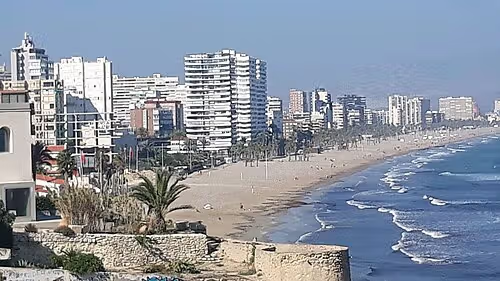
Residential towers ring this curved bay, giving it a suburban, local flavor distinct from the tourist-heavy sands further north. The water here is calm, protected by the shape of the coast, making it a swimming pool for the neighborhood. It sits at the mouth of a dry ravine and holds significant history; the ruins of Roman Lucentum are just a short walk away. The sand is darker and more compacted than at San Juan, and the vibe is decidedly domestic.

You won't find rows of souvenir shops here. Instead, you find families who live in the apartments above coming down for their daily swim. It is one of the Alicante attractions that feels claimed by residents. In summer, it gets busy, but the crowd is less transient. The backdrop of buildings is close, making the beach feel like an extension of the city rather than a wild escape.

A wooden walkway connects different sections, and rock clusters at the ends offer spots for fishing or snorkeling. It is convenient, accessible by tram, and lacks the pretension of the resort areas. It serves its purpose as a cooling station for the northern districts perfectly.

Hours Check locally
Price Check locally
Website N/A
Insider TipTake the tram (L1, L3, or L4) to the 'La Isleta' stop; it drops you right next to the beach and the Roman ruins.
Pozos de Garrigós

3. Pozos de Garrigós

Carved directly into the rock of Mount Benacantil, these three cisterns are a testament to the preciousness of water. They date back to the 16th century (or possibly earlier, the origins are debated) and were designed to catch and hold every drop of rain that fell on the mountain. The interior is vaulted and cathedral-like, not built for beauty but for the immense pressure of stored liquid. Now empty, they serve as a unique exhibition space, usually tied to the Water Museum.

The acoustics are haunting, amplifying footsteps and whispers. Walking into the hillside, you feel the temperature drop immediately. It is a raw, industrial space from a pre-industrial age. Among Alicante attractions, this is one of the few that takes you inside the geology of the city. The stone walls still bear the marks of the tools used to hew them.

Exhibitions here are often temporary art installations or historical displays, but the container is more interesting than the content. It’s a reminder of the engineering required to sustain a city in a dry land. The connection to the outside world is just a small entrance, making the vastness of the interior a surprise.

Hours Mon: Closed | Tue-Fri: 10:00 AM – 2:00 PM, 5:00 – 8:00 PM | Sat-Sun: 10:00 AM – 2:00 PM
Price Check locally
Location 38.3465, -0.4803
Insider TipEntrance is through the Museo de Aguas on Plaza del Puente; don't look for a separate door on the street.
Get Your Own Private Tour with AI Guide
AI Guide
  • Personalized tour tailored to your interests
  • Your AI guide tells stories, shares facts, and cracks jokes
  • Turn-by-turn GPS navigation
  • Available in your language — no download needed
Try for Free

🎨 Best Museums & Galleries in Alicante

World-class museums and galleries that make Alicante a cultural treasure.

Hogueras Museum

1. Hogueras Museum

Fire is the central character of Alicante's biggest festival, and this museum explains why the city burns its art every June. Located in the Casa de la Festa, it displays the *ninots indultats*—the individual figures saved from the flames by popular vote. The collection is a riot of papier-mâché, satire, and caricature, preserving the grotesque and beautiful sculptures that would otherwise be ash. It offers a permanent glimpse into the temporary madness of the Hogueras de San Juan without the smoke and heat.

The exhibits trace the evolution of the festival from simple piles of junk furniture to towering artistic monuments. Costumes, photographs, and scale models fill in the context, showing how the city transforms for those few chaotic days. For travelers who can't visit in June, this is one of the most culturally specific Alicante attractions, explaining a tradition that can seem baffling to outsiders.

It is small enough to see in thirty minutes but dense with local pride. The audiovisual room helps connect the static figures to the noise and energy of the actual event. Seeing the craftsmanship up close—the painted expressions, the satirical details—makes the realization that they are built to be destroyed even more striking.

Hours Mon: Closed | Tue-Thu: 10:00 AM – 1:30 PM, 5:00 – 7:30 PM | Fri: 10:00 AM – 1:30 PM, 5:00 – 7:00 PM | Sat-Sun: 10:00 AM – 1:30 PM
Price Check locally
Insider TipCheck the video schedule upon entry; the footage of the 'Cremà' (the burning) gives context to the statues that you won't get just by looking at them.
Get Your Own Private Tour with AI Guide
AI Guide
  • Personalized tour tailored to your interests
  • Your AI guide tells stories, shares facts, and cracks jokes
  • Turn-by-turn GPS navigation
  • Available in your language — no download needed
Try for Free

🍕 Food Markets & Culinary Spots in Alicante

The best food markets, food halls, and culinary destinations in Alicante.

Mercado Central de Alicante

1. Mercado Central de Alicante

Modernist flourishes on the facade give way to a cathedral of commerce inside. This two-story building is the working stomach of the city, smelling of cured ham, fresh dill, and crushed ice. It is loud and chaotic in the best possible way. The bottom floor handles the heavy lifting of fish and meat, where butchers shout orders and fishmongers slice tuna with surgical precision. Upstairs is lighter, filled with fruit stacks, cheeses, and bakeries. It is not a sanitized food court for tourists; it is where grandmothers still haggle over the price of tomatoes.

Saturdays transform the market square into a social hub known as *tardeo*, where locals gather to drink vermouth and eat tapas from the surrounding stalls. Among Alicante attractions, this offers the most direct line to the local lifestyle. The architecture, with its high ceilings and decorative tile work, elevates the mundane act of grocery shopping into an event. You will see products here you don't recognize and cuts of meat that might make you squeamish, which is exactly the point.

The rear entrance opens onto a square filled with flowers, adding a splash of color to the stone and iron. It is best visited hungry and early, before the best catch is sold and the stalls start washing down their counters. It feels permanent and essential, a place that has survived bombings and economic shifts without losing its purpose.

Hours Mon-Fri: 7:00 AM – 2:30 PM | Sat: 7:00 AM – 3:00 PM | Sun: Closed
Price Check locally
Insider TipGo to the lower level for the salted fish stalls (salazones) and ask for 'mojama' (cured tuna loin) to take away; it's the local delicacy.
Get Your Own Private Tour with AI Guide
AI Guide
  • Personalized tour tailored to your interests
  • Your AI guide tells stories, shares facts, and cracks jokes
  • Turn-by-turn GPS navigation
  • Available in your language — no download needed
Try for Free

🌳 Parks & Best Viewpoints in Alicante

Beautiful parks, gardens, and panoramic viewpoints for the best views of Alicante.

Parque El Palmeral

1. Parque El Palmeral

Dusty paths give way to a dense canopy of date palms in this park on the southern edge of the city. It feels like an oasis, deliberately designed to mimic the agricultural palm groves of nearby Elche but with a recreational twist. Artificial waterfalls, small bridges, and a rowing lake create a landscape that is clearly man-made yet deeply relaxing. The sound of running water is constant, masking the noise of the nearby road and the airport flight path.

Families dominate the space on weekends, spreading out picnics on the grass and renting small boats. It is not a manicured botanical garden; it has a rougher, more usable feel. Unlike the tightly packed Alicante attractions in the center, here you have space to breathe. The light filtering through the palm fronds is fractured and soft, making it a relief from the glare of the beach.

A bike path connects it to the city center, making it accessible without a car. It shows a greener side of the Costa Blanca, one that values shade above all else. Whether you are running on the trails or just sitting on a bench, the sheer number of trees lowers the temperature by a few degrees.

Hours Daily: 9:00 AM – 11:00 PM
Price Check locally
Insider TipBring your own food and water; the kiosks inside are often closed or have limited options.
Get Your Own Private Tour with AI Guide
AI Guide
  • Personalized tour tailored to your interests
  • Your AI guide tells stories, shares facts, and cracks jokes
  • Turn-by-turn GPS navigation
  • Available in your language — no download needed
Try for Free

Explore with AI Guide

AI Guide App

Get personalized tours with our AI-powered guide. No download needed — works right in your browser.