Best Time to Visit Bamberg
Month-by-month weather, crowds and prices, plus a full calendar of festivals and events worth planning a trip around.
Best monthsMay, Sep
CheapestJan, Feb, Nov
AvoidAug
BusiestJul, Aug
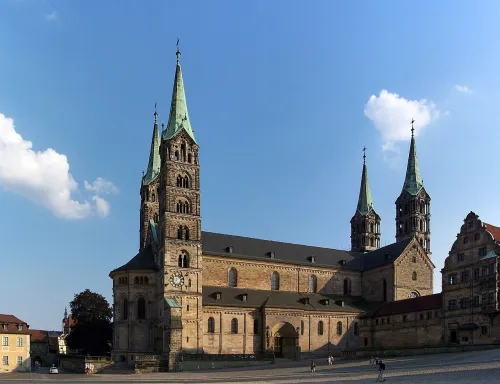
When is the best time to visit Bamberg?
Come in May or September: mild 18-20°C, the Rosengarten in bloom or the carp season opening, and the UNESCO old town walkable without crowds. July and August are the hottest and busiest, peaking in Sandkerwa week (20-24 August). January is cheapest and almost empty, the trade being grey, foggy skies.
Start our tool and find your best time to visit Bamberg
Your perfect month
Free · ~30 seconds
or tap a month directly
What matters to you?
And this?
Best overall: May, Sep. Mid-to-late May and the second half of September are the sweet spot: 18-21°C, the Rosengarten or the golden Regnitz foliage, every sight open, and none of the August crush. Book either and you get the best of Bamberg with room to breathe.
Best value: Jan, Oct. January for the year's lowest hotel rates and near-empty museums, or October for a yearly-low nightly average paired with carp season, autumn gold on the riverbanks, and the free Rosengarten still open.
Avoid: Aug. Sandkerwa week (20-24 August) unless you booked months ahead: hotels sell out and run near double price, around 40,000 visitors a day flood the old town, and the Regnitz heat in the cobbled lanes is relentless.
- January: Tough month, 4°C. This is the one month you have the cathedral almost to yourself. No day-trippers, no queues, just locals and a slow, foggy quiet. The grey skies are the honest price, and for the emptiness and the rock-bottom rates it is a fair one.
- February: Good time, 6°C. February is unperformed Bamberg, with no show put on for visitors and no seasonal markup. If you want the UNESCO old town to feel like a real working town in winter rather than a postcard, this is the month.
- March: Good time, 10°C. March is the last calm window before the season turns. Bamberg stirs awake, terrace chairs reappear and the riverside blossom begins, yet you still get the old town without the crush. That window shuts fast.
- April: Good time, 15°C. April is lovely and no longer a secret. Easter services pack the Dom and the holiday crowds arrive, but the riverside blossom and the driest skies of the year earn it back. Go knowing it is the first busy stretch, not the quiet shoulder.
- May: Great time, 19°C. Mid-to-late May is the genuine sweet spot most people are actually after: warm enough, everything open, blossoming gardens, and none of the August crush. Come in the second half of the month and you get Bamberg at close to its best.
- June: Good time, 24°C. June is the tipping point from busy-but-easy into full summer mode. The long, light evenings are the real reward: dusk-lit open-air theatre and the roses at their peak make it the most romantic stretch of the year, even as the day crowds thicken.
- July: Good time, 25°C. July rewards anyone who plans around the heat. Midday in the cobbled lanes is genuinely draining, but a Calderon performance at dusk or a riverside beer once the sun drops is a different, better Bamberg. Where a private human guide charges peak summer rates and books out, our live AI guide stays a flat 5€/hour and walks the cool early hours with you on your own clock, telling the story of everything you pass and answering whatever you ask.
- August: Tough month, 25°C. Sandkerwa is either the highlight of your year or the thing to flee, with no middle ground. The water-jousting and brass-band cellars are genuinely special, but 40,000 people a day in lanes built for a medieval town is intense, and the heat in the cobbles is relentless. Decide which camp you are in before you book.
- September: Great time, 20°C. Late September is Bamberg exhaling after summer. The crowds thin, the heat is gone, the carp Gasthofs reopen for the season, and the riverside light turns gold. For a first visit with room to breathe, the second half of the month is hard to beat.
- October: Great time, 15°C. October is the locals' secret: cheap, quiet and quietly beautiful. The riverbanks turn gold, the carp inns fill on weekends with regulars rather than tour groups, and you can have the cathedral to yourself on a weekday morning. The best value-and-atmosphere combination of the year.
- November: Good time, 8°C. Early November is the year's overlooked quiet, all fog and bare trees and empty squares. It is atmospheric in a melancholy way, and once the Christmas market opens on the 24th the city flicks back to life. Time it for either the silence or the first glühwein, but know which you want.
- December: Tough month, 5°C. Bamberg's Christmas market is the anti-Nuremberg: compact, low-key and not a mass-tourism circus. Midweek it is almost all locals; advent weekends bring the Nuremberg day-trippers. For the cosiest version, come Wednesday or Thursday in the first ten days of December.
Bamberg weather by month
HighLowRainfall
Jan4°
Feb6°
Mar10°
Apr15°
May19°
Jun24°
Jul25°
Aug25°
Sep20°
Oct15°
Nov8°
Dec5°
| Month | Temp | Rain | Sun | Crowds | Prices | Highlight |
|---|---|---|---|---|---|---|
| Jan | 4° / -1° | 81mm · 16 rainy days | 3.2 h/day | ●○○○○ | ●○○○○ | Carp Season |
| Feb | 6° / -1° | 62mm · 12 rainy days | 5.8 h/day | ●○○○○ | ●○○○○ | Carp Season |
| Mar | 10° / 1° | 66mm · 12 rainy days | 7.6 h/day | ●●○○○ | ●●○○○ | Carp Season |
| Apr | 15° / 4° | 48mm · 11 rainy days | 10.3 h/day | ●●●○○ | ●●○○○ | Walpurgis Night Parties |
| May | 19° / 9° | 65mm · 11 rainy days | 10.9 h/day | ●●●○○ | ●●●○○ | Franconian Beer Week |
| Jun | 24° / 14° | 61mm · 10 rainy days | 12.0 h/day | ●●●●○ | ●●●●○ | Erlangen Bergkirchweih |
| Jul | 25° / 15° | 76mm · 11 rainy days | 12.1 h/day | ●●●●○ | ●●●●○ | Calderon Theatre Festival |
| Aug | 25° / 15° | 77mm · 12 rainy days | 10.7 h/day | ●●●●● | ●●●●● | Cathedral Midday Organ Concerts |
| Sep | 20° / 11° | 51mm · 9 rainy days | 9.2 h/day | ●●●○○ | ●●●○○ | Cathedral Midday Organ Concerts |
| Oct | 15° / 7° | 63mm · 11 rainy days | 6.2 h/day | ●●○○○ | ●●○○○ | Cathedral Midday Organ Concerts |
| Nov | 8° / 3° | 68mm · 12 rainy days | 4.0 h/day | ●●○○○ | ●●○○○ | Carp Season |
| Dec | 5° / 1° | 83mm · 16 rainy days | 2.7 h/day | ●●●○○ | ●●●○○ | Carp Season |
How we score this: weather = long-run climate normals (Open-Meteo), crowds & prices = relative season read, events checked yearly against official dates.
Best time to visit Bamberg: weather, prices & crowds
Best months for good weather
May, Jun, Sep
May, June and September give the most reliable warmth: 18-24°C highs, long evenings that hold light past 21:00 in June, and short showers rather than all-day rain.
Quietest months to avoid the crowds
Jan, Feb, Nov
From January to February and again in November the day-trippers vanish: you can stand alone in the Dom on a weekday morning and walk Klein Venedig without a single tour group.
Cheapest time to visit Bamberg
Jan, Oct
January is the cheapest month, with rooms from around 52€ a night, roughly 30-35% below summer; October is the quiet autumn bargain at a yearly-low nightly average.
Best time for festivals and events
Aug, Dec
Sandkerwa (20-24 August) brings the Fischerstechen jousting on the Regnitz before Klein Venedig, a spectacle unique in Bavaria; December swaps it for a compact, locals-first Christmas market on Maximiliansplatz.
How many days do you need in Bamberg?
Two days is the sweet spot for Bamberg. The UNESCO old town is compact and entirely walkable, so one full day covers the headline sights, but a second lets you climb the Michelsberg, slow down over a Rauchbier, and reach the carp Gasthofs in the surrounding villages without rushing.
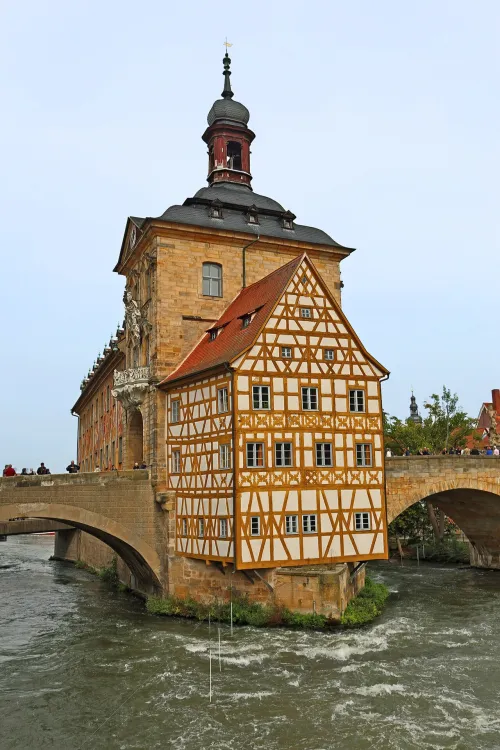
One day
The old town in a tight loop
One day is enough to cover the core. Start at the four-towered Bamberger Dom on the Domberg, walk down to the Altes Rathaus perched mid-river on the Obere Brücke, then follow the canal cottages of Klein Venedig along the Regnitz. This self-guided Bamberg walking tour links 11 stops across just 3.7 km in about 2.3 hours, a scenic loop that leaves time for the Neue Residenz and its free Rosengarten panorama.
Two daysRecommended
Beer culture and the hills
A second day is where Bamberg opens up. Climb the Michelsberg to the Kloster Michelsberg for the skyline view and the Brauereimuseum, then drop into Schlenkerla for the smoky Rauchbier that the city is known for. Browse the Grüner Markt produce stalls under the Altes Rathaus and end with a fried Aischgrund carp lunch in a village Gasthof around Memmelsdorf or Frensdorf.
Three days
Day-trips into Franconia
With a third day you can ride out into beer country. A 25-minute direct train reaches Erlangen and its Bergkirchweih beer festival in early summer, and a 20-minute one reaches the Annafest cellars in Forchheim's Kellerwald. The 45-minute train to Nuremberg makes an easy contrast: a big imperial city against Bamberg's small-town calm.
Four days or more
Settle in and slow down
Four days or more turns the trip into a proper Franconian stay. Walk the autumn gold along the Regnitz and the Hainpark, catch a dusk performance at the open-air Calderon festival in the Alte Hofhaltung courtyard in summer, and work through more of the nine working breweries. Cycle the river paths or simply linger over carp and Kellerbier without watching the clock.
Best time to visit Bamberg by traveller type
Same city, different trip. Here's the month that fits how you're travelling.
🧭
Best time to visit Bamberg for the first time
MaySep
May or September: the Rosengarten and Calderon festival not yet in full swing in May, summer heat gone and carp season starting in September, mild 18-20°C, and every sight open without peak-season pressure.
❤️
Best time to visit Bamberg for couples
JunOct
June for the Rosengarten roses at full bloom and open-air Calderon theatre under 21:00 dusk light, or October for autumn gold along the Regnitz and a carp dinner in an old riverside Gasthof.
💶
Best time to visit Bamberg on a budget
JanOct
January for the year's lowest rooms from around 52€ and empty museums, or October for a yearly-low nightly average; the Rosengarten, Dom and Klein Venedig are free year-round, and Tuesday-Wednesday beats the weekend.
🍝
Best time to visit Bamberg for food and wine
SepOct
September into October for the height of Aischgrund carp season, freshly baked in the original village Gasthofs, plus the nine working breweries pouring autumn Festbier and the smoked Rauchbier any day.
Worst time to visit Bamberg
The one stretch to avoid is Sandkerwa week in late August, roughly 20 to 24 August. Around 200,000 people, about 40,000 a day, pack lanes built for a medieval town, hotels sell out at near double price, and the heat on the cobbles in the Regnitz valley is relentless with no breeze to ease it. The rest of July and August are simply hot and busy, with midday in the old town genuinely draining.
Still worth it for The festival itself is special: the Fischerstechen water-jousting on the river is unique in Bavaria, so the week is only the worst time if you are not there for it. If you book a hotel six or more months ahead, or stay in Nuremberg and ride the train in, Sandkerwa becomes a highlight rather than a hassle.
Go instead in May, September, when Bamberg is at its best.
Best time for a tour of Bamberg
Bamberg is a compact city best taken on foot, and the calendar swings hard between comfortable and grim. May and September are the sweet spots: highs of 18 to 20 °C, long daylight, and just nine to eleven rain days mean you can climb the slope to the Bamberger Dom, cross the bridges of Klein-Venedig, and linger in the Rosengarten der Neuen Residenz without sweating or shivering. June through August push highs to 25 °C with thick crowds in August, when the cobbled lanes around the Altes Rathaus and the Grüner Markt fill up and the open stretch Am Kranen along the Regnitz offers little shade by midday. Winter is honest and cold: January and December barely reach 4 to 5 °C, fall dark by late afternoon, and bring sixteen wet days each, which turns the steep climb to Kloster Michelsberg into a slick, gloomy haul. April and October are the gambles, mild but changeable, rewarding anyone who carries a jacket.
The good news is that with AI Tourguide the climate sets your hour, not a tour operator. There are no fixed departure times, so on a warm August day you simply start your Bamberg tour at eight in the morning, walk the loop while the Grüner Markt is still quiet, and be back in the shade before the heat builds. It runs entirely in your browser, no app and no download, and a voice-first guide leads the whole way, telling the stories behind the Alte Hofhaltung, asking what you want to see next, and adapting the route while you keep full control of the pace.
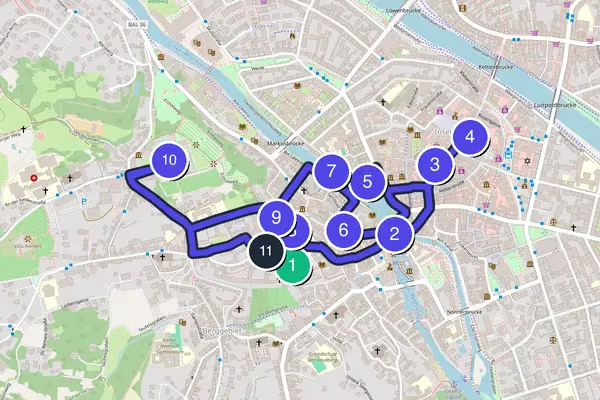

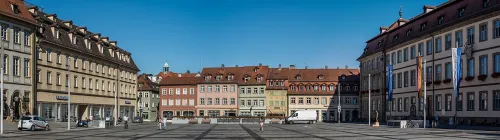 +7
+7All 11 stops are already on the map.
You just press start.
You just press start.
 AI Tourguide
You just read the route.
Now walk it with a guide in your ear.
Press start wherever you are, even hundreds of kilometres from Bamberg, and the guide begins telling its stories right away. In the city, pick any of the 11 stops to start from: it leads you there, then talks with you the whole route, asking, listening, remembering, and shaping the tour around your answers.
11stops3.7km2.3hours11languages
▶Start the tour freeFree to start · Runs in your browser · No app, no download
Bamberg events and festivals calendar
Annual highlights worth timing a trip around, listed month by month.
April
🎵 MusicWalpurgis Night Parties Tanz in den Mai
Apr 30 – May 1
night of 30 April
Walpurgis Night parties across several inner-city venues, with the Live Club running roughly 22:30-2:30, entry from age 16.
May
🍷 Food and wineFranconian Beer Week Fränkische Bierwoche
May 1–10 ~
first days of May
More than 40 Franconian breweries set up wooden stalls on the cobbles of Domplatz, pouring new seasonal beers with folk music alongside.
🎵 MusicCathedral Midday Organ Concerts Mittagsorgelkonzerte im Dom
May 1 – Oct 31
midday, May to October
Free public midday organ concerts inside Bamberg Cathedral; the Dom closes to sightseeing while they play.
🎉 FestivalSpring Market Frühjahrsmarkt
May 4–16
early-to-mid May
A funfair with stalls, carousels and local traders that officially opens Bamberg's outdoor season.
🎉 FestivalErlangen Bergkirchweih Erlanger Bergkirchweih
May 21 – Jun 1 ~
twelve days around Whitsun
The oldest beer festival in the world, running since 1755 on Erlangen's Burgberg, drawing around a million visitors over twelve days.
June
🎨 Art and cultureCalderon Theatre Festival Calderón-Festspiele
Jun 26 – Jul 31
late June through July
Open-air theatre in the courtyard of the Alte Hofhaltung, running since 1973 with 600 seats; evening performances begin around 20:30.
July
🍷 Food and wineAnnafest Forchheim
Jul 24 – Aug 3 ~
late July around St Anne's day
Franconia's oldest beer festival, going since 1840, set among more than 20 historic beer cellars in Forchheim's Kellerwald, 30 km from Bamberg.
August
🎉 FestivalSandkerwa Folk Festival Bamberger Sandkerwa
Aug 20–24 ~
five days in late August
Bamberg's biggest folk festival, with the Fischerstechen water-jousting on the Regnitz before Klein Venedig, beer cellars, brass bands and Monday fireworks; about 200,000 visitors over five days.
September
🌸 Seasonal natureCarp Season Karpfensaison
Sep 1 – Apr 30
months with an 'r', September to April
The traditional Aischgrund carp season, when EU-protected Aischgrund carp is served fried in village Gasthofs across the region; restaurant demand peaks September to November.
October
🌸 Seasonal natureAutumn Market Herbstmarkt
Oct 1 – Nov 15 ~
October into November
Autumn weekly markets on the Grüner Markt selling pumpkins, carp and Franconian wine as the season turns.
November
🎄 Christmas marketBamberg Christmas Market Bamberger Weihnachtsmarkt
Nov 24 – Dec 23
late November to 23 December
Around 100 stalls on Maximiliansplatz and the Sandstraße, with hot Rauchbier punsch as the local speciality and a parallel artisan craft market.
Insider tips for visiting Bamberg
The rules buried in forums, in one place.
- The Dom only opens to visitors at 13:00 on Sundays, with services running all morning. For photos of the empty cathedral, come on a weekday between 9:00 and 10:00 instead.
- Midday organ concerts run in the Dom from May to October and close it to sightseeing while they play, about 30-40 minutes. Visit the interior in the morning or later afternoon, or come for the free concert itself.
- For Sandkerwa (20-24 August) book a Bamberg hotel six or more months ahead, or stay in Nuremberg and ride the train in, 45 minutes each way. Last-minute rooms in town are gone or near double price.
- The Neue Residenz closes all day on Carnival Tuesday (17 February), its one regular closing day outside public holidays. If you travel in February, plan that Tuesday around the Dom and the old town instead.
- The Fränkisches Brauereimuseum on the Michelsberg opens only Wednesday to Friday 13:00-17:00 and Saturday-Sunday 11:00-17:00, shut Monday and Tuesday. Pair a weekend visit with the free monastery garden next door.
- Calderon festival tickets (from 26 June) sell out fast for just 600 open-air seats. Book several weeks ahead through the ETA Hoffmann Theater at theater.bamberg.de.
- Carp-season weekends (September to November) book out the popular village Gasthofs around Memmelsdorf, Frensdorf and the Aischgrund on Saturdays. Come midweek for a table without a reservation.
- The best weekly market is the Grüner Markt under the Altes Rathaus, Friday 7:00-13:00, for Franconian produce, Rauchbier butchers and local growers. Saturday is a farmers' market with a different range; no market on Sundays.
Public holidays in Bamberg
On these dates many shops and offices close, transport thins out, and sights can be mobbed or shut. Plan around them.
| Date | Holiday | What closes |
|---|---|---|
| Jan 1 | New Year's Day | Everything closed; the Dom opens in the afternoon only. The quietest day of the year in the old town. |
| Jan 6 | Epiphany | Bavarian public holiday: shops closed. The Dom is open after its morning service. |
| Feb 17 | Carnival Tuesday | The Neue Residenz closes all day, its only regular closing day outside public holidays. The old town stays quiet. |
| Apr 3 | Good Friday | Everything closed; the Dom is full. A Stations of the Cross procession winds through the old town, the oldest preserved one in Germany. |
| Apr 6 | Easter Monday | Shops closed; museums open. A popular spring day-trip date, so the old town and cafés fill up. |
| May 1 | Labour Day | Shops closed. Local Tanz in den Mai parties run the night before at venues like the Live Club. |
| May 14 | Ascension Day | Shops closed; a common bridge-day long weekend that brings regional visitors into town. |
| May 25 | Whit Monday | Shops closed, within the Bavarian Whitsun holidays (26 May-5 June). The Erlangen Bergkirchweih beer festival is already running nearby. |
| Jun 4 | Corpus Christi | Bavarian public holiday: shops closed. A Corpus Christi procession on Domplatz is a striking sight worth catching. |
| Aug 15 | Assumption Day | Bavarian public holiday falling on a Saturday in 2026, so no bridge day; shops keep normal Saturday hours and churches are full. |
| Oct 3 | German Unity Day | National holiday falling on a Saturday in 2026, so no bridge day; shops keep normal Saturday hours. |
| Nov 1 | All Saints' Day | Bavarian public holiday on a Sunday in 2026, so no bridge day; cemeteries are lit with candles in the evening. One of the quietest days in town. |
| Dec 25 | Christmas Day | Everything closed. The old town is very quiet; the Christmas market has already ended on 23 December. |
| Dec 26 | St Stephen's Day | Everything closed; most restaurants shut too. Plan opening hours carefully over 24-26 December. |
Bamberg month by month
January in Bamberg
High4°C / 39°F
Low-1°C
Rain81mm / 16 rainy days
Sun3.2 h/day
Daylight9 h/day
Humidity85%
Crowds●○○○○Prices●○○○○
January is Bamberg at its emptiest and cheapest. Daytime highs hover around 4°C with frequent valley fog over the Regnitz, 16 days see some precipitation, and snow is never guaranteed. The Dom and Neue Residenz are close to deserted, and you can wander Klein Venedig without a single tour group. Bring a proper coat, plan around the New Year and Epiphany closures, and the city is yours.
The vibe This is the one month you have the cathedral almost to yourself. No day-trippers, no queues, just locals and a slow, foggy quiet. The grey skies are the honest price, and for the emptiness and the rock-bottom rates it is a fair one.
Don't miss The Neue Residenz and the Historisches Museum collections feel almost private on a weekday. Carp season is in full swing, so a fried Aischgrund carp in a warm village Gasthof is the season's signature meal.
Crowd drivers No day-trippers once Epiphany passes on 6 January; the lowest visitor pressure of the entire year.
In season Aischgrund carp season is on, baked crisp in the original country inns around Bamberg.
Heads up 1 January and 6 January are public holidays: shops and museums shut, the Dom opens afternoons only on the 1st.
Year's cheapest month: rooms from around 52€, roughly 30-35% below summer.
Events this month
🌸 Seasonal natureCarp Season Karpfensaison
Sep 1 – Apr 30
months with an 'r', September to April
The traditional Aischgrund carp season, when EU-protected Aischgrund carp is served fried in village Gasthofs across the region; restaurant demand peaks September to November.
Crispy fried Aischgrund carp in an original country inn is the defining Franconian dish, at its best around October.
February in Bamberg
High6°C / 44°F
Low-1°C
Rain62mm / 12 rainy days
Sun5.8 h/day
Daylight10 h/day
Humidity79%
Crowds●○○○○Prices●○○○○
February is the quietest stretch of the year, mild for winter at around 6°C highs but still damp and grey. Visitor numbers sit at their floor. The one date to note is Carnival Tuesday on 17 February, when the Neue Residenz closes all day, its only regular closing day outside public holidays. Otherwise the old town is calm, the Dom is open and empty, and prices stay at their lowest.
The vibe February is unperformed Bamberg, with no show put on for visitors and no seasonal markup. If you want the UNESCO old town to feel like a real working town in winter rather than a postcard, this is the month.
Don't miss Carp season continues, ideal for a long indoor lunch. The Fränkisches Brauereimuseum on the Michelsberg is an easy cold-weather afternoon, open Wednesday to Sunday.
Crowd drivers No school holidays and no festivals; tourist numbers bottom out for the year.
In season Smoked Rauchbier and fried carp are the winter staples; the nine working breweries pour year-round.
Heads up The Neue Residenz closes all day on Carnival Tuesday (17 February); plan that day around the Dom and old town.
Still the low season; hotel rates stay at January levels.
Events this month
🌸 Seasonal natureCarp Season Karpfensaison
Sep 1 – Apr 30
months with an 'r', September to April
The traditional Aischgrund carp season, when EU-protected Aischgrund carp is served fried in village Gasthofs across the region; restaurant demand peaks September to November.
Crispy fried Aischgrund carp in an original country inn is the defining Franconian dish, at its best around October.
March in Bamberg
High10°C / 51°F
Low1°C
Rain66mm / 12 rainy days
Sun7.6 h/day
Daylight12 h/day
Humidity73%
Crowds●●○○○Prices●●○○○
March wakes the city up. Highs climb toward 10°C, the cherry trees along the Regnitz start to blossom from late month, and café terraces creep back out. Crowds are still light, with the first families arriving once the Bavarian Easter holidays open near month's end. It is the last genuinely quiet month before spring fills the lanes, so a Saturday table is still easy to get.
The vibe March is the last calm window before the season turns. Bamberg stirs awake, terrace chairs reappear and the riverside blossom begins, yet you still get the old town without the crush. That window shuts fast.
Don't miss Cherry blossom along the Regnitz and the Hainpark runs from late March into mid-April depending on the weather. The first outdoor coffee of the year on a sunlit square feels like a small event.
Crowd drivers Regional trade-fair demand in nearby Nuremberg and Erlangen lifts hotel prices; the Bavarian Easter holidays (30 March-10 April) begin to draw early families.
In season Carp season is winding toward its end; eat it now before the months without an 'r' close it in May.
Prices tick up around 20% versus January, partly on regional trade-fair demand from Nuremberg and Erlangen.
Events this month
🌸 Seasonal natureCarp Season Karpfensaison
Sep 1 – Apr 30
months with an 'r', September to April
The traditional Aischgrund carp season, when EU-protected Aischgrund carp is served fried in village Gasthofs across the region; restaurant demand peaks September to November.
Crispy fried Aischgrund carp in an original country inn is the defining Franconian dish, at its best around October.
April in Bamberg
High15°C / 58°F
Low4°C
Rain48mm / 11 rainy days
Sun10.3 h/day
Daylight14 h/day
Humidity68%
Crowds●●●○○Prices●●○○○
April brings the city fully back to life. Highs reach a comfortable 15°C and it is the driest month of the year at just 48mm of rain. The Bavarian Easter holidays (30 March-10 April) fill the Dom for services and bring the first real family crowds. Good Friday on 3 April closes shops but stages the oldest preserved Stations of the Cross procession in Germany through the old town, a striking thing to witness.
The vibe April is lovely and no longer a secret. Easter services pack the Dom and the holiday crowds arrive, but the riverside blossom and the driest skies of the year earn it back. Go knowing it is the first busy stretch, not the quiet shoulder.
Don't miss Cherry blossom along the Regnitz peaks into mid-April. The Good Friday Stations of the Cross procession (3 April), the oldest preserved in Germany, winds through the old town.
Crowd drivers The Bavarian Easter school holidays (30 March-10 April) and the Easter weekend bring the year's first family surge.
In season Last call for fried Aischgrund carp before the 'r'-less summer months close the season.
Heads up Good Friday (3 April), Easter Sunday (5 April) and Easter Monday (6 April): shops shut, Dom services limit sightseeing, museums open Monday.
School-holiday demand peaks but rates stay moderate, around 20% above January.
Events this month
🌸 Seasonal natureCarp Season Karpfensaison
Sep 1 – Apr 30
months with an 'r', September to April
The traditional Aischgrund carp season, when EU-protected Aischgrund carp is served fried in village Gasthofs across the region; restaurant demand peaks September to November.
Crispy fried Aischgrund carp in an original country inn is the defining Franconian dish, at its best around October.
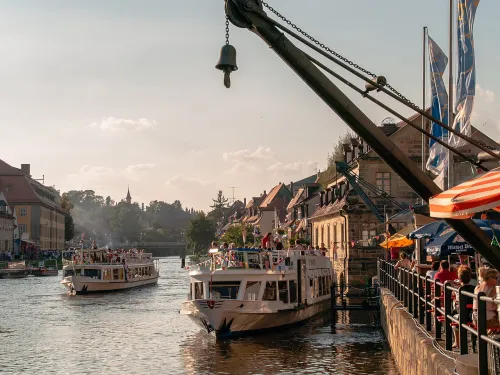
May in Bamberg
High19°C / 65°F
Low9°C
Rain65mm / 11 rainy days
Sun10.9 h/day
Daylight15 h/day
Humidity68%
Crowds●●●○○Prices●●●○○
May is one of the two best months to come. Highs sit at a mild 18-21°C, the Rosengarten behind the Neue Residenz opens in full bloom with its free panorama over the Michaelsberg, and the Spring Market runs 4-16 May. The Franconian Beer Week brings 40-plus breweries onto Domplatz in the first days, and crowds are present but never overwhelming. Everything is open and the days stretch past 15 hours of light.
The vibe Mid-to-late May is the genuine sweet spot most people are actually after: warm enough, everything open, blossoming gardens, and none of the August crush. Come in the second half of the month and you get Bamberg at close to its best.
Don't miss The Rosengarten opens 9:00-18:00 with 70 rose beds and a free Michaelsberg view. Franconian Beer Week pours new seasonal beers on Domplatz in the first days, and the free midday organ concerts in the Dom begin.
Crowd drivers The Bavarian Whitsun holidays (26 May-5 June) and the nearby Erlangen Bergkirchweih (from 21 May) draw regional visitors toward month's end.
In season New seasonal beers flow at Franconian Beer Week; the Aischgrund carp season has now closed for the warm months.
Heads up Labour Day (1 May), Ascension (14 May) and Whit Monday (25 May) close shops; the Dom shuts to visitors during midday organ concerts.
Shoulder turning mid-season; rates rise above spring but stay under the summer peak. Whitsun holidays (26 May-5 June) lift the end of the month.
Events this month
🍷 Food and wineFranconian Beer Week Fränkische Bierwoche
May 1–10 ~
first days of May
More than 40 Franconian breweries set up wooden stalls on the cobbles of Domplatz, pouring new seasonal beers with folk music alongside.
Franconia is the densest brewery region on earth, and tasting it in a small-town cellar atmosphere right beside the cathedral is a one-off.
🎉 FestivalSpring Market Frühjahrsmarkt
May 4–16
early-to-mid May
A funfair with stalls, carousels and local traders that officially opens Bamberg's outdoor season.
Family-friendly and free, it is the easy first sign that spring has properly arrived in the city.
🎵 MusicWalpurgis Night Parties Tanz in den Mai
Apr 30 – May 1
night of 30 April
Walpurgis Night parties across several inner-city venues, with the Live Club running roughly 22:30-2:30, entry from age 16.
A local spring ritual and the liveliest single night out of the season if you want Bamberg after dark.
🎉 FestivalErlangen Bergkirchweih Erlanger Bergkirchweih
May 21 – Jun 1 ~
twelve days around Whitsun
The oldest beer festival in the world, running since 1755 on Erlangen's Burgberg, drawing around a million visitors over twelve days. The mayor taps the first keg on the opening evening at 17:00.
A 25-minute direct train from Bamberg makes it an essential, free day-trip for anyone serious about Franconian beer culture, and it is older than Oktoberfest.
🎵 MusicCathedral Midday Organ Concerts Mittagsorgelkonzerte im Dom
May 1 – Oct 31
midday, May to October
Free public midday organ concerts inside Bamberg Cathedral; the Dom closes to sightseeing while they play.
Free organ music in one of Europe's great imperial cathedrals, though you trade the chance to tour the interior during the concert.

June in Bamberg
High24°C / 75°F
Low14°C
Rain61mm / 10 rainy days
Sun12.0 h/day
Daylight16 h/day
Humidity66%
Crowds●●●●○Prices●●●●○
June opens the Bamberg summer. Highs reach 24°C, the Rosengarten roses are at full bloom, and evenings hold light past 21:15, perfect for the open-air Calderon festival that begins on 26 June in the Alte Hofhaltung courtyard. It is statistically the wettest month at around 75mm, but the rain comes as short 30-60 minute showers rather than all-day soaks. Crowds are building toward the summer peak.
The vibe June is the tipping point from busy-but-easy into full summer mode. The long, light evenings are the real reward: dusk-lit open-air theatre and the roses at their peak make it the most romantic stretch of the year, even as the day crowds thicken.
Don't miss The Rosengarten is in peak rose bloom. The Calderon Theatre Festival opens 26 June with evening performances around 20:30 in the baroque courtyard of the Alte Hofhaltung; book ahead for the 600 seats.
Crowd drivers The Corpus Christi bridge holiday (4 June) and the start of the Calderon festival (26 June) drive the early-summer surge.
In season Beer-garden season is in full swing; the smoked Rauchbier of Schlenkerla is the local pour to seek out.
Heads up Corpus Christi (4 June) closes shops; a procession crosses Domplatz. The Dom shuts to visitors during midday organ concerts.
High season begins; rooms run 35-50% above January, and the Corpus Christi bridge weekend pushes rates up.
Events this month
🎨 Art and cultureCalderon Theatre Festival Calderón-Festspiele
Jun 26 – Jul 31
late June through July
Open-air theatre in the courtyard of the Alte Hofhaltung, running since 1973 with 600 seats; evening performances begin around 20:30.
The baroque bishop's palace as a stage in the open-air dusk is a setting nowhere else can match, so book early because seats sell out.
🎵 MusicCathedral Midday Organ Concerts Mittagsorgelkonzerte im Dom
May 1 – Oct 31
midday, May to October
Free public midday organ concerts inside Bamberg Cathedral; the Dom closes to sightseeing while they play.
Free organ music in one of Europe's great imperial cathedrals, though you trade the chance to tour the interior during the concert.

July in Bamberg
High25°C / 77°F
Low15°C
Rain76mm / 11 rainy days
Sun12.1 h/day
Daylight16 h/day
Humidity64%
Crowds●●●●○Prices●●●●○
July is hot and busy. Highs average 25°C and heatwaves can push past 28°C, with no coastal breeze to ease the Regnitz valley, which acts as a heat sink. The cobbled old town bakes, so the best sightseeing windows are 8:00-11:00 and after 17:00; the massive sandstone Dom stays cool inside through the day. The Calderon festival runs all month, and school holidays in other German states keep arrivals high.
The vibe July rewards anyone who plans around the heat. Midday in the cobbled lanes is genuinely draining, but a Calderon performance at dusk or a riverside beer once the sun drops is a different, better Bamberg. Where a private human guide charges peak summer rates and books out, our live AI guide stays a flat 5€/hour and walks the cool early hours with you on your own clock, telling the story of everything you pass and answering whatever you ask.
Don't miss The Calderon Theatre Festival continues with dusk-lit open-air performances. The Rosengarten holds its bloom into early August, and the long evenings suit a slow walk along the lit Regnitz.
Crowd drivers Summer school holidays in North Rhine-Westphalia, Lower Saxony and other states begin, feeding a steady stream of arrivals.
In season Beer gardens and cellars are at their summer best; cold Kellerbier straight from the barrel is the move in the heat.
Heads up The Dom closes to visitors during its midday organ concerts; the Brauereimuseum keeps short Wednesday-to-Sunday hours.
Hotel prices sit at their yearly high as other German states' school holidays begin.
Events this month
🎨 Art and cultureCalderon Theatre Festival Calderón-Festspiele
Jun 26 – Jul 31
late June through July
Open-air theatre in the courtyard of the Alte Hofhaltung, running since 1973 with 600 seats; evening performances begin around 20:30.
The baroque bishop's palace as a stage in the open-air dusk is a setting nowhere else can match, so book early because seats sell out.
🍷 Food and wineAnnafest Forchheim
Jul 24 – Aug 3 ~
late July around St Anne's day
Franconia's oldest beer festival, going since 1840, set among more than 20 historic beer cellars in Forchheim's Kellerwald, 30 km from Bamberg.
A 20-minute direct train delivers you to a far more original beer festival than Oktoberfest, served under old chestnut trees.
🎵 MusicCathedral Midday Organ Concerts Mittagsorgelkonzerte im Dom
May 1 – Oct 31
midday, May to October
Free public midday organ concerts inside Bamberg Cathedral; the Dom closes to sightseeing while they play.
Free organ music in one of Europe's great imperial cathedrals, though you trade the chance to tour the interior during the concert.
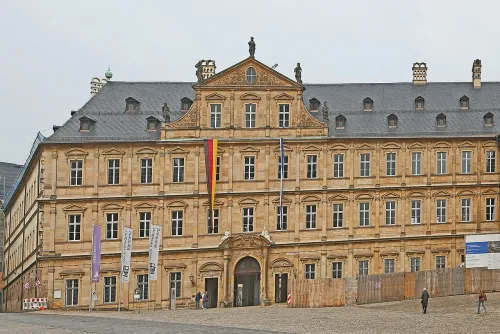
August in Bamberg
High25°C / 76°F
Low15°C
Rain77mm / 12 rainy days
Sun10.7 h/day
Daylight14 h/day
Humidity68%
Crowds●●●●●Prices●●●●●
August is the busiest month of the year, peaking hard in Sandkerwa week. Highs hold near 25°C with possible spikes, and the narrow lanes stay warm well into the evening. From 20 to 24 August, around 200,000 people, roughly 40,000 a day, pack the old town for the festival and its Fischerstechen jousting on the Regnitz. Outside that week, August is simply a warm, busy summer month with everything open.
The vibe Sandkerwa is either the highlight of your year or the thing to flee, with no middle ground. The water-jousting and brass-band cellars are genuinely special, but 40,000 people a day in lanes built for a medieval town is intense, and the heat in the cobbles is relentless. Decide which camp you are in before you book.
Don't miss The Fischerstechen water-jousting before Klein Venedig is unique in Bavaria, ending with Monday-night fireworks. Outside the festival week, the Rosengarten still holds its last roses into mid-August.
Crowd drivers Sandkerwa (20-24 August) is the single biggest crowd driver of the year; surrounding German school holidays keep the rest of the month full.
In season Sandkerwa runs on beer-cellar fare; for the rest of August the breweries and beer gardens carry the month.
Heads up Assumption Day (15 August) falls on a Saturday in 2026, so shops keep normal Saturday hours; churches are full.
Sandkerwa week (20-24 August) sells hotels out at near double price; book months ahead or stay in Nuremberg.
Events this month
🎉 FestivalSandkerwa Folk Festival Bamberger Sandkerwa
Aug 20–24 ~
five days in late August
Bamberg's biggest folk festival, with the Fischerstechen water-jousting on the Regnitz before Klein Venedig, beer cellars, brass bands and Monday fireworks; about 200,000 visitors over five days.
The Fischerstechen lance-duel on wooden boats is unique in Bavaria and worth timing a trip for, but book months ahead or the week becomes the one to avoid.
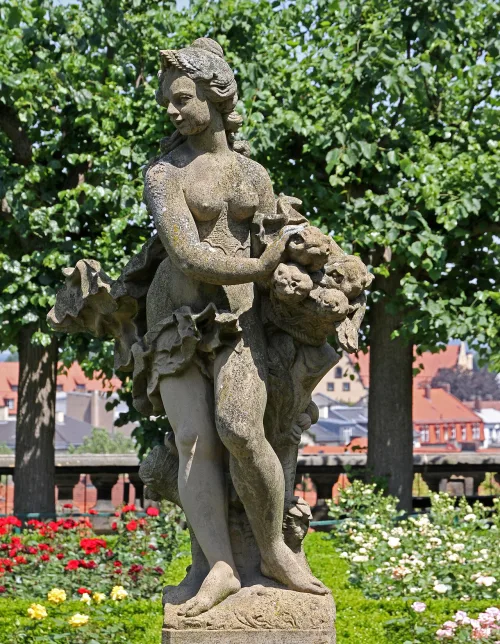
September in Bamberg
High20°C / 69°F
Low11°C
Rain51mm / 9 rainy days
Sun9.2 h/day
Daylight13 h/day
Humidity74%
Crowds●●●○○Prices●●●○○
September is the other best month to visit. The summer heat is gone, with comfortable 20°C highs and the driest stretch of the autumn at 51mm. The Bavarian summer holidays end on 14 September, so the second half of the month is calmer and cheaper. Carp season starts again, the first autumn gold appears on the Regnitz banks, and the light turns soft and golden over the old town. Everything is open and the pressure has lifted.
The vibe Late September is Bamberg exhaling after summer. The crowds thin, the heat is gone, the carp Gasthofs reopen for the season, and the riverside light turns gold. For a first visit with room to breathe, the second half of the month is hard to beat.
Don't miss Aischgrund carp season reopens, with riverside Gasthofs booking out on weekends. Early autumn foliage begins along the Regnitz, the best stretch of the year for a slow riverside walk.
Crowd drivers The Bavarian summer holidays end on 14 September, so crowds drop sharply in the back half of the month.
In season Carp season returns; freshly baked Aischgrund carp in a country inn is the dish of the month.
Rates ease after mid-September as the Bavarian summer holidays end on the 14th.
Events this month
🌸 Seasonal natureCarp Season Karpfensaison
Sep 1 – Apr 30
months with an 'r', September to April
The traditional Aischgrund carp season, when EU-protected Aischgrund carp is served fried in village Gasthofs across the region; restaurant demand peaks September to November.
Crispy fried Aischgrund carp in an original country inn is the defining Franconian dish, at its best around October.
🎵 MusicCathedral Midday Organ Concerts Mittagsorgelkonzerte im Dom
May 1 – Oct 31
midday, May to October
Free public midday organ concerts inside Bamberg Cathedral; the Dom closes to sightseeing while they play.
Free organ music in one of Europe's great imperial cathedrals, though you trade the chance to tour the interior during the concert.
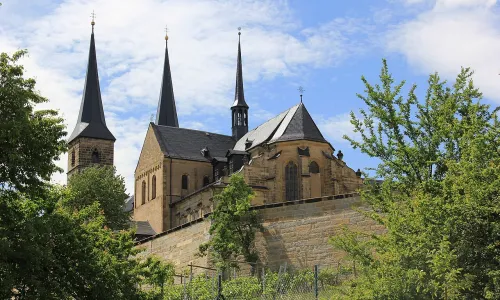
October in Bamberg
High15°C / 59°F
Low7°C
Rain63mm / 11 rainy days
Sun6.2 h/day
Daylight11 h/day
Humidity82%
Crowds●●○○○Prices●●○○○
October is the quiet autumn bargain. Highs ease to 15°C, and despite about 11 days with some rain the totals stay low at 63mm, so showers are short. Autumn gold lines the Regnitz and the Hainpark from mid-October, the carp season is at its peak in the village inns, and the Dom is nearly empty again. It is the cheapest month after January, with the free Rosengarten, Dom and Klein Venedig all still open.
The vibe October is the locals' secret: cheap, quiet and quietly beautiful. The riverbanks turn gold, the carp inns fill on weekends with regulars rather than tour groups, and you can have the cathedral to yourself on a weekday morning. The best value-and-atmosphere combination of the year.
Don't miss Autumn foliage along the Regnitz and the Hainpark peaks mid-October into early November, ideal for the season's best boat trips. Aischgrund carp is at its finest now in the regional country inns.
Crowd drivers Only the short Bavarian autumn holidays (2-6 November tail) and weekend carp-diners lift numbers; otherwise it is calm.
In season Peak Aischgrund carp month; reserve a riverside or village Gasthof ahead for an October Saturday.
Quietest and cheapest autumn month, with a yearly-low nightly average around 115 US$.
Events this month
🌸 Seasonal natureCarp Season Karpfensaison
Sep 1 – Apr 30
months with an 'r', September to April
The traditional Aischgrund carp season, when EU-protected Aischgrund carp is served fried in village Gasthofs across the region; restaurant demand peaks September to November.
Crispy fried Aischgrund carp in an original country inn is the defining Franconian dish, at its best around October.
🌸 Seasonal natureAutumn Market Herbstmarkt
Oct 1 – Nov 15 ~
October into November
Autumn weekly markets on the Grüner Markt selling pumpkins, carp and Franconian wine as the season turns.
It marks the carp-season start, when regional restaurants book out on October Saturdays, so reserve ahead.
🎵 MusicCathedral Midday Organ Concerts Mittagsorgelkonzerte im Dom
May 1 – Oct 31
midday, May to October
Free public midday organ concerts inside Bamberg Cathedral; the Dom closes to sightseeing while they play.
Free organ music in one of Europe's great imperial cathedrals, though you trade the chance to tour the interior during the concert.
November in Bamberg
High8°C / 47°F
Low3°C
Rain68mm / 12 rainy days
Sun4.0 h/day
Daylight9 h/day
Humidity87%
Crowds●●○○○Prices●●○○○
November is grey, damp and quiet, the lull before the Christmas season. Highs drop to around 8°C, fog settles over the Regnitz valley, and daylight shrinks below 9.5 hours. All Saints' Day on 1 November is calm, with candle-lit cemeteries in the evening. Then on 24 November the Christmas market opens on Maximiliansplatz, and the final week of the month begins to fill with the first advent visitors and coach groups.
The vibe Early November is the year's overlooked quiet, all fog and bare trees and empty squares. It is atmospheric in a melancholy way, and once the Christmas market opens on the 24th the city flicks back to life. Time it for either the silence or the first glühwein, but know which you want.
Don't miss The Christmas market opens 24 November on Maximiliansplatz and the Sandstraße, with hot Rauchbier punsch as the local speciality. Carp season continues in the village inns.
Crowd drivers Short Bavarian autumn holidays (2-6 November) and coach groups arriving for the advent market drive the late-month rise.
In season Carp season carries on; the new Christmas market pours its signature hot Rauchbier punsch from 24 November.
Heads up All Saints' Day (1 November) is a Bavarian holiday on a Sunday in 2026; shops keep normal Sunday closure.
Prices stay low until the Christmas market opens on 24 November, then the final week lifts.
Events this month
🎄 Christmas marketBamberg Christmas Market Bamberger Weihnachtsmarkt
Nov 24 – Dec 23
late November to 23 December
Around 100 stalls on Maximiliansplatz and the Sandstraße, with hot Rauchbier punsch as the local speciality and a parallel artisan craft market.
Far more compact than Nuremberg and barely touched by mass tourism, it is at its best midweek and from 1 to 10 December when it is almost all locals.
🌸 Seasonal natureCarp Season Karpfensaison
Sep 1 – Apr 30
months with an 'r', September to April
The traditional Aischgrund carp season, when EU-protected Aischgrund carp is served fried in village Gasthofs across the region; restaurant demand peaks September to November.
Crispy fried Aischgrund carp in an original country inn is the defining Franconian dish, at its best around October.
December in Bamberg
High5°C / 42°F
Low1°C
Rain83mm / 16 rainy days
Sun2.7 h/day
Daylight8 h/day
Humidity88%
Crowds●●●○○Prices●●●○○
December is Christmas-market month, but a gentle one. The market runs 24 November to 23 December with around 100 stalls across Maximiliansplatz and the Sandstraße, hot Rauchbier punsch and a parallel craft market. Highs sit around 5°C with frequent fog and short days that end near 16:10. Day-trippers come up from Nuremberg on the 45-minute train, busiest on advent weekends. After the 23rd the market closes, and over 24-26 December the old town goes very quiet with most things shut.
The vibe Bamberg's Christmas market is the anti-Nuremberg: compact, low-key and not a mass-tourism circus. Midweek it is almost all locals; advent weekends bring the Nuremberg day-trippers. For the cosiest version, come Wednesday or Thursday in the first ten days of December.
Don't miss The Christmas market (to 23 December) is best midweek and from 1 to 10 December, with hot Rauchbier punsch the speciality to try. Carp season continues for a festive dinner.
Crowd drivers Advent weekend day-trippers from Nuremberg and nearby cities are the main driver; midweek stays calm and local.
In season Hot Rauchbier punsch at the market and a festive Aischgrund carp dinner are the December pairing.
Heads up Over 24-26 December almost everything shuts, restaurants included; the Christmas market has already ended on the 23rd. Plan opening hours carefully.
Advent weekends run 15-25% above the November base; the 24th-26th go quiet as everything shuts.
Events this month
🎄 Christmas marketBamberg Christmas Market Bamberger Weihnachtsmarkt
Nov 24 – Dec 23
late November to 23 December
Around 100 stalls on Maximiliansplatz and the Sandstraße, with hot Rauchbier punsch as the local speciality and a parallel artisan craft market.
Far more compact than Nuremberg and barely touched by mass tourism, it is at its best midweek and from 1 to 10 December when it is almost all locals.
🌸 Seasonal natureCarp Season Karpfensaison
Sep 1 – Apr 30
months with an 'r', September to April
The traditional Aischgrund carp season, when EU-protected Aischgrund carp is served fried in village Gasthofs across the region; restaurant demand peaks September to November.
Crispy fried Aischgrund carp in an original country inn is the defining Franconian dish, at its best around October.
Frequently asked questions
What is the best time to visit Bamberg?
May and September are the best months. Mid-to-late May brings the Rosengarten in bloom, the Spring Market and mild 18-21°C, all before the summer crowds. The second half of September has 20°C highs, the new carp season, golden Regnitz light, and lower prices once the Bavarian school holidays end on 14 September.
What is the cheapest time to visit Bamberg?
January is the cheapest, with rooms from around 52€ a night, roughly 30-35% below summer, and near-empty museums. October is the quiet autumn alternative, hitting a yearly-low nightly average around 115 US$. In both, free highlights like the Rosengarten, the Dom and Klein Venedig stay open, and midweek beats the weekend.
What is the worst time to visit Bamberg?
Sandkerwa week (20-24 August) is the time to avoid unless you have booked months ahead. Around 40,000 people a day pack the medieval lanes, hotels sell out at near double price, and the heat in the cobbled old town is relentless. The festival itself is special, so it is only the worst time if you are not there for it.
When is the Bamberg Christmas market open in 2026?
The Bamberg Christmas market runs from 24 November to 23 December 2026 on Maximiliansplatz and the Sandstraße, with around 100 stalls and hot Rauchbier punsch as the local speciality. It is at its best midweek and from 1 to 10 December, when it is mostly locals. It closes before Christmas Eve, and 24-26 December are very quiet with most things shut.
What is the weather like in Bamberg in summer?
July is warmest, averaging 25°C highs with heatwaves past 28°C and no coastal breeze, as the Regnitz valley acts as a heat sink. The cobbled old town bakes by midday, so sightsee 8:00-11:00 or after 17:00. June is the wettest month at around 75mm, but the rain falls as short 30-60 minute showers, not all-day soaks.
How many days do you need in Bamberg?
Two days is the sweet spot. One day covers the UNESCO old town: the Dom, the Alte Hofhaltung, the Neue Residenz with its free Rosengarten, the Altes Rathaus and Klein Venedig. A second lets you climb the Michelsberg for the brewery museum, try the smoked Rauchbier, and slow down over a fried Aischgrund carp lunch in the surrounding villages.
Is Bamberg worth visiting in winter?
Yes, with the right expectations. December brings the compact, locals-first Christmas market to 23 December and hot Rauchbier punsch, while January and February are the cheapest, emptiest months for having the Dom and Klein Venedig almost to yourself. Expect grey, foggy skies, highs of 4-6°C, and no guaranteed snow, so pack a warm coat.
When can you see the Rosengarten in bloom in Bamberg?
The Rosengarten behind the Neue Residenz is in peak rose bloom from June into mid-August, with 70 beds and a free panorama over the Michaelsberg. It opens daily 9:00-18:00 from April to October, with shorter winter hours. June is the prettiest, pairing the roses with long evenings and the open-air Calderon theatre.

Any month, any day: your guide is already there
Whatever date you pick, a private human guide gets pricier and harder to book on weekends, holidays and in peak season. Our live AI guide, the one that walks with you and answers anything you ask out loud, works the opposite way.
One flat price, every day
No holiday, weekend, night or peak-season surcharge. A private guide in Bamberg runs well over 100 euro for a half day, and more on holidays. Ours stays the same.
Available the moment you want it
Start at midnight or at dawn, on Christmas, in the snow, in the August heat. No sold-out high season, no booking weeks ahead.
Your pace, no meter running
Pause for a long lunch, restart after dark, repeat a stop. The tour simply waits for you.
Free to try, a fraction of the cost
Test it for free, then a transparent flat price that undercuts any private guide, in every season.
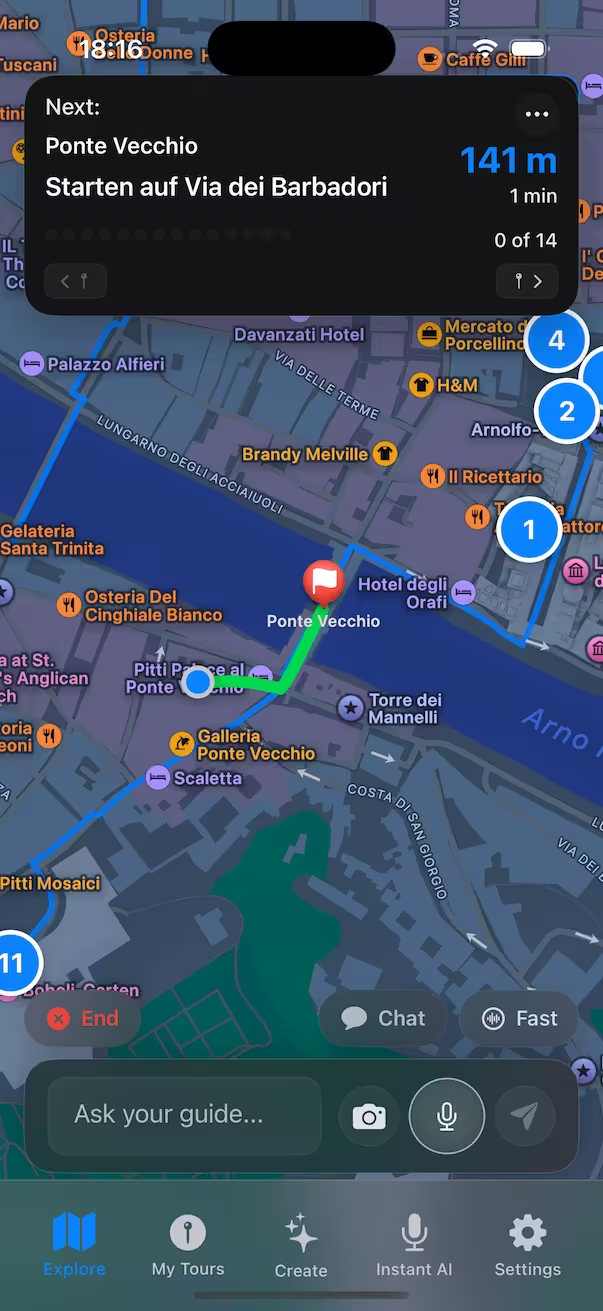
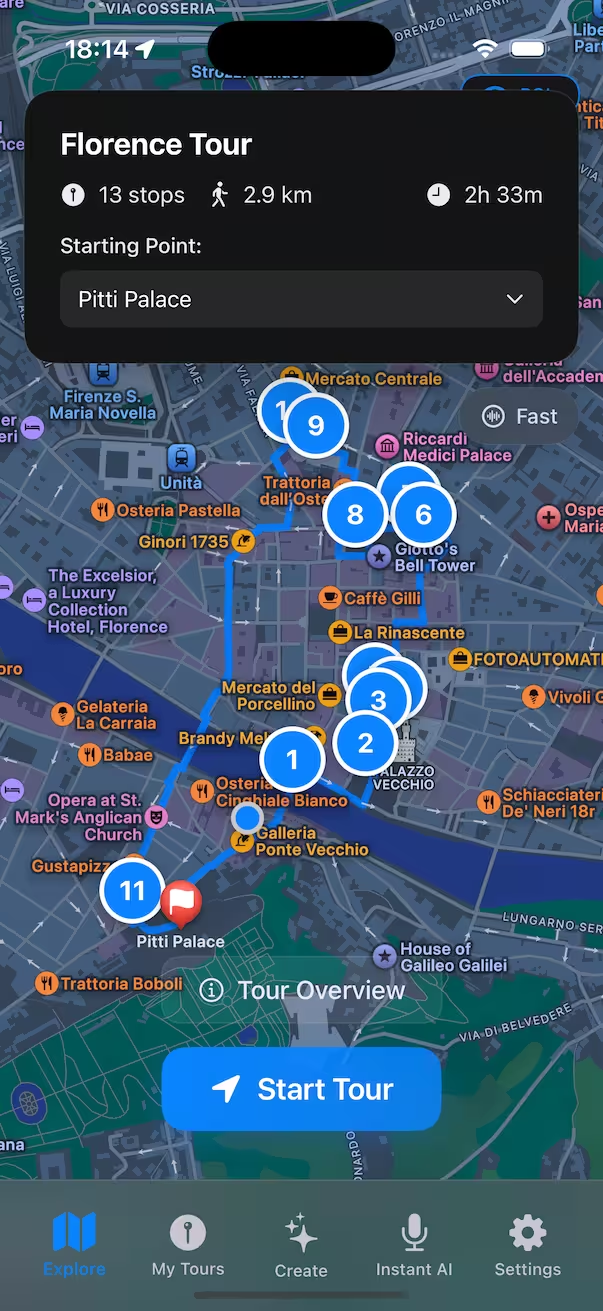
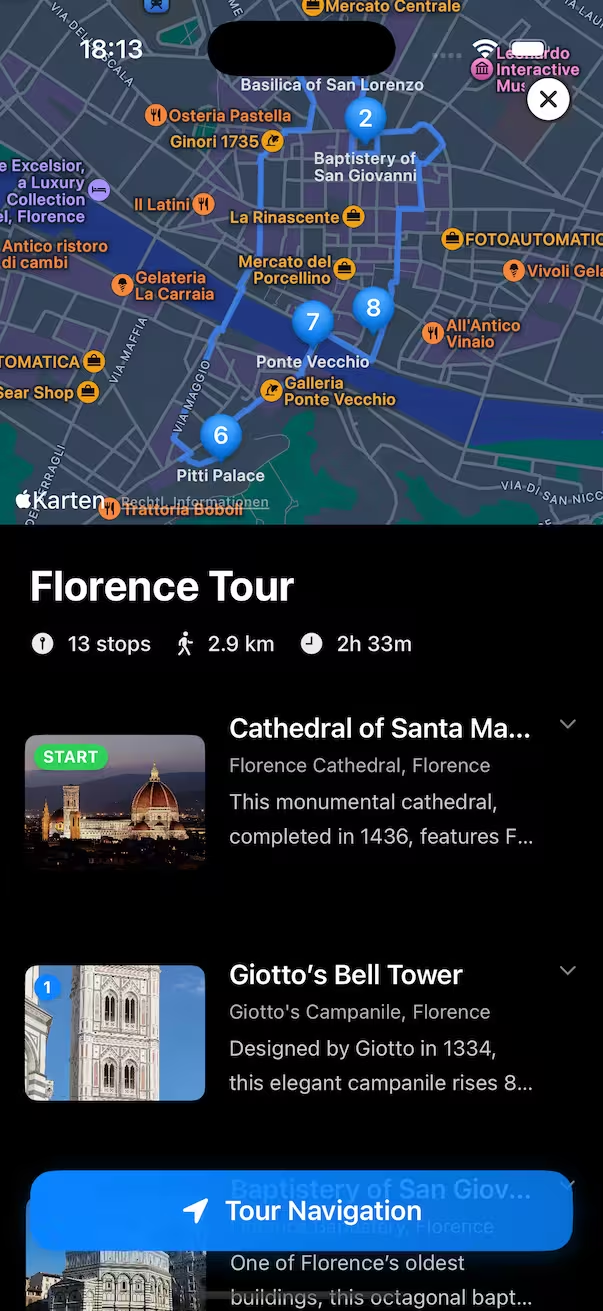
The classic Bamberg tour: 11 stops, 3.7 km, about 2 h on foot
Your live AI guide and the self-guided Bamberg route, together in your browser.