Best Time to Visit Rothenburg ob der Tauber
Month-by-month weather, crowds and prices, plus a full calendar of festivals and events worth planning a trip around.
Best monthsApr, May, Oct
CheapestJan, Feb, Nov
AvoidAug
BusiestJul, Aug
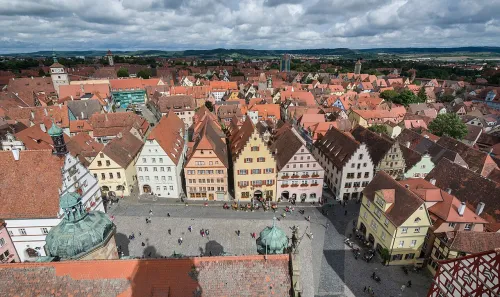
When is the best time to visit Rothenburg ob der Tauber?
In Rothenburg the hour matters more than the month: tour buses arrive around 10:00 and clear out by 15:30, so any month is wonderful before 09:30 and after 16:00 if you stay overnight. For the best weather and atmosphere combined, come late April to mid-May (skip the Meistertrunk Pentecost weekend unless that is the point) or the first three weeks of October for golden valley foliage. January and February are cheapest and emptiest. Avoid the Taubertal Festival weekend (6-9 August) if you want a quiet medieval town.
Start our tool and find your best time to visit Rothenburg ob der Tauber
Your perfect month
Free · ~30 seconds
or tap a month directly
What matters to you?
And this?
Best overall: Apr, May, Oct. Late April to mid-May and the first three weeks of October are the sweet spots: comfortable 12-18°C walking weather, every attraction open, the Night Watchman tour running nightly, and crowds well below the July-August crush. May adds Franconian Spargel season and spring blossom in the valley; October adds golden foliage and the chance of fog photography from the Burggarten.
Best value: Jan, Feb, Nov. January, February and early November bring the lowest hotel rates of the year, 60-110 € a night for a 3-star inside the walls, with museums open daily and the Night Watchman tour still running. The catch is cold, short days and a handful of restaurants taking a winter break. The free, heated Käthe Wohlfahrt Christmas village is a welcome escape on a raw afternoon.
Avoid: Aug. August, and specifically the Taubertal Festival weekend (6-9 August), is the year's worst value for a quiet medieval visit. Bavarian school holidays, peak US and Asian tour-bus traffic, 24-26°C heat in the airless lanes, and 20,000-plus festival-goers combine to push within-walls hotels to 160-220 € and fill every car park by 10:30.
- January: Tough month, 4°C. This is the month to have the Plönlein and the Stadtmauer walls walk to yourself at any hour, no buses, no photo-mob. It is cold and quiet, the honest trade for the lowest prices and biggest emptiness of the year. Bring warm layers and you get the medieval town stripped back to its bare, beautiful self.
- February: Good time, 6°C. February is Rothenburg without a single bus group: silent lanes, no queues, and the lowest prices of the year. It rewards the visitor who does not mind the cold with a town that feels entirely yours, especially on a crisp clear morning when frost or light snow lifts the half-timbered houses out of the grey.
- March: Good time, 10°C. March is the last genuinely quiet month before spring fills the town. The valley greens up, the blossom begins, and you can still walk the lanes and shoot the Plönlein without a crowd. Use it: that window closes fast once the April festivals and Easter holidays arrive.
- April: Good time, 14°C. April is when Rothenburg shakes off winter and shows its best face: blossom in the valley, mild walking weather, and every attraction open without the summer crush. Aside from the Easter and Stadtfest weekends, the lanes stay walkable, and the long light evenings make the Night Watchman tour a highlight.
- May: Good time, 17°C. May is the medieval town at its loveliest: green, mild and full of light. Time it right and you catch the Meistertrunk pageantry; time it for the weeks either side and you get the same gorgeous weather with the lanes far quieter. Either way, May is one of the two strongest months of the year.
- June: Great time, 22°C. June is warm, long-lit and still breathable before the school holidays land. The early-to-mid weeks are the quiet payoff: comfortable temperatures, dry mornings, and the lanes far less crowded than they will be in July. Catch the golden evening light on the walls after a day-trip crowd has cleared.
- July: Good time, 24°C. July is hot, packed and bus-driven during the day, then transformed once the coaches leave. The trick is timing: walk the walls before 10:00 or after 16:00 to dodge both the heat and the photo-mob, and stay overnight so you get the lantern-lit lanes after the day-trippers have gone.
- August: Tough month, 24°C. August is full-throttle Rothenburg: heat, packed lanes, and a major music festival camped below the walls. It is glorious if you came for the Taubertal Festival, and a poor choice if you came for a quiet medieval town. Either time your visit around the festival weekend or skip the month for the calmer shoulders of April-May or October.
- September: Good time, 19°C. September is a tale of one huge weekend and three quiet ones. The Reichsstadt-Festtage are unmissable medieval pageantry if you plan far ahead, but the weeks after are a gentle, well-priced shoulder season with the summer crush gone and the weather still kind. Pick your week deliberately.
- October: Good time, 14°C. October is the connoisseur's month: golden foliage, dramatic morning fog, comfortable walking and crowds well down from summer. The light is at its most beautiful on the orange facades, and the valley walk is at its peak. This and late spring are the two windows a local would steer you toward.
- November: Good time, 8°C. Early November is the couples' secret: the town nearly to yourselves, dark atmospheric lanes, and the lowest prices outside deep winter. Then the Reiterlesmarkt arrives to light the final stretch. Come on a weekday before the market opens for romance, or a Tuesday after it opens for an uncrowded Christmas market.
- December: Tough month, 5°C. December trades autumn's calm for festive bustle: Glühwein, lights and crowds at the Reiterlesmarkt. It is genuinely magical, but go on a weekday morning to avoid the dangerous Saturday-afternoon crush in the narrow lanes. Then, after 23 December, the silent snow-dusted streets are a different kind of magic for overnight guests.
Rothenburg ob der Tauber weather by month
HighLowRainfall
Jan4°
Feb6°
Mar10°
Apr14°
May17°
Jun22°
Jul24°
Aug24°
Sep19°
Oct14°
Nov8°
Dec5°
| Month | Temp | Rain | Sun | Crowds | Prices | Highlight |
|---|---|---|---|---|---|---|
| Jan | 4° / -1° | 80mm · 15 rainy days | 3.3 h/day | ●○○○○ | ●○○○○ | Käthe Wohlfahrt Christmas Village |
| Feb | 6° / -1° | 57mm · 11 rainy days | 5.8 h/day | ●○○○○ | ●○○○○ | Käthe Wohlfahrt Christmas Village |
| Mar | 10° / 1° | 57mm · 12 rainy days | 7.7 h/day | ●●○○○ | ●●○○○ | Spring Awakening and Hiking Week |
| Apr | 14° / 4° | 51mm · 10 rainy days | 9.9 h/day | ●●●○○ | ●●○○○ | Spring Awakening and Hiking Week |
| May | 17° / 8° | 75mm · 13 rainy days | 10.6 h/day | ●●●●○ | ●●●○○ | Meistertrunk Pentecost Festival |
| Jun | 22° / 13° | 68mm · 10 rainy days | 11.9 h/day | ●●●○○ | ●●●○○ | Culture in the Monastery Courtyard |
| Jul | 24° / 15° | 65mm · 12 rainy days | 12.2 h/day | ●●●●○ | ●●●●○ | Culture in the Monastery Courtyard |
| Aug | 24° / 15° | 73mm · 12 rainy days | 10.7 h/day | ●●●●● | ●●●●● | Culture in the Monastery Courtyard |
| Sep | 19° / 11° | 51mm · 10 rainy days | 9.2 h/day | ●●●●○ | ●●●●○ | Culture in the Monastery Courtyard |
| Oct | 14° / 7° | 62mm · 11 rainy days | 6.3 h/day | ●●●○○ | ●●●○○ | Night Watchman Tour |
| Nov | 8° / 3° | 63mm · 11 rainy days | 4.1 h/day | ●●○○○ | ●●○○○ | Night Watchman Tour |
| Dec | 5° / 1° | 78mm · 15 rainy days | 2.9 h/day | ●●●●○ | ●●●●○ | Night Watchman Tour |
How we score this: weather = long-run climate normals (Open-Meteo), crowds & prices = relative season read, events checked yearly against official dates.
Best time to visit Rothenburg ob der Tauber: weather, prices & crowds
Best months for good weather
May, Jun, Sep
May, June and September give the most comfortable walking weather: 16-22°C, long bright evenings on the orange sandstone facades, and far less of July and August's 24-26°C heat that radiates off the stone in the narrow lanes. June is statistically the wettest month, but Franconian rain mostly comes as short afternoon thunderstorms, so mornings stay dry.
Quietest months to avoid the crowds
Jan, Feb, Nov
January, February and the first three weeks of November are the emptiest. With no day-tripper buses and the lanes nearly silent, you can shoot the Plönlein crowd-free at any hour. The trade is cold (highs of 2-5°C) and short grey days, plus the Topplerschlösschen being entirely closed in November.
Cheapest time to visit Rothenburg ob der Tauber
Jan, Feb, Nov
January and February are the cheapest months of the year, with 3-star hotels inside the walls down to 60-90 € a night, roughly half of the July-August level. Early November (before the Reiterlesmarkt opens on 20 November) runs 80-110 €. Pack warm layers and you get the medieval town at its most affordable.
Best time for festivals and events
Oct, Nov, Dec
Two signature experiences land in this window. From mid-October into November, morning valley fog (typically 07:00-09:30) fills the Tauber below while the town sits above in sun, a sea-of-fog view from the Burggarten and Stadtmauer. Then from 20 November to 23 December the medieval Reiterlesmarkt fills the lanes between the Rathaus and St. Jakob with Glühwein, Schneeballen and one of Germany's most-photographed Christmas-market scenes.
How many days do you need in Rothenburg ob der Tauber?
Rothenburg ob der Tauber is tiny by design: the entire medieval core is under two square kilometres, and one full day covers it comfortably. Two days, however, is the genuine sweet spot. The second day frees you to walk the Tauber valley, linger inside St. Jakobs-Kirche with Riemenschneider's Holy Blood Altar, climb the Rathausturm before the crowds form, and stay for the Night Watchman tour at 20:00, which alone transforms the visit.
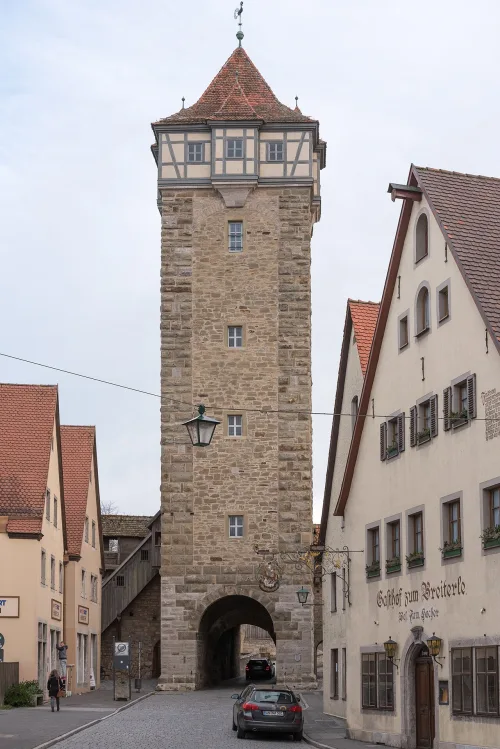
One day
The essential medieval circuit
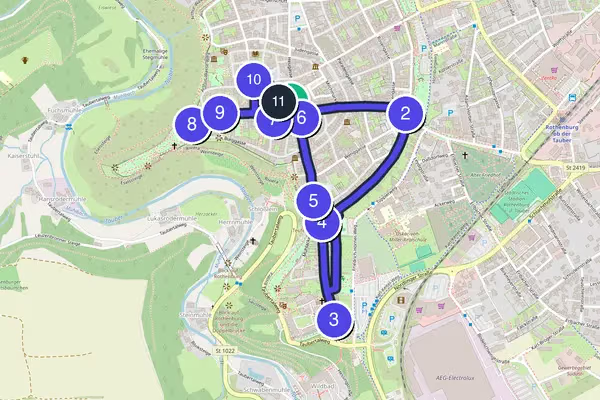
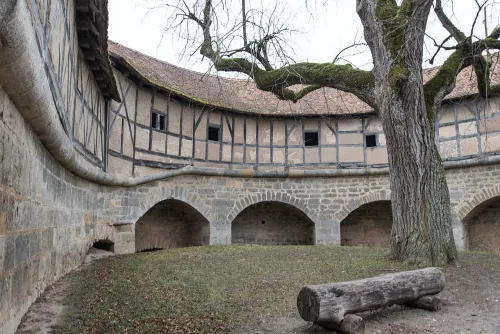
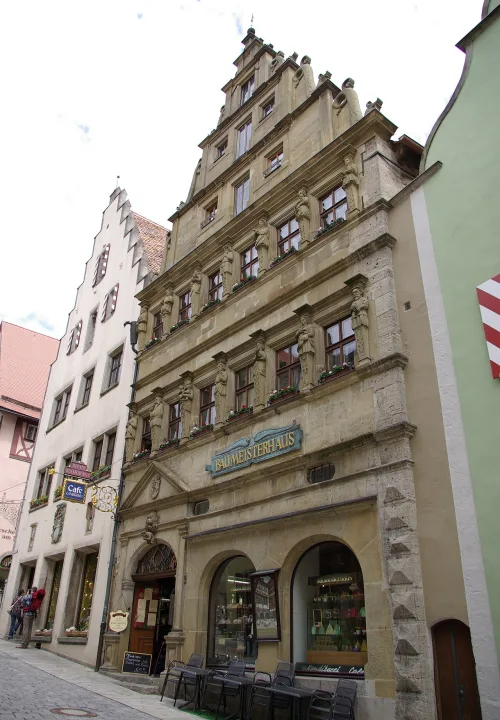
Start at the Marktplatz by 09:00, before the first buses arrive. Walk the self-guided Rothenburg ob der Tauber walking tour, 11 stops across 2.8 km in about 2.1 hours: Marktplatz, Roderturm, Spitalbastei, the Stadtmauer ramparts, Plönlein, Baumeisterhaus, Käthe Wohlfahrt Weihnachtsdorf, Burgtor, Burggarten, St. Jakobs-Kirche, and the Rathaus. After the day-trippers clear around 16:00, the lanes go quiet again. Stay for the Night Watchman tour at 20:00 from the Marktplatz (12 €, cash only, no booking) and you will see an entirely different Rothenburg.
Two daysRecommended
Valley, museums and the night
Use your early morning to climb the Rathausturm (4 €) for a crowd-free shot of the Marktplatz, then walk the 15-minute valley path from the Rödertor down to the Topplerschlösschen, open only Friday to Sunday, 13:00-16:00, so plan accordingly. Afternoon is for the Mittelalterliches Kriminalmuseum (open daily 10:00-18:00) and the RothenburgMuseum. End with the Night Watchman tour if you missed it on day one. From mid-October, add a 07:15 start at the Burggarten to catch the Tauber valley fog below the walls in morning sun.
Three days
Slow Rothenburg with festival or market depth
A third day rewards timing: in May, stay through the Meistertrunk Pentecost weekend for the Sunday 15:00 military procession (free, 900-plus participants) along the main streets. In October, a third day means a second fog morning at the Burggarten and a longer valley walk through golden Tauber woodland. In late November or December, add a weekday at the Reiterlesmarkt: go Tuesday at 11:00 for Glühwein and Schneeballen between the Rathaus and St. Jakob without the Saturday-afternoon crush.
Four days or more
The surrounding Romantic Road and Tauber villages
Four days makes sense only if you are using Rothenburg as a base for the wider Romantic Road. Day trips to Dinkelsbühl (40 minutes south) or Weikersheim (30 minutes north), both similarly walled medieval towns, round out a regional picture that one town alone cannot give. Otherwise, three days is the honest ceiling for Rothenburg itself: the town is beautiful but small, and a fourth day inside the walls tends to repeat what you have already seen.
Best time to visit Rothenburg ob der Tauber by traveller type
Same city, different trip. Here's the month that fits how you're travelling.
🧭
Best time to visit Rothenburg ob der Tauber for the first time
AprOct
Late April or early-to-mid October. The medieval town looks its best in soft spring or autumn light, walking temperatures are a comfortable 12-18°C, and crowds sit well below peak summer. The Night Watchman tour runs nightly at 20:00, the definitive way to see the lanes once the day-trippers have gone.
❤️
Best time to visit Rothenburg ob der Tauber for couples
NovOct
November weekdays before the Reiterlesmarkt opens (1-19 November), or mid-October for valley foliage. These are the least-visited, most atmospheric windows: candlelit restaurant evenings, empty lanes after dark, golden valley light. If the Christmas market appeals, arrive on a Tuesday or Wednesday for a romantic, uncrowded version.
💶
Best time to visit Rothenburg ob der Tauber on a budget
JanFeb
January or February, when 3-star rooms inside the walls drop to 60-90 € a night, the cheapest of the whole year. Museums stay open daily, the Night Watchman tour still runs, and the free, warm Käthe Wohlfahrt shop is a genuine refuge. Pack warm layers for highs of 2-5°C.
🍝
Best time to visit Rothenburg ob der Tauber for food and wine
MayJun
May for Franconian Spargel (white asparagus) season, when local restaurants run dedicated menus, or late June for the Jakobimarkt summer fair's regional food stalls. Year-round, buy the local Schneeball pastry fresh from a bakery on Schmiedgasse rather than plastic-wrapped from a tourist shop.
Worst time to visit Rothenburg ob der Tauber
August is the hardest month to recommend for a quiet medieval visit. Bavarian school holidays, peak US and Asian tour-bus traffic, and 24-26°C heat radiating off the stone in the narrow airless lanes already make the days exhausting. The Taubertal Festival (early August, Thursday to Sunday) then adds 20,000-plus music fans camped on the Eiswiese meadow below the walls, pushes within-walls hotels to 160-220 € a night, and fills every car park by 10:30. The Plönlein, which can be shot crowd-free at 08:00 in April, becomes impassable for a clean photograph by 11:00 in August.
Still worth it for If the Taubertal Festival itself is your goal, August works fine, especially with a base in Würzburg or Ansbach. The Night Watchman tour still runs at 20:00 and the lantern-lit lanes after dark remain genuinely magical even in the busiest month.
Go instead in April, May, October, when Rothenburg ob der Tauber is at its best.
Best time for a tour of Rothenburg ob der Tauber
May and September are the sweet spots for walking Rothenburg ob der Tauber. In May temperatures sit between 8 and 17 °C, the cobblestones are dry underfoot, and the Stadtmauer's open-sky rampart walk rewards you without the August crush that packs the Marktplatz shoulder to shoulder. September pulls back to a quieter crowd while still delivering 11 to 19 °C, good for the long loop from Burgtor through Burggarten and back around to Plonlein without needing a rest in the shade every ten minutes. July and August bring highs of nearly 24 °C, which sounds mild on paper, but the medieval lanes are narrow and trap heat, and when the town is heaving with visitors the Marktplatz and the alley leading to Plonlein become slow shuffles rather than walks. December has a charm of its own near the Käthe Wohlfahrt Weihnachtsdorf and St. Jakobs-Kirche, though expect 15 wet days, barely 5 °C, and a different kind of crowd around the Christmas market. January and February are genuinely near-empty, cold at 3 to 6 °C and often grey, but if a frosty clear morning arrives the Stadtmauer offers a quiet that you simply cannot find any other time of year.
What makes the timing entirely your call is that AI Tourguide runs in your browser, no app to download, no fixed departure time to match. Set off at 7 am on a warm August day to reach Burgtor before the lanes fill, or take a slow midweek morning in June when the Rathaus square is calm and the guide has time to tell you the full story of the Meistertrunk legend before the tour groups arrive. Start your Rothenburg ob der Tauber tour whenever the light and the weather agree with you: the voice guide greets you, leads you through every stop, asks what you want to know more about, listens, and shapes the rest of the walk around your answers. No fixed schedule, no tour operator's bus to catch, just the old town at whatever hour suits you best.
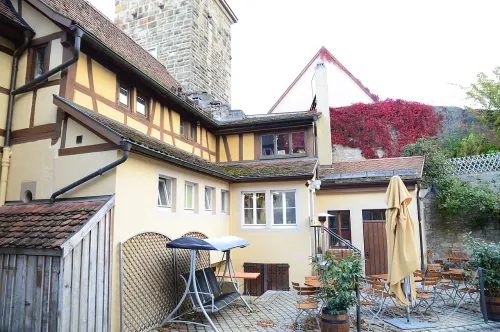 +7
+7All 11 stops are already on the map.
You just press start.
You just press start.
 AI Tourguide
You just read the route.
Now walk it with a guide in your ear.
Press start wherever you are, even hundreds of kilometres from Rothenburg ob der Tauber, and the guide begins telling its stories right away. In the city, pick any of the 11 stops to start from: it leads you there, then talks with you the whole route, asking, listening, remembering, and shaping the tour around your answers.
11stops2.8km2.1hours11languages
▶Start the tour freeFree to start · Runs in your browser · No app, no download
Rothenburg ob der Tauber events and festivals calendar
Annual highlights worth timing a trip around, listed month by month.
January
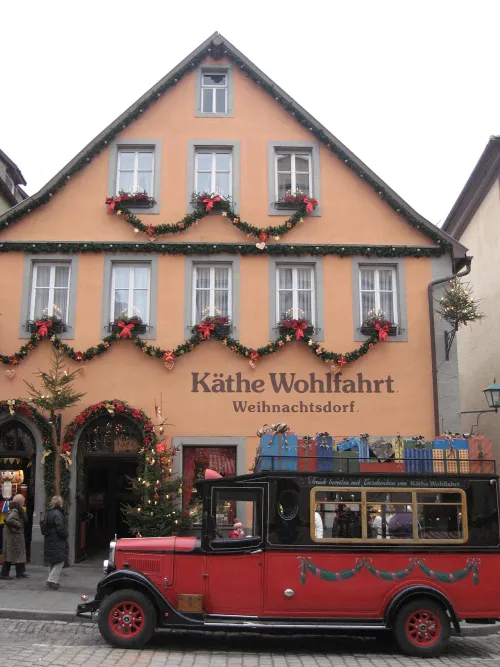
🎄 Christmas marketKäthe Wohlfahrt Christmas Village Käthe Wohlfahrt Weihnachtsdorf
Jan 1 – Dec 31
open year-round, daily 10:00-18:00
A permanent Christmas shop and themed retail village at Herrngasse 1-2, selling ornaments, nutcrackers and Advent decorations 365 days a year, with the attached Deutsches Weihnachtsmuseum (5 € adults).
🎨 Art and cultureGerman Christmas Museum Deutsches Weihnachtsmuseum
Jan 1 – Dec 31
open year-round, daily 10:00-17:00
A museum of Christmas traditions and ornament history attached to the Käthe Wohlfahrt shop, small but genuinely interesting on the history of Advent customs.
March
🌸 Seasonal natureSpring Awakening and Hiking Week Frühlingserwachen / Frühlingswanderwoche
Mar 14 – Apr 30
mid-March to the end of April, with the hiking week 14-22 March
A regional spring promotion of guided hikes through the Tauber valley and viewings of private gardens opened by appointment, framed by apple and cherry blossom in the valley below the walls.
🎨 Art and cultureNight Watchman Tour Nachtwächterführung
Mar 27 – Dec 31
nightly from late March, departing 20:00 from the Marktplatz, with a winter schedule on request
An English-language guided walk of about 60 minutes led by a costumed night watchman through the lamp-lit old town, departing 20:00 from the Marktplatz.
April
🎉 FestivalStadtfest (City Festival) Stadtfest Rothenburg
Apr 25–26
a weekend in late April, Saturday 14:00-21:00 and Sunday 11:00-18:00
A local town festival around the Würzburg Gate and Hasa area with live music, food stalls and plenty of regional character.
May
🎨 Art and cultureCulture in the Monastery Courtyard Kultur im Klosterhof
May 3 – Sep 12
across the summer, early May to mid-September
A summer cultural programme of theatre, music and readings staged in the Franciscan monastery courtyard, an atmospheric outdoor setting within the old town walls.
🎉 FestivalMeistertrunk Pentecost Festival Pfingstfestspiele / Der Meistertrunk
May 22–25 ~
the Pentecost long weekend, Friday to Monday in late May
A four-day re-enactment of the legendary 1631 Thirty Years' War event when Mayor Nusch supposedly drank 3.25 litres of wine in one draught to save the town.
June
🎉 FestivalSummer Fair (Jakobimarkt) Rothenburg Sommerfest / Jakobimarkt
Jun 26 – Jul 1
the last week of June into early July
A folk festival with market stalls at the Spitaltor area, mixing traditional crafts, regional food and small funfair elements over several days.
July
🎵 MusicAmbassadors of Music Botschafter der Musik
Jul 2–23
early to mid-July, typically in the evenings
Free open-air concerts by young international musicians on the Marktplatz, run by an international youth exchange programme, usually in the evening.
August
🎵 MusicTaubertal Festival Taubertal-Festival
Aug 6–9
Thursday to Sunday in early August
An open-air rock, pop and alternative festival on the Eiswiese meadow below the city walls, typically featuring 40-plus acts across four days with on-site camping.
September
🎉 FestivalImperial City Days Rothenburger Reichsstadt-Festtage
Sep 4–6
the first weekend of September, Friday to Sunday
The town's biggest traditional event, where 27 historical groups recreate medieval camp life inside and outside the walls.
November
🎄 Christmas marketReiterlesmarkt Christmas Market Reiterlesmarkt
Nov 20 – Dec 23
from the third Friday of Advent to 23 December
A medieval-themed Christmas market between the town hall and St.
Insider tips for visiting Rothenburg ob der Tauber
The rules buried in forums, in one place.
- Beat the 10:00-15:00 dead zone. Tour buses arrive at the Parkplatz Taubertal from about 10:00 and most day-trippers leave before 15:30, so the town is a completely different place before 09:30 and after 16:00. The Plönlein junction, the most photographed spot in Germany after Neuschwanstein, can be shot crowd-free at 08:00 and is impassable for photos by 11:00.
- Stay overnight, do not day-trip. There are only about 350 hotel rooms inside the walls against 1.9 million day-trippers a year. An overnight lets you have the lantern-lit lanes almost to yourself after 20:00, and the Night Watchman tour at 20:00 (12 € adults, 6 € youth, under 12 free, cash only, no booking) is the definitive expression of it.
- The Topplerschlösschen trap. It opens only Friday to Sunday, 13:00-16:00 (April-October), and is entirely closed in November. Thousands walk the 15-minute valley path and find it shut on a Monday to Thursday. If you want to go inside, plan a Friday-to-Sunday visit between 13:00 and 15:30.
- Reiterlesmarkt: weekday mornings only. The Christmas market runs Mon-Thu 11:00-19:00 and Fri-Sun 11:00-20:00, but Saturday afternoon in December packs the narrow passage from the Marktplatz to the Grüner Markt shoulder-to-shoulder. A Tuesday at 11:00 is a completely different, walkable experience.
- Meistertrunk: the play versus the meadow. The festival meadow between Galgentor and Rödertor costs 12 € from Saturday evening, while the historical play in the Kaisersaal of the Rathaus needs a separate ticket and sells out early. The free spectacle is the military procession on Sunday at 15:00, so build your plan around Sunday afternoon if you want pageantry without tickets.
- Reichsstadt-Festtage booking window. The first weekend of September (4-6 September in 2026) is the most-booked weekend of Rothenburg's entire year. Accommodation within the walls and within 10 km books out four to six months ahead, and even Würzburg, 70 km north, sees elevated rates. Book by late March for a September visit.
- Rathausturm weather risk. The 4 € climb up the town-hall tower gives the only way to photograph the Marktplatz with no people in the shot, but it closes without notice in lightning risk or strong wind. Go first thing in the morning, before the queue forms and before the weather can turn.
- Autumn fog photography. From mid-October into November, valley fog typically fills the Tauber from 07:00 to 09:30 while the town sits in sun above. The sea-of-fog view from the Burggarten and Stadtmauer is a known Instagram secret now, so arrive at the Burggarten by 07:15 to be early; it usually burns off around 10:00 on clear days.
- Parking and arrival. The walled old town is pedestrianised, so every visitor car park is outside the walls. The main Taubertal car park is a 5-minute walk from the Rödertor, and Parkplatz Wildbad is closest to the Plönlein. Arrive before 09:30 to find a space in peak season; by 10:30 in July and August the main car parks are full.
- Closure quirks to plan around. St.-Jakobs-Kirche closes at 17:00 from November to March (vs 18:00 April-October) and bars entry during services, while the RothenburgMuseum and Kriminalmuseum open daily 10:00-18:00 with no weekly closing day, unusually for Germany. Many independent restaurants take a two-week break in January or August, so check ahead for a specific place.
Public holidays in Rothenburg ob der Tauber
On these dates many shops and offices close, transport thins out, and sights can be mobbed or shut. Plan around them.
| Date | Holiday | What closes |
|---|---|---|
| Jan 1 | New Year's Day | Almost everything is closed and the town is very quiet. A good time to walk the empty lanes if you are already staying overnight, but expect most restaurants and shops shut. |
| Jan 6 | Epiphany | A public holiday in Bavaria, so most shops are closed; it is a normal working day elsewhere in Germany, so the tourist impact is minimal in deep low season. |
| Apr 5 | Easter Sunday | Shops are closed and churches hold services, so St.-Jakobs-Kirche may have limited visitor hours. Easter weekend brings a noticeable surge of German domestic visitors to the old town. |
| Apr 6 | Easter Monday | A public holiday: most shops are closed but the tourist sights stay open. Still a busy domestic-tourism day as the Easter school holidays run. |
| May 1 | Labour Day | A public holiday; some shops shut. A busy domestic day-trip day if it falls on a weekend, with German visitors out in numbers. |
| May 25 | Whit Monday | A public holiday and the closing day of the Meistertrunk Pentecost festival, so the town is very busy with festival crowds in full medieval costume. Book accommodation months ahead. |
| Jun 4 | Corpus Christi | A public holiday in Bavaria with a possible religious procession; many shops are closed. A quieter day for sightseeing outside the church areas. |
| Aug 15 | Assumption Day | A public holiday in Bavaria: shops are closed. It falls in peak season just after the Taubertal Festival, so crowds and prices remain high. |
| Oct 3 | German Unity Day | A national holiday; shops are shut. A busy day-trip day for Germans, so expect heavier than usual crowds for early October. |
| Nov 1 | All Saints' Day | A public holiday in Bavaria with most shops closed and cemeteries visited. A quiet, low-season day in the town just before the Christmas market opens. |
| Dec 25 | Christmas Day | Everything is closed and the Reiterlesmarkt has already ended on 23 December. The streets are silent and occasionally snow-covered, atmospheric but with almost nothing open. |
| Dec 26 | Boxing Day | A public holiday with everything closed; the town is very quiet. The 24-31 December stretch is the calmest, most atmospheric end to the year for overnight guests. |
Rothenburg ob der Tauber month by month
January in Rothenburg ob der Tauber
High4°C / 38°F
Low-1°C
Rain80mm / 15 rainy days
Sun3.3 h/day
Daylight9 h/day
Humidity87%
Crowds●○○○○Prices●○○○○
January is Rothenburg at its emptiest and most affordable. Highs sit at just 2-5°C, days are short, and the post-Christmas lull empties the lanes once the Reiterlesmarkt has ended. Snow falls on perhaps 10-15 days across January and February combined and rarely settles more than a day or two, but when it does the half-timbered houses become the picture-postcard image. The Topplerschlösschen is closed and some smaller restaurants take a winter break.
The vibe This is the month to have the Plönlein and the Stadtmauer walls walk to yourself at any hour, no buses, no photo-mob. It is cold and quiet, the honest trade for the lowest prices and biggest emptiness of the year. Bring warm layers and you get the medieval town stripped back to its bare, beautiful self.
Don't miss Walk the empty city walls and shoot the Plönlein crowd-free at any time of day. When snow settles, the half-timbered lanes are at their iconic best. The free, heated Käthe Wohlfahrt Christmas village and the RothenburgMuseum (open daily) are warm refuges, and the Night Watchman tour still runs on a winter schedule.
Crowd drivers The post-Christmas lull with German school term back in session and no major event. The Käthe Wohlfahrt year-round shop draws only a trickle. The lowest visitor pressure of the entire year.
In season A few independent restaurants take a two-week January break, so check ahead for a specific place. The Schneeball pastry is on sale year-round; buy it fresh from a bakery on Schmiedgasse.
Heads up New Year's Day (1 January) closes almost everything. Epiphany (6 January) is a Bavarian public holiday, so most shops shut. The Topplerschlösschen is closed all winter, and St.-Jakobs-Kirche closes at 17:00.
The cheapest month of the year: 3-star hotels inside the walls run 60-90 € a night, roughly half the July-August level.
Events this month
🎄 Christmas marketKäthe Wohlfahrt Christmas Village Käthe Wohlfahrt Weihnachtsdorf
Jan 1 – Dec 31
open year-round, daily 10:00-18:00
A permanent Christmas shop and themed retail village at Herrngasse 1-2, selling ornaments, nutcrackers and Advent decorations 365 days a year, with the attached Deutsches Weihnachtsmuseum (5 € adults).
A Rothenburg constant: even summer visitors get the Christmas atmosphere, and on a raw winter afternoon the free, warm interior is a genuine refuge. Worth 30 minutes any time of year.
🎨 Art and cultureGerman Christmas Museum Deutsches Weihnachtsmuseum
Jan 1 – Dec 31
open year-round, daily 10:00-17:00
A museum of Christmas traditions and ornament history attached to the Käthe Wohlfahrt shop, small but genuinely interesting on the history of Advent customs. Entry is 5 € adults, 2 € children 6-11, 11 € family.
A useful rainy-day option in any month, and a natural pairing with the free Käthe Wohlfahrt village next door.
February in Rothenburg ob der Tauber
High6°C / 43°F
Low-1°C
Rain57mm / 11 rainy days
Sun5.8 h/day
Daylight10 h/day
Humidity79%
Crowds●○○○○Prices●○○○○
February is the other deep-low-season month, just as quiet and cheap as January. Highs nudge toward 5°C and it stays cold, with the year's driest weather but the shortest patience for being outdoors. A moveable Fasching Sunday in mid-February brings a small local parade, but otherwise the town is empty and the museums uncrowded. Snow is still possible and at its most photogenic on the half-timbered facades.
The vibe February is Rothenburg without a single bus group: silent lanes, no queues, and the lowest prices of the year. It rewards the visitor who does not mind the cold with a town that feels entirely yours, especially on a crisp clear morning when frost or light snow lifts the half-timbered houses out of the grey.
Don't miss The indoor sights carry the month: the Mittelalterliches Kriminalmuseum (medieval crime and punishment, open daily 10:00-18:00), the RothenburgMuseum, and the Deutsches Weihnachtsmuseum. Walk the walls between cold snaps, and if snow falls, the Plönlein and Marktplatz are at their picture-postcard best with nobody else around.
Crowd drivers Deep low season with German school term in session and no major event beyond a small local Fasching parade on 15 February. International tourism is at its annual low.
In season Hearty Franconian cooking is at its most welcome in the cold: roast pork, dumplings and a Schneeball with coffee to warm up. Check ahead, as a handful of restaurants are still on winter break.
Heads up No major public-holiday closures this month. The Topplerschlösschen remains closed for winter, and St.-Jakobs-Kirche closes at 17:00 through March.
Prices at their annual floor alongside January: 60-90 € a night for a 3-star inside the walls.
Events this month
🎄 Christmas marketKäthe Wohlfahrt Christmas Village Käthe Wohlfahrt Weihnachtsdorf
Jan 1 – Dec 31
open year-round, daily 10:00-18:00
A permanent Christmas shop and themed retail village at Herrngasse 1-2, selling ornaments, nutcrackers and Advent decorations 365 days a year, with the attached Deutsches Weihnachtsmuseum (5 € adults).
A Rothenburg constant: even summer visitors get the Christmas atmosphere, and on a raw winter afternoon the free, warm interior is a genuine refuge. Worth 30 minutes any time of year.
🎨 Art and cultureGerman Christmas Museum Deutsches Weihnachtsmuseum
Jan 1 – Dec 31
open year-round, daily 10:00-17:00
A museum of Christmas traditions and ornament history attached to the Käthe Wohlfahrt shop, small but genuinely interesting on the history of Advent customs. Entry is 5 € adults, 2 € children 6-11, 11 € family.
A useful rainy-day option in any month, and a natural pairing with the free Käthe Wohlfahrt village next door.
March in Rothenburg ob der Tauber
High10°C / 49°F
Low1°C
Rain57mm / 12 rainy days
Sun7.7 h/day
Daylight12 h/day
Humidity74%
Crowds●●○○○Prices●●○○○
March brings the first signs of spring. Highs climb toward 8-15°C, apple and cherry orchards in the Tauber valley start to bloom from late March, and the Frühlingserwachen promotion (from 14 March) opens guided valley hikes and private gardens. Crowds stay low until the very end of the month, when an early-April Easter pulls forward some German domestic visitors. The Night Watchman tour resumes its nightly summer schedule on 27 March.
The vibe March is the last genuinely quiet month before spring fills the town. The valley greens up, the blossom begins, and you can still walk the lanes and shoot the Plönlein without a crowd. Use it: that window closes fast once the April festivals and Easter holidays arrive.
Don't miss Join a guided Frühlingserwachen hike through the blossoming Tauber valley, or simply walk down to the Topplerschlösschen (now reopening Fri-Sun 13:00-16:00) through riverside willows. From 27 March the nightly Night Watchman tour at 20:00 returns, the best way to see the lamp-lit town after dark.
Crowd drivers Low season holds for most of the month. The Frühlingserwachen hiking week (14-22 March) brings walkers in modest numbers, and a late-March bump appears in years when Easter falls in early April.
In season Spring Franconian dishes begin to appear, and the first asparagus is on the horizon. The Schneeball is on sale all year; buy it fresh rather than plastic-wrapped.
Heads up No fixed public holidays this month, though St.-Jakobs-Kirche still closes at 17:00 until the end of March. The Topplerschlösschen is open again Fri-Sun only.
Prices recover gently to 65-100 € a night, with a modest uptick in the last two weeks if Easter falls in early April.
Events this month
🌸 Seasonal natureSpring Awakening and Hiking Week Frühlingserwachen / Frühlingswanderwoche
Mar 14 – Apr 30
mid-March to the end of April, with the hiking week 14-22 March
A regional spring promotion of guided hikes through the Tauber valley and viewings of private gardens opened by appointment, framed by apple and cherry blossom in the valley below the walls.
A low-crowd window for walkers, with mild 8-15°C days and the valley at its freshest before the festival season begins.
🎨 Art and cultureNight Watchman Tour Nachtwächterführung
Mar 27 – Dec 31
nightly from late March, departing 20:00 from the Marktplatz, with a winter schedule on request
An English-language guided walk of about 60 minutes led by a costumed night watchman through the lamp-lit old town, departing 20:00 from the Marktplatz. It is the most famous of Rothenburg's evening experiences.
The best way to see the town once the day-trippers have left, and it needs no advance booking: 12 € adults, 6 € youth aged 12-18, under 12 free, cash only. The single strongest argument for staying overnight.
🎄 Christmas marketKäthe Wohlfahrt Christmas Village Käthe Wohlfahrt Weihnachtsdorf
Jan 1 – Dec 31
open year-round, daily 10:00-18:00
A permanent Christmas shop and themed retail village at Herrngasse 1-2, selling ornaments, nutcrackers and Advent decorations 365 days a year, with the attached Deutsches Weihnachtsmuseum (5 € adults).
A Rothenburg constant: even summer visitors get the Christmas atmosphere, and on a raw winter afternoon the free, warm interior is a genuine refuge. Worth 30 minutes any time of year.
🎨 Art and cultureGerman Christmas Museum Deutsches Weihnachtsmuseum
Jan 1 – Dec 31
open year-round, daily 10:00-17:00
A museum of Christmas traditions and ornament history attached to the Käthe Wohlfahrt shop, small but genuinely interesting on the history of Advent customs. Entry is 5 € adults, 2 € children 6-11, 11 € family.
A useful rainy-day option in any month, and a natural pairing with the free Käthe Wohlfahrt village next door.
April in Rothenburg ob der Tauber
High14°C / 56°F
Low4°C
Rain51mm / 10 rainy days
Sun9.9 h/day
Daylight14 h/day
Humidity69%
Crowds●●●○○Prices●●○○○
April is one of the best months to visit. Highs reach a comfortable 12-18°C, the valley blossom peaks in the first half of the month, and the medieval town looks its best in soft spring light. The Easter weekend (5-6 April) surges with German domestic visitors, and the Stadtfest (25-26 April) briefly fills the old town with a friendly local crowd. The Frühlingserwachen promotion runs all month and the Night Watchman tour is nightly.
The vibe April is when Rothenburg shakes off winter and shows its best face: blossom in the valley, mild walking weather, and every attraction open without the summer crush. Aside from the Easter and Stadtfest weekends, the lanes stay walkable, and the long light evenings make the Night Watchman tour a highlight.
Don't miss Walk the city walls and down into the blossoming valley under comfortable 12-18°C skies. The Stadtfest around the Würzburg Gate brings live music and food stalls, and the nightly Night Watchman tour at 20:00 is at its spring best with longer evenings. The Rathausturm climb (4 €) gives the cleanest morning shot of the Marktplatz.
Crowd drivers German Easter school holidays drive demand all month, the Easter weekend itself surges with domestic visitors, and the Stadtfest (25-26 April) briefly fills the centre. None of it approaches the summer bus-tour peak.
In season Franconian Spargel (white asparagus) season opens in April, with local restaurants running asparagus menus served with new potatoes and ham. The Stadtfest stalls add a first taste of festival food.
Heads up Easter Sunday (5 April) closes shops and may limit St.-Jakobs-Kirche visitor hours during services; Easter Monday (6 April) closes most shops but the sights stay open. The Topplerschlösschen opens Fri-Sun 13:00-16:00.
Rates climb to 75-110 € a night, with the Easter weekend and the Stadtfest weekend (25-26 April) the busiest stretches.
Events this month
🌸 Seasonal natureSpring Awakening and Hiking Week Frühlingserwachen / Frühlingswanderwoche
Mar 14 – Apr 30
mid-March to the end of April, with the hiking week 14-22 March
A regional spring promotion of guided hikes through the Tauber valley and viewings of private gardens opened by appointment, framed by apple and cherry blossom in the valley below the walls.
A low-crowd window for walkers, with mild 8-15°C days and the valley at its freshest before the festival season begins.
🎉 FestivalStadtfest (City Festival) Stadtfest Rothenburg
Apr 25–26
a weekend in late April, Saturday 14:00-21:00 and Sunday 11:00-18:00
A local town festival around the Würzburg Gate and Hasa area with live music, food stalls and plenty of regional character. It briefly fills the old town with a friendly, mostly local crowd.
A pleasant, genuinely local atmosphere that is far from as packed as the major festivals, ideal for a families or first-timer visit in good spring weather.
🎨 Art and cultureNight Watchman Tour Nachtwächterführung
Mar 27 – Dec 31
nightly from late March, departing 20:00 from the Marktplatz, with a winter schedule on request
An English-language guided walk of about 60 minutes led by a costumed night watchman through the lamp-lit old town, departing 20:00 from the Marktplatz. It is the most famous of Rothenburg's evening experiences.
The best way to see the town once the day-trippers have left, and it needs no advance booking: 12 € adults, 6 € youth aged 12-18, under 12 free, cash only. The single strongest argument for staying overnight.
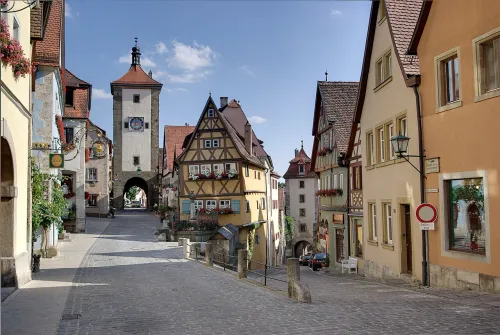
May in Rothenburg ob der Tauber
High17°C / 63°F
Low8°C
Rain75mm / 13 rainy days
Sun10.6 h/day
Daylight15 h/day
Humidity70%
Crowds●●●●○Prices●●●○○
May offers near-perfect walking weather, with highs around 16-22°C, the valley in full leaf, and long bright evenings. It also brings the year's biggest spring event: the Meistertrunk Pentecost festival (22-25 May), when 900-plus costumed participants stage a military procession, a historical market and an evening camp. The shoulder weeks either side of Pentecost are a real sweet spot, mild and far less crowded. The Kultur im Klosterhof summer programme also begins.
The vibe May is the medieval town at its loveliest: green, mild and full of light. Time it right and you catch the Meistertrunk pageantry; time it for the weeks either side and you get the same gorgeous weather with the lanes far quieter. Either way, May is one of the two strongest months of the year.
Don't miss The Meistertrunk's free Sunday 15:00 military procession through the streets is the spectacle to catch; the festival meadow costs 12 € from Saturday evening. Outside the festival, walk the walls and the valley in 16-22°C warmth, and start the summer Kultur im Klosterhof programme in the monastery courtyard.
Crowd drivers The Meistertrunk Pentecost long weekend (22-25 May) is the single biggest spring draw and fully books within-walls hotels three to four months ahead. European half-term visitors add to demand, but the non-Pentecost weeks stay pleasant.
In season Peak Franconian Spargel season: local restaurants build whole menus around white asparagus. The Meistertrunk historical market adds period food and drink for its weekend.
Heads up Whit Monday (25 May) is a public holiday and the festival's busy closing day; most shops are shut but the town is lively. The Topplerschlösschen stays Fri-Sun 13:00-16:00.
Rates rise to 90-130 € a night; the Meistertrunk Pentecost weekend (22-25 May) books out within-walls hotels months ahead.
Events this month
🎉 FestivalMeistertrunk Pentecost Festival Pfingstfestspiele / Der Meistertrunk
May 22–25 ~
the Pentecost long weekend, Friday to Monday in late May
A four-day re-enactment of the legendary 1631 Thirty Years' War event when Mayor Nusch supposedly drank 3.25 litres of wine in one draught to save the town. More than 900 participants stage a military procession on Sunday at 15:00, a historical market and an evening camp on the meadow between Galgentor and Rödertor.
Unmissable if you want the town in full medieval costume, but expect very large crowds Saturday and Sunday and book your hotel three to four months ahead. The Sunday 15:00 procession is the free highlight; the festival meadow costs 12 € from Saturday evening and the Kaisersaal play needs a separate ticket.
🎨 Art and cultureCulture in the Monastery Courtyard Kultur im Klosterhof
May 3 – Sep 12
across the summer, early May to mid-September
A summer cultural programme of theatre, music and readings staged in the Franciscan monastery courtyard, an atmospheric outdoor setting within the old town walls.
A good reason to stay an extra night from May to August, and a useful wet-weather alternative when an afternoon thunderstorm rolls through the valley.
🎨 Art and cultureNight Watchman Tour Nachtwächterführung
Mar 27 – Dec 31
nightly from late March, departing 20:00 from the Marktplatz, with a winter schedule on request
An English-language guided walk of about 60 minutes led by a costumed night watchman through the lamp-lit old town, departing 20:00 from the Marktplatz. It is the most famous of Rothenburg's evening experiences.
The best way to see the town once the day-trippers have left, and it needs no advance booking: 12 € adults, 6 € youth aged 12-18, under 12 free, cash only. The single strongest argument for staying overnight.
June in Rothenburg ob der Tauber
High22°C / 72°F
Low13°C
Rain68mm / 10 rainy days
Sun11.9 h/day
Daylight16 h/day
Humidity68%
Crowds●●●○○Prices●●●○○
June is a pre-peak sweet spot, especially the weeks before the Bavarian school holidays begin in late June. Highs are a mild 20-23°C and the days are at their longest, with golden-hour light on the orange sandstone facades until well past 20:30. It is statistically the wettest month at 70-80 mm, but the rain comes mostly as short afternoon thunderstorms, so mornings stay dry. The Jakobimarkt summer fair (from 26 June) and the Botschafter der Musik concerts (from 2 July) round out the month.
The vibe June is warm, long-lit and still breathable before the school holidays land. The early-to-mid weeks are the quiet payoff: comfortable temperatures, dry mornings, and the lanes far less crowded than they will be in July. Catch the golden evening light on the walls after a day-trip crowd has cleared.
Don't miss Use the long days for early-morning wall walks and late-evening valley light. The Jakobimarkt at the Spitaltor brings crafts, food and a small funfair, and the Botschafter der Musik free open-air concerts begin on the Marktplatz. The Topplerschlösschen valley walk is at its leafiest, open Fri-Sun 13:00-16:00.
Crowd drivers The Bavarian school holidays begin late in the month, so the early weeks stay relatively quiet. The Jakobimarkt summer fair (26 June-1 July) draws regional visitors, and warm weekends bring more day-trippers.
In season The Jakobimarkt stalls are among the best regional food of the year. Asparagus season tails off, replaced by early summer produce; the Schneeball remains a year-round staple.
Heads up Corpus Christi (4 June) is a Bavarian public holiday with many shops closed and a possible religious procession. No other major closures this month.
Rates sit at 85-120 € a night, rising slightly over the Summer Fair (26 June-1 July).
Events this month
🎉 FestivalSummer Fair (Jakobimarkt) Rothenburg Sommerfest / Jakobimarkt
Jun 26 – Jul 1
the last week of June into early July
A folk festival with market stalls at the Spitaltor area, mixing traditional crafts, regional food and small funfair elements over several days.
It adds colour to an early-summer visit, with modest crowds compared with the July and August peak, and some of the best regional food stalls of the year.
🎨 Art and cultureCulture in the Monastery Courtyard Kultur im Klosterhof
May 3 – Sep 12
across the summer, early May to mid-September
A summer cultural programme of theatre, music and readings staged in the Franciscan monastery courtyard, an atmospheric outdoor setting within the old town walls.
A good reason to stay an extra night from May to August, and a useful wet-weather alternative when an afternoon thunderstorm rolls through the valley.
🎨 Art and cultureNight Watchman Tour Nachtwächterführung
Mar 27 – Dec 31
nightly from late March, departing 20:00 from the Marktplatz, with a winter schedule on request
An English-language guided walk of about 60 minutes led by a costumed night watchman through the lamp-lit old town, departing 20:00 from the Marktplatz. It is the most famous of Rothenburg's evening experiences.
The best way to see the town once the day-trippers have left, and it needs no advance booking: 12 € adults, 6 € youth aged 12-18, under 12 free, cash only. The single strongest argument for staying overnight.
July in Rothenburg ob der Tauber
High24°C / 75°F
Low15°C
Rain65mm / 12 rainy days
Sun12.2 h/day
Daylight16 h/day
Humidity65%
Crowds●●●●○Prices●●●●○
July is the busiest non-event month. Highs average 24-26°C and can reach 32-34°C in a heatwave, and the narrow half-timbered lanes trap radiated heat off the stone in the afternoon. Bavarian summer school holidays run from mid-July, and US and Asian tour buses are at maximum, so the Plönlein photo-mob lasts all day. Beat the heat and the crowds with an 08:00 wall walk and a Plönlein shot before 09:30. The Botschafter der Musik free open-air concerts on the Marktplatz (evenings, early to mid-July) are a fine reward after a day in the cool early hours. Walk the Stadtmauer in the cool hours and save midday for the shaded interior of the Kriminalmuseum or a rest under the Burggarten trees.
The vibe July is hot, packed and bus-driven during the day, then transformed once the coaches leave. The trick is timing: walk the walls before 10:00 or after 16:00 to dodge both the heat and the photo-mob, and stay overnight so you get the lantern-lit lanes after the day-trippers have gone.
Don't miss Beat the heat and the crowds with an 08:00 wall walk and a crowd-free Plönlein shot before 09:30. The exposed Stadtmauer is miserable at midday in a heatwave, so save it for the cool hours. When the day's heat or the cost of a pre-booked human guide puts you off, our live in-browser AI guide is the flexible, flat-priced alternative: it walks the lanes with you in the cool early morning, telling the story at each stop and answering your questions as you go, for 5 € an hour or 20 € all-in with 100 free credits to start. The Botschafter der Musik free evening concerts on the Marktplatz are a fine way to end a hot day.
Crowd drivers Bavarian summer school holidays from mid-July, peak US and Asian tour-bus traffic, and warm-weather day-trippers combine to make this the busiest non-event month. The 10:00-15:00 dead zone is at its most extreme.
In season Beer-garden and outdoor dining come into their own in the warm evenings. A few family-run restaurants take a two-week summer break in July or August, so check ahead for a specific Wirtshaus.
Rates climb to 110-160 € a night as the busiest non-event season arrives.
Events this month
🎵 MusicAmbassadors of Music Botschafter der Musik
Jul 2–23
early to mid-July, typically in the evenings
Free open-air concerts by young international musicians on the Marktplatz, run by an international youth exchange programme, usually in the evening.
Worth timing an evening visit around: crowds gather, but a free concert against the floodlit Rathaus is an exceptional setting on a warm July night.
🎨 Art and cultureCulture in the Monastery Courtyard Kultur im Klosterhof
May 3 – Sep 12
across the summer, early May to mid-September
A summer cultural programme of theatre, music and readings staged in the Franciscan monastery courtyard, an atmospheric outdoor setting within the old town walls.
A good reason to stay an extra night from May to August, and a useful wet-weather alternative when an afternoon thunderstorm rolls through the valley.
🎨 Art and cultureNight Watchman Tour Nachtwächterführung
Mar 27 – Dec 31
nightly from late March, departing 20:00 from the Marktplatz, with a winter schedule on request
An English-language guided walk of about 60 minutes led by a costumed night watchman through the lamp-lit old town, departing 20:00 from the Marktplatz. It is the most famous of Rothenburg's evening experiences.
The best way to see the town once the day-trippers have left, and it needs no advance booking: 12 € adults, 6 € youth aged 12-18, under 12 free, cash only. The single strongest argument for staying overnight.
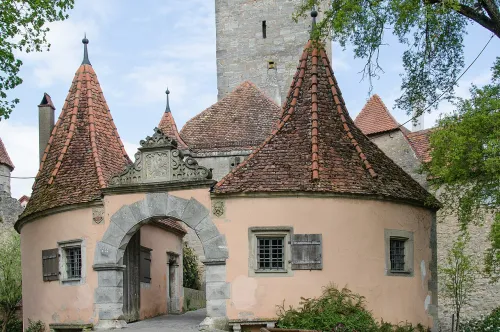
August in Rothenburg ob der Tauber
High24°C / 74°F
Low15°C
Rain73mm / 12 rainy days
Sun10.7 h/day
Daylight14 h/day
Humidity69%
Crowds●●●●●Prices●●●●●
August is the single busiest and most expensive month, and the one to think hardest about. Bavarian school holidays continue, heat regularly hits 24-26°C in the airless lanes, and the Taubertal Festival (6-9 August) brings 20,000-plus music fans to the Eiswiese meadow below the walls, booking out within-walls hotels and the campsite months ahead. For a quiet medieval visit, this is the weekend to avoid; base yourself in Würzburg or Ansbach if you want to attend the festival.
The vibe August is full-throttle Rothenburg: heat, packed lanes, and a major music festival camped below the walls. It is glorious if you came for the Taubertal Festival, and a poor choice if you came for a quiet medieval town. Either time your visit around the festival weekend or skip the month for the calmer shoulders of April-May or October.
Don't miss If you came for the music, the Taubertal Festival on the Eiswiese meadow is the draw, with 40-plus acts and on-site camping. Otherwise, defend yourself against heat and crowds: walls before 10:00, valley shade in the afternoon, and the lantern-lit lanes and Night Watchman tour after 20:00 once the day-trippers leave. The Kultur im Klosterhof courtyard offers a cooler cultural evening.
Crowd drivers Continued Bavarian school holidays plus the Taubertal Festival (6-9 August), which sells out the surrounding accommodation and spikes hotel prices sharply. Tour-bus traffic remains at its summer peak.
In season Beer gardens and outdoor terraces stay busy through the warm evenings; note that some family-run restaurants take their summer break this month, so check ahead. Festival stalls cluster around the Eiswiese over the Taubertal weekend.
Heads up Assumption Day (15 August) is a Bavarian public holiday with shops closed; it falls in peak season, so crowds and prices stay high regardless.
The year's priciest month: rates run 120-180 € normally and 160-220 € over the Taubertal Festival weekend (6-9 August).
Events this month
🎵 MusicTaubertal Festival Taubertal-Festival
Aug 6–9
Thursday to Sunday in early August
An open-air rock, pop and alternative festival on the Eiswiese meadow below the city walls, typically featuring 40-plus acts across four days with on-site camping. Past headliners have included SIDO, Biffy Clyro, Dropkick Murphys and Sportfreunde Stiller.
Book well ahead if you want to attend (around 174 € for a 4-day pass), but avoid this weekend if you want the quiet medieval town. Hotels within the walls fully book out and rates spike to 160-220 €; the best base for non-festival visitors is Würzburg or Ansbach.
🎨 Art and cultureCulture in the Monastery Courtyard Kultur im Klosterhof
May 3 – Sep 12
across the summer, early May to mid-September
A summer cultural programme of theatre, music and readings staged in the Franciscan monastery courtyard, an atmospheric outdoor setting within the old town walls.
A good reason to stay an extra night from May to August, and a useful wet-weather alternative when an afternoon thunderstorm rolls through the valley.
🎨 Art and cultureNight Watchman Tour Nachtwächterführung
Mar 27 – Dec 31
nightly from late March, departing 20:00 from the Marktplatz, with a winter schedule on request
An English-language guided walk of about 60 minutes led by a costumed night watchman through the lamp-lit old town, departing 20:00 from the Marktplatz. It is the most famous of Rothenburg's evening experiences.
The best way to see the town once the day-trippers have left, and it needs no advance booking: 12 € adults, 6 € youth aged 12-18, under 12 free, cash only. The single strongest argument for staying overnight.
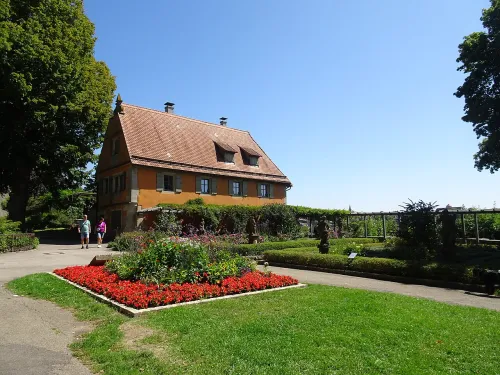
September in Rothenburg ob der Tauber
High19°C / 67°F
Low11°C
Rain51mm / 10 rainy days
Sun9.2 h/day
Daylight13 h/day
Humidity74%
Crowds●●●●○Prices●●●●○
September splits in two. The first weekend brings the Reichsstadt-Festtage (4-6 September), the most spectacular event of the year and the single most-booked weekend in Rothenburg, with within-walls hotels 30-40% above their normal September rate. After that the school holidays end and the rest of the month settles into shoulder quality: mild weather, thinning crowds and comfortable walking. Book the festival weekend four to six months ahead or aim for the calmer days that follow.
The vibe September is a tale of one huge weekend and three quiet ones. The Reichsstadt-Festtage are unmissable medieval pageantry if you plan far ahead, but the weeks after are a gentle, well-priced shoulder season with the summer crush gone and the weather still kind. Pick your week deliberately.
Don't miss The Reichsstadt-Festtage recreate medieval camp life with 27 historical groups, a Friday torchlight procession with a crown fire and light show, and Saturday fireworks by the double bridge. In the quieter weeks that follow, walk the walls and the valley in mild light, with the nightly Night Watchman tour still running and the Topplerschlösschen open Fri-Sun.
Crowd drivers The Reichsstadt-Festtage (4-6 September) is the busiest weekend of the year, packing the town inside and out. After the early-September school return, demand drops sharply for the rest of the month.
In season Festival food stalls fill the streets over the Reichsstadt-Festtage weekend. Beyond it, autumn Franconian cooking returns to the menus as the evenings cool.
Rates run 100-160 € a night, jumping to 150-200 € over the Reichsstadt-Festtage weekend (4-6 September).
Events this month
🎉 FestivalImperial City Days Rothenburger Reichsstadt-Festtage
Sep 4–6
the first weekend of September, Friday to Sunday
The town's biggest traditional event, where 27 historical groups recreate medieval camp life inside and outside the walls. A Friday torchlight procession runs from the double bridge to the Marktplatz with a crown fire and light show, and Saturday brings fireworks near the double bridge, all celebrating 750-plus years of imperial-city history.
The most spectacular event of the year, and the single most-booked weekend in Rothenburg. Book within-walls accommodation four to six months ahead, as rates run 30-40% above the normal September level.
🎨 Art and cultureCulture in the Monastery Courtyard Kultur im Klosterhof
May 3 – Sep 12
across the summer, early May to mid-September
A summer cultural programme of theatre, music and readings staged in the Franciscan monastery courtyard, an atmospheric outdoor setting within the old town walls.
A good reason to stay an extra night from May to August, and a useful wet-weather alternative when an afternoon thunderstorm rolls through the valley.
🎨 Art and cultureNight Watchman Tour Nachtwächterführung
Mar 27 – Dec 31
nightly from late March, departing 20:00 from the Marktplatz, with a winter schedule on request
An English-language guided walk of about 60 minutes led by a costumed night watchman through the lamp-lit old town, departing 20:00 from the Marktplatz. It is the most famous of Rothenburg's evening experiences.
The best way to see the town once the day-trippers have left, and it needs no advance booking: 12 € adults, 6 € youth aged 12-18, under 12 free, cash only. The single strongest argument for staying overnight.
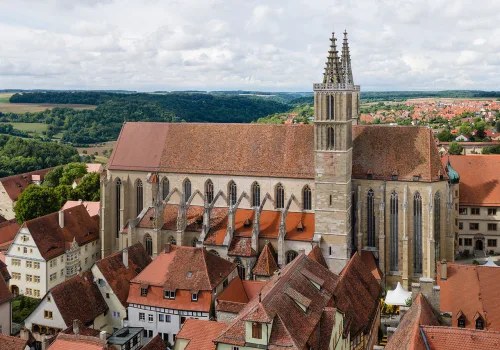
October in Rothenburg ob der Tauber
High14°C / 58°F
Low7°C
Rain62mm / 11 rainy days
Sun6.3 h/day
Daylight11 h/day
Humidity82%
Crowds●●●○○Prices●●●○○
October is one of the best months of all and the most photogenic for landscape. Highs sit at a comfortable 12-18°C, and from mid-October the Tauber valley turns gold and amber, outstanding on the walk down to the Topplerschlösschen and from the Burggarten viewpoint. Morning valley fog becomes common, filling the river below while the town sits in sun above, a sought-after sea-of-fog photo. The crowds thin after the summer, apart from a half-term bump late in the month.
The vibe October is the connoisseur's month: golden foliage, dramatic morning fog, comfortable walking and crowds well down from summer. The light is at its most beautiful on the orange facades, and the valley walk is at its peak. This and late spring are the two windows a local would steer you toward.
Don't miss Catch the morning valley fog from the Burggarten or Stadtmauer by arriving around 07:15, before it burns off near 10:00. Walk down through golden riverside woodland to the Topplerschlösschen (open Fri-Sun 13:00-16:00). The foliage from the Burggarten viewpoint is the year's best landscape shot, and the Night Watchman tour still runs nightly.
Crowd drivers A post-school-holiday lull through most of the month keeps crowds moderate, with a mini-surge during the Bavarian autumn break (roughly 26 October-6 November). German Unity Day (3 October) brings a busy day-trip weekend.
In season Autumn Franconian cooking is at its heartiest: game, mushrooms and pumpkin on local menus, with a Schneeball and coffee to warm up after a cool morning on the walls.
Heads up German Unity Day (3 October) closes shops; All Saints' Day (1 November) falls just after the month and closes Bavarian shops. The Topplerschlösschen has its last open weekends of the year before closing for November.
Rates ease to 80-120 € a night, with a mini-surge over the Bavarian autumn half-term (late October).
Events this month
🎨 Art and cultureNight Watchman Tour Nachtwächterführung
Mar 27 – Dec 31
nightly from late March, departing 20:00 from the Marktplatz, with a winter schedule on request
An English-language guided walk of about 60 minutes led by a costumed night watchman through the lamp-lit old town, departing 20:00 from the Marktplatz. It is the most famous of Rothenburg's evening experiences.
The best way to see the town once the day-trippers have left, and it needs no advance booking: 12 € adults, 6 € youth aged 12-18, under 12 free, cash only. The single strongest argument for staying overnight.
🎄 Christmas marketKäthe Wohlfahrt Christmas Village Käthe Wohlfahrt Weihnachtsdorf
Jan 1 – Dec 31
open year-round, daily 10:00-18:00
A permanent Christmas shop and themed retail village at Herrngasse 1-2, selling ornaments, nutcrackers and Advent decorations 365 days a year, with the attached Deutsches Weihnachtsmuseum (5 € adults).
A Rothenburg constant: even summer visitors get the Christmas atmosphere, and on a raw winter afternoon the free, warm interior is a genuine refuge. Worth 30 minutes any time of year.
🎨 Art and cultureGerman Christmas Museum Deutsches Weihnachtsmuseum
Jan 1 – Dec 31
open year-round, daily 10:00-17:00
A museum of Christmas traditions and ornament history attached to the Käthe Wohlfahrt shop, small but genuinely interesting on the history of Advent customs. Entry is 5 € adults, 2 € children 6-11, 11 € family.
A useful rainy-day option in any month, and a natural pairing with the free Käthe Wohlfahrt village next door.
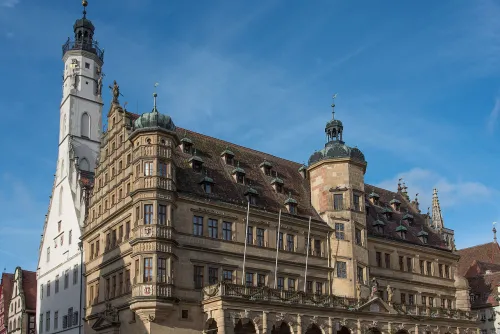
November in Rothenburg ob der Tauber
High8°C / 47°F
Low3°C
Rain63mm / 11 rainy days
Sun4.1 h/day
Daylight9 h/day
Humidity87%
Crowds●●○○○Prices●●○○○
November is two months in one. The first three weeks are the quietest, most atmospheric stretch of the autumn: empty lanes, candlelit restaurant evenings, low prices and persistent grey overcast with the occasional morning valley fog. Then on 20 November the Reiterlesmarkt opens, bringing a first burst of Christmas life and light into the lanes between the Rathaus and St. Jakob. Note the Topplerschlösschen is closed the entire month, a common disappointment.
The vibe Early November is the couples' secret: the town nearly to yourselves, dark atmospheric lanes, and the lowest prices outside deep winter. Then the Reiterlesmarkt arrives to light the final stretch. Come on a weekday before the market opens for romance, or a Tuesday after it opens for an uncrowded Christmas market.
Don't miss Walk the silent lanes and catch the last of the autumn valley fog from the Burggarten on a clear morning. Once the Reiterlesmarkt opens on 20 November, come on a weekday for Glühwein, Schneeballen and one of Germany's most-photographed market scenes without the weekend crush. The free, warm Käthe Wohlfahrt village is the ideal escape from the grey.
Crowd drivers Pre-Christmas low season holds for the first three weeks. The Reiterlesmarkt opening on 20 November fills the weekends immediately, while weekdays stay quiet.
In season Glühwein, roasted Marroni and Schneeballen appear with the market in the final third of the month; before it, hearty Franconian autumn dishes carry the candlelit evenings.
Heads up All Saints' Day (1 November) is a Bavarian public holiday with most shops closed. The Topplerschlösschen is closed all month, and St.-Jakobs-Kirche reverts to its 17:00 winter closing.
Among the cheapest months at 80-110 € a night, until the Reiterlesmarkt opens on 20 November and lifts weekend rates to 100-140 €.
Events this month
🎄 Christmas marketReiterlesmarkt Christmas Market Reiterlesmarkt
Nov 20 – Dec 23
from the third Friday of Advent to 23 December
A medieval-themed Christmas market between the town hall and St. Jakob, in the Grüner Markt and Kirchplatz, with stalls of hand-crafted goods, Glühwein, Schneeballen and carved wooden items. It runs Mon-Thu 11:00-19:00 and Fri-Sun 11:00-20:00 and is one of Germany's most-photographed markets.
Arrive on a weekday for a manageable crowd: Saturday afternoons pack the narrow lanes dangerously tight. Book accommodation months ahead, as the market weekends fill fast.
🎄 Christmas marketKäthe Wohlfahrt Christmas Village Käthe Wohlfahrt Weihnachtsdorf
Jan 1 – Dec 31
open year-round, daily 10:00-18:00
A permanent Christmas shop and themed retail village at Herrngasse 1-2, selling ornaments, nutcrackers and Advent decorations 365 days a year, with the attached Deutsches Weihnachtsmuseum (5 € adults).
A Rothenburg constant: even summer visitors get the Christmas atmosphere, and on a raw winter afternoon the free, warm interior is a genuine refuge. Worth 30 minutes any time of year.
🎨 Art and cultureGerman Christmas Museum Deutsches Weihnachtsmuseum
Jan 1 – Dec 31
open year-round, daily 10:00-17:00
A museum of Christmas traditions and ornament history attached to the Käthe Wohlfahrt shop, small but genuinely interesting on the history of Advent customs. Entry is 5 € adults, 2 € children 6-11, 11 € family.
A useful rainy-day option in any month, and a natural pairing with the free Käthe Wohlfahrt village next door.
December in Rothenburg ob der Tauber
High5°C / 41°F
Low1°C
Rain78mm / 15 rainy days
Sun2.9 h/day
Daylight8 h/day
Humidity88%
Crowds●●●●○Prices●●●●○
December is Christmas-market Rothenburg. The Reiterlesmarkt runs until 23 December between the Rathaus and St. Jakob, the Käthe Wohlfahrt shop draws Christmas shoppers, and German and international visitors fill the weekends. Daylight is short at about 8.5 hours, so afternoon Plönlein photography is in near-dark by 15:30. After the market closes on 23 December, the 24-31 December stretch turns very quiet and atmospheric, occasionally with a white backdrop, though some restaurants close.
The vibe December trades autumn's calm for festive bustle: Glühwein, lights and crowds at the Reiterlesmarkt. It is genuinely magical, but go on a weekday morning to avoid the dangerous Saturday-afternoon crush in the narrow lanes. Then, after 23 December, the silent snow-dusted streets are a different kind of magic for overnight guests.
Don't miss Visit the Reiterlesmarkt on a Tuesday or Wednesday at 11:00 for a walkable, uncrowded version, with Glühwein, Schneeballen and carved wooden goods between the Rathaus and St. Jakob. Photograph the Plönlein early, before the 15:30 near-dark. After 23 December, the silent lanes, occasionally under light snow, are the picture-postcard image at its most peaceful.
Crowd drivers The Reiterlesmarkt (to 23 December) packs the weekends, especially Saturday afternoons, with German and international visitors and Käthe Wohlfahrt shoppers. The 24-31 December stretch empties out once the market ends.
In season Glühwein, roasted Marroni and Schneeballen are everywhere at the market until 23 December. Over Christmas itself, check ahead, as some independent restaurants close and those that open often need a reservation.
Heads up The Reiterlesmarkt ends 23 December. Christmas Day (25 December) and Boxing Day (26 December) close everything, and the town is very quiet. St.-Jakobs-Kirche closes at 17:00 and bars entry during services.
Rates run 100-150 € a night, with market weekends at 130-170 €; the 24-31 December stretch is very quiet.
Events this month
🎄 Christmas marketReiterlesmarkt Christmas Market Reiterlesmarkt
Nov 20 – Dec 23
from the third Friday of Advent to 23 December
A medieval-themed Christmas market between the town hall and St. Jakob, in the Grüner Markt and Kirchplatz, with stalls of hand-crafted goods, Glühwein, Schneeballen and carved wooden items. It runs Mon-Thu 11:00-19:00 and Fri-Sun 11:00-20:00 and is one of Germany's most-photographed markets.
Arrive on a weekday for a manageable crowd: Saturday afternoons pack the narrow lanes dangerously tight. Book accommodation months ahead, as the market weekends fill fast.
🎄 Christmas marketKäthe Wohlfahrt Christmas Village Käthe Wohlfahrt Weihnachtsdorf
Jan 1 – Dec 31
open year-round, daily 10:00-18:00
A permanent Christmas shop and themed retail village at Herrngasse 1-2, selling ornaments, nutcrackers and Advent decorations 365 days a year, with the attached Deutsches Weihnachtsmuseum (5 € adults).
A Rothenburg constant: even summer visitors get the Christmas atmosphere, and on a raw winter afternoon the free, warm interior is a genuine refuge. Worth 30 minutes any time of year.
🎨 Art and cultureGerman Christmas Museum Deutsches Weihnachtsmuseum
Jan 1 – Dec 31
open year-round, daily 10:00-17:00
A museum of Christmas traditions and ornament history attached to the Käthe Wohlfahrt shop, small but genuinely interesting on the history of Advent customs. Entry is 5 € adults, 2 € children 6-11, 11 € family.
A useful rainy-day option in any month, and a natural pairing with the free Käthe Wohlfahrt village next door.
Frequently asked questions
What is the best time to visit Rothenburg ob der Tauber?
Late April to mid-May and the first three weeks of October are the best overall. You get comfortable 12-18°C walking weather, every attraction open, the Night Watchman tour running nightly, and crowds well below the July-August crush. May adds Franconian asparagus season and valley blossom; October adds golden foliage and the chance of dramatic morning fog from the Burggarten. Whatever month you choose, the hour matters most: come before 09:30 or after 16:00 to dodge the tour buses.
What is the cheapest time to visit Rothenburg?
January and February are the cheapest, with 3-star hotels inside the walls down to 60-90 € a night, roughly half the July-August level. Early November (before the Reiterlesmarkt opens on 20 November) runs 80-110 €. The trade is cold weather (highs of 2-5°C), short grey days, and the Topplerschlösschen being closed all winter. Museums stay open daily and the Night Watchman tour still runs.
What is the worst time to visit Rothenburg?
The Taubertal Festival weekend (6-9 August) if you want a quiet medieval town. Bavarian school holidays, peak tour-bus traffic, 24-26°C heat in the airless lanes, and 20,000-plus festival-goers combine to push within-walls hotels to 160-220 € and fill every car park by 10:30. If you want to attend the festival, base yourself in Würzburg or Ansbach instead. The Reichsstadt-Festtage weekend (4-6 September) is also extremely busy, though spectacular if you book months ahead.
Should I visit Rothenburg as a day trip or stay overnight?
Stay overnight if you possibly can. There are only about 350 hotel rooms inside the walls against 1.9 million day-trippers a year, and the town is a completely different place once the buses leave around 15:30. The lantern-lit lanes after 20:00 are nearly empty, the Plönlein is crowd-free, and the Night Watchman tour at 20:00 (12 € adults, cash only, no booking) is the definitive Rothenburg experience that day-trippers miss.
When are the Christmas markets in Rothenburg?
The Reiterlesmarkt runs from 20 November to 23 December 2026, open Mon-Thu 11:00-19:00 and Fri-Sun 11:00-20:00, in the lanes between the Rathaus and St. Jakob. It is one of Germany's most-photographed markets. Go on a weekday morning, around 11:00 on a Tuesday or Wednesday, because Saturday afternoons pack the narrow passages dangerously tight. The year-round Käthe Wohlfahrt Christmas village adds to the festive feel and is free to enter.
What is the weather like in Rothenburg through the year?
Spring and autumn are mild at 12-18°C and the most comfortable for walking. July and August average 24-26°C and can hit 32-34°C in a heatwave, with the narrow stone lanes radiating heat in the afternoon, so walk before 10:00 or after 16:00. June is the wettest month, but rain comes mostly as short afternoon thunderstorms. January and February are cold at 2-5°C, with light snow on 10-15 days that rarely settles more than a day or two, but is iconic when it does.
When is the foliage and fog season in Rothenburg?
From mid-October to early November the Tauber valley turns gold and amber, best seen on the walk down to the Topplerschlösschen and from the Burggarten viewpoint. This is also fog season: on clear October and November mornings, valley fog fills the Tauber below from about 07:00 to 09:30 while the town sits in sun above, a sea-of-fog view from the Burggarten and Stadtmauer. Arrive by 07:15 to be early, as it usually burns off around 10:00.
Is Rothenburg worth visiting in winter?
Yes, for two very different reasons. The Reiterlesmarkt (20 November to 23 December) brings festive lights, Glühwein and one of Germany's most-photographed Christmas-market scenes, best on a weekday to avoid the weekend crush. And January to February is the cheapest, emptiest time of year, when you can have the snow-dusted half-timbered lanes and the Plönlein almost entirely to yourself. Just pack warm layers for highs of 2-5°C and note the Topplerschlösschen is closed all winter.

Any month, any day: your guide is already there
Whatever date you pick, a private human guide gets pricier and harder to book on weekends, holidays and in peak season. Our live AI guide, the one that walks with you and answers anything you ask out loud, works the opposite way.
One flat price, every day
No holiday, weekend, night or peak-season surcharge. A private guide in Rothenburg ob der Tauber runs well over 100 euro for a half day, and more on holidays. Ours stays the same.
Available the moment you want it
Start at midnight or at dawn, on Christmas, in the snow, in the August heat. No sold-out high season, no booking weeks ahead.
Your pace, no meter running
Pause for a long lunch, restart after dark, repeat a stop. The tour simply waits for you.
Free to try, a fraction of the cost
Test it for free, then a transparent flat price that undercuts any private guide, in every season.
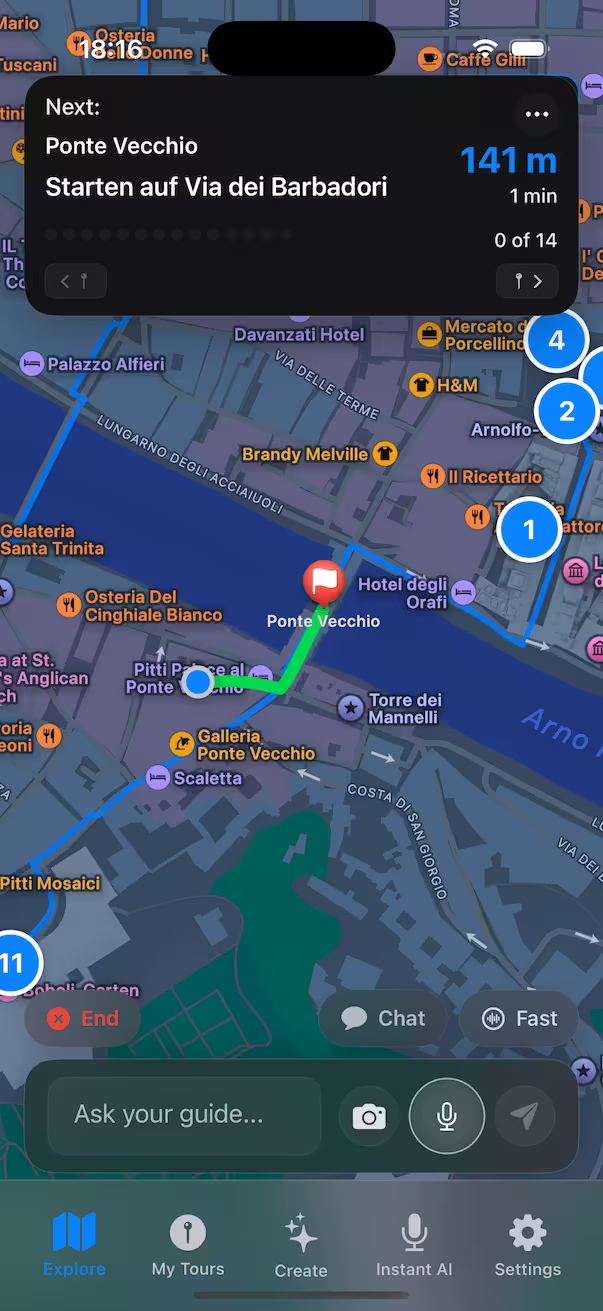
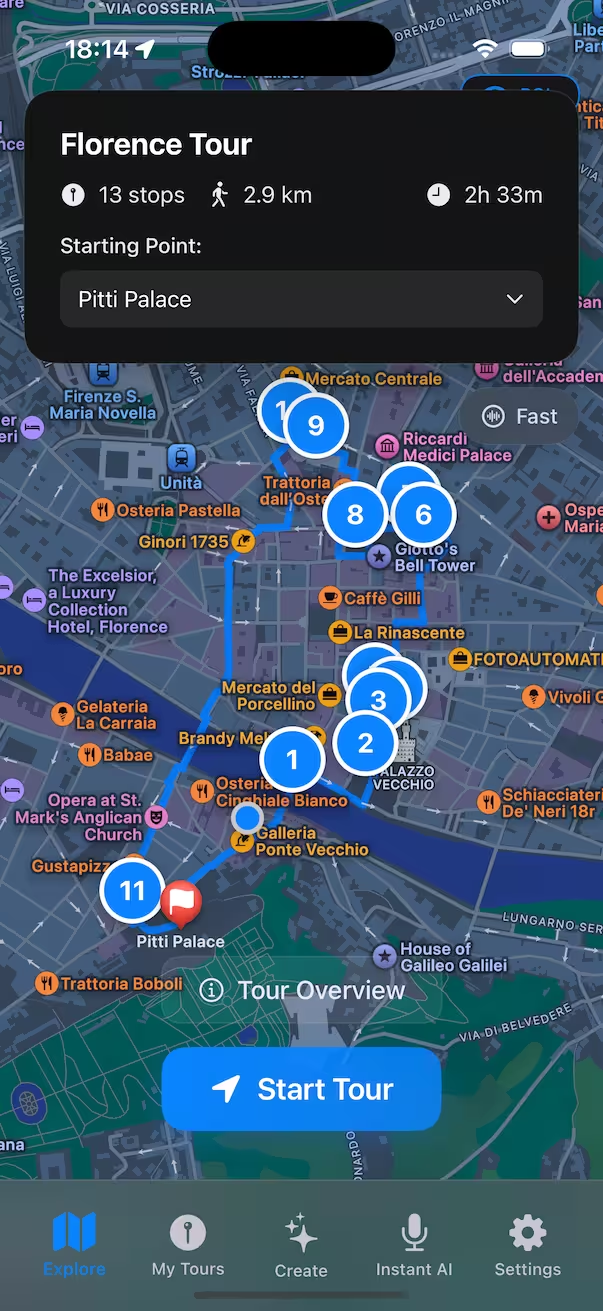
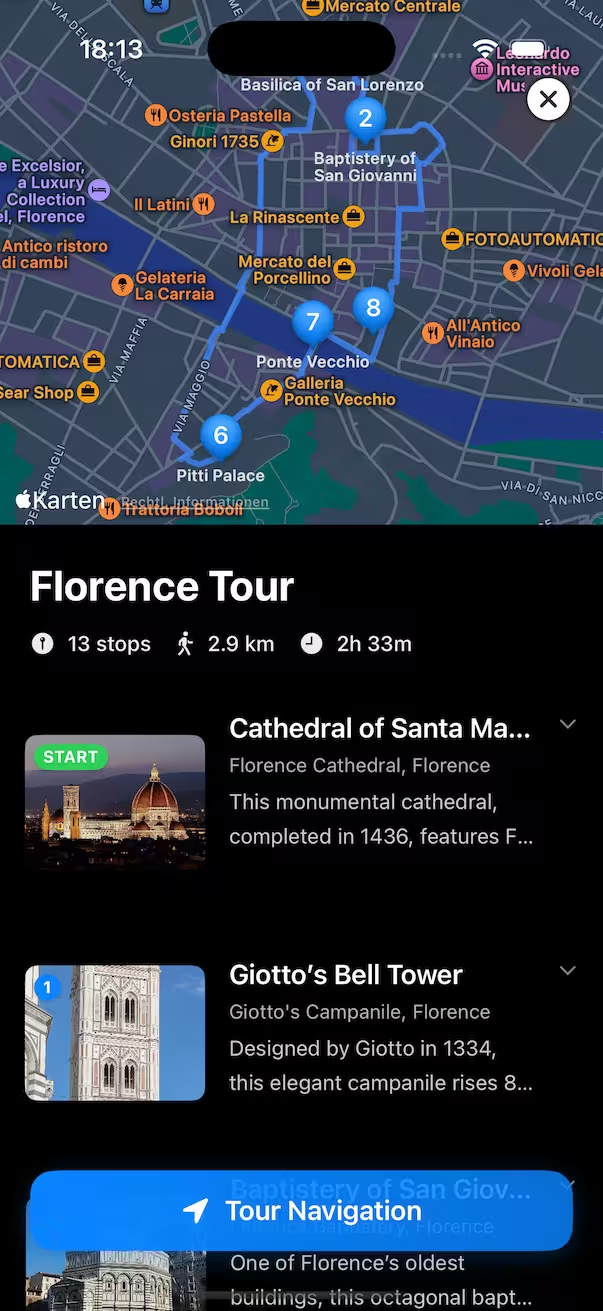
The classic Rothenburg ob der Tauber tour: 11 stops, 2.8 km, about 2 h on foot
Your live AI guide and the self-guided Rothenburg ob der Tauber route, together in your browser.