Self-Guided Walking Tour in Koblenz

A 10-stop loop through Koblenz, starting at the Deutsches Eck where the Mosel meets the Rhine and closing at the Basilika St. Kastor. This page gives you the map, the walking time for every leg, the real prices and opening hours for the cable car and the fortress, and shorter versions if you have less time.

10 Stops9.8 km~4 hours walking4–5 hours with stops
What you get with AI Tourguide
Full GPS navigationInteractive AI guidePersonalized to youWorks in your browser
Try this tour with Alex

Koblenz Walking Tour at a Glance

This route is built for someone who wants to see Koblenz properly on foot without joining a group or paying for interiors they don't care about. Every paid stop is optional: you can follow the whole loop for the cost of the cable car and the fortress, or skip both and still get the confluence, the medieval squares, the palace grounds and the riverfront for nothing. It runs in a sensible order so the city tells a story instead of feeling random.

StartEmperor William Memorial at Deutsches Eck (Kaiser-Wilhelm-Denkmal am Deutschen Eck)
FinishBasilica of St. Castor (St. Kastor)
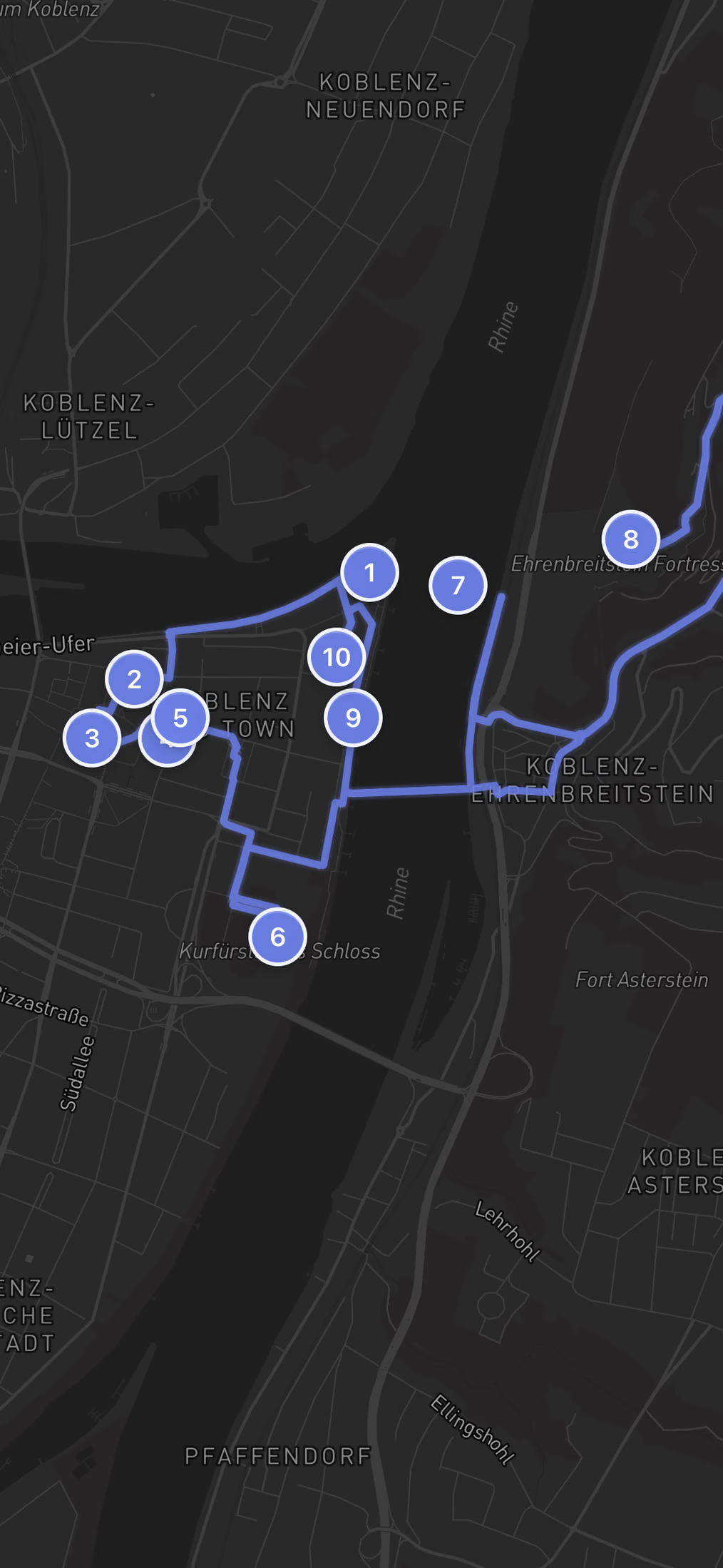
Route typeA near-loop, not a straight line. You head south-west off the Deutsches Eck into the old-town squares, drop south to the palace, then swing east across the Rhine by cable car to the fortress before the riverfront brings you back north to the basilica, a few steps from where you started. Almost no backtracking.
Realistic timePlan for a half day, roughly 4 to 5 hours once you add the stops. Actual walking is around two hours; the fortress and cable car are what eat the clock.
DifficultyEasy. The route covers about 9.5 kilometres but the one real climb is handled by the cable car, so it stays essentially flat. The old-town lanes are cobblestone and uneven; the Rheinanlagen promenade is smooth and stroller-friendly.
Cost to followThe outdoor route is free: the Deutsches Eck, all the squares, the palace grounds, the promenade and the basilica cost nothing. The only paid elements are the Seilbahn cable car at €8 for a round trip and the Festung Ehrenbreitstein at €10, so €18 covers everything.
Best for:

First-time visitors who want the confluence, the Altstadt and the fortress in one coherent afternoon, at their own pace, without a guided group or a fixed schedule.

The Route

Free Walking Tour Map of Koblenz

10 stops9.8 kmabout 4 hours
Loading the interactive map…The complete walking route will appear here.
Want the route to guide you while you walk?Open the route with navigation and a personal guide for the history, stories and questions that matter to you.
Open route + AI guide

The 10 stops along this route

  1. Emperor William Memorial at Deutsches Eck (Kaiser-Wilhelm-Denkmal am Deutschen Eck) in Koblenz, stop 1 on the self-guided walking tour
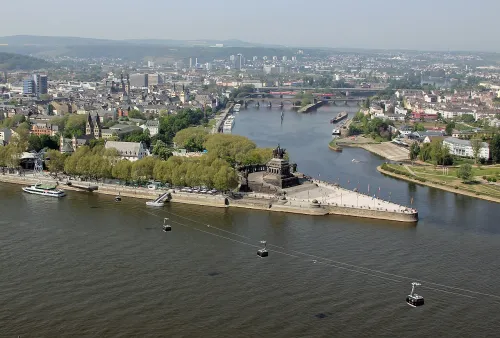
    1Emperor William Memorial at Deutsches Eck (Kaiser-Wilhelm-Denkmal am Deutschen Eck)
  2. Florinsmarkt in Koblenz, stop 2 on the self-guided walking tour
    2Florinsmarkt
  3. Brunnen Am Plan in Koblenz, stop 3 on the self-guided walking tour
    3Brunnen Am Plan
  4. Schängelbrunnen in Koblenz, stop 4 on the self-guided walking tour
    4Schängelbrunnen
  5. Jesuitenplatz in Koblenz, stop 5 on the self-guided walking tour
    5Jesuitenplatz
  6. Electoral Palace Koblenz (Kurfürstliches Schloss) in Koblenz, stop 6 on the self-guided walking tour
    6Electoral Palace Koblenz (Kurfürstliches Schloss)
  7. Koblenz cable car (Seilbahn Koblenz) in Koblenz, stop 7 on the self-guided walking tour
    7Koblenz cable car (Seilbahn Koblenz)
  8. Ehrenbreitstein Fortress (Festung Ehrenbreitstein) in Koblenz, stop 8 on the self-guided walking tour
    8Ehrenbreitstein Fortress (Festung Ehrenbreitstein)
  9. Rheinanlagen Koblenz (Rheinanlagen) in Koblenz, stop 9 on the self-guided walking tour
    9Rheinanlagen Koblenz (Rheinanlagen)
  10. Basilica of St. Castor (St. Kastor) in Koblenz, stop 10 on the self-guided walking tour
    10Basilica of St. Castor (St. Kastor)
  11. That's the complete route.

    If you want more than the map and text, add live navigation and a conversational AI guide while you walk.

    Open route + AI guide
    You made it
Stop 1 of 10
Swipe →

Your Koblenz Walking Tour, Stop by Stop

  1. 1

    Emperor William Memorial at Deutsches Eck (Kaiser-Wilhelm-Denkmal am Deutschen Eck)

    Emperor William Memorial at Deutsches Eck (Kaiser-Wilhelm-Denkmal am Deutschen Eck) in Koblenz, stop 1 on the self-guided walking tour

    The land narrows to a stone wedge and the two rivers close in from both sides, the Mosel from the left, the Rhine from the right, meeting in front of you. Above it all rears the Kaiser Wilhelm monument, a 44-meter equestrian statue of Germany's first emperor that was built between 1895 and 1897 and counts among the country's national monuments. Climb the steps onto the base for the best vantage. You stand directly over the waterline with both rivers fanning out, the fortress on the hill opposite, and the cable car gliding overhead. It is free and open around the clock, so there is no ticket and no queue. Give it fifteen minutes. This is the sight that defines Koblenz, and it sets up everything that follows on this walk.
    Hours
    Open 24/7
    Price
    Free
  2. 2

    Florinsmarkt

    Florinsmarkt in Koblenz, stop 2 on the self-guided walking tour

    Head inland off the point and within a couple of minutes the open river light gives way to a tight medieval square. Florinsmarkt is dominated by the Florinskirche, one of the three Romanesque churches that give the Altstadt skyline its shape. Look up at the gable of the old Kaufhaus building for the Augenroller, a carved face that rolls its eyes and sticks out its tongue on the half hour. It is a small thing and easy to miss if you don't know to watch for it, so pause and wait for the chime. The square is free, always open, and a good spot to get your bearings before the streets start to twist. There's no interior to pay for here, it's the ensemble of facades and the clock that make the stop. Five minutes is plenty unless you're waiting on the eye-roll.

    Hours
    Always open
    Price
    Free
  3. 3

    Brunnen Am Plan

    Brunnen Am Plan in Koblenz, stop 3 on the self-guided walking tour

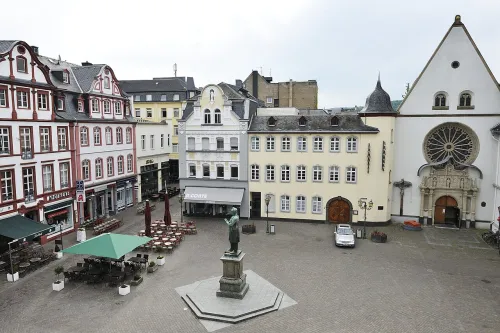
    A short walk through the old-town lanes opens onto Am Plan, a broad rectangular square that has been the commercial center of Koblenz for centuries. This is where markets, fairs and public events have always landed, and on a normal day it's lined with cafe tables and shopfronts. The classicist fountain in the middle is one of the last surviving traces of the city's early water supply, alongside the Kastorbrunnen and the Deinhardplatz obelisk. It's an honest, lived-in square rather than a museum piece, which is exactly the point. Grab a coffee at one of the terraces if you want a sit-down, or just cross through. No ticket, open all hours. Five minutes to take it in, longer if the weather and a free chair tempt you to linger.

    Hours
    Open 24/7
    Price
    Free
  4. 4

    Schängelbrunnen

    Schängelbrunnen in Koblenz, stop 4 on the self-guided walking tour

    Duck into the courtyard beside the town hall and watch the small bronze boy in the center, because he spits. The Schängelbrunnen has stood here since 1941, and the figure represents the Koblenzer Schängel, the cheeky local street urchin who is something of a city mascot. The catch is the water jet, which fires out at irregular intervals and catches a steady stream of tourists who got too close for a photo. Stand back, watch a cycle or two, then move in for your shot. It's free, always running in season, and genuinely one of the more charming things in town. The courtyard, now the Willi-Hörter-Platz, is ringed by Renaissance and Baroque facades that make a nice frame. Five minutes, mostly spent timing the spit.

    Hours
    Open 24/7
    Price
    Free
  5. 5

    Jesuitenplatz

    Jesuitenplatz in Koblenz, stop 5 on the self-guided walking tour

    You're already at the edge of it, since the Schängelbrunnen sits in the courtyard right off this square. Jesuitenplatz is the civic heart of the Altstadt, home to the old town hall, the former Jesuit college that gives the square its name, and a steady flow of locals cutting between the shopping streets. There's no entry fee and nothing to queue for, it's a place to stand for a moment and feel the rhythm of the town rather than tick off a monument. On Tuesdays and Thursdays a weekly market sets up nearby from 8am to 2pm, worth knowing if you want fruit, bread or a quick bite. Otherwise five minutes here is enough before you turn toward the river and the palace. This is the last of the tight old-town squares before the route opens out again.

    Hours
    Always open
    Price
    Free
  6. 6

    Electoral Palace Koblenz (Kurfürstliches Schloss)

    Electoral Palace Koblenz (Kurfürstliches Schloss) in Koblenz, stop 6 on the self-guided walking tour

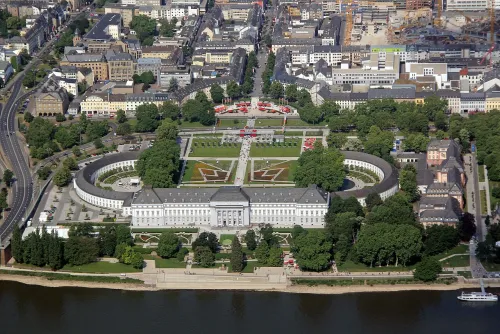
    The lanes release you onto a long open frontage on the Rhine, and the palace stretches out in a pale, symmetrical line. The Kurfürstliches Schloss was built at the end of the 18th century as the residence of Clemens Wenzeslaus, the last Elector and Archbishop of Trier, and it counts among the last grand residences raised in Germany right before the French Revolution. The future Kaiser Wilhelm I lived here for a stretch as a military governor. Today it houses federal offices, so you can't tour stately interiors, but the grounds are open daily from 6am to 10:30pm and they're free. Walk the riverside terrace for the best angle, with the French early-classicist facade on one side and the Rhine on the other. Ten minutes outside is the right call. Then follow the promenade upriver toward the cable car station.

    Hours
    Daily: 6:00 AM – 10:30 PM
    Price
    Free
  7. 7

    Koblenz cable car (Seilbahn Koblenz)

    Koblenz cable car (Seilbahn Koblenz) in Koblenz, stop 7 on the self-guided walking tour

    Follow the river back toward the Deutsches Eck and you'll spot the cables strung high across the Rhine, gondolas sliding over the water in both directions. The Seilbahn Koblenz is Germany's first tricable circulating cableway, built for the 2011 federal garden show, and it moves up to 7,600 people an hour, the highest capacity in the country. The crossing takes only a few minutes but it's a genuine attraction in its own right, with some cabins fitted with glass floors so you watch the Rhine pass beneath your feet. It runs daily from 10am to 7pm, and a round trip is €8. Buy the round trip rather than one-way, since you'll want to come straight back down after the fortress. This is the smart way up the hill: no climb, and the best moving view of the confluence you'll get anywhere.

    Hours
    Daily: 10:00 AM – 7:00 PM
    Price
    €8 (round trip)
  8. 8

    Ehrenbreitstein Fortress (Festung Ehrenbreitstein)

    Ehrenbreitstein Fortress (Festung Ehrenbreitstein) in Koblenz, stop 8 on the self-guided walking tour

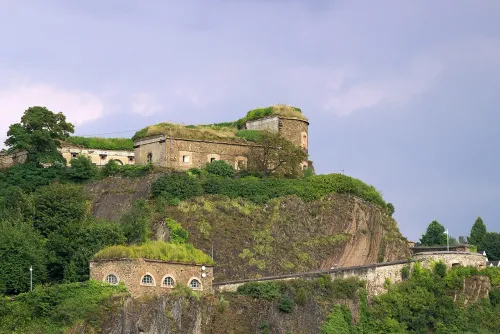
    Step out of the gondola and the whole point of the day snaps into focus. The Festung Ehrenbreitstein is a vast Prussian fortress on the high right bank, rebuilt in its present form between 1817 and 1828 on a site fortified since the Middle Ages, and it looks straight down over the Deutsches Eck and the meeting of the rivers. The earlier fortress here was blown up by French revolutionary troops in 1801. From the ramparts you get the panorama that no photo from below quite captures, the wedge of land, both rivers, the old town spread out behind. Inside is the Landesmuseum Koblenz and a memorial to the German army. It's open daily 10am to 6pm and entry is €10. Budget at least an hour up here, more if you do the museum. The cable car drops you right at the plateau, so there's no walking up.

    Hours
    Daily: 10:00 AM – 6:00 PM
    Price
    €10
  9. 9

    Rheinanlagen Koblenz (Rheinanlagen)

    Rheinanlagen Koblenz (Rheinanlagen) in Koblenz, stop 9 on the self-guided walking tour

    Ride the gondola back down and you land beside the Rheinanlagen, the long landscaped promenade that runs 3.5 kilometers along the left bank. The original stretch was laid out as an English landscape garden between 1856 and 1861 by Peter Lenné for Princess Augusta, and since 2002 the whole riverfront has been part of the Upper Middle Rhine Valley UNESCO World Heritage Site. This is the easy, flat connecting walk back toward the old town, with the Rhine on one side and lawns, old trees and benches on the other. It's free and open at all hours. Pick a bench facing the water and rest your legs for a few minutes, you've earned it after the fortress. Then continue the short distance to the basilica that closes the loop near the point where you started.

    Hours
    Open 24/7
    Price
    Free
  10. 10

    Basilica of St. Castor (St. Kastor)

    Basilica of St. Castor (St. Kastor) in Koblenz, stop 10 on the self-guided walking tour

    Just behind the Deutsches Eck, set back from the land's tip, stands the oldest church in Koblenz. The Basilika St. Kastor was first completed in the early 9th century, with the form you see today shaped in the 12th and 19th centuries, and it's one of the most complete Romanesque buildings on the Middle Rhine. Pope John Paul II raised it to a basilica minor in 1991. The twin towers and the warm stone make a quiet contrast to the open river light outside. On the forecourt stands the Kastorbrunnen, an odd little fountain that dates from the Napoleonic wars and carries an inscription that history made faintly ridiculous. The interior is free and open daily from 10am to 4pm, so step inside if the timing works. Ten minutes here, and you've closed the circle right back where the rivers meet.

    Hours
    Daily: 10:00 AM – 4:00 PM
    Price
    Free

How Long Does This Walking Tour Really Take?

Walking time on this loop is modest, under two hours of actual movement, but the fortress is what stretches it into a half day. Between the cable car each way and the time on the ramparts, give the Seilbahn and Festung Ehrenbreitstein at least two hours together, more with the Landesmuseum. The old-town squares are five to ten minutes each.

Walking time on this loop is modest, well under an hour of actual movement, but you should plan for a half day once you add the stops. The fortress is what eats the clock: between the cable car ride each way and the time up top, give the Seilbahn and Festung Ehrenbreitstein at least two hours together, more if you go into the Landesmuseum. The old-town squares are quick, five to ten minutes each, and the riverfront stretches are pleasant walking rather than standing-and-staring.

The natural break point is the fortress plateau itself, where there's a cafe with terrace seating and the best view in the city to drink it with. If you'd rather pause in the old town first, the terraces at Am Plan are the easy choice, with cafe tables right on the square. On the way back, a bench in the Rheinanlagen facing the Rhine is the free option for a rest before the final short walk to the basilica. Early afternoon up at the fortress and late afternoon back along the river is the timing I'd aim for.

Full Route, Shorter Walk or Two-Day Version?

The full loop is the recommended way to do Koblenz, but the two paid stops sit on the longest legs, so it's easy to trim or split if you have less time or less budget. Here are three ways to run the same route depending on how much of the day you want to give it.

Old Town Only

Skip the fortress, stay on the flat

Stops 1 to 6, then 9 and 10, cutting the cable car and Ehrenbreitstein. Around 2 to 2.5 hours, and free.

Drop the two longest legs and the two paid stops. You still get the Deutsches Eck, all four medieval squares, the palace grounds, the riverfront promenade and the oldest church in town, entirely on the level and without a ticket. The right call for a short visit, tired legs, or a rainy afternoon when the ramparts hold no appeal.

Two-Day Split

Old town one day, fortress the next

Day one: stops 1 to 6 plus the basilica. Day two: the Seilbahn, Festung Ehrenbreitstein and the Rheinanlagen. Roughly 2 hours each.

Break the loop at the palace. Spend the first afternoon on the compact Altstadt squares and finish at St. Kastor near the point. Come back the next day fresh for the cable car, the fortress and its museum, then unwind along the river. Ideal if you're staying overnight and would rather not rush the view from the top.

You can walk it in reverse, riding up to the Festung Ehrenbreitstein first and ending in the old-town squares, but the given direction is better: the medieval squares make more sense once you've seen the two rivers meet, and the fortress panorama lands hardest after you've stood at the confluence below it. Save the big view for the middle, not the start.

Is This Koblenz Walking Tour Right for You?

Koblenz is one of the easier German cities to do entirely on foot, but the route still suits some travellers better than others. Here's who it's built for, and how to bend it if that isn't quite you.

A good fit if you…

  • First-timers who want the Deutsches Eck, the Altstadt and the fortress in one logical sequence
  • Walkers who prefer flat ground and let the cable car handle the only real climb
  • Anyone travelling on a budget: the whole outdoor loop is free, with just €18 for the two paid stops
  • Photographers chasing the confluence from below at the point and from above on the ramparts

Adapt the route if you…

  • You have only a couple of hours: run the Old Town Only version and skip the fortress
  • You're travelling with a stroller: the Rheinanlagen is smooth, but the cobbled squares are bumpy going
  • You want the fortress but not the walk to it: the cable car drops you right on the plateau, no climb
  • You're staying overnight: use the Two-Day Split so the view from the top never feels rushed

Tickets & Skip-the-Line in Koblenz

Only two stops on this route cost anything, and neither needs a reservation. Here's what you pay and when they're open, so you can plan the fortress visit around the cable car's running hours.

Koblenz cable car (Seilbahn Koblenz)€8 for a round trip, and buy the round trip rather than one-way since you'll want to come straight back down after the fortress. It runs daily from 10:00 to 19:00. Tickets are sold at the valley station near the Deutsches Eck, and the counter also offers a combined cable car plus fortress ticket that saves a couple of euros over buying the two separately.
Ehrenbreitstein Fortress (Festung Ehrenbreitstein)€10 for entry, which includes the ramparts and the Landesmuseum Koblenz. Open daily 10:00 to 18:00. No booking needed; buy on arrival, or take the combined ticket at the cable car valley station. Budget at least an hour up top, more if you do the museum. official ticket site ↗
Everything elseThe Deutsches Eck, Florinsmarkt, Am Plan, the Schängelbrunnen, Jesuitenplatz, the Kurfürstliches Schloss grounds, the Rheinanlagen and the Basilika St. Kastor are all free open spaces with no ticket and no queue.
Optional upgrade
+6
The same 10-stop route,
now with navigation and a guide.
Optional AI experience

You already have the route.
The AI guide brings it to life.

Standing at the Deutsches Eck with the Mosel and the Rhine in front of you? Open AI Tourguide in your browser, no app and no download, and a voice guide walks you into the old-town squares and up to the fortress in the right order. It greets you, tells the story along the way, then asks what you want to see and adapts the route as you go. A real conversation built into the walk, not a recording. Start with 100 free credits.

Livenavigation13languagesAnyquestionYourinterests
Open this route with the AI guide

Try it in your browser · No app or download required

Tips for Walking in Koblenz

  • Time the cable car for the second half of your walk. It runs daily 10am to 7pm, so start in the old town in the morning, then ride up to the Festung Ehrenbreitstein early afternoon when the light is good over the confluence. Buy the €8 round trip, not one-way.
  • The Altstadt lanes are cobblestone and uneven, and the climb is handled by the cable car, so you don't need hiking boots, but flat shoes with a bit of grip beat smooth-soled sandals on the old paving. The Rheinanlagen promenade is smooth and stroller-friendly.
  • Public restrooms are reliable at the cable car valley station near the Deutsches Eck and up at the fortress, where there's a proper visitor facility. In the old town, use a cafe at Am Plan if you buy a drink.
  • For a sit-down break with the view, the cafe terrace on the fortress plateau is the spot. For something local in the evening, the Weindorf Koblenz in the Rheinanlagen pours regional Mosel and Rhine wines in a village-style courtyard, open Wed to Fri from 5pm, weekends from midday, closed Mon and Tue.
  • For the signature photo, climb onto the base of the Kaiser Wilhelm monument at the Deutsches Eck and shoot back toward the fortress with both rivers in frame. Late afternoon light hits the water and the Ehrenbreitstein hill best. For the reverse angle, the fortress ramparts looking down on the point are unbeatable around the same hour.

Why Walk This Route?

Koblenz is a city built around a point on the map, the spot where the Mosel runs into the Rhine, and almost everything worth seeing here sits within a tight loop you can walk in an afternoon. The old town is compact and mostly flat, the riverfront promenade is wide and uncluttered, and the one big climb is handled for you by a cable car. That combination makes Koblenz one of the easier German cities to do entirely on foot, without ever feeling like you skipped the good parts.

This route is built to flow with the geography instead of fighting it. You start at the dramatic confluence, drop into the medieval squares where locals actually do their shopping, walk down to the Baroque palace on the Rhine, then ride the gondola across the river to the fortress for the view that explains the whole city in one glance. The return leg follows the river back past the oldest church in town. No backtracking, no pointless detours.

Why walk it rather than wander? Because Koblenz rewards order. The squares of the Altstadt make more sense once you've seen the rivers meet, and the fortress means nothing until you've stood at the point it was built to defend. Do it in sequence and the city tells you a story. Do it randomly and it's just pretty buildings.

Common Questions

Is koblenz safe to walk around?

Koblenz is a small, calm city and the old town, riverfront and fortress are all comfortable to walk, including after dark in the central areas. There are no tourist-targeting scams to speak of. The usual sense applies near the train station at night and on the riverbank during festival crowds. The main physical hazard is the spitting Schängelbrunnen catching you with a water jet if you stand too close for a photo, which is harmless but real.

What if it rains during my koblenz tour?

The route has decent indoor cover. Duck into the Basilika St. Kastor, open daily 10am to 4pm and free, and the Landesmuseum inside the Festung Ehrenbreitstein, open 10am to 6pm with the €10 entry, both shelter you for a good while. The cable car cabins are fully enclosed, so the crossing works in any weather. The old-town squares and the Rheinanlagen are the parts you'd want to save for a dry spell.

What's the best time of day for this walking tour?

Start mid-morning in the old town, around 10am, so the squares are waking up and the markets near Jesuitenplatz are open on Tuesday and Thursday. Aim to be at the cable car and fortress by early to mid afternoon, when the light over the confluence is at its best and the valley views are clearest. Finishing along the Rheinanlagen in the late afternoon gives you the warm river light on the walk back.

Take this route with you

Open this exact tour with navigation and your personal AI guide.

Start GPS Navigation + AI Guide
AI Tourguide
Researched and curated by the AI Tourguide teamWe plan and quality-check every route, then research and verify the opening hours, prices, and practical tips for each stop along it.
▶ Open route with AI guideNavigation, stories and your questions