Self-Guided Walking Tour in Trier

Here is the whole tour for free: the route, the interactive map, GPS navigation and every stop with its description, opening hours and prices. Want a voice AI guide to lead you and tell the stories as you walk? Add it as an optional extra.

10 Stops 6.1 km ~2.8 hours
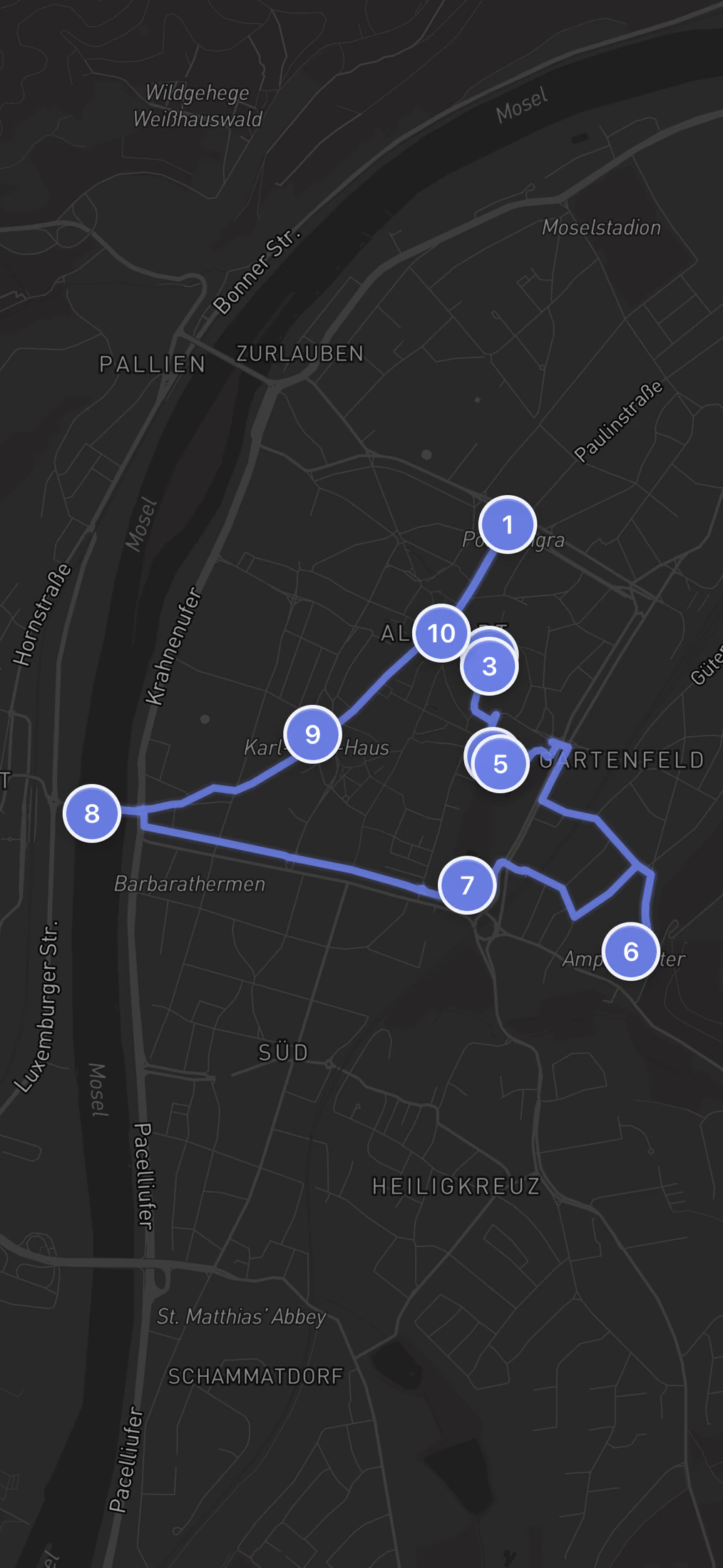
Walking tour route map of Trier Open interactive map

Why Walk Trier? A Self-Guided Tour

Trier is the oldest city in Germany, and it wears that age out in the open. The Romans founded Augusta Treverorum here, and instead of burying their ruins under glass, the city left them standing in the street where people still walk past them on the way to buy bread. A 1,850-year-old gate, an imperial bath complex, the oldest bridge in the country, an audience hall built for emperors. Most of it is free to look at, and the whole lot fits inside a compact center you can cross on foot in twenty minutes.

This route is a loop, and that matters. You start at the Porta Nigra, drop south through the cathedral quarter to the Roman monuments on the edge of town, swing across the Mosel on the Römerbrücke, then come back through the Karl-Marx-Haus to finish in the market square where you started. No backtracking, no metro, about 6 km total. You could wander Trier randomly and still trip over something Roman, but you would miss the order of it. Walked in sequence, the stops tell the story straight: emperors, archbishops, then a man born in 1818 who changed the world from a townhouse three streets from the cathedral.

The distances between stops are short, the surfaces are mostly flat, and almost every monument is either free or a few euros. Bring decent shoes, a refillable water bottle, and an appetite for Mosel Riesling. That last part is not a joke. There is a wine stand on the market square, and you will want to know about it.

The Route

Walking Map of Trier

10 stops 6.1 km about 3 hours
Tap to load interactive map

The 10 stops along this route

  1. Porta Nigra in Trier, stop 1 on the self-guided walking tour
    1Porta Nigra
  2. Trierer Dom, stop 2 on the self-guided walking tour
    2Trierer Dom
  3. Liebfrauenkirche in Trier, stop 3 on the self-guided walking tour
    3Liebfrauenkirche
  4. Konstantinbasilika in Trier, stop 4 on the self-guided walking tour
    4Konstantinbasilika
  5. Kurfürstliches Palais in Trier, stop 5 on the self-guided walking tour
    5Kurfürstliches Palais
  6. Amphitheater in Trier, stop 6 on the self-guided walking tour
    6Amphitheater
  7. Kaiserthermen in Trier, stop 7 on the self-guided walking tour
    7Kaiserthermen
  8. Römerbrücke in Trier, stop 8 on the self-guided walking tour
    8Römerbrücke
  9. Karl-Marx-Haus (Museum Karl-Marx-Haus) in Trier, stop 9 on the self-guided walking tour
    9Karl-Marx-Haus (Museum Karl-Marx-Haus)
  10. Hauptmarkt in Trier, stop 10 on the self-guided walking tour
    10Hauptmarkt
  11. That's the full loop.

    Walk it with a live AI guide talking you through every one of these streets.

    Start free in your browser
    You made it
Stop 1 of 10 Swipe →

Your Trier Walking Tour, Stop by Stop

  1. 1

    Porta Nigra

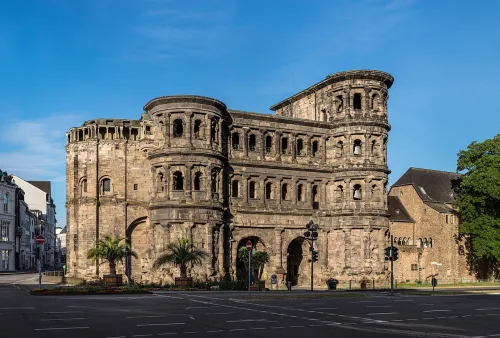
    Porta Nigra in Trier, stop 1 on the self-guided walking tour

    It is black, it is enormous, and it has been standing in the same spot since around 170 AD. The Porta Nigra (Latin for "black gate") is the best-preserved Roman city gate north of the Alps, and the locals are so fond of it they just call it "die Porta." Originally it ran 36 meters long and just over 29 meters high, built from sandstone blocks stacked without mortar, held together by iron clamps. Walk up close and you can see the gouges where medieval scavengers pried those clamps out. You can climb the gate daily from 9:00 AM to 6:00 PM, and the ticket is worth it for the view down the pedestrian street, though the exterior alone earns the stop. Stand on the Porta-Nigra-Platz side first, with the dark stone filling your whole field of view, before you walk under the arches. From here head south down Simeonstraße, the main shopping street, straight toward the cathedral.
    Hours
    Daily: 9:00 AM – 6:00 PM
    Price
    Free

    6 min walk to next stop

  2. 2

    Trierer Dom

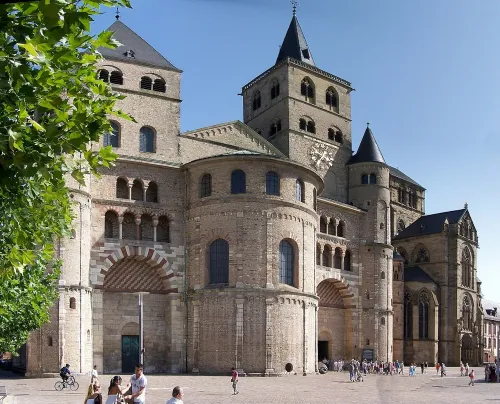
    Trierer Dom, stop 2 on the self-guided walking tour

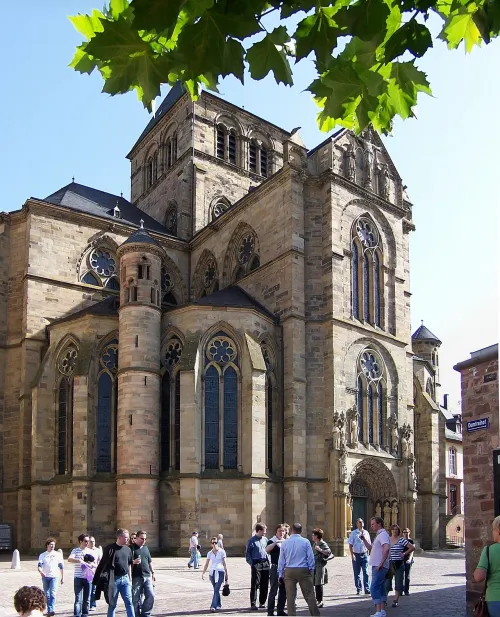
    After the shop windows of Simeonstraße, the street opens and a wall of pale rough stone rises on your left. This is the Dom St. Peter, the oldest bishop's church in Germany, and you can see its age in the masonry: the squarish Roman core is plainly different from the medieval additions bolted on around it. At 112.5 meters long it is the biggest church in the city and has served as a cathedral without a break since late antiquity. Inside it guards the Holy Robe, said to be the tunic of Christ, shown publicly only on rare pilgrimages. Entry is free, daily from 6:30 AM to 5:30 PM, and you should go in. The cloister to the side is calm and usually empty. Do not leave yet, because the next stop shares a wall with this one and is the reason the cathedral looks so wide from outside.

    Hours
    Daily: 6:30 AM – 5:30 PM
    Price
    Free

    1 min walk to next stop

  3. 3

    Liebfrauenkirche

    Liebfrauenkirche in Trier, stop 3 on the self-guided walking tour

    Step out of the cathedral and the building immediately to the south, joined to it almost seamlessly, is a completely different beast. The Liebfrauenkirche is one of the two oldest Gothic churches in Germany, and the earliest Gothic central-plan building in the country. From outside the two churches read as one mass of stone, but inside the Liebfrauenkirche is a flower in plan: twelve columns laid out so the floor forms a cross within a circle. Stand in the middle and look up. The light through the high windows is the whole point. Entry is free, open daily 10:00 AM to 6:00 PM from April to October, and 11:00 AM to 5:00 PM November through March. Five minutes here is enough to feel the contrast with the heavy Roman Dom next door. From the church square, walk south down Liebfrauenstraße toward the largest single room you will stand in all day.

    Hours
    Apr-Oct: Daily 10:00 AM - 6:00 PM | Nov-Mar: Daily 11:00 AM - 5:00 PM
    Price
    Free

    3 min walk to next stop

  4. 4

    Konstantinbasilika

    Konstantinbasilika in Trier, stop 4 on the self-guided walking tour

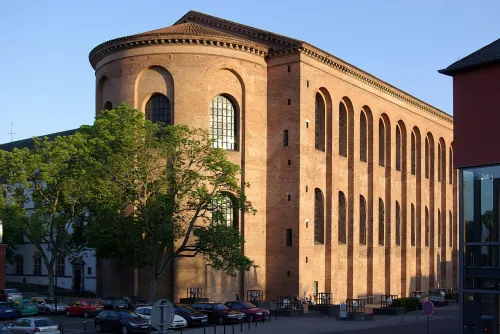
    From the cathedral quarter you come out at a plain brick block that looks almost industrial. Do not be fooled. The Konstantinbasilika was the throne room of Roman emperors, built in the 4th century as the audience hall of Constantine the Great. Step inside and the scale is staggering: a single undivided space with no columns, just enormous walls and a vaulted apse, the largest surviving single room from the Roman world. The plainness is deliberate. The interior was stripped back to bare stone walls and a wooden coffered ceiling after the building burned out in a 1944 air raid and was rebuilt in the 1950s. It is now a Protestant church, the oldest building in Germany still used as one. Entry is free, but mind the hours: closed Mondays, open Tuesday to Saturday 10:00 AM to 12:00 PM and 2:00 to 4:00 PM, Sundays 2:00 to 4:00 PM only. Walk out the south side straight into the next stop, which was literally built onto this hall.

    Hours
    Mon: Closed | Tue-Sat: 10:00 AM – 12:00 PM, 2:00 – 4:00 PM | Sun: 2:00 – 4:00 PM
    Price
    Free

    1 min walk to next stop

  5. 5

    Kurfürstliches Palais

    Kurfürstliches Palais in Trier, stop 5 on the self-guided walking tour

    Turn the corner from the bare brick basilica and the contrast is comic: a pink-and-cream Rococo palace grafted right onto the Roman wall. The Kurfürstliches Palais was the residence of the prince-bishops who ruled Trier until 1794, and it was partly built on the foundations of the basilica next door. In the 19th century they actually tore down the palace's west wing to dig the Roman hall back out. The building now holds government offices, so the interior is not a tourist sight, but the garden front is the reason to come. The offices are open Monday to Friday 9:00 AM to 3:30 PM and closed at weekends, though you will spend your time outside regardless. Walk into the Palastgarten behind it, a free public park since the early 20th century, with fountains, baroque statues, and benches facing the basilica. This is the best rest point on the route. From the far end of the garden, head southeast toward the hillside and the amphitheatre.

    Hours
    Mon-Fri: 9:00 AM – 3:30 PM | Sat-Sun: Closed
    Price
    Free

    10 min walk to next stop

  6. 6

    Amphitheater

    Amphitheater in Trier, stop 6 on the self-guided walking tour

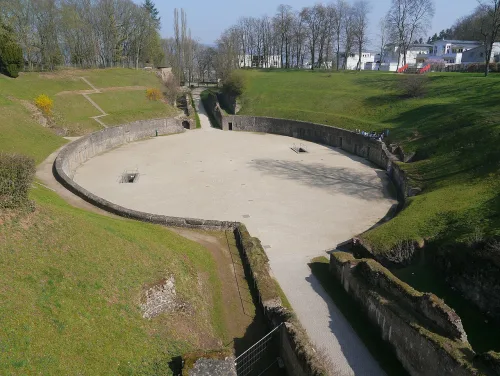
    The walk out of the garden takes you to the edge of the old town, and the ground starts to rise. The Roman amphitheatre is cut straight into the hillside, which is why it has survived so well: the slope itself forms the seating bank. It once held around 18,000 people for gladiator fights and animal hunts. What grabs you now is below ground. You can go down into the cellars beneath the arena floor, the cold stone chambers where animals and fighters waited to be hoisted up into the noise. Stand in the empty oval at the bottom and the silence is the opposite of what this place was built for. Open daily 9:00 AM to 6:00 PM, and entry is free. Allow twenty minutes, more if the underground passages are open. From here, double back downhill and west toward the towering brick walls of the imperial baths.

    Hours
    Daily: 9:00 AM – 6:00 PM
    Price
    Free

    8 min walk to next stop

  7. 7

    Kaiserthermen

    Kaiserthermen in Trier, stop 7 on the self-guided walking tour

    You see the brick before you reach it: massive curved walls, some still standing 19 meters high, with rows of arched window openings that frame the sky. The Kaiserthermen were imperial baths, among the largest Roman baths north of the Alps, though here is the twist: they were never finished as baths and ended up converted into a cavalry barracks. The site is now an archaeological park, and the real reward is below. A network of underground service tunnels runs beneath the floor, the channels that once carried heat and water, and you can walk through them. It is the most atmospheric Roman experience in the city. Open daily 9:00 AM to 6:00 PM, entry €6, the only paid Roman monument on this loop and the one most worth paying for. Give it forty minutes. Afterward, head west and downhill toward the river. The Mosel and the oldest bridge in Germany are about fifteen minutes away.

    Hours
    Daily: 9:00 AM – 6:00 PM
    Price
    €6

    16 min walk to next stop

  8. 8

    Römerbrücke

    Römerbrücke in Trier, stop 8 on the self-guided walking tour

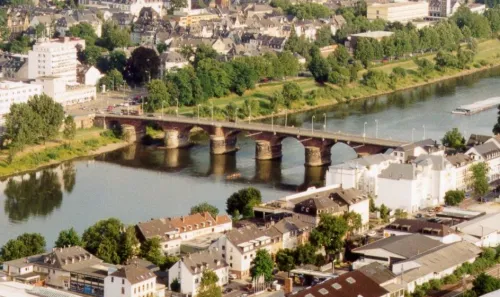
    The longest stretch of the walk drops you at the riverbank, and the bridge ahead looks ordinary until you know what you are standing on. The Römerbrücke is the oldest bridge in Germany, and its stone piers were sunk into the Mosel in the 2nd century AD. Cars and buses still cross on those same Roman foundations every day. The road deck on top is modern, but the dark basalt pillars in the water are eighteen centuries old and still doing their job. Walk out to the middle and look back at the city: the Mosel valley, the wooded slopes, and high on the far hill the Mariensäule, a 40-meter column standing more than 150 meters above the town. The bridge is open at all hours and free. There is no ticket, no queue, just the quiet fact of the thing. When you are done, head back into town to the northeast, toward a modest townhouse with an outsized history.

    Hours
    Always open
    Price
    Free

    12 min walk to next stop

  9. 9

    Karl-Marx-Haus (Museum Karl-Marx-Haus)

    Karl-Marx-Haus (Museum Karl-Marx-Haus) in Trier, stop 9 on the self-guided walking tour

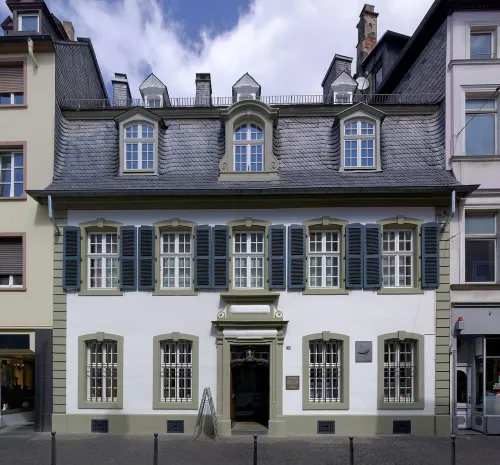
    Back among the streets, on Brückenstraße, stands an unremarkable Baroque townhouse painted soft yellow. Karl Marx was born here in 1818, and the building is now a museum about his life, his work, and the long afterlife of his ideas. You do not have to be a communist, or have read a word of Das Kapital, to find it interesting: the exhibits trace how one man's writing from a few small rooms reshaped the politics of the next century and a half. Open daily, 10:00 AM to 1:00 PM and 1:30 to 6:00 PM, with a closed lunch slot in between, so check your timing. Admission is €7. If museums are not your thing, the facade and the courtyard are free to see and the photo is the point for most visitors anyway. From here it is a short walk northeast into the market square to close the loop.

    Hours
    Daily: 10:00 AM – 1:00 PM, 1:30 – 6:00 PM
    Price
    €7

    8 min walk to next stop

  10. 10

    Hauptmarkt

    Hauptmarkt in Trier, stop 10 on the self-guided walking tour

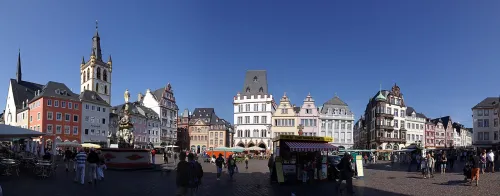
    The loop ends where the everyday life of Trier still happens. The Hauptmarkt is one of the largest squares in the city, ringed by a two-thirds-intact run of Renaissance, Baroque and Classicist houses, and it has been a market since the 10th century. The archbishop set up the stone market cross here in 958 as a symbol of his authority, and it still stands. Look for the Steipe, a banqueting house from around 1430 rebuilt after wartime destruction, and the Rotes Haus with the inscription boasting that Trier stood 1,300 years before Rome. The square is open at all hours and free, and unlike the Roman ruins it is full of people: cafe tables, a fountain, a flower stall. This is the spot to sit. The wine stand on the square pours Mosel Riesling by the glass, open Monday to Saturday from 10:00 AM and Sundays from 11:00 AM until 10:00 PM. Order one, find a step in the sun, and watch the city you just walked through go about its day.

    Hours
    Open 24/7
    Price
    Free
Walking tour route map of Trier Route loaded
Porta NigraTrierer DomLiebfrauenkircheKonstantinbasilika+6
All 10 stops are already on the map.
You just press start.
AI Tourguide

You just read the route.
Now walk it with a guide in your ear.

Press start wherever you are, even hundreds of kilometres from Trier, and the guide begins telling its stories right away. In the city, pick any of the 10 stops to start from: it leads you there, then talks with you the whole route, asking, listening, remembering, and shaping the tour around your answers.

10stops 6.1km 2.8hours 11languages
Start the tour free

Free to start · Runs in your browser · No app, no download

Self-Guided Tour vs. Group Tour in Trier

Here is the honest math. Almost every stop on this route is free to enter. The Porta Nigra, the Dom, the Liebfrauenkirche, the Konstantinbasilika, the amphitheatre, the Römerbrücke and the Hauptmarkt cost nothing to look at and walk through. The only paid Roman site is the Kaiserthermen at €6, and the Karl-Marx-Haus museum at €7. Do this walk self-guided and you can see the entire Roman city for the price of one bath ticket and a glass of wine. That is rare. Trier is one of the few major heritage cities in Germany where the headline sights are not gated behind expensive combined passes.

Guided walking tours of the old town from the tourist office and private operators typically run around €10 to €15 per person for a roughly two-hour walk, and a good guide does add the layer this page is trying to give you: which clamp-holes on the Porta Nigra were dug by medieval thieves, why the basilica looks like a brick warehouse, what the Latin on the Rotes Haus says. If you love a knowledgeable human in front of you and do not mind a fixed schedule, it is fair value.

But Trier rewards the self-guided walker more than most cities. The route is compact, the sites are unmissable by sight alone, and the underground tunnels at the Kaiserthermen and the cellars at the amphitheatre are things you explore at your own pace, not on a guide's clock. Walk it yourself, spend the saved tour money on a combined ticket for the Roman monuments if you want interiors, and pocket the rest for Riesling.

Group Tour AI Self-Guided
Price €25–€50 per person €5/hour or €20 all-inclusive
Flexibility Fixed schedule Start anytime, skip stops
Languages 1–2 languages 11 languages
Pace Group pace Your own pace

How Long Does This Trier Tour Take?

Our route covers 6.1 km with 10 stops and takes approximately 2.8 hours at a relaxed pace.

Walking time alone is roughly two hours for the full 6 km loop, but plan on four to five hours to do it properly. The stops that eat time are the ones with interiors and undergrounds: the Kaiserthermen tunnels reward a full forty minutes, the amphitheatre cellars another twenty, and the cathedral plus Liebfrauenkirche together about half an hour. The Karl-Marx-Haus museum adds an hour if you go in.

The natural break is the Palastgarten behind the Kurfürstliches Palais, roughly the midpoint after the cathedral quarter and before the long pull out to the Roman monuments. Find a bench facing the basilica, eat something you brought, and rest your legs before the climb to the amphitheatre. The other obvious stop is the very end: the Weinstand on the Hauptmarkt pours Mosel Riesling by the glass from 10:00 AM, and a glass there with the market crowd is the right way to close a walk through the oldest city in Germany.

Is a "free tour" of Trier really free?

A traditional "free" tour

Free to join, but you pay at the end

  • A guide leads a fixed group at a set meeting time
  • You keep pace with 20 to 40 other people
  • A tip of about 15 to 20 EUR per person is expected at the end
  • One or two languages, whatever the guide speaks

AI Tourguide Trier

Genuinely free, with clear pricing

  • The full route, interactive map and GPS navigation, free
  • Every stop with descriptions, opening hours and prices, free
  • Start whenever you want and go at your own pace
  • Optional voice AI guide that leads you and tells the stories

Clear price, usually less than a tip: free to start, then 5 EUR/hour or 20 EUR all-inclusive.

Tips for Walking in Trier

  • Trier has no metro. The route is a flat walking loop starting at the Porta Nigra, a 10-minute walk from the Hauptbahnhof down Theodor-Heuss-Allee. Trains from Koblenz and Luxembourg arrive there; from the station, walk straight toward the black gate and you are at stop one.
  • Surfaces are mostly flat cobblestone and paved pedestrian streets through the center, but the amphitheatre sits on a hillside and the underground passages at both the amphitheatre and Kaiserthermen have uneven stone floors and low light. Wear closed shoes with grip, not sandals.
  • Public restrooms are easiest to find at the Hauptmarkt area and inside paid sites like the Kaiserthermen. Use the facilities at the Kaiserthermen since you have a €6 ticket anyway, before the long stretch across the Römerbrücke where there is nothing.
  • End at the Weinstand on the Hauptmarkt, open Mon to Sat from 10:00 AM and Sun from 11:00 AM until 10:00 PM. Order a glass of Mosel Riesling, the local white the whole valley is famous for, and drink it standing on the square like the locals do.
  • Best photo is on the Römerbrücke: walk to the middle, face back east toward the old town, and shoot the city against the wooded Mosel slopes. Late afternoon light puts the sun behind you and lights up the riverbank. For the Porta Nigra, shoot early from the Porta-Nigra-Platz side before the crowds and shop deliveries arrive.
Walking tour route map of Trier Route loaded
Porta NigraTrierer DomLiebfrauenkircheKonstantinbasilika+6
All 10 stops are already on the map.
You just press start.
AI Tourguide

Your guide is ready when you are.

Press start and a voice AI tourguide takes it from here: leading the route through Trier, telling the stories, and turning your walk into a real back-and-forth conversation. No app, no download, it runs in your browser.

10stops 6.1km 2.8hours 11languages
Start the tour free

Free to start · Runs in your browser · No app, no download

Your AI Guide for This Walk

Standing under the black sandstone arches of the Porta Nigra right now? Open AI Tourguide in your browser, no app and no download, and a voice guide walks Germany's oldest city with you, greeting you, telling the story from the Roman gate to the Dom and the Konstantinbasilika, and asking what you want to see so it can shape the rest of the route. A real conversation built into the walk, not a recording. Start with 100 free credits.

A Real Conversation A voice AI tourguide greets you, leads the whole route, and tells the stories and facts as you walk, asking what you want to see and keeping a real conversation going. Not a recording you press play on.
Map Navigation Follow the route on the map and walk at your own pace. You choose where to start and when to move to the next stop.
Ask Anything Curious about a building you pass? Ask your AI guide on the spot and the conversation carries on.
11 Languages Switch language anytime. No separate tour needed.
Start free in your browser

Common Questions

Is Trier safe to walk around?

Yes. Trier is a small, calm cathedral city of about 110,000 people and the walking route stays in busy, well-used streets the whole way. There are no rough areas on this loop. The usual caution applies for valuables in the crowds on the Hauptmarkt and Simeonstraße, and the Römerbrücke and riverbank get quiet after dark, so do that stretch in daylight. There are no notable tourist scams here.

What if it rains during my Trier tour?

Several stops shelter you. The Konstantinbasilika is one enormous covered hall, the Trierer Dom and Liebfrauenkirche are both indoors and free, and the Karl-Marx-Haus museum (€7) is a dry hour. For a longer rain plan, the Rheinisches Landesmuseum near the Palastgarten is one of Germany's biggest archaeology museums, €10, closed Mondays, open Tuesday to Sunday 10:00 AM to 5:00 PM, and it holds the Roman finds that fill in everything you saw outside.

What's the best time of day for this walking tour?

Start by 9:00 AM. That is when the Porta Nigra, amphitheatre and Kaiserthermen all open, it puts you at the gate before tour groups and shop deliveries clog Simeonstraße, and it lines you up to reach the Römerbrücke in the warm light of late afternoon. Starting early also means you finish at the Hauptmarkt wine stand in the evening, when the square is at its liveliest.

Is the tour really free?

Yes. The route, interactive map, navigation and the text for every stop are free and you use them without paying anything. Only the voice AI guide is optional and paid: you test it free with credits, then it costs 5 EUR per hour or 20 EUR for the whole tour.

Do I have to tip?

No. Unlike group free tours, there is no guide waiting for a tip and no social pressure at the end. The price is clear upfront and usually lower than the tip a free tour expects.

Do I need to download an app?

No. Everything runs in your phone browser. Open the route and start walking, no download and no sign-up required.

Do I need to book the walking tour in advance?

No booking needed. This self-guided tour is available anytime. Open the route in your browser and start walking. The AI guide works instantly, no app, no reservation required.

What languages is the AI guide available in?

The AI guide speaks 11 languages: English, German, French, Spanish, Italian, Japanese, Chinese, Portuguese, Danish, Norwegian, and Swedish.

Can I skip stops or change the route?

Yes. Skip any stop, spend extra time at places you like, or start the route from any point. It is your walk, you set the pace.
AI Tourguide
Researched and curated by the AI Tourguide team We plan and quality-check every route, then research and verify the opening hours, prices, and practical tips for each stop along it.
Last reviewed July 2026
▶ Start free in your browser Runs in your browser, no app, no download