Self-Guided Walking Tour in Wiesbaden

Here is the whole tour for free: the route, the interactive map, GPS navigation and every stop with its description, opening hours and prices. Want a voice AI guide to lead you and tell the stories as you walk? Add it as an optional extra.

12 Stops 8.1 km ~3.6 hours
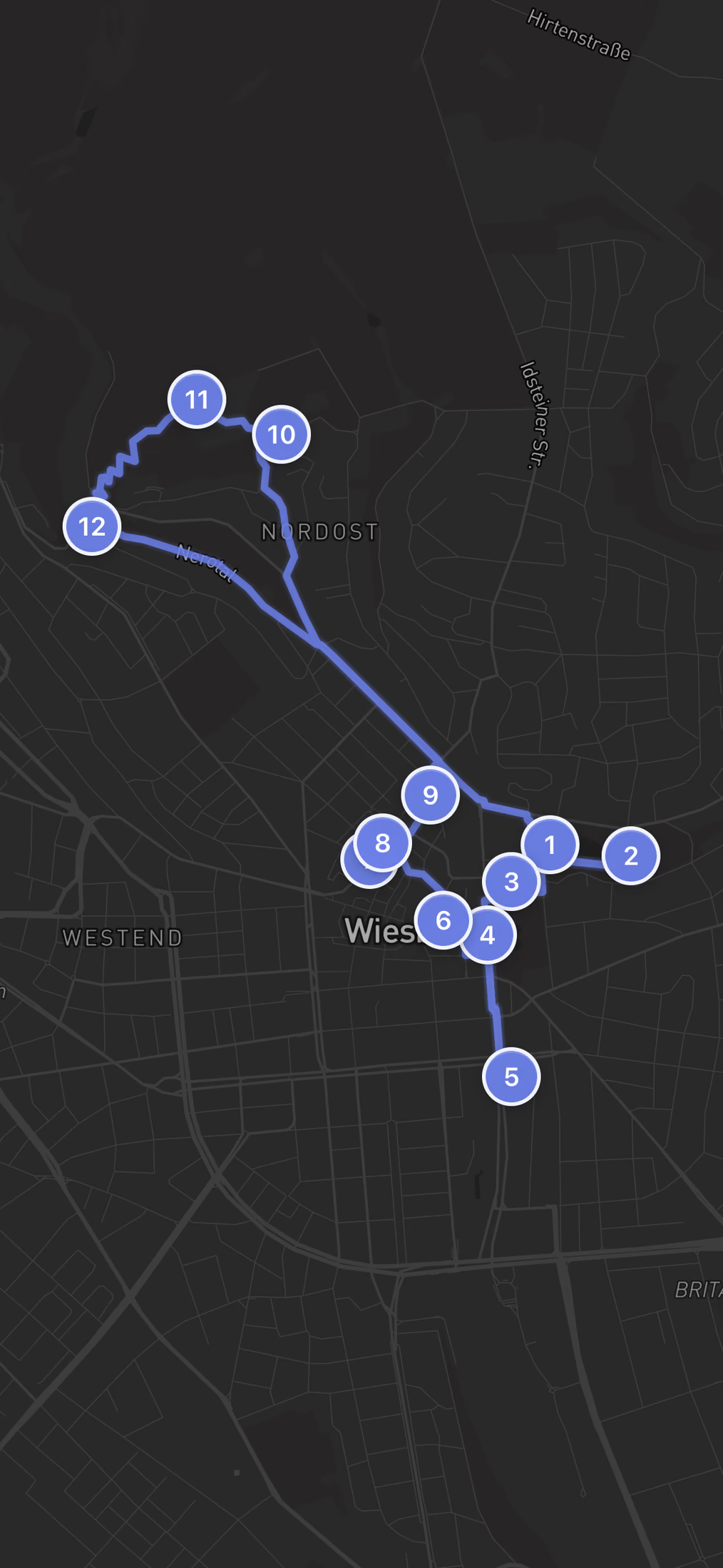
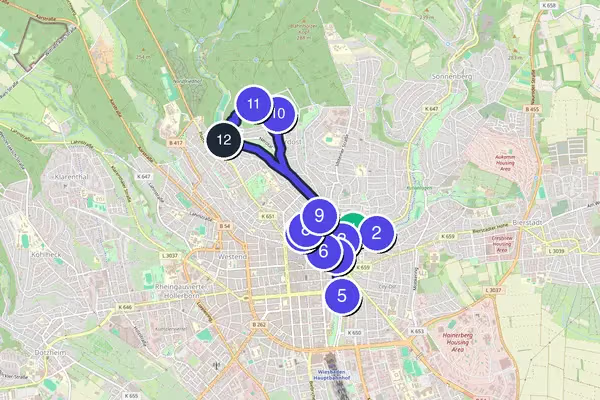
Walking tour route map of Wiesbaden Open interactive map

Why Walk Wiesbaden? A Self-Guided Tour

Wiesbaden is a spa town that never stopped acting like one. The whole center was built for people who came to take the waters, gamble in the evening, and stroll between the two. That history left behind a compact core of grand boulevards, a casino in a palace, and hot springs that still bubble up through the pavement. Almost everything worth seeing sits inside a flat square mile, which is exactly why walking beats any other way of getting around here. You can hop a bus, but you will miss the whole point.

This route runs the logical line: start at the Kurhaus and its park where the spa culture is most concentrated, drop down the grand axis past the theatre and Wilhelmstraße shops, cut through the old town to the market church and the Roman wall, then loop back to the hot springs before heading north and uphill to the Neroberg. It saves the climb for last and lets the funicular do the hard work. The total is about 8 kilometers, so this is a half-day commitment, not a quick loop.

What makes Wiesbaden better than wandering is the contrast built into the geography. Belle Epoque grandeur downtown, a genuine Roman ruin two streets away, a golden Russian church on a vineyard hill. Do it in order and the city tells you its own story, from Roman bath to imperial resort, without anyone having to explain it.

The Route

Walking Map of Wiesbaden

12 stops 8.1 km about 4 hours
Tap to load interactive map

The 12 stops along this route

  1. Kurhaus Wiesbaden, stop 1 on the self-guided walking tour
    1Kurhaus Wiesbaden
  2. Kurpark (Kurpark Wiesbaden), stop 2 on the self-guided walking tour
    2Kurpark (Kurpark Wiesbaden)
  3. Hessisches Staatstheater (Hessisches Staatstheater Wiesbaden), stop 3 on the self-guided walking tour
    3Hessisches Staatstheater (Hessisches Staatstheater Wiesbaden)
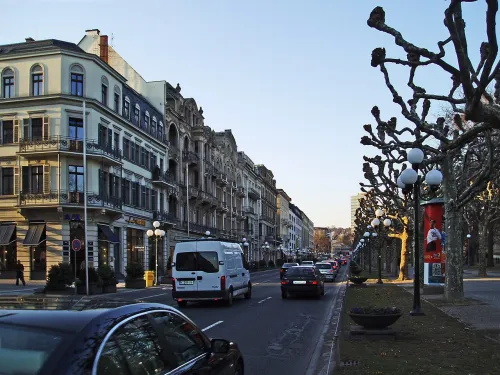
  4. Wilhelmstrasse in Wiesbaden, stop 4 on the self-guided walking tour
    4Wilhelmstrasse
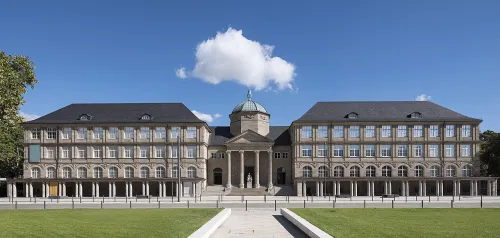
  5. Museum Wiesbaden, stop 5 on the self-guided walking tour
    5Museum Wiesbaden
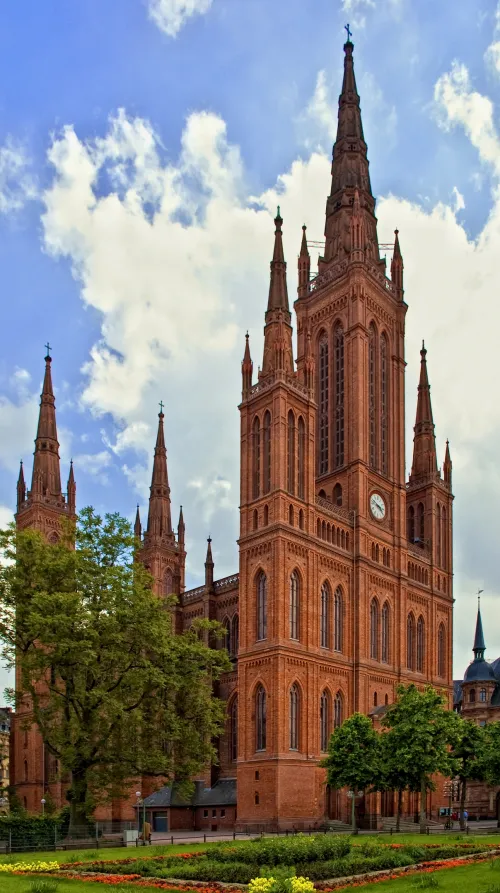
  6. Marktkirche in Wiesbaden, stop 6 on the self-guided walking tour
    6Marktkirche
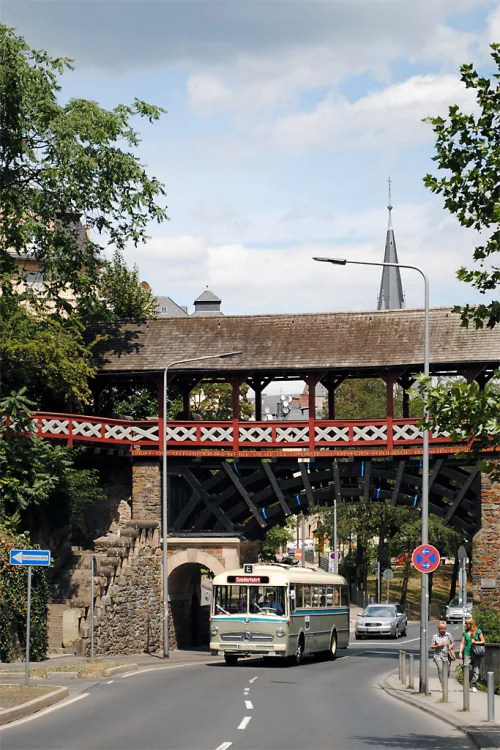
  7. Roemische Heidenmauer in Wiesbaden, stop 7 on the self-guided walking tour
    7Roemische Heidenmauer
  8. Kaiser-Friedrich-Therme in Wiesbaden, stop 8 on the self-guided walking tour
    8Kaiser-Friedrich-Therme
  9. Kochbrunnen in Wiesbaden, stop 9 on the self-guided walking tour
    9Kochbrunnen
  10. Russisch-Orthodoxe Kirche (Russisch-Orthodoxe Kirche Wiesbaden), stop 10 on the self-guided walking tour
    10Russisch-Orthodoxe Kirche (Russisch-Orthodoxe Kirche Wiesbaden)
  11. Neroberg in Wiesbaden, stop 11 on the self-guided walking tour
    11Neroberg
  12. Nerobergbahn in Wiesbaden, stop 12 on the self-guided walking tour
    12Nerobergbahn
  13. That's the full loop.

    Walk it with a live AI guide talking you through every one of these streets.

    Start free in your browser
    You made it
Stop 1 of 12 Swipe →

Your Wiesbaden Walking Tour, Stop by Stop

  1. 1

    Kurhaus Wiesbaden

    Kurhaus Wiesbaden, stop 1 on the self-guided walking tour

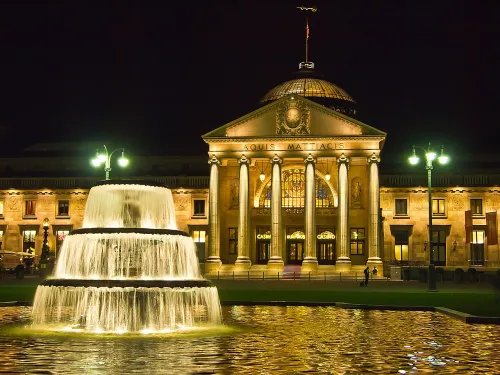
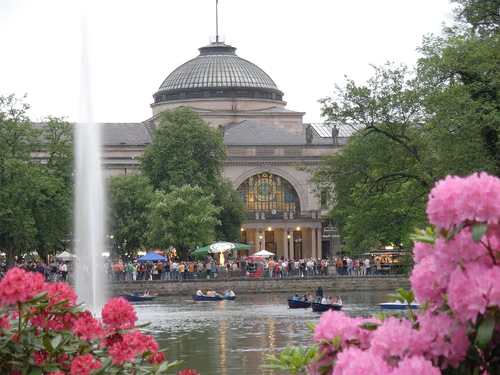
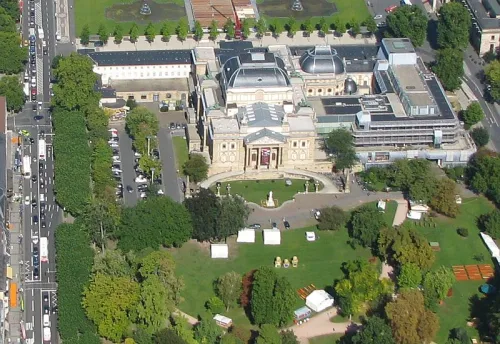
    Start where the whole town points: the Kurhaus, with its columned portico and the long Bowling Green lawn rolling out in front. This is one of the most ostentatious event buildings in Germany, opened in 1907 with Kaiser Wilhelm II at the ceremony. Inside is the Spielbank Wiesbaden, the casino, plus two grand ballrooms and the Käfer restaurant. The building is open around the clock and entry is free, so walk into the entrance hall and look up at the dome even if you have no interest in roulette. The casino itself is free to enter; you only pay if you play. Dostoevsky gambled in the earlier spa house here and it fed straight into his novel The Gambler. Cross the Bowling Green toward the back of the building to reach the park.
    Hours
    Open 24/7
    Price
    Free (casino entry free, gaming expenses vary)

    3 min walk to next stop

  2. 2

    Kurpark (Kurpark Wiesbaden)

    Kurpark (Kurpark Wiesbaden), stop 2 on the self-guided walking tour

    Behind the Kurhaus the noise drops away and you are in the Kurpark, laid out in 1852 as an English landscape garden. It covers 75,000 square meters along a stream valley, and the centerpiece is a lake with a fountain that shoots six meters into the air. Open daily from 5 in the morning until 11 at night, free, and rarely crowded on a weekday. Look for the Dostoevsky bust near the lake and two sandstone columns salvaged from the original 1810 spa house. Early April is the moment to be here, when the magnolias bloom across the whole park. There is a bench-lined path around the water if you want five minutes of sitting before the walking gets serious. Head back out the south side toward the theatre.

    Hours
    Daily: 5:00 AM – 11:00 PM
    Price
    Free

    2 min walk to next stop

  3. 3

    Hessisches Staatstheater (Hessisches Staatstheater Wiesbaden)

    Hessisches Staatstheater (Hessisches Staatstheater Wiesbaden), stop 3 on the self-guided walking tour

    The Staatstheater sits just south of the Kurhaus, a neo-Baroque pile built between 1892 and 1894 on the order of Kaiser Wilhelm II. The Viennese firm Fellner and Helmer, who built theatres all over the empire, did the design. The colonnaded foyer facing the park is the part worth pausing for. The main hall seats 1,041, and the place runs five separate ensembles covering opera, drama, ballet, concerts and youth theatre. The exterior is open to look at any time and costs nothing. If you want to see the gilded interior you need a ticket to a performance, or check the website for the occasional guided building tour. Otherwise admire the facade and the fountain on Kaiser-Friedrich-Platz across the way, then walk south onto the grand boulevard.

    Hours
    Always open
    Price
    Free

    3 min walk to next stop

  4. 4

    Wilhelmstrasse

    Wilhelmstrasse in Wiesbaden, stop 4 on the self-guided walking tour

    Locals call it die Rue. Wilhelmstraße is the showpiece boulevard, planned in 1810 by city architect Christian Zais and named since 1820 after Duke Wilhelm of Nassau. It runs the eastern edge of the historic pentagon, with the old town on one side and the villa and spa quarter on the other. One side is lined with plane trees, the other with the kind of shops where the prices are not in the window. This is the stretch for window-shopping and people-watching rather than ticking off a monument. At the northern end you passed the Kurhaus colonnades; near the southern end, at Wilhelmstraße 1, stands the Museum Reinhard Ernst, a striking abstract-art museum by Japanese architect Fumihiko Maki that opened in June 2024. Keep walking south toward the larger Museum Wiesbaden.

    Hours
    Always open
    Price
    Free

    5 min walk to next stop

  5. 5

    Museum Wiesbaden

    Museum Wiesbaden, stop 5 on the self-guided walking tour

    At the southern end of the spa axis sits Museum Wiesbaden, one of the five Hessian state museums and an unusual two-in-one: art on one side, natural history on the other. The draw for art people is the Jawlensky collection, the largest holding anywhere of the Russian Expressionist who spent his last years in Wiesbaden. Closed Mondays. Open Tuesday and Wednesday 10 to 5, Thursday until 9, and Friday through Sunday 10 to 5. Admission is 12 euros, but here is the trick: on Thursday evening after 6, it drops to 4 euros. If the weather has turned, this is your indoor escape and easily an hour or two. If you are pressing on, just note the building and the broad Friedrich-Ebert-Allee, then double back and cut west into the old town toward the market church.

    Hours
    Mon: Closed | Tue-Wed: 10:00 AM – 5:00 PM | Thu: 10:00 AM – 9:00 PM | Fri-Sun: 10:00 AM – 5:00 PM
    Price
    €12 (€4 after 6 PM)

    5 min walk to next stop

  6. 6

    Marktkirche

    Marktkirche in Wiesbaden, stop 6 on the self-guided walking tour

    Turn into the old town and the Marktkirche announces itself with five red-brick spires, the tallest reaching higher than anything else in Wiesbaden. Carl Boos built it between 1853 and 1862 as the Protestant main church and the cathedral of the Duchy of Nassau, and at the time it was the largest brick building in the duchy. The deep red against the sky photographs well from Schlossplatz. Entry is free. It is closed Mondays; otherwise open Tuesday to Friday noon to 6, Saturday noon to 5, and Sunday 1 to 5. The interior is plainer than the exterior promises, so a ten-minute look is plenty unless a service or organ recital is on. Step back out onto the square, where the dukes' palace now houses the Hessian state parliament, then walk west a couple of streets to the Roman wall.

    Hours
    Mon: Closed | Tue-Fri: 12:00 – 6:00 PM | Sat: 12:00 – 5:00 PM | Sun: 1:00 – 5:00 PM
    Price
    Free

    4 min walk to next stop

  7. 7

    Roemische Heidenmauer

    Roemische Heidenmauer in Wiesbaden, stop 7 on the self-guided walking tour

    A few streets west of the squares you hit the Heidenmauer, the Heathen Wall, the oldest surviving structure in the city. It is a Roman wall fragment, a reminder that Wiesbaden began as the spa settlement Aquae Mattiacorum, the Romans coming for the same hot springs you are about to see. Do not expect a fortress: it is a weathered stretch of masonry standing in the modern street, easy to walk past if you are not looking. Open all the time, free, and a two-minute stop. The value is in the sequence: this is where the bath culture started, eighteen centuries before the Kurhaus. From here it is a short step to the historic bathhouse that carries the tradition forward.

    Hours
    Open 24/7
    Price
    Free

    2 min walk to next stop

  8. 8

    Kaiser-Friedrich-Therme

    Kaiser-Friedrich-Therme in Wiesbaden, stop 8 on the self-guided walking tour

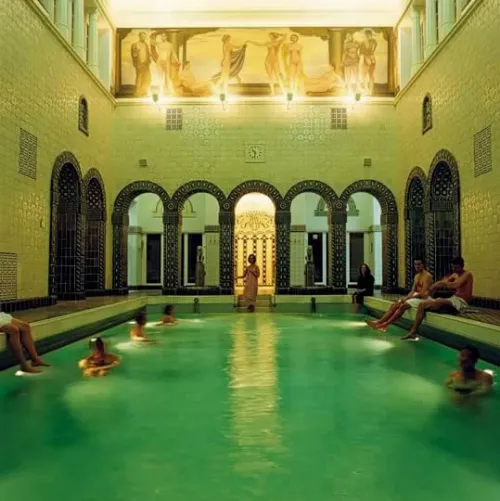
    Right beside the Roman wall stands the Kaiser-Friedrich-Therme, a historic thermal bath built between 1910 and 1913 in a Jugendstil and reform style. It is fed by the Adlerquelle, the city's second-biggest hot spring, at 64.6 degrees Celsius. The reason to go in is the so-called Irish-Roman bath with its mosaic tiling, restored in 1999, spread across 1,450 square meters of saunas, steam rooms, a tepidarium, a frigidarium and a tropical ice-rain zone. Open daily 10 to 10, with entry from 6.50 to 15 euros depending on how long you stay. Worth knowing: it is textile-free, so there is no swimwear inside. If that is not for you, the building exterior is still a good Jugendstil look. If it is, this is the most authentic spa experience on the whole walk. From here head north to the springs themselves.

    Hours
    Daily: 10:00 AM – 10:00 PM
    Price
    €6.50–€15

    2 min walk to next stop

  9. 9

    Kochbrunnen

    Kochbrunnen in Wiesbaden, stop 9 on the self-guided walking tour

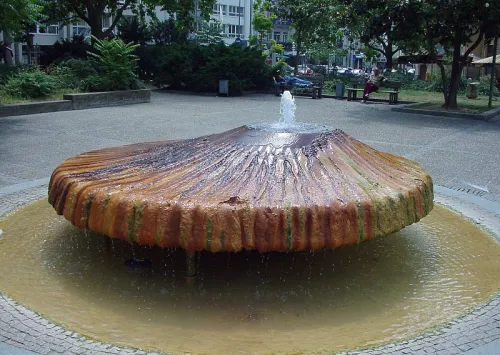
    Follow your nose. The Kochbrunnen is the famous one, the hottest spring in the city at over 66 degrees Celsius, and you smell the minerals before you reach the fountain. In the 19th century this was the center of the Trinkkur, the drinking cure, when visitors lined up to swallow glasses of the warm salty water for their health. The spring still gushes in the open square, leaving rusty orange iron deposits on the stone around it. It is free and always accessible. Touch the water if you want to feel just how hot it comes out of the ground. This is the literal heart of the spa town and a good spot to refill your sense of why any of this exists. From here the route turns properly north and starts the long stretch up toward the Neroberg.

    Hours
    Open 24/7
    Price
    Free

    20 min walk to next stop

  10. 10

    Russisch-Orthodoxe Kirche (Russisch-Orthodoxe Kirche Wiesbaden)

    Russisch-Orthodoxe Kirche (Russisch-Orthodoxe Kirche Wiesbaden), stop 10 on the self-guided walking tour

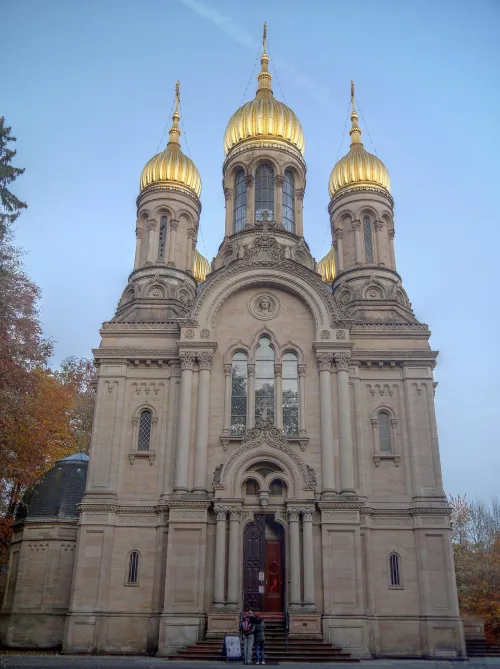
    The climb is rewarded by the gold. Five gilded onion domes catch the light on the slope of the Neroberg, the Russian Orthodox Church of Saint Elizabeth, which locals just call the Greek Chapel. A Nassau duke built it in the 1850s for his young Russian wife who died in childbirth, and her tomb is inside. Open Monday to Saturday 10 to 4 and Sunday from 9, free to enter, though a small donation is expected and photography rules apply. Behind it lies one of the largest Russian Orthodox cemeteries in Western Europe, worth a quiet wander. The domes against blue sky or autumn vineyard are the postcard shot of Wiesbaden. After the chapel, keep going up to the summit and its temple.

    Hours
    Mon-Sat: 10:00 AM – 4:00 PM | Sun: 9:00 AM – 4:00 PM
    Price
    Free

    8 min walk to next stop

  11. 11

    Neroberg

    Neroberg in Wiesbaden, stop 11 on the self-guided walking tour

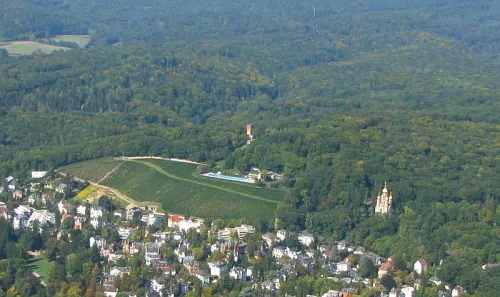
    The Neroberg is the city's house mountain, 245 meters up, and the top opens out to a view over the whole basin of Wiesbaden with the Rhine plain beyond. There is a small monopteros temple, an outdoor swimming pool with one of the best views in any German lido, and vineyards running down the slopes. Open all the time, free. This is the spot to sit and let your legs recover after the climb. On a clear afternoon you can pick out the Marktkirche spires and the Kurhaus dome you started from, the whole route laid out below you. Bring a drink or grab one at the kiosk near the top. When you are done looking, walk over to the upper station of the funicular for the easy way down.

    Hours
    Open 24/7
    Price
    Free

    4 min walk to next stop

  12. 12

    Nerobergbahn

    Nerobergbahn in Wiesbaden, stop 12 on the self-guided walking tour

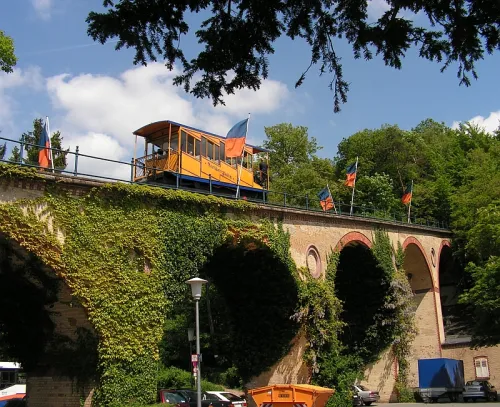
    End the walk by letting an antique do the descending. The Nerobergbahn opened in 1888 and is the last water-ballast funicular of its kind in Germany, a protected technical monument. It works with no motor at all: the top car fills its tank with water to outweigh the lower car and gravity pulls it down, hauling the other up. The line climbs 83 meters over 438 meters of track at a 19 percent grade. It runs daily 9 to 7 and costs 6 euros for adults, 3.50 for children. Over 250,000 people ride it a year, most of them visitors. Taking it down to the Nerotal station is the right way to finish, saving your knees the steep walk and ending the tour on the oldest working piece of machinery in the city. From the bottom it is a short walk or bus ride back into the center.

    Hours
    Daily: 9:00 AM – 7:00 PM
    Price
    €6 adults (€3.50 children)
Walking tour route map of Wiesbaden Route loaded
Kurhaus WiesbadenKurpark (Kurpark Wiesbaden)Hessisches Staatstheater (Hessisches Staatstheater Wiesbaden)Wilhelmstrasse+8
All 12 stops are already on the map.
You just press start.
AI Tourguide

You just read the route.
Now walk it with a guide in your ear.

Press start wherever you are, even hundreds of kilometres from Wiesbaden, and the guide begins telling its stories right away. In the city, pick any of the 12 stops to start from: it leads you there, then talks with you the whole route, asking, listening, remembering, and shaping the tour around your answers.

12stops 8.1km 3.6hours 11languages
Start the tour free

Free to start · Runs in your browser · No app, no download

Self-Guided Tour vs. Group Tour in Wiesbaden

Wiesbaden is one of the easier cities to do on your own. The center is small, flat, and well signed, the springs and the wall are free, and the one stop where a guide genuinely adds context, the Russian church, has its story on plaques and online. Local operators run city walks roughly in the 12 to 18 euro range, and there are themed spa-history tours that cost more. For most people the money is better spent on the funicular ticket and a glass of wine on the Neroberg.

Where a guided tour earns its fee is if you want the inside of the Kurhaus casino explained, or a behind-the-scenes look at the Staatstheater. The theatre runs occasional building tours, and those are worth booking if architecture is your thing, because you cannot see the gilded hall otherwise without a performance ticket. Check the theatre website for dates.

The honest verdict: walk this one yourself. Spend on the things that cost money and reward you anyway, the Kaiser-Friedrich-Therme if you want a real Jugendstil bath at 6.50 to 15 euros, and the Nerobergbahn at 6 euros. Save the museum for a rainy Thursday evening when it drops to 4 euros after 6.

Group Tour AI Self-Guided
Price €25–€50 per person €5/hour or €20 all-inclusive
Flexibility Fixed schedule Start anytime, skip stops
Languages 1–2 languages 11 languages
Pace Group pace Your own pace

How Long Does This Wiesbaden Tour Take?

Our route covers 8.1 km with 12 stops and takes approximately 3.6 hours at a relaxed pace.

Plan a half day, around four to five hours including stops, more if you bathe at the Kaiser-Friedrich-Therme or sit on the Neroberg. The first half through the spa quarter, theatre and Wilhelmstraße moves quickly because most of it is exterior looking. The walk slows at three places worth lingering: the Kurpark lake, where a bench by the fountain is the obvious pause; the Kochbrunnen square, good for a coffee break before the long northward stretch; and the Neroberg summit, where you will want at least twenty minutes for the view.

The natural break point is the Kochbrunnen, roughly the middle of the route and right before the 20-minute uphill push. There are cafes around the spring quarter for a sit-down. If you would rather eat with a view, hold out for the kiosk and terrace at the top of the Neroberg. Tackle the climb in the afternoon and the church and summit catch the best light.

Is a "free tour" of Wiesbaden really free?

A traditional "free" tour

Free to join, but you pay at the end

  • A guide leads a fixed group at a set meeting time
  • You keep pace with 20 to 40 other people
  • A tip of about 15 to 20 EUR per person is expected at the end
  • One or two languages, whatever the guide speaks

AI Tourguide Wiesbaden

Genuinely free, with clear pricing

  • The full route, interactive map and GPS navigation, free
  • Every stop with descriptions, opening hours and prices, free
  • Start whenever you want and go at your own pace
  • Optional voice AI guide that leads you and tells the stories

Clear price, usually less than a tip: free to start, then 5 EUR/hour or 20 EUR all-inclusive.

Tips for Walking in Wiesbaden

  • Start at the Kurhaus by mid-morning. Many buses and lines 1 and 8 stop at Kurhaus/Theater; from Wiesbaden Hauptbahnhof it is a 15-minute walk or a short bus ride north to the spa quarter.
  • Wear real shoes. The old town has cobbles, and the stretch from the Kochbrunnen up to the Russian church and Neroberg is a steady uphill climb, not a stroll. Take the funicular down to spare your knees.
  • Public restrooms are reliable at the Kurhaus entrance hall and inside Museum Wiesbaden if you buy a ticket. There are also facilities near the Nerobergbahn stations.
  • At the Kochbrunnen, try a sip of the spring water if you are brave; it is hot and salty. For a proper drink, the cafes around the spring quarter are cheaper than the Kurhaus terrace.
  • For the signature photo, frame the five golden domes of the Russian Orthodox Church against the vineyard slope; shoot in the afternoon with the sun in the west behind you for the brightest gold.
Walking tour route map of Wiesbaden Route loaded
Kurhaus WiesbadenKurpark (Kurpark Wiesbaden)Hessisches Staatstheater (Hessisches Staatstheater Wiesbaden)Wilhelmstrasse+8
All 12 stops are already on the map.
You just press start.
AI Tourguide

Your guide is ready when you are.

Press start and a voice AI tourguide takes it from here: leading the route through Wiesbaden, telling the stories, and turning your walk into a real back-and-forth conversation. No app, no download, it runs in your browser.

12stops 8.1km 3.6hours 11languages
Start the tour free

Free to start · Runs in your browser · No app, no download

Your AI Guide for This Walk

Standing on the Bowling Green in front of the Kurhaus, or smelling the minerals at the Kochbrunnen? Open AI Tourguide in your browser, no app and no download, and a voice guide walks the spa town with you up Wilhelmstrasse to the Marktkirche, greeting you, telling the story along the way and asking what you want to see so it can shape the route. A real conversation, not an audioguide. Start with 100 free credits.

A Real Conversation A voice AI tourguide greets you, leads the whole route, and tells the stories and facts as you walk, asking what you want to see and keeping a real conversation going. Not a recording you press play on.
Map Navigation Follow the route on the map and walk at your own pace. You choose where to start and when to move to the next stop.
Ask Anything Curious about a building you pass? Ask your AI guide on the spot and the conversation carries on.
11 Languages Switch language anytime. No separate tour needed.
Start free in your browser

Common Questions

Is Wiesbaden safe to walk around?

Yes, very. It is an affluent state capital and the whole tour route runs through central, well-kept areas. The zone around Wiesbaden Hauptbahnhof can feel a bit rougher late at night, like any German station district, but the spa quarter, old town and Neroberg are calm. Normal city sense is enough; there are no notable tourist scams here.

What if it rains during my Wiesbaden tour?

You have good cover on this route. Duck into Museum Wiesbaden, which is two-in-one art and natural history and easily fills an hour or two; admission is 12 euros, or 4 euros Thursday after 6. The Kaiser-Friedrich-Therme is the better rainy-day call: a warm Jugendstil bathhouse open daily 10 to 10, entry 6.50 to 15 euros. The Kurhaus entrance hall and Marktkirche also give you a dry pause.

What's the best time of day for this walking tour?

Start mid-morning, around 10. That gets you through the spa quarter and old town before the lunch crowd, puts you at the Museum or Kaiser-Friedrich-Therme around midday, and brings you up to the Russian church and Neroberg in the afternoon when the western light hits the gold domes and the view over the city is clearest. The Nerobergbahn stops running at 7, so do not leave the climb too late.

Is the tour really free?

Yes. The route, interactive map, navigation and the text for every stop are free and you use them without paying anything. Only the voice AI guide is optional and paid: you test it free with credits, then it costs 5 EUR per hour or 20 EUR for the whole tour.

Do I have to tip?

No. Unlike group free tours, there is no guide waiting for a tip and no social pressure at the end. The price is clear upfront and usually lower than the tip a free tour expects.

Do I need to download an app?

No. Everything runs in your phone browser. Open the route and start walking, no download and no sign-up required.

Do I need to book the walking tour in advance?

No booking needed. This self-guided tour is available anytime. Open the route in your browser and start walking. The AI guide works instantly, no app, no reservation required.

What languages is the AI guide available in?

The AI guide speaks 11 languages: English, German, French, Spanish, Italian, Japanese, Chinese, Portuguese, Danish, Norwegian, and Swedish.

Can I skip stops or change the route?

Yes. Skip any stop, spend extra time at places you like, or start the route from any point. It is your walk, you set the pace.
AI Tourguide
Researched and curated by the AI Tourguide team We plan and quality-check every route, then research and verify the opening hours, prices, and practical tips for each stop along it.
Last reviewed July 2026
▶ Start free in your browser Runs in your browser, no app, no download