Self-Guided Walking Tour in Worms

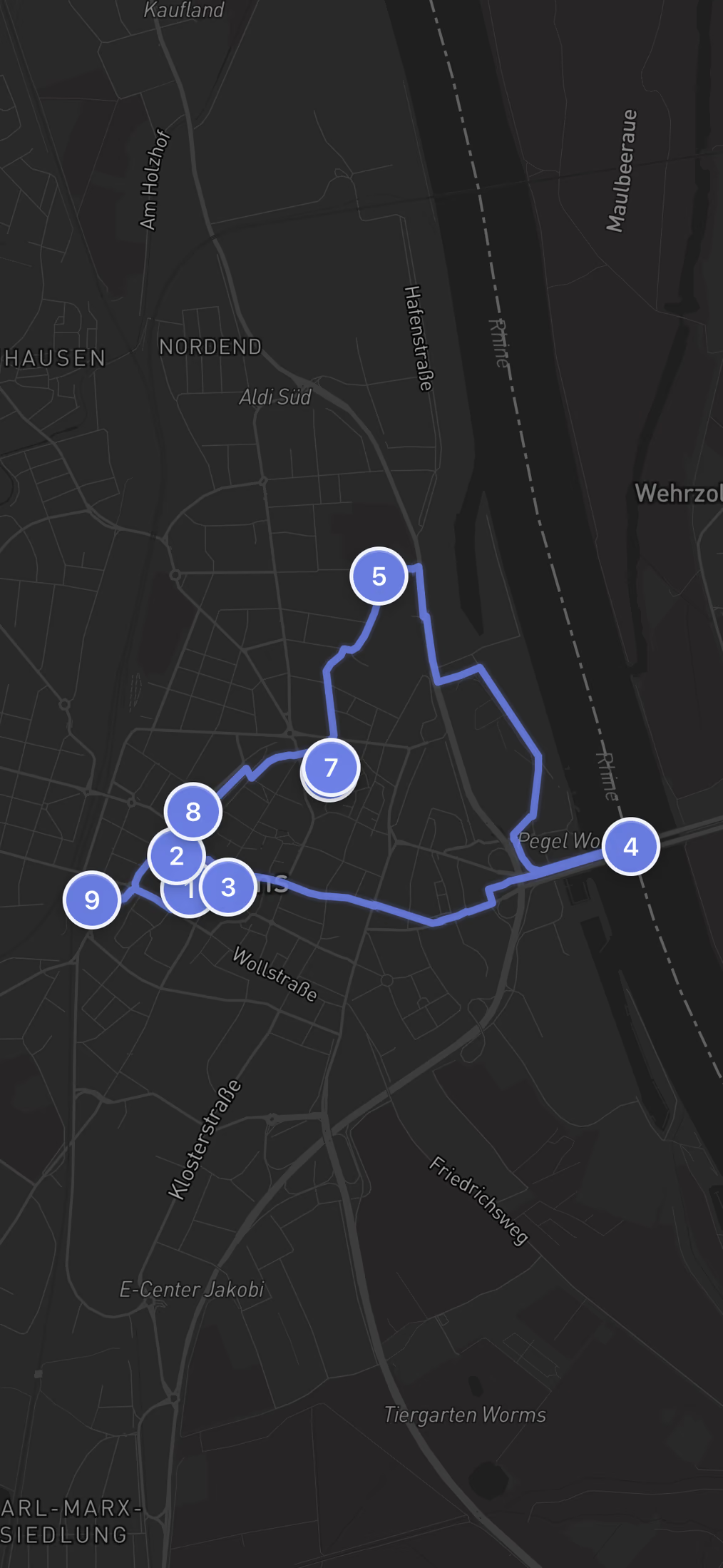
A 6.1 km self-guided loop through Worms, 9 stops from the Wormser Dom to the Heiliger Sand, the oldest Jewish cemetery in Europe. This page gives you the full map, walking time for every leg, real opening hours and prices, and shorter versions when the day is tight.

9 Stops6.1 km~3 hours walking3–3.5 hours with stops
What you get with AI Tourguide
Full GPS navigationInteractive AI guidePersonalized to youWorks in your browser
Try this tour with Alex

Worms Walking Tour at a Glance

This route is built for anyone who wants the whole story of Worms on foot in an afternoon: the Imperial cathedral, the spot where Luther made his stand, the medieval Jewish quarter, and two UNESCO World Heritage sites. Every interior is optional. You walk it at your own speed, step inside what pulls you, and skip what doesn't.

StartWorms Cathedral (Wormser Dom)
FinishJewish Cemetery (Heiliger Sand)
Route typeA compact loop that starts and ends near the cathedral in the southwest, pushes east to the Rhine, swings north to the vineyards, then comes back south through the Jewish quarter with almost no backtracking.
Realistic timeThe 6.1 km of walking alone runs about 75 minutes. With outdoor stops figure two hours, and with the cathedral, the synagogue and the cemetery done properly, plan three to three and a half.
DifficultyEasy and flat, 6.1 km total, on a mix of old-town cobblestones, paved footpaths and bare earth between the graves at the cemetery. No hills, but two longer legs out to the Rhine and up to the vineyards.
Cost to followFollowing the outdoor route is free. Seven of the nine stops cost nothing to enter; only the Heiliger Sand cemetery charges admission at €10, and the interiors that are free stay free.
Best for:

History-minded travellers and anyone drawn to Reformation history, Jewish heritage and Romanesque architecture who is happy walking a flat 6.1 km at their own pace.

The Route

Free Walking Tour Map of Worms

9 stops6.1 kmabout 3 hours
Loading the interactive map…The complete walking route will appear here.
Want the route to guide you while you walk?Open the route with navigation and a personal guide for the history, stories and questions that matter to you.
Open route + AI guide

The 9 stops along this route

  1. Worms Cathedral (Wormser Dom) in Worms, stop 1 on the self-guided walking tour
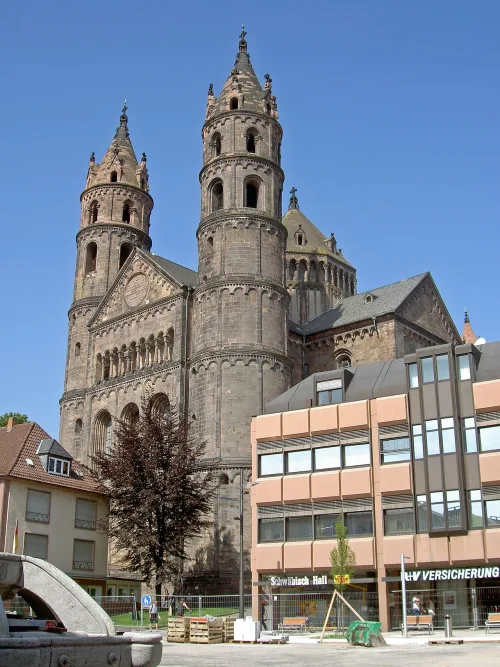
    1Worms Cathedral (Wormser Dom)
  2. Heylshof in Worms, stop 2 on the self-guided walking tour
    2Heylshof
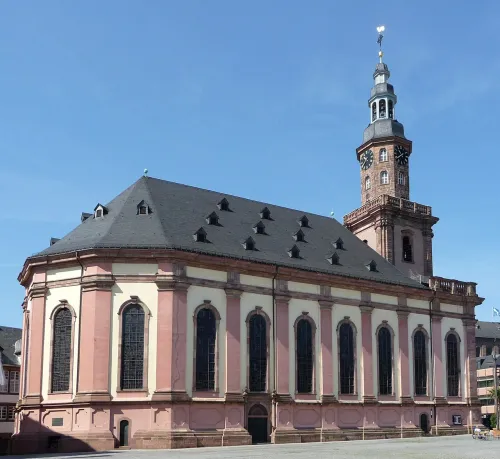
  3. Trinity Church, Worms (Dreifaltigkeitskirche Worms) in Worms, stop 3 on the self-guided walking tour
    3Trinity Church, Worms (Dreifaltigkeitskirche Worms)
  4. Nibelungenbrücke Worms in Worms, stop 4 on the self-guided walking tour
    4Nibelungenbrücke Worms
  5. Catholic Church of Our Lady, Worms (Katholische Liebfrauenkirche, Worms) in Worms, stop 5 on the self-guided walking tour
    5Catholic Church of Our Lady, Worms (Katholische Liebfrauenkirche, Worms)
  6. Raschi-Haus in Worms, stop 6 on the self-guided walking tour
    6Raschi-Haus
  7. Worms Synagogue (Synagoge Worms) in Worms, stop 7 on the self-guided walking tour
    7Worms Synagogue (Synagoge Worms)
  8. Luther monument Worms (Lutherdenkmal Worms) in Worms, stop 8 on the self-guided walking tour
    8Luther monument Worms (Lutherdenkmal Worms)
  9. Jewish Cemetery (Heiliger Sand) in Worms, stop 9 on the self-guided walking tour
    9Jewish Cemetery (Heiliger Sand)
  10. That's the complete route.

    If you want more than the map and text, add live navigation and a conversational AI guide while you walk.

    Open route + AI guide
    You made it
Stop 1 of 9
Swipe →

Your Worms Walking Tour, Stop by Stop

  1. 1

    Worms Cathedral (Wormser Dom)

    Worms Cathedral (Wormser Dom) in Worms, stop 1 on the self-guided walking tour

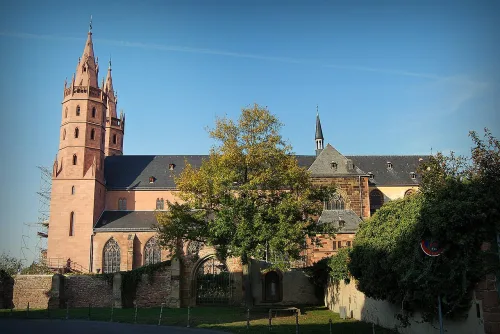
    Four towers and two domes against the sky, all in red Rhenish sandstone. The cathedral fills your view before you reach it, and it is the obvious place to start because everything else in Worms orbits it. This is one of the three great Imperial Romanesque cathedrals of the Rhine, alongside Speyer and Mainz, and the proportions inside are the point: heavy, plain, enormous, built to make a person feel small in front of an emperor's God. Go in. It is free and always open, and the Baroque high altar by Balthasar Neumann is worth the walk down the nave. Give it twenty minutes. The east choir is the oldest part, the west the most dramatic. From the cathedral, walk around to the north side toward the green of Heylshof-Park, less than a minute on foot.

  2. 2

    Heylshof

    Heylshof in Worms, stop 2 on the self-guided walking tour

    Step out of the cathedral's shadow and into a quiet garden, and you are standing on the most consequential patch of ground in Worms. The Bischofshof, the bishop's palace, once stood here. In April 1521 this is where Martin Luther faced Charles V and the assembled Diet and would not take back his writings. The palace is long gone, burned in 1689, and what remains is a calm park with old trees, a few statues, and the small art museum Heylshof at the far edge. The park is open around the clock and costs nothing. Stand here a moment and picture the room: this single refusal split Western Christianity. The museum is a side trip for art lovers only. Otherwise leave the garden on the east side and head for the market square and the big Baroque church you can already see.

  3. 3

    Trinity Church, Worms (Dreifaltigkeitskirche Worms)

    Trinity Church, Worms (Dreifaltigkeitskirche Worms) in Worms, stop 3 on the self-guided walking tour

    The market square opens up and a broad Baroque facade closes one end of it. This is the Dreifaltigkeitskirche, the largest Protestant church in Worms, and its full name says everything about why it exists: the Reformation Memorial Church of the Holy Trinity. It was built to honor exactly the event you just stood over in the park. The interior is a single wide Baroque hall, light and plain compared to the cathedral's stone weight, and the contrast between the two churches in five minutes of walking is the real reason to step inside. Entry is free. Hours run 7:00 AM to 6:00 PM April through September, and 8:00 AM to 5:00 PM October through March. Ten minutes is plenty. This is also your last city-center stop before the long stretch east, so use the cafes around the market square if you need one. Then head down toward the Rhine.

    Hours
    Summer (April-September): 7:00 AM – 6:00 PM | Winter (October-March): 8:00 AM – 5:00 PM
    Price
    Free
  4. 4

    Nibelungenbrücke Worms

    Nibelungenbrücke Worms in Worms, stop 4 on the self-guided walking tour

    This is the longest leg of the walk, about eighteen minutes east through the edge of town, and the payoff is the river and a stone tower. The Nibelungenbrücke carries the only road bridge across the Rhine between Mannheim and Mainz, and the reason to come is the Nibelungenturm, the gate tower on the Worms side. The bridge takes its name from the Nibelungenlied, the medieval epic set in this city, and the tower leans into that legend with its dark stone arch. The original bridge of 1900 was destroyed in 1945; the current spans went up in the 1950s and again in 2008. Both bridges have combined foot and bike paths, so you can walk out onto the Rhine for the view back toward the cathedral towers. It is free and open at all hours. Stay ten minutes, then turn back inland and head north toward the vineyards and the Liebfrauenkirche.

    Hours
    Open 24/7
    Price
    Free
    Website
    worms.de ↗
  5. 5

    Catholic Church of Our Lady, Worms (Katholische Liebfrauenkirche, Worms)

    Catholic Church of Our Lady, Worms (Katholische Liebfrauenkirche, Worms) in Worms, stop 5 on the self-guided walking tour

    After the bridge, the walk turns quiet and green. The Liebfrauenkirche sits among working vineyards on the northern edge of Worms, a slender High-Gothic church with twin spires that you spot across the vines well before you arrive. Here is the fact most people want: this church and its surrounding vineyard gave the name to Liebfraumilch, the sweet white wine exported around the world. The grapes really did grow here. The interior is only open by appointment, so call +49 (0) 6241 44267 ahead if you want in; otherwise the church is best appreciated from the outside, framed by the vineyard. It costs nothing to stand here. Honestly the setting is the attraction, not the locked door. Give it ten minutes, take the photo with the vines, then head back south toward the medieval Jewish quarter and the cluster of UNESCO sites waiting there.

  6. 6

    Raschi-Haus

    Raschi-Haus in Worms, stop 6 on the self-guided walking tour

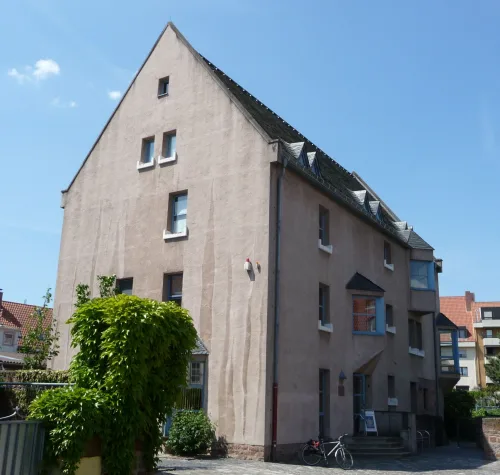
    Back inside the old town, the streets tighten and you reach the Judengasse, the medieval Jewish quarter. The Raschi-Haus stands at its heart, named for Rashi, the eleventh-century scholar who studied in Worms and whose commentaries are still read today. Inside is the Jewish Museum, and it is the context machine for everything in this corner of the city: it explains the ShUM community of Speyer, Worms and Mainz, why this quarter mattered to Ashkenazi Judaism, and what the buildings next door actually are. Entry is €2,50, which is close to free for what you get. Hours are 11:00 AM to 5:00 PM Tuesday through Sunday, closed Mondays. Plan thirty minutes. Do this before the synagogue and the cemetery and they will mean far more. The synagogue is right next door, a few steps away.

  7. 7

    Worms Synagogue (Synagoge Worms)

    Worms Synagogue (Synagoge Worms) in Worms, stop 7 on the self-guided walking tour

    A few steps from the museum and you are at the synagogue, the oldest in Germany by foundation. The first prayer house here was endowed in 1034. What you see has been destroyed and rebuilt more than once, most brutally in 1938, and reconstructed in the 1960s on the medieval foundations. Go down into the Mikwe, the underground ritual bath from the twelfth century, where stone steps drop to the groundwater. That descent is the moment that stays with you. The synagogue and the cemetery together became UNESCO World Heritage in 2021 as part of the ShUM sites. Entry is free, open daily 10:00 AM to 5:00 PM. Men should cover their heads; kippot are provided at the door. Twenty minutes inside and below. From here it is a short walk west, back past the cathedral, to the Reformation monument.

    Hours
    Daily: 10:00 AM – 5:00 PM
    Price
    Free
  8. 8

    Luther monument Worms (Lutherdenkmal Worms)

    Luther monument Worms (Lutherdenkmal Worms) in Worms, stop 8 on the self-guided walking tour

    You round a corner into a small park and there it is: a bronze Luther standing high on a pedestal, ringed by a whole company of figures below him. This is the largest Reformation monument in the world, unveiled on 25 June 1868, designed by Ernst Rietschel. Around the base sit Luther's forerunners, Wyclif and Hus and Savonarola among them, with allegorical figures of the Protestant cities. It closes the loop on the story you began in Heylshof-Park: the refusal of 1521 turned into bronze in 1868. The monument stands in the open air, free, accessible at any hour, and it photographs best in late-afternoon light when the bronze warms up. Give it fifteen minutes to read the figures. Then comes the final stop, the one that is older than everything else you have seen today, a short walk southwest.

    Hours
    Open 24/7
    Price
    Free
    Website
    worms.de ↗
  9. 9

    Jewish Cemetery (Heiliger Sand)

    Jewish Cemetery (Heiliger Sand) in Worms, stop 9 on the self-guided walking tour

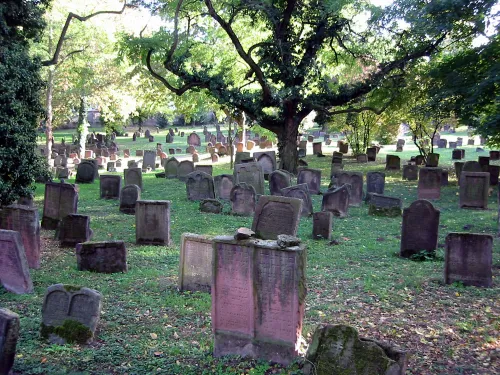
    The walk ends among two thousand five hundred leaning sandstone headstones under old trees. Heiliger Sand, the Holy Sand, is the oldest Jewish cemetery in Europe still standing where it was made, with the earliest graves dating to the eleventh century. The stones tilt at every angle, mossed and weathered, and the quiet here is total after a day of churches and traffic. This is the second half of the UNESCO ShUM listing you began at the synagogue, and seeing both on the same afternoon is the whole point of the route. Entry costs €10. Hours are 10:00 AM to 5:00 PM Monday to Friday and Sunday; it is closed Saturday for Shabbat. Of the two paid stops on this walk, this is the one I would pay for. Men cover their heads. Spend thirty minutes wandering the rows slowly. There is no better place to end.

    Hours
    Mon-Fri: 10:00 AM – 5:00 PM | Sat: Closed | Sun: 10:00 AM – 5:00 PM
    Price
    €10

How Long Does This Walking Tour Really Take?

Pure walking is around 75 minutes for the 6.1 km. Add quick outdoor stops and you're near two hours; give the cathedral, the synagogue with its Mikwe and the Heiliger Sand cemetery the time they deserve and the full loop lands at three to three and a half hours.

Budget three to three and a half hours at an unhurried pace, including the two longer legs out to the Rhine and up to the vineyards. The stops that deserve real time are the cathedral, the Raschi-Haus museum, the synagogue with its Mikwe, and the Heiliger Sand cemetery. The bridge and the Liebfrauenkirche are quick: arrive, look, photograph, move on.

If you want a break, the market square near the Dreifaltigkeitskirche is the natural midpoint before the long stretch east, and there are cafes right on the square for a coffee and a sit. On the far side of the walk, the Lutherpark benches around the Lutherdenkmal are a good place to rest your legs before the final push to the cemetery. If you only have ninety minutes, cut the Nibelungenbrücke and Liebfrauenkirche and keep the cathedral, the Jewish quarter and the Lutherdenkmal as a tight core loop.

Full Route, Shorter Walk or Two-Day Version?

The same 9 stops work three ways depending on how much time you have and how much walking you want. Here are the versions I'd actually recommend, with real stop numbers and honest timings.

The Tight Core

The compact old-town circuit

Stops 1, 2, 3, 6, 7, 8, 9, about 3 km, roughly 90 minutes

Cut the two longest legs, the 19-minute stretch east to the Nibelungenbrücke (stop 4) and the 22-minute climb up to the Liebfrauenkirche (stop 5). What's left is a dense central loop through the cathedral, the Reformation sites and the UNESCO Jewish heritage, with almost no dead walking between stops.

The Two-Part Split

Reformation half, then heritage half

Day one stops 1 to 5, day two stops 6 to 9, or a long café break at the market square

Break the walk at the Dreifaltigkeitskirche market square. Do the cathedral, Luther sites and the Rhine-and-vineyard outer arc first, rest over lunch on the square, then take the Jewish quarter, the Lutherdenkmal and the cemetery as a calmer second half. Ideal in heat or with kids.

You can walk it in reverse from the Heiliger Sand cemetery back to the cathedral, but I recommend the given direction: you start at the Wormser Dom, a 10-minute walk from Worms Hauptbahnhof, and end at the oldest Jewish cemetery in Europe, which is the quietest and most fitting place to finish the day.

Is This Worms Walking Tour Right for You?

This is a flat, compact route with a serious concentration of history, but it isn't for everyone or every mood. Here's who it suits and how to bend it to your day.

A good fit if you…

  • Anyone interested in Reformation history, Jewish heritage or Romanesque architecture, all packed into 6.1 km
  • Walkers who like a flat, mostly easy route with no climbs and clear signposting
  • Day-trippers arriving by train, since the cathedral start is a 10-minute walk from Worms Hauptbahnhof
  • Travellers who want to see two UNESCO World Heritage sites, the synagogue and the cemetery, in a single afternoon

Adapt the route if you…

  • Short on time: drop stops 4 and 5, the Rhine bridge and the vineyard church, and keep the 90-minute core loop
  • Travelling with kids or in heat: split the walk in two at the market square and rest over lunch
  • Unsteady on your feet: skip the bare-earth paths at the cemetery and the uneven cobblestones of the Judengasse where you can
  • On a tight budget: everything except the €10 cemetery is free, so you can walk almost the whole route for nothing

Tickets & Skip-the-Line in Worms

Most of this route is free and needs no ticket. Only a couple of stops charge admission or keep set hours worth planning around. Here's what to know before you go.

Jewish Cemetery (Heiliger Sand)Admission is €10. Open Monday to Friday and Sunday, 10:00 AM to 5:00 PM; closed Saturday for Shabbat. This is the paid stop worth the money, the oldest Jewish cemetery in Europe. Men should cover their heads. Book or check details on the official page. official ticket site ↗
Worms Synagogue (Synagoge Worms)Entry is free, open daily 10:00 AM to 5:00 PM. Go down into the twelfth-century Mikwe ritual bath while you're there. Men should cover their heads; kippot are provided at the door. official ticket site ↗
Trinity Church, Worms (Dreifaltigkeitskirche Worms)Free to enter. Hours are 7:00 AM to 6:00 PM April through September, and 8:00 AM to 5:00 PM October through March. official ticket site ↗
Catholic Church of Our Lady, Worms (Katholische Liebfrauenkirche, Worms)Free, but the interior is open by appointment only. Call +49 (0) 6241 44267 ahead if you want in; otherwise the church is best seen from the vineyard outside. official ticket site ↗
Everything elseThe cathedral, Heylshof-Park, the Nibelungenbrücke and the Lutherdenkmal are all free, open-air or always-open spaces with no ticket needed.
Optional upgrade
+5
The same 9-stop route,
now with navigation and a guide.
Optional AI experience

You already have the route.
The AI guide brings it to life.

Standing in front of the cathedral's four towers right now? Open AI Tourguide right in your browser, no app and no download, and a voice guide walks the rest of the loop with you, from Luther's stand in Heylshof-Park to the thousand-year-old graves at the Jewish cemetery, greeting you, telling the story along the way and asking what you want to see so it can adapt as you go. A real conversation built into the walk, not a recording. Start with 100 free credits.

Livenavigation13languagesAnyquestionYourinterests
Open this route with the AI guide

Try it in your browser · No app or download required

Tips for Walking in Worms

  • Worms Hauptbahnhof is a 10-minute walk from the cathedral, with direct regional trains from Mannheim (about 20 min) and Mainz (about 30 min). Start the walk before 11:00 AM so the Raschi-Haus and cemetery are both still open when you reach them in the afternoon.
  • The old-town streets and the Judengasse are cobblestone and uneven in places, and the cemetery paths at Heiliger Sand are bare earth and grass between the stones. Flat, sturdy shoes only; heels will fight you the whole way.
  • Public restrooms are scarce on the route. Use the facilities at the Raschi-Haus / Jewish Museum while you are there (open 11:00 AM to 5:00 PM, closed Mondays), or the cafes on the market square. There is little between the Rhine bridge and the vineyards.
  • For food, the cafes and bakeries around the Marktplatz by the Dreifaltigkeitskirche are your best bet mid-walk. Grab a coffee and a regional pastry for a few euros. If you want a sit-down meal, do it here, because the eastern and northern legs of the walk have almost nothing.
  • Best photo is the cathedral's four towers from the green of Heylshof-Park in late morning, or the Lutherdenkmal in late-afternoon light with the bronze facing west. For the Liebfrauenkirche, stand south of the church so the vineyard rows lead the eye up to the twin spires.

Why Walk This Route?

Worms is small enough that you can walk the whole thing, and it packs more history per square meter than cities twenty times its size. This is where Martin Luther refused to recant before the Holy Roman Emperor in 1521. It is where Europe's oldest surviving Jewish cemetery still stands. It is the city the medieval Nibelungenlied is named for. You can string all of it together on foot in an afternoon, and that is exactly what this route does.

The walk runs about 6.1 km in a loop that starts at the cathedral, pushes east to the Rhine, swings north through the vineyards, comes back through the medieval Jewish quarter, and ends at the oldest Jewish cemetery in Europe. Wandering Worms on your own works, but you would miss the connections: the same square where Luther stood, the synagogue rebuilt three times, the cemetery and the synagogue that earned UNESCO status together in 2021. This route ties the threads.

Most of it is free. Two stops cost money, and only one of those is genuinely worth your euros. I will tell you which as we go. Wear shoes you can stand in for three hours and bring a bottle of water, because Worms does not have a tourist on every corner handing you one.

Common Questions

Is Worms safe to walk around?

Yes. Worms is a small, calm city of around 80,000 people and the whole route runs through quiet residential and old-town streets. There are no tourist-trap scams here because there are not many tourists. The only real caution is the leg out to the Nibelungenbrücke, which follows busy roads near the B47, so stick to the marked footpaths and watch the traffic at crossings.

What if it rains during my Worms tour?

Duck into the indoor stops, which you have plenty of. The cathedral is always open and free, the Dreifaltigkeitskirche keeps daytime hours, the synagogue is open daily 10:00 AM to 5:00 PM, and the Raschi-Haus Jewish Museum (€2,50) is a genuinely good 30 minutes under cover. Save the Rhine bridge and the open-air cemetery for a dry window, since both are exposed.

What's the best time of day for this walking tour?

Start around 10:00 to 11:00 AM. That way the cathedral and Dreifaltigkeitskirche are open early, the Raschi-Haus and Heiliger Sand cemetery (both closed or limited at the edges of the day) are open when you reach them mid to late afternoon, and you hit the Lutherdenkmal in the warm light around 4:00 to 5:00 PM. Avoid arriving so late that the cemetery's 5:00 PM closing cuts your visit short.

Take this route with you

Open this exact tour with navigation and your personal AI guide.

Start GPS Navigation + AI Guide
AI Tourguide
Researched and curated by the AI Tourguide teamWe plan and quality-check every route, then research and verify the opening hours, prices, and practical tips for each stop along it.
▶ Open route with AI guideNavigation, stories and your questions