
Milan to Genoa Day Trip: Train, Time, What to See
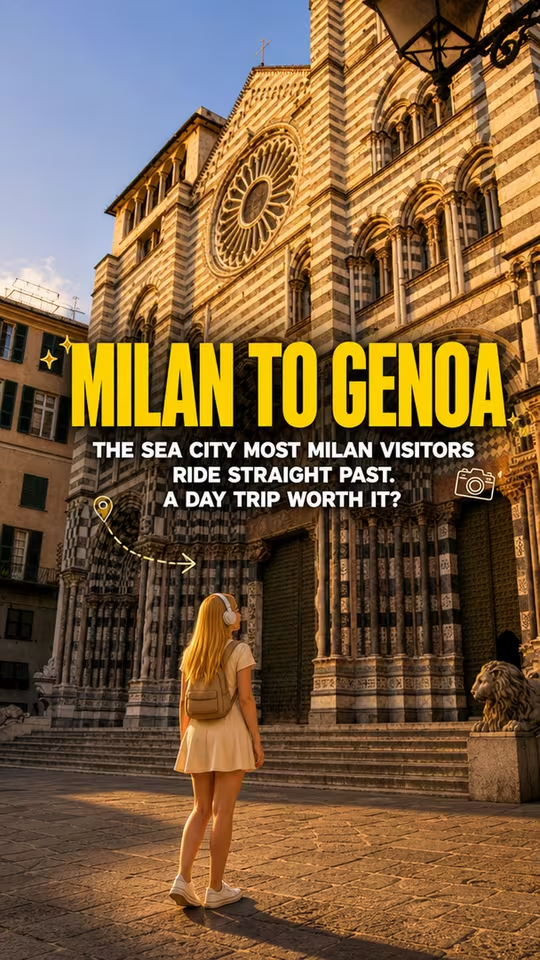
Trains run Milano Centrale to central Genoa in about 1h30, roughly 31 a day, from €6.90 booked ahead. Step off in the old town, open our free self-guided voice tour, and it walks you through the UNESCO palaces, the caruggi and the largest aquarium in Italy.
The Quick Answer: Milan to Genoa
Genoa is the big Italian city almost everyone skips, and that is exactly why it stays honest. The train covers the roughly 133 kilometres from Milan down to the sea in about 1h30, dropping you a few minutes from a medieval centre that is one of the largest in Europe. Waiting there: a maze of caruggi, the narrow alleys that defeat maps entirely, a UNESCO street of Renaissance merchant palaces, a black-and-white striped cathedral, Marco Polo's old prison, and the largest aquarium in Italy sitting out on the old port. This is not a polished postcard town. It is a working sea city they nicknamed La Superba, the Superb One, with two faces, stately palaces on one street and gritty harbour realness on the next. That contrast is the whole reason to come.
| Question | Short answer |
|---|---|
| How long is the trip? | About 1h30 by fast train, roughly 1h40 to 1h50 on Intercity or regional, all from Milano Centrale |
| What does it cost? | Around €10 to €21 each way, from €6.90 on Italo booked ahead |
| How often do trains run? | Roughly 31 departures a day from Milano Centrale across all train types |
| Do I need to book ahead? | Only for the cheap Frecciarossa and Italo fares. Intercity and regional are turn up and go |
| Is one day enough? | Yes for the walkable old town. Add the aquarium and it fills the day completely |
| Best day to go? | Any day but Sunday, when many attractions and restaurants close. Palace museums also close Mondays |
Is the Milan to Genoa Day Trip Worth It?
Yes, as long as you know what Genoa is. This is not Como or Portofino. It does not perform for visitors, and the first walk out of the station can feel gritty and steep. Push into the old town and it rewards you fast. Within a few hundred metres you go from a Renaissance courtyard on a UNESCO street to a 13th-century palace where Marco Polo dictated his travels, to a dark striped cathedral with an unexploded 1941 naval shell sitting in a glass case. The caruggi are genuinely disorienting, and that is part of the pleasure: you turn a corner expecting a dead end and hit a sunlit piazza instead. Add the smell of warm focaccia every fifty metres, the pesto that was actually invented here, and the fact that locals still outnumber tourists, and the day builds a strong case for itself.
The best of Genoa, stop by stop


The case against is honest too. Genoa is layered and a little rough. If you came to Italy for lakes, beaches or immaculate hill towns, this will feel like a real port city, because it is one. The geography is vertical and the navigation is a challenge without a plan. Parts of the old town, especially the Molo alleys near the port, feel rough enough that solo travellers should stay on the busier lanes. And the marquee draw, the aquarium, is a two to three hour commitment that can swallow half your day, so you cannot casually do both the aquarium and the full old town without choosing a pace.
You already know the lakes and want a raw, layered Italian city with real character.
You love medieval alleys, palaces, port history and eating your way through a town.
You came for a resort day. Genoa is a working harbour, not a lakeside promenade.
You want everything neat and easy. The old town is steep, dense and confusing on purpose.
Good fit if you...
- Want medieval, maritime and aristocratic layers in one walkable centre
- Like getting a little lost in alleys and eating focaccia as you go
- Are travelling with kids who would love the largest aquarium in Italy
- Already did Milan and want somewhere with genuine grit and history
Skip it (save Genoa) if you...
- Have only a few hours and want a lake or a famous single icon
- Need flat, obvious, stroller-easy streets
- Are set on a beach or swim day, since the harbour is for looking, not swimming
- Can only go on a Sunday, when much of the city shuts
How to Get from Milan to Genoa by Train
Every sensible way from Milan to Genoa runs the same corridor south to the coast, and the train wins outright. It leaves from Milano Centrale in the heart of the city and drops you in the centre of Genoa, roughly 31 times a day, in about 1h30. The bus is cheaper on paper but slower, and it leaves from Lampugnano out on the metro, not Centrale. A BlaBlaCar rideshare is flexible and occasionally faster, but you are trusting a stranger's timing. Driving is the worst of the lot for a day trip: about the same time, plus tolls, fuel and the real punishment of parking in a dense port city.
| Option | Time | Price each way | Frequency | Verdict |
|---|---|---|---|---|
| Train (all types) | ~1h30–1h50 | €10–21 typical, from €6.90 booked ahead | ~31 a day | WINNER. Centrale to the centre, fast, frequent, no parking. |
| Rideshare (BlaBlaCar) | ~1h20–2h | from €9.99 | ~18 a day | Flexible and last-minute, but you depend on a driver's car and schedule. |
| Bus (FlixBus / BlaBlaCar) | ~1h50–2h05 | €4–8.50 | roughly every 4h | Cheapest fare, but slower and it leaves from Lampugnano, not Centrale. |
| Car (A7 motorway) | ~1h40–2h | €10–14 tolls and fuel, plus parking | anytime | Unnecessary. Parking in the port city is the real cost. |
The honest local line on driving: do not bring a car into Genoa for a day trip. The historic core is a dense, largely pedestrian maze, parking is mostly paid and scarce, and the streets were built for mules, not cars. The train drops you in the middle of everything and spares you all of it.

The Train in Detail
Here is the thing the booking sites bury: there is no single fast train that dominates this route. The Frecciarossa is the quickest at about 1h30, but it runs only a couple of times a day. Italo has the cheapest advance fare at €6.90, but it too runs just once or twice. The real workhorses are the Intercity, the most common option at €13 to €21 with a departure roughly every four hours, and the regional trains, the cheapest at €9.70 to €13 and the most frequent. Across all of them you get around 31 departures a day from Milano Centrale, so in practice you take whatever train leaves closest to your target time and expect €10 to €21 for the ride.
| Which train to take | Time | Price each way | Frequency |
|---|---|---|---|
| Frecciarossa (high-speed) | ~1h30 | €18–30+ | twice a day |
| Intercity | ~1h43 | €13–21 | every ~4h |
| Regional | ~1h30–1h40 | €9.70–13 | frequent |
| Italo | ~1h40–1h53 | from €6.90 booked ahead | 1–2 a day |
One detail decides your arrival: the Frecciarossa pulls into Genova Piazza Principe, the grand historic station near the port, while the Intercity, regional and Italo trains run to Genova Brignole on the eastern side. For sightseeing, Brignole is a touch more central and closer to the walking loop, though both stations sit on the metro and bus network and both put you a short walk or ride from the old town. If you have a choice, Brignole edges it.
If you buy a regional paper ticket, stamp it in the green and white validation machines on the platform before you board. Conductors here do not make exceptions, and an unvalidated ticket earns a fine or a firm removal at the next stop. Tickets bought online or in the app do not need stamping.
Booking Strategy
The booking question really only applies to the two fast trains. Italo and Frecciarossa fares are cheapest weeks out and climb as seats sell, so the €6.90 Italo and low Frecciarossa fares are the first to vanish. If you can plan ahead, lock one of those for a fixed morning departure and you get speed and a low price at once. Intercity fares move far less and regional fares are effectively fixed, so for those there is no reward for booking early, you simply turn up, buy, and go.
A day return is just two singles, so there is no special round-trip ticket to hunt for. Book the outbound early if you want a cheap fast train, then either pin a fixed evening service home or leave the frequent regional and Intercity trains as a flexible fallback. If you hold a rail pass, remember the Frecce charge a seat-reservation fee, so on a pass the Intercity or regional can work out effectively cheaper.
Booking checklist
- Decide the mode first: a fast train for speed, Intercity or regional for turn-up flexibility.
- For Italo or Frecciarossa, book a few weeks ahead to catch the €6.90 to low fares.
- Aim to leave Milan around 07:30 to 08:00 and arrive in Genoa by 09:00 to 09:30 for a full day.
- Keep the return loose given roughly 31 trains a day, or book a fixed evening seat if you prefer certainty.
- If your ticket is a regional paper type, validate it on the platform before boarding.
Genoa in One Day
Here is what makes this a day trip and not a navigation ordeal: you do not need a plan. Genoa is famously easy to get lost in, and that is precisely the problem our tour solves. You step off at Brignole or Principe, walk a few minutes into the old town, and open our free self-guided Genoa tour in your browser. From there it leads. The guide is a voice that actually talks with you, greeting you, telling the story of the caruggi and the merchant palaces as you walk between them, asking what you want to see and adjusting the route to match. It runs in the browser with no app and no download, gives you step-by-step navigation through the maze of alleys where paper maps give up, and starts you off with 100 free credits. You bring your feet, it handles the where-to-next. It is a real conversation walking beside you, not a recording talking at you.

The time math
Catch a train out of Milan around 07:30 to 08:00 and you reach central Genoa between 09:00 and 09:30, with the palaces and the port waking up around you. Take a return any time up to roughly 20:00 to 21:00 and you still get a comfortably full day, because trains run late into the evening. That is nine to eleven usable hours on the ground, plenty for the walkable old town at a slow pace, or a tighter loop plus the aquarium. The one thing that eats time is the aquarium, so decide early whether it is in or out.
What you'll see
One loop covers the historic core, because Genoa stacks its highlights close together between the port and the civic centre.
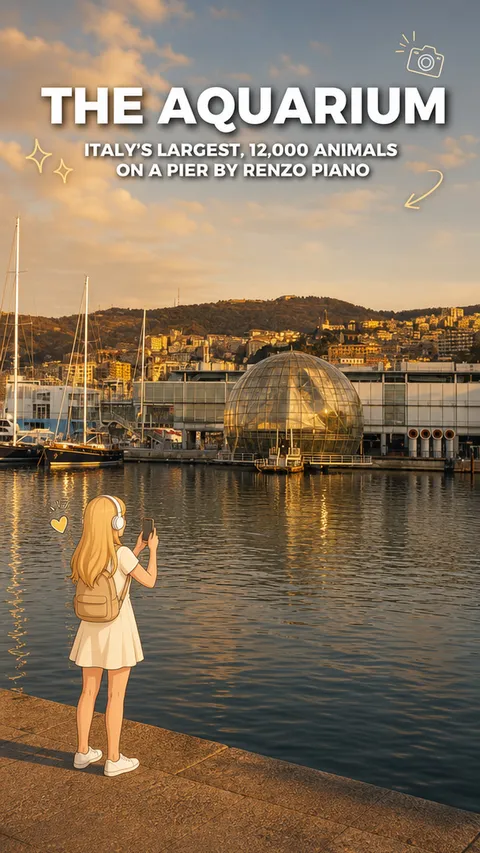
- Aquarium of Genoa (around €22 booked a month ahead, up to €29 on the day, open daily, longer hours in summer): the largest in Italy and one of the largest in Europe, over 12,000 animals across 70 tanks on a pier partly designed by Renzo Piano, with open-air dolphin tanks. Two to three hours, best right at opening on a weekday, and book a timeslot ahead.
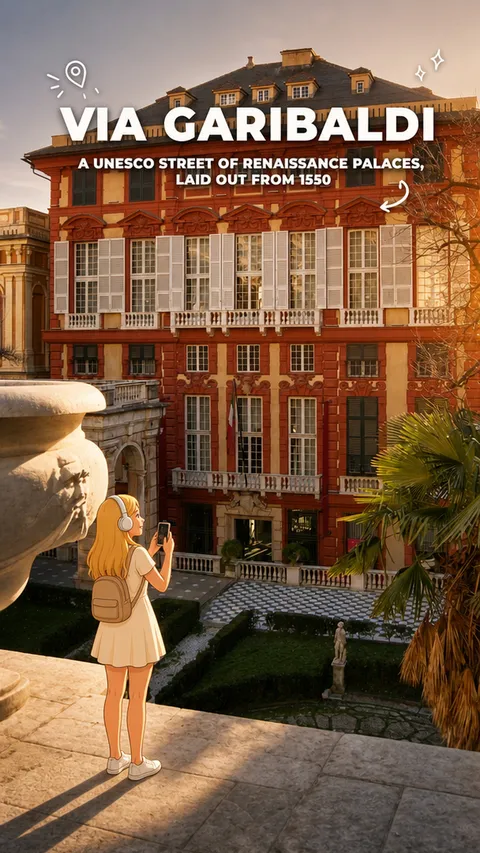
- Via Garibaldi and Palazzo Rosso (street free; Palazzo Rosso €9, Tue–Sun 10:00–18:30, closed Mon): a UNESCO street of aristocratic palaces laid out from 1550, with Van Dyck and Dürer inside the red palazzo. Even skipping the interiors, walking its length and looking up at the courtyards is worth it.
- San Lorenzo Cathedral (nave free; treasury small fee): the black-and-white striped cathedral, with an unexploded 1941 naval shell in a glass case inside and the Sacro Catino relic in the treasury below. Look for the tiny carved dog by the right-hand doors.
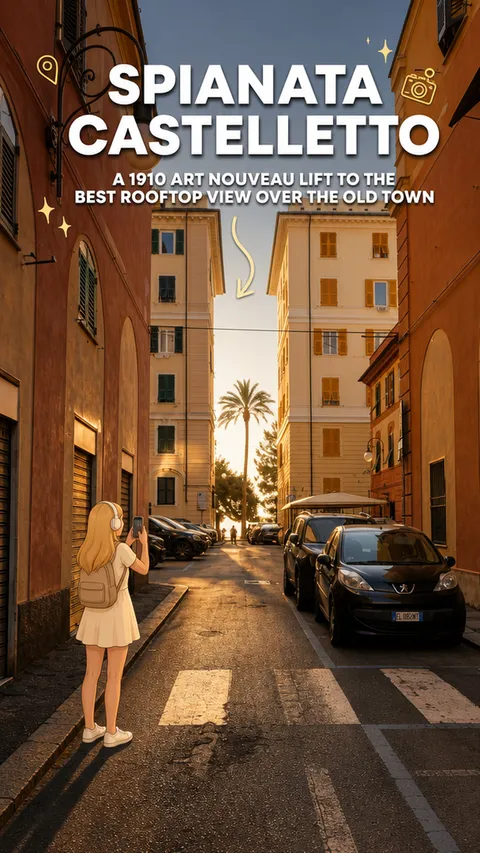
- Spianata Castelletto (free viewpoint; lift a small fare): a tree-lined terrace reached by a 1910 Art Nouveau lift, with the best rooftop panorama over the striped dome, the port cranes and the sea. Grab gelato at the top.
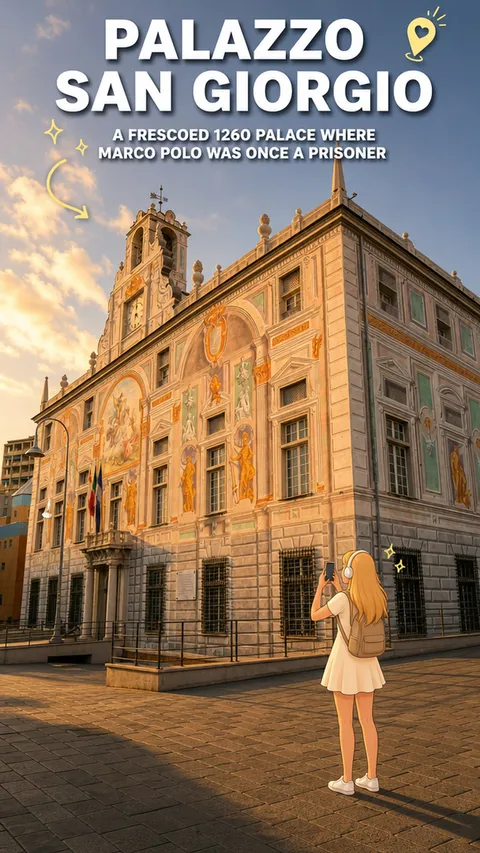
- Palazzo San Giorgio (free to view from outside; interior limited): a frescoed 1260 palace on the port, once home to what some call the world's oldest chartered bank, and Marco Polo's prison in 1298.
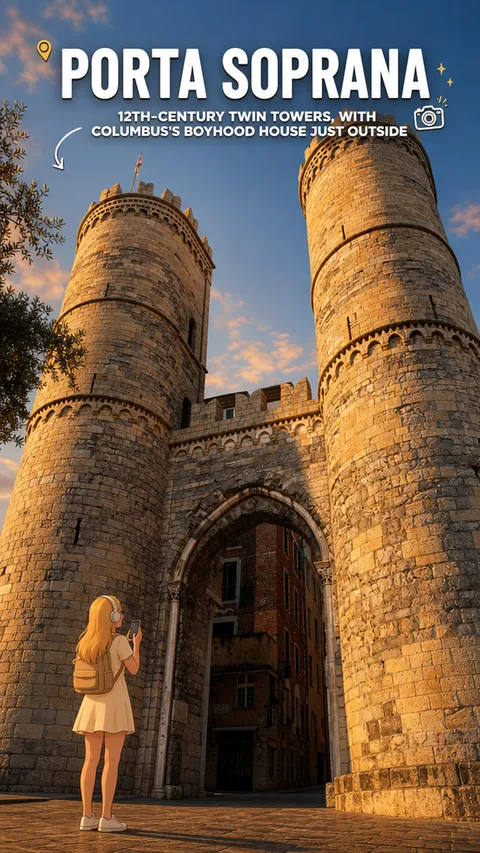
- Porta Soprana and Columbus's house (gate exterior free): the 12th-century twin towers of the Barbarossa walls, with an 11th-century house traditionally said to be Christopher Columbus's boyhood home just outside.
The route the tour walks with you
The tour starts from any stop, so you never backtrack: open it wherever you arrive and it threads the loop in order, climbing once to the terrace and getting paid back with the view, then dropping to the port and cutting home through the alleys. This is the route it walks with you, beginning at the civic heart of the city.
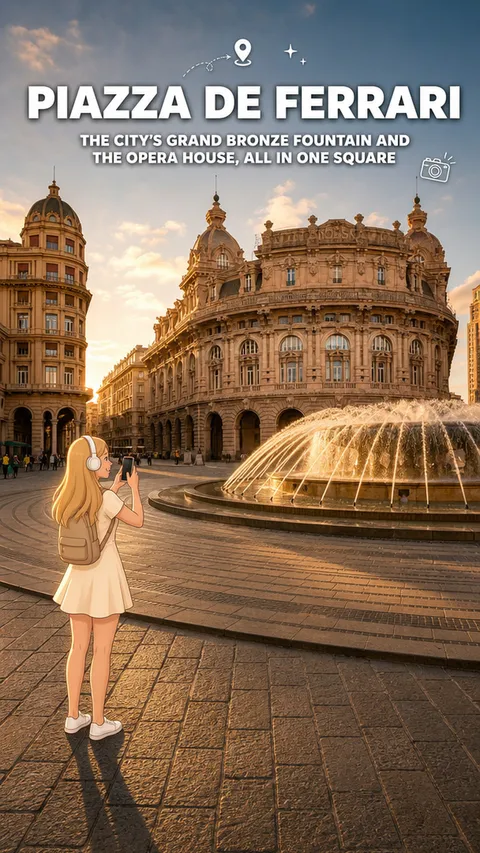
- 1Piazza De Ferrari Your entry point · free
The grand bronze fountain at the centre of Genoa, framed by the Carlo Felice opera house and the Palazzo Ducale, the meeting point locals still use.
- 2Via Garibaldi / Palazzo Rosso Palazzo €9 · ticket
A UNESCO street of Renaissance palaces from 1550, with Van Dyck and Dürer inside the red palazzo. Closed Mondays.
- 3Spianata Castelletto Free
Ride the 1910 Art Nouveau lift 79 metres up to a terrace with the best view in the centre, the striped dome and the port laid out below.
- 4Palazzo Reale Courtyard free
The largest palace on Via Balbi, once the Savoy royal residence, with a Hall of Mirrors inspired by Versailles behind a plain street front.
- 5Galata Museum of the Sea Museum ticket
The biggest maritime museum in the Mediterranean, with a real 63-metre submarine docked out front and a recreated emigrant-ship experience inside.
- 6Aquarium of Genoa ~€22–29 · ticket
The largest aquarium in Italy on a Renzo Piano pier, with open-air dolphin tanks. Two to three hours if you go in, worth walking past even if you don't.
- 7Palazzo San Giorgio Free outside
A frescoed 1260 palace on the port, once the world's oldest chartered bank, where Marco Polo dictated his travels from a prison cell.
- 8San Lorenzo Cathedral Free nave
The black-and-white striped cathedral wedged into the old town, with an unexploded naval shell inside and the Sacro Catino relic below.
- 9Porta Soprana Free outside
The 12th-century twin towers of the Barbarossa walls, with Columbus's supposed boyhood house just outside the gate.
- 10Palazzo Ducale Free courtyard
The former seat of the Genoese Doges, back at Piazza De Ferrari where you started, its free courtyards open to walk through.

It runs in your browser, no app and no download. A voice guide walks the loop with you and leads a real conversation as you go: it greets you, tells the story between stops, asks what you actually want to see, and adapts. It is not a recording and not an audioguide. The map and step-by-step navigation get you from each stop to the next.
Insider Tips for the Genoa Day Trip
Do
- Wear flat, thick-soled shoes. The caruggi are uneven stone slabs and steep gradients
- Eat focaccia Genovese and a slice of hot farinata, the chickpea flatbread, for a few euros
- Ride the Castelletto lift for the view, ideally in late-afternoon light
- Book the aquarium online ahead if you want it, to skip the queue and pay less than the gate
Don't
- Drive into the centre. Scarce paid parking and a pedestrian maze make it a headache
- Rely on a paper map in the alleys. The old town defeats them, which is what the tour is for
- Wander deep into the Molo alleys near the port alone, and keep your phone in a front pocket
- Try to do the full aquarium and the whole old town at a rush. Pick a pace
Food
Genoa is a food town with a claim to fame: pesto was invented here, and focaccia is practically a way of life, eaten warm and often sold by weight, even dipped in cappuccino at breakfast. Stop at a sciamadda near the port for hot farinata, a chickpea flatbread, for around 3 euros, or grab a slab of focaccia from a bakery like Il Fornaio by the waterfront. Trofie al pesto and fresh Ligurian seafood are the sit-down picks. Prices in the old town run noticeably gentler than Milan.
Buffer
The aquarium is the time sink. It genuinely takes two to three hours, so if you want it, treat it as half your day and keep the old-town loop tight around it. If you would rather have the caruggi, the palaces and the terraces at a slow pace, skip the interior and just walk the harbour past it. You cannot do both deeply in one day without rushing. With extra time, the pastel fishing cove of Boccadasse is a short bus 31 from Brignole, and Nervi is a quick train hop for a swim.
Sunday is the day to avoid: many restaurants and some attractions close, and a Sunday trip can leave you looking at shut doors. If Sunday is your only option, plan around the free outdoor sights. Note also that Palazzo Rosso and the Via Garibaldi palace museums close on Mondays, while the streets, the cathedral nave, the port and the Castelletto terrace stay open daily. If the aquarium is your priority, book the timed entry online before you travel.
More day trips from Milan
Out in the morning, back in time for dinner. Every route here fits in one full day.
What the Milan to Genoa Journey Feels Like
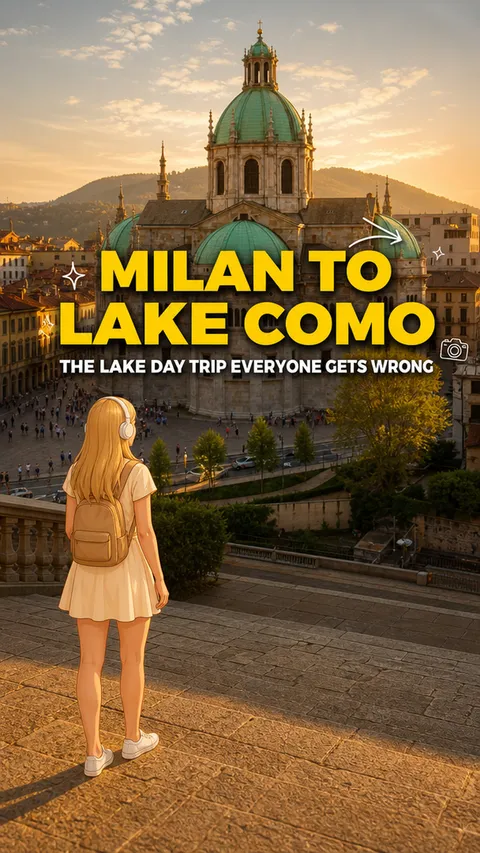
The train ride sets up the reveal. You leave the flat Milanese plain, the line threads through the green barrier of the Apennine tunnels, and then the land tips downward toward the sea. By the time you roll into the station the light has changed, the air smells of salt, and you are somewhere that feels nothing like Lombardy. Genoa hits you as a change of scenery in the fullest sense: blue sea, colour, and a completely different pace, the orderly geometry of the north traded for a tangle of stone.
Then you walk in, and the city plays its trick. The caruggi close over your head, laundry strung between balconies, dark stone underfoot, and you lose your bearings within minutes. It should feel claustrophobic. Instead it feels alive, because every so often the alley spits you out into a piazza full of light, or onto the port where the water opens up and the cranes and the aquarium sit against the sea. The buildings that look run-down at first glance were often built by Genoa's wealthy families, who hid their money behind plain facades rather than flaunting it. This is a city with two faces, baroque splendour on one street and gritty realness on the next, and walking Genoa means moving between them all day.
The single best moment is the Castelletto terrace. You take the old lift up out of the alleys, step out onto a quiet tree-lined plateau, and the whole city drops away below you: the striped dome of San Lorenzo, the tangle of the old town, the port, and the sea beyond it. It is free, it is calm, and it is the payoff that turns a good walk into a memorable one. Come back down for focaccia by the water as the light goes, and the day ends exactly where it should, a short walk from the train home.
Milan to Genoa: Your Questions Answered
Is Genoa worth a day trip from Milan?
Yes, for the right traveller. You get one of Europe's largest medieval centres, a UNESCO street of Renaissance palaces, a striped cathedral, Marco Polo's old prison and the largest aquarium in Italy, all in a walkable core about 1h30 from Milan. The catch is that Genoa is a gritty, vertical working port, not a polished resort. If you like layered history, alleys and real character over neat postcards, it is one of the best day trips Milan offers.
How long is the train from Milan to Genoa?
About 1h30 on a fast Frecciarossa, and roughly 1h40 to 1h50 on the more frequent Intercity and regional services. Trains run from Milano Centrale, with fast trains arriving at Genova Piazza Principe and most others at Genova Brignole, both close to the old town.
How much does the Milan to Genoa train cost?
Around €10 to €21 each way for the typical Intercity and regional trains. The cheapest advance fare is €6.90 on Italo booked ahead, while the fast Frecciarossa runs higher at roughly €18 to €30. For the best mix of price and flexibility, most people simply take the next Intercity or regional.
Do I need to book Milan to Genoa train tickets in advance?
Only for the two fast trains. Italo and Frecciarossa fares are cheapest booked a few weeks out and climb as seats sell. Intercity fares move far less, and regional fares are effectively fixed, so for those you can turn up and go, validating a paper ticket on the platform if you have one.
Which Genoa station should I arrive at, Principe or Brignole?
Both sit close to the old town. Genova Brignole, on the eastern side, is a touch more central for sightseeing and is where the Intercity, regional and Italo trains arrive. Genova Piazza Principe, near the port, is the grand historic station and the one the Frecciarossa uses. Whichever you land at, the walking loop is a short walk or metro ride away.
What is there to do in Genoa in one day?
Walk one loop covering Piazza De Ferrari, the UNESCO palaces of Via Garibaldi, the Castelletto viewpoint, Palazzo Reale, the port with the Galata sea museum and the aquarium, Palazzo San Giorgio, the striped San Lorenzo cathedral and Porta Soprana with Columbus's house. Add the aquarium interior if you have kids or two spare hours, and finish with focaccia by the water.
Is the Aquarium of Genoa worth it, and how long does it take?
It is the largest aquarium in Italy, on a pier partly designed by Renzo Piano, with over 12,000 animals and open-air dolphin tanks. A full visit takes two to three hours, so it is a real commitment on a day trip. It is a big hit with families. Book the timed entry online, roughly €22 a month ahead against up to €29 on the day, and arrive right at opening on a weekday to dodge the worst crowds.
Should I go on a Sunday?
It is the weakest day. Many restaurants and some attractions close on Sundays in Genoa, and the day can end in front of shut doors. Any other weekday is better. If you can only manage a Sunday, lean on the free outdoor sights: the streets, the cathedral nave, the port and the Castelletto terrace stay open.
Do I need a car in Genoa?
No. The historic centre is a dense, largely pedestrian maze that cars struggle to enter, parking is scarce and paid, and the train drops you right in the middle of it. Driving from Milan means around two hours plus tolls and parking grief. The train is faster, cheaper and far less stressful.
Plan Your Genoa Day Trip
You do not need to memorise any of this on the day. Take a morning train from Milano Centrale, step off in central Genoa, and open our free Genoa tour in your browser. It greets you, walks you through the merchant palaces, the striped cathedral, the port and the caruggi as a single conversation, navigates the alleys that defeat paper maps, and starts from whichever stop you happen to be standing at. No app, no download, no audioguide reading at you, just a voice guide that adapts to what you want to see, with 100 free credits to start.
It runs in your browser, no app and no download. A voice guide walks the loop with you and leads a real conversation as you go: it greets you, tells the story between stops, asks what you actually want to see, and adapts. It is not a recording and not an audioguide. The map and step-by-step navigation get you from each stop to the next.
