
Verona Day Trip from Padua: Roman Arena in Under an Hour
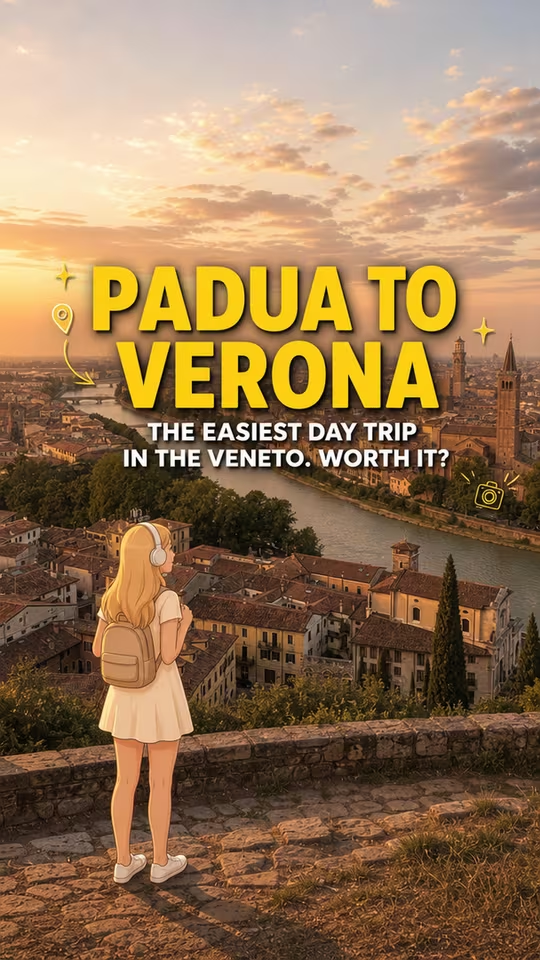
A direct train from Padova slides you into Verona Porta Nuova in 44 minutes, and our free self-guided tour walks you from the Arena to Ponte Pietra without a single decision to make.
The Quick Answer: Padua to Verona
Padua to Verona is the simplest day trip the Veneto offers. Two UNESCO-level cities sit 82 km apart on the same rail line, tied together by trains that leave every half hour and cover the distance in 44 minutes for the price of a pizza. You wake up in Giotto's city of porticos and students, you lunch inside a Roman amphitheatre, and you are back in Padua in time for the Aperol spritz that was actually invented here. No other region in northern Italy gives you a pairing this rich on a connection this easy.
The honest version: both cities deserve a full day each, and a day trip forces choices. You can comfortably do the Arena, Juliet's courtyard, Piazza delle Erbe, Ponte Pietra and one museum in a day. You cannot do all of it.
| Question | Short answer |
|---|---|
| Is it doable as a day trip? | Yes, easily. 44 minutes by direct train, every 30 minutes. |
| Fastest, simplest way there? | Direct regional RV or Frecciarossa from Padova to Verona Porta Nuova. |
| Cheapest fare? | €7.80 one-way on the RV regional, fixed. |
| How long on the ground? | 8 to 10 hours if you take an early train and a 7pm return. |
| Do I need a car? | No. ZTL zones and €17 parking make the train faster door to door. |
| Best day to go? | Tuesday to Sunday. Most Verona museums shut Monday. |
Is the Padua to Verona Day Trip Worth It?
Here is the case for going. Verona gives you the two things Padua cannot: a working Roman amphitheatre in the middle of a living square, and a soft, romantic river setting that loops through the old town. The Arena is the third-largest Roman theatre still standing and you walk into it from a café. Ponte Pietra is a 1st-century-BC bridge rebuilt from the riverbed after the German army blew it in 1944. Add a Shakespeare balcony a 1970s guide invented, Gothic Scaliger tombs, and the best people-watching square in the Veneto, and you have a full day that does not feel like filler.
The best of Verona, stop by stop


Here is the case against. Verona is more tourist-oriented than Padua, and you feel it in the pricing around Piazza Bra and Casa di Giulietta. If you hate crowds at famous balconies, the courtyard will irritate you. And if your real goal is to absorb a city rather than sample one, splitting a single day between two of Italy's deepest historic centres short-changes both.
44 minutes, every half hour, from €7.80. No day trip in the Veneto is better connected. [no] Both cities genuinely deserve a full day each. Doing both in one day short-changes both. [yes] Roman Arena, Roman bridge, Gothic tombs, Shakespeare. Density per square metre is off the scale. [no] Eating in Piazza Bra or Piazza delle Erbe means tourist-trap prices for mediocre food.
Good fit if you...
- are based in Padua and want a taste of Verona's Roman ruins and romantic river setting in one day
- travel on the early train and accept you will only see 4 to 5 sights, done properly
- like the idea of standing inside a 30 AD amphitheatre two hours after breakfast in another city
- want the easiest transport math in the Veneto, no change, no car, no planning
Skip it (save Verona) if you...
- want to actually absorb a city instead of sampling one, give Verona its own overnight
- hate crowds at tourist icons like Juliet's balcony and the Arena steps
- are trying to bundle Padua and Verona into a single day from Venice, that is too much
- come on a Monday, when most Verona museums including Castelvecchio are shut
How to Get from Padua to Verona by Train
The decision here is unusually clean. The train wins on every axis that matters: speed, frequency, price and station-to-centre convenience. The A4 motorway runs roughly parallel but lands you in ZTL-restricted streets with €17 for five hours of parking, and the bus offers no time advantage over the regional train. Take the train.
| Option | Time | Price | Verdict |
|---|---|---|---|
| Trenitalia RV regional (Padova to Verona Porta Nuova) | 47 min, no change | €7.80 | WINNER. Same fare as the painfully slow R train, half the time. |
| Italo high-speed (Padova to Verona Porta Nuova) | 43 to 44 min, no change | from €8.90 | Equally fast, slightly slicker. Pick whichever time fits. |
| Trenitalia R regional (slow) | ~90 min, no change | €7.80 | Avoid. Same fare as the RV, double the time. |
| FlixBus / Itabus | ~1h05 to 1h10 | from €3.90 | Cheaper but no time advantage, only 4 a day. |
| Car (A4 motorway) | ~57 min drive | ~€17 parking + tolls + fuel | Slower door to door. Only worth it for a Lake Garda or Valpolicella add-on. |
Take the RV regional, not the R. Same €7.80 fare, 43 minutes saved each way. The single most useful sentence on this route.

The Train in Detail
Three operators run Padova to Verona Porta Nuova on the same Venice to Milan main line. Trenitalia's RV regional is the workhorse: 47 minutes, €7.80, no reserved seat, leaves roughly hourly. Italo runs seven slick AGV high-speed services a day in 43 minutes from €8.90 promotional. The Trenitalia R regional crawls in 90 minutes for the same €7.80 as the RV, so it exists only to catch out travellers who did not check the train code. The overnight DB/ÖBB Nightjet also calls once, useless for a day trip.
Verona Porta Nuova is the station you want. It sits a flat 15 to 20 minute walk down Via Roma to Piazza Bra and the Arena. Porta Vescovo, the other Verona station some slower services use, is a 35 minute walk to the centro storico and will eat your day before it starts. Check the destination on the departures board at Padova.
Two practical points. Regional tickets are unreserved, so your €7.80 ticket is valid on any regional service of that code, not a specific train. And paper regional tickets must be validated in the platform machine before boarding, or the inspector fines you on the spot even with a valid ticket. Italo and Frecce tickets do not need validation.
RV regional or Italo, which to book?
For most travellers, whichever departs next. The time difference is three to four minutes, the fare gap is one or two euros on a promo and €10+ walk-up. Italo gives you a reserved seat and a quieter carriage, the RV gives you flexibility to leave when you wake up.
| Route | Changes | Time | Price | Best for |
|---|---|---|---|---|
| RV regional | None | 47 min | €7.80 fixed | Spontaneous travellers, cheapest day. |
| Italo AGV | None | 43 to 44 min | from €8.90, walk-up higher | Travellers who want a reserved seat and a slicker ride. |
| Frecciarossa | None | ~50 min | €10 to €25 | Worth it only when Italo is sold out. |
Italo's day-return offer knocks up to 50% off the round trip if you book ahead. Worth checking before you commit to the regional.
Booking Strategy
For the RV regional there is almost nothing to book. The €7.80 fare is fixed whether you buy three weeks out or two minutes before boarding, and the ticket is not tied to a specific departure. Buy two singles at the Trenitalia machines, the Trenitalia app, or the ticket office at Padova. Validate each paper ticket on the platform before you board.
The only place advance booking matters is Italo. Italo uses dynamic pricing, so the cheapest €8.90 seats sell first and walk-up fares can hit €20+. Their day-return offer is the genuine hack: book a round trip in advance and you can save up to 50% versus two separate singles.
Booking checklist
- Decide if you want flexibility (RV, €7.80, no booking) or comfort (Italo, from €8.90, book ahead).
- If Italo: book the round trip together online to trigger the day-return discount.
- If RV: buy two singles at the machine, no time pressure.
- On the platform at Padova, validate paper regional tickets in the green or yellow machine before boarding.
- Use the Italian city name Padova when searching Trenitalia, not Padua. Verona is Verona on both sites.
Verona in One Day
You step off at Verona Porta Nuova and a flat 15 minute walk down Via Roma drops you into Piazza Bra with the Arena filling the view. That is where the planning stops. You open our free self-guided Verona tour in your browser, no app and no download, and a voice guide takes over the day. It greets you, sets you off on the right loop around the old town, tells the Roman and Scaligeri story between stops, and asks what you actually want to see so it shapes the walk around you. It is a real conversation with step-by-step navigation, not an audioguide and not a recording, and it starts from any stop on the route, so it does not matter if you wander off for a coffee.

The time math
A comfortable shape is the 8:22 train from Padova, which puts you at Verona Porta Nuova at 9:09 and at the Arena by 9:30, before the big tour groups clog the steps. Take the 7:13pm or 8:13pm return from Verona and you get roughly 10 hours on the ground, with time for a long lunch and an early spritz. The earliest useful train is 7:22am, the latest sensible return is 9pm-ish, and trains on this line run late. The single rule: pick the RV over the R. The R burns 45 extra minutes each way for zero savings.
What you'll see
The historic centre curves inside a bend of the Adige and you can walk across it in 25 minutes. This is the honest must-do shortlist:
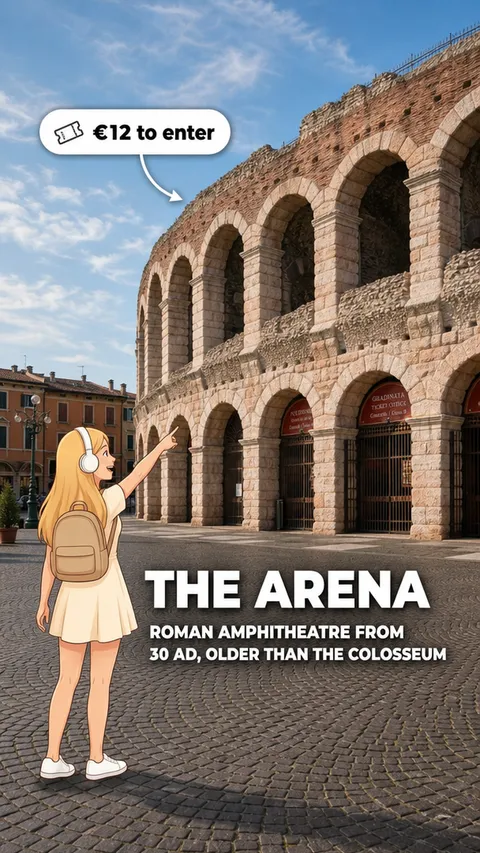
- Arena di Verona (€10, Tue to Sun 9:00 to 19:00, closed Monday mornings): the third-largest Roman amphitheatre still standing, 30 AD, holds 22,000 and still hosts the summer opera festival. Climb to the top tier for scale. Free to admire from Piazza Bra.
- Piazza Bra (free, any time): the grand civic square wrapping the Arena, gardens and the Liston promenade. Walk through it, do not eat here.
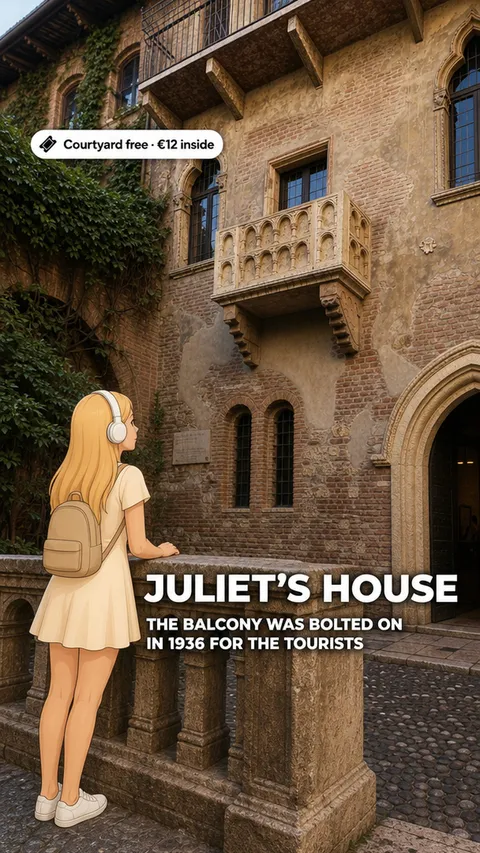
- Casa di Giulietta (courtyard free, museum ticketed, book ahead even with Verona Card): the 13th-century house with the balcony a guide invented in the 1970s. The courtyard, the love-letter wall and the bronze Juliet are the scene. Skip the museum unless you love Shakespeare props.
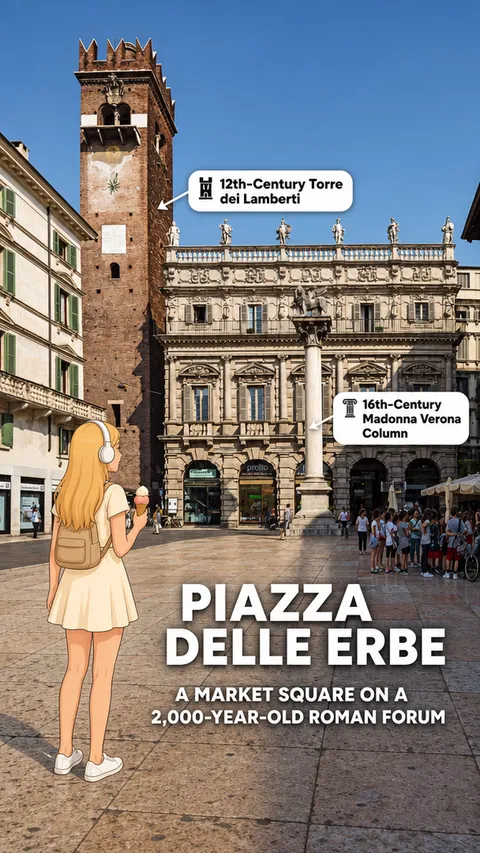
- Piazza delle Erbe (free, daily market): Verona's liveliest square on the old Roman forum, frescoed facades, the Madonna Verona fountain, the whale rib hanging there for four centuries. Best people-watching in town.
- Torre dei Lamberti (€6, daily 10:00 to 19:00, lift small extra fee): 84 metre medieval bell tower, 368 stairs or lift, the best aerial view of Verona's red rooftops.
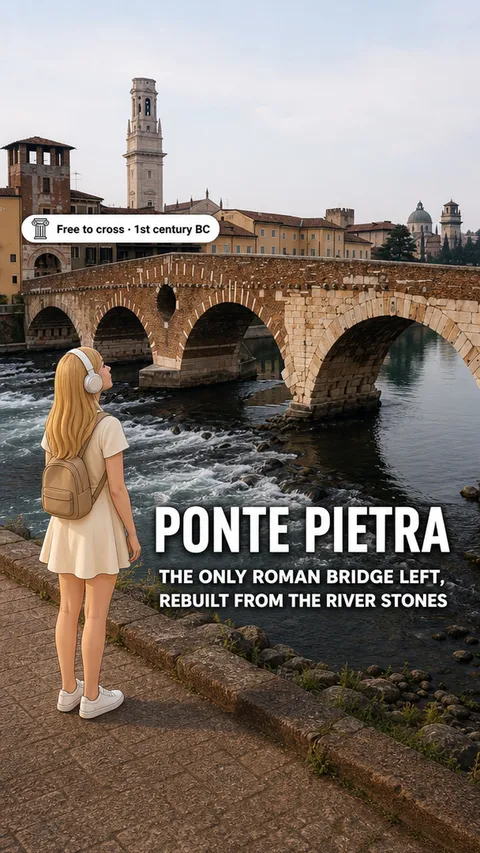
- Ponte Pietra (free): the oldest bridge in Verona, 1st century BC, rebuilt from original stones pulled out of the Adige after the 1944 retreat. The single best view of the city is from the middle, facing the Roman Theatre hill at sunset.
- Arche Scaligere (free from outside): Gothic funerary monuments to the Scaligeri family that ruled Verona for 400 years, equestrian statues on tooth-like tabernacles behind iron railings.
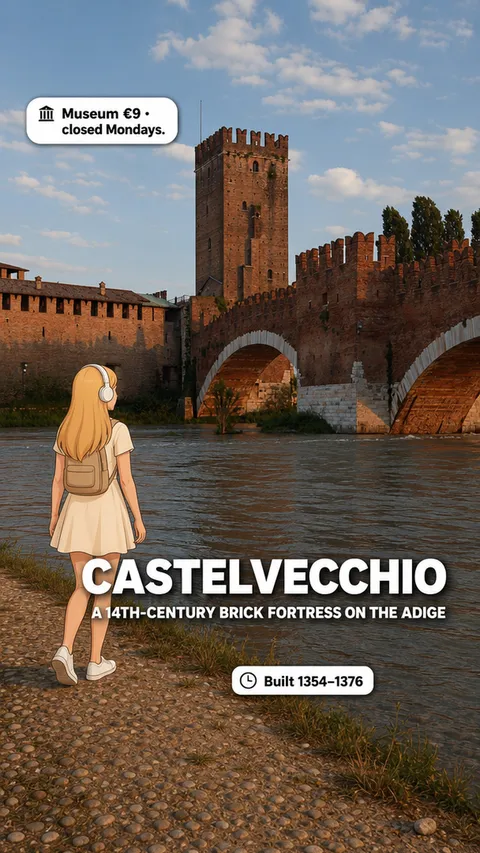
- Castelvecchio Museum (€6, Tue to Sun 10:00 to 18:00, closed Monday): 14th-century Scaligeri fortress, art museum restored by Carlo Scarpa, plus the fortified Ponte Scaligero bridge across the Adige.
The route the tour walks with you
The loop is about 5.2 km of mostly flat walking and the guide can start you from any stop, no backtracking. It strings the Roman ruins, the medieval squares and the river crossings into one logical circle so the busy sights come early and the river-and-castle stretch comes as a cool-down in the afternoon. Here is the order it walks with you, starting at Piazza Bra:
- 1Piazza Bra & Arena di Verona Your entry point · €10 inside
The wide civic square and the 30 AD amphitheatre that fills it. Walk the corridors, climb the top tier, check the acoustics. Free from outside if the queue is long.
- 2San Fermo Maggiore Church Small fee · quiet stop
A two-level church, 11th-century Romanesque below, 14th-century Gothic above, with a ship's-keel ceiling and Pisanello frescoes. Usually empty.
- 3Casa di Giulietta (Juliet's House) Courtyard free · museum ticketed
The balcony, the love-letter wall, the bronze Juliet. Go early, the courtyard gets loud by 11am. Skip the museum unless booked.
- 4Torre dei Lamberti €6 · lift extra
84 metres up, 368 stairs or lift, the rooftops and the Adige curve laid out. Book the lift slot ahead on busy days.
- 5Piazza delle Erbe Free · market
The old Roman forum, now the loudest market square in Verona. Frescoed facades, the winged lion of St Mark, the whale rib. Grab fruit from a stall, do not sit at a café.
- 6Piazza dei Signori Free · quiet
A sudden hush after the market. Statue of Dante in the centre, the Renaissance Loggia del Consiglio on the north side. Same historic weight, fraction of the crowd.
- 7Arche Scaligere (Scaliger Tombs) Free from outside
Gothic tooth-like tombs of the Scaligeri family behind iron railings, equestrian statues climbing skyward. The fence is the view, no need to pay to enter.
- 8Basilica di Sant'Anastasia Small fee
Verona's largest church, 1290 to 1481, with Pisanello's St George and the Princess fresco and the carved hunchback holy-water fonts. Plain facade, soaring interior.
- 9Ponte Pietra Free · sunset spot
The 1st-century-BC Roman bridge, blown up in 1944, rebuilt stone by stone. Stop halfway across, face the Roman Theatre hill, this is the photo.
- 10Teatro Romano & Museo Archeologico €4.50 · hillside climb
1st-century-BC Roman theatre built into the San Pietro hillside, with the archaeological museum above. The view over Verona from the top is the payoff.
- 11Duomo di Verona (Cathedral) Small fee
Romanesque and Gothic mix, double porch on pink marble, Titian's Assumption inside. Quick stop, rarely crowded.
- 12Porta Borsari (Roman Gate) Free
1st-century Roman city gate, white limestone, two archways, stranded in modern traffic. Walk through it as the Romans did.
- 13Castelvecchio Museum €6 · closed Monday
The Scaligeri red-brick fortress on the Adige, museum restored by Carlo Scarpa, plus the fortified Ponte Scaligero. Strong closing stop.
- 14Piazza Bra & Arena di Verona (Return) End of loop
The loop closes where it started, with the Arena catching evening light. Bench under the trees, then the walk back down Via Roma to Porta Nuova.
It runs in your browser, no app and no download. A voice guide walks the loop with you and leads a real conversation as you go: it greets you, tells the story between stops, asks what you actually want to see, and adapts. It is not a recording and not an audioguide. The map and step-by-step navigation get you from each stop to the next.
Insider Tips for the Verona Day Trip
Do
- take the 8:22am train from Padova to land at the Arena before the tour buses
- pick the RV regional over the R, same €7.80 fare, half the time
- cross Ponte Pietra and climb to Castel San Pietro for the panoramic rooftop view of Verona
- eat two streets back from Piazza Bra and Piazza delle Erbe, same food, half the price
- try tortellini Valeggio style, bigoli pasta, and a glass of Amarone, the local answers to Padua's risotto
Don't
- eat on Piazza Bra or Piazza delle Erbe, tourist markup, mediocre plates
- take the slow R train, it adds 30+ minutes each way for zero savings
- rub the bronze Juliet's breast, it is now actively discouraged and worn smooth for nothing
- come on a Monday, Castelvecchio and several museums are shut
- assume you can wing the Arena queue in peak season, book ahead in summer opera months
Luggage
There is no point bringing a bag. Padova to Verona Porta Nuova is 44 minutes, you walk straight off the train into town, and dragging anything through Piazza delle Erbe crowds is misery. If you are connecting from a hotel checkout, leave bags at Padova station.
Buffer
The Arena alone eats 60 to 90 minutes if you go inside. Torre dei Lamberti at sunset is the second queue you should budget time for. Build slack for the river stretch between Ponte Pietra and Castelvecchio, it is the prettiest part of the day and rewards slowing down.
If you are coming in summer, the Arena doubles as the venue for the evening opera festival, so closing times shift on performance days. Check the day's schedule before you queue, you may be folded out at 3pm instead of 7pm.
More day trips from Padua
Out in the morning, back in time for dinner. Every route here fits in one full day.
What the Padua to Verona Journey Feels Like
The ride is short enough that you barely settle in before you are pulling out again. Padova station gives way to the flat Veneto plain, then the train curves north-west toward the foothills of the Alps. On a clear day you can see the Dolomites in the distance as you approach Verona, pale sharp peaks behind the red rooftops. Forty-four minutes, no change, no stress, the kind of train ride that makes you wonder why anyone drives anywhere in Italy.
Then comes the moment that sells the whole trip. You walk out of Verona Porta Nuova, down Via Roma, and the Arena rises in front of you, a Roman amphitheatre the size of a city block sitting in a living square with joggers and office workers passing its arches. It is ancient and casual at the same time. The Adige curves around the old town and gives Verona a green softness Padua does not have, and by late afternoon, when the pink marble of the churches glows and the crowds thin, you understand why people call this the most romantic city in Italy. You do not need Shakespeare to feel it.
Padua to Verona: Your Questions Answered
How long is the train from Padua to Verona?
44 to 47 minutes on the direct RV regional or Italo high-speed, no change. The slow R regional takes about 90 minutes for the same €7.80 fare, so avoid it. Trains leave Padova for Verona Porta Nuova roughly every 30 minutes through the day.
Is there a direct train from Padua to Verona?
Yes. The Trenitalia RV regional, Trenitalia Frecciarossa, and Italo AGV all run direct from Padova to Verona Porta Nuova on the Venice to Milan main line, no change. Italo has seven daily departures, the RV roughly hourly, Frecce in between.
How much does the Padua to Verona train cost?
€7.80 one-way on the RV regional, fixed fare that does not change with how far ahead you buy. Italo starts at €8.90 promotional and rises to €20+ walk-up. A round trip is two singles. Italo's day-return offer can knock up to 50% off if booked ahead.
Can you see Verona in one day from Padua?
Yes, comfortably. With an 8:22am train out and a 7pm return you get roughly 10 hours on the ground, enough for the Arena, Juliet's courtyard, Piazza delle Erbe, Ponte Pietra, one museum, and a long lunch. Two days only help if you want every interior.
What's the best day to visit Verona from Padua?
Tuesday to Sunday. Castelvecchio and most Verona museums shut on Monday. Sunday is lively but the market is in full swing on Piazza delle Erbe. Avoid summer opera evenings if you want the Arena to yourself during the day, performance days shift closing times.
Do I need to book anything in advance?
The Arena in summer opera season (June to September), because performance-day opening hours shift and queues lengthen. Casa di Giulietta museum, even with a Verona Card. Italo trains if you want the cheapest €8.90 fare or the day-return discount. The RV regional needs no booking at all, the fare is fixed and the ticket works on any RV.
Is the Padua to Verona day trip worth it?
If you want Roman ruins, a romantic river setting and a walkable historic centre on the easiest connection in the Veneto, yes. Forty-four minutes by train from €7.80, no car, no change, no planning beyond opening the tour. The honest caveat is that both cities deserve a full day each, so if you can overnight, do.
Do I need a Verona Card?
Only if you plan three or more paid entries in 24 hours. The 24-hour card is €27, the 48-hour is €32. If you are mostly walking exteriors and doing one paid entry inside the Arena, pay per sight. First Sunday of the month, November to March, public museums are €1 entry.
What should I eat in Verona?
Tortellini Valeggio style, bigoli pasta, baccalà, and a glass of Amarone or Valpolicella. Avoid the restaurants on Piazza Bra and Piazza delle Erbe, walk two streets back for the same food at half the price. An espresso at the bar costs about €1.50.
Plan Your Verona Day Trip
The whole point of this route is that you do not need to plan it stop by stop. Take the 8:22am RV regional from Padova, walk down Via Roma to Piazza Bra, and open our free self-guided Verona tour in your browser. The voice guide leads the entire 5.2 km loop with you, greets you, tells the Roman and Scaligeri story between the Arena and the river, asks what you want to see and adapts the walk as you go, with step-by-step navigation the whole way. No download, no audioguide script, just a real conversation that starts from any stop. You get 100 free credits to begin, so you can try the whole thing for nothing.
