
Padua to Venice Day Trip: The 26-Minute Train Done Right
The Regionale Veloce train puts you on the Grand Canal in about 26 minutes for roughly €5, with a departure every 20 minutes and no reservation needed. This is the easiest day trip in the Veneto, and here is the honest plan, the ticket trap to avoid, and a free, self-guided walking tour for the hours on the ground.
The Quick Answer: Padua to Venice
Take the regional train, and do not overthink any other option. The Regionale Veloce from Padova Centrale to Venezia Santa Lucia runs in about 26 minutes, with a departure roughly every 20 minutes through the day, for around €4.70 each way (the slow Regionale that stops everywhere costs the same and takes 45 to 50 minutes, so wait for the next Veloce). No seat reservation, no dynamic pricing, no advance discount to chase. The price is the price whether you buy a week out or five minutes before you board. Two stations, both dead center: you walk from Padua's porticoed streets onto the train, and 26 minutes later you step out of Santa Lucia straight onto the Grand Canal. As a day trip this is almost absurdly easy, and you can give Venice a long, full day for the cost of two coffees.
| Question | Answer |
|---|---|
| Fastest journey time | ~26 min on the Regionale Veloce; ~45–50 min on the stopping Regionale (same price) |
| Frequency | Roughly every 20 min through the day, both directions |
| Price from | ~€4.70 one way (~€9.40 round trip). Same price online and at the machines |
| Operators / how | Trenitalia Regionale and Regionale Veloce. Frecciarossa and Italo also run but cost 4–8× more for ~2 min saved |
| First / last train | First from Padova around 5:30–6:00 a.m.; last return from Venezia Santa Lucia around 11:30 p.m. to midnight |
| Worth it as a day trip? | Yes, unreservedly. This is the easiest, cheapest major day trip you can make in Italy |
Is the Padua to Venice Day Trip Worth It?
This is a different question from the one travelers ask about Rome-to-Venice or Milan-to-Venice day trips, because from Padua the math flips in your favor. You are not trading eight hours of train for six hours on the ground. You are trading 26 minutes for an entire day in a city that exists nowhere else on earth. The honest verdict is that this is the single easiest worthwhile day trip we cover, and almost anyone based in Padua should do it.
The best of Venice, stop by stop


The case for going is the train itself, the price, and the arrival. For €4.70 you sit down in a clean, modern regional train, and half an hour later you walk out onto the Grand Canal. No transfer, no taxi, no airport, no parking. Venice station is a waterfront terminus: the doors open, the lagoon is right there, and you are already in the city.
At 26 minutes and €4.70, this is the cheapest, fastest, most effortless major day trip in northern Italy. Period.
Padua is the smart base. You sleep in affordable, grounded, real Italy and spend the day in the dream, then ride 26 minutes home.
The case against is narrow but real. If you have already done Venice properly on its own trip, a day trip adds little; you will not see anything new. And if your dream version of Venice involves empty back canals at dawn and a slow spritz as the light fades over the Salute, the day-trip rhythm will not give you that, because you arrive with the crowds and leave before the city goes quiet.
If you have already given Venice its own trip, spend today on Padua's own treasures instead: the Scrovegni Chapel, the Basilica, Prato della Valle.
Our call: if you have not been to Venice, or you have but someone you are traveling with has not, just go. The train makes it nearly free, and a day is genuinely enough for the highlights loop. Book the Basilica and the Doge's Palace ahead if you want the inside of either, walk the rest, and be back in Padua in time for dinner at prices Venice cannot match.
Good fit if you...
- Are based in Padua and have not done Venice (or are with someone who has not)
- Want the headline sights: San Marco, the Basilica, the Rialto, the Grand Canal
- Travel on a budget and refuse to pay Venice hotel prices
- Have a free day and 26 minutes to spare each way
Skip it (give Venice its own night) if you...
- Have already seen Venice properly and would see nothing new
- Want the outer islands, Murano and Burano, at a slow pace
- Dream of an empty Venice at dawn and dusk, which day-trippers miss
- Hate crowds and tight timing on a holiday
How to Get from Padua to Venice by Train
You can get from Padua to Venice five ways, and for a day trip the regional train wins so hard that the rest are not really alternatives. The reason is simple: the regional train is faster, cheaper, more frequent, and more convenient than every other option, all at once. Usually you trade price for speed. Here you do not.

| Mode | Time | Price | Verdict |
|---|---|---|---|
| Regionale Veloce train | ~26 min | ~€4.70 one way | WINNER. Downtown to Grand Canal, every 20 min, no reservation |
| Stopping Regionale train | ~45–50 min | ~€4.70 one way | Same price, slower. Take it only if you miss the Veloce |
| Frecciarossa / Italo high-speed | ~27–29 min | €20–45 one way | Same time as the Regionale, 4–8× the price. Pointless here |
| FlixBus / Itabus | ~55 min | €10–28 | Slower and more expensive than the train. No upside |
| Car | ~31 min, 38 km | fuel + toll + €25–35 parking at Tronchetto | Venice is car-free. You pay to park on the mainland and walk anyway |
The high-speed train is the rookie mistake on this route. The Frecciarossa shaves perhaps a minute or two off the Regionale Veloce and charges you four to eight times more for the privilege, because the fast trains are built for the long haul to Rome or Milan and the Padua to Venice hop is barely a warm-up for them. Save the Frecciarossa budget for a different leg of your trip. The bus is worse on every axis: slower, pricier, less frequent. The car is genuinely pointless for a day trip, because you cannot drive into Venice at all. You would park at Tronchetto or Piazzale Roma on the edge of the city, pay €25 to €35 for the day, and then walk or take a vaporetto exactly as if you had arrived by train. The train drops you at the same doorstep for €4.70.
The Regionale Veloce is the unanimous call. Take it.

The Train in Detail
Trenitalia runs the regional service on this corridor. There are two flavors, and the price is identical, so always grab the faster one if it is leaving soon:
- Regionale Veloce (RV): the winner. About 26 minutes, fewer stops. This is the train you want.
- Regionale (R): the slow one. About 45 to 50 minutes, calls at every little station along the way. Same €4.70 price. Useful only if you just missed a Veloce and the next one is 20 minutes out.
The trains on this line are modern, clean, and rarely crowded. The carriages have low-floor boarding with a small ramp that slides out when the doors open, so there is no gap to step over, and charging sockets sit between the seats. The route runs flat across the Venetian plain, then climbs onto the long causeway over the lagoon for the final stretch. That causeway crossing is the moment the day actually starts: open water on both sides, domes and campaniles ahead, and the train slowing into Santa Lucia as the city materializes around you.
A note on stations, because this is the one place people go wrong. You depart from Padova Centrale, Padua's main station, a 10-minute walk or a short tram ride from the historic center. You arrive at Venezia Santa Lucia, the station on the island, whose front steps land you directly on the Grand Canal. There is one stop just before it called Venezia Mestre, on the mainland. Do not get off there. Santa Lucia is the end of the line. Stay on until the train stops at a waterfront terminus and you cannot go any further.
Regionale or Regionale Veloce, which to catch?
Whichever leaves next. They cost the same and arrive at the same station, so the only variable is time. If a Veloce is on the board in the next 5 to 10 minutes, wait for it. If the next Veloce is 20 minutes away and a stopping Regionale is on the platform, take the Regionale and accept the extra 20 minutes on board. You will still be in Venice inside an hour.
| Compare | Regionale Veloce | Regionale (stopping) |
|---|---|---|
| Time | ~26 min | ~45–50 min |
| Stops | Few | All |
| Price | ~€4.70 | ~€4.70 |
| Frequency | Roughly every 20–30 min | Fills the gaps between Veloce trains |
| Verdict | The train you want | The fallback if you just missed one |
Booking Strategy
This is the easiest booking chapter in any day-trip page we publish, because regional tickets in Italy do not have dynamic pricing. The €4.70 fare is the same whether you buy it three months out or three minutes before departure. There is no advance discount to chase, no bucket that sells out, no "book early or pay triple" trap. You win on process, not on timing.
Buy at the station or in the Trenitalia app. The big red ticket machines in the entrance hall at Padova Centrale have an English menu and take cards. The Trenitalia app is the cleanest option: you buy, the ticket lands on your phone, and it is already validated, no stamping needed. Use "Padova" and "Venezia" in Italian on the app, not the English names.
Round trip is just two one-ways. Ask for "andata e ritorno" at the counter if you want both directions on one transaction, but there is no discount for doing so. Two singles at €4.70 each are exactly the same total.
The critical step: validate paper tickets. If you buy a physical ticket from a machine or the office, you MUST stamp it in one of the green-and-white machines sitting between the platforms before you board. Failure to validate is treated as traveling without a ticket, and the fines are large. Online and app tickets are auto-validated, so skip this step if you bought on your phone.
| Discount / pass | Who it helps | Notes |
|---|---|---|
| Youth / children | Kids under about 4 travel free; older kids pay reduced fare | Confirm current age brackets on Trenitalia |
| Senior fares | Limited on regional trains | Regional pricing is flat; bigger savings live on high-speed |
| Eurail / Interrail | Passholders | The Padua to Venice regional line is fully covered |
Booking checklist
- Decide your rough window the night before. Trains run every 20 minutes, so you do not need to commit to a specific time.
- Buy in the Trenitalia app or at the machines at Padova Centrale. Use "Padova" and "Venezia."
- If you bought paper, validate in the green-and-white machine on the platform before boarding. App tickets are already valid.
- Save the QR code on your phone and screenshot it in case signal drops on the lagoon causeway.
- On the return, look for "Padova" on the board at Santa Lucia. The train will often show as the Verona service, because Padua is an intermediate stop. Check the binario and board.
- Validate your paper return ticket before boarding in Venice.
Venice in One Day
You step off the train at Venezia Santa Lucia and the front doors open straight onto the Grand Canal. No suburb, no transfer, no taxi rank, no map-checking. The water is in front of you, the vaporetto stops are 30 seconds to the left, and the city starts right there. This is the part most day-trip guides bury, and it is the whole point: you do not need a plan. You walk out of the station, open our free self-guided Venice tour, and start it from the stop nearest the platforms. The voice guide takes the planning off your hands and walks the city with you from there.

The time math
Leave Padua around 8:00 a.m. and you are on the Grand Canal by 8:30. The last sensible regional back to Padova leaves Santa Lucia somewhere around 11:30 p.m. to midnight, which gives you a potential 14 to 15 hours in the city if you want them. A more realistic shape is to arrive by 9:00 a.m., leave Venice around 7:00 to 8:00 p.m., and be back in Padua for dinner. That is a long, full day with roughly 10 to 12 usable hours on the ground, more than any other day trip we cover. Once you subtract museum queues, a proper cicchetti lunch, a long spritz break, and the inevitable getting-lost time, your genuinely useful sightseeing window is about six to eight good hours, which is more than enough for the headline loop. The Padua to Venice ratio is the friendliest in Italy.
What you'll see
This is the consensus must-do list for one day in Venice, with the practical reality attached. Hours and prices shift seasonally, so confirm the timed sights on their official sites before you go:
- Piazza San Marco (free, 24/7): Napoleon's "drawing room of Europe." Get here early, because by late morning the square is jammed wall to wall.
- St Mark's Basilica (main entry small fee; museum and terrace extra, ~€10 to €30 all-in): Byzantine gold mosaics over a 1063 church, open Monday to Saturday roughly 9:30 a.m. to 5:15 p.m. and Sunday afternoons. Dress code: shoulders and knees covered.
- Doge's Palace (Palazzo Ducale) (~€30 online, €35 onsite; combined St Mark's Square ticket): a thousand years of Venetian power, open roughly 9:00 a.m. to 6:00 p.m. Book online to skip the line.
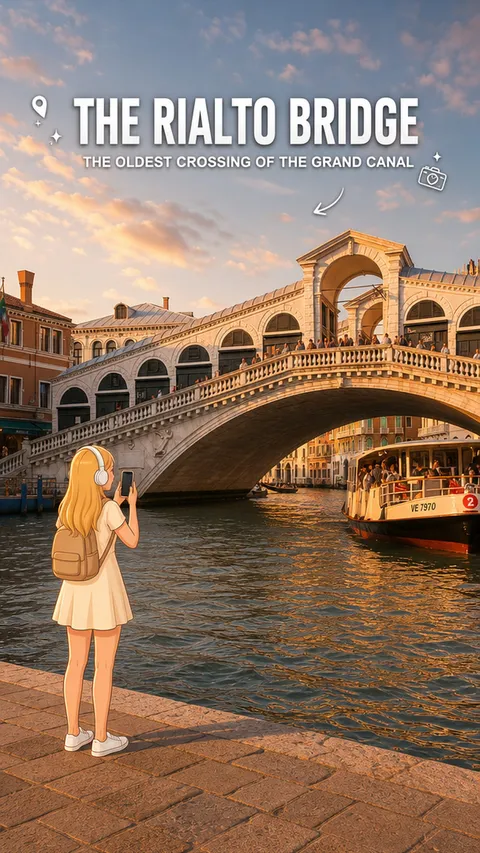
- Rialto Bridge (free): the oldest crossing of the Grand Canal. The Rialto food market sits beside it (mornings, Mon to Sat, closed Sundays).
- Bridge of Sighs (free to view from Ponte della Paglia): the white limestone bridge where prisoners glimpsed Venice for the last time.
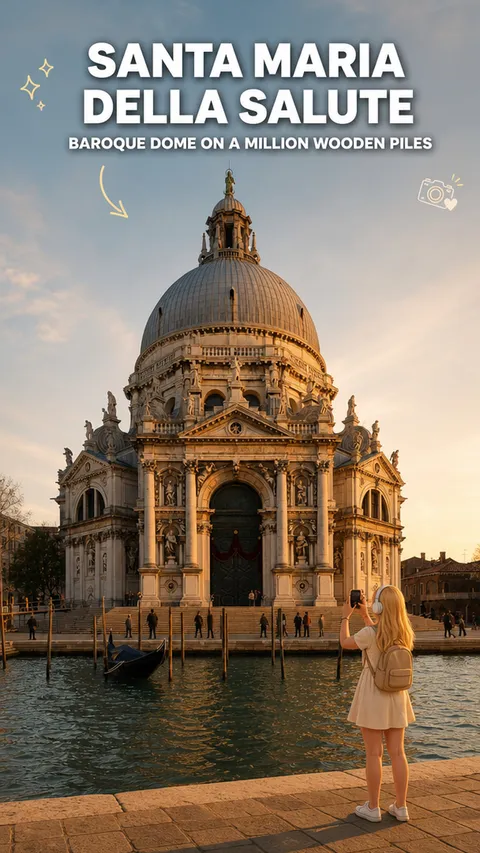
- Santa Maria della Salute (free entry; sacristy ~€3): Longhena's domed baroque masterpiece on a million wooden piles, guarding the canal mouth.
- Gallerie dell'Accademia (~€15; closed Monday): the world's great collection of Venetian painting for an art-led morning.
- Campo Santa Margherita (free): the student square in Dorsoduro, the best spot for an unhurried €4 spritz away from the San Marco prices.
The route the tour walks with you
Instead of a generic "see San Marco, then the Rialto" list, you walk one efficient loop and the tour walks it with you. This is the real sixteen-stop order, starting in Piazza San Marco, looping out through Dorsoduro and back across the Rialto, so you barely double back. The tour can be launched from any stop, so if you would rather start at the Rialto or the station and walk the loop in reverse, you do you.
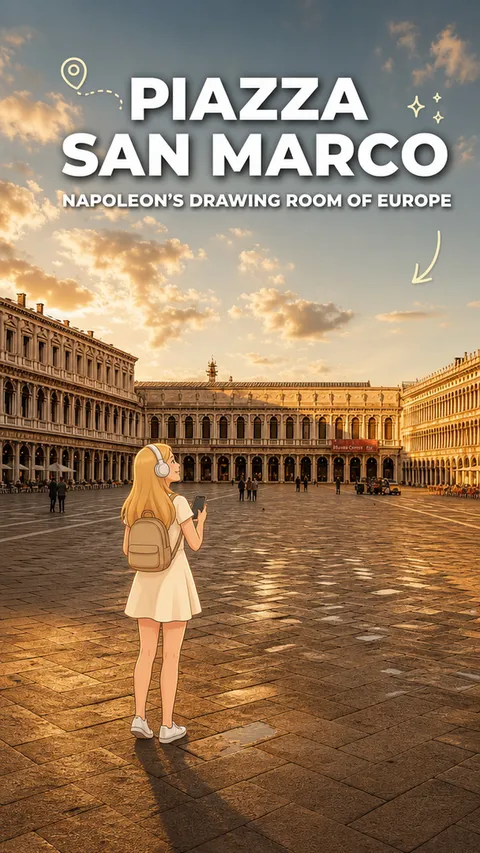
- 1Piazza San Marco Free · your start
Napoleon's "finest drawing room in Europe," a 176-meter square that is the beating heart of the city. Arrive before the late-morning crush and it is briefly yours.
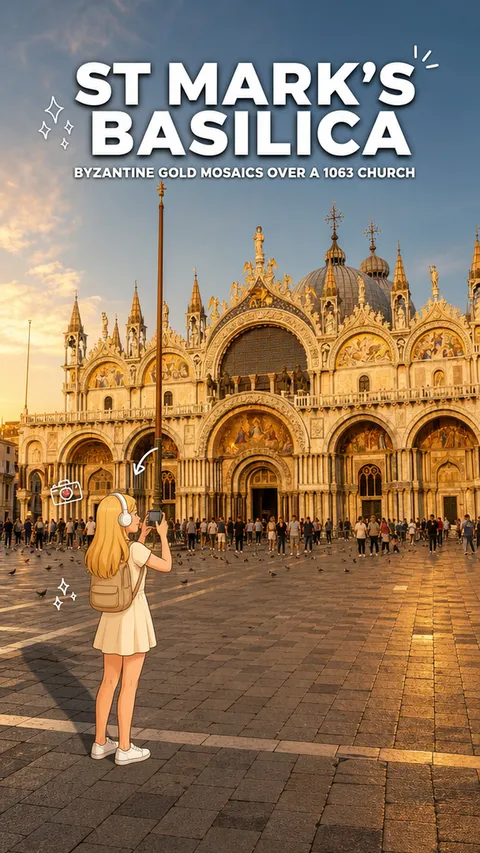
- 2St Mark's Basilica Entry small fee
Byzantine architecture from 1063, holding the relics of Saint Mark beneath more than 500 columns of precious marble and a ceiling of gold mosaic.
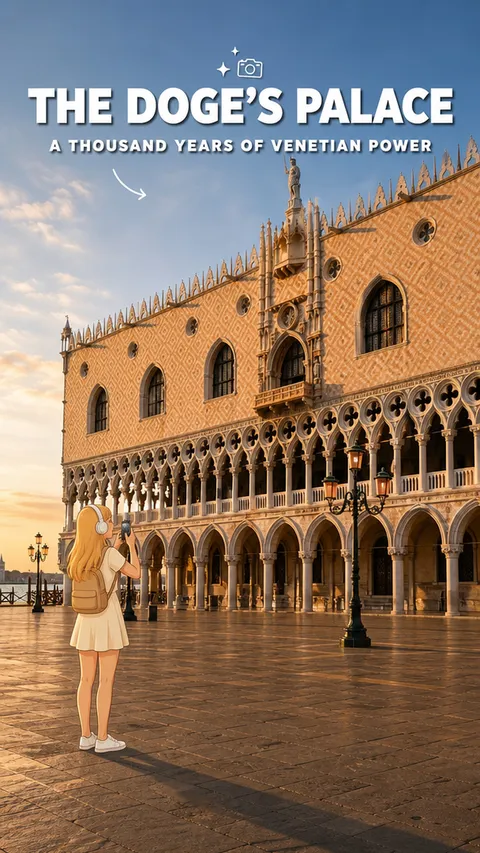
- 3Doge's Palace ~€30 online
Seat of Venice's Doges for a thousand years, joined to the old prison by the Bridge of Sighs. The Gothic facade alone is worth the pause.
- 4Bridge of Sighs Free to view
Built in 1603, the covered bridge where prisoners glimpsed Venice for the last time. The name was a romantic invention of the 19th century.
- 5San Zaccaria Free · crypt ~€1.50–3.50
Burial place of eight Doges and home to Giovanni Bellini's luminous "Sacra Conversazione," founded back in the 9th century. The flooded crypt mirrors its own columns.
- 6Santa Maria della Salute Free · ~€3 sacristy
Longhena's baroque masterpiece on a million wooden piles, raised in thanks for the end of the 1631 plague, guarding the mouth of the Grand Canal.
- 7Gallerie dell'Accademia ~€15 · closed Mon
The world's largest collection of Venetian painting, with Titian and Tintoretto, in the former monastery school of the Carità.
- 8Ponte dell'Accademia Free
One of only four bridges over the Grand Canal, rebuilt in 1985, with a postcard view straight to the Salute.
- 9Dorsoduro Free
"Hard back," Venice's firmest ground, a student quarter of quiet canals and the city's calmest wandering.
- 10Ca' Rezzonico ~€10 to 14 · closed Tue
Robert Browning's last home, now the museum of 18th-century Venice, with frescoes by Giambattista Tiepolo.
- 11Campo Santa Margherita Free
A lively student square, the only one in Venice with trees, and the best spot for an unhurried spritz.
- 12Campo San Polo Free
Venice's second-largest square, once a venue for bullfights and masked balls, hushed now between the lanes.
- 13Mercato di Rialto Free · mornings, closed Sun
A thousand years of market tradition since 1097, loud with fresh fish and produce, the city waking up at work.
- 14San Giacomo di Rialto Free
Reputedly Venice's oldest church, its 24-hour clock once a warning to merchants against the fraud of night trading.
- 15Rialto Bridge Free
The only crossing of the Grand Canal until 1854, a single 28-meter stone span paid for by the shop rents along its back.
- 16Piazza San Marco Free · loop close
Back to the start, where Caffè Florian, open since 1720, claims the title of Europe's oldest coffee house.
It runs in your browser, no app and no download. A voice guide walks the loop with you and leads a real conversation as you go: it greets you, tells the story between stops, asks what you actually want to see, and adapts. It is not a recording and not an audioguide. The map and step-by-step navigation get you from each stop to the next.
That whole loop is our free, self-guided Venice walking tour, and because it can be launched from any of its stops, you do not backtrack to find an official start, you just begin where you are. You open it the moment you step off the train at Santa Lucia, ride vaporetto Line 1 down the Grand Canal to San Marco, and enter the loop right there. It runs in your browser, with no app and no download. A voice guide walks the route with you and leads a real conversation as you go: it greets you, tells the story between stops, asks what you actually want to see, and adapts to the eight hours you have. It is not a recording and not an audioguide. The map and step-by-step navigation get you from San Marco to the Rialto and back without squinting at Google Maps. See the full route on the Venice walking tour page, and you get 100 free credits to try it.
Insider Tips for the Venice Day Trip
A day trip this easy lives or dies on a few small habits, none of them expensive.
Do
- Take the Regionale Veloce, not the stopping Regionale, when one is leaving soon
- Validate paper tickets in the green-and-white machine before boarding
- Get off at Venezia Santa Lucia, the island terminus, never Mestre
- Walk into Venice early, around 8:30 a.m., before the cruise crowds land at 9:30
- Eat cicchetti at a bacaro in Cannaregio or Dorsoduro, not lunch on the San Marco drag
- Carry a refillable bottle. Venice tap water is safe and the nasoni flow all day
- Wear real shoes. You will walk 15 to 25 km, much of it on bridged stone steps
Don't
- Don't take the Frecciarossa. It costs 4 to 8 times more for the same 26 minutes
- Don't skip validating a paper ticket. Fines are large and inspectors are not forgiving
- Don't eat on the San Marco drag. Walk 10 minutes in any direction for half the price
- Don't try to bolt on Murano and Burano. Each is a 40+ minute vaporetto each way
- Don't buy a vaporetto pass unless you will ride 3+ times. Walking is free and faster
- Don't plan the day around the absolute last train. Take the second-to-last instead
Two Venice-specific heads-ups. First, pickpockets work the crowds around Piazza San Marco, the Rialto Bridge, and the vaporetto, so keep bags zipped and in front. Second, Venice runs a day-tripper access fee (the Contributo di Accesso) on a set list of high-season days, aimed exactly at visitors who arrive and leave the same day. The fee is modest (around €5) and the qualifying dates change each year, so check the official Venezia Unica site before your travel date and register if your day is on the list. Overnight visitors are exempt.
Luggage
If you are on a pure day trip from Padua, this is a non-issue: leave the bag at your Padua hotel and travel light. If you are transiting through, Santa Lucia station has a left-luggage office (Kipoint) near platform 1, and there are private luggage drops within a few minutes of the station. The regional trains have overhead racks and end-of-car space, and a small daypack is never a problem.
Buffer
Build in a margin on the return. The locals' rule is to take the second-to-last regional back to Padova, not the absolute last train of the night, so a delay or a missed connection does not strand you. Regional trains on this line run late, but they do run, and there is another one every 20 minutes through the evening.
More day trips from Padua
Out in the morning, back in time for dinner. Every route here fits in one full day.
What the Padua to Venice Journey Feels Like
This is the part no fare table captures. The Padua to Venice leg is short, but the last five minutes are the kind of train approach you remember.
Out of Padova Centrale, the train rolls flat through the mainland edge of the Venetian plain, past warehouses, electrical yards, and the back fences of Mestre. Then the land falls away on both sides. The track climbs onto the causeway across the lagoon, the water opens up, and for a few minutes you are gliding over open water toward a skyline of domes and campaniles, with no road and no cars anywhere. The doors open at Santa Lucia onto a waterfront terminus, the Grand Canal right there, and that strange Venetian hush, the one that sits under all the noise, hits immediately.
Then the day itself, the texture of it. The interior of Saint Mark's is one giant glitterfest of gold mosaic, every surface catching the light, your neck sore from looking up. The Rialto market in the morning is sensory overload: fish stalls, vendors shouting in dialect, black squid ink and tiny lagoon crabs on ice. The back canals of Dorsoduro go quiet enough that you hear your own footsteps, and the locals walking dogs look vaguely surprised to see you. A spritz at a plastic table on Campo Santa Margherita costs €4 to €5 and tastes exactly right.
Then the contrast, which is the whole emotional arc of this day trip. Venice floats serenely on water, all dream and beauty and crowds. Padua hums with everyday Italian life: markets, bicycles, espresso bars, students, 12 kilometers of porticoes that keep you dry even in the rain. The 26-minute train lets you live in the grounded city and spend the day in the dream, and at the end of the day it brings you home to affordable dinner and a real piazza. That contrast is why this is the model day trip: not because Venice is the better city, but because the two of them together are better than either one alone.
Padua to Venice: Your Questions Answered
Can you do Venice as a day trip from Padua?
Yes, easily. The regional train is about 26 minutes each way, runs every 20 minutes, and costs around €4.70 one way. Leave at 8:00 a.m. and you have a full 10 to 12 hours on the ground if you want them. This is the easiest and cheapest major day trip in the Veneto.
How long is the train from Padua to Venice?
About 26 minutes on the Regionale Veloce and 45 to 50 minutes on the stopping Regionale. Both cost the same €4.70 and arrive at Venezia Santa Lucia. Take the Veloce when one is leaving soon.
How much does the train cost?
Around €4.70 one way, or about €9.40 round trip. Regional tickets have flat pricing: the fare is the same whether you buy weeks ahead or minutes before departure. No advance discount, no dynamic pricing, no surge.
Do I need to book in advance?
No. This is the rare Italian train route where booking ahead saves you nothing. Buy in the Trenitalia app or at the station machines on the day. The only thing you must do with a paper ticket is validate it in the green-and-white machine before boarding.
Frecciarossa or Italo instead?
Not on this route. The high-speed trains cost €20 to €45 one way, require seat reservations, and arrive in roughly the same 27 to 29 minutes as the €4.70 Regionale Veloce. Save that budget for a longer leg.
What time is the first and last train?
First regional trains from Padova start around 5:30 to 6:00 a.m. Last regional trains back from Venezia Santa Lucia run until roughly 11:30 p.m. to midnight. For comfort, take the second-to-last train rather than the absolute last.
Which Venice station should I get off at?
Venezia Santa Lucia, the island terminus on the Grand Canal. Do not get off at Venezia Mestre, which is the mainland stop just before Santa Lucia. Stay on until the train reaches its final waterfront stop.
Should I buy a vaporetto pass?
Only if you plan to ride three or more times. Single rides are about €9.50, a 24-hour pass is about €25. Most of Venice is best seen on foot, and walking is free, so for a one-day visit where you plan to walk most of the loop, pay per ride or skip the vaporetto entirely.
Is the Venice day-tripper fee a thing?
Yes, on selected high-season days. Venice charges a modest access fee (around €5) to non-overnight visitors on certain peak dates, aimed exactly at day-trippers. Check the official Venezia Unica site before you go to see if your date qualifies and to register in advance.
Plan Your Venice Day Trip
You have the train sorted, which is the part most people get wrong on harder routes. Now make the hours on the ground count. The sixteen-stop loop above is our free, self-guided Venice walking tour, and because it starts from any stop, you launch it the second you step off the train at Santa Lucia, ride Line 1 down the Grand Canal to San Marco, and enter the loop right there. Open it and start walking with 100 free credits.
Before you go, two more things worth a look:
- When to actually visit Venice: the best months, the crowd patterns, and the acqua alta season, so you pick the right day.
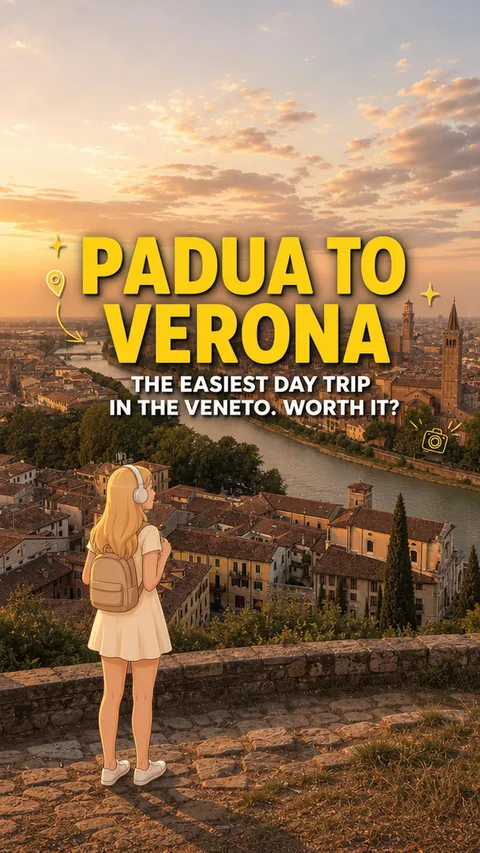
- More day trips from Padua: if Venice gets its own overnight instead, Vicenza, Verona, and the Euganean Hills are all easy from Padua and reward a slower day.
