
Padua Day Trip from Venice: 30 Min to Giotto
Thirty minutes west of the lagoon, a fixed €4.75 regional train drops you in the centre of Padua. You don't need to plan the day: open our free self-guided guide and it walks you from Giotto's frescoes to the squares.
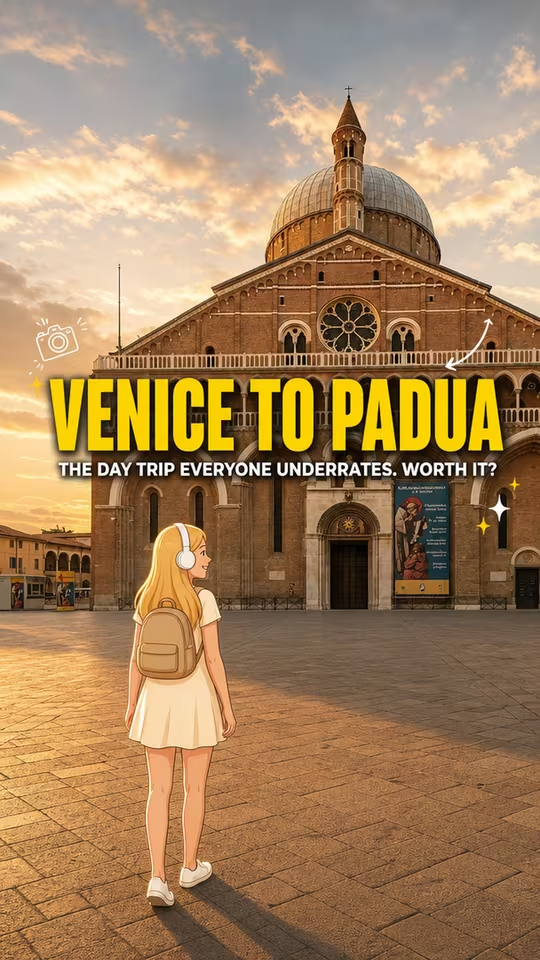
The Quick Answer: Venice to Padua
Padua (Padova in Italian) is the easiest day trip you can make from Venice, and quietly one of the best. It sits 37 km west of the lagoon, a fixed €4.75 regional train gets you there in under half an hour, and the historic centre starts a ten-minute walk from the station. The pull is Giotto's Scrovegni Chapel, a complete 1305 fresco cycle that is the foundation of Italian painting and a UNESCO World Heritage site. Around it you get a working university city (founded 1222), the great pilgrimage Basilica of Saint Anthony, one of Europe's largest squares, and an aperitivo culture that fills the piazzas every evening. It is real, lived-in Italy, half an hour from Venice's crowds. The one rule: book the chapel before you do anything else.
| Question | The short version |
|---|---|
| How long is the trip? | About 25 to 30 minutes on a regional train, Venezia Santa Lucia to Padova Centrale. |
| How much? | €4.75 each way on the regional, a fixed fare. High-speed exists but is overkill here. |
| How often? | Roughly 80 trains a day, about one every 15 to 20 minutes. No timetable to plan around. |
| Do I need to book? | Not the train. Yes, the Scrovegni Chapel, well in advance. |
| Is one day enough? | Yes, comfortably. You get 8 to 10 usable hours on the ground. |
| The one thing to get right? | Reserve your Scrovegni Chapel slot first. The whole day builds around it. |
Is the Venice to Padua Day Trip Worth It?
Yes, without hesitation, and of every mainland option from Venice this is the one we send first-timers on. The case for Padua is simple. You trade Venice's beautiful, exhausting tourist crush for a city that still belongs to its students and its market traders, you see arguably the most important early-Renaissance painting in Italy, and you spend a fraction of Venice prices on lunch and drinks. The arcaded streets keep you dry in the rain, the centre is flat and crossable on foot in twenty minutes, and nothing about it feels staged.
The best of Padua, stop by stop


The case against is narrow. If you have only two or three nights in Venice and have not yet seen San Marco, the Rialto and a quiet back canal at dawn, Padua can wait for a return trip. And if you flatly refuse to pre-book anything, the Scrovegni Chapel's reserved-slot system will frustrate you. For everyone else, it is a clean win.
Thirty minutes and under five euros buys a UNESCO fresco cycle and a city that still feels like real Italy. [yes] The chapel alone is worth the train. Everything else is the city you get for free. [no] If you have two nights in Venice and have not seen San Marco yet, save Padua for next time. [yes] Of all the mainland day trips, Padua and Verona are the two we would never talk anyone out of.
Good fit if you...
- Want Giotto's frescoes, the painting everything Italian came from
- Are tired of Venice's crowds and want a real, working Italian city
- Travel on a budget, where Padua food and drinks cost a fraction of the lagoon
- Like markets, student energy and a long aperitivo in the squares
Skip it (save Padua) if you...
- Have only two or three days in Venice and have not seen the basics
- Will not pre-book anything (the chapel needs a reserved slot)
- Want beaches or designer shopping, not churches and frescoes
How to Get from Venice to Padua by Train
The train wins this route so decisively that the only real question is which train. Venezia Santa Lucia, the station in Venice's historic centre right on the Grand Canal, runs frequent regional trains to Padova Centrale, on the northern edge of Padua's old town. From there it is a ten-minute walk to the Scrovegni Chapel or a short ride on the SIR1 tram. Buses and cars are slower, dearer and drop you in worse places. The Brenta Canal boat is wonderful, but it is a full-day experience, not a way to get to Padua and back.

| Option | Time each way | Cost each way | Verdict |
|---|---|---|---|
| Regional train (Regionale Veloce) | 25 to 30 min | €4.75 fixed | WINNER. Cheap, frequent, no booking, drops you a 10-min walk from the chapel. |
| High-speed (Frecciarossa / Italo) | 13 to 20 min | €9 to €18 | Faster on paper. You pay two to four times the fare to save ten minutes on a 30 km hop. |
| Bus (FlixBus / ACTV) | 40 min to 1h7 | €10 to €28 | Slower and dearer than the train, and it leaves from Tronchetto, not the centre. |
| Car | about 35 min | A4 tolls + parking | Pointless. You pay motorway tolls and Padua centre parking to arrive no faster. |
| Brenta Canal boat | 9 to 10 hrs | €99 to €139 | Not transport. It is a full-day Palladian villa cruise, glorious but a different trip. |
Skip the Frecciarossa. On a half-hour hop the regional is the obvious value pick, and it leaves from the very same station.
The Train in Detail
Trenitalia runs the regional service, and it could not be simpler. The Regionale Veloce covers Venezia Santa Lucia to Padova Centrale in about 26 minutes for a flat €4.75, with no seat reservation and no need to match a specific departure. With roughly 80 trains a day you turn up, buy a ticket and take the next one. One thing to remember with a paper ticket: validate it in the green and white machines on the platform before you board, or you risk a fine. Tickets bought in the Trenitalia app are validated automatically, which is the easy way to do it.
Both Trenitalia's high-speed Frecce and the private operator Italo also run this line, advertising 13 to 20 minute journeys. They are real, and if your timing happens to land on one at a good advance fare, fine. But they are built for the long Milan and Rome runs, not a 30 km commuter hop, and the maths does not favour them here.
Regional or high-speed, which to book?
| Regional (Regionale Veloce) | High-speed (Frecciarossa / Italo) | |
|---|---|---|
| Time | 25 to 30 min | 13 to 20 min |
| Fare | €4.75, fixed | €9 to €18, dynamic |
| Booking | None, any train | Reserved seat on a specific train |
| Best for | Everyone on this route | Almost nobody, for 30 km |
The fast trains exist on this line. Paying three times the fare to shave ten minutes off a half-hour ride is not a flex.
Booking Strategy
The train needs no strategy at all. The booking that matters is the Scrovegni Chapel, and that one reservation dictates the shape of your whole day. Reserve it online at the official Padova Musei site before anything else: admission runs about €15 to €16 plus a €1 fee, and the ticket also covers the Eremitani Civic Museums. Book at least 24 hours ahead, and 4 to 6 weeks ahead in summer, because slots genuinely sell out. Pick a time with a comfortable buffer after your train: a late or cancelled regional is exactly how you lose a non-refundable slot. Many people book the chapel as the last sight of the day, in the late afternoon or an evening slot, so a delayed train never threatens it.
For everything else, save your money. The PadovaCard, around €16 for 48 hours, bundles the chapel booking with free entry to the Musei Civici, Palazzo della Ragione and the botanical garden, and it pays for itself fast on this exact loop. The Urbs Picta fresco card, by contrast, only earns its keep if you visit three or more fresco sites, so most one-day visitors should leave it.
Booking checklist
- Reserve the Scrovegni Chapel slot first, before you book a single other thing.
- Choose a slot with at least a 30-minute buffer after your planned train.
- Decide on the PadovaCard if you will do the chapel plus the Salone plus the garden. It pays off.
- Do not pre-book the regional train. Buy it the morning you travel, or in the Trenitalia app where it auto-validates.
- If you want Palazzo Bo's anatomy theatre, book that guided tour separately on the university's own site.
Padua in One Day
You step off at Padova Centrale, ten minutes' walk from the Scrovegni Chapel and right at the top of the old town. Here is the part most guides get wrong: you do not need a route, a paper map, or a plan worked out the night before. Open our free self-guided tour in your browser, no app and no download, and it leads you from the moment you leave the platform. It is a real voice guide that greets you, tells the story of each stop as you reach it, navigates you turn by turn to the next one, and asks what you want to see so it can adapt the day around you. Not a recording, not a Q&A box. You start it from any stop you like, in any order, with 100 free credits to begin.

The time math
Take a regional out around 8:00 to 8:30 and you are in Padua before nine. Trains run back to Venice late, with the last comfortable departures around 22:00 to 23:00, so you realistically have 8 to 10 hours on the ground, which is plenty. The only fixed point in the day is your Scrovegni Chapel slot. Build everything else around it: the squares, the basilica and the garden all keep flexible hours, so they bend to the chapel and not the other way round.
What you'll see
One loop links almost everything that matters, and most of it is free or cheap. The headline sights, with honest current prices and hours:
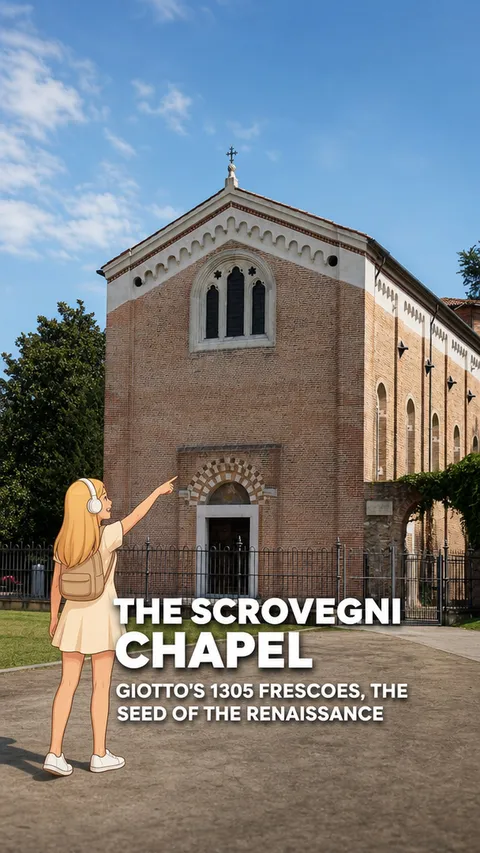
- Scrovegni Chapel (€15 to €16 + €1 fee, daily 9:00 to 19:00, must pre-book): Giotto's complete 1305 fresco cycle under a deep blue vault, 38 scenes, a strict timed slot with a 15-minute antechamber video first.
- Basilica of Saint Anthony (free, daily 6:15 to 19:00; museums €2.50): one of Italy's great pilgrimage churches, eight domes, Donatello bronzes on the high altar, the Gattamelata equestrian monument out front. Shoulders and knees covered.
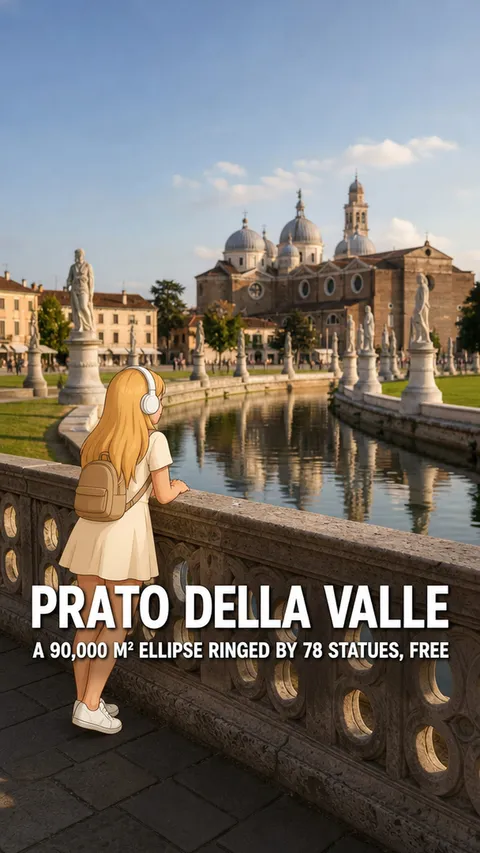
- Prato della Valle (free, open 24/7): an elliptical island ringed by a canal and 78 statues, nearly 90,000 m², one of the largest squares in Europe.
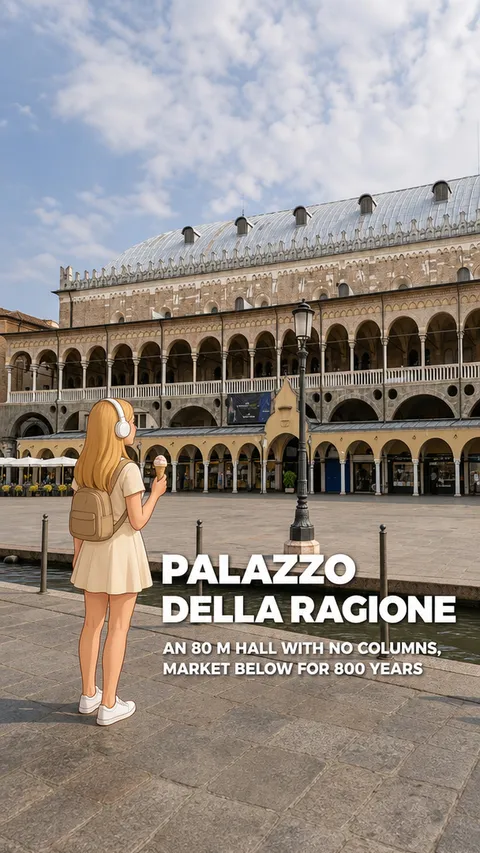
- Palazzo della Ragione (about €7 to €10, Tue to Sun 9:00 to 18:30): the medieval Salone, an 80 m hall with no columns and an astrological fresco cycle. The Sotto il Salone market below it is free and has traded for some 800 years.
- Caffè Pedrocchi (free to enter): the neoclassical grand cafe of 1831, once open around the clock as "the cafe without doors". Order the signature Pedrocchi: espresso, mint, cream and cocoa.
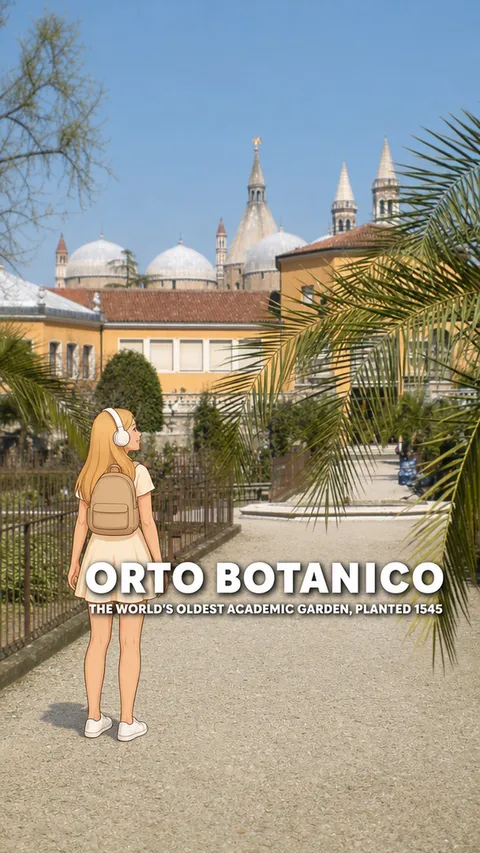
- Botanical Garden (Orto Botanico) (€10, hours vary by season, roughly 9:00 to 19:00 in summer): the world's oldest academic botanical garden still on its original 1545 site, with Goethe's palm of 1585 under glass.
- Baptistery of the Cathedral (about €15, daily, timed entry): a small domed interior frescoed top to bottom by Giusto de' Menabuoi in the 1370s, part of the same UNESCO listing as the Scrovegni and a fraction of the crowd.
The route the tour walks with you
The walking loop is about 5.3 km of flat, mostly arcaded ground, so rain barely touches you. It runs north to south and back, and because the guide starts from any stop, you can join it wherever your chapel slot drops you and never have to backtrack.
- 1Scrovegni Chapel Pre-booked · €15
Your timed slot under Giotto's blue vault. Book the morning's first slots for the quietest room and the softest light.
- 2Church of the Eremitani Free
Two minutes south, and almost nobody walks over. Mantegna's bombed and reassembled frescoes, a ship's-keel wooden ceiling, the same UNESCO circuit.
- 3Basilica of Saint Anthony Free
The domed silhouette guides you in. Donatello's bronzes inside, the Gattamelata bronze horse in the square. Cover shoulders and knees.
- 4Botanical Garden of Padua €10
The calm green counterpoint to a day of churches, a walled circle of 1545 beds. Skip it without guilt if gardens bore you.
- 5Prato della Valle Free
The street opens onto the giant ellipse and its statue ring. The natural turning point, and a fine place to sit on the grass.
- 6University of Padua (Palazzo Bo) €7, tour
Plain front, the world's oldest anatomy theatre inside, Galileo's lectern. Guided tours only, or walk the free arcaded courtyard.
- 7Palazzo della Ragione €7 to €10 upstairs
You hear it before you see it: the Piazza delle Erbe and Piazza della Frutta markets. Eat a porchetta panino at Sotto il Salone below.
- 8Piazza dei Signori Free
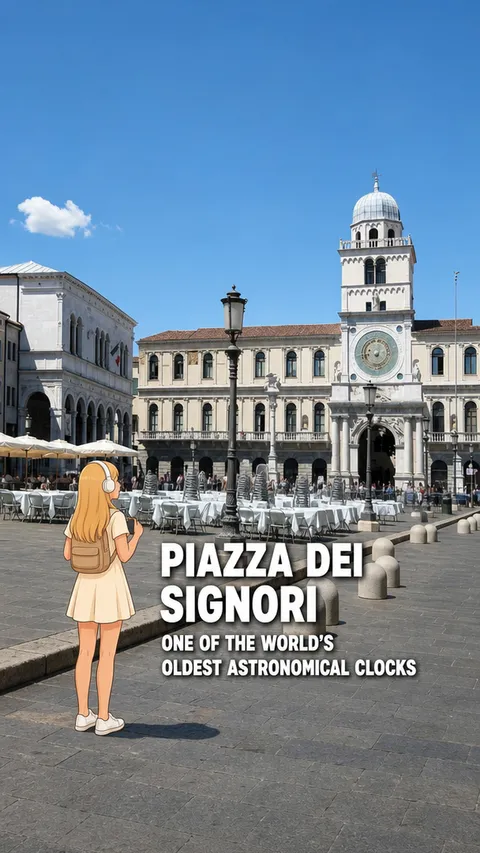
The grand civic square and its astronomical clock tower. Late light hits the dial well. Four gelato shops line the edge.
- 9Baptistery of Padua Cathedral About €15
A small door, an overwhelming frescoed sky by Giusto de' Menabuoi. It rivals the Scrovegni and gets a fraction of the crowd.
- 10Ponte Molino Free
The loop ends at water, a Roman-era bridge and the medieval Porta Molino tower. Five minutes east is the chapel where you started.
It runs in your browser, no app and no download. A voice guide walks the loop with you and leads a real conversation as you go: it greets you, tells the story between stops, asks what you actually want to see, and adapts. It is not a recording and not an audioguide. The map and step-by-step navigation get you from each stop to the next.
Insider Tips for the Padua Day Trip
Do
- Book the Scrovegni Chapel first. That one slot dictates the rest of the day.
- Take the regional, not the Frecciarossa, and save around €20 per couple round trip.
- Eat at Sotto il Salone, the market under Palazzo della Ragione, the best-value lunch in town.
- Order the signature Caffè Pedrocchi, espresso with mint, cream and cocoa.
- Use the SIR1 tram if your feet give out. Tap a bank card on board, no paper ticket needed.
Don't
- Don't rush for the earliest train back. The evening aperitivo in the squares is half the point.
- Don't buy the Urbs Picta Card on reflex. It only pays off for three or more fresco sites.
- Don't visit Prato della Valle on a Saturday if you want to see the square. The market covers it.
- Don't arrive at siesta. The Baptistery, the museums and the basilica's relic chapel close midday.
- Don't search "Padua" on Trenitalia. Use the Italian "Padova", or you will get no results.
A note on the station
The walk out of Padova Centrale is not Venice stepping onto the Grand Canal. The few streets right around the station are plain rather than charming, so walk briskly down toward Corso del Popolo, or hop the tram, and you are in the handsome arcaded centre within minutes. It sets a false first impression of a city that gets lovelier with every block.
The Scrovegni Chapel is non-refundable and sells out weeks ahead in summer. Book it the moment your travel dates are fixed, give yourself a buffer after the train, and treat it as the anchor the rest of the day hangs from.
More day trips from Venice
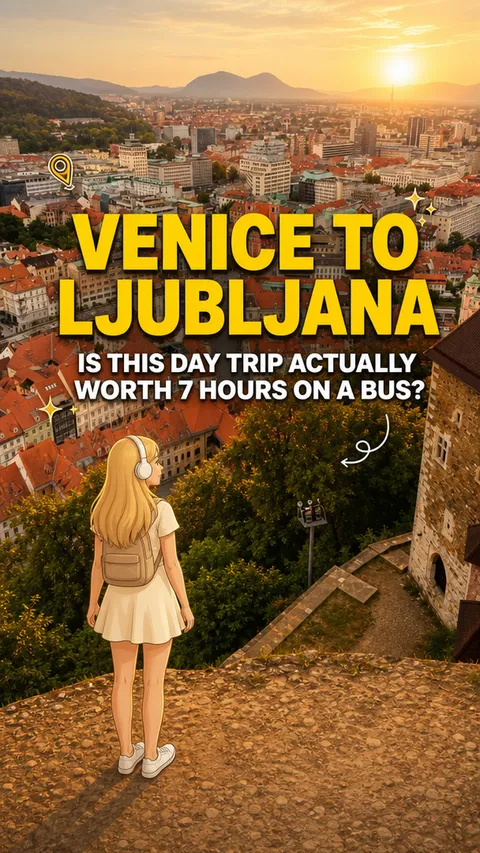
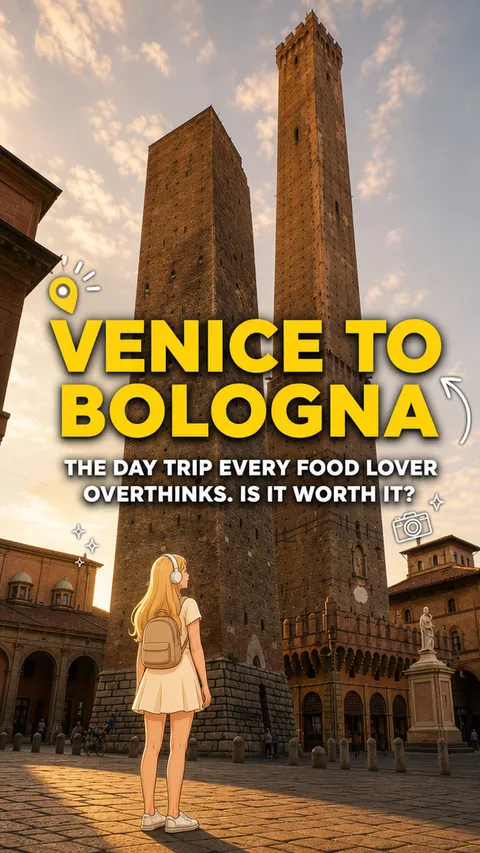
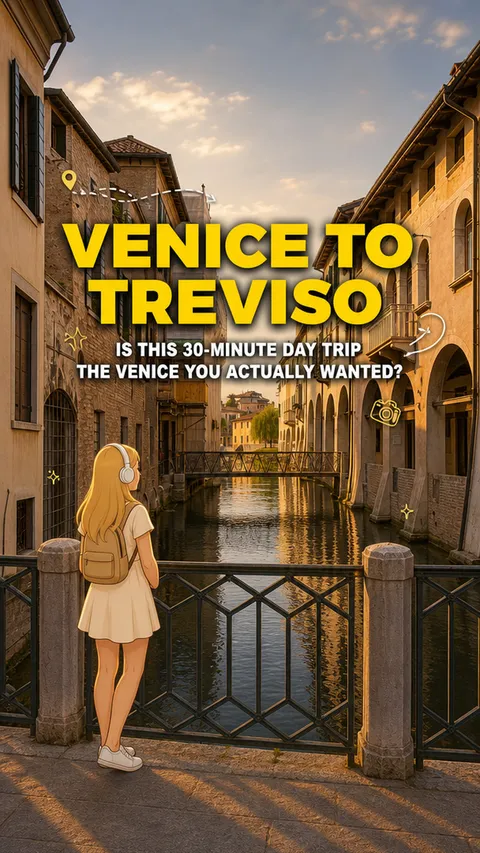
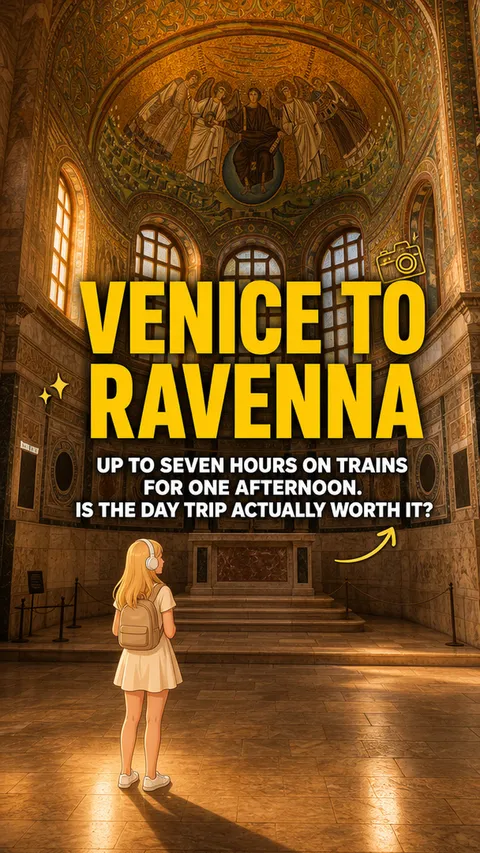
Out in the morning, back in time for dinner. Every route here fits in one full day.
What the Venice to Padua Journey Feels Like
The ride itself is a half-hour of flat Veneto countryside sliding past the window, fields and farmhouses and the first low hills, gone before you have finished a coffee. Then Padua arrives all at once. The brick box of the Scrovegni Chapel gives nothing away from the park outside, and then you are under that deep blue ceiling and it lands even if you did not think you cared about frescoes. It is the seed of everything that came after in Italian painting, and you feel it.
After that the city loosens. The basilica fills and empties with pilgrims touching the green marble of the tomb. The market squares smell of cheese and porchetta and spilled spritz, and students cut through on bicycles between lectures. The arcades carry you from square to square out of the sun or the rain. By late afternoon the light goes long and gold on Prato della Valle, the statue ring throws shadows across the grass, and the smart move is to do nothing about it: sit, order an Aperol, and let the earliest train back leave without you. Padua's evening is the reward, and rushing for the first train home is how you miss the best of the city.
Venice to Padua: Your Questions Answered
How long is the train from Venice to Padua?
About 25 to 30 minutes on a regional train from Venezia Santa Lucia to Padova Centrale. High-speed trains can do it in 13 to 20 minutes, but for such a short hop the time saving is not worth the higher fare.
How much does the Venice to Padua train cost?
The regional train is a fixed €4.75 each way, so €9.50 round trip. High-speed Frecciarossa or Italo fares run from roughly €9 up to €18 each way depending on how far ahead you book.
Do I need to book the train in advance?
No. The regional train is turn-up-and-go with no reservation, and there are around 80 a day. Just buy a ticket and take the next departure. If you use a paper ticket, validate it on the platform before boarding; app tickets validate themselves.
Is one day in Padua enough?
Yes, comfortably. With 8 to 10 hours on the ground you can see the Scrovegni Chapel, the Basilica of Saint Anthony, the main squares and the markets at a relaxed pace, with time for a long aperitivo before the train back.
Do I have to book the Scrovegni Chapel?
Yes, and it is the single most important piece of planning. Booking is mandatory and online only at the official Padova Musei site. Reserve at least 24 hours ahead, and 4 to 6 weeks ahead in summer. Choose a slot with a buffer after your train, since the ticket is non-refundable.
Is Padua worth it compared with Verona or the islands?
For a first-timer, Padua and Verona are the two strongest mainland day trips from Venice, and we would not steer anyone away from either. The lagoon islands of Murano and Burano are a different, shorter kind of outing. Padua is the pick if you want frescoes, a real working city and good-value food.
Which Venice station do I leave from, and where do I arrive?
You leave from Venezia Santa Lucia, the station in Venice's historic centre on the Grand Canal, not Mestre on the mainland. You arrive at Padova Centrale, a ten-minute walk or a short tram ride from the centre.
Is Padua a good rainy-day trip?
One of the best. The old town runs under about 12 km of arcaded porticoes, so you can walk most of the route mostly dry, and the paid indoor sights, the chapel, the basilica, the Baptistery and the Salone, make natural shelters. Mind the slick stone underfoot.
Should I take the Brenta Canal boat instead of the train?
Only if a slow scenic cruise past Palladian villas is the experience you want, not Padua's sights. The boat is a full 9 to 10 hour day, runs March to October, and costs €99 to €139. If you want Padua itself, take the €4.75 train and keep the day for the city.
Plan Your Padua Day Trip
Reserve your Scrovegni Chapel slot, take the next regional from Venezia Santa Lucia, and let the rest of the day stay loose. When you walk out of Padova Centrale, open our free self-guided guide in your browser. It greets you, walks you from the chapel to Prato della Valle and back, tells the story behind each fresco and square, navigates you turn by turn, and adapts as you go. A real conversation, not a recording, no download, starting from any stop with 100 free credits. Spend the saved planning time on a spritz in Piazza dei Signori instead.
It runs in your browser, no app and no download. A voice guide walks the loop with you and leads a real conversation as you go: it greets you, tells the story between stops, asks what you actually want to see, and adapts. It is not a recording and not an audioguide. The map and step-by-step navigation get you from each stop to the next.
