
Venice to Bolzano Day Trip: Train Times & Day Plan
The train is the only sensible answer here: 3 hours each way through the Adige valley, you step out five minutes from Waltherplatz, and the Alps open up around a city that suddenly speaks German. Here is the honest day plan, with fares, transfer logic, and a free self-guided tour for the hours on the ground.
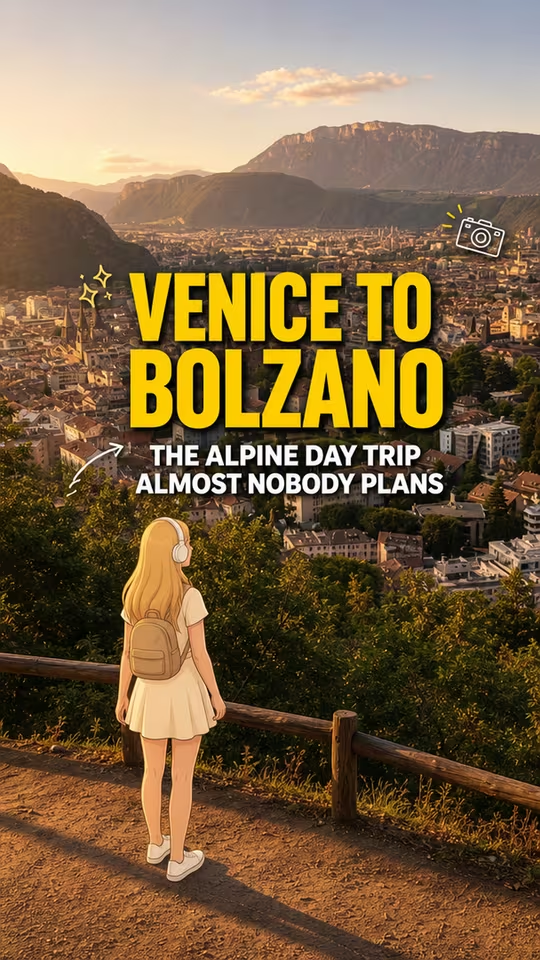
The Quick Answer: Venice to Bolzano
The smart way from Venice to Bolzano is the train, and on this route there is no real second choice. Trenitalia and Italo get you from Venezia Santa Lucia to Verona Porta Nuova in 1h12 to 1h30, usually nonstop, and from Verona a regional or Intercity service climbs north through the Adige valley to Bolzano/Bozen in 1h38 to 2h21. Total journey time around 3 hours each way, with a comfortable same-station change at Verona of roughly 20 minutes. Fares land at about €25 to €50 each way if you book a little ahead, with floor prices near €21 on the regional legs and €15 on the high-speed leg if you catch a Super Economy seat early. Bolzano station sits a flat 5-minute walk south of Piazza Walther, the main square, so you step off the train straight into the old town.
As a day trip Bolzano is doable, rewarding, and a long day. Leave Venice around 7:00 a.m., arrive in Bolzano near 10:00 a.m., and you have seven to eight usable hours before an early-evening train back. That is enough for Ötzi, the cathedral, the arcades, the produce market, a proper plate of canederli, and a stroll out to Castel Roncolo. The trade is the transit: six hours on trains for one Alpine day. For most travelers with three or more days in Venice, that trade is worth it. For someone on a tight Venice schedule, it is not.
| Question | Answer |
|---|---|
| Fastest journey time | ~2h56 by the 2x daily DB Intercity direct; ~3h12 via Verona (the standard route) |
| Frequency | Hourly to Verona all day; connections north to Bolzano every 1 to 2 hours |
| Price from | ~€21 to €25 one-way regional floor booked early; typical €30 to €50 each way |
| Operators / how | Trenitalia + Italo to Verona, then Trenitalia Regionale or DB Intercity to Bolzano. Optional direct DB IC 2x daily |
| First / last | First sensible trains from ~6:30 to 7:00 a.m.; last return from Bolzano around 7:00 to 8:00 p.m., back to Venice ~10:00 to 11:00 p.m. |
| Worth it as a day trip? | Yes, with realistic expectations. Seven usable hours on the ground, fully walkable, no car needed |
Is the Venice to Bolzano Day Trip Worth It?
Bolzano is the strangest day trip you can take from Venice, and that strangeness is the whole reason to go. In three hours on a train you trade the lagoon, the crowds, and the Byzantine glitter for an Alpine basin where the street signs switch to German first, the cafés pour Lagrein alongside Aperol, and the Dolomites fill the end of every street. It is the closest thing to leaving Italy without actually leaving Italy, and that contrast is the entire appeal. If you want a day that feels completely different from Venice, Bolzano delivers it harder than anywhere else reachable on a day trip rail ticket.
The best of Bolzano, stop by stop


The "absolutely go" case rests on density. Bolzano is small, walkable, and packed. The cathedral, the arcades, the produce market, the South Tyrol Museum of Archaeology with Ötzi the 5,300-year-old iceman, and a frescoed medieval castle on a river rock all sit inside a 3.3-kilometer line that you can walk end to end in an afternoon. The train station is five minutes from the main square. There is no transfer drama, no parking stress, no car needed. You just step off the train and start walking.
Three hours of train for a city that swaps canals for mountains, German for Italian, and Ötzi for the Doges. A long day, but the contrast is worth every minute on the rail.
The "give it more time" camp is not arguing against Bolzano. They are arguing against the rush. Six hours on a train is a real cost. The transit eats into your Venice trip, and a long day means leaving in the dark and coming home in the dark. Bolzano is also the natural gateway to the Dolomites, the Renon plateau, the wine road, and the Christmas markets, all of which reward an overnight. If you can spare the night, spare it. The city is lovelier after the day-trippers leave, when the arcades go quiet and the cafés on Waltherplatz pour Hugo spritzes to locals.
If you have less than three full days in Venice, save Bolzano. Six hours on a train steals too much of a short Venice trip. Spend it on the lagoon.
Our call: if you have a spare day in Venice, you want a contrast, and you can commit to an early train, Bolzano is one of the most rewarding day trips you can take. The headline sights are all walkable, the food alone is worth the ticket, and the city is calm in a way Venice never is. The only travelers who should hesitate are those still short on Venice itself, families with very young kids who would melt on a six-hour rail day, and anyone planning a separate Dolomites trip, in which case fold Bolzano into that instead.
Good fit if you...
- Have 3+ days in Venice and one to spare
- Want a complete alpine, German-speaking contrast to the lagoon
- Are curious about Ötzi or South Tyrolean food and wine
- Are comfortable with a 6-hour round-trip on trains
- Travel light and walk well
Skip it (save Bolzano for an overnight) if you...
- Only have 1 or 2 full days in Venice itself
- Travel with very young children or limited mobility
- Are already planning a Dolomites trip
- Hate early mornings or long train days
- Want a beach, not a mountain, day
How to Get from Venice to Bolzano by Train
There is one sensible mode for a Venice to Bolzano day trip, and it is the train. The car is faster on paper and worse in practice. The bus is too slow. The rideshare is unreliable on a fixed day-trip clock. The night train is for staying over, not coming back.
| Mode | Time | From | Frequency | Verdict |
|---|---|---|---|---|
| Train via Verona | ~3h12 each way | ~€25 to €50 one-way | Hourly to Verona, connecting north | WINNER. Downtown to downtown, no car, no ZTL, fastest reliable option. |
| Direct DB Intercity | ~2h56 each way | ~€25 to €45 one-way | 2x daily each way | Strong alternative if the times line up with your day. |
| Car | ~2h30 each way | Petrol + tolls + parking | When you want | Faster on paper, worse in practice. ZTL cameras in central Bolzano are notorious, parking is a chore, and the train is simpler. |
| FlixBus | ~3h55 to 4h15 each way | from €20.48 one-way | 4x daily from Tronchetto | Cheap but 8 hours of transit kills the day. Avoid. |
| BlaBlaCar rideshare | ~2h30 each way | from €9.99 | Variable | Cheap and quick when it lines up, but you cannot plan a day trip around someone else's departure. |
The train wins for one reason beyond speed: the Bolzano/Bozen station is a flat 5-minute walk south of Piazza Walther, the central square. There is no last-mile taxi, no bus, no navigation headache. You step off the train, walk north across the Talvera bridge if you want, or straight into the arcades. For a day-tripper trying to maximize hours on the ground, that station-to-center geometry is gold.
Train via Verona, every time. One easy change, you arrive on foot in the center, no car and no ZTL stress.

The Train in Detail
The standard Venice to Bolzano day-trip route is two legs, with a same-station change at Verona Porta Nuova. It looks more complicated than it is.
Leg 1: Venezia Santa Lucia to Verona Porta Nuova. A Frecciarossa or Italo high-speed service covers the 120 kilometers west in 1h12 to 1h28, nonstop, leaving roughly every 20 to 30 minutes through the day. Booked a few weeks out, Super Economy fares sit at €15 to €20. Walk-up or same-week fares climb to €40 or more. Slower Regionale Veloce trains also run the same route in about 1h30 for a flat €10 or so, unreserved, which is the cheapest option if you are flexible on time.
Leg 2: Verona Porta Nuova to Bolzano/Bozen. From Verona a Trenitalia Regionale or a Deutsche Bahn Intercity (DB IC) service runs north through the Adige valley to Bolzano in 1h38 to 2h21, roughly every 1 to 2 hours. The regional fare is around €10 to €15 one-way. The DB IC is the comfortable pick: reserved, cleaner, with power sockets, and barely more expensive when booked ahead.
The Verona change is easy. Same station, same platforms cluster, usually a 15 to 25-minute connection window, which is plenty. There is a hall with cafés and a pharmacy between platforms 1 and 2.
The direct option. Deutsche Bahn runs two direct Intercity trains each way per day between Venezia Santa Lucia and Bolzano, covering the 265-kilometer rail distance in about 2h56, no change. If the times fit your day, take it. If they do not, the via-Verona route is identical in comfort and only 15 minutes slower door to door.
Frecciarossa or DB Intercity, which to book?
| Option | Time | Typical fare | When to pick it |
|---|---|---|---|
| Frecciarossa/Italo + Regionale via Verona | ~3h12 | €25 to €50 | When you want frequency and flexibility. Hourly departures all day. |
| Direct DB Intercity | ~2h56 | €25 to €45 | When the two daily slots fit your morning and evening. No change, more legroom. |
| Regionale Veloce all the way | ~3h30 | €21 to €25 | Cheapest floor, unreserved, longest, no Super Economy. For tight budgets. |
For a day trip, lock the Frecciarossa or Italo leg to Verona early for the price, and accept whatever regional ticket north fits your connection. The high-speed leg is where Super Economy lives.
Booking Strategy
The booking strategy here is split across two legs, because the operators are different. Treat them as two separate tickets.
The high-speed leg (Venice to Verona) is the one to book early. Frecciarossa and Italo release Super Economy seats from about €15, and they sell out first. Book two to six weeks out for the best fares. Same-week bookings climb toward €40 to €60. Use trenitalia.com and italotreno.com directly, or a Trenitalia app. Cross-operator aggregators will not show you the cheapest Super Economy bucket reliably.
The Verona-to-Bolzano leg is regional and DB Intercity. Regional fares are fixed-price and cannot sell out, so there is no booking advantage to buying them early. The DB IC is reservable and slightly cheaper booked ahead, but the price delta is small. You can safely buy this leg on the day at the station, or roll it into a single Trenitalia cart at the same time as the high-speed leg.
The direct DB Intercity Venice to Bolzano, when it exists on your date, can be booked on bahn.com or trenitalia.com. It is one ticket, one seat, no change. The catch is timing: the two daily slots do not always line up with a day-trip schedule.
Booking checklist
- Pick your date two to four weeks out, ideally a Tuesday to Thursday for the lowest fares.
- Check trenitalia.com and italotreno.com for the Venice to Verona leg. Lock the cheapest morning Frecciarossa or Italo you can find.
- Add the Verona to Bolzano regional or DB IC leg to the same Trenitalia cart if you want one ticket; otherwise buy it separately.
- Check bahn.com for any direct DB IC trains on your date that might simplify the whole thing.
- Book your return leg in the same session, with a departure from Bolzano no later than 7:30 p.m. to be safe.
- Buy Ötzi museum tickets online via iceman.it at the same time, especially in summer or on rainy days. The museum is the one stop that actually queues.
- Avoid Mondays: both the Ötzi museum and Castel Roncolo close on Mondays.
There is no rail pass that meaningfully beats the advance-purchase fares on this route unless you are already running an Interrail or Eurail pass across Italy, in which case the regional legs are covered and the high-speed leg costs a pass-keeper supplement.
Bolzano in One Day
You step out of Bolzano/Bozen station, walk five minutes north, and the city opens up around you. German signs first, Italian second, mountains in the distance, the spire of the Duomo rising over the rooftops. No plan needed: open our free self-guided Bolzano walking tour right there on the station steps, and it walks you from Waltherplatz through the cathedral, the arcades, and the produce market to Ötzi, then along the Talvera to Castel Roncolo. It greets you, narrates between stops, and starts from any waypoint you happen to be standing on. A real conversation, not an audioguide. Bring headphones.

The time math
A realistic day-trip schedule:
- 6:30 to 7:00 a.m. Frecciarossa or Italo out of Venezia Santa Lucia.
- 7:30 to 7:45 a.m. Change at Verona Porta Nuova (hot coffee between platforms 1 and 2).
- 10:00 a.m. Arrive Bolzano, walk 5 minutes to Piazza Walther.
- 10:00 a.m. to 5:30 p.m. Seven and a half usable hours on the ground. Plenty for a coffee, the Duomo, the market, Ötzi, a long lunch, and the walk out to Castel Roncolo.
- 6:00 to 7:30 p.m. Train back, changing at Verona.
- 9:30 to 11:00 p.m. Back at Venezia Santa Lucia.
That is a long day. The earlier you leave Venice, the more Bolzano you get. A 9 a.m. start shrinks usable hours to about four, which is tight for everything in the timeline below.
What you'll see
The Bolzano walking tour covers the city's medieval core, the Ötzi climax, and the riverside walk out to a painted castle, in that order.
- Piazza Walther (free, 24/7): The pastel-ringed living room of the city, 900 years old, with the cathedral on one corner and café terraces all around. Coffee stop, orientation point, and the natural start.
- Bolzano Cathedral (Duomo) (free, Mon-Fri 8:00-18:00, Sat-Sun until 19:00): A Gothic church with a steeply tiled green-and-yellow Tyrolean roof, two weathered lions at the door, and a 1507 sandstone pulpit inside. Ten minutes is enough.
- Piazza delle Erbe Market (free, Mon-Sat 8:00-19:00, closed Sundays): The daily produce market, running since 1295. Buy a paper cone of speck and mountain cheese for lunch.
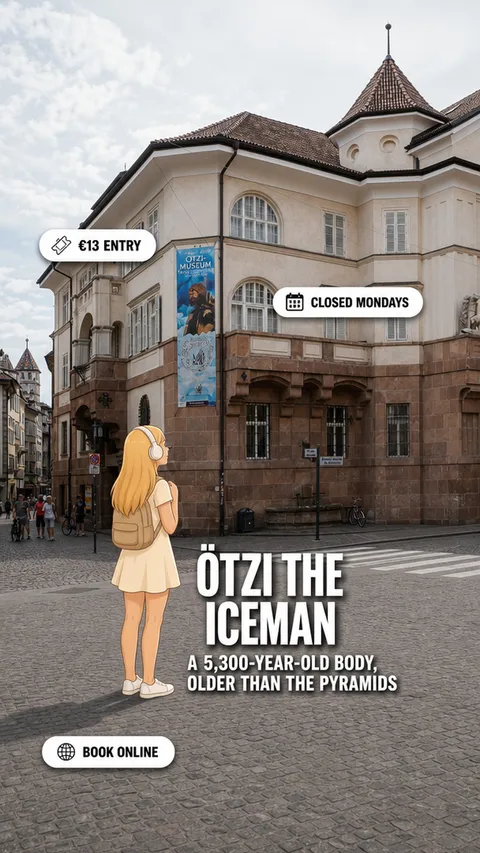
- South Tyrol Museum of Archaeology (Ötzi) (€13, Tue-Sun 10:00-18:00, closed Mondays): The 5,300-year-old iceman in a climate-controlled chamber, plus his clothes, his copper axe, and the arrowhead in his shoulder. Book online. Budget one full hour, two if you like museums.
- Talvera Promenade (free, 24/7): The riverside walk that hands you from medieval squares to Alpine landscape. Twenty flat minutes along the Talfer, with vineyards on the far bank and the Dolomites ahead.
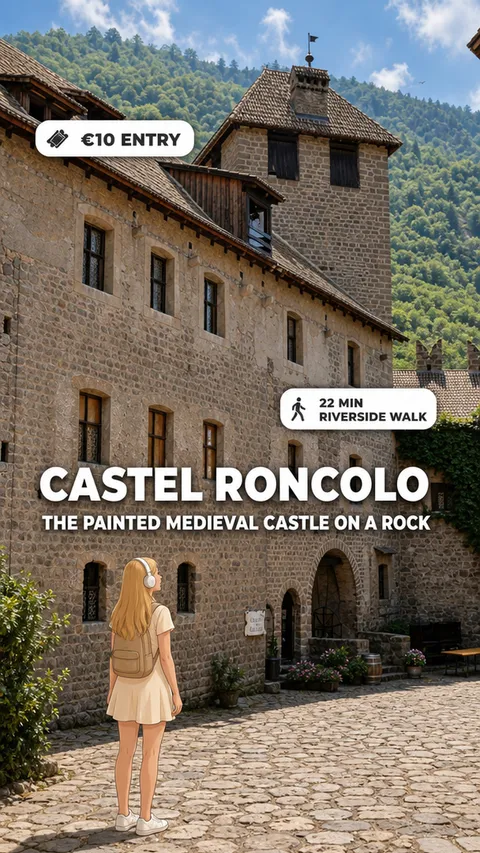
- Castel Roncolo (Runkelstein) (€10, Tue-Sun 10:00-18:00, closed Mondays): A 12th-century castle on a rock spur, painted end to end with the largest cycle of secular medieval frescoes anywhere in Europe. The climb is the only real uphill of the day.
The route the tour walks with you
The tour starts from whichever stop you happen to be standing on, no backtrack, no fixed direction. The natural line from the station runs cathedral, market, museum, river, castle, with the city tightening around you in the middle and opening up at the end.
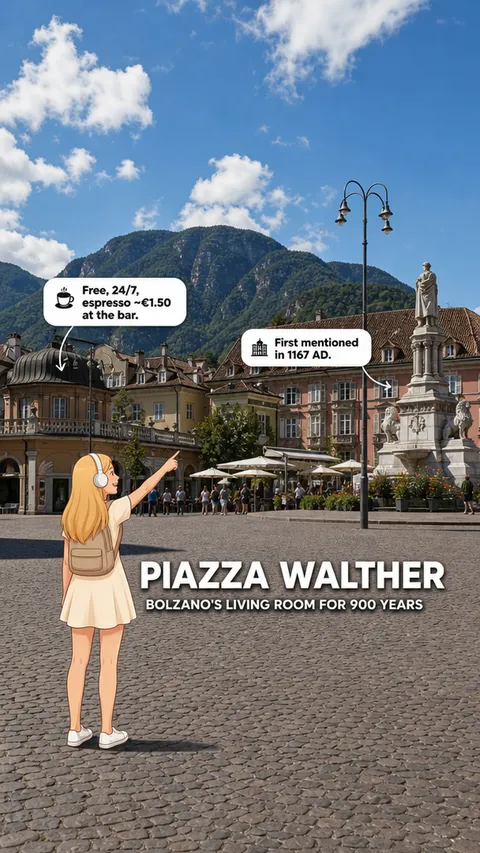
- 1Piazza Walther Start · 5 min from station
The pastel living room of Bolzano. Coffee on a terrace, the Duomo spire on the corner, statue of Walther von der Vogelweide in the middle. Do not rush this, the square is the orientation point for everything that follows.
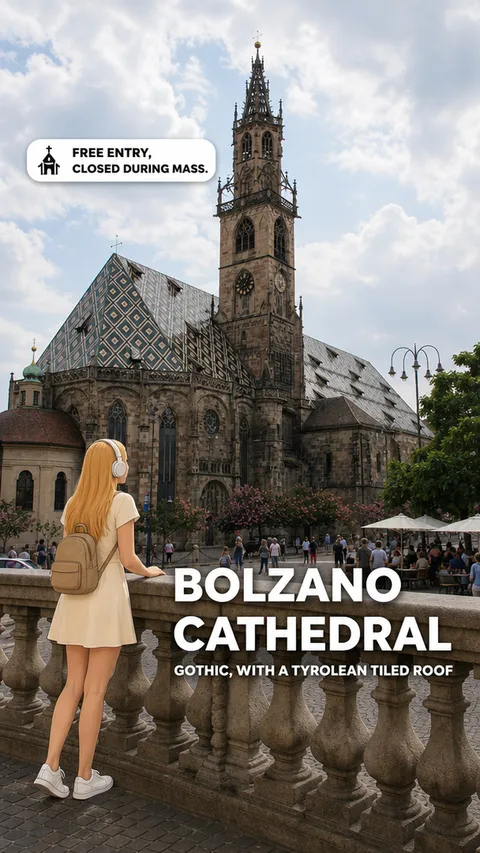
- 2Bolzano Cathedral Free · 10 min
A Gothic Duomo with a green-and-yellow tiled Tyrolean roof and a 1507 sandstone pulpit. Free to enter, dark and quiet inside, working church so skip during Mass.
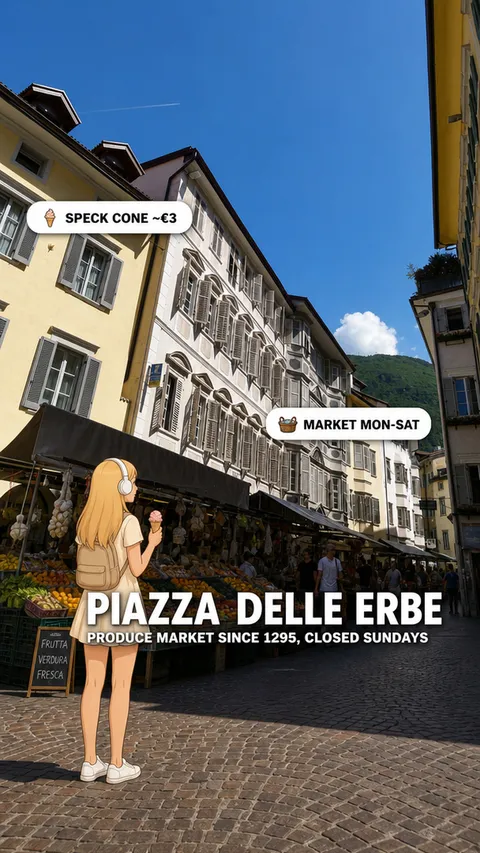
- 3Piazza delle Erbe Market Free · daily market
The produce market since 1295, reached through the Lauben arcades. Speck, cheese, fruit, flowers, fresh bread. Closed Sundays, so do not come on a Sunday expecting it.
- 4South Tyrol Museum of Archaeology €13 · 1h
The reason most people come to Bolzano. Ötzi, the 5,300-year-old iceman, in a refrigerated chamber. His clothes, his copper axe, the arrowhead that killed him. Closed Mondays. Buy online.
- 5Talvera Promenade Free · 20 min walk
The riverside exhale after the museum. Wide paved path along the Talfer, vineyards on the far bank, Dolomites on the horizon. The tonal shift from medieval city to Alpine landscape.
- 6Castel Roncolo €10 · 1h
The painted castle on a rock spur above the river. Largest cycle of secular medieval frescoes in Europe: knights, tournaments, the legend of Tristan. The only real climb of the day. Tavern inside if you want a glass of Lagrein before the walk back.
It runs in your browser, no app and no download. A voice guide walks the loop with you and leads a real conversation as you go: it greets you, tells the story between stops, asks what you actually want to see, and adapts. It is not a recording and not an audioguide. The map and step-by-step navigation get you from each stop to the next.
Insider Tips for the Bolzano Day Trip
Do...
- Leave Venice on a 6:30 to 7:00 a.m. train. Earlier means hours; later means a rush.
- Buy Ötzi tickets online before you leave home, especially in summer or on rainy days.
- Carry real shoes, not sandals, if you plan to climb to Castel Roncolo.
- Eat canederli (Tyrolean dumplings) and a glass of Lagrein at a market-square bar.
- Learn five words of German: Hallo, Danke, Bitte, Ja, Nein. Bolzano speaks German first.
Don't...
- Don't come on a Monday. The Ötzi museum and Castel Roncolo both close on Mondays.
- Don't come on a Sunday if you want the produce market, which is closed Sundays.
- Don't try to drive into the center. The ZTL cameras are unmarked and the fine lands weeks later.
- Don't plan a day trip around BlaBlaCar. Rides cancel; trains do not.
- Don't try to also do the Dolomites, Lake Carezza, or the Messner Museum on a day trip. They are separate trips.
Luggage
Day-tripping from Venice means no luggage. If you are changing cities and need to bring a bag, left luggage at Bolzano station is the cleanest answer, and Verona Porta Nuova also has deposit bags if you want to drop them at the change. Do not drag a wheelie through the Lauben arcades.
Buffer
Trains back from Bolzano to Verona run until early evening. The last comfortable Bolzano departure that still connects to a Venice service is around 7:30 p.m., which puts you back at Santa Lucia near 10:30 p.m. Build in a 30-minute buffer at Verona on the return, because a missed Frecciarossa is a €40 mistake.
Ötzi and Castel Roncolo both close on Mondays. The produce market closes on Sundays. That leaves Tuesday through Saturday as the only full day-trip windows. Sunday is the worst day to come: no market, both main sights shut.
More day trips from Venice
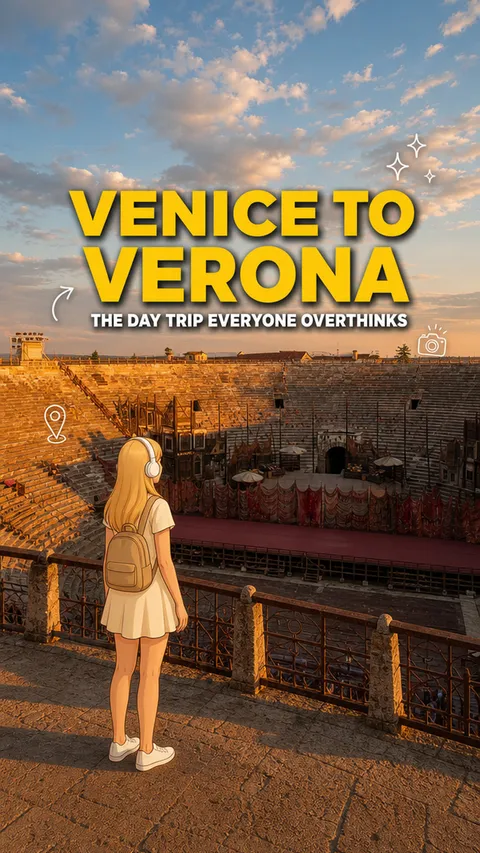
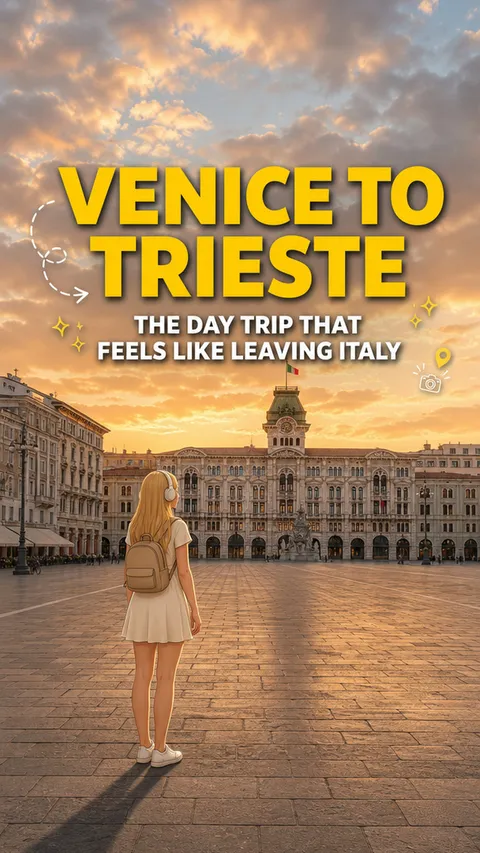
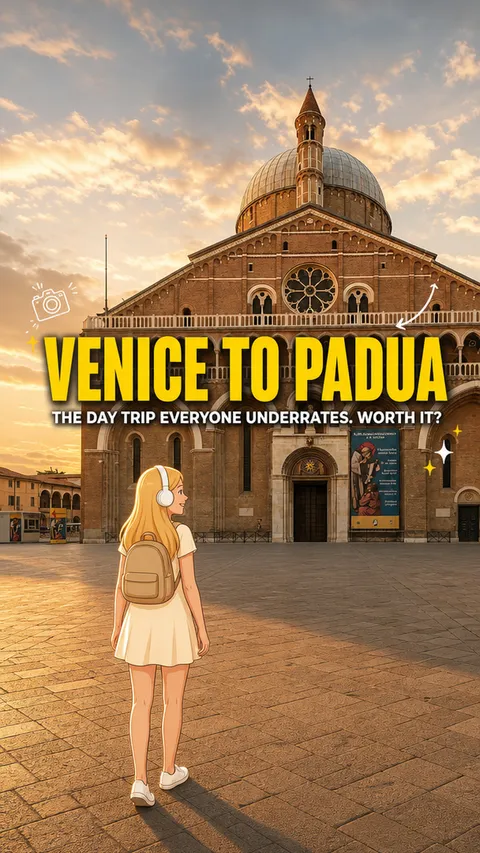
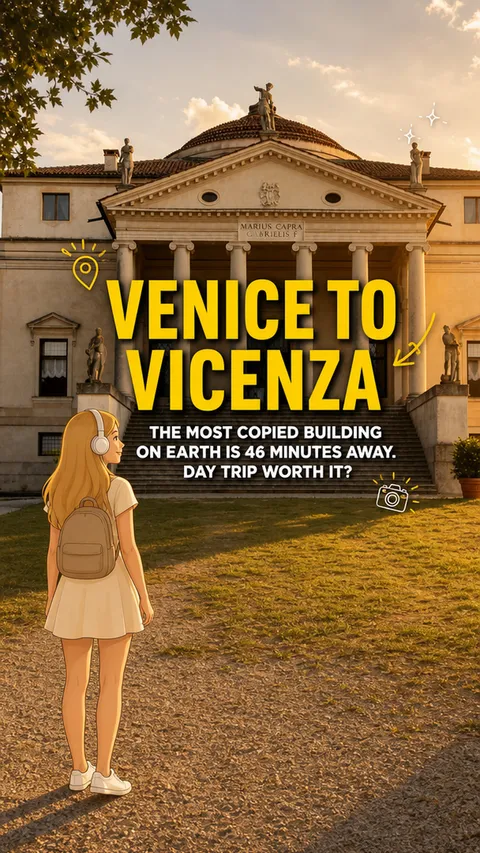
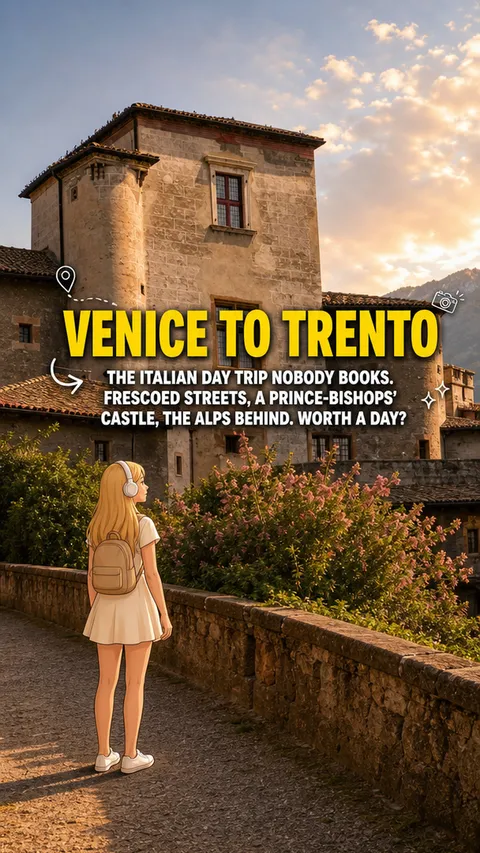
Out in the morning, back in time for dinner. Every route here fits in one full day.
What the Venice to Bolzano Journey Feels Like
The morning Frecciarossa out of Santa Lucia is the easy part. You cross the lagoon causeway, the water flat and silver in the early light, and then you are on the plain, the flatlands of the Veneto scrolling past the window until the spires of Vicenza and the brick of Verona loom up. Coffee from the Frecciarossa trolley is decent and overpriced; bring your own.
The change at Verona is brisk. Verona Porta Nuova is a big, working station, and the regional platforms on the north side fill with German-speaking travelers heading for the mountains. As soon as the regional train leaves Verona, the landscape changes. The plain folds into hills, then the Adige valley narrows, vineyards terracing up both sides, the limestone walls of the Dolomites closing in. Italian gives way to German on the station signs. Trento, then Bolzano. The whole second leg feels like a slow migration from Mediterranean Europe into Central Europe.
You arrive in Bolzano and the air is different. Cleaner, cooler, mountain-sharp. German signage first, Italian second. The arcades of the Lauben swallow you within five minutes of leaving the station. The smell of speck and warm bread drifts out of the market. The Duomo's green-and-yellow tiled roof catches the sun in a way no Italian cathedral does. The whole city feels like a hinge between two countries that have spent centuries arguing over it and ended up sharing.
The day itself runs at a slower pace than Venice. Nobody is rushing. The market takes its time. The cafés on Waltherplatz pour aperitivos without checking the clock. Even the climb up to Castel Roncolo, the one exertion of the day, has benches and a river path and the Dolomites opening up behind you. By late afternoon you are back on the platform, tired from walking and full of speck, and the regional train slides south again through the valley as the light goes. The Frecciarossa back to Venice is quiet. You cross the causeway in the dark, the lagoon black on both sides, and step out at Santa Lucia into the noise of Venice again. It feels, briefly, like a different country.
Venice to Bolzano: Your Questions Answered
Is a Venice to Bolzano day trip actually doable?
Yes. Roughly three hours each way by train, with hourly departures and a five-minute walk from Bolzano station to the main square, makes it a long but realistic day trip. Leave around 7 a.m., get seven usable hours on the ground, and you are back in Venice by 10 or 11 p.m. The catch is the transit: it is a 6-hour rail day, so bring a book and snacks.
Do I need to change trains?
Usually yes, at Verona Porta Nuova. The change is same-station, 15 to 25 minutes, well signed. Deutsche Bahn also runs two direct Intercity trains each way per day that skip the change entirely. If the direct times fit your day, take them. If not, the via-Verona route is identical in comfort and barely 15 minutes slower.
What does it cost?
About €25 to €50 each way per person, depending on how far ahead you book the high-speed leg. Regional legs (Verona to Bolzano) are fixed-price at €10 to €15. Walk-up same-day fares climb to €60 or more on the Frecciarossa. The cheapest realistic day-trip rail budget is around €50 to €60 return if you catch Super Economy early.
Is Bolzano worth it compared to Verona, Padua, or Vicenza?
Different question, different answer. Bolzano is the only one of those that does not feel Italian. It is Alpine, German-speaking, mountain-framed, and built around a 5,300-year-old mummy. If you want a contrast day from Venice, Bolzano wins outright. If you want more Venice-style art and architecture, Verona or Padua is the better spend of a day.
Can I do this without a car?
Yes, and you should. Bolzano is one of the most conveniently located railway cities in Europe. The station is a five-minute walk from the main square. Everything in the old town is flat and walkable. The one sight outside the center, Castel Roncolo, is a 22-minute riverside walk. A car actively hurts you here, because the ZTL cameras in central Bolzano are unmarked and the fine arrives weeks later in Italian.
What about the Bolzano Bozen Card?
When available, it covers public transport and major museum entries, including the Ötzi museum and the Renon cable car. Pricing and availability shift year to year, so check the official bolzano-bozen.it tourism site shortly before your trip. For a single day-trip with Ötzi and Castel Roncolo, the math often works out close to break-even.
Can I extend this to the Dolomites on the same day?
Not realistically. The Dolomites are another 30 to 90 minutes further on, and Bolzano itself is already eating six hours of transit. If you want the Dolomites, plan a separate overnight trip. Bolzano is the gateway, not the destination, for a proper Dolomites loop.
What about the Christmas markets?
Late November through December, Bolzano hosts one of Italy's largest Christmas markets, packing Piazza Walther with wooden stalls selling Tyrolean crafts, bratwurst, and glühwein. Daylight is short, mountain weather can be cold, but the markets are a genuine draw and the city is at its most beautiful. The same train logic applies; bring a warm coat.
Is Bolzano safe?
Yes, very. It is a small, calm, low-crime Alpine city. The old town, market, and river paths are comfortable day or night. Normal city sense around the station after dark, but no notable scams and no no-go areas on any of the routes the tour walks.
Plan Your Bolzano Day Trip
If you have read this far, the next move is the easy one. Open the free Bolzano walking tour on your phone the moment you step off the train, plug in headphones, and let it walk you from Waltherplatz through the cathedral, the arcades, and the produce market up to Ötzi, then along the Talvera to Castel Roncolo. It greets you, narrates between stops, asks what you want to see, and starts from any waypoint. A real voice-AI conversation in your browser, no download, no audioguide, with 100 free credits to begin. Then catch the 7:30 p.m. Verona train home and be back in Venice before the vaporetto stops running.
- More day trips from Venice, by train
- When to visit the Dolomites: seasons, crowds, and cable cars
