
Vicenza Day Trip from Venice: The Honest Guide
Take the regional train from Santa Lucia and you are walking Palladio's Corso within the hour. Open our free self-guided tour at the station and it leads you through the whole day, no planning required.
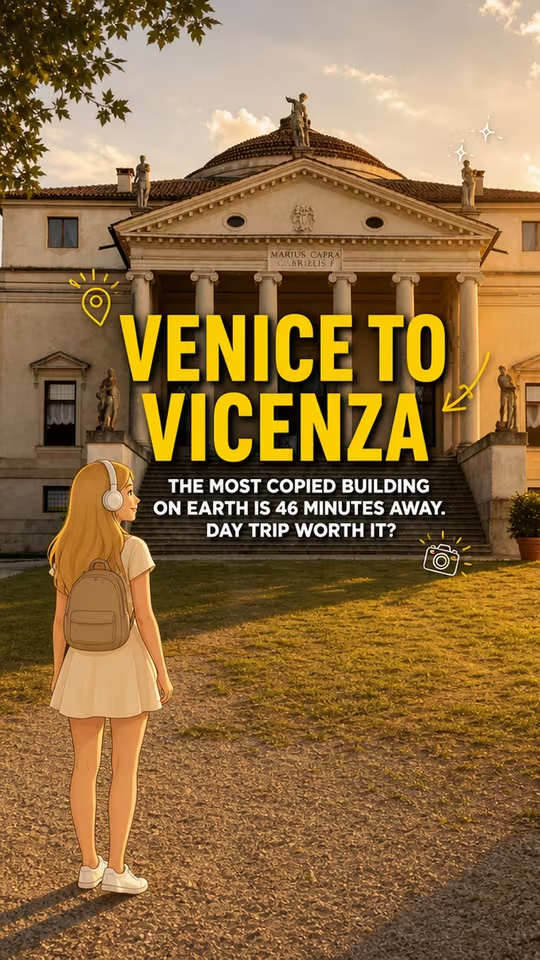
The Quick Answer: Venice to Vicenza
Yes, Vicenza is one of the best day trips from Venice, and it is one of the easiest. A regional train covers the 67 km in about 46 minutes to an hour, costs from €6 one way, runs every 20 to 30 minutes all day, and needs no booking. You step off at Vicenza's single station, walk 10 to 12 minutes down Via Roma into Corso Palladio, and you are inside an open-air museum of Andrea Palladio, the most copied architect in history. This is the City of Palladio: 23 of his buildings in the centre alone, plus the villas on the hills outside. If you have any interest in architecture, it rewards a full day. If grand buildings leave you cold, it is a calm, queue-free half-day rather than a headline, and Verona or Padua might suit you better.
| Question | Answer |
|---|---|
| How far is Vicenza from Venice? | 67 km west, on the main Milan-Venice line. About 46 minutes by regional train. |
| What does the train cost? | From €6 to €7 one way on the regional. High-speed Frecciarossa or Italo runs €10 to €20-plus. |
| How long do I need? | A full day is ideal. A whistle-stop of the centre works in 3 to 4 hours. |
| Best way to get there? | The regional train. No car, no booking, every 20 to 30 minutes. |
| What is the one unmissable sight? | The Teatro Olimpico, the oldest surviving indoor theatre in the world. |
| Biggest mistake to avoid? | Coming on a Monday (interiors shut) or any weekday if getting inside La Rotonda matters. |
Is the Venice to Vicenza Day Trip Worth It?
Here is the honest split. Vicenza does not have Venice's drama or Verona's polish, and it sees a fraction of their visitors. For some travellers that absence of crowds is the whole point. You can stand alone in the Teatro Olimpico in front of a 440-year-old stage set, then eat lunch on a market square without queuing for anything. Walk Corso Palladio end to end and you are reading the source code for half the grand buildings you have ever seen, from English country houses to the White House in Washington. For an architecture lover, this is a pilgrimage and a full day is not enough.
The best of Vicenza, stop by stop


For everyone else, be honest with yourself. The headline villas, La Rotonda and Villa Valmarana, sit on the outskirts, and the centre is more elegant than dramatic. If you have one day trip left from Venice and have not seen Verona or Padua yet, those two carry more obvious wow. Vicenza is the quiet, wealthy, walkable option, and its joy is the lack of stress, not the spectacle.
If you care about architecture, this is the most rewarding low-stress day in the Veneto.
If grand facades bore you, it is a pleasant half-day, not a trip to build around.
No crowds, no booking traps, no skip-the-line tickets to buy. The simplicity is the luxury.
Want nightlife, a deep food scene, or big-city energy? This is not your town.
Good fit if you...
- Love architecture, design, or Palladio in particular
- Want to escape Venice's crowds for a calm, walkable day
- Are on a budget (food and drink are far cheaper than Venice)
- Enjoy strolling and looking up at facades over ticking off must-sees
Skip it (save Vicenza) if you...
- Find grand buildings leave you cold
- Have not yet seen Verona or Padua on your one free day
- Want drama, nightlife, or a buzzing restaurant scene
- Are travelling on a Monday with no flexibility (most interiors close)
How to Get from Venice to Vicenza by Train
The decision makes itself: take the train, no car needed. Vicenza's centre is flat, compact, and fully walkable, so a car only earns its keep if you plan to chase the Palladian villas scattered across the countryside (Villa Barbaro at Maser, Villa Emo). For the city itself, rail wins on every axis that matters, and the regional train wins over the high-speed for value.

| Option | Time | Cost (one way) | Frequency | Verdict |
|---|---|---|---|---|
| Regional train (RV) | 46 min to 1h20 | From €6 to €7, fixed fare | Every 20 to 30 min | WINNER. Cheap, frequent, no booking, only 15 to 20 min slower than high-speed. |
| High-speed (Frecciarossa / Italo) | 25 to 45 min | €10 to €20-plus, dynamic | Frecciarossa roughly hourly | Faster, but you pay for it and the fare moves. Book ahead for the low price. |
| Car (A4 motorway) | About 48 min | Fuel, tolls, parking, ZTL risk | Anytime | Pointless for a day trip. The centre is a restricted-traffic zone and you will park outside it anyway. |
| FlixBus | About 55 min | €5 to €10 | Once daily | Skip. Departs Tronchetto, not Santa Lucia, and runs a single time. |
The regional train is the move. It leaves from Venezia Santa Lucia, the fares are fixed so you never chase a price, and an open ticket stays valid for 60 days with no seat reservation. You buy at the station kiosk or in the Trenitalia app, validate if it is a paper ticket, get on, and find a seat. The high-speed only shaves 15 to 20 minutes and costs two to three times more.
The Train in Detail
Trenitalia runs both the regional trains and the Frecce; Italo runs a handful of high-speed services too. Everything departs Venezia Santa Lucia, the terminus right on the Grand Canal, and some high-speed runs also call at Venezia Mestre on the mainland, which can trim a few minutes if your hotel is over there. Vicenza has a single station, so there is no confusion about where to get off. From the platform it is a flat, signposted 10 to 12 minute walk: out the front, down Via Roma, and you join Corso Palladio at its western end by Porta Castello, which happens to be exactly where the tour begins.
Regional or high-speed, which to book?
| Regional (RV) | High-speed (Frecciarossa / Italo) | |
|---|---|---|
| Journey time | 46 min to 1h20 | 25 to 45 min |
| Fare | From €6 to €7, fixed | €10 to €20-plus, dynamic |
| Booking | None needed, walk up | Book ahead for the cheap fare |
| Flexibility | Open ticket, valid 60 days | Tied to a specific train |
| Best for | Almost everyone | Only if you value the 20 minutes and booked early |
For a day trip, the regional is the right answer for almost everyone. The only case for high-speed is if you have pre-booked a cheap advance fare and genuinely want the extra 20 minutes in the city. Otherwise the flexibility of a fixed-fare open ticket is worth more than the time saved, especially on the way home when you may not know which train you will catch.
Booking Strategy
The good news is that the winning option needs no strategy at all. Regional fares are fixed, so there is nothing to book and nothing to game: turn up, buy, go. Save the planning energy for the one thing that actually moves money, which is whether you buy a Vicenza museum card (more on that below) rather than single tickets.
If you do want a high-speed train, that is the only part of the journey where booking ahead pays. Advance Frecciarossa and Italo fares can sit near the regional price; walk-up fares on the day can be double. For the return, a regional open ticket is the safety net: you can wander into aperitivo and dinner, then catch whichever evening train suits, with services running late.
Booking checklist
- Decide regional (no booking) or high-speed (book ahead if you want the low fare).
- For high-speed, buy a few days out in the Trenitalia or Italo app for the cheaper bucket.
- For regional, buy a one-way out and keep the return open, or buy two singles. The open ticket is valid 60 days.
- Validate paper regional tickets before boarding; app tickets activate themselves.
- Do not buy a guided tour or a skip-the-line ticket. Vicenza has neither the crowds nor the traps that make those worth it.
Vicenza in One Day
You step off the train, walk into the centre, and you do not need a plan, because the plan walks with you. Open our free self-guided AI tour in your browser at the station, and from your very first steps down Corso Palladio it greets you, sets the scene, and leads you stop by stop with map and turn-by-turn directions. No download, no app store, no audioguide droning at you. It is a real conversation: it tells the story between sights, asks what you want to see more of, and adapts the route as you go. You arrive in the centre and simply start it.

The time math
A regional train out around 8:00 to 9:00 puts you in the centre by 9:00 to 10:00, just as the museums open at 10:00. Trains back run until late evening, so a relaxed day gives you 8 to 10 hours on the ground without rushing. The flat centre, the first eight stops of the route, fills about three hours at an easy pace with a couple of interiors; add the theatre and you are near four. Monte Berico and La Rotonda turn a half-day into a full day. The best hour of all comes late: after the day-trippers leave, the light goes gold on the Basilica's marble and the squares fill with locals for the passeggiata. Build your day to catch that, not to flee it.
One hard warning that wrecks otherwise good trips: nearly everything closes on Mondays, and La Rotonda's interior opens only Friday to Sunday for most of the year. Plan around both.
What you'll see
The whole centre lines up along one 700-metre street, so you are never backtracking. The shortlist worth your tickets:
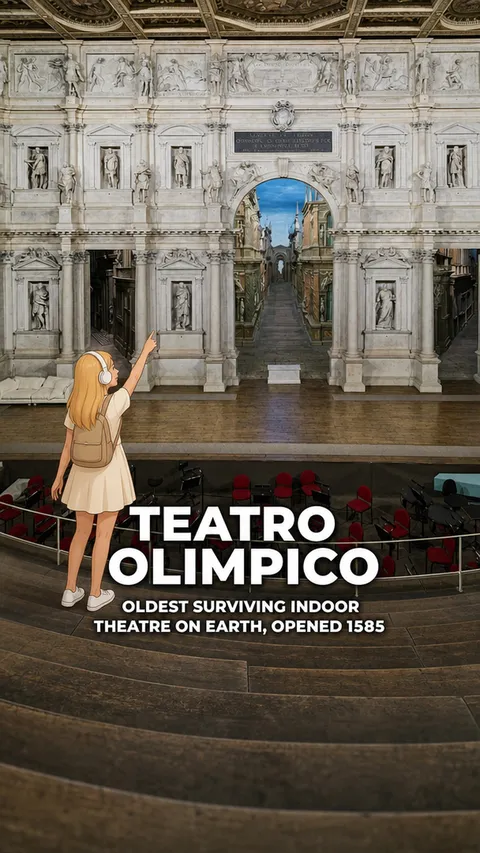
- Teatro Olimpico (€12 single, Tue-Sun, 9:00-17:00): Palladio's last work and the oldest surviving covered theatre on earth, with Scamozzi's permanent stage set faking seven streets receding into deep distance on a stage only metres deep. Never skip this.
- Basilica Palladiana (loggia and piazza free; rooftop terrace €5, Tue-Sun, 10:00-18:00): the white marble loggias that made Palladio's reputation, wrapping a medieval town hall. Pay the €5 for the terrace view.
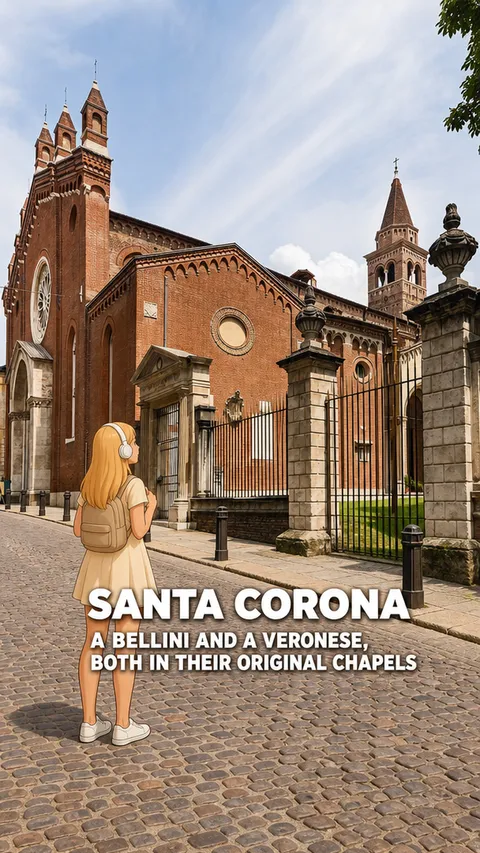
- Chiesa di Santa Corona (€4, Tue-Sun, 10:00-18:00): a Giovanni Bellini Baptism of Christ and a Veronese Adoration of the Magi in their original chapels. The bargain of the day. Bring a €1 coin for the light boxes.
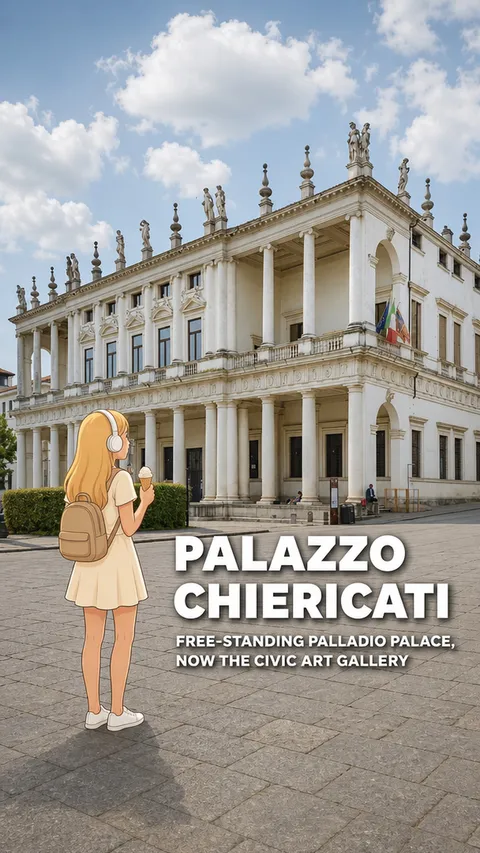
- Palazzo Chiericati (on the museum card, Tue-Sun): a free-standing Palladio palace, now the civic art gallery, its double loggia facade among his most photographed.
- Villa Capra La Rotonda (around €15, Fri-Sun only, 10:00-13:00 and 15:00-18:00 most of the year): the most copied villa in the world, a perfectly symmetrical domed block with four identical temple fronts. Closed Mon to Thu, so check before you build your day on it.
On tickets: if you are doing two or more civic sites, the Vicenza SILVER card (€16, any 4 of 11 sites) is cheaper than buying the Teatro Olimpico and Palazzo Chiericati as singles, and it throws in two more. The GOLD card (€22) covers all 11. Neither covers La Rotonda or Villa Valmarana, which are privately owned and charge €15 at the door.
The route the tour walks with you
The tour starts from any stop, so there is no backtracking and no wrong entry point; pick it up wherever you arrive. It runs west to east through the flat old town, then climbs south to the hills for the finale. Here is the line it walks:
- 1Giardino Salvi Start · Free
A small garden just outside Porta Castello where two Palladian loggias sit over a canal, a preview of the white arches you will see all day. Calm spot to get your bearings before the centre fills.
- 2Palazzo Barbaran da Porto €8 · Palladio Museum
The only full city palace Palladio designed and finished entirely himself, now the Palladio Museum, with his drawings and scale models that finally make the proportions click. Tue-Sun 10:00-18:00.
- 3Chiesa di Santa Corona €4
A raw 13th-century Dominican church holding a Bellini and a Veronese in their original chapels, the single best art stop on the walk. Bring a €1 coin for the light boxes.
- 4Palazzo Chiericati Museum card
Piazza Matteotti opens up and there stands this free-standing Palladio palace, open arches stacked over open arches, housing the Pinacoteca Civica. Best in late-afternoon light.
- 5Teatro Olimpico €12 single
The reason many people get off the train. Walk into the wooden hall and the forced-perspective stage set still fools you, four and a half centuries on. Give it 40 minutes in the raked seats.
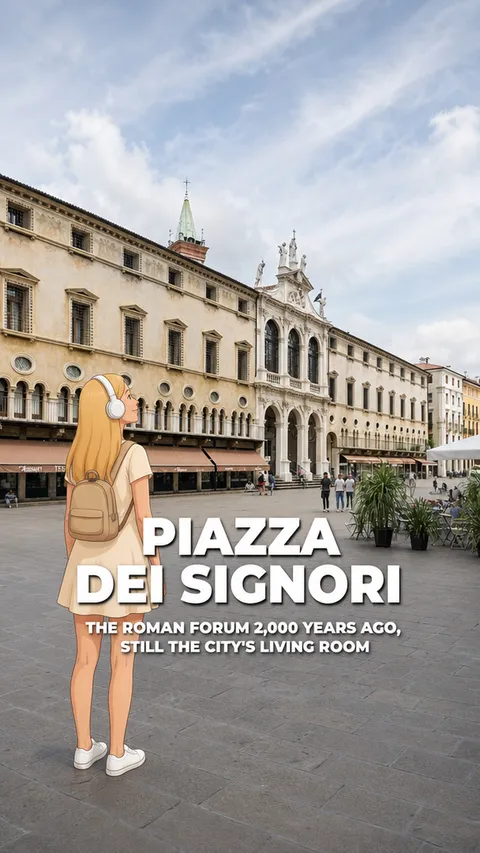
- 6Piazza dei Signori Free
The Roman forum two thousand years ago, still where Vicenza gathers. The natural halfway pause: order a spritz, around €4 to €5, and watch the square.
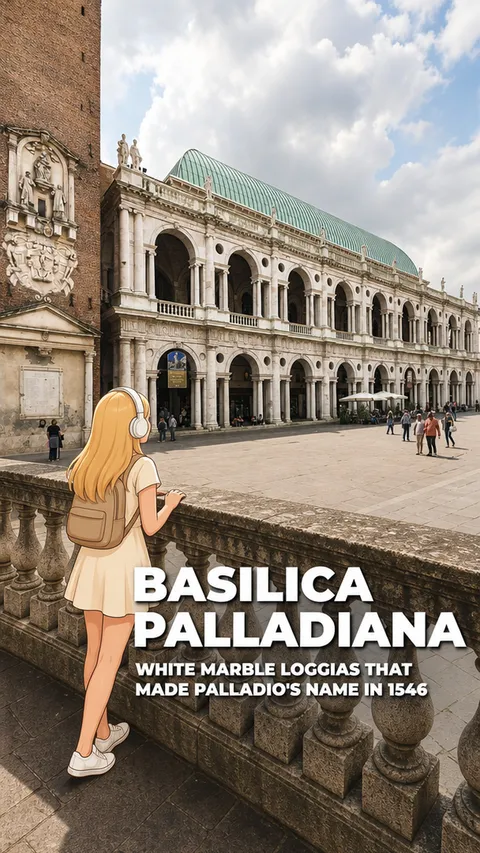
- 7Basilica Palladiana €5 terrace
Impossible to miss, the white marble symbol of the city. Pay the €5 and climb to the rooftop terrace for the view back over the piazza and the rooftops.
- 8Corso Palladio Free
The 700-metre spine of the old town, dead straight from Porta Castello to Piazza Matteotti, lined with Renaissance palazzi. Keep looking up or you miss half of it.
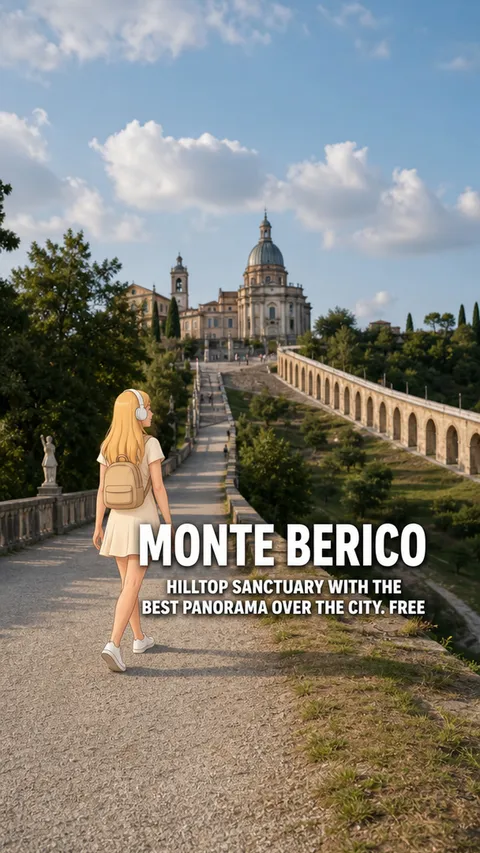
- 9Monte Berico Free
The flat day ends. Climb the long covered portico or take bus 8 to the hilltop sanctuary for the best panorama in the area, the whole city below and the Prealps behind.
- 10Villa Capra La Rotonda €15 · Fri-Sun
The climax, the most copied villa Palladio ever built, perfectly symmetrical under its central dome. Closed Mon to Thu; midweek you photograph it from the lane, which is the classic shot anyway.

It runs in your browser, no app and no download. A voice guide walks the loop with you and leads a real conversation as you go: it greets you, tells the story between stops, asks what you actually want to see, and adapts. It is not a recording and not an audioguide. The map and step-by-step navigation get you from each stop to the next.
Insider Tips for the Vicenza Day Trip
Do
- Start the walk by 10:00 so the museums (all open at 10:00) line up with the route
- Buy the SILVER card if you are doing two or more civic sites; it beats two singles
- Bring a €1 coin for the light boxes in Santa Corona
- Eat a baccala mantecato crostino at a bacaro near Piazza delle Erbe, €2 to €3 with a small wine
- Stay for the evening passeggiata; the best light hits the Basilica's marble late
Don't
- Come on a Monday if interiors matter; the museums, theatre and Basilica all close
- Turn up midweek expecting to get inside La Rotonda; it is Fri to Sun most of the year
- Pay for a guided tour or skip-the-line ticket on reflex; there are no crowds to skip
- Try to do both villas; pick one or skip both and keep your city time
- Rely on finding a public toilet; use the cafes on Piazza dei Signori or the Teatro
Luggage
There is no left-luggage office at Vicenza station to count on, so travel light if you are passing through between cities. The centre is a flat 12-minute walk from the platform, easy enough to wheel a small case, but you will not want a big bag on the Monte Berico climb or the lane up to La Rotonda.
Buffer
The two hill stops, Monte Berico and La Rotonda, are where time disappears, between the walking, the bus waits, and La Rotonda's strict hours. If you only have a half-day, do the flat centre well and skip the hills rather than racing them.
La Rotonda's interior is open only Friday to Sunday for most of the year, weekends only in March and November, and shut Monday to Thursday otherwise. This is the single most common thing that catches people out. If getting inside matters, go on a weekend and check the official site first. Mid-week, you can still admire it over the fence from the lane, which is the postcard view anyway.
More day trips from Venice
Out in the morning, back in time for dinner. Every route here fits in one full day.
What the Venice to Vicenza Journey Feels Like
The train ride sets the tone. You pull out of Santa Lucia over the lagoon causeway, the water gives way to the flat Veneto plain, and 46 minutes later the crowds of Venice are simply gone. Vicenza arrives quietly: a county-town feel, wealthy and traditional, shops closing for siesta in the early afternoon, locals greeting each other on the Corso. It is the opposite of Venice's intensity, and after a few days in the lagoon that is exactly the relief you did not know you needed.
Inside the Teatro Olimpico, the room goes hushed and you may have it nearly to yourself. People fall a little in love with it and do not want to leave. Then there is the long covered portico zigzagging up to Monte Berico, 150 arches counted off like a rosary, and at the top the whole city spread out under the Berici hills. The day saves its best for last. When the afternoon crowds thin and the light turns gold on the Basilica's marble, the squares quietly become the locals' living room again. A rushed day trip misses that hour entirely. Linger for it.
Venice to Vicenza: Your Questions Answered
Is a Vicenza day trip from Venice worth it?
For architecture lovers, absolutely: Vicenza is the City of Palladio and a genuine pilgrimage, easy to reach and free of crowds. For everyone else it is a calm, walkable half to full day rather than a must-see. If you have not yet done Verona or Padua and have only one free day, those carry more obvious drama. Vicenza's appeal is its quiet, its low cost, and the walk-up simplicity of its sights.
How do I get from Venice to Vicenza?
Take the regional train from Venezia Santa Lucia. It runs every 20 to 30 minutes, takes about 46 minutes to an hour, costs from €6 to €7 one way at a fixed fare, and needs no booking. High-speed Frecciarossa and Italo trains are faster (25 to 45 minutes) but cost €10 to €20-plus with dynamic pricing.
How long is the train from Venice to Vicenza?
About 46 minutes to 1 hour 20 minutes on the regional, depending on how many stops it makes, and 25 to 45 minutes on the high-speed. Vicenza has a single station, a flat 10 to 12 minute walk from the historic centre.
Do I need to book the train in advance?
No, not for the regional. Its fares are fixed, so you buy at the station or in the Trenitalia app and walk on, and the open ticket stays valid for 60 days. Only the high-speed trains reward booking ahead, where advance fares are much cheaper than buying on the day.
How many hours do I need in Vicenza?
Three to four hours covers a whistle-stop of the centre (Teatro Olimpico, Basilica Palladiana, Corso Palladio, Piazza dei Signori). A full day, six to eight hours on the ground, lets you add Monte Berico and one villa at a comfortable pace. With early and late trains you can easily get 8 to 10 hours.
What is the one thing not to miss in Vicenza?
The Teatro Olimpico, Palladio's final masterpiece and the oldest surviving indoor theatre in the world, opened in 1585. Its forced-perspective stage set, faking seven receding streets on a shallow stage, is the single image most people take away from the city. Entry is €12, open Tuesday to Sunday, closed Monday.
Should I buy a Vicenza museum card?
If you are visiting two or more civic sites, yes. The SILVER card (€16, any 4 of 11 sites) already costs less than the Teatro Olimpico and Palazzo Chiericati bought as singles, and gives you two more sites on top. The GOLD card (€22) covers all 11. Note that La Rotonda and Villa Valmarana are privately owned and not on either card; you pay €15 at each door.
What is the biggest mistake people make in Vicenza?
Two. Coming on a Monday, when nearly every interior (museums, theatre, Basilica) is closed. And turning up midweek expecting to get inside La Rotonda, which opens its interior only Friday to Sunday for most of the year. Plan your day around both before you go.
Can I do Vicenza on a Monday?
You can walk it, but you will see facades, not interiors. The squares, Corso Palladio, the exterior of the Basilica, and Monte Berico (whose sanctuary keeps its own hours) all still work. The Teatro Olimpico, the museums, and the Basilica interior are shut. If your only option is a Monday, treat it as a streets-and-views day and accept you will be looking from outside.
Plan Your Vicenza Day Trip
Get yourself to Vicenza on a morning regional train, then let the day run itself. Open our free self-guided AI tour in your browser the moment you reach the centre. It greets you, walks you from the Giardino Salvi down Corso Palladio to the Teatro Olimpico and on up to La Rotonda, tells the story between stops, and answers what you actually want to know, all with map and step-by-step directions and not a single download. It starts from any stop and comes with 100 free credits, so you can simply arrive and begin. No plan, no guidebook, no audioguide. Just you, the city, and a guide that walks with you.
