
Venice to Ravenna Day Trip: Mosaics Worth the Haul
Be honest with yourself first: Ravenna is a long haul from Venice. There is no direct train, so you change once at Ferrara or Bologna and it runs 2h30 to 3h30 each way. Driving is faster if you rent at Mestre. But step off at Ravenna's central station, open our free self-guided tour, and it walks you round the finest Byzantine mosaics on earth.
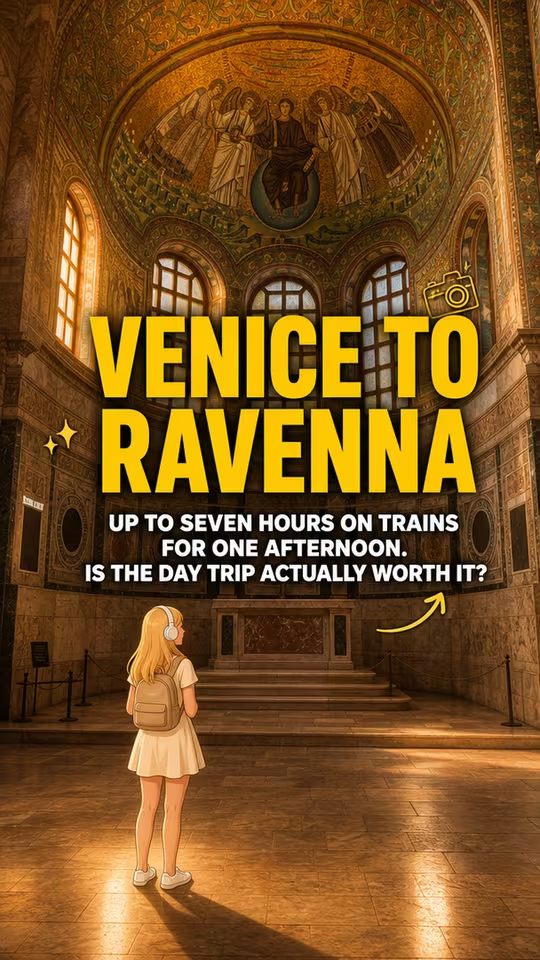
The Quick Answer: Venice to Ravenna
Yes, a Venice to Ravenna day trip is worth it, but go in with your eyes open, because this is the Venice day trip people most often underestimate. Do not picture the easy Bologna to Ravenna hop, which is a single direct regional train of roughly an hour. From Venice there is no direct train at all. You change once, at Ferrara or at Bologna, and the honest door-to-door time is 2 hours 30 minutes to 3 hours 30 minutes each way, sometimes more if the connection is thin. That is up to seven hours of transit for a single afternoon on the ground. You pay that toll for exactly one reason: Ravenna holds the best-preserved early-Christian and Byzantine mosaics on earth, eight monuments under one UNESCO listing, and there is nothing remotely like them in Venice, Florence or anywhere else in Italy.
| Question | Answer |
|---|---|
| How long is the journey? | 2h30 to 3h30 by train, always with one change at Ferrara or Bologna. No direct service. |
| Best way to get there? | Regional train for a carless day trip. A car is faster (~2h15) if you rent at Mestre. |
| How much does it cost? | Roughly €15–30 each way by train depending on regional versus high-speed. Entries ~€17. |
| How often do trains run? | Roughly hourly on each leg. That frequency is why the train beats the once-daily bus. |
| Is it worth it? | Yes if Byzantine mosaics move you. If only mildly curious, go to Verona or Padua instead. |
| How long should I stay? | 5 to 6 hours on the ground. Enough for the full mosaic loop plus a piadina and a coffee. |
Is the Venice to Ravenna Day Trip Worth It?
Here is the honest version. Ravenna is not a spectacle city. There is no skyline, no famous canal, no single view that stops you in the street. From the outside its great monuments are plain brick boxes standing on quiet lawns. The entire payoff is inside, and it is astonishing: octagonal chapels where the walls dissolve into gold, a tiny mausoleum whose ceiling becomes a deep blue night sky scattered with hundreds of stars, processions of white-robed saints that have shimmered on the same walls for fifteen centuries. If that is the thing you crossed a continent to see, no other day trip from Venice comes close, and the town is a genuine relief: quiet, flat, uncrowded, built to human scale, and a fraction of Venice prices for food and tickets.
The best of Ravenna, stop by stop


The case against it is just as real, and it is almost entirely the clock. Five to seven hours of trains for one afternoon is a heavy tax on your time in Venice, and Venice itself rewards slow mornings and empty evenings more than almost anywhere. Travellers who attempt Ravenna as a train day trip regularly come back saying they wish they had stayed the night instead. If you are only mildly curious about mosaics, the round trip will swallow your day and you will get more variety, and less transit, from Verona, Padua or Bologna. Ravenna is the specialist's trip. Know which camp you are in before you buy the ticket.
Go if Byzantine mosaics genuinely move you. Nothing in Venice or Florence is remotely like these gold-and-blue ceilings. [yes] Go if you want a calm, flat, uncrowded town and do not mind a long travel day to reach it. [no] Skip it if you are only half interested in mosaics. The travel eats the day and Verona gives more back. [no] Skip it if your time in Venice is already short. Under four days on the lagoon, keep the day trips closer.
Good fit if you...
- Care about early-Christian and Byzantine art, or would love to be converted to it
- Want a calm, flat, walkable town with almost no tourist crowds
- Like the idea of standing at Dante's actual grave, the poet Florence exiled and never took back
- Are happy to leave Venice early and treat the long train morning as part of the day
- Have four or more days in Venice, so losing one to a trek does not hurt
Skip it (save Ravenna) if you...
- Only have two or three days on the lagoon
- Want postcard spectacle and big views above all else
- Tire on long travel days, or are travelling with someone who does
- Would rather take two easy, closer trips (Padua, Verona) than one long one
How to Get from Venice to Ravenna by Train
Every route runs south into Emilia-Romagna, and every one has a catch, because there is no clean, direct link from Venice to Ravenna. For the typical carless traveller based in Venice, the regional train wins on balance: it runs roughly hourly on each leg, so you are not chained to a single departure, it is cheap, nothing needs booking, and it drops you at Ravenna's central station two minutes from the first monument. The other options each solve one problem and create another. A car is genuinely the fastest door-to-door and the only way to also reach Sant'Apollinare in Classe, but you cannot drive in or out of Venice, so you first have to get to a rental office at Mestre, and one-day rentals are hard to find and must be returned before the office shuts. The direct FlixBus needs no change and is the cheapest fare, but it runs only once a day, not even every weekday, which makes a same-day round trip fragile.

| Mode | Time | Cost | Verdict |
|---|---|---|---|
| Regional train (via Ferrara) | 2h30–3h30 | €15–30 each way | WINNER for a carless day trip. Roughly hourly, no booking, arrives at the central station. |
| Car (rented at Mestre) | ~2h15 | Rental + tolls + parking | Fastest and the only way to add Classe. But you cannot drive from Venice, and 1-day rentals are scarce. |
| FlixBus / coach | 3h15–3h40 | €13–20 | Direct, no change, cheapest fare. But once daily and drops you a 15-min walk out of the centre. |
| Train via Bologna (high-speed) | 2h30–3h30 | €20–45 each way | Can feel faster, but the high-speed leg is dynamic-priced and you still change to a regional. |
If you remember one thing: leave from Venezia Santa Lucia on the island, not Venezia Mestre on the mainland, and pin your return connection before you set off. The evening links thin out.
The Train in Detail
There are two sensible ways to string the ride together, and both change once. The cheap, flexible workhorse is the regional route via Ferrara. A Trenitalia regional train from Venezia Santa Lucia to Ferrara takes roughly 1 hour 25 minutes, then a second regional from Ferrara down to Ravenna, which is the end of that line, takes about another hour. Both legs carry a fixed fare and never need advance booking, so you can decide over breakfast and go. The faster-feeling alternative pairs a high-speed Frecciarossa or Italo up front, either to Ferrara in about an hour or to Bologna Centrale, then a regional onward to Ravenna. It can trim the clock a little, but the high-speed leg is dynamic-priced, so it only pays off if you book it ahead. Either way, budget 2 hours 30 minutes to 3 hours 30 minutes door to door, and expect the return to sit at the higher end because the evening connections are sparser.
Two practical notes save the day. First, Ravenna's station sits right at the northern edge of the historic centre, a two-minute walk from the Mausoleo di Teodorico, which is exactly where the walk below begins, so you lose no time hunting for the sights on arrival. Second, the change is the whole art of this trip. Give yourself a real buffer at Ferrara or Bologna rather than a five-minute sprint, and check the return times before you leave Venice in the morning, because a missed evening link is what turns a long day into a stranded one.
Via Ferrara or via Bologna, which to book?
| Route | Time | Cost | Note |
|---|---|---|---|
| Regional via Ferrara | 2h30–3h30 | €15–30 | Cheapest and simplest. Buy at the machine, validate, go. Change platform at Ferrara. |
| High-speed via Bologna | 2h30–3h30 | €20–45 | Feels faster on the trunk line, but you still change to a regional. Book the fast leg ahead. |
In practice, unless a cheap advance high-speed fare is sitting there when you look, take the regional route via Ferrara. The time you save with high-speed is modest once you add the connection and the wait, and the fixed regional fare removes every worry about surge pricing and booking windows.
Booking Strategy
The regional legs need almost no strategy, just one habit: validate the paper ticket. If you buy an unreserved regional ticket from a machine, stamp it in the small green or white validation box on the platform before you board, or you risk a fine. High-speed tickets with a fixed seat reservation, if you take that route, do not need stamping. Keep that one distinction straight and Italian regional travel is completely painless.
The only place advance booking really pays off is the optional high-speed leg, where fares climb as the train fills. Book it a week or two out and it can be genuinely cheap. Buy it on the platform that morning and it can cost several times more, at which point the all-regional route via Ferrara is both cheaper and no slower once you count the connection.
Booking checklist
- The night before, look up the outbound and, crucially, the return connections for both routes (via Ferrara and via Bologna).
- If a cheap advance high-speed fare exists, grab it. Otherwise plan the all-regional route via Ferrara.
- Confirm your origin reads Venezia Santa Lucia, not Venezia Mestre.
- Aim to leave Venice by 8:00 and pin a return that gets you back before the last comfortable evening train.
- Save tickets to your phone. Validate any unreserved regional ticket on the platform before boarding.
Ravenna in One Day
You step off the train, walk two minutes to the first monument, and from there you do not need a plan at all. The moment you reach the Mausoleo di Teodorico you open our free self-guided tour in your browser and it takes over the day. There is no app to download and no audio file to scrub through. It is a voice guide that holds a real conversation: it greets you, tells you what you are looking at, talks between the stops, and asks what actually draws your eye, then shapes the route around your answer. It runs the map and the step-by-step navigation so you never stand on a corner second-guessing a turn. That is precisely what makes a long-haul day trip pay off. You spend your short, hard-won hours on the ground looking up at gold ceilings, not decoding a wall of opening hours.

The time math
Leave Venezia Santa Lucia around 8:00 and, with one clean change, you are walking into Ravenna by roughly 10:30 to 11:00. The mosaic sites open at 9:00 and fill with tour groups from late morning, so you arrive just as the early rush eases. A return leaving Ravenna around 18:00 to 19:00 puts you back on the lagoon in the mid to late evening. That leaves a real 5 to 6 hours on the ground, which is exactly what the full mosaic loop needs. The walking core is only about 5.5 kilometres on flat pavement, so the time goes on interiors, not on hiking.
What you'll see
The monuments cluster in two tight knots, and one combined ticket covers most of them, which is the whole reason to walk them in order rather than wander. Here is the must-do shortlist with the details that decide your day:
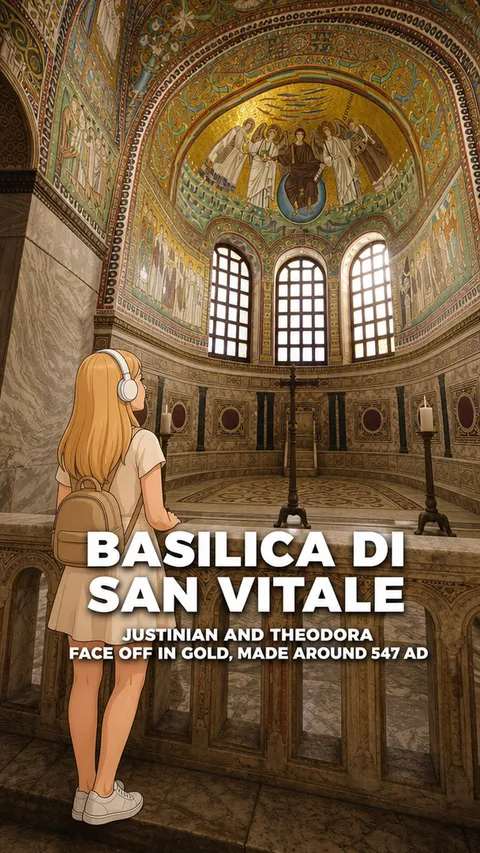
- Basilica di San Vitale (€12 combined ticket; daily 9:00–19:00): the supreme mosaic church, where Emperor Justinian and Empress Theodora face each other across the chancel in gold, made around 547. This single ticket also covers Galla Placidia, the Neonian Baptistery, Sant'Apollinare Nuovo and the Archbishop's Museum, so buy it here first.
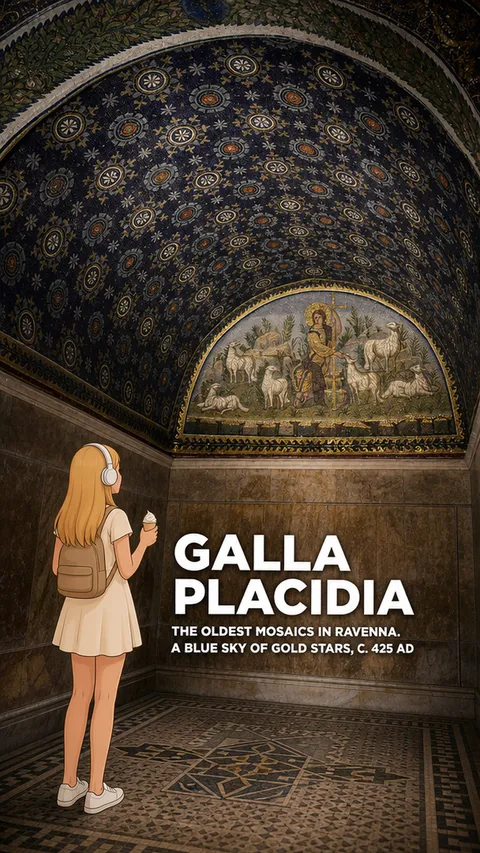
- Mausoleo di Galla Placidia (on the San Vitale ticket; daily 9:00–18:30): a tiny brick chapel holding the oldest and most loved mosaic in the city, a vault of gold stars on deep blue. A timed slot of a few minutes is enforced in busy months, so it can queue.
- Battistero Neoniano (on the combined ticket; daily 9:00–18:45): the oldest standing monument in Ravenna, its dome showing the Baptism of Christ ringed by the twelve apostles.
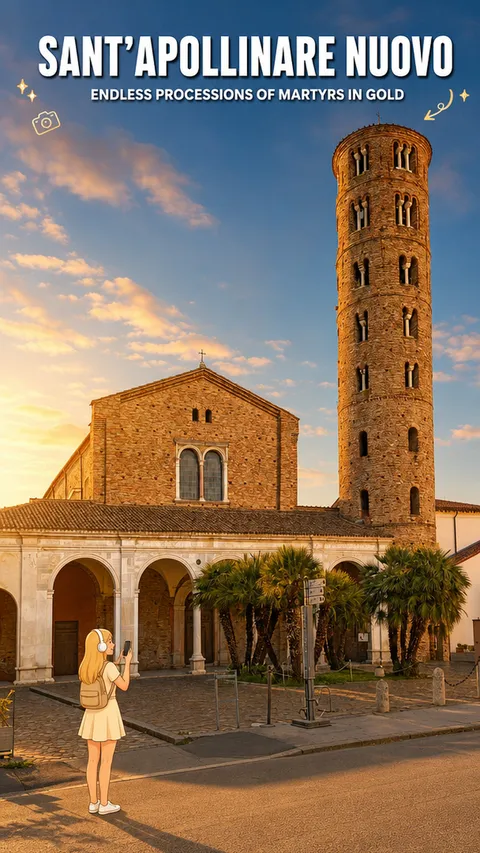
- Basilica di Sant'Apollinare Nuovo (on the combined ticket; daily 9:00–18:30): Theodoric's palace church, its nave walls lined with twenty-two virgins and twenty-six martyrs in endless mosaic procession.
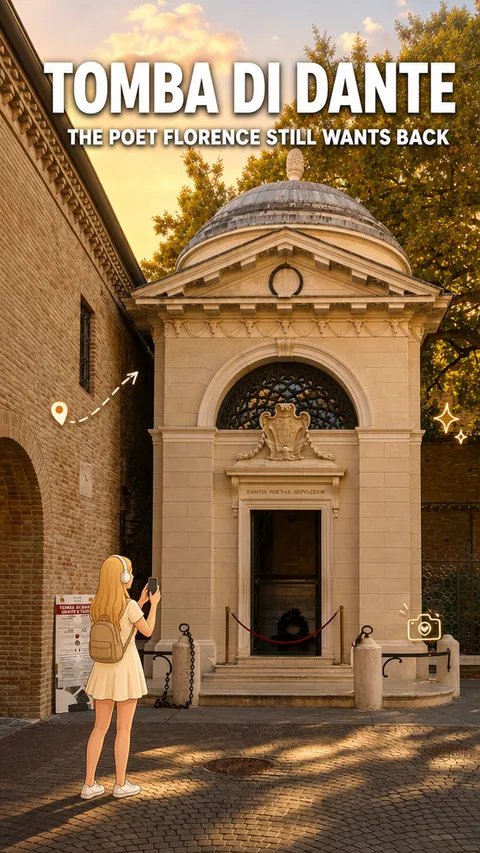
- Tomba di Dante (free; daily 10:00–18:00): the poet's grave, where he has lain since 1321 after Florence exiled him and never took him back. A lamp inside is kept perpetually lit.
- Mausoleo di Teodorico (€4; daily 8:30–19:00): the strange stone drum by the station, roofed with a single 300-tonne limestone monolith and standing apart from the golden churches in both date and mood.
- Battistero degli Ariani (€1; check the short split hours): the Arian counterpart to the Neonian dome and the cheapest, quietest way to finish the loop.
One more, and it is the one people wrongly skip: Basilica di Sant'Apollinare in Classe, about 5 km south of the centre, holds mosaics many rank as the single most beautiful of all. It is off the walking loop and needs a short bus, a taxi or, if you drove, the car. On a tight carless day it is an honest trade-off, and it is the strongest single argument for renting at Mestre.
The route the tour walks with you
The tour starts from any stop, so you never backtrack. Arrive by train and it begins right at the monument by the station, then loops you south through the two mosaic clusters and back. This is the roughly 5.5-kilometre order it walks with you by default:
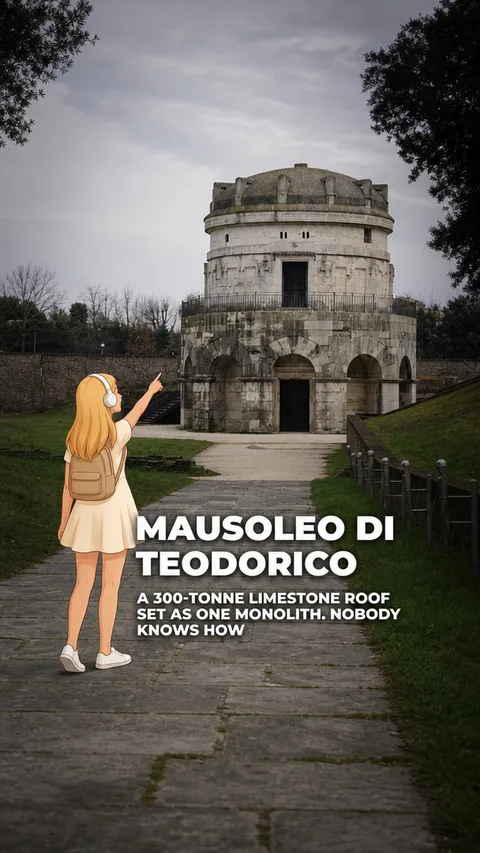
- 1Mausoleo di Teodorico Your entry point · €4
Two minutes from the station, the squat stone tomb of Theodoric the Great, crowned by a 300-tonne monolithic dome nobody is sure how the Ostrogoths lifted. Bare stone inside, ten minutes is plenty.
- 2Basilica di San Vitale €12 combined ticket
The one you came for. Step into the octagon and the apse erupts in green, gold and blue, with the Justinian and Theodora panels facing off across the chancel. Buy the combined ticket here.
- 3Mausoleo di Galla Placidia On the combined ticket
Seventy-five metres across the same garden, a low door opens onto the starry vault, the oldest mosaics in the city. Cole Porter is said to have taken inspiration from this ceiling on his honeymoon.
- 4Museo Arcivescovile On the combined ticket
Upstairs by the cathedral, home to the only surviving private-chapel mosaics from the early Christian world and the carved ivory Throne of Maximian.
- 5Battistero Neoniano On the combined ticket
Beside the Duomo, the oldest monument in Ravenna. Look straight up: the Baptism of Christ ringed by the apostles, the most complete early baptistery dome anywhere.
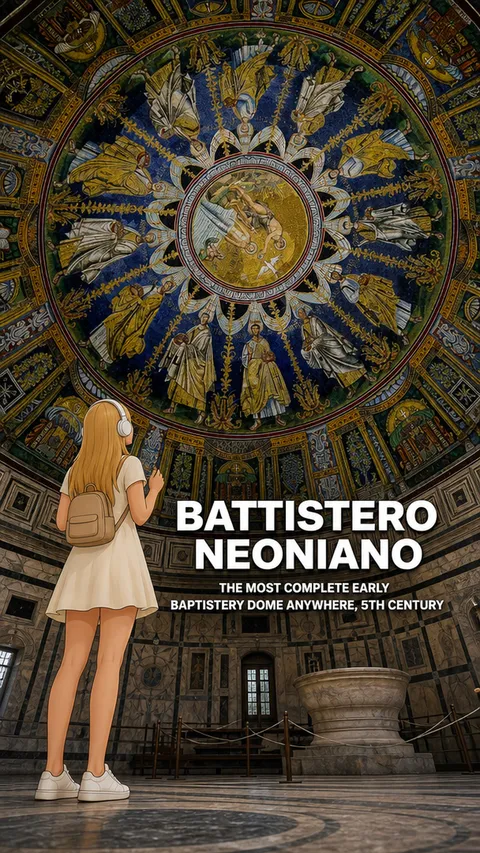
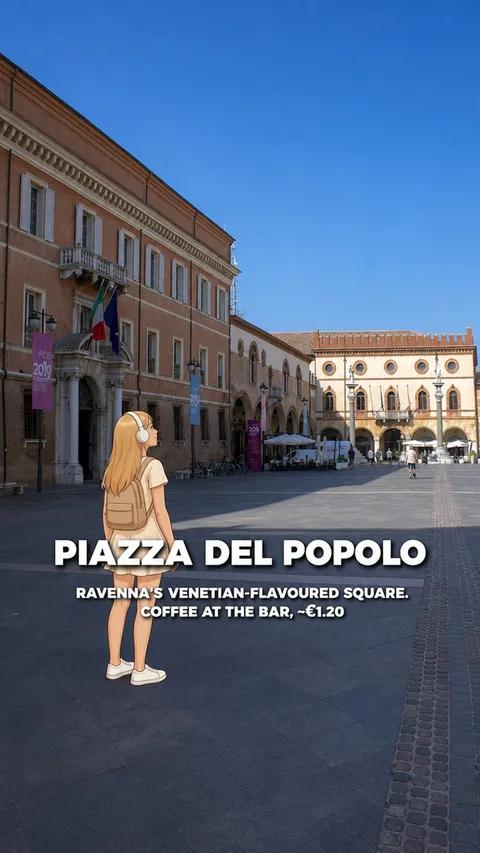
- 6Piazza del Popolo Free
A neck rest and a coffee. The arcaded civic heart, distinctly Venetian from the centuries Venice ruled the town, with twin columns carrying the city's patron saints. An espresso at the bar runs about €1.20.
- 7Tomba di Dante Free
A few steps into the hushed zona dantesca, the neoclassical temple where Dante lies. Florence sends the oil for the perpetual lamp every year, a quiet act of penance for exiling him.
- 8Basilica di Sant'Apollinare Nuovo On the combined ticket
Back to gold. Two mosaic processions run the length of the nave, and lower down you can still spot ghostly hands where Arian figures were edited out after the Byzantines took over.
- 9Battistero degli Ariani €1
The quiet finale most groups skip. Its dome mirrors the Neonian one you saw earlier, the Arian version of the same Baptism, which makes seeing both the real reward of the loop. The cheapest ticket in town and a deliberate place to end.


It runs in your browser, no app and no download. A voice guide walks the loop with you and leads a real conversation as you go: it greets you, tells the story between stops, asks what you actually want to see, and adapts. It is not a recording and not an audioguide. The map and step-by-step navigation get you from each stop to the next.
The guide costs nothing to start and comes with 100 free credits, enough to walk the full loop. Open it, say hello back, and let it carry the timing and the stories so you can keep your attention on the ceilings.
Insider Tips for the Ravenna Day Trip
Do
- Buy the San Vitale combined ticket first, it covers five of the seven headline sites
- Do San Vitale and Galla Placidia early, while your eyes are still fresh for gold ceilings
- Point your phone straight up in Galla Placidia for the starry-vault shot, flash off (it is banned anyway)
- Break at Piazza del Popolo halfway, or grab a piadina at the covered Mercato Coperto just north of it
- Check the Arian Baptistery's short split hours so you do not arrive after it closes
Don't
- Leave from or return to Venezia Mestre by mistake, you want Santa Lucia
- Cut the connection to five minutes, give yourself a real buffer at Ferrara or Bologna
- Try to add a second town, Ravenna plus this much travel already fills the whole day
- Race all eight interiors, mosaic fatigue is real by the fifth gold dome
- Forget to validate an unreserved regional ticket before boarding
Classe, and whether to chase it
Sant'Apollinare in Classe is the site people most regret skipping, but it sits 5 km south of the loop. On a train day you would take a short local bus or a taxi from the centre, which realistically costs you an hour there and back. If seeing it matters to you, that is the clearest reason to rent a car at Mestre instead of taking the train, since driving folds Classe in with no extra logistics.
Opening hours at the mosaic sites shift seasonally, and Galla Placidia enforces short timed entries in peak months. Check the official Ravenna Mosaici ticket page before you build the day around a specific site, and start the loop early so a queue never costs you the last comfortable train back to Venice.
More day trips from Venice
Out in the morning, back in time for dinner. Every route here fits in one full day.
What the Venice to Ravenna Journey Feels Like
The ride south is not the point, and that is fine. You watch the lagoon give way to flat Emilia-Romagna farmland, change trains in the bustle of Ferrara or Bologna, and then trundle out across the plain toward the coast. It is unglamorous, and by the time you walk out of Ravenna's small station you have earned the quiet that meets you. The contrast with Venice is the whole feeling of the day. You leave a city drowning in visitors, where everything costs double and half the conversations happen in English, and you arrive somewhere unhurried and local, where cyclists claim the right of way through streets that belong to the people who live there. This is a provincial town that keeps its wonders behind plain walls, and the magic is in the reveal: you push open an ordinary brick door and the room inside is on fire with gold.
Then comes the moment that justifies the whole trek. You duck into the little Galla Placidia mausoleum, your eyes adjust, and the vault overhead becomes a deep blue sky of hundreds of gold stars, made around sixteen centuries ago and still glowing. People fall silent under it. Later you stand at Dante's grave, a poet exiled from Florence and claimed forever by this modest town, the lamp flickering above the door. Ravenna does not shout. It simply, quietly, holds things that nowhere else on earth still has.
By early evening you are back at the station, a little tired and fuller than you expected, watching for the train that will loop you north through Ferrara to the lagoon. Venice, emptied of its day-trippers by the time you return, looks all the better for the long day away.
Venice to Ravenna: Your Questions Answered
How long is the train from Venice to Ravenna?
Between 2 hours 30 minutes and 3 hours 30 minutes each way, always with one change, because no train runs direct. The cheap all-regional route changes at Ferrara. A high-speed train to Bologna or Ferrara plus a regional onward can feel faster on the trunk line, but you still change trains and the total lands in the same range once you count the connection.
Why is there no direct train?
Ravenna sits off the main Venice to Bologna high-speed spine, on a regional coastal line that terminates in the city. The network pairs a trunk-line train with a regional connection, so you change once, at either Ferrara or Bologna. It is a simple cross-platform step, not a complicated transfer, but it is unavoidable.
How much does the trip cost?
Roughly €15 to €30 each way by train, cheaper if you stick to the fixed-price regional legs via Ferrara and more if you take a dynamic-priced high-speed train. Entry to the monuments in Ravenna is separate, around €17 total for seven UNESCO-grade sites, which is excellent value.
Which station should I use in Venice?
Venezia Santa Lucia, the station on the island at the head of the Grand Canal. Do not leave from or return to Venezia Mestre on the mainland by mistake, which is the single most common error on any Venice day trip.
Is Ravenna worth a day trip from Venice?
Yes if Byzantine and early-Christian mosaics genuinely interest you. These are the best-preserved in the world, and nothing in Venice or Florence compares. If you are only mildly curious, the long round-trip travel is hard to justify, and Verona, Padua or Bologna deliver more variety for far less time in transit.
Should I go by train, bus or car?
For a carless traveller based in Venice, the train wins because it runs roughly hourly, so you are not tied to one departure, and it arrives at the central station. The direct FlixBus is cheaper but runs only once a day and drops you a walk out of the centre, which is risky for a same-day return. A car is the fastest door to door and the only way to add Classe, but you cannot drive from Venice and must rent at Mestre.
How many hours do I actually get in Ravenna?
Leave Venice around 8:00 and you are on the ground by roughly 10:30 to 11:00. A return around 18:00 to 19:00 gives you a solid 5 to 6 hours, which comfortably covers the full mosaic loop plus a coffee and a piadina. The walk itself is only 5.5 flat kilometres, so most of the day goes on the interiors.
What is the combined mosaic ticket?
A single €12 ticket covers five headline monuments: San Vitale, the Galla Placidia mausoleum, the Neonian Baptistery, Sant'Apollinare Nuovo and the Archbishop's Museum. The Mausoleo di Teodorico (€4) and the Arian Baptistery (€1) need separate tickets. Dante's tomb and Piazza del Popolo are free, so seven UNESCO-grade sites come to about €17.
Should I just stay overnight instead?
If mosaics are the main reason you came to this corner of Italy, seriously consider it. Travellers who do Ravenna as a train day trip from Venice often wish they had given it a night, which frees you to add Sant'Apollinare in Classe and eat properly in the Darsena district. As a single day it absolutely works, but it is a full, early-start, late-return day.
Plan Your Ravenna Day Trip
Take the regional train via Ferrara, leave from Santa Lucia, and pin your return connection before you go. When you step off two minutes from the Mausoleo di Teodorico, open our free self-guided tour in your browser. It greets you, walks the mosaic loop with you from Teodorico through San Vitale and Galla Placidia to Dante's tomb and the Arian Baptistery, tells the stories between the stops, and answers what you ask, a real conversation rather than a recording you press play on. No download, no audioguide, 100 free credits, and it starts from whichever stop you happen to be standing at.
