
Padua Day Trip from VERONA: Giotto, the Santo, 78 Statues
Eighty kilometres east on the Venice-Milan line sits the city the crowds skip on their way to Venice. Padua has Giotto's 1305 frescoes, the great pilgrimage basilica of the Santo, Europe's largest square and 12 km of porticoes. The train is 43-47 minutes, and you arrive ready to walk. Open our free self-guided tour and it leads you through the lot.
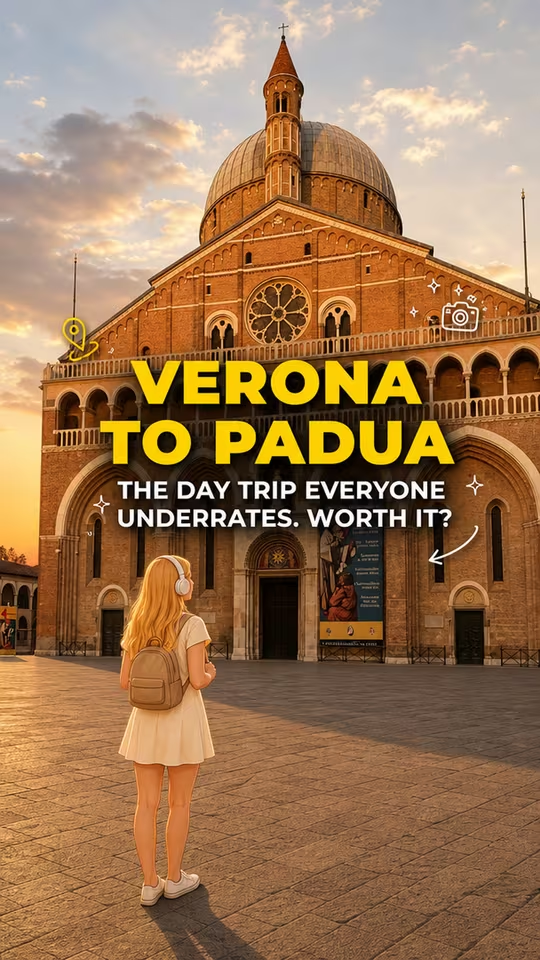
The Quick Answer: Verona to Padua
Padua (Padova in Italian, the name on the train tickets) is the easiest, densest day trip out of Verona. Eighty kilometres east on the Milan-Venice mainline, 43 to 47 minutes by fast train, and you step out of Padova station straight into a flat, arcaded city that UNESCO listed in 2021 for its 14th-century fresco cycles. What you get is a real place: a 60,000-student university town where Galileo taught for 18 years, the great pilgrimage basilica of Saint Anthony, the Scrovegni Chapel where Giotto effectively started the Renaissance in 1305, and one of the largest squares in Europe. You can do all of it on foot. Most people skip Padua for Venice and that is their mistake. One full day here covers the highlights and leaves a mark.
| Question | Answer |
|---|---|
| How far is it? | ~82 km east, on the Venice-Milan mainline |
| How long by train? | 43 min on Italo high-speed, ~47 min on the Trenitalia Regionale Veloce |
| What does it cost? | From €7.80 one-way on the RV, from €8.90 on Italo, fixed regional fares |
| What is the draw? | Giotto's Scrovegni Chapel, the Basilica of Saint Anthony, Prato della Valle |
| Is one day enough? | Yes for the highlights, if you book the Scrovegni slot in advance |
| Where do I start? | Walk 10 min south from Padova station and open our free self-guided tour |
Is the Verona to Padua Day Trip Worth It?
Yes, without much debate. Padua is the rare Italian city that earns the word underrated in the literal sense: it sits 35 minutes from Venice, has art and architecture on the same level, and gets a fraction of the crowds. The Scrovegni Chapel alone is reason enough to make the trip. Giotto's 1305 fresco cycle is the painting that broke with medieval convention and pointed Italian art straight at the Renaissance, and seeing it in person, in a small brick box you might walk past if it were not signed, is one of the great art experiences in Europe. Around it, Padua strings together the Basilica of Saint Anthony, one of Christianity's busiest pilgrimage churches, the world's oldest academic botanical garden, the vast ellipse of Prato della Valle, and a university founded in 1222 where you can stand in the oldest surviving anatomical theatre. Add in 12 km of porticoed streets, two great market squares, and the cafe where the Aperol Spritz was born, and you have a full, layered day for the price of a regional train ticket.
The best of Padua, stop by stop


The honest counter-case: if you came to Italy for vistas and skyline drama, Padua will not deliver. The city is flat, dense, and low-slung. There are no grand views apart from the campanile climbs, and the individual sights, with the exception of the Scrovegni, are not blockbuster-famous. If you only have time for one day trip out of Verona and you want the postcard shot, Lake Garda will serve better. And you do have to plan around the Scrovegni slot. The chapel uses strict timed entry, reservations are mandatory, and same-day tickets are notoriously hard to get. Book the slot before you book the train.
Giotto's Scrovegni Chapel, the Santo, and Europe's largest square, all in a flat arcaded city. [no] No skyline drama, no blockbuster gallery, no postcard view. Padua is dense, not photogenic. [yes] Less than an hour by train from Verona for a fixed €7.80 fare, and almost no tour-bus crush. [no] If you have not booked the Scrovegni slot in advance, do not bother going.
Good fit if you...
- want first-rate frescoes and one of the founding works of Western painting
- like pilgrimage churches, relics, and the lived feel of a working Italian university city
- prefer calm, local, student-aged places over polished tourist honeypots
- are happy walking 5 km of flat arcaded streets in exchange for a dense, layered day
Skip it (save Padua) if you...
- came for lake, mountain, or coastal views rather than art and churches
- only have one day trip and want a famous postcard shot
- cannot commit to booking the Scrovegni Chapel slot before you travel
- hate porticoed old towns and want open scenery
How to Get from Verona to Padua by Train
Take the train. Padua's historic centre is a ZTL, a limited-traffic zone where car drop-offs land far from the sights, and the train station is a flat 10-minute walk from the Scrovegni Chapel. The line is one of the busiest in Italy, with a train roughly every 20 minutes between Trenitalia and Italo combined. The smart pick is the Trenitalia Regionale Veloce (RV). It runs the 82 km in about 47 minutes for a fixed €7.80, the same fare as the slow all-stops Regionale that takes nearly twice as long. Italo's high-speed train is 4 minutes faster for a slightly higher fare from €8.90. The slow Regionale (R) is the trap: same price as the RV, 90+ minutes, and most first-timers end up on it by accident.
| Option | Time | Cost | Verdict |
|---|---|---|---|
| Trenitalia Regionale Veloce (RV) | ~47 min | €7.80 one-way, fixed | WINNER. Same fare as the slow train, half the time. Walk up, no reservation, fixed price. |
| Italo high-speed (AGV) | ~43 min | from €8.90 one-way | Four minutes faster, slightly more. The fastest hop, and a good fallback if RV times don't line up. |
| Slow Regionale (R) | ~1h 27m | €7.80 one-way | Same fare, nearly double the time. Only take it if nothing else is leaving soon. |
| FlixBus / Itabus | ~1h 5-15m | from €3.90-5 | Cheapest, but slower and less frequent. A budget fallback only. |
| Car | ~1h via A4 | fuel + ZTL risk + parking | Drop-offs land outside the centre. No time gained, real risk of a ZTL fine. |
The Regionale Veloce, every time. €7.80, 47 minutes, fixed fare, no reservation, walk up and go.

The Train in Detail
The Verona-Padua hop is shared between Trenitalia and Italo. Trenitalia runs the bulk of the service: the Regionale Veloce (marked RV on the departures board) does the run in about 47 minutes with a few intermediate stops, while the all-stops Regionale (R) crawls to 90 minutes and is worth avoiding. Italo runs seven daily high-speed AGV sets each way on the Venice-Milan line that stop at Padova, fastest at 43 minutes. Trains leave Verona Porta Nuova roughly every 20 minutes combined in the daytime, with first departures around 6 am and last returns from Padova running well into the evening. The 6:13 pm or 7:13 pm return out of Padova gives you dinner back in Verona; later trains still run if you stay for a late spritz.
Fares on the regional services are fixed and not dynamic. The RV and the R both cost €7.80 one-way whether you buy weeks ahead or minutes before, so there is no booking advantage. You cannot reserve a seat on the regional. Buy on the Trenitalia app and you can board straight away. Buy a paper ticket at a machine and you must validate it in the small platform machines before boarding, or risk a fine. Italo's high-speed fares are dynamic and do move, so for Italo, book ahead for the best price; Italo also sells a day-return option with up to 50% off and flexible changes up to three days before departure, worth a look if your plans are soft.
RV or Italo, which to book?
| Regionale Veloce (Trenitalia) | Italo high-speed | |
|---|---|---|
| Time | ~47 min | ~43 min |
| Fare | €7.80 fixed | from €8.90, dynamic |
| Reservation | None, sit anywhere | Assigned seat |
| Flexibility | Turn up and go | Book ahead for best price |
| Best for | Spontaneous day trips, fixed budget | Locking in a fast hop in peak season |
Take the RV if you want zero planning and a fixed price. Take Italo if its departure time lines up better with your Scrovegni slot, or if you are travelling in peak season and want an assigned seat.
Booking Strategy
For the train, there is almost nothing to book. Regional fares do not move with demand, so buy on the day on the Trenitalia app and go. If you buy a paper ticket at a machine, validate it in the platform slot before boarding. App tickets need no validation. That is the entire train procedure. If you have chosen Italo instead, book a few days ahead for the cheaper fares and consider the day-return deal.
Where the planning really matters is the Scrovegni Chapel. The chapel uses strict timed entry, 15 to 20 minutes inside, and reservations are mandatory. Same-day tickets are sometimes available at the Eremitani Museum desk but routinely sell out, especially in shoulder season when cruise groups and school parties book out entire slots. Book 1 to 3 days ahead minimum, a week or more in peak season, through the official vendor Vivaticket at cappelladegliscrovegni.it. If you want to bundle, the PadovaCard (around €16 for 48 hours) covers the Scrovegni reservation plus the Musei Civici, Palazzo della Ragione, and the Botanical Garden, and pays for itself by the second museum.
Booking checklist
- Reserve the Scrovegni Chapel slot online at cappelladegliscrovegni.it, 1-7 days ahead. Book 9 am or late afternoon to dodge school and cruise groups.
- Buy your regional train ticket on the day on the Trenitalia app. Same price early or late.
- Validate a paper regional ticket in the platform machine before boarding. App tickets need no stamp.
- If the Scrovegni is sold out, do not cancel. The Baptistery frescoes and the Eremitani Church are on the same UNESCO listing and rarely need advance booking.
- Do not visit on a Monday. Most major sights (Scrovegni closed, Palazzo della Ragione closed, Botanical Garden closed) shut.
Padua in One Day
Here is the part that makes this day easy. You walk out of Padova station, 10 minutes south, and you are at the edge of the historic centre. No plan needed, no paper map, no guide waiting by a door. You open our free self-guided Padua tour in your browser, and a real voice guide takes over. It is not an audioguide you press play on. It greets you, tells you what you are looking at, points out the fresco details you would miss, asks what draws your eye, and shapes the rest of the walk around your pace. It has step-by-step navigation between stops, so you never stand on a corner wondering which way to turn. No app, no download, 100 free credits to start, and it works from any stop on the loop, so if you arrive late or drift off-route it simply picks you up where you are.

The time math
Catch the 7:22 or 8:22 am train out of Verona Porta Nuova and you are in Padua before 9, in time for opening at the Scrovegni if you booked the first slot. That gives you a clean run at the chapel before the 10-to-2 crush, when most day-trippers try to cram it in. Break for a market lunch around 12:30 at Piazza delle Erbe, walk it off through the botanical garden in the early afternoon, hit Prato della Valle and Piazza dei Signori in the soft late-afternoon light, and grab a spritz at Caffè Pedrocchi before the 6:13 or 7:13 pm return. That is a generous nine to ten usable hours on the ground, more than almost any other Verona day trip. Even a compressed four to five hours covers the Scrovegni, the Basilica of Saint Anthony, and one square, though it feels rushed.
What you'll see
Padua's centre is a tight knot of arcaded streets, market squares, and church domes, all of it flat and walkable. The loop below strings the UNESCO fresco cycle together with the great pilgrimage basilica, the oldest university, and the largest square. The highlights, in the order the route takes them:
- Scrovegni Chapel (€15, timed entry, book ahead, closed Mondays): Giotto's 1305 fresco cycle wrapping all 700 m² of wall and vault. The single work that pointed Western painting at the Renaissance. Mandatory advance reservation through Vivaticket.
- Basilica of Saint Anthony (Il Santo) (free, daily 6:15-19:30): the great pilgrimage basilica with Donatello's bronzes on the high altar and his Gattamelata equestrian statue in the square outside. Shoulders and knees covered or you get turned away.
- Prato della Valle (free, open 24/7): one of Europe's largest squares at roughly 90,000 m², an elliptical island ringed by a canal and 78 statues of famous Paduans. Saturday market, third-Sunday antiques market.
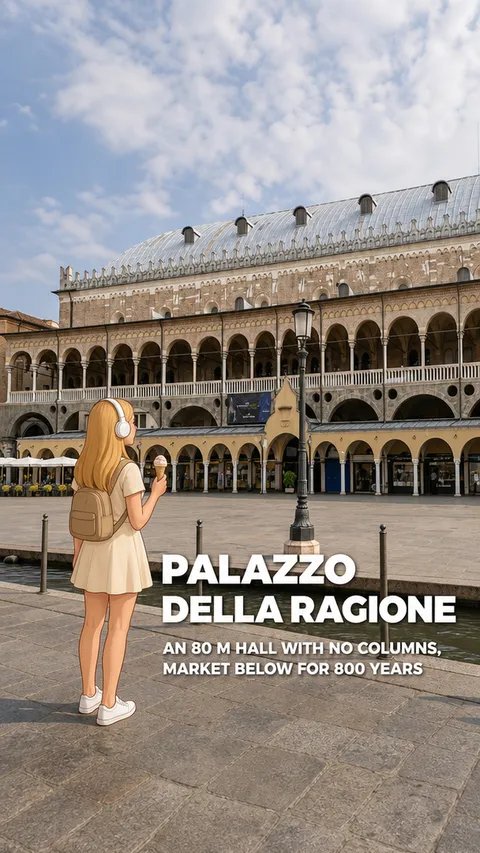
- Palazzo della Ragione (€10, Tue-Sat, closed Sun-Mon): the 13th-century law court with the Salone, an 80 m hanging hall with no columns and a ship's-keel wooden roof. The ground-floor Sotto il Salone market is free.
- Botanical Garden of Padua (€10, Tue-Sun, closed Mon): founded 1545, the world's oldest academic botanical garden still on its original site. UNESCO-listed. A calm, shaded 30 minutes.
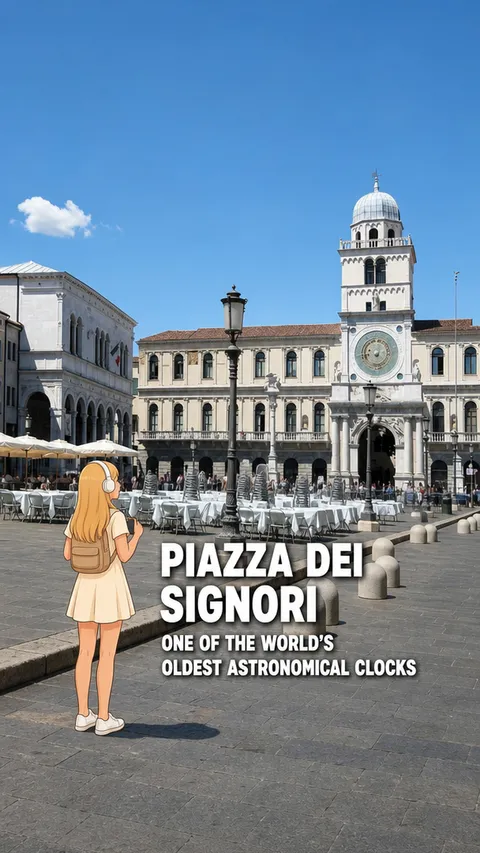
- Piazza dei Signori (free, always open): the grand civic square with the Torre dell'Orologio astronomical clock, one of the oldest preserved in the world.
The route the tour walks with you
The loop below is the exact order the tour follows, and it starts from any stop, so there is no backtracking and no wrong place to begin. It opens at the Scrovegni Chapel in the north, runs south down the eastern edge to the Basilica of Saint Anthony and the botanical garden, swings out to the great ellipse of Prato della Valle, then climbs back up through the university, the market squares, and the cathedral baptistery before closing at the river.
- 1Scrovegni Chapel €15 · book ahead
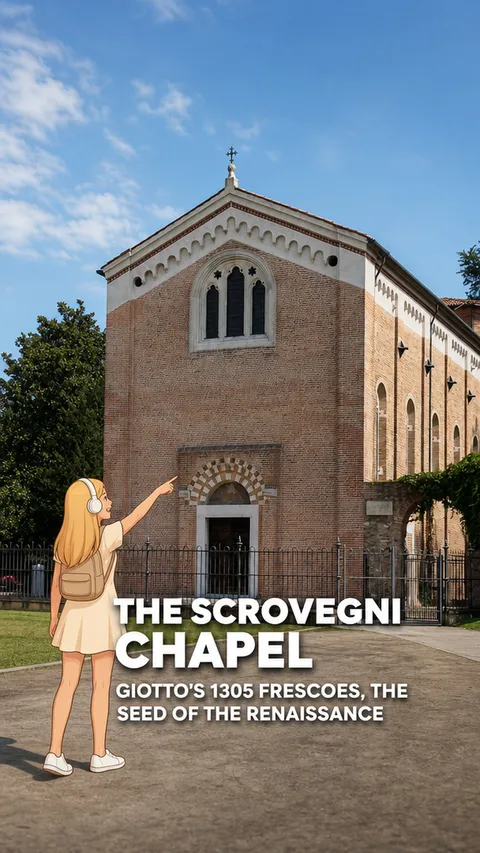
Start here, and book ahead, because this is the one stop you cannot improvise. From the outside the chapel is a plain brick box in a park, easy to underestimate. Inside, Giotto's 1305 fresco cycle wraps all 700 square metres of wall and that deep blue vault, and it changed Western painting. Strict timed slot: a climate antechamber first, then 15 to 20 minutes inside. Reserve at cappelladegliscrovegni.it.
- 2Church of the Eremitani Free
Two minutes from the chapel and almost nobody walks over. This big medieval church, begun in 1264, holds the wreckage and the survivors of Mantegna's early frescoes; an Allied bomb flattened the Ovetari Chapel in 1944, so what you see is partly reassembled fragments. On the same UNESCO 14th-century fresco listing as the Scrovegni. Step inside for the ship's-keel wooden ceiling even if frescoes are not your thing.
- 3Basilica of Saint Anthony Free
The domes and minaret-like towers tell you where you are long before you arrive. Locals call it il Santo. One of the great pilgrimage churches, over 6.5 million visitors a year for the tomb of Saint Anthony. Look for Donatello's bronze reliefs and crucifix on the high altar, and his Gattamelata equestrian bronze in the square outside. Dress code enforced: shoulders and knees covered.
- 4Botanical Garden of Padua €10
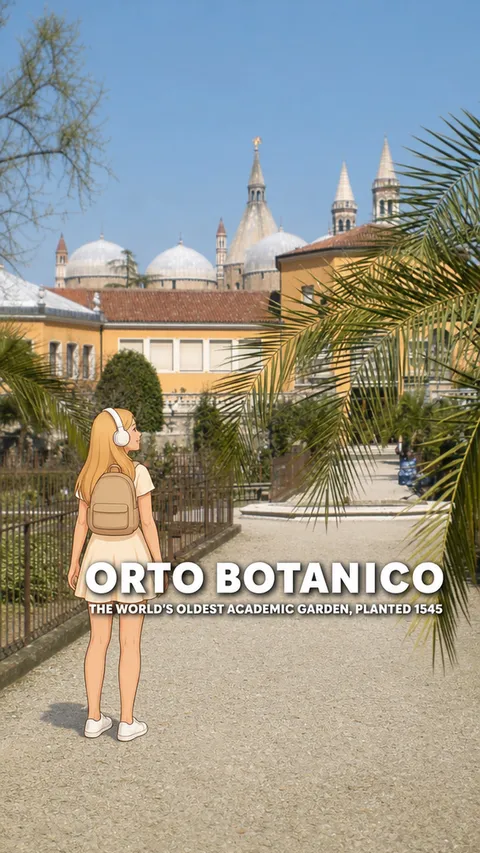
The antidote to the basilica crush. Founded 1545, oldest academic botanical garden still on its original site, UNESCO-listed since 1997, laid out as a walled circle of geometric beds across 2.2 hectares. The headline plant is a palm from 1585 that Goethe wrote about. Calm, shaded, rarely busy. Closed Mondays.
- 5Prato della Valle Free
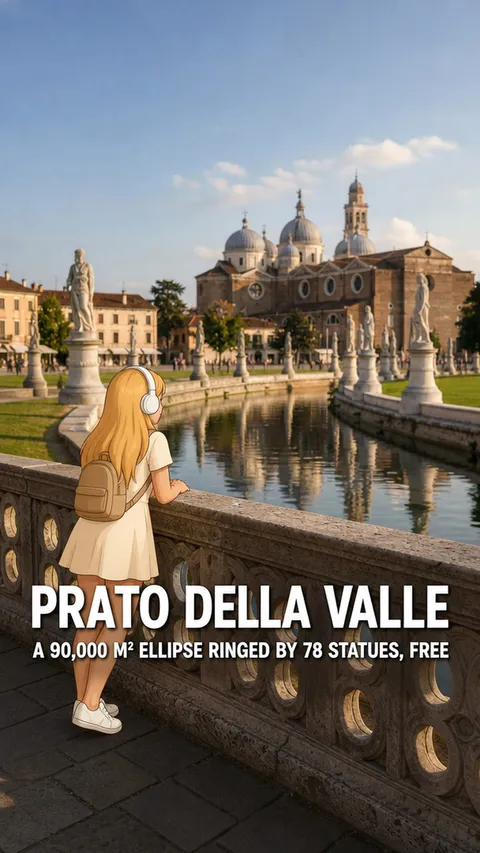
The street opens and suddenly you are at the edge of one of the largest squares in Europe. A central elliptical island, Isola Memmia, sits inside a canal lined by a double ring of 78 statues. Cross one of the four little bridges onto the island and walk the ring; the whole circuit is about 570 m. Saturday brings a large general market. The natural turning point of the loop, a good place to sit on the grass.
- 6University of Padua (Palazzo Bo) €7 · tour book ahead
Founded 1222, one of the oldest universities in the world. Palazzo Bo holds the world's oldest surviving permanent anatomical theatre, a steep wooden funnel from 1594 where students stood ringed above a dissection table. Galileo taught here for 18 years; his lectern is still in the building. Guided tours only, book on the unipd.it site. The arcaded courtyard is free to walk through.
- 7Palazzo della Ragione €10
You hear this stop before you see it: the chatter of Piazza delle Erbe and Piazza della Frutta, the two market squares that wrap around the building. The 13th-century law court is topped by the Salone, a single hanging hall roughly 80 by 27 m under a wooden ship's-keel roof, one of the largest unsupported medieval rooms anywhere, with a 15th-century astrological fresco cycle, part of the UNESCO listing. The ground floor is the Sotto il Salone covered market of butchers, cheese, and salumi.
- 8Piazza dei Signori Free
A different mood from the market chaos you just left. This is the civic square, broader and grander, where Padua once held tournaments. The Torre dell'Orologio clock tower has one of the oldest astronomical clocks in the world, its face tracking the zodiac and the moon. Late afternoon light hits the tower face well.
- 9Baptistery of Padua Cathedral €15 · timed entry
Small door, overwhelming interior. From the outside this is just a squat brick block next to the plain Duomo. Step inside and every surface is covered by Giusto de' Menabuoi's 1370s fresco cycle, a domed sky packed with figures, one of the best-preserved 14th-century interiors in Italy and a key part of Padua's UNESCO listing. Rivals the Scrovegni, a fraction of the crowd. Book through kalata.it.
- 10Ponte Molino Free
The loop ends at water. This low stone bridge over the Bacchiglione dates to the late Roman republic, and the stout medieval Porta Molino tower stands guard at its southern end. Marks the historic northern edge of the old town. Nothing to pay, nothing to queue for; this is a stop for the view and a breather before you walk back to the station.
It runs in your browser, no app and no download. A voice guide walks the loop with you and leads a real conversation as you go: it greets you, tells the story between stops, asks what you actually want to see, and adapts. It is not a recording and not an audioguide. The map and step-by-step navigation get you from each stop to the next.
Insider Tips for the Padua Day Trip
Do
- book the Scrovegni Chapel slot 1-7 days ahead at cappelladegliscrovegni.it, and pick 9 am or late afternoon to dodge school and cruise groups
- buy a PadovaCard (around €16 / 48 h) if you will see the Scrovegni plus two more museums. It bundles the reservation and pays off fast
- eat at the Sotto il Salone market under Palazzo della Ragione: a porchetta panino runs a few euros, far better than the cafe tables on Piazza dei Signori
- have an Aperol Spritz in the city where it was invented. Caffè Pedrocchi's outdoor tables, late afternoon, is the moment
- take the fast Regionale Veloce (RV), not the slow Regionale (R). Same €7.80 fare, half the time
Don't
- visit on a Monday. Most major sights including the Scrovegni, Palazzo della Ragione, and Botanical Garden are closed
- eat near the Basilica. The Prato della Valle area hides the osterias where locals actually go
- try to do Verona and Padua in one day. Each deserves its own full day; you will short-change both
- take a taxi from the station. The ZTL means the drop-off lands outside the centre anyway. It is a flat 10-minute walk
The Scrovegni slot
The single most common mistake here is treating the Scrovegni like a normal sight. It is not. You must book a time slot in advance, the slot is strict, and once the automatic doors close no further visitors are admitted. Arrive 30 minutes before your slot at the Eremitani Museum entrance. You sit through a 15-minute climate-stabilization video, then get 15 to 20 minutes inside the chapel. That is enough, and there are no re-entries. If your travel date is firm, book the chapel before you book the train.
Plan around the closing day. Most of Padua's major sights, including the Scrovegni Chapel, Palazzo della Ragione, and the Botanical Garden, are closed on Mondays. Visit Tuesday through Sunday. Museum hours shift by season, so confirm current times on the official sites before you travel.
More day trips from Verona
Out in the morning, back in time for dinner. Every route here fits in one full day.
What the Verona to Padua Journey Feels Like
The ride east is short and flat, the Verona plain turning into the Veneto in under an hour, and then you are simply there. Padua does not announce itself the way Verona does. The station edge is plain, the walk south is unremarkable for the first few blocks, and then the porticoes start and the city takes over. The first thing that strikes you is how lived-in it feels. Verona is polished, romantic, tourist-facing, Shakespeare-branded. Padua is grittier, denser, more student-powered. The streets are arcaded, so rain barely touches you, and underneath the arcades everything is open, busy, and running on its own clock.
The Scrovegni is the moment the day shifts. You walk into a small brick chapel and a deep blue vault covered in figures closes over you. Giotto's colours are intense, the sacred narrative reads surprisingly modern, and you get why this is the painting that pointed Italian art at the Renaissance. From there the day unfolds in layers. The domes of the Basilica of Saint Anthony, the hush of the cloisters, the shock of the anatomical theatre at Palazzo Bo, the sudden opening of Prato della Valle with its 78 statues looking inward across the canal. By late afternoon you are standing in Piazza dei Signori with a spritz, surrounded by students and locals who all know each other, and the day has the shape of something genuinely found, not consumed.
The vibe at aperitivo hour is the city's defining moment. Nobody plans a big night out. They just end up in the piazza, drop a message, and people drift in. Padua rewards that kind of slow, accidental day. It is a city you walk through, look up in, and end up staying longer than you planned.
Verona to Padua: Your Questions Answered
How long is the train from Verona to Padua?
About 47 minutes on the Trenitalia Regionale Veloce (RV), the fast regional. Italo's high-speed does it in 43 minutes. The slow all-stops Regionale (R) takes around 1 hour 27 minutes for the exact same €7.80 fare, so check which service you are boarding. Trains leave Verona Porta Nuova roughly every 20 minutes combined in the daytime.
Do I need to book the Verona to Padua train in advance?
Not for the regional. RV and R fares are fixed at €7.80 one-way whether you buy weeks ahead or minutes before, and you cannot reserve a seat on the regional, so turn up and buy on the Trenitalia app. Validate a paper ticket in the platform machine before boarding. If you choose Italo, fares are dynamic and you should book ahead for the best price.
Is one day enough for Padua?
Yes, for the highlights. A single full day covers the Scrovegni Chapel, the Basilica of Saint Anthony, Prato della Valle, Palazzo della Ragione, the Botanical Garden, and a walk through the university, with time for a market lunch and a spritz. Two days would let you add the smaller fresco cycles and a slower cafe rhythm. One day, with a booked Scrovegni slot, genuinely delivers the essentials.
What day should I avoid visiting Padua?
Avoid Monday. The Scrovegni Chapel, Palazzo della Ragione, and the Botanical Garden are all closed, and several other sights run reduced hours. Tuesday through Sunday is the safe window. Saturday is lively for the Prato della Valle market but the Scrovegni slots fill faster, so book further ahead.
How much does it cost to see Padua's sights?
The Basilica of Saint Anthony, Prato della Valle, Piazza dei Signori, and the church squares are all free. Budget €15 for the Scrovegni Chapel (mandatory booking), €10 for Palazzo della Ragione, €10 for the Botanical Garden, €7 for a Palazzo Bo tour, and €15 for the Baptistery frescoes. If you will see three or more, the PadovaCard at around €16 for 48 hours bundles the Scrovegni reservation with several major museums and pays for itself quickly.
Is Padua worth visiting compared to other Verona day trips?
Yes, if you want frescoes, pilgrimage churches, and a working university town rather than lake or mountain scenery. Padua has Giotto's Scrovegni Chapel, one of the great pilgrimage basilicas, and Europe's largest square, all with a fraction of Venice's crowds. If you specifically want a postcard view or a lake, Lake Garda or Venice will serve better. For art, atmosphere, and food, Padua is one of the most rewarding day trips out of Verona.
Do I need to book the Scrovegni Chapel in advance?
Yes, mandatorily. The chapel uses strict timed entry, reservations are required, and same-day tickets are notoriously hard to get. Book 1 to 7 days ahead through Vivaticket at cappelladegliscrovegni.it. Pick 9 am to dodge school groups, or late afternoon after 3:30 pm once cruise groups have left. Arrive 30 minutes before your slot. You get a 15-minute climate video, then 15 to 20 minutes inside.
What should I eat in Padua?
Start with bigoli in salsa, thick spaghetti in an anchovy-onion sauce, or bigoli with duck ragù (about €12 at a trattoria near Prato della Valle). Baccalà alla vicentina, salted cod over polenta, is the Veneto classic. For lunch, grab a porchetta panino for a few euros at the Sotto il Salone market under Palazzo della Ragione. Finish with a Pedrocchi coffee, the cafe's signature mint-and-coffee without milk, and an Aperol Spritz where it was invented.
How do I get from Padova station to the centre?
It is a flat 10-minute walk south from Padova station to the Scrovegni Chapel and the Eremitani Museum, the start of the loop. The single tram line (SIR1) also runs from the station down through the centre, stopping at Eremitani, Ponti Romani, Santo, and Prato della Valle. Tap a bank card on boarding, no paper ticket needed.
Plan Your Padua Day Trip
Catch the 7:22 or 8:22 am train out of Verona Porta Nuova, and by the time you reach the Scrovegni Chapel your day is already handled. Open our free self-guided Padua tour in your browser, no app and no download, and a real voice guide walks the loop with you, greeting you, explaining Giotto's frescoes, the relics of the Santo, and the 78 statues of Prato della Valle, pointing out the overhead porticoes and the anatomical theatre, and asking what draws your eye so it can shape the rest of the route. It is a conversation woven into the walk, with step-by-step navigation between the stops, and it starts from any stop, so it works whether you begin at the Scrovegni or somewhere in the middle. You get 100 free credits to start. That is the whole plan: 47 minutes on the RV, a booked chapel slot, and a guide that does the thinking so you can just look up.
