
Verona to Bergamo Day Trip: 80 Minutes to a Walled Medieval Hill Town
Eighty minutes on a FlixBus buys you one of Italy's most underrated cities. Verona Porta Nuova to Bergamo station runs direct, hourly, from about €7, and the medieval Città Alta is a funicular ride above the platform. Here is the honest plan, the one reason to book ahead, and a free, self-guided walking tour for the hours on the ground.
The Quick Answer: Verona to Bergamo
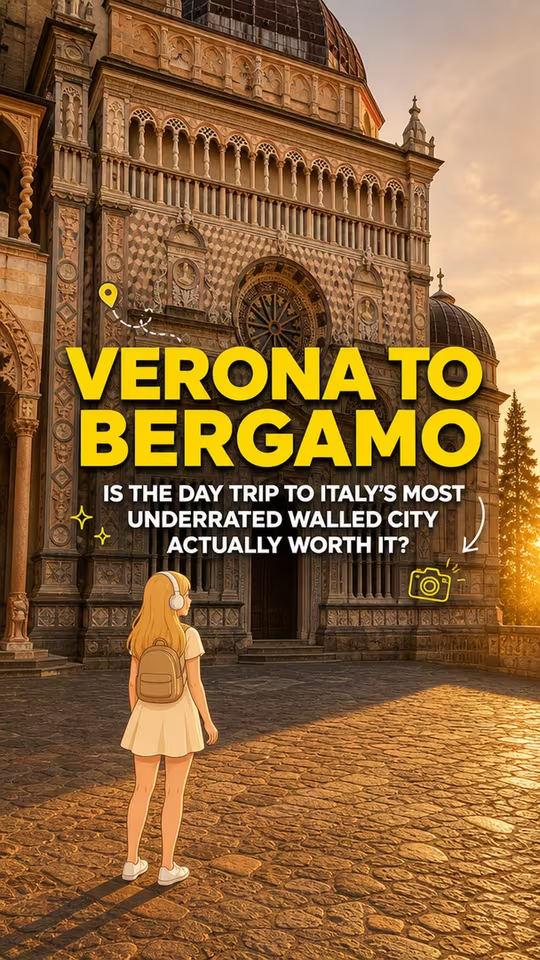
Take the FlixBus, and do not overthink the rest. Verona Porta Nuova to Bergamo station runs in about 1 hour 20 minutes to 1 hour 40, direct, with no transfer, on the most underrated day-trip corridor out of Verona. Service runs hourly, with at least four FlixBus rides a day plus BlaBlaCar Bus filling earlier and later slots. Book a few days out and FlixBus advertises fares from about €6.98, with realistic advance seats in the €7 to €15 band. Leave it to the morning you travel and you still pay less than the train, but the cheapest seats vanish first. The arrival is the quiet luxury: Bergamo station sits in the modern Città Bassa, and a 15-minute bus 1A or a short walk takes you to the lower funicular, which hauls you up into the walled Città Alta in three minutes. Is 80 minutes on a coach worth a whole day? For the walled medieval upper town alone, yes. This is a UNESCO-listed hilltop that most travellers fly straight over on their way to Milan, and the contrast with Verona's polished Shakespearean streets is the whole reason to come.
| Question | Answer |
|---|---|
| Fastest journey time | ~1h20 direct on FlixBus (realistic 1h25 to 1h40) |
| Frequency | Hourly, at least 4 FlixBus rides a day plus BlaBlaCar Bus slots |
| Price from | ~€6.98 FlixBus advance, typically €7 to 15, higher same-day |
| Operators / how | FlixBus and BlaBlaCar Bus, both direct, station to station |
| First / last | First FlixBus around 10:05 (earlier BlaBlaCar Bus), last back from Bergamo ~20:10 to 20:20 |
| Worth it as a day trip? | Yes. Short ride, painless arrival, one of Italy's best walled hill towns |
Is the Verona to Bergamo Day Trip Worth It?
Some day trips earn their keep through scale or fame. Bergamo earns it through contrast. The ride is short, the arrival is easy, and the upper town is so completely different from Verona that stepping off the funicular feels like changing countries. Where Verona is polished, romantic and Shakespearean, Bergamo is raw, layered and medieval: cobbled lanes, pastel walls weathered by alpine winters, clay roof tiles, and 6 kilometres of intact 16th-century Venetian walls looping the hilltop. The Città Alta is small enough to walk in a day and dense enough to fill it, with a Romanesque basilica, a Renaissance marble mausoleum, a 52-metre civic tower and a hilltop castle all within a few hundred metres of each other.
The best of Bergamo, stop by stop


The case for going is the case about atmosphere and value. Bergamo is the city Milan flights land at and almost nobody stops to explore, which is precisely the appeal. It feels more like a large town than a city, intimate and unhurried, with a food culture that is hearty, regional and noticeably cheaper than Verona: BudgetYourTrip's comparative data puts Bergamo at roughly €185 a day against Verona's €210. The locals eat casoncelli alla bergamasca, a stuffed pasta with amaretti and breadcrumbs in butter and sage, drink Moscato di Scanzo, and finish with a polenta e osei cake that contains no polenta at all. The ice cream here matters too: stracciatella was invented in Bergamo in 1961.
Eighty minutes on a bus, a funicular up, and you are inside a walled UNESCO hill town that most travellers fly straight past.
The honest counterpoint is not logistics, it is appetite and time. There is no direct train, and the train alternative (via Brescia) takes 1h40 to 2h10 with a change, so if you cannot stomach a coach, Bergamo is not your easiest day trip. Città Alta alone needs three to four hours minimum, and a rushed visit feels like a tease. If you only have one full day in Verona itself, do not split it. And if you want a lake or a beach, this is a hilltop city, not water.
Skip it if you only have one day in Verona itself, or if a coach ride rules out your day. The train alternative needs a change in Brescia.
Our call: for anyone with two or more full days in Verona who wants a real, walkable Italian hill town without the crowds of a marquee destination, Bergamo is close to the perfect pick. Take the morning bus, ride the funicular up, walk the walls, eat a long lunch, and catch the 17:00 bus home. You will not run out of things to see, and you will spend less than dinner costs in Verona.
Good fit if you...
- Have two or more full days in Verona and want a contrasting Italian hill town
- Are fine on a coach for 80 minutes each way in exchange for a direct, cheap ride
- Love walled medieval towns, cobblestones and dramatic topography
- Want a day that costs less than Verona and clears the tourist-circuit crowds
Skip it (save Bergamo) if you...
- Only have one full day in Verona itself, keep it
- Refuse to ride a coach and insist on a through train (there is none)
- Need a blockbuster museum or a lake to justify the day
- Want guaranteed dry heat: Città Alta can be breezy and cool on the walls
How to Get from Verona to Bergamo by Bus
There are four realistic ways to cover the 115 kilometres between Verona and Bergamo, and for a day trip the direct FlixBus wins so clearly there is almost nothing to weigh. The only genuine decision is when to buy, because the cheapest fares sell first and the timetable has one seasonal catch worth knowing.

| Mode | Time | Price | Verdict |
|---|---|---|---|
| FlixBus / BlaBlaCar Bus (direct) | ~1h20 to 1h40 | ~€6.98 advance, typically €7 to 15 | WINNER. Direct, station to station, no transfer, cheapest |
| Train via Brescia | 1h40 to 2h10 | €9 to 15 typical, Trenord from €9 | Slower and pricier; only worth it to stop in Brescia on the way |
| Car (A4 autostrada) | ~1h05 to 1h15 | ~€6.20 tolls one way + fuel | Fastest, but Città Alta is a ZTL and parking is tight |
| BlaBlaCar rideshare | ~1h30 | €5 to 8 | Cheapest of all, but only useful if a driver's slot matches yours |
The train deserves one honest line: there is no direct train from Verona to Bergamo. The route forces a change in Brescia, which pushes the journey out to 1h40 to 2h10 and bumps the typical fare to €9 to €15, more than the bus for a slower trip. It only really earns its keep if you want to break the journey in Brescia, with its impressive Roman ruins and Duomo Vecchio. Driving is the fastest option on paper, about 1h05 to 1h15 down the A4, but Bergamo's Città Alta is a limited-traffic zone (ZTL), parking up top is scarce, and you arrive sober and stressed about where to leave the car. The bus drops you at Bergamo station, lets you eat and drink properly, costs the least, and is quicker door-to-door than the train. It is the rare day trip where the cheapest option is also the best.
The direct FlixBus is the only mode that turns 115 kilometres into a single 80-minute ride with no transfer.
The Bus in Detail
Two operators run the direct coach corridor between Verona and Bergamo, and both serve the same station-to-station spine. FlixBus runs at least four rides a day, hourly through the middle of the day, with the first departure from Verona around 10:05 and the last return from Bergamo in the evening around 20:10 to 20:20. BlaBlaCar Bus fills earlier and later slots, with departures from Verona as early as 5:45 a.m. on some days, though schedules shift by day of the week. The journey is advertised at 1h20 and realistically lands at 1h25 to 1h40 depending on traffic around the Brescia and Bergamo interchanges.
The stops are simple. In Verona, FlixBus leaves from Viale Girolamo Cardinale, the bus axis right alongside Verona Porta Nuova station, so you can connect straight off a Regionale or a Frecciarossa. In Bergamo, you arrive at the bus yard beside Bergamo station, on the southern edge of modern Città Bassa. From there the upper town is a 15-minute city bus (line 1A, ticket €1.60) to the lower funicular station, or a 20-minute walk if you prefer to stretch your legs.
One live caveat worth knowing: FlixBus periodically relocates the Verona stop for roadworks, and a recent notice shifted it from Viale Girolamo Cardinale to Viale Andrea Palladio for the whole month of July. Always check the departure point on your booking confirmation the day before you travel, because the platform number is not where it usually is when this happens.
FlixBus or BlaBlaCar Bus, which to book?
Carry no brand loyalty here. Both run the same direct corridor, both use the same standard long-distance coaches with Wi-Fi, power sockets and a toilet, and both arrive at Bergamo station. Compare them on the FlixBus site and the blablacar.co.uk/bus site for your exact date and take whichever is cheaper or better timed. FlixBus tends to run the densest midday schedule, BlaBlaCar Bus tends to cover the early morning and late evening shoulders. If you want to leave Verona proper early, BlaBlaCar Bus is more likely to have a 6 to 9 a.m. slot. If you want a civilised 10 a.m. departure, FlixBus is your friend.
| Option | Time | Price | Best for |
|---|---|---|---|
| FlixBus | ~1h20 to 1h35 | From ~€6.98 advance | The densest midday schedule, easiest booking app |
| BlaBlaCar Bus | ~1h20 to 1h40 | €5 to 12 | Early morning and late evening slots, sometimes cheaper |
| Itabus / Marino (when running) | ~1h30 to 1h45 | €6 to 12 | Filling gaps on heavy travel days |
Booking Strategy
FlixBus fares are dynamic, so the biggest lever on price is how early you buy. The cheapest advance fares, the ones near €6.98, are limited and sell first. Book late and the same seat can cost two or three times as much, which is the classic mistake on this route. As soon as your date is fixed, buy direct on the FlixBus app or website, choosing Verona to Bergamo. For the return, FlixBus tickets are tied to a specific departure, so if you want a loose evening you either buy a slightly dearer flexible fare for the way home or simply accept a fixed return time and plan your day around it. Aim the return at a second-to-last departure rather than the very last one, so a long lunch never turns into a sprint across Bergamo.
Booking checklist
- Book as early as you can on the official FlixBus app or site, choosing Verona (Viale Girolamo Cardinale) to Bergamo (Bus Station).
- Cross-check the blablacar.co.uk/bus site for your date. The journey is the same, so let price and timing decide.
- Take a mid-morning FlixBus out, around 10:00, to reach Bergamo by 11:30 and bank a full afternoon.
- Print or screenshot your QR code before you leave wifi. FlixBus drivers scan it directly off your phone screen.
- Aim the return at a second-to-last bus, around 17:00, so a long lunch never becomes a sprint for the last 20:10.
- The day before you travel, re-check the Verona departure stop on your booking. FlixBus relocates it for roadworks, often to Viale Andrea Palladio, and the platform is not where the app usually says.
Bergamo in One Day
Here is the part most day-trip guides bury, and it is the whole point: you do not need to plan a route. The bus sets you down at Bergamo station in Città Bassa, you take bus 1A or a short walk to the lower funicular, and the 1887 funicular hauls you up into the walled Città Alta in three minutes. From the upper station you open our free, self-guided Bergamo tour on your phone and start it from wherever you are standing. The voice guide takes the planning off your hands and walks the upper town with you, stop by stop, so the moment you step off the funicular becomes the first beat of the day rather than a map problem. No route-wrangling, no "now where to next", just the city and a guide that talks you through it.

The time math
Take the 10:00 FlixBus out of Verona and you reach Bergamo station around 11:25. Add 15 to 20 minutes for bus 1A and the funicular up, and you are standing in Città Alta before midday. Catch the 17:00 return and you arrive back at Porta Nuova around 18:25, with about five and a half to six usable hours on the ground. That is the right amount for the walls, Piazza Vecchia, the basilica and the Cappella Colleoni, plus a relaxed lunch and the second funicular up to San Vigilio for the panorama. Push the return to the 18:00 or 19:00 bus and you buy another hour for the Accademia Carrara or a long dinner up top, but the 17:00 is the safest slot for a day that already felt full. Anything later than 20:10 and you are into the last bus, which is a gamble you do not need.
What you'll see
Città Alta is small, hilly and almost entirely pedestrianised, so a single day covers the lot without rushing. Hours and prices shift, so confirm the ticketed sights on their official channels before you go:
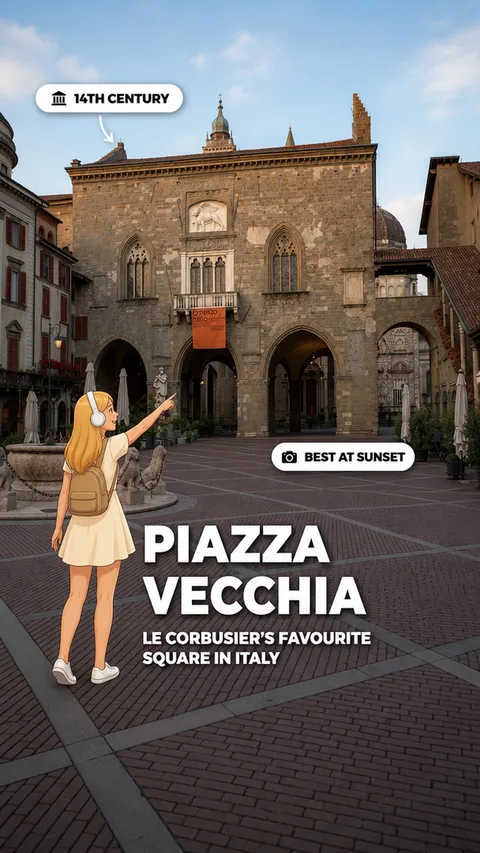
- Piazza Vecchia (free, open 24h): the monumental heart of the upper town, framed by the medieval Palazzo della Ragione and the white marble Contarini fountain. Le Corbusier called it one of the most beautiful squares in Europe. This is where you orient yourself.
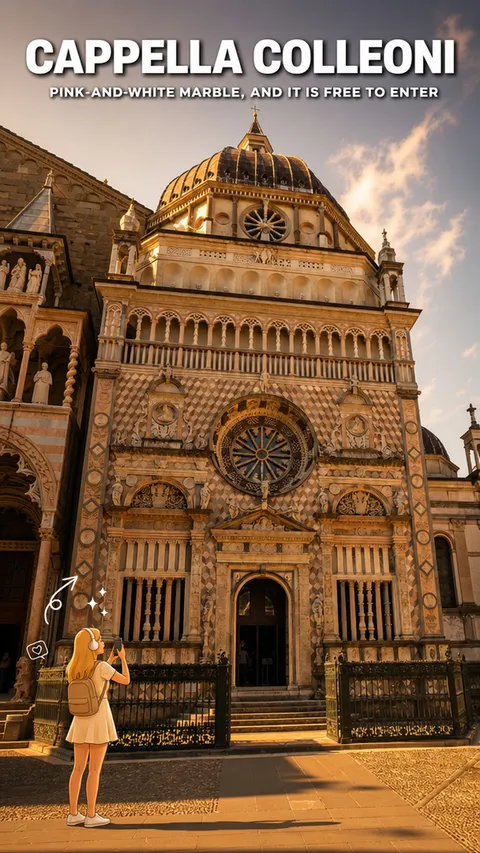
- Cappella Colleoni (free entry, closed Mondays): the 1476 pink-and-white marble mausoleum of the condottiero Bartolomeo Colleoni, with a facade carved into a riot of medallions and the family crest of three figs that are anatomically not figs at all. Free to walk in, closed Monday mornings and over lunch.
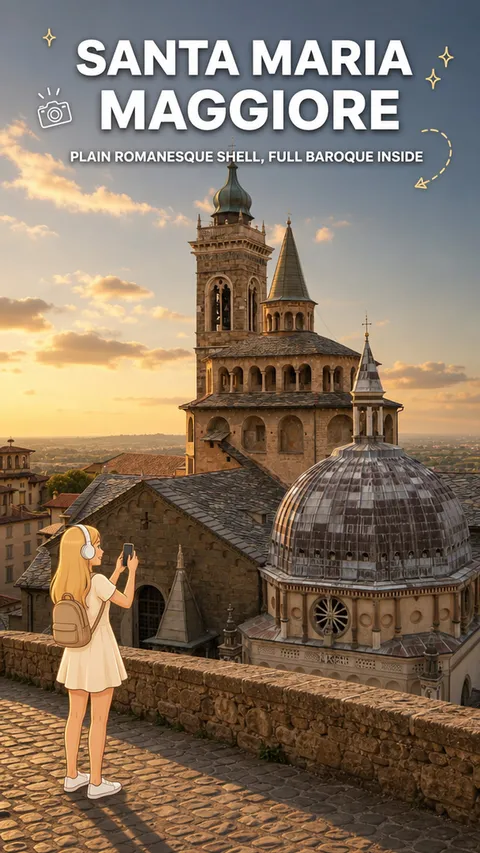
- Basilica di Santa Maria Maggiore (€5 entry, 9:00 to 18:00 daily): a sober Romanesque shell hiding an overwhelming Baroque interior of gilded stucco, Flemish tapestries, inlaid wooden choir stalls by Lorenzo Lotto, and the tomb of composer Gaetano Donizetti. Cover shoulders and knees. No photography inside.
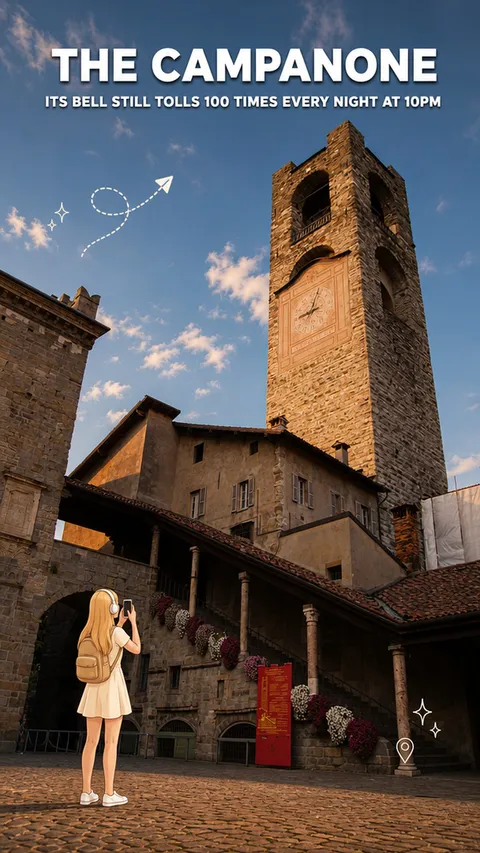
- Campanone (Civic Tower) (€9 lift, closed Mondays): the 52-metre medieval bell tower over Piazza Vecchia, with a lift to the best close-up panorama of the tiled roofs. The bell still tolls 100 times every evening at 22:00, a curfew echo from when the city gates closed for the night.
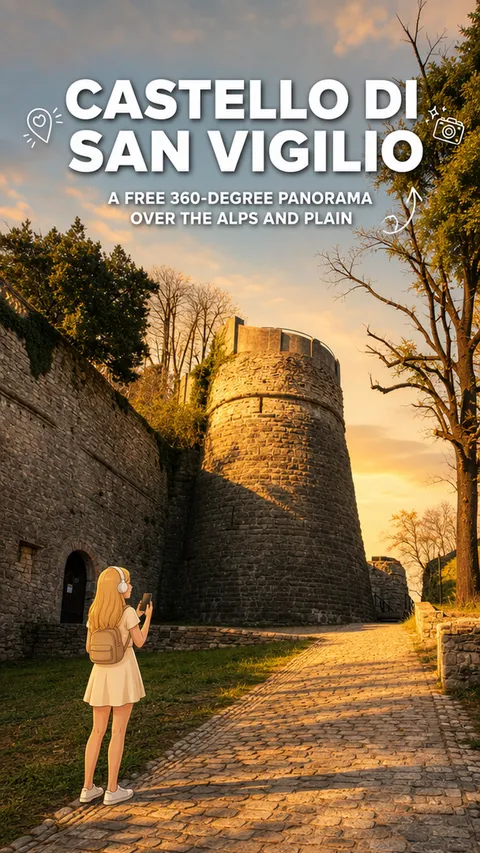
- Castello di San Vigilio (free, 9:00 to 17:00 daily): the free Venetian-era castle ruins on the hill above Città Alta, reached by a second funicular, with the most expansive 360-degree panorama of the old town, the Po plain and the Orobie Alps.
- Venetian Walls (free, open 24h): six kilometres of intact 16th-century Venetian fortifications looping the hilltop, the reason Bergamo carries a UNESCO World Heritage listing. The promenade along the top is the best first view of where you are.
- Accademia Carrara (€10, 9:00 to 19:00, late Fridays to 23:00): one of Italy's serious picture galleries, with Botticelli, Raphael, Mantegna, Bellini, Titian and a wall of Moroni portraits, in a neoclassical palazzo just below the walls in Città Bassa. Best saved for the end, when your legs are done with cobbles.
The route the tour walks with you
Instead of a generic "see the square, then the chapel" list, you walk one efficient loop and the tour walks it with you. Because it launches from any of its stops, you never backtrack to find an official start, you just begin where you are standing. This is the real ten-stop order, climbing on the funicular, looping the walls and San Vigilio hill first, dropping into the monumental core around Piazza Vecchia, and finishing down in the lower town at the Accademia Carrara so the long museum stop comes when your legs are ready for it:
- 1Funicular to Città Alta €1.60 · your start
The 1887 funicular hauls you up the hillside in under three minutes. Buy your ticket from the machine, validate it, and grab the downhill-facing side for the view back over the plain.
- 2Venetian Walls Free · open 24h
Six kilometres of intact 16th-century Venetian bastions, the reason Bergamo is UNESCO-listed. Walk the promenade along the top for your first real sense of the Lombard plain stretching south.
- 3Castello di San Vigilio Free · 9 to 17 daily
Take the second funicular further up to the castle ruins, with walkable towers, underground tunnels and a full 360-degree panorama taking in the old town and the Orobie Alps.
- 4Campanone (Civic Tower) €9 lift · closed Mons
The 52 m tower over Piazza Vecchia. The lift gives the best close-up view of the rooftops from directly above. Its bell still tolls 100 times each evening at 22:00, a curfew echo from when the gates shut.
- 5Piazza Vecchia Free · open 24h
The monumental heart, framed by the Palazzo della Ragione and the Contarini fountain ringed by stone lions. Stop under the porticoes for a coffee and just look. Le Corbusier called it one of the most beautiful squares in Europe.
- 6Cappella Colleoni Free entry · closed Mons
The 1476 pink-and-white marble mausoleum of condottiero Bartolomeo Colleoni, with Tiepolo ceiling frescoes and the famous family crest of three figs that are anatomically not figs at all.
- 7Basilica di Santa Maria Maggiore €5 · 9 to 18 daily
A sober Romanesque shell hiding an overwhelming Baroque interior, with Renaissance tapestries, inlaid wooden choir stalls by Lorenzo Lotto, and the tomb of composer Gaetano Donizetti. No photos inside.
- 8Rocca di Bergamo Grounds free · museum €5
The medieval fortress on the eastern hill, with a green park wrapping the ramparts and long views back across the old town. The museum is skippable; the ramparts and the free Parco della Rocca are the draw.
- 9Palazzo Moroni €12 · closed Tuesdays
An 18th-century noble palace on Via Porta Dipinta, with frescoed halls and a picture gallery of Giovan Battista Moroni portraits. The real surprise is the terraced Italian gardens climbing the hillside out back.
- 10Accademia Carrara €10 · 9 to 19 daily
One of Italy's serious picture galleries, in a neoclassical palazzo just below the walls in Città Bassa. Botticelli, Raphael, Mantegna, Bellini, Titian and a wall of Moroni portraits. The right place to finish the loop.
It runs in your browser, no app and no download. A voice guide walks the loop with you and leads a real conversation as you go: it greets you, tells the story between stops, asks what you actually want to see, and adapts. It is not a recording and not an audioguide. The map and step-by-step navigation get you from each stop to the next.
That whole loop is our free, self-guided Bergamo walking tour, and because it can be launched from any of its stops, you do not backtrack to find an official start, you just begin where you are standing. You open it the moment you step off the funicular and it leads the loop with you from the walls to San Vigilio, the Campanone, Piazza Vecchia and the Cappella Colleoni. It runs in your browser, with no app and no download. A voice guide walks the route and holds a real conversation as you go: it greets you, tells the story between stops, asks what you actually want to see, and shapes the walk around your day. It is not a recording and not an audioguide. The map and step-by-step navigation get you from cobbled lane to cobbled lane without squinting at Google Maps. See the full route on the Bergamo walking tour page, and you get 100 free credits to try it.
Insider Tips for the Bergamo Day Trip
A Bergamo day has its own rhythm, and a few habits make it smoother. The upper town is entirely on cobbles and stone, much of it on a slope, with two genuine climbs at San Vigilio and the Rocca, so wear flat shoes with grip and skip the heels. Eat the local casoncelli alla bergamasca, the stuffed pasta with amaretti and breadcrumbs in butter and sage, at a trattoria off Via Gombito rather than on the main square, where the same plate costs more. Stracciatella gelato was invented here in 1961 at La Marianna on Via G. Rezzara, so a cone from there is the authentic version of what the world eats as vanilla-with-chips. And do not be confused when you order polenta e osei for dessert and find no polenta in it: it is a sponge cake shaped to look like polenta, with a chocolate bird on top. Carry a light layer for the walls, which can be breezy and cool even when Città Bassa is warm.
Do
- Wear flat shoes with grip: Città Alta is cobbles and slopes, with two real climbs
- Eat casoncelli alla bergamasca at a trattoria off Via Gombito, not on the main square
- Try stracciatella at La Marianna, the cafe that invented the flavour in 1961
- Carry cash for small pastry shops and the funicular machines
- Take the second funicular up to San Vigilio for the best panorama in town
- Aim your return bus at the second-to-last departure, not the last one
Don't
- Don't drive into Città Alta, it is a ZTL and parking up top is scarce
- Don't expect a direct train: there is none, you change in Brescia
- Don't skip the funicular up to save time, the walk is steep and the ride is the point
- Don't build the day around the Cappella Colleoni on a Monday, it closes
- Don't bother with the Rocca museum unless you love 19th-century history, the ramparts are free
- Don't confuse polenta e osei with actual polenta, the dessert is sponge cake
Several Città Alta sights shut on Mondays (the Cappella Colleoni and the Campanone are the headline closures) and the Palazzo Moroni shuts Tuesdays, so Tuesday is genuinely the best day to walk through everything without hitting a closed door. The Cappella Colleoni also closes for a long lunch break, roughly 12:30 to 14:00, so time it morning or late afternoon. The Basilica di Santa Maria Maggiore expects covered shoulders and knees. And the day before you travel, re-check the Verona FlixBus stop on your booking confirmation, since roadworks periodically relocate it from Viale Girolamo Cardinale to Viale Andrea Palladio.
More day trips from Verona
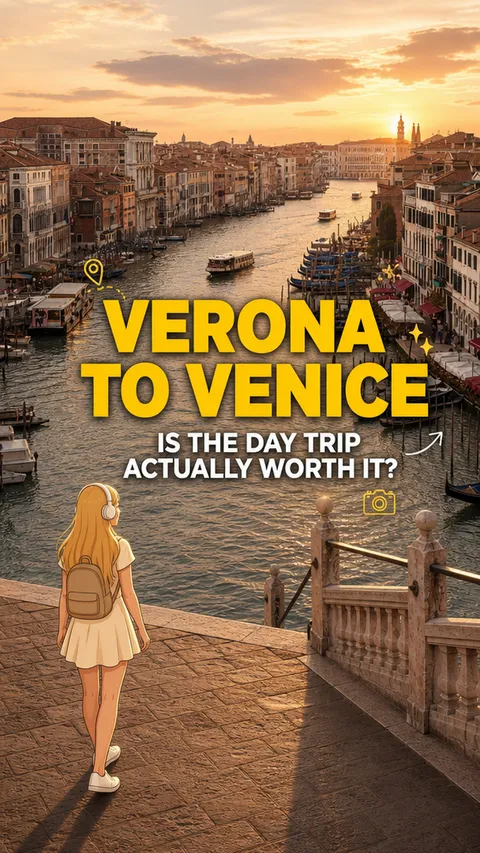
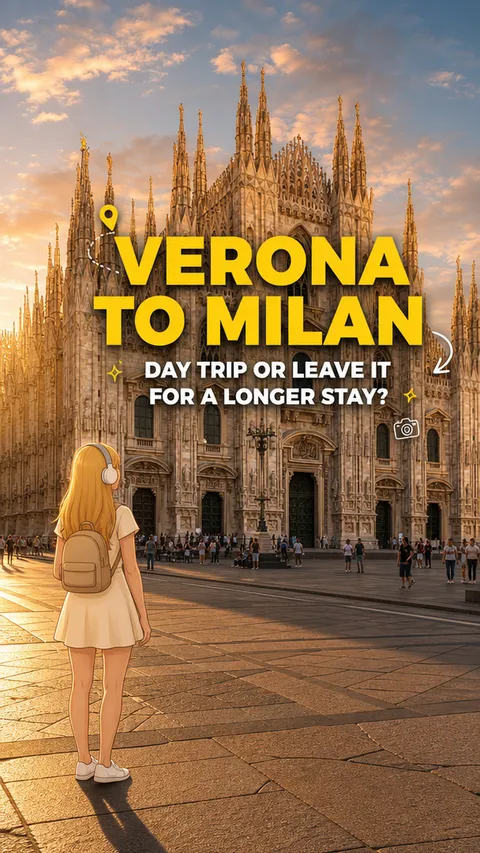
Out in the morning, back in time for dinner. Every route here fits in one full day.
What the Verona to Bergamo Journey Feels Like
This is the part no timetable captures. The FlixBus pulls out of Viale Girolamo Cardinale alongside Verona Porta Nuova and is on the A4 within ten minutes, sliding north-east past Soave's vineyards and the flat Lombard plain. It is a clean, modern coach, the kind with Wi-Fi that mostly works and a toilet that mostly does not, and the ride is short enough that you have barely settled in before the Bergamasque Alps start to fill the windscreen. About 80 minutes after you boarded, the bus rolls into the yard beside Bergamo station, and you are already in the modern lower town, a single bus and a funicular away from the medieval upper town. The transition is dramatic: Città Bassa is functional, flat and forgettable, and then the funicular climbs through a cutting in the old fortifications and the rooftops drop away below you, and you are inside the walls.
The other thing people remember is how unforced Bergamo feels. This is a real, lived-in Italian town, not a place remade for visitors. Locals jog the Venetian walls at dusk, students cluster on the Contarini fountain steps at lunch, and the café terraces on Piazza Vecchia are full of people who actually live here. The air smells of stone and wood-fired pizza. The food is hearty and regional, not tourist-priced: a plate of casoncelli is around €12 to €15, a lunch meal deal with bread, a main, a drink and coffee is about €10, and an espresso at the bar is barely more than a euro. The light on the rooftops from the Campanone lift in the late afternoon is the postcard you did not know to expect.
Coming from Verona's quieter, more polished streets, the contrast is the point. Verona is Romance with a capital R, the Adige looping under Roman bridges, Juliet's balcony drawing the crowds, the Arena doing opera at scale. Bergamo is discovery: a walled medieval hill town that most travellers fly straight past on their way to Milan, with a funicular, a castle, a marble chapel with an irreverent family crest, and a food culture you have never heard of. You leave one in the morning and stand in the other before lunch, and the only thing you will regret is not booking an earlier bus back so you could come back the next day.
Verona to Bergamo: Your Questions Answered
Can you do Verona to Bergamo as a day trip?
Yes, and it is one of the most underrated day trips from Verona. The direct FlixBus takes about 1h20 to 1h40 each way, hourly, and Bergamo station connects to the walled Città Alta by bus plus funicular in 15 to 20 minutes. A 10:00 departure and a 17:00 return leave you about five and a half to six hours on the ground, enough for the walls, Piazza Vecchia, the basilica, lunch and the San Vigilio panorama.
Is there a direct train from Verona to Bergamo?
No. Every train journey requires a change in Brescia, which pushes the journey out to 1h40 to 2h10 and typically costs €9 to €15, more than the bus for a slower trip. Trenord runs the regional Brescia to Bergamo leg, with Trenitalia Frecce and Italo handling the Verona to Brescia segment. The direct FlixBus is faster and cheaper.
How much does the Verona to Bergamo bus cost?
FlixBus fares are dynamic. The cheapest advance fares sit around €6.98 one way, with typical advance fares in the €7 to €15 band. Buy on the day and the same seat costs more, so booking a few days ahead on the FlixBus app is the single biggest saving. BlaBlaCar Bus sometimes undercuts FlixBus on the early morning and late evening slots.
How often do the buses run?
Hourly through the middle of the day, with at least four FlixBus rides plus BlaBlaCar Bus filling earlier and later slots. The first FlixBus from Verona leaves around 10:05, with BlaBlaCar Bus running earlier morning departures on some days. The last return from Bergamo leaves around 20:10 to 20:20.
Which Bergamo stop do I arrive at, and how do I reach Città Alta?
Bergamo station, on the southern edge of modern Città Bassa. From the station, take bus line 1A (ticket €1.60) to the lower funicular station, then the 1887 funicular up to Città Alta (€1.60 one way, about three minutes). Total transfer time is 15 to 20 minutes. A 24-hour ATB transport ticket covering buses and funiculars pays off if you do multiple rides.
FlixBus or BlaBlaCar Bus, which is better?
Both run the same direct corridor, both use standard long-distance coaches with Wi-Fi, power and a toilet, and both arrive at Bergamo station. Compare them on the FlixBus site and blablacar.co.uk/bus for your exact date and take whichever is cheaper or better timed. FlixBus tends to run the densest midday schedule, BlaBlaCar Bus covers the early morning and late evening shoulders.
Is Bergamo safe to walk around?
Very. The upper town is small, well-trafficked and feels safe day and night. Usual city-sense applies around the train and bus station in Città Bassa after dark, and watch your bag in the funicular crush at peak times, but there is no specific scam or area to avoid here.
What should I eat in Bergamo on a day trip?
The essentials are casoncelli alla bergamasca, the crescent-shaped stuffed pasta filled with beef, amaretti and breadcrumbs in butter and sage, a plate of polenta taragna with melted Taleggio, and a polenta e osei dessert, which is sponge cake shaped like polenta and contains no polenta at all. Stracciatella gelato was invented here in 1961 at La Marianna, so a cone from there is the authentic version. Lunch meal deals in Città Alta run about €10 for bread, a main, a drink and coffee.
Is the train or car a good alternative?
Not for a day trip. The train needs a change in Brescia and runs 1h40 to 2h10, slower and pricier than the bus. Driving is the fastest on paper, about 1h05 to 1h15 down the A4, but Città Alta is a ZTL, parking up top is scarce, and you arrive sober and stressed about where to leave the car. The bus is faster door-to-door than the train, cheaper than both, and drops you at Bergamo station ready to ride the funicular up.
Plan Your Bergamo Day Trip
You have the bus sorted, which is the part most people get wrong. Now make the hours on the ground count with our free, self-guided Bergamo walking tour: open it the moment you step off the funicular, and start the loop wherever you are standing. A voice guide leads the route with you from the Venetian Walls to San Vigilio, the Campanone, Piazza Vecchia and the Cappella Colleoni, holding a real conversation as you go, all in your browser with no app and no download. You get 100 free credits, and the full route is on the Bergamo tour page.
