
Venice Day Trip from Verona: The Honest Plan
The train is the only sensible answer here, 1h01 on a Frecciarossa or 1h30 on the flat-rate regionale from Verona Porta Nuova straight onto the Grand Canal, with at least two departures an hour. Here is the honest plan, the fare tricks that actually save money, and a free, self-guided walking tour for the hours on the ground.
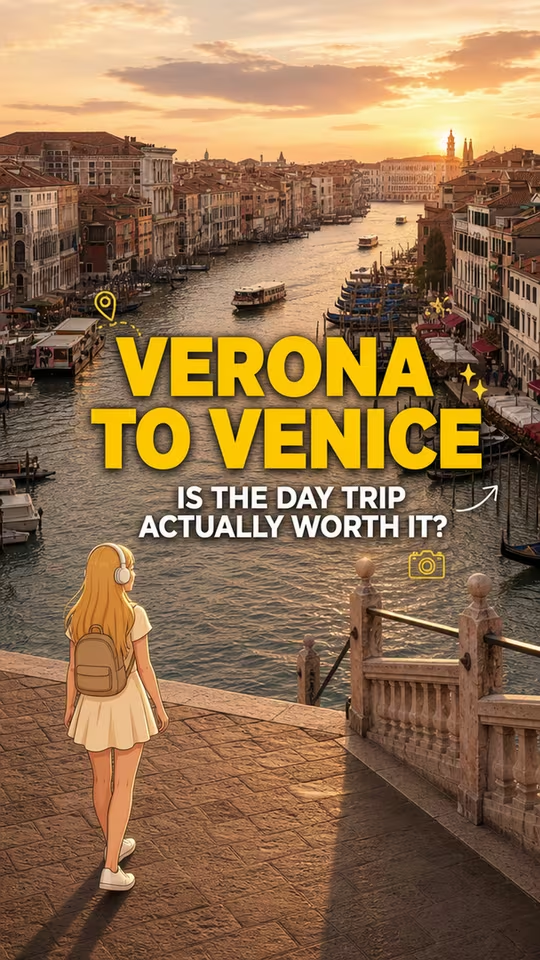
The Quick Answer: Verona to Venice
Take the train and stop debating it. Verona Porta Nuova to Venezia Santa Lucia runs in 1 hour 1 minute on a Frecciarossa or Italo direct, or 1h28 to 1h30 on the Regionale Veloce, with at least two trains an hour in each direction for most of the day. The budget sweet spot is the regionale: a flat €10.55 one-way, no booking, no dynamic pricing, bought at the machine on the day. Pay three times that for the fast train and you save fifteen minutes. Either way you step out of Santa Lucia and the Grand Canal is right in front of you, which is one of the great station arrivals in Europe. Is it worth a single day? Yes. This is the easiest, highest-payoff day trip you can do out of Verona, and the contrast between compact, dry-land Verona and a city where the streets are water is the whole point.
| Question | Answer |
|---|---|
| Fastest journey time | ~1h01 direct (Frecciarossa / Italo), 1h28 to 1h30 on the Regionale Veloce |
| Frequency | At least 2 trains per hour, roughly every 30 minutes |
| Price from | €10.55 flat on the regionale; ~€8.90 to 30 on the fast train by timing |
| Operators / how | Trenitalia (Frecciarossa + Regionale Veloce), Italo. Bus, car, and rideshare all slower |
| First / last | Out from ~5:30 to 6:00 a.m. Last regionale back sometimes as early as 9 p.m., check the date |
| Worth it as a day trip? | Yes. Short ride, walkable centre, Byzantine to Gothic to Renaissance in one loop |
Is the Verona to Venice Day Trip Worth It?
Most Verona day trips are gentle. This one is dramatic. Ninety minutes after leaving the Veneto plain you are standing in front of the largest Byzantine facade in Italy, watching a vaporetto full of commuters swing across a canal that has no equivalent anywhere else. Venice is genuinely disorienting in a way no photograph prepares you for: no cars, no straight roads, water where the traffic lane should be, and the constant sound of footsteps on stone. The change of register from human-scaled Verona to a city built on a million wooden piles is the single biggest contrast you can buy for €10.55.
The best of Venice, stop by stop


The case for going is strong. You see Byzantine mosaics at St Mark's, the Gothic civic grandeur of the Doge's Palace, the Rialto Bridge arching the Grand Canal, and a residential backstreet life in Dorsoduro that the day-trip masses never find. All in a centre you can walk end to end in roughly an hour. Add the Grand Canal by vaporetto at the start, an early-morning Piazza San Marco before the cruise crowds land, and a cicchetto and a glass of Soave at a bacaro near the Rialto market, and you have done what most people who pay for a hotel in Venice never quite manage.
€10.55 flat, 1h30 on the regionale, and you trade Verona's Roman stone for Byzantine gold and a city where the streets are water.
The honest counterpoint is crowds and mobility. Venice's centro storico is one of the most touristed patches of ground in Europe: roughly 50,000 residents share the historic centre with about 20 million visitors a year, and at midday in peak season Piazza San Marco feels more like a stadium than a square. Anyone with limited mobility should know that Venice has 436 bridges, almost all with steps, and essentially zero ramp access. And anyone who hates crowds needs to be disciplined about arriving early and staying late, because the middle of the day is rough.
If you cannot handle crowds or steps, recalculate. Venice has 436 bridges and 20 million visitors a year.
Our call: for anyone with two or more full days in Verona, this is the easiest and most rewarding detour you can make. Go early, leave the suitcase behind, treat Murano and Burano as a separate trip, and you will have a full day that more than justifies the train fare.
Good fit if you...
- Have two or more days in Verona and have not done Venice before
- Want the single biggest city-to-city contrast in northern Italy
- Can commit to an early train and a late return to dodge the crowds
- Are comfortable on your feet for 6 to 8 hours with bridge stairs
Skip it (save Venice) if you...
- Have mobility limits, Venice has 436 stepped bridges and no ramps
- Hate crowds and cannot arrive before 11 a.m. or leave after 6 p.m.
- Want to do Murano, Burano, and the Accademia properly, that needs a night
- Have already done Venice, try Mantua or Lake Garda instead
How to Get from Verona to Venice by Train
There are four realistic ways from Verona to Venice, and for a day trip the train wins on every axis that matters. The only real decision is which train: pay a little more for the fast one, or take the flat-rate regionale and pocket the difference.

| Mode | Time | Price | Verdict |
|---|---|---|---|
| Train (Frecciarossa / Italo high-speed) | ~1h01 to 1h12 | €8.90 to 30 | WINNER. Porta Nuova to Santa Lucia, hourly, then one step to the Grand Canal |
| Train (Regionale Veloce) | ~1h28 to 1h30 | €10.55 flat | Budget champion. Same price as the slow regionale, no booking, comfortable double-deck |
| Bus (FlixBus / Itabus) | ~1h45 to 2h30 | €5 to 15 | Cheap, but drops at Tronchetto or Mestre, not Santa Lucia. Loses 30 to 60 min |
| Car (A4 / E70 motorway) | ~1h15 to 1h30 | ~€10 toll + €45 parking/24h | Pointless. Venice is car-free, ZTL fines are €100 a shot, and the drive is a lorry-filled motorway |
The bus is the cheapest option on paper, from about €5 with FlixBus or Itabus, but it drops you at Tronchetto island or Venice Mestre, not at Santa Lucia. From Tronchetto you still need the People Mover or a vaporetto to reach the historic centre, which eats the saving and adds thirty minutes. Driving is worse than pointless. The A4 is a flat, lorry-choked motorway with no scenic payoff, Venice's historic centre is car-free, parking at Piazzale Roma runs about €45 for 24 hours, and the camera-enforced ZTL zones slap a €100 fine on every violation. The train drops you on the Grand Canal, lets you drink at lunch, and costs less once tolls and parking are counted.
The Train in Detail
Two high-speed operators and the regional network all run the corridor. Trenitalia's Frecciarossa and the private Italo both leave from Verona Porta Nuova and reach Venezia Santa Lucia in about 1h01 to 1h12, with at least two fast or regional services an hour between them across the day. The train pulls into Santa Lucia, on the island, not Venezia Mestre on the mainland. This matters: as soon as you walk out of the doors, the Grand Canal is right in front of you. It is one of the most striking station arrivals in Europe, and the single most common mistake is getting off one stop early at Mestre, an industrial mainland suburb with no canals and no gondoliers. Stay on the train.
The budget sweet spot is the Regionale Veloce, not the slow regionale. It runs the corridor in about 1h28 to 1h30, costs a flat €10.55 one-way regardless of when you buy it, and is only about 15 to 18 minutes slower than a Frecciarossa that costs two to three times as much. The carriages are modern double-deck units, comfortable and clean, and you can buy the ticket from the machines on the day. The slow Regionale (no "Veloce") takes 2h15 to 2h22 because it stops at every station, and costs the same €10.55 as the Veloce. There is no reason to take it. The booking screen will list both, so read the time, not just the price.
Frecciarossa, Italo, or the Regionale Veloce, which to book?
Pick by price and departure time, not by brand. Frecciarossa and Italo run almost identical journeys and one is often a few euros cheaper than the other on your exact slot. The real choice is fast versus cheap, and for a day trip the regionale is genuinely the right answer for most people, especially on the return leg when you are tired and do not want to be tied to a reserved time.
| Option | Time | Price | Best for |
|---|---|---|---|
| Frecciarossa / Italo (high-speed) | ~1h01 to 1h12 | €8.90 advance to ~€30 | Tight days, weekends, comfort, guaranteed seat |
| Regionale Veloce (Trenitalia) | ~1h28 to 1h30 | €10.55 flat, no booking | Budget, flexibility, off-peak weekdays, return leg |
A warning specific to regional tickets: if you buy a paper ticket from the machine, you must validate it in the green or grey platform machine before boarding, or you risk a large on-board fine. Digital tickets bought through the official app auto-validate. High-speed tickets come with a seat reservation and need no stamping.
Booking Strategy
Regional fares are flat-rate, so there is no booking strategy for the €10.55 ticket, you just buy it on the day from the machine or app. High-speed fares are dynamic and the single biggest lever on price is how early you buy. The €8.90 advance Italo fare is real but limited, the standard window runs €15 to 30, and a walk-up same-day Frecciarossa can hit €50 or more. Book direct on the official Trenitalia or Italo app as soon as your date is fixed, not through a third-party reseller, which keeps changes easy and dodges commissions.
The neat local trick for this route: take the regionale both ways. The €10.55 fare is fixed, you can buy the return ticket on the day from a machine at Santa Lucia, and you are never tied to a reserved slot when you are full of cicchetti and might miss it by ten minutes. If you want the early start, take a Frecciarossa out at 7-something a.m. and a flexible regionale back. The two-hour amble across the plain is no hardship when you are ready to nap. If you qualify, the named discount fares below cut the high-speed price further. Allocations are limited, terms shift, so confirm on the official site when you book.
| Discount fare | Who qualifies | Roughly |
|---|---|---|
| Frecciarossa "FrecciaYOUNG" | Under 30 | Up to ~50% off Base, limited seats |
| Frecciarossa "FrecciaSENIOR" | 60 and over | Up to ~50% off Base, limited seats |
| Trenitalia "Bimbi Gratis" / Family | Groups of 2 to 5 with kids under 15 | Children travel free, adults at Base |
| Italo "Young" | Under 30 | Discounted seats, book early |
| Italo "Senior" | 60 and over | Discounted seats, book early |
Booking checklist
- Decide fast or cheap. For most day-trippers the Regionale Veloce both ways at €10.55 each way is the right answer.
- If you want the fast train, book on the official Trenitalia or Italo app as soon as your date is fixed, choosing Verona Porta Nuova → Venezia Santa Lucia.
- Compare both fast operators for your exact slot, the price difference is often €5 to 10 for the same journey.
- Apply any youth, senior, or family fare you qualify for.
- On a high-speed e-ticket, no stamping. On a paper regionale ticket you must validate it in the green or grey platform machine before boarding.
- Confirm the last regionale back for your date (it can be as early as 9 p.m.), and plan around the second-to-last train, not the very last one.
Venice in One Day
Here is the part most day-trip guides bury, and it is the whole point: you do not need to plan a route. The train sets you down at Venezia Santa Lucia, you step through the doors, and the Grand Canal is right in front of you. From there you open our free, self-guided Venice tour on your phone and start it from wherever you are standing. The voice guide takes the planning off your hands and walks the city with you, stop by stop, so the moment you reach the water becomes the first beat of the day rather than a logistics problem. No map-wrangling in a city where the GPS signal is unreliable, no "now where to next", just the city and a guide that talks you through it.

The time math
Take an early train, around 7:00 to 8:00 a.m. from Porta Nuova, and you are on the Grand Canal by roughly 8:30 to 9:30, before the big tour groups arrive at 11. The last regionale back can be as early as 9 p.m., so plan around the second-to-last train and keep a cushion. Even a conservative day gives you roughly nine to ten usable hours on the ground, which is more than enough to walk the full loop, cross to Dorsoduro, eat a proper cicchetti lunch, and watch the light hit the Salute dome from the Ponte dell'Accademia at six. The one thing you cannot add is Murano or Burano; both eat three hours of vaporetto round trip and are a separate trip.
What you will see
The historic centre is small and the sights cluster, so a full day covers the headline acts without rushing. Hours and prices shift, so confirm the ticketed sights on their official sites before you go:
- Piazza San Marco & St Mark's Basilica (basilica €3 online booking, free without skip-the-line, open 9:30 to 17:15, Sundays afternoon only): Napoleon called it Europe's finest drawing room. The basilica's gold mosaics are Byzantine, not Italian, and the interior is darker and stranger than any other Italian church.
- Doge's Palace (€30 online, €35 onsite, open 9:00 to 19:00): 1000 years of Venetian government in pink-and-white Gothic marble, the Bridge of Sighs linked straight to the prisons. Book online or queue for an hour.
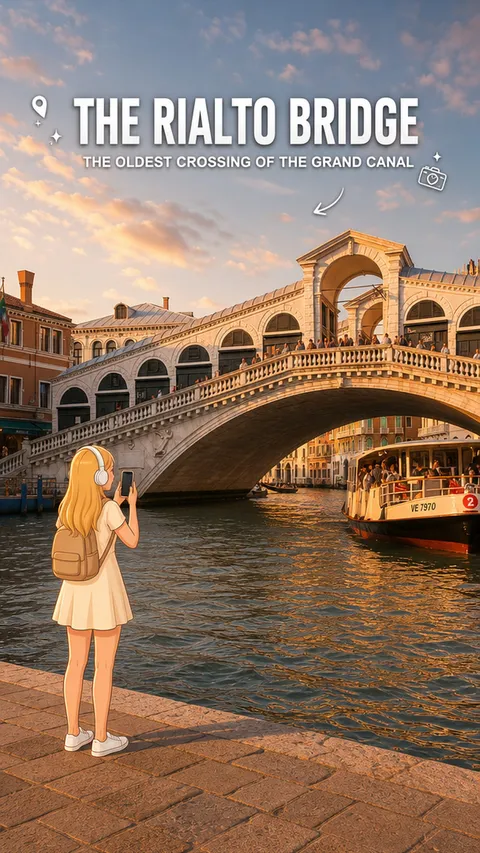
- Rialto Bridge (free, 24/7): the only bridge over the Grand Canal until 1854, a single 28-metre stone arch with shops built into it. Best at 8 a.m., worst at 1 p.m.
- Grand Canal by vaporetto line 1 (€9.50 single, valid 75 min): 45 minutes end to end from Santa Lucia to San Marco, floating past Ca' d'Oro, Ca' Rezzonico, the Accademia. The cheapest "tour" in the city.
- Santa Maria della Salute (free, 9 to noon, reopen 15:00 to 17:30): the great white dome at the canal entrance, built to thank God for ending the 1631 plague, sitting on a million wooden piles.
- Ponte dell'Accademia (free): one of only four Grand Canal bridges, wooden, slightly rickety, and the best free photo spot in Venice at sunset facing the Salute.
The route the tour walks with you
Instead of a generic "see the basilica, then the bridge" list, you walk one efficient loop and the tour walks it with you. Because it launches from any of its stops, you never backtrack to find an official start, you just begin where you are standing. This is the real sixteen-stop order, looping from the Grand Canal through the major squares and across into the quieter Dorsoduro district and back, so you barely double back:
- 1Piazza San Marco Free · your start
The vast stone square Napoleon called Europe's finest drawing room. Get here before 9:30 and the pigeons outnumber the people.
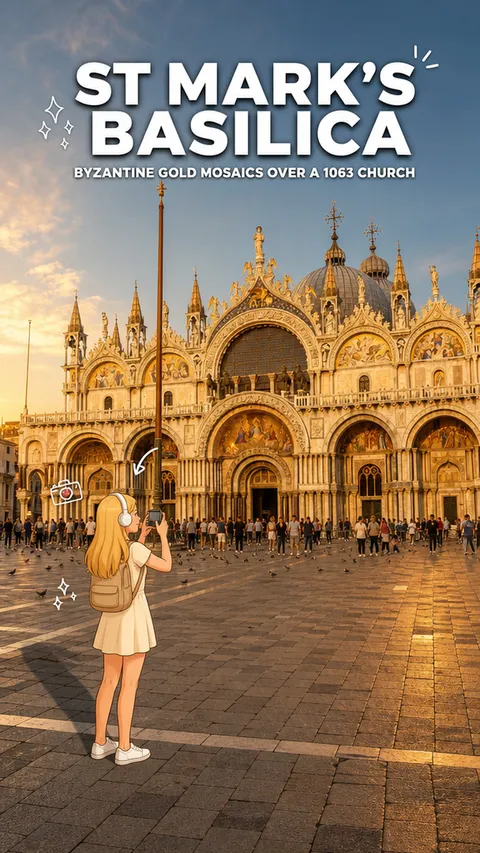
- 2St Mark's Basilica €3 skip-the-line
Byzantine mosaics from 1063, over 500 columns of precious marble, the relics of St Mark beneath the high altar. Queue moves fast.
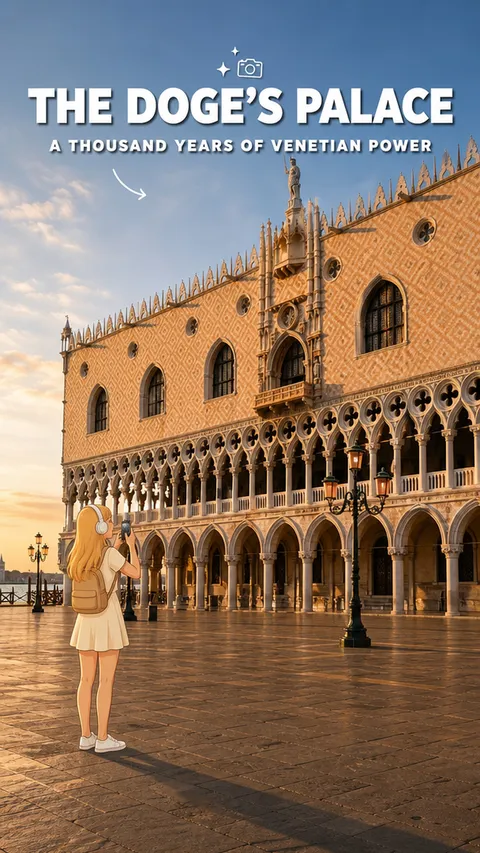
- 3Doge's Palace €30 online
A thousand years of Venetian government in pink-and-white Gothic marble. Skip the inside if you are short on time and admire the facade on foot.
- 4Bridge of Sighs Free view
The white limestone bridge that connected the palace to the prisons, the last sliver of lagoon light a condemned man would see. Snap fast, the viewing bridge packs out.
- 5San Zaccaria Free · crypt €1.50 to €3.50
A quiet square most tour groups skip entirely. The flooded crypt mirrors its columns in dark water, plus Bellini's Sacra Conversazione inside.
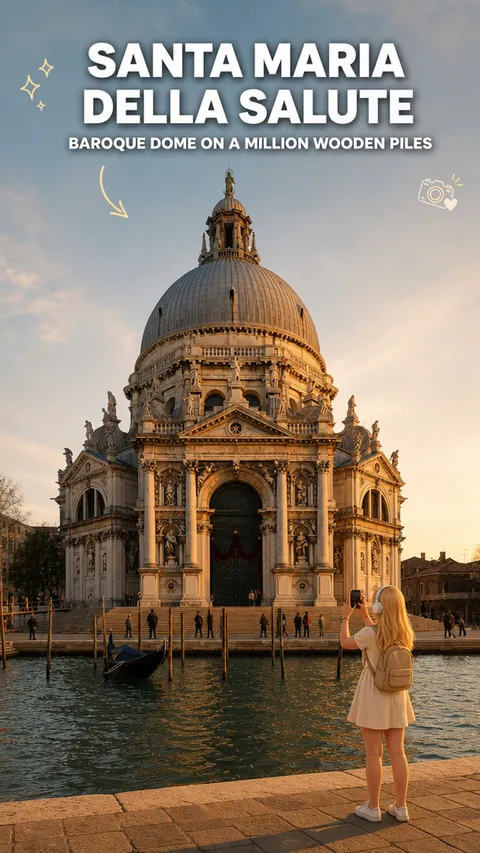
- 6Santa Maria della Salute Free
Baldassare Longhena's great baroque dome, raised on a million wooden piles in gratitude for the end of the 1631 plague.
- 7Gallerie dell'Accademia €15
Five centuries of Venetian painting, Titian and Tintoretto and Bellini. Pay only if you are a serious art lover, the next stop is the real reason walkers come here.
- 8Ponte dell'Accademia Free
The wooden Grand Canal bridge. Climb to the centre, face east, and the Salute dome fills the view at the end of the canal. The postcard shot.
- 9Dorsoduro Free
The university district, where the frantic main-square energy drops away. Locals walking dogs, students with groceries, better and cheaper restaurants.
- 10Ca' Rezzonico €10
A Grand Canal palace turned museum of 18th-century Venice, with ceiling frescoes by Giambattista Tiepolo. Skip if time is tight.
- 11Campo Santa Margherita Free
The neighbourhood's outdoor living room, the only Venice square with trees. Order a Spritz at Caffè Rosso, you will hear more Italian than English.
- 12Campo San Polo Free
Venice's second-largest square, once the site of bull hunts and masked balls. Quiet, stony, breathing room.
- 13Mercato di Rialto Free
A thousand-year-old market under Gothic arches, Tuesday to Saturday mornings. Squid ink, swordfish, lagoon crabs on ice. Empty and hosed-down after 1 p.m.
- 14San Giacomo di Rialto Free
The city's oldest church, supposedly founded in 421 AD, with a 15th-century clock that once regulated the merchants' trading hours.
- 15Rialto Bridge Free
The single stone arch over the Grand Canal, lined with jewellery and glass shops. Wedge in for the view, hold your bag close, cross slowly with the crowd.
- 16Piazza San Marco Loop close
Back to where you started, but the light is different in the afternoon and the string quartets at the cafes are tuning up.
It runs in your browser, no app and no download. A voice guide walks the loop with you and leads a real conversation as you go: it greets you, tells the story between stops, asks what you actually want to see, and adapts. It is not a recording and not an audioguide. The map and step-by-step navigation get you from each stop to the next.
That whole loop is our free, self-guided Venice walking tour, and because it can be launched from any of its stops, you do not backtrack to find an official start, you just begin where you are. You open it the second you step out of Santa Lucia and it leads the loop with you from Piazza San Marco through the Dorsoduro backstreets and across to the Rialto. It runs in your browser, with no app and no download. A voice guide walks the route and holds a real conversation as you go: it greets you, tells the story between stops, asks what you actually want to see, and shapes the route around your day. It is not a recording and not an audioguide. The map and step-by-step navigation get you from square to square without squinting at Google Maps in a city where GPS lies. See the full route on the Venice walking tour page, and you get 100 free credits to try it.
Insider Tips for the Venice Day Trip
A Venice day has its own rhythm, and a few habits make it smoother. Have your coffee and pastry in Verona before you board, because Venice prices step up the moment you are standing next to a canal. Wear thick-soled shoes, since the paving stones are uneven, the bridges are stepped, and everything gets slippery when wet. Carry a refillable bottle, since Venice has free public water fountains and the tap water is safe. Bring a power bank, because the single worst outcome of the day is a dead phone in a city built like a maze. Use the train toilet before you arrive; public loos in Venice cost about €1.50.
Do
- Arrive before 9:30 a.m., the big tour groups roll in around 11
- Take the Regionale Veloce both ways, flat €10.55, no booking stress
- Stay on the train to Santa Lucia, Mestre is not Venice
- Take vaporetto line 1 down the Grand Canal as your floating introduction
- Eat cicchetti in Dorsoduro or near the Rialto market, not on St Mark's
- Take the second-to-last train home, keep a backup
Don't
- Don't get off at Mestre, stay on to Santa Lucia
- Don't drive, €100 ZTL fines and €45 parking await
- Don't buy a vaporetto day pass unless you will ride 3+ times or go to the islands
- Don't drag a suitcase over 436 stepped bridges
- Don't try to add Murano or Burano, that is a separate trip
- Don't take the slow Regionale by mistake, only the Veloce
If you take a regionale, validate the paper ticket in the green or grey platform machine before you board. The on-board fine is large and the inspector will not care that you are a tourist. A digital ticket bought through the official Trenitalia app auto-validates and dodges this entirely. Also: Venice's 2026 entry fee (€5 if booked 4 days ahead at cda.ve.it, €10 last minute) applies on certain peak days, mostly weekends from April to July, for arrivals between 8:30 a.m. and 4:00 p.m. They check at Santa Lucia. Pay ahead and carry the QR code.
More day trips from Verona
Out in the morning, back in time for dinner. Every route here fits in one full day.
What the Verona to Venice Journey Feels Like
This is the part no timetable captures. The ride out is fast and flat, the train slicing across the Veneto plain past Soave vineyards and Padua's outskirts, then over the long bridge across the lagoon. The moment Santa Lucia appears, white and floating at the end of the tracks, is genuinely cinematic, and stepping out of the doors onto the Grand Canal with the vaporetti rocking in the wake is one of the great arrival feelings in European travel. People who do this trip remember that first minute, the smell of salt water and stone, the echo of footsteps already surrounding them.
The other thing people remember is the morning light in Piazza San Marco before the crowds arrive, when the arcades are still in shadow and the basilica's gold picks up the first sun. By midday the square is a stadium, but the backstreets of Dorsoduro never are, and the moment you sit down at a plastic table in Campo Santa Margherita with a Spritz and the locals are still in their work clothes is when the city actually lets you in. Coming home, the train rolls back across the lagoon bridge at sunset, and the campanile of San Marco stands up black against the sky for a long minute before the city disappears. It is a fully packed day, but it leaves a mark.
Verona to Venice: Your Questions Answered
Can you do Verona to Venice as a day trip?
Yes, and it is one of the easiest day trips in northern Italy. The train takes 1h01 on a Frecciarossa or 1h28 to 1h30 on the Regionale Veloce each way, so an early departure and an evening return leave nine to ten hours on the ground. Venice's historic centre is walkable end to end in about an hour, so a single day covers the basilica, the Doge's Palace, the Rialto Bridge, and a Grand Canal ride with time for lunch.
How long is the train from Verona to Venice?
About 1 hour 1 minute to 1 hour 12 minutes direct on a Frecciarossa or Italo high-speed train between Verona Porta Nuova and Venezia Santa Lucia. The cheaper Regionale Veloce takes 1h28 to 1h30. The slow Regionale takes 2h15 to 2h22 and is never worth it, since it costs the same €10.55 as the Veloce.
How much does the Verona to Venice train cost?
The Regionale Veloce is a flat €10.55 one-way, bought on the day from the machine, no booking, no dynamic pricing. High-speed fares are dynamic: from about €8.90 booked weeks ahead on Italo, €15 to 30 in the standard window, and €50 or more walking up on the day. Youth, senior, and family fares cut the high-speed price further.
Frecciarossa, Italo, or the Regionale Veloce, which is best?
For most day-trippers the Regionale Veloce both ways is the right answer, €10.55 flat, 1h30, no reserved time, no stress. If you want the early start and a guaranteed seat, take a Frecciarossa or Italo out and a flexible regionale back. Carry no brand loyalty between Frecciarossa and Italo, pick by price for your exact slot.
What are the first and last trains?
Sensible departures run from about 5:30 to 6:00 a.m. out of Porta Nuova. The last Frecciarossa back is usually around 9:30 p.m., but the last Regionale can be as early as 9 p.m. on some days. Plan around the second-to-last train of whatever type you are on, so you keep a backup, and confirm times on the official Trenitalia site for your date.
Which Venice station should I get off at?
Venezia Santa Lucia, on the island. Stay on the train past Venezia Mestre, which is an industrial mainland suburb and not the Venice you came for. Santa Lucia is the terminus, you cannot miss it, and the Grand Canal is directly outside the doors.
Do I need to validate my ticket?
Only on the regionale. A paper regionale ticket must be stamped in the green or grey platform machine before you board, or you risk a large on-board fine. A digital regionale ticket bought through the official app auto-validates, and a high-speed e-ticket with a seat reservation needs no stamping.
Is the Venice entry fee a problem?
Not usually, but check. The 2026 fee is €5 if booked at least 4 days ahead at cda.ve.it, €10 last minute, and applies on certain peak days, mostly weekends from April to July, for arrivals between 8:30 a.m. and 4:00 p.m. They check at Santa Lucia station. Pay ahead, carry the QR code, and you will not notice it.
Is the bus or car a good alternative?
Not for a day trip. The bus is slightly cheaper than the train but takes 1h45 to 2h30 and drops you at Tronchetto or Mestre, not Santa Lucia, so you lose the saving in transfer time. The car is worse: motorway tolls, €45 for 24 hours of parking at Piazzale Roma, €100 ZTL camera fines, and a city that is car-free once you arrive. The train wins on every axis.
Plan Your Venice Day Trip
You have the train sorted, which is the part most people get wrong. Now make the hours on the ground count with our free, self-guided Venice walking tour: open it the second you step out of Santa Lucia, and start the loop wherever you are standing. A voice guide leads the route with you from Piazza San Marco through Dorsoduro to the Rialto, holding a real conversation as you go, all in your browser with no app and no download. You get 100 free credits, and the full route is on the Venice tour page.
