
Bologna to Ferrara Day Trip: The Renaissance City
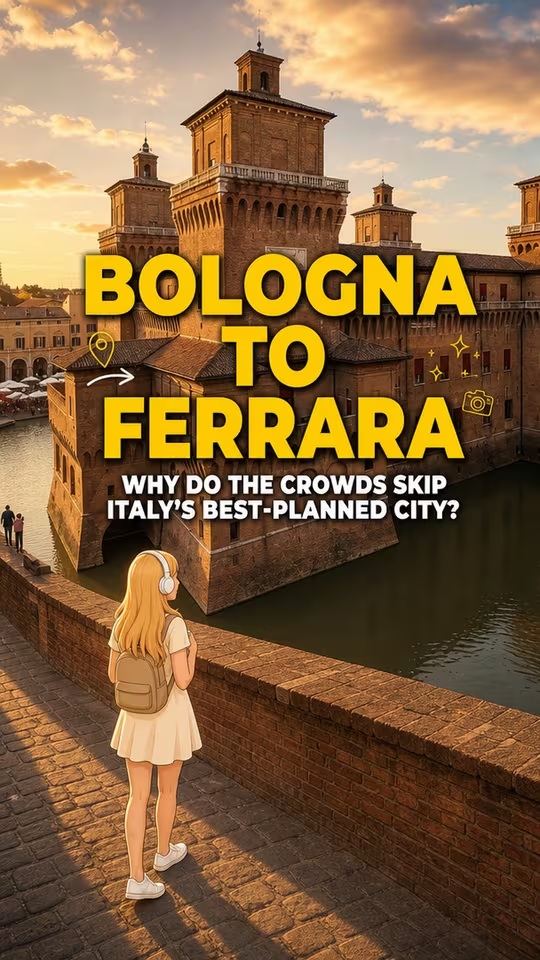
Thirty minutes north on a regional train drops you into the best-preserved Renaissance city in Italy. You arrive, open our free self-guided tour, and it walks you from the moated Este castle to the diamond palace and the medieval Via delle Volte.
The Quick Answer: Bologna to Ferrara
Ferrara is the most underrated day trip out of Bologna, and it is barely half an hour away. A regional train runs the roughly 50 km north toward Venice for a few euros, no advance booking, and leaves you a flat walk or a short bike ride from a city that UNESCO listed whole. This was the seat of the Este dukes, who in the 1490s laid out the Addizione Erculea, the first planned Renaissance city expansion in Europe, so instead of the medieval tangle you get in most Italian towns you get wide straight avenues, long sightlines, and a moated castle sitting dead in the centre. You can see the essentials, eat a plate of cappellacci di zucca, walk a stretch of 9 km wall, and be back in Bologna for dinner. One full day covers it comfortably. Two would do it more justice, but one is genuinely enough.
| Question | Answer |
|---|---|
| How far is it? | ~50 km north, on the flat Po plain toward Venice |
| How long by train? | ~30 min on the Regionale Veloce, up to 50-60 min on a slow Regionale |
| What does it cost? | From about €4, typically €6-8 on the day, walk-up, no booking |
| What is the draw? | The moated Este castle, the diamond-clad palace, and a UNESCO Renaissance centre |
| Is one day enough? | Yes for the highlights. Two days lets you cycle the walls properly |
| Where do I start? | Walk or bike from the station and open our free self-guided tour |
Is the Bologna to Ferrara Day Trip Worth It?
Yes, and without hesitation. Ferrara is the rare Italian city that was designed rather than grown, and you feel it the moment you arrive: everything is human-scale, ordered, and calm, streets wide enough to breathe in, a castle with a real drawbridge, and almost no tour-bus crush even in high summer. The big draws are genuinely first-rate. The Castello Estense is one of the few moated castles in Europe still ringed by water. The Palazzo dei Diamanti wears 8,500 marble points that shift and glitter as you walk past. And the Salone dei Mesi inside Palazzo Schifanoia is one of the great secular fresco rooms in Italy, far less mobbed than anything in Florence. For anyone who likes Renaissance architecture, medieval atmosphere, or Emilia-Romagna food beyond Bologna, this is a heavyweight day for a light-rail fare.
The best of Ferrara, stop by stop


The honest counter-case: Ferrara is quiet. It has no blockbuster gallery on the scale of the Uffizi, no skyline drama, and no real nightlife. If you only have one day trip out of Bologna and you want big-name paintings, Ravenna's mosaics or Florence will hit harder. And the 15 to 20 minute walk from the station cuts through a dull modern periphery before the old town begins, which surprises people expecting instant beauty. Rent a bike, grab a taxi, or just know the slog is coming and it stops mattering.
The best-planned Renaissance city in Italy, half an hour from Bologna, and never crowded. [no] Almost no tourist crush, but also no nightlife or blockbuster gallery. Ferrara whispers. [yes] A moated castle, a diamond palace, and 9 km of bikeable walls for a regional-train fare. [no] Only one day trip and you want famous paintings? Go to Ravenna or Florence instead.
Good fit if you...
- love Renaissance architecture, urban planning, or a good medieval street
- want a calm, uncrowded Italian city instead of another packed hotspot
- like cycling, and would enjoy 9 km of flat wall-top to ride
- came to Emilia-Romagna for the food and want a signature dish beyond ragù
Skip it (save Ferrara) if you...
- want blockbuster art and only have one day trip from Bologna
- need constant stimulation, shopping, and nightlife in a city
- are put off by a dull 15-20 min walk in from the station
- would rather relax over lunch in Bologna than move around a new town
How to Get from Bologna to Ferrara by Train
The decision is easy: take the Trenitalia regional train, and specifically the faster Regionale Veloce. It is cheap, frequent, and drops you in the centre of a small city, so there is nothing to gain by driving and a real risk of a fine in the historic zone. The one thing to avoid is the slow all-stops Regionale, which takes nearly twice as long for no saving. High-speed trains do run this hop but make no sense here, as they cost several times more to shave about five minutes.
| Option | Time | Cost | Verdict |
|---|---|---|---|
| Regionale Veloce (Trenitalia) | ~30 min | from €4, ~€6-8 on the day | WINNER. Fast, frequent, no booking, fixed cheap fare. |
| Slow Regionale (R) | ~50-60 min | from €4, ~€6-8 on the day | Same price, nearly double the time. Only take it if the Veloce is not leaving soon. |
| Frecciarossa / Italo high-speed | ~25 min | ~€15-18 | Saves about five minutes for several times the fare. Pointless on this route. |
| Car | ~40-55 min via A13 | fuel + parking €0.50-1.60/hr | The centre restricts cars. Parking hunt, ticket risk, no real time gained. |
Regionale Veloce, every time. It costs less than a coffee and a pastry, and there is nothing to reserve.

The Train in Detail
Trenitalia runs the line, with Italo also on it but far less often, roughly every three hours against Trenitalia's every 20 to 30 minutes at peak. What you want is the Regionale Veloce, the modern double-decker regional that does the run in about half an hour. The plain Regionale (marked R) stops everywhere and takes 50 to 60 minutes, so check the service before you sit down. Trains leave Bologna Centrale 30 to 60 times a day, thickest in the morning rush from about 6 to 9, roughly hourly at midday, and busy again in the evening. First departures from Bologna are around 5:20 in the morning, and the last return from Ferrara is late, near 11 at night.
Fares on the regional are fixed and cheap, from about €4 booked ahead and typically €6 to €8 bought on the day, and there is no advantage to booking early because the price does not move. You do not need, and cannot make, a seat reservation on the Regionale. Buy a mobile ticket on the Trenitalia app and you can board straight away, no stamping needed. Buy a paper ticket from a machine and you must validate it in the small platform machines before boarding, or risk a fine.
The walk in from the station
Ferrara station sits about 1.5 km from the Castello Estense, a flat, signposted 15 to 20 minute walk along Viale Cavour. Be warned: it runs through an unremarkable modern edge of town, and plenty of first-timers find it a dull slog before the old centre begins. You have three good fixes. Grab a taxi from the rank outside for a few euros. Rent a bike at or near the station, roughly €8-15 for a half day and €12-25 for a full day, and join the locals, because Ferrara is one of Italy's most bike-friendly cities and the flat centre is made for it. Or simply accept the walk and let it warm you up.
Booking Strategy
There is almost nothing to book for the train, and that is the whole appeal. Regional fares are not dynamic, so you buy a ticket at a machine, on the app, or at the counter on the day and go. If it is a paper ticket, validate it in the platform machine before you board. App tickets need no validation. That is the entire train procedure.
Where a little planning pays off is the museums and lunch. The two big interiors, the Castello Estense and Palazzo Schifanoia, have awkward closing days that can wreck a badly-timed visit. If you plan to see the interiors and expect to visit more than one museum, the MyFe tourist card is worth a look: it runs €20 for two days and covers eight municipal museums including both the Castello and Schifanoia, so it pays for itself by the second site. Buy it at the Castello ticket office, the tourist info in the castle courtyard, the station office, or online. On weekends, the popular trattorias fill fast, so book a lunch table ahead if you have a place in mind.
Booking checklist
- Buy your regional train ticket on the day. Same price early or late, so there is no need to book ahead.
- Validate a paper ticket in the platform machine before boarding. App tickets need no stamp.
- Do not visit on a Monday or Tuesday, when one of the two headline museums is closed.
- If you will see two or more museums, buy the MyFe card (€20 / 2 days) at the Castello.
- On a weekend, reserve a lunch table. The best spots book out by early afternoon.
Ferrara in One Day
Here is the part that makes this easy. You reach the centre, and you do not need a plan, a paper map, or a guide waiting by a door. You start at the moat of the Castello Estense, open our free self-guided Ferrara tour in your browser, and it takes over from there. It is a real voice guide that holds a conversation, not a recording you press play on. It greets you, tells you what you are looking at, points out the details you would miss, asks what draws your eye, and shapes the loop around your pace. It has step-by-step navigation between the stops, so you never stand on a corner wondering which way to turn. No app, no download, and it starts from any stop, so if you arrive late or drift off route it simply picks you up where you are.

The time math
Leave Bologna around 8 to 9 in the morning and you are in Ferrara by roughly 8:30 to 9:30, ready to be at the Castello Estense as it opens. That gives you a clean run at the interiors before the day-trip wave arrives. Break for lunch by around 13:00, keep going through the early afternoon, and a return train around 17:30 to 19:00 still has you back for a Bologna dinner. That is a generous eight to nine usable hours on the ground, more than almost any other Bologna day trip. If you only have a compressed three to four hours, you can still cover the Castello, Schifanoia, and a quick loop of the medieval quarter, though it will feel rushed.
What you'll see
The centre splits into two zones that do not connect obviously: the grand planned Renaissance north and the dense medieval south. The walk below stitches both into one clean loop. The highlights, in the order the route takes them:
- Castello Estense (around €10-12, roughly 10:00-18:00, closed Tuesday): the moated, four-towered Este castle at the dead centre of town, with frescoed apartments, dungeons, and a tower climb over the whole grid. The moat walk outside is free.
- Cathedral of Ferrara (free, Mon-Sat with a long midday break, come before noon or after 15:30): the 12th-century Romanesque-Gothic Duomo, a triple-arched marble front two minutes from the castle. The exterior is the star.
- Palazzo dei Diamanti (around €9, typically Tue-Sun): the Renaissance palace faced in 8,500 diamond-cut marble blocks, anchor of the Addizione Erculea, housing the Pinacoteca Nazionale and major temporary shows. The facade is free from the street.
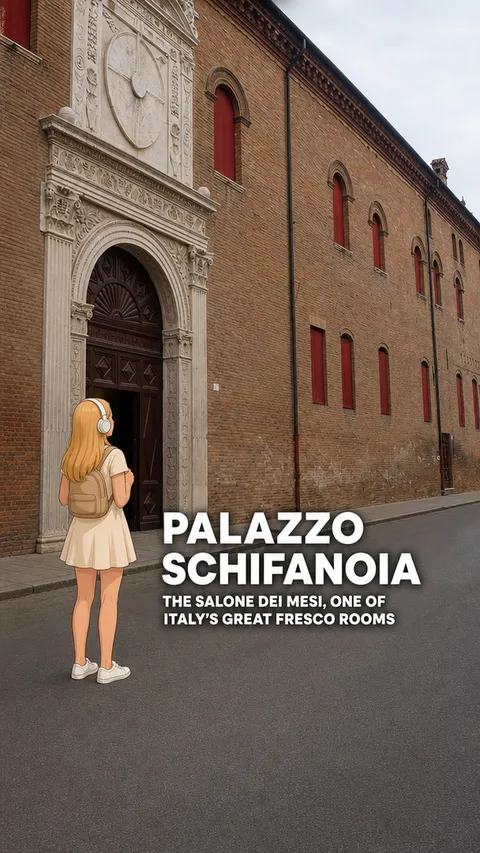
- Palazzo Schifanoia (around €8-12, roughly 10:00-19:00, closed Monday): the Este pleasure palace whose Salone dei Mesi fresco cycle is the single best interior in the city. If you buy one ticket, make it this.
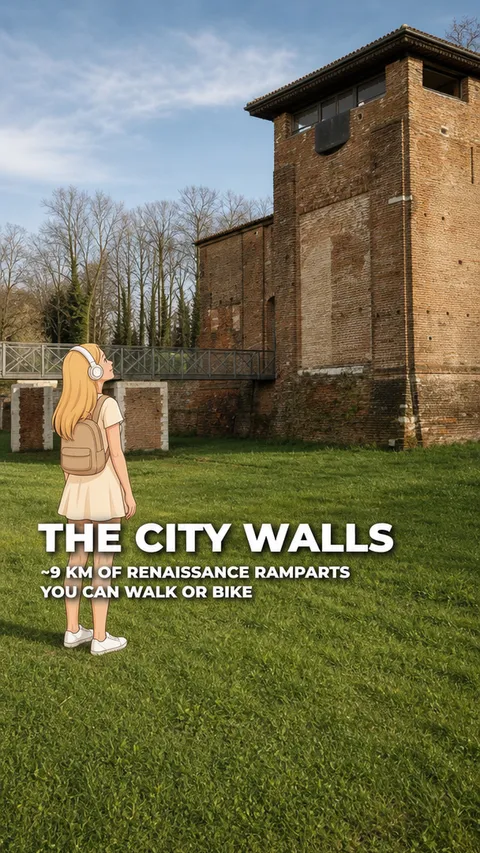
- City Walls of Ferrara (free, open all day): around 9 km of intact Renaissance ramparts, tree-lined and used by local cyclists and joggers, with elevated views over the rooftops.
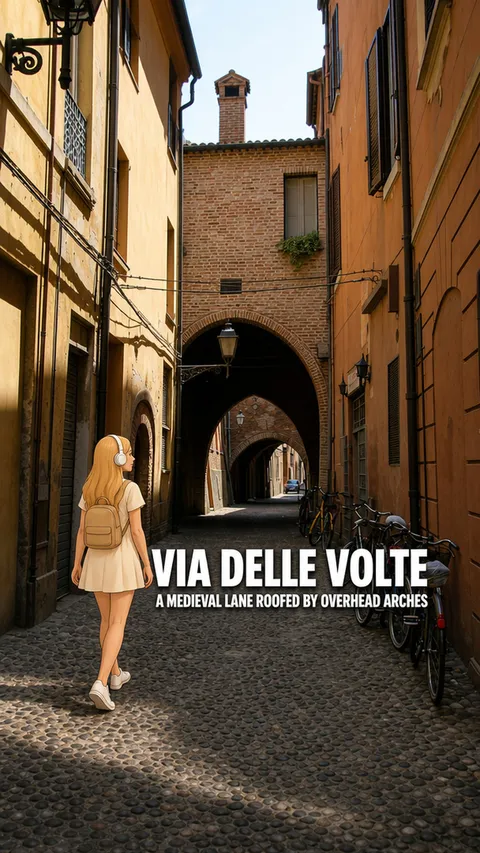
- Via delle Volte (free, open all hours): the city's most atmospheric medieval street, a long lane roofed in stretches by overhead arches, best in low late-afternoon light.
The route the tour walks with you
The loop below is the exact order the tour follows, and it starts from any stop, so there is no backtracking and no wrong place to begin. It opens at the castle in the centre, swings north to the diamond palace, drops southeast to the walls and the frescoed Schifanoia, then threads back through the old ghetto and Via delle Volte to close on the main square, a three-minute walk from where you started.
- 1Castello Estense €10-12 · moat walk free
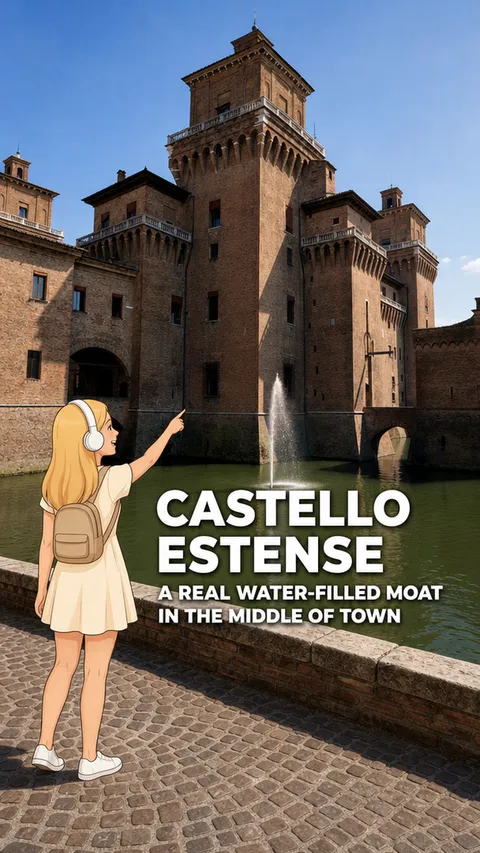
Start at the water. A real filled moat, drawbridges, and four squat brick towers in the middle of a modern city. Inside are painted ceilings, dungeons, and a tower with the whole grid laid out below. Easily an hour if you go in.
- 2Cathedral of Ferrara Free
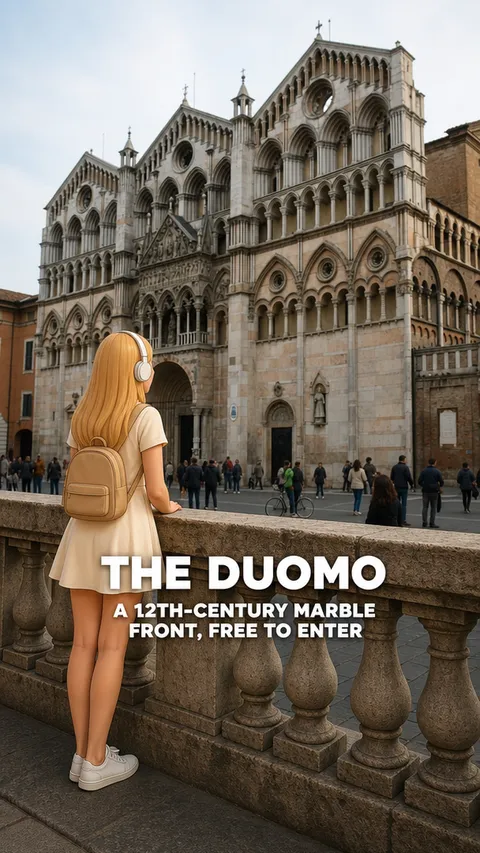
Round the south side and the Duomo's triple-arched marble front hits you, half Romanesque, half Gothic. The exterior and the marble loggia along the square are the reward. Mind the long midday closing.
- 3Palazzo dei Diamanti €9 · facade free
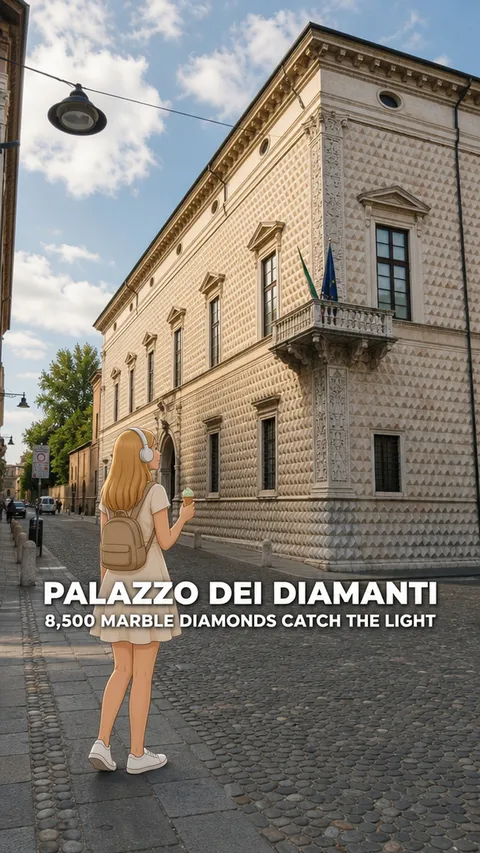
The one that stops people mid-stride. The whole wall is clad in 8,500 marble points angled to catch the light, at the crossroads of the Renaissance grid. Walk its full length to watch the diamonds shift.
- 4City Walls of Ferrara Free
A green tree-lined embankment on top of the ramparts, cyclists and joggers and almost no tourists. Pick up a short stretch near the southeastern baluardi for the view out to the countryside.
- 5Palazzo Schifanoia €8-12
The Este "banish boredom" palace. Plain brick outside, but upstairs is the Salone dei Mesi, a fresco cycle of the months full of gods, zodiac signs, and the duke at work and play. The highlight of the southern half. Closed Mondays.
- 6Casa Romei €3-6
An easy one to walk past, which is why it is good. A rare 15th-century merchant's house with two quiet frescoed courtyards. Human-scale and calm after Schifanoia. Watch the split hours.
- 7Jewish Ghetto of Ferrara Free
The lanes narrow and darken around Via Mazzini and Via Vignatagliata, the world Bassani wrote into "The Garden of the Finzi-Continis." No ticket, just walk slowly and read the walls.
- 8Via delle Volte Free
The photo you did not know to take. A long medieval lane roofed in stretches by overhead arches that once linked merchants' houses to their river warehouses. Come when the sun is low.
- 9Piazza Trento e Trieste Free
The loop opens out into the main square on the cathedral's south flank, market stalls and cafe tables under the medieval loggia. Grab a table, order a spritz, then it is three minutes back to the castle where you started.

It runs in your browser, no app and no download. A voice guide walks the loop with you and leads a real conversation as you go: it greets you, tells the story between stops, asks what you actually want to see, and adapts. It is not a recording and not an audioguide. The map and step-by-step navigation get you from each stop to the next.
Insider Tips for the Ferrara Day Trip
Do
- rent a bike near the station. Ferrara is one of Italy's most cycle-friendly cities and the flat centre and wall-top are made for it
- check the day. The Castello closes Tuesday and Schifanoia closes Monday, so visiting on either risks missing a headline sight
- buy the MyFe card if you will see two or more museums. It covers both big interiors and pays off at the second one
- try the cappellacci di zucca, the local hat-shaped pumpkin pasta and the dish every Ferrarese kitchen is known for
Don't
- take the slow Regionale (R) if a Regionale Veloce is leaving soon. Same fare, nearly double the time
- expect instant beauty from the station. The 15-20 min walk in is dull, so bike, taxi, or brace for it
- turn up on a weekend without a lunch booking. The good trattorias fill by early afternoon
- wear thin flat soles. The ghetto and Via delle Volte are paved in rough river stones that punish bad shoes
Beat the closures
The single most common mistake here is visiting on a Monday or Tuesday, when either Palazzo Schifanoia or the Castello Estense is shut. If your day is flexible, come midweek from Wednesday to Sunday and both are open. Ferrara never really feels crowded, so there is no dawn-raid strategy needed, but an early start still buys you the interiors in near silence and leaves the golden late-afternoon light for Via delle Volte and the walls.
Plan around the closing days. The Castello Estense is closed Tuesdays and Palazzo Schifanoia is closed Mondays, so visiting on either day means missing one of the two biggest sights. Museum hours and days can shift by season, so confirm current times before you travel.
More day trips from Bologna
Out in the morning, back in time for dinner. Every route here fits in one full day.
What the Bologna to Ferrara Journey Feels Like
The ride north is short and unglamorous, a flat run across the Po plain toward Venice, and then you are simply there. The first thing that strikes you about Ferrara is how little it announces itself. The station edge is plain and modern, the walk in is quiet, and then the old town opens and the scale changes. The streets are wide and leafy in a way Bologna's porticoed lanes never are, and the noise drops away. People notice the birdsong, the room to move, the sense of a city built to be lived in slowly.
Then you reach the moat, and there is the castle, a genuine water-ringed fortress with drawbridges sitting where you would expect a piazza. It is an odd, wonderful thing to find in the middle of daily traffic. From there the day is a series of quiet reveals: the marble front of the Duomo, the glittering diamond wall of the Palazzo dei Diamanti, the sudden dim tunnel of Via delle Volte where you can stand alone in the middle of the street to frame a shot. The Salone dei Mesi frescoes are the kind of thing you walk into expecting little and leave a little stunned.
Between the sights the town rewards small pleasures: a plate of cappellacci di zucca in a half-empty trattoria that fills by 1:30, a coffee under the cathedral loggia, an aperitivo in Piazza Trento e Trieste as the passeggiata drifts past. Rent a bike and a stretch of the 9 km walls becomes the best part of the day, green and elevated and entirely local. It is a slow, ordered, human-scale place, and it tends to send day-trippers back to Bologna quietly plotting a return for longer.
Bologna to Ferrara: Your Questions Answered
How long is the train from Bologna to Ferrara?
About 30 minutes on the Regionale Veloce, the modern fast regional train. The slow all-stops Regionale takes 50 to 60 minutes for the same fare, so check which service you are boarding. Trains run every 20 to 30 minutes at peak and roughly hourly at midday.
Do I need to book the Bologna to Ferrara train in advance?
No. Regional fares are fixed at a few euros whether you buy weeks ahead or minutes before, and you cannot reserve a seat on the Regionale, so just turn up and buy on the day. If it is a paper ticket, validate it in the platform machine before boarding. App tickets need no stamp.
Is one day enough for Ferrara?
For the highlights, yes. A single full day comfortably covers the Castello Estense, the cathedral, the Palazzo dei Diamanti, Palazzo Schifanoia, the medieval quarter, and Via delle Volte, with time for lunch. Two days would let you cycle the full ring of walls and explore the museums at a slower pace, but one day genuinely delivers the essentials.
What day should I avoid visiting Ferrara?
Avoid Monday and Tuesday. Palazzo Schifanoia is closed on Mondays and the Castello Estense is closed on Tuesdays, so either day means missing one of the two main sights. Wednesday to Sunday is the safe window for both interiors.
How much does it cost to see Ferrara's sights?
Many of the best things are free: the castle moat walk, the cathedral exterior, the city walls, the Jewish ghetto, Via delle Volte, and the main square. For interiors, budget roughly €10-12 for the Castello Estense, €8-12 for Palazzo Schifanoia, €9 for the Palazzo dei Diamanti, and a few euros for Casa Romei. If you will see two or more, the MyFe card (€20 for two days) covers eight museums and pays for itself quickly.
Is Ferrara worth visiting compared to other Bologna day trips?
Yes, if you want Renaissance planning and medieval calm rather than blockbuster art. Ferrara offers a moated castle, a UNESCO-listed centre, and Italy's best cycling city, all with barely any crowds. If you specifically want world-famous paintings or mosaics, Florence or Ravenna may suit you better, but for architecture, atmosphere, and food, Ferrara is one of the most rewarding options.
Can I cycle in Ferrara?
Absolutely, and you should. Ferrara is one of the most bike-friendly cities in Italy, the centre is dead flat, and the roughly 9 km of Renaissance walls have a tree-lined path on top made for riding. Bike rental runs about €8-15 for a half day and €12-25 for a full day, available at or near the station.
What should I eat in Ferrara?
Start with cappellacci di zucca, the hat-shaped pasta stuffed with pumpkin, parmesan, and nutmeg, served with butter and sage or a meaty ragù. The bolder local speciality is salama da sugo, a spiced, slow-cooked pork sausage over mash, and the local bread is the twisted, crunchy coppia ferrarese. Finish with tenerina, a molten chocolate cake. Expect around €12-20 for a full trattoria lunch with wine.
How do I get from Ferrara station to the centre?
It is about 1.5 km, a flat 15 to 20 minute walk along Viale Cavour, though the route runs through a plain modern edge of town that many find dull. A taxi from the rank costs a few euros, or rent a bike at the station and ride in with the locals.
Plan Your Ferrara Day Trip
Take the mid-morning regional train, and by the time you reach the castle moat your day is already handled. Open our free self-guided Ferrara tour in your browser, no app and no download, and a real voice guide walks the loop with you, greeting you, explaining the castle, the diamond facade, and the Salone dei Mesi frescoes, pointing out the overhead arches of Via delle Volte, and asking what draws your eye so it can shape the rest of the route. It is a conversation woven into the walk, with step-by-step navigation between the stops, and it starts from any stop, so it works whether you begin at the castle or somewhere in the middle. You get 100 free credits to start. That is the whole plan: half an hour on the train, a couple of tickets, and a guide that does the thinking so you can just look up.
