
Bologna to Verona Day Trip: Train, Fares & Free Walking Tour
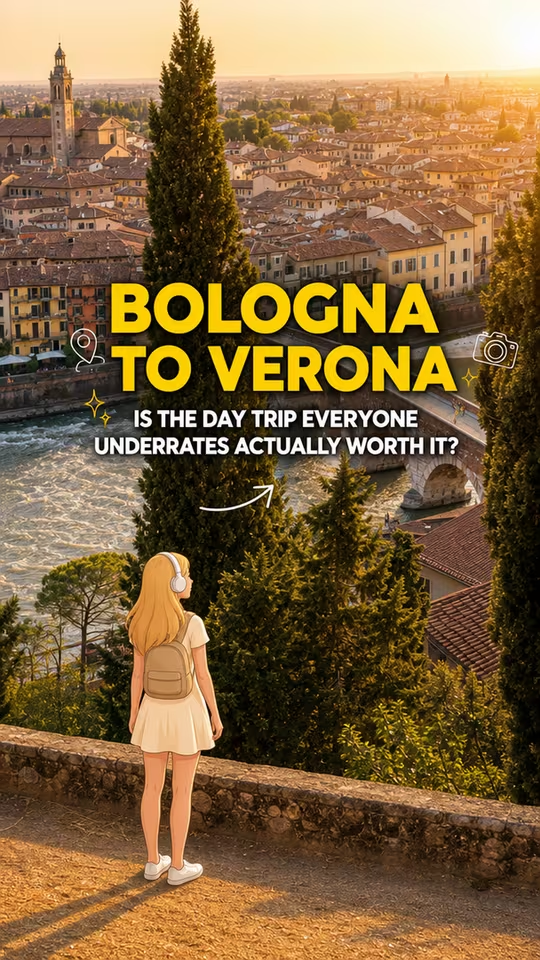
About 52 minutes on the high-speed train, a departure every 20 to 30 minutes, fares from €8.90 if you book ahead. Here is the honest plan for doing Verona in a day, plus a free, self-guided walking tour for the hours on the ground.
The Quick Answer: Bologna to Verona
The high-speed train from Bologna to Verona takes 52 minutes nonstop, leaves roughly every 20 to 30 minutes through the day, and starts around €8.90 each way if you book ahead. Two operators run it head to head, Trenitalia (Frecciarossa) and Italo, so the fares stay honest, book whichever is cheaper or better timed on your date. You board at Bologna Centrale and step off at Verona Porta Nuova, about a 20-minute walk or a 10-minute bus ride (€1.50) from Piazza Bra and the Arena. As a day trip it is one of the easiest in Italy: the ride is shorter than your morning commute in most cities, and Verona's old town is compact, flat and walkable, with all the major sights inside a tight loop.
| Question | Answer |
|---|---|
| Fastest journey time | 52 minutes on Frecciarossa or Italo nonstop. Regional trains take 1h 25min to 2 hours |
| Frequency | Roughly every 20 to 30 minutes at peak, about 30 high-speed trains a day |
| Price from | €8.90 each way (advance, 2nd class). Realistic same-week fares land €15 to €40+. Regional is about €11 |
| Operators / how | Trenitalia (Frecciarossa) and Italo. Bologna Centrale to Verona Porta Nuova, then 20 min walk to the centre |
| First / last train | First useful departure around 6 to 7 a.m.; last return from Verona around 9 to 10 p.m. |
| Worth it as a day trip? | Yes. Short ride, walkable centre, and Verona's headline sights sit in a tight loop you can finish in a day |
Is the Bologna to Verona Day Trip Worth It?
The honest verdict first: yes, a Bologna to Verona day trip is genuinely worth it for most travellers, and the only real question is whether Verona is the right pick for your one slot from Bologna. On the transport side there is no debate. The high-speed train is so fast and so frequent that Verona is effectively a suburb of Bologna for the day. What decides whether you come home delighted or underwhelmed is picking the right day for it: Verona is a city of atmosphere and big sights, not a food-first destination like Modena or Parma.
The best of Verona, stop by stop


Here is what makes it work. The train is under an hour, it runs constantly so you are never locked into one departure, and Verona's old town wraps tightly inside a bend of the Adige River that you can cross on foot in under thirty minutes. The Arena, Piazza delle Erbe, Juliet's House and the river bridges all sit within a 15-minute walk of each other. Leave Bologna after breakfast, be standing in front of a 2,000-year-old Roman amphitheatre by mid-morning, watch the sun set from the Castel San Pietro viewpoint, and roll back into Bologna for a late dinner.
52 minutes each way and a city built for walking. Verona in a day is genuinely easy from Bologna.
Here is the catch, and it is real. Verona is polished, romantic and unmistakably tourist-facing. The crowds cluster around Juliet's balcony and Piazza delle Erbe, the drinks on those squares are priced for the view, and the streets are quieter in the evening when the day-trippers leave. If you want a food-led day trip from Bologna, this is the wrong one: Bologna is already Italy's food capital, and Modena, Parma or Ravenna deliver something Bologna cannot. Verona is for Roman ruins, Renaissance piazzas, river views and a glass of Valpolicella on the way home.
Coming to Bologna for the food? Save Verona for another trip and day-trip to Modena, Parma or Ravenna instead.
Our call: for first-time visitors to Italy, romance seekers, architecture buffs and anyone curious about the Arena opera season, Verona is a no-brainer day trip from Bologna. Repeat visitors to Italy who already know Venice or Florence may find it a touch generic by comparison. Bologna itself is earthier and less touristed, so some travellers prefer to spend the day the other way round. But anyone based 52 minutes from a Roman amphitheatre that still stages Aida under the stars should not skip it.
Good fit if you...
- Want Roman ruins, medieval squares and river views for the day
- Are curious about the Arena summer opera or Juliet's balcony
- Like a walkable, compact city with photo-ready viewpoints
- Can leave on an early train and stay for sunset at Castel San Pietro
Skip it (save Verona) if you...
How to Get from Bologna to Verona by Train
You can get from Bologna to Verona four realistic ways, and for a day trip three of them are the wrong answer. The high-speed train wins so clearly that the rest of this page is mostly about getting that one right.

| Mode | Time | Price | Verdict |
|---|---|---|---|
| High-speed train (Frecciarossa / Italo) | 52 min | from €8.90 advance; realistic €15 to €40+ | WINNER. Bologna Centrale to Verona Porta Nuova, then a short bus or walk |
| Regional train (Regionale Veloce) | 1h 25min to 2h | ~€11 fixed | Same fare whatever you pay, but it eats an hour each way |
| Bus (FlixBus) | ~1h 45min | €7 to €19 | Cheap, but roughly every four hours and slower than the train |
| Car (A1/E35 Autostrada) | 1h 29min to 2h+ | tolls €8 to €15 each way + parking + ZTL risk | Pointless for a day trip. Verona fines unauthorised drivers in the historic centre |
| BlaBlaCar rideshare | ~1h 48min | ~€9 to €17 | Cheap and social, but timings are unpredictable for a tight day |
The reason the train wins is not just clock time, it is where it puts you. Verona Porta Nuova sits just south of the historic centre, so you walk out of the station and into the city with one short bus or taxi transfer, or a 20-minute walk to Piazza Bra. The bus undercuts it on price, but FlixBus runs only every four hours or so and takes nearly twice as long, which trades away the very thing a day trip cannot spare: time on the ground.
Driving is the option people overestimate. The A1 north is quick enough, but Verona wraps its centre in a restricted traffic zone (ZTL) that fines unauthorised drivers automatically, the penalties land on your rental company, and parking near the Arena is expensive. For a day trip, do not bring a car at all.
The Train in Detail
Two operators run the high-speed service and both are good. Trenitalia, the state railway, runs the Frecciarossa, the sleek red-and-silver train that connects Bologna with Verona Porta Nuova in 52 minutes flat on the fastest services. Italo is the private challenger and runs a similar sleek bullet train on the same corridor. Both use Bologna Centrale, on the main north-south line, and both arrive at Verona Porta Nuova, the city's main station. There are about 30 high-speed departures a day between the two carriers, with practical frequency of one every 20 to 30 minutes through the daytime peak.
Journey time runs about 52 minutes on the nonstop services, occasionally a few minutes longer when a train calls at one intermediate stop. Both operators have air conditioning, power outlets at every seat, and Wi-Fi that drops in the longer tunnels. On a ride this short you barely settle in before the announcement for Verona comes over the speakers. Regional trains cover the same route for a couple of euros less but take anywhere from 1h 25min to 2 hours because they stop along the way, so they only make sense if you are on a shoestring or missed the last high-speed departure.
One quirk of these trains catches first-timers. High-speed services on this line are through trains, so Bologna and Verona are usually not the final destination shown on the departure board. The train you want might be heading to Bolzano, Munich, Innsbruck or, in the other direction, Rome, Naples or Venice. Match the train number and departure time on your ticket, not the city name on the board, before you step aboard.
Frecciarossa or Italo, which to book?
Stop agonising. Both are high-speed, both make the run in roughly the same time, and both are clean and reliable. Italo tends to surface a slightly cheaper advance fare a little more often. Trenitalia runs more departures and reaches more stations beyond Verona. Neither difference is big enough to plan a day around, which is exactly why regular travellers on this line split evenly between the two.
The actual decision is price and departure time on your date. Open both apps, compare the exact trains, and book whichever is cheaper or leaves when you want.
| Compare | Trenitalia Frecciarossa | Italo |
|---|---|---|
| Departs | Bologna Centrale | Bologna Centrale |
| Arrives | Verona Porta Nuova | Verona Porta Nuova |
| Typical run | ~52 min | ~52 min |
| Trains per day | very frequent | frequent, fewer than Trenitalia |
| Floor fare | from €8.90 to €15 advance | often a touch cheaper on advance |
| Feel | The workhorse, most departures | Newer, sleeker, bullet trains only |
Booking Strategy
This is where we can actually help, because live fares change daily and any page quoting you a single price is out of date by tomorrow. We win on strategy, not on a number.
Book at least 2 to 3 weeks ahead. This is the one rule everyone agrees on. The route is busy and the cheap fare buckets sell out, so the earlier you book, the more you save. Same-day and last-minute tickets can cost three to four times the advance fare. Discounted advance tickets are non-refundable and generally non-changeable, so only buy ahead once your plans are firm.
Use the day-return discount. Both operators sell same-day round-trip fares (A/R in giornata) at a discount, which is exactly the structure a day-tripper wants. If you go and come back the same day, look for this first.
Stack an age or family discount if you qualify. Trenitalia runs youth fares (big discounts for under-30s), senior fares for over-60s, and a family option where children travel free or heavily reduced with a paying adult. Italo carries similar group and advance-purchase offers. Children under 4 ride free without a seat on both railways.
| Fare / offer | Operator | Discount | Who it's for |
|---|---|---|---|
| Day return (A/R in giornata) | Both | reduced | Anyone returning the same day |
| Advance / Economy fares | Both | cheapest buckets | Book 2 to 3 weeks ahead |
| Youth fare | Both | up to about -50% | Under-30s |
| Senior fare | Trenitalia | reduced | Ages 60+ |
| Family / kids | Both | children free or reduced | Families travelling together |
Book in the right place, and mind the spelling. Use the official Trenitalia and Italo apps and websites to avoid markups, or Trainline and Omio to see both operators side by side for a small fee. One small trap on the Trenitalia site: if you type "Verona" and take the first match, you can land at a Veronetta-side station by mistake. Pick Verona Porta Nuova specifically from the dropdown, since that is the stop the high-speed trains use.
Booking checklist
- Pick your date and a rough departure window first.
- Open both the Trenitalia and Italo apps (or Trainline) and compare the exact trains.
- Filter for the day-return fare, then add any youth, senior, or family discount.
- Book as early as you reasonably can. Two to three weeks out, not the day before.
- Save the QR-code e-ticket to your phone and screenshot it in case you lose signal at the station.
Verona in One Day
Here is the part most day-trip guides bury, and it is the whole point: you do not need to plan a route. You step off the train at Verona Porta Nuova, walk 20 minutes up to Piazza Bra or hop the €1.50 bus, open our free self-guided Verona tour, and start it from wherever you are standing. The voice guide takes the planning off your hands and walks the city with you, stop by stop, so the only decision left is whether to spend on the Arena, Juliet's House or the Verona Card. Verona is small enough to cross on foot in under thirty minutes, which is exactly why a single deliberate loop beats a frantic dash between big-name sights.

The time math
Be realistic, but the maths here is kind. Catch a train out around 7 to 8 a.m. and you are on the ground in Verona well before mid-morning. With the last return leaving Verona around 9 to 10 p.m., you have a genuine 10 to 12 usable hours if you want them. You will not need all of it. The full walking loop is 5.2 km and about three and a half hours at a leisurely pace, so a comfortable day is two or three paid sights, a long lunch of risotto all'Amarone, the climb up to Castel San Pietro for the sunset, and the second-to-last train back as a buffer. Remember the 20-minute walk from Verona Porta Nuova up to the centre at the start, or take the bus.
What you'll see
This is what a first-time day-tripper should not miss, with the practical reality attached:
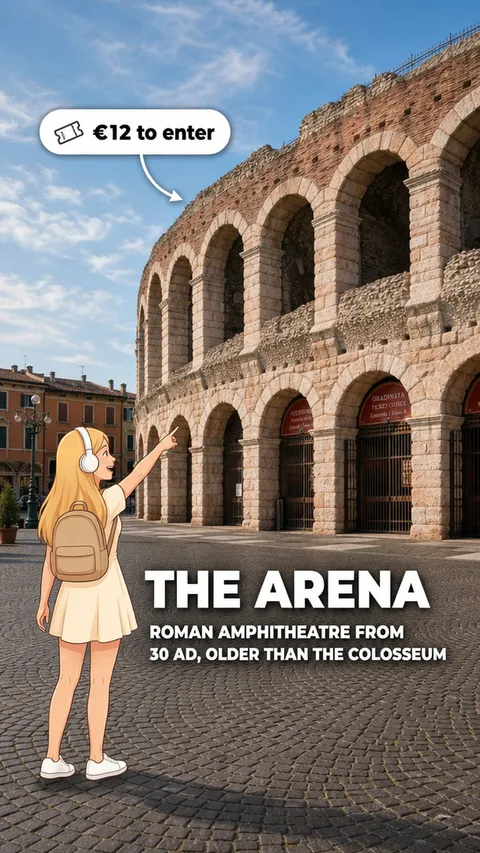
- Arena di Verona (€10, daily 9 a.m. to 7 p.m.): a first-century AD Roman amphitheatre in pink and white marble, older than the Colosseum and still hosting summer opera. Walk to the top of the seats for the view over Piazza Bra. Opera tickets are sold separately on arena.it and run €30 to €200+ for summer performances.
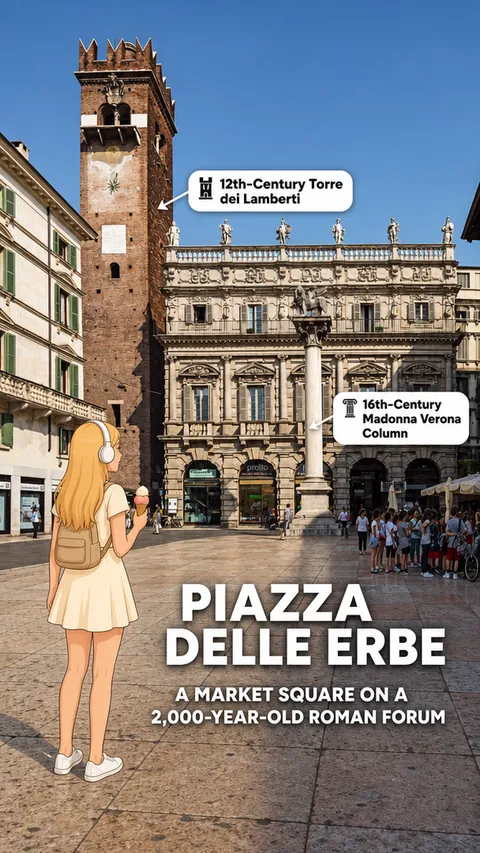
- Piazza delle Erbe (free): Verona's main square, on the site of the Roman forum, with frescoed facades, market stalls and the 84 m Torre dei Lamberti. Sit on a terrace once for the view, then retreat to cheaper streets for the next coffee.
- Piazza dei Signori (free): the quieter, more elegant square just off Erbe, with a statue of Dante and the Renaissance Loggia del Consiglio. The locals' favourite.
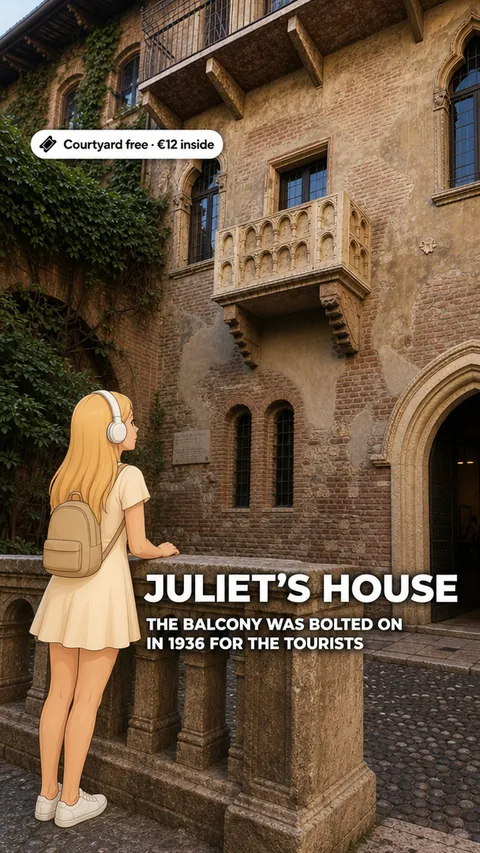
- Casa di Giulietta (Juliet's House) (courtyard free, museum €12, closed Mondays): the 14th-century Gothic house with the famous balcony (added in the 1930s). The courtyard, the bronze Juliet statue and the love-note walls are free to see. Book a timeslot in advance if you want the museum.
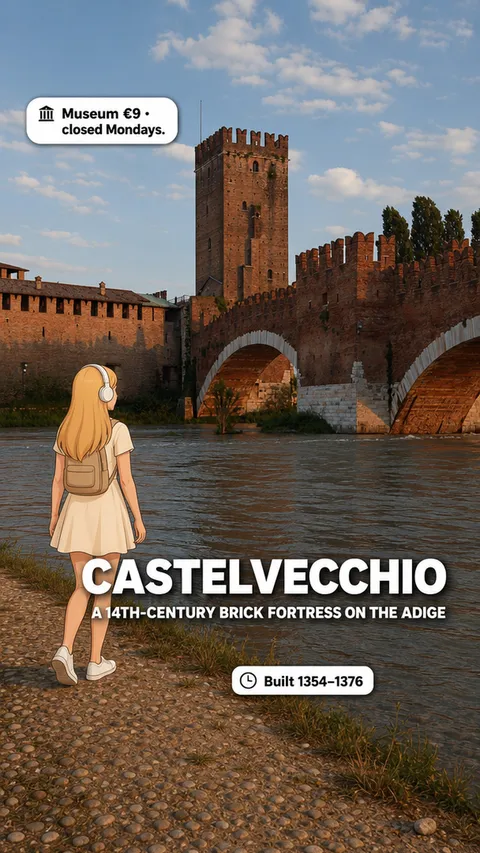
- Castelvecchio Museum and Ponte Scaligero (museum €6, daily 10 a.m. to 6 p.m., closed Mondays; bridge free): a 14th-century Scaliger fortress on the riverbank, now an art museum restored by Carlo Scarpa. The fortified Ponte Scaligero bridge is free to walk and one of the most photogenic spots in the city.
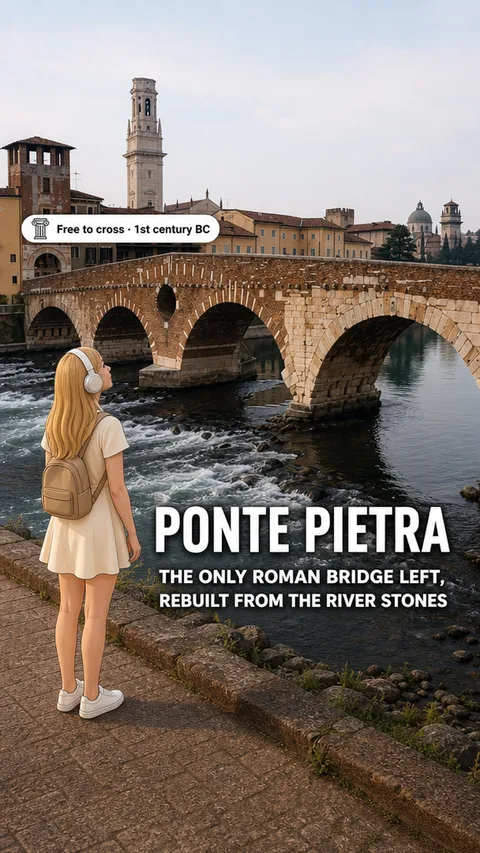
- Ponte Pietra (free): the Roman bridge from 100 BC, blown up by the German army in 1945 and rebuilt stone by stone from the river. Cross it on the way to the Castel San Pietro viewpoint.
- Castel San Pietro (funicular €2 each way, 10 a.m. to 9 p.m., or a 10-minute walk up): the panoramic terrace above the city. Sunset here is the single most photogenic moment in Verona.
- Basilica di Sant'Anastasia (€4): Verona's largest church, Gothic, with famous frescoes and the carved hunchback holy-water fonts. If you only see one church interior in Verona, make it this one.
If you plan to enter three or more paid sights, the Verona Card (24-hour about €28, 48-hour about €33) almost certainly pays for itself. It covers the Arena, Juliet's House, Castelvecchio, Torre dei Lamberti, most churches and the city buses, with a pre-booked timeslot for Juliet's House. Buy it at the tourist office near the Arena from 9 a.m., or online in advance.
The route the tour walks with you
Instead of a scattered scramble from the Arena to the balcony and back, you walk one logical loop and the tour walks it with you. Our self-guided Verona walking tour is 14 stops and 5.2 km, looping from Piazza Bra through the Roman and medieval centre, across the river to Castel San Pietro and back through the quieter streets to Castelvecchio. It starts from any stop, so you never backtrack to find an official beginning. Arriving at Porta Nuova, you are a 20-minute walk from Piazza Bra, the natural first stop, so open it there and let the loop reorder itself around you:
- 1Piazza Bra & Arena di Verona Start · €10
The wide opening piazza and the pink-marble Roman amphitheatre that still stages summer opera. Snap the exterior early before the crowds build, then head northeast down Via Roma.
- 2San Fermo Maggiore Church €4 or Verona Card
A two-level church, Romanesque below and Gothic above, with a ship's-keel wooden ceiling. The small piazza in front is a good spot to pause.
- 3Casa di Giulietta (Juliet's House) Courtyard free · museum €12
The famous balcony (added in the 1930s) and the bronze Juliet statue. The courtyard is free; the museum needs a pre-booked timeslot.
- 4Torre dei Lamberti Verona Card · elevator
The 84-metre striped brick tower above Piazza delle Erbe. Take the elevator up for the best 360-degree view over the rooftops.
- 5Piazza delle Erbe Free
Verona's market square on the Roman forum, frescoed palaces, the Madonna Verona fountain and the winged lion of St. Mark. Walk slowly through the middle.
- 6Piazza dei Signori Free
The quieter, formal square next door, with the Dante statue and the Renaissance Loggia del Consiglio. A sharp contrast to the market bustle.
- 7Arche Scaligere (Scaliger Tombs) Street view free
Ornate Gothic funerary monuments to the della Scala family behind a wrought-iron fence. Cangrande I's tomb is topped with an equestrian statue.
- 8Basilica di Sant'Anastasia €4 or Verona Card
Verona's largest church, Italian Gothic, with Pisanello's St. George fresco and the carved hunchback holy-water fonts.
- 9Ponte Pietra Free
The Roman bridge from 100 BC, rebuilt from original stones pulled out of the Adige after WWII. Stop halfway across to look at the river and hills.
- 10Teatro Romano & Museo Archeologico Museum ticket
The Roman theatre cut into the hillside above the river, with the archaeological museum in the convent above. Climb up for the wide city view.
- 11Duomo di Verona (Cathedral) Small fee
Santa Maria Matricolare, Romanesque with a Gothic double porch, two stone griffins at the door and a Titian Assumption inside.
- 12Porta Borsari (Roman Gate) Free
The first-century Roman city gate, white limestone, stranded in a modern street. Cars and pedestrians pass through the arches.
- 13Castelvecchio Museum €6 · closed Mondays
The 14th-century Scaliger fortress on the riverbank, restored by Carlo Scarpa, with the fortified Ponte Scaligero bridge you can walk for free.
- 14Piazza Bra & Arena di Verona (Return) Free
The loop closes back at the Arena, now catching late-afternoon light. The cafes on the west side are expensive but the view is direct.
It runs in your browser, no app and no download. A voice guide walks the loop with you and leads a real conversation as you go: it greets you, tells the story between stops, asks what you actually want to see, and adapts. It is not a recording and not an audioguide. The map and step-by-step navigation get you from each stop to the next.
That entire loop is our free, self-guided Verona walking tour, and because it launches from any of its stops, you never backtrack to find a start. You open it the moment you reach Piazza Bra and walk at your own pace, detouring up to Castel San Pietro for sunset before the train home. It runs in your browser, with no app and no download. A voice guide walks the loop with you and leads a real conversation as you go: it greets you, tells the story between stops, asks what you most want to see, and adapts the rest of the walk around your answer. It is not a recording and not an audioguide. The map and step-by-step navigation get you from each stop to the next, so you never stand on a corner squinting at Google Maps. See everything on the Verona walking tour page, and you get 100 free credits to try it.
Insider Tips for the Verona Day Trip
The most expensive rookie error on this route is not the train, it is the Juliet's House queue and the overpriced drinks on Piazza delle Erbe. Juliet's House needs a pre-booked timeslot in peak season, and the drinks on the main squares cost two to three times what they do two streets over. After that, the mistakes are about crowds, food and comfortable shoes.
Do
- Pre-book Juliet's House timeslot before you leave Bologna if you want the museum
- Buy the Verona Card if you plan to enter three or more paid sights
- Walk up to Castel San Pietro for sunset. It is the single best view in the city
- Eat risotto all'Amarone and drink the local Valpolicella. Verona is the gateway to Amarone country
- Wear thick-soled shoes for the uneven river-stone paving
- Take the second-to-last train back as a buffer
Don't
- Don't eat or drink on Piazza Bra or Piazza delle Erbe unless you are happy paying for the view
- Don't waste the day queueing for every church. Pick two or three and walk the rest
- Don't board a through train to Bolzano or Munich by mistake. Check the train number
- Don't drive into the historic centre. The ZTL fines are automatic and the rental company passes them on
- Don't skip the Castelvecchio bridge. It is free and one of the most photogenic spots in the city
Luggage
You are day-tripping, so travel light. A small daypack clears the Juliet's House bag check faster than a big bag. If you want to wander before your train home, Verona Porta Nuova has a left-luggage deposit (Kipoint) near platform 1, so you do not have to lug anything up to Castel San Pietro.
Buffer
Build slack into the return. Verona's museum queues are unpredictable, the streets around the Arena clog with tour groups from late morning, and a missed advance-fare train means buying a fresh walk-up ticket. The second-to-last departure is your safety net, and it keeps you off the very last train when the station area quiets down.
The Arena and Juliet's House are the two sights that catch day-trippers out. The Arena closes for safety checks on opera performance days, sometimes with little notice, and Juliet's House needs a pre-booked timeslot in peak season. Both close on Mondays. If a big sight is the point of your visit, plan the day trip for Tuesday to Saturday and book ahead.
More day trips from Bologna
Out in the morning, back in time for dinner. Every route here fits in one full day.
What the Bologna to Verona Journey Feels Like
This is the part no fare table can give you. The ride itself is almost comically easy. You settle into a quiet, smooth carriage, the flat Emilia-Romagna plain gives way to the first hills of the Veneto, the train slides past Soave vineyards and the occasional medieval tower on the horizon, and before you have finished your coffee the announcement for Verona Porta Nuova comes over the speakers. Under an hour, and you have moved from Bologna's red-brick porticoes to a Roman city on a river bend.
The contrast at the far end is the real pleasure. Bologna is a working university city, arcaded, earthy, unshowy, where the food is the point. Step off at Porta Nuova and Verona hits you differently: pink marble on the Arena, fresco fragments still clinging to the facades, the fast-flowing Adige cutting a tight loop around the historic centre, bridges everywhere you look. It is more polished than Bologna, more tourist-facing, and unmistakably romantic. The crowd around Juliet's balcony is intense but fleeting; two streets away the city exhales again.
The other small comedy is the return. After a day on your feet, the walk back down to Porta Nuova feels longer than it did in the morning, especially if you stayed for the Castel San Pietro sunset. Factor it in, aim for a train with a little margin, and you roll back into Bologna in time for a late dinner, which in the food capital of Italy is not a bad way to end the day.
Bologna to Verona: Your Questions Answered
Can you do Verona as a day trip from Bologna?
Yes, easily. The high-speed train is about 52 minutes each way, runs every 20 to 30 minutes, and Verona Porta Nuova is a 20-minute walk or short bus ride from the centre. You get 10 to 12 usable hours if you want them, which is plenty for the Arena, Piazza delle Erbe, Juliet's House and the river bridges. It is one of the easiest day trips in Italy.
How long is the train from Bologna to Verona?
About 52 minutes on a Frecciarossa or Italo high-speed train, nonstop. Regional trains take 1h 25min to 2 hours because they stop along the way. "Under an hour" is the honest rule of thumb for the fast train.
How much does the train cost?
Advance fares start around €8.90 each way in second class and realistically land €15 to €40+ depending on how far ahead you book. Same-day tickets can cost three to four times the advance price. Regional trains are about €11 fixed but much slower. Book two to three weeks ahead to pay the least.
Frecciarossa or Italo, which is better?
Both are fine. They make the run in roughly the same time and are clean and reliable. Italo is sometimes a touch cheaper on advance fares; Trenitalia runs more departures. Compare the exact trains on your date and book whichever is cheaper or better timed.
What time is the first and last train?
The first useful departures leave Bologna around 6 to 7 a.m., and the last return from Verona is around 9 to 10 p.m. For a day trip, take a morning train out and the second-to-last train back as a safety buffer.
Do I need to book train tickets in advance?
Strongly recommended. The route is busy, the cheap fare buckets sell out first, and last-minute fares are far higher. You can buy at the station because trains are frequent, but you will pay the walk-up price. Book two to three weeks ahead, and only commit to a non-refundable advance fare once your plans are firm.
Which Verona sights can I actually see in one day?
Comfortably: the Arena, Piazza delle Erbe, Piazza dei Signori, Juliet's House courtyard, Ponte Pietra, Castelvecchio and the Ponte Scaligero, plus the Castel San Pietro viewpoint at sunset. Pick two or three paid interiors (the Arena, one church, optionally Juliet's House museum) and walk the rest.
Is the Verona Card worth it for a day trip?
Often yes. The 24-hour card costs about €28 and covers the Arena (€10), Juliet's House (€12), Castelvecchio (€6), Torre dei Lamberti, most churches and the city buses. If you plan to enter three or more paid sights, it pays for itself. Book the Juliet's House timeslot even with the card.
Is the bus or driving worth it instead?
Rarely for a day trip. The FlixBus is cheap (€7 to €19) but only runs about every four hours and takes nearly twice as long as the train. Driving means A1 tolls (€8 to €15 each way), Verona's restricted traffic zone (ZTL) with automatic fines, and expensive parking near the centre. The train is faster, central and cheaper once you account for parking.
Plan Your Verona Day Trip
You have the train sorted, and that is the part most people overthink. Now make the hours on the ground count. The 14-stop loop above is our free, self-guided Verona walking tour: open it the moment you reach Piazza Bra, walk it at your own pace, and finish up at Castel San Pietro for the sunset before your train home. See everything on the Verona walking tour page, with 100 free credits to start.
