
Bologna to Rimini Day Trip: Roman Ruins, Beach, and Fellini in One Day
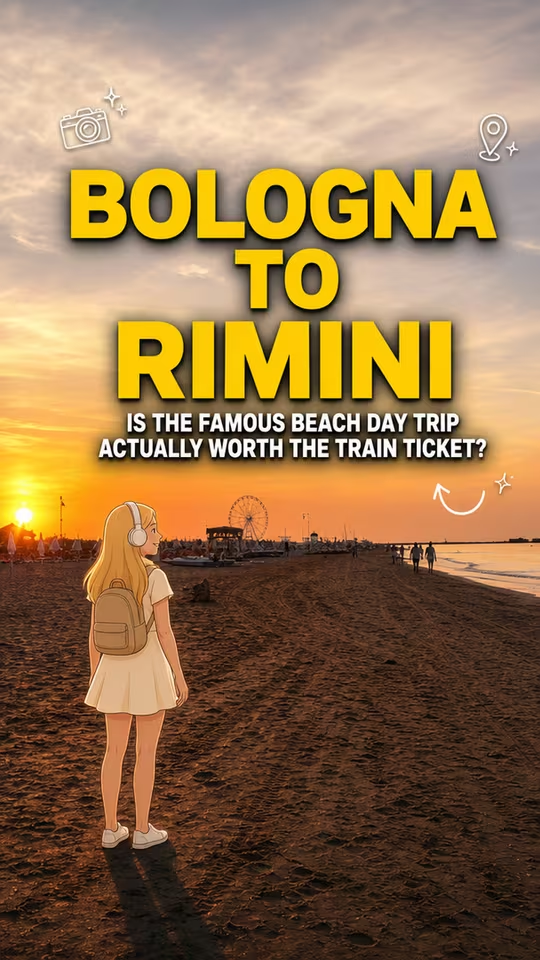
About an hour southeast on the train, fare from €5, and you trade Bologna's medieval porticoes for the oldest Roman arch in Italy, a 2,000-year-old bridge still carrying traffic, and 15 km of flat Adriatic sand. You arrive at Rimini station, open our free self-guided tour, and it walks you from the Arch of Augustus to the Tiberius Bridge and the old fishermen's quarter.
The Quick Answer: Bologna to Rimini
Rimini is the easiest beach from Bologna, full stop. A direct train rolls the 115 km southeast along the old Via Emilia corridor in roughly an hour, drops you at a station in the city centre, and from there it is a 12-minute walk to the oldest surviving Roman arch on earth and a 20-minute walk to 15 km of Adriatic sand. What surprises most first-timers is that the beach is only half the story. Behind the resort strip sits a genuine Roman city with a 2,000-year-old bridge still carrying traffic, an unfinished Renaissance cathedral by Alberti, a Roman surgeon's house dug up under a square in 1989, and the hometown of Federico Fellini, woven into the streets. You can string the whole historic core together on foot in a morning and still be on a sunbed with a spritz by late afternoon. That dual identity, classic Italian beach resort and underrated Roman walk, is what makes a Bologna to Rimini day trip work.
| Question | Answer |
|---|---|
| How far is it? | ~115 km southeast, on the Adriatic coast |
| How long by train? | ~56 min on Frecciarossa/Italo, 1h13-1h30 on Regionale Veloce |
| What does it cost? | From €5 on the regional, €10-15 if booked early on a fast train, €15-55 last-minute high-speed |
| What is the draw? | 15 km of sandy beach plus the Arch of Augustus, Tiberius Bridge, Malatesta Temple, and Fellini's city |
| Is one day enough? | Yes. 8-10 hours covers the old town walk plus an afternoon on the beach |
| Where do I start? | Walk from Rimini station and open our free self-guided tour |
Is the Bologna to Rimini Day Trip Worth It?
Yes, if you are honest about what Rimini is. This is not Portofino, not the Cinque Terre, not the Amalfi Coast. It is Italy's largest beach resort, flat, wide, sun-drenched, lined with numbered bagno beach clubs and high-rise hotels, and packed with Northern Italian families every August. If you came looking for dramatic cliffs and pastel villages perched above the sea, you will be disappointed, and you should pick a different day trip. What Rimini does offer, and does well, is a slice of unapologetic Italian beach culture within an hour of Bologna, plus a genuine Roman and Renaissance old town that most beachgoers never walk ten minutes inland to see.
The best of Rimini, stop by stop


That old town is the surprise. The Arco di Augusto is the oldest surviving Roman arch in Italy, built in 27 BC. The Ponte di Tiberio is a five-arch Roman bridge started under Augustus and finished under Tiberius, still carrying traffic two thousand years later. The Tempio Malatestiano is the unfinished Renaissance cathedral that Leon Battista Alberti wrapped around a medieval church for Sigismondo Pandolfo Malatesta, with interior work by Piero della Francesca. And the Domus del Chirurgo, dug up by accident in 1989, holds one of the most complete sets of Roman surgical instruments ever found. None of this is minor. The reason it is underrated is that the beach resort next door is louder.
The honest counter-case: Rimini is loud in peak summer, the beach is packed, the coast is flat and not photogenic in the cliffside-Italian-town sense, and beach clubs charge €15-30 for two chairs and an umbrella. Off-season, from November to March, the beach clubs shut and the old town goes quiet, which is calm but limits the beach half of the day. And if you came to Emilia-Romagna mainly for culture, Ravenna's mosaics are arguably the heavier draw. But for a single day that mixes a real walk through serious history with a genuine afternoon on a sandy beach, no other destination from Bologna comes this close or this easy.
The closest sandy beach to Bologna, plus Roman ruins worth a morning on their own. [no] Not the Amalfi Coast. Rimini is loud, flat, and unapologetically a beach resort. [yes] A 2,000-year-old arch, a Roman bridge still in use, and Alberti's cathedral for €5 round trip. [no] Coming only for old-town culture? Ravenna's mosaics hit harder. Pick that instead.
Good fit if you...
- want a sandy beach day within an hour of Bologna, no car needed
- like Roman and Renaissance history and are happy to walk a flat 3 km loop to see it
- are curious about Federico Fellini's hometown and Italian beach culture
- travel in June or September, when the beach is warm but the crowds are thinner
Skip it (save Rimini) if you...
- want dramatic coastal scenery, cliffs, and pastel villages
- hate crowds, noise, or the rhythmic thump of beach club music
- are visiting November to March, when the beach clubs are shut
- came for famous art and only have one day trip slot from Bologna
How to Get from Bologna to Rimini by Train
Take the train. There is no real debate. The Bologna to Rimini rail corridor is one of the most served in Emilia-Romagna, with both Trenitalia and Italo running fast trains hourly and regional trains four to five times a day, all from Bologna Centrale to Rimini station in the city centre. The bus exists but runs only twice a day, the car costs you a toll and a parking hunt for no time gained, and BlaBlaCar is a backup plan, not a primary one.
| Option | Time | Cost | Verdict |
|---|---|---|---|
| Regionale Veloce (Trenitalia) | ~1h13-1h30 | from €5, fixed | WINNER. Cheap, fixed fare, no booking, drops you in the centre. |
| Frecciarossa / Italo high-speed | ~56 min | from €10-15 early, €15-55 last-minute | Faster and pricier. Worth it only if you are short on time. |
| Slow Regionale (R) | ~1h50-2h | ~€5-8 | Same corridor, stops everywhere. Take only if the timing suits. |
| FlixBus | ~1h35 | €3.50-6 | Two departures daily. Too inflexible for a day trip. |
| Car (A14 motorway) | ~1h15 | toll €8-12 + fuel + parking | Parking near the beach in summer is painful. Unnecessary. |
| BlaBlaCar | ~1h10-1h40 | from ~€6-10 | Cheap but driver-dependent. Good backup, not a plan. |
Train, every time. Five euros, fixed fare, hourly service, and you step out in the centre of Rimini.

The Train in Detail
Trenitalia runs the line, with Italo competing on the high-speed hop. Fast trains, Frecciarossa and Italo, do the run in roughly 56 minutes, with hourly departures through the day from early morning to late evening. Regionale Veloce trains take between 1h13 and 1h30 and run four to five times daily, on a fixed regulated fare that makes them the budget sweet spot. The slow all-stops Regionale takes up to two hours and is only worth it if the timing happens to fit.
Fares on the regional services are fixed at roughly €5 to €10 whether you book weeks ahead or at the machine on the day, so there is no advantage to booking early. The high-speed trains are dynamic: a Frecciarossa booked early can land at €10-15, last-minute can climb to €55. If your day is tight and you want the 56-minute run, book it a week or two ahead. If your day is flexible, take the regional and save the money for lunch.
A practical warning that catches people every year: Bologna Centrale has multiple tracks with confusingly similar names, for example Binario 6 and Binario 6 Ovest. Check the departure board carefully before you sit down to wait, and walk all the way to the right platform section.
Frecciarossa or Regionale, which to book?
| Frecciarossa / Italo | Regionale Veloce | |
|---|---|---|
| Time | ~56 min | ~1h13-1h30 |
| Price | €10-15 early, up to €55 last-minute | from €5, fixed |
| Frequency | Hourly | 4-5 per day |
| Seats | Reserved | Unreserved |
| Best for | Tight schedule, last-minute decision | Budget, flexibility, day-of booking |
Short on time? Book the Frecciarossa early and pay €10-15. Flexible day? Take the Regionale Veloce for €5.
Booking Strategy
For the regional trains there is nothing to book. Fares are fixed, seats are unreserved, and you buy a ticket at the station machine, on the Trenitalia app, or with Trainline and walk on. If you bought a paper ticket, validate it in the small platform machines before boarding or risk a fine. App tickets need no validation. That is the entire procedure.
For the fast trains, book early. The €10-15 advance fare on Frecciarossa and Italo is the best value on the route, and it disappears the closer you get to travel day, with last-minute dynamic pricing climbing toward €55. Book one to two weeks ahead for the headline fare, especially in July and August.
The smart pattern for a day trip: buy a one-way regional ticket to Rimini in the morning, and decide your return time on the day. Regional trains do not sell out, the fare is the same, and you keep your options open. If you decide you want the faster return, buy a Frecciarossa on the app at the beach.
Booking checklist
- Buy a regional one-way to Rimini on the day. Same price early or late, so there is no need to commit.
- Validate a paper regional ticket in the platform machine. App tickets need no stamp.
- If you want the Frecciarossa, book it one to two weeks ahead for €10-15. Last-minute is up to €55.
- Buy the return ticket only when you know your evening plan. Regional trains run late, including night trains.
- Double-check the platform section at Bologna Centrale: Binario 6 and Binario 6 Ovest are different.
Rimini in One Day
Here is the part that makes this easy. You step off at Rimini station, in the centre, and you do not need a plan, a paper map, or a guide waiting by a door. You walk 12 minutes southeast to the Arch of Augustus, open our free self-guided Rimini tour in your browser, and it takes over from there. It is a real voice guide that holds a conversation, not a recording you press play on. It greets you, tells you what you are looking at, points out the details you would miss, asks what draws your eye, and shapes the loop around your pace. It has step-by-step navigation between the stops, so you never stand on a corner wondering which way to turn. No app, no download, and it starts from any stop, so if you arrive late or drift off route it simply picks you up where you are.

The time math
Catch a 7:30 to 8:30 AM train from Bologna Centrale and you are in Rimini by roughly 8:30 to 9:45, ready to start the historic walk before the heat builds. The loop takes two to three hours at a real pace, with the Fellini Museum pushing it toward four. Have lunch around 1 PM, hit the beach from 3 to 6 PM, an aperitivo at the old fish market around 6 PM, and a return train between 7:30 and 10 PM. That is a clean 10 to 12 usable hours on the ground, more than almost any other Bologna day trip. Trains from Rimini run late into the night, so you do not need to sprint for an early evening return.
What you'll see
The historic centre is strung along the old Roman decumanus, now Corso d'Augusto, running dead straight from the Arch of Augustus in the south to the Tiberius Bridge in the north. The beach is a 20-minute walk east of the station. The highlights, in the order the route takes them:
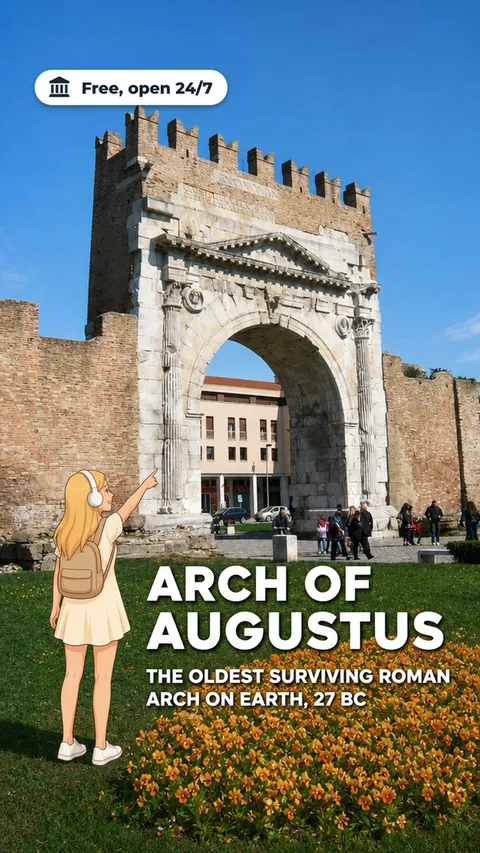
- Arch of Augustus (free, open 24/7): the oldest surviving Roman arch in Italy, built in 27 BC, sitting in a modern traffic island at the southern gate of the ancient city.
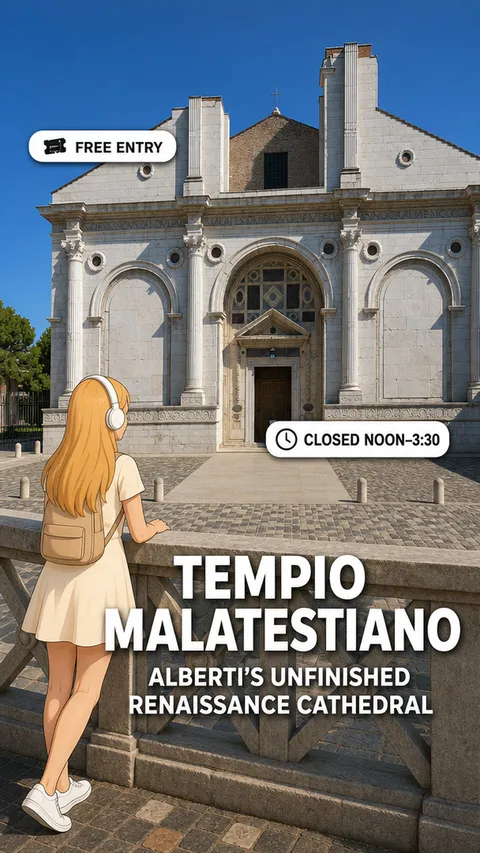
- Tempio Malatestiano (free entry, daily 8:30-noon & 3:30-6:30, closed to tourists at lunch): Rimini's cathedral, where Alberti wrapped a medieval church in a classical Roman temple shell for Sigismondo Malatesta, with interior work by Piero della Francesca.
- Domus del Chirurgo (~€7, Tue-Sun 10-1 & 4-7, closed Mon): the excavated 2nd-century house of a Roman surgeon, with mosaics, frescoes, and the most complete Roman surgical instrument set ever found, displayed in the Museo della Città.
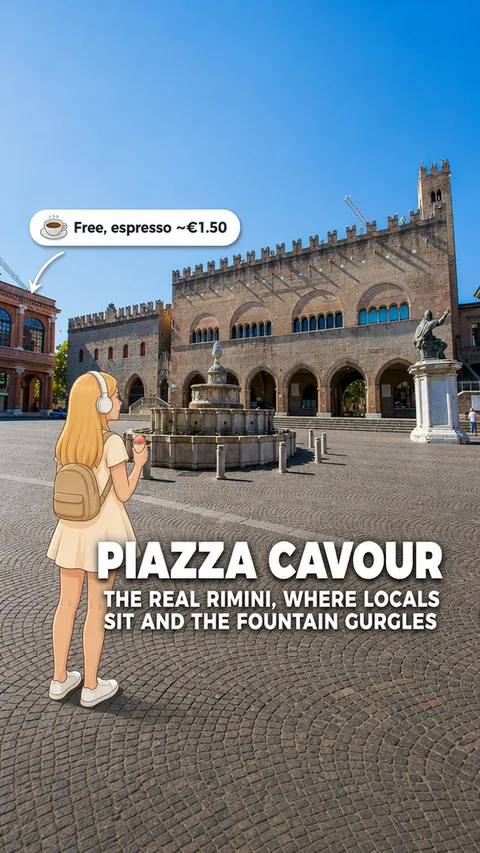
- Piazza Cavour (free, always open): the medieval main square, with the pine-cone-topped Pigna fountain Leonardo da Vinci reportedly admired, the brick Palazzo dell'Arengo, and the restored Teatro Galli opera house.
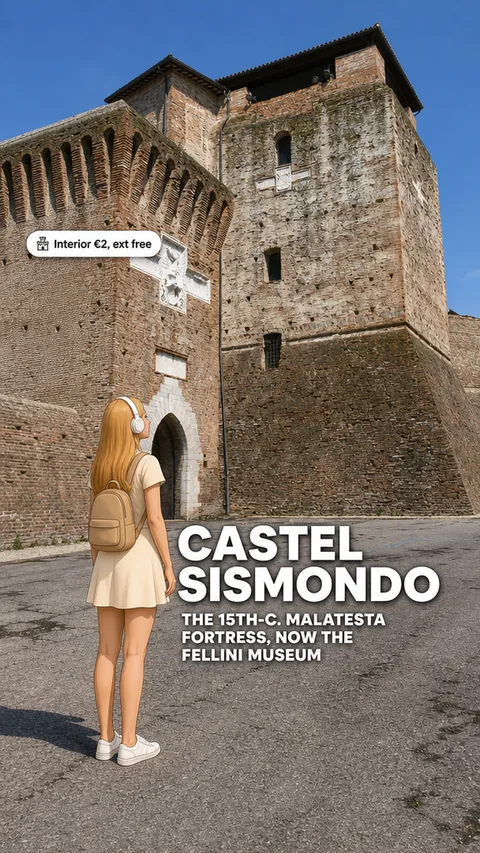
- Castel Sismondo (€2 for the castle interior, ext free, Tue-Sun 10-1 & 4-7, closed Mon): the 15th-century Malatesta fortress, anchor of the Fellini Museum complex.
- Fellini Museum (~€10, Tue-Sun 10-19, closed Mon): an immersive route across Castel Sismondo, the piazza outside, and Palazzo del Fulgor with the old Cinema Fulgor, dedicated to Federico Fellini.
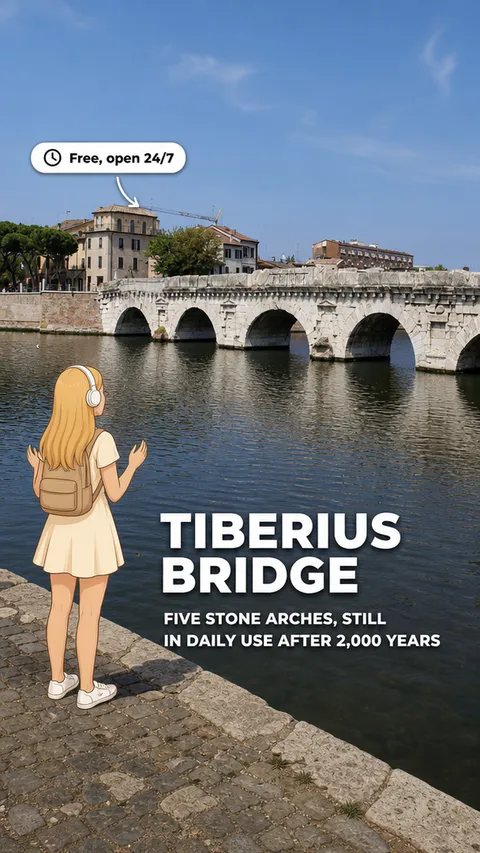
- Tiberius Bridge (free, open 24/7): five stone arches from the 1st century AD, started under Augustus and finished under Tiberius, still carrying traffic and the start of the ancient Via Emilia northwest.
- Borgo San Giuliano (free, just streets): the former fishermen's quarter across the bridge, low painted houses and murals of Fellini film scenes, the prettiest corner of Rimini.
- Rimini beach (free public stretches; bagno clubs €15-30 for 2 chairs + umbrella): 15 km of flat Adriatic sand divided into numbered bagno sections, with free beach near the port.
The route the tour walks with you
The loop below is the exact order the tour follows, and it starts from any stop, so there is no backtracking and no wrong place to begin. It opens at the Arch of Augustus at the southern gate, runs straight up the Roman decumanus to the Renaissance cathedral and the Roman surgeon's house, swings west to the old fish market and the main square, hits the Malatesta castle and the Fellini Museum, then crosses the Tiberius Bridge into the painted lanes of Borgo San Giuliano before looping back down Corso d'Augusto.
- 1Arch of Augustus Free · 24/7
Start at the southern gate of the ancient city. Built in 27 BC by decree of the Roman Senate, the oldest surviving Roman arch on earth. Five minutes is enough: walk around it, look up at the medallions and the medieval brick crenellations, take the shot. Head straight up Corso d'Augusto, the dead-straight Roman main road.
- 2Tempio Malatestiano Free
Three minutes north, Alberti's marble facade stops you mid-stride. Sigismondo Malatesta hired him to wrap a medieval church in a classical Roman temple shell, with Piero della Francesca inside. It was never finished and the upper facade just stops. Hours are tight, daily 8:30-noon and 3:30-6:30, do not arrive at lunch.
- 3Domus del Chirurgo ~€7
In Piazza Ferrari, under a glass canopy, the 2nd-century house of a Roman surgeon dug up by accident in 1989, with mosaics, frescoes, and the most complete Roman surgical instrument set ever recovered. Closed Mondays. Allow 30-40 minutes, or look down from the square railing for free.
- 4La Vecchia Pescheria Free
The 18th-century old fish market, a covered loggia with stone selling slabs and dolphin-head spouts. The fishmongers are gone and the arcades fill with bars at aperitivo hour, busiest from 6 PM. Walk through during the day to see the architecture, clock it for a spritz later.
- 5Piazza Cavour Free
The living room of old Rimini. Medieval main square with the Pigna fountain, brick Palazzo dell'Arengo, and the restored Teatro Galli opera house. Sit on a bench or grab a cafe table and watch the town go by. If you only pause once on the walk, do it here.
- 6Castel Sismondo €2 · ext free
A blunt brick 15th-century Malatesta fortress, partly to Sigismondo's own design. What you see is only the central core; the moat and outer ring are gone. The exterior piazza is free, the castle interior is €2, and the building is more impressive from outside than in.
- 7Fellini Museum ~€10
Rimini's most famous son in a route across Castel Sismondo, the piazza, and Palazzo del Fulgor with the old Cinema Fulgor young Fellini sneaked into. Immersive projections, sound, recreated sets from La Dolce Vita and Amarcord. Budget an hour or more. Closed Mondays.
- 8Tiberius Bridge Free · 24/7
The street opens onto water and there they are: five stone arches from the 1st century AD, started under Augustus and finished under Tiberius, still in daily use. Walk out onto it and look back at the old town reflected in the Piazza sull'Acqua basin below. The postcard view of Rimini.
- 9Borgo San Giuliano Free
Across the bridge, the scale shrinks to a tangle of low, brightly painted houses. The old fishermen's quarter, now the prettiest corner of the city, with murals of Fellini film scenes on the walls. Wander the lanes and let yourself get lost. Walk back across the bridge and follow Corso d'Augusto south to close the loop.
It runs in your browser, no app and no download. A voice guide walks the loop with you and leads a real conversation as you go: it greets you, tells the story between stops, asks what you actually want to see, and adapts. It is not a recording and not an audioguide. The map and step-by-step navigation get you from each stop to the next.
Insider Tips for the Rimini Day Trip
Do
- walk the old town in the morning before the beach crowds, then hit the sand in the afternoon. The Roman sights are best in morning light.
- bring swimwear in a daypack. The beach is 20 minutes from the station, no extra planning needed.
- come back to La Vecchia Pescheria around 6 PM for an aperitivo under the arches, when the whole quarter fills up.
- buy a one-way train ticket and decide your return on the day. Regional trains do not sell out.
Don't
- eat at the first restaurant you see near the beach. Walk 5-10 minutes inland to the Piazza Cavour area for real food.
- expect dramatic coastal scenery. Rimini is flat sandy beach country, not cliffs.
- visit only in August if you hate crowds. The beach is packed. June and September are ideal.
- forget to validate a paper train ticket in the platform machine before you board. The fine is real.
Luggage
There is no point hauling bags for a beach day. If you are connecting through Rimini on a longer trip, the station has a left-luggage desk, and most bagno clubs will hold a small daypack at the sunbed area if you are a customer. For a straight day trip from Bologna, travel light: swimwear, towel, sunscreen, water, and a phone.
Beat the closures
The single most common mistake is visiting on a Monday. The Domus del Chirurgo, Castel Sismondo, and the Fellini Museum are all closed on Mondays, so if your day is flexible come Tuesday through Sunday. The free outdoor monuments, the Arch, the bridge, the Pescheria, Piazza Cavour, Borgo San Giuliano, and the beach itself, are open every day.
Plan around Monday closures. The Domus del Chirurgo, Castel Sismondo, and the Fellini Museum all shut on Mondays. The free sights and the beach stay open, but a Monday visit loses three of the biggest interiors. Museum hours can shift by season, so confirm current times before you travel.
More day trips from Bologna
Out in the morning, back in time for dinner. Every route here fits in one full day.
What the Bologna to Rimini Journey Feels Like
The ride out of Bologna is one of the sharpest transitions in Emilia-Romagna in under an hour. You leave red-brick medieval density, porticoed lanes, and the smell of ragù and coffee, and you roll southeast through the Romagna hills, the countryside opening up as the train threads past vineyards and small towns. By the time you hit the coastal plain the sky widens, the air changes, and you smell salt and sunscreen before you see the sea.
The first thing that strikes you about Rimini is the light. It is horizontal where Bologna is vertical, bright where Bologna is shadowed, open-skied where Bologna is porticoed. The station area is modern and a bit plain, but 12 minutes down Corso d'Augusto the Roman city appears. First the Arch of Augustus, sitting incongruously in a traffic island, 2,000 years old and still being photographed. Then the marble facade of the Tempio Malatestiano stopping you mid-stride. Then the Pigna fountain gurgling in Piazza Cavour while old men read newspapers at cafe tables. This is where Rimini feels most itself, not the beach.
Cross the Tiberius Bridge in late afternoon light and the old town reflects in the Piazza sull'Acqua basin below, the postcard view. On the far side, Borgo San Giuliano's painted houses and Fellini murals are the prettiest corner of the city. Then the day flips: 20 minutes east and you are on a sunbed under a numbered umbrella, listening to the thump of beach club music and the chatter of Italian families who have been coming to the same hotel for 30 years. It is not charming in the hill-town sense. It is loud, wide, sun-drenched, and thoroughly itself.
Bologna to Rimini: Your Questions Answered
How long is the train from Bologna to Rimini?
About 56 minutes on a Frecciarossa or Italo high-speed train, 1h13 to 1h30 on a Regionale Veloce, and up to two hours on the slow all-stops Regionale. Trains run hourly on the fast services and four to five times a day on the regional, from early morning to late evening.
Do I need to book the Bologna to Rimini train in advance?
Only if you want the Frecciarossa or Italo. Their advance fares start at €10-15 and climb to €55 last-minute. The regional trains are fixed at roughly €5-10 whether you book weeks ahead or at the machine on the day, so just turn up and buy. If it is a paper regional ticket, validate it in the platform machine before boarding.
Is one day enough for Rimini?
Yes. A full day covers the historic walk in the morning, lunch, an afternoon on the beach, and an aperitivo at the old fish market before the return train. Two days would let you add San Marino, reachable by bus from Rimini station in 30-50 minutes.
What day should I avoid visiting Rimini?
Avoid Monday if you want the interiors. The Domus del Chirurgo, Castel Sismondo, and the Fellini Museum all close on Mondays. The free outdoor sights and the beach stay open every day. Avoid August if you hate crowds: it is peak Italian holiday season and the beach is packed. June and September are the sweet spots.
How much does it cost to see Rimini's sights?
Most of the best things are free: the Arch of Augustus, the Tempio Malatestiano, Piazza Cavour, the Vecchia Pescheria, the Tiberius Bridge, Borgo San Giuliano, and the public beach. Paid interiors are the Domus del Chirurgo at roughly €7, Castel Sismondo at €2, and the full Fellini Museum at €10. A Rimini Art Card bundles several museums for around €10-15 if you plan to see them all.
Is Rimini worth visiting compared to other Bologna day trips?
Yes, if you want a beach day. Rimini is the closest sandy beach to Bologna and the easiest to reach by train. For pure culture, Ravenna's UNESCO mosaics or Florence are heavier draws. For food, Modena or Parma win. Rimini's strength is the mix: a real Roman and Renaissance walk plus a genuine afternoon on the sand, all in one day.
Is the beach at Rimini free?
Partly. There are free public stretches, especially near the port and some sections north and south of the centre. Most of the 15 km is divided into numbered bagno beach clubs that rent sun loungers, umbrellas, and facilities for roughly €15-30 per day for two chairs and an umbrella. Some bagno clubs, like Bagno Tiki 26, have a bar, restaurant, volleyball courts, and showers.
What should I eat in Rimini?
Start with piadina, the regional Romagna flatbread, thinner in Rimini than elsewhere, folded around cheese, prosciutto, or grilled veg, served for €5-8 and eaten standing up. Add fritto misto, mixed fried seafood, at a beach club or trattoria, and a glass of Sangiovese di Romagna DOC with a meaty lunch or a Rebola dei Colli di Rimini white with seafood. For a sit-down meal, walk inland from the beach to the Piazza Cavour area or cross into Borgo San Giuliano.
How do I get from Rimini station to the beach?
It is about a 20-minute walk east from Rimini station to the beach. The station is currently under construction as of 2025 to create a new walkway, so expect some detouring. For the old town instead, it is roughly a 12-minute walk southeast to the Arch of Augustus.
Plan Your Rimini Day Trip
Take the 7:30 to 8:30 AM train from Bologna Centrale, and by the time you reach the Arch of Augustus your day is already handled. Open our free self-guided Rimini tour in your browser, no app and no download, and a real voice guide walks the Roman decumanus with you, greeting you, explaining the Tempio Malatestiano and the Domus del Chirurgo, pointing out the dolphins on the old fish market spouts and the reflection in the Piazza sull'Acqua basin, and asking what draws your eye so it can shape the rest of the route. It is a conversation woven into the walk, with step-by-step navigation between the stops, and it starts from any stop, so it works whether you begin at the Arch or somewhere in the middle. You get 100 free credits to start. Walk the loop, lunch in Borgo San Giuliano, hit the beach by 3 PM, an aperitivo at the Vecchia Pescheria around 6 PM, and a late train back. That is the whole plan.
