Self-Guided Walking Tour in Rimini

9 Stops 3.0 km ~1.9 hours
Start This Tour Free
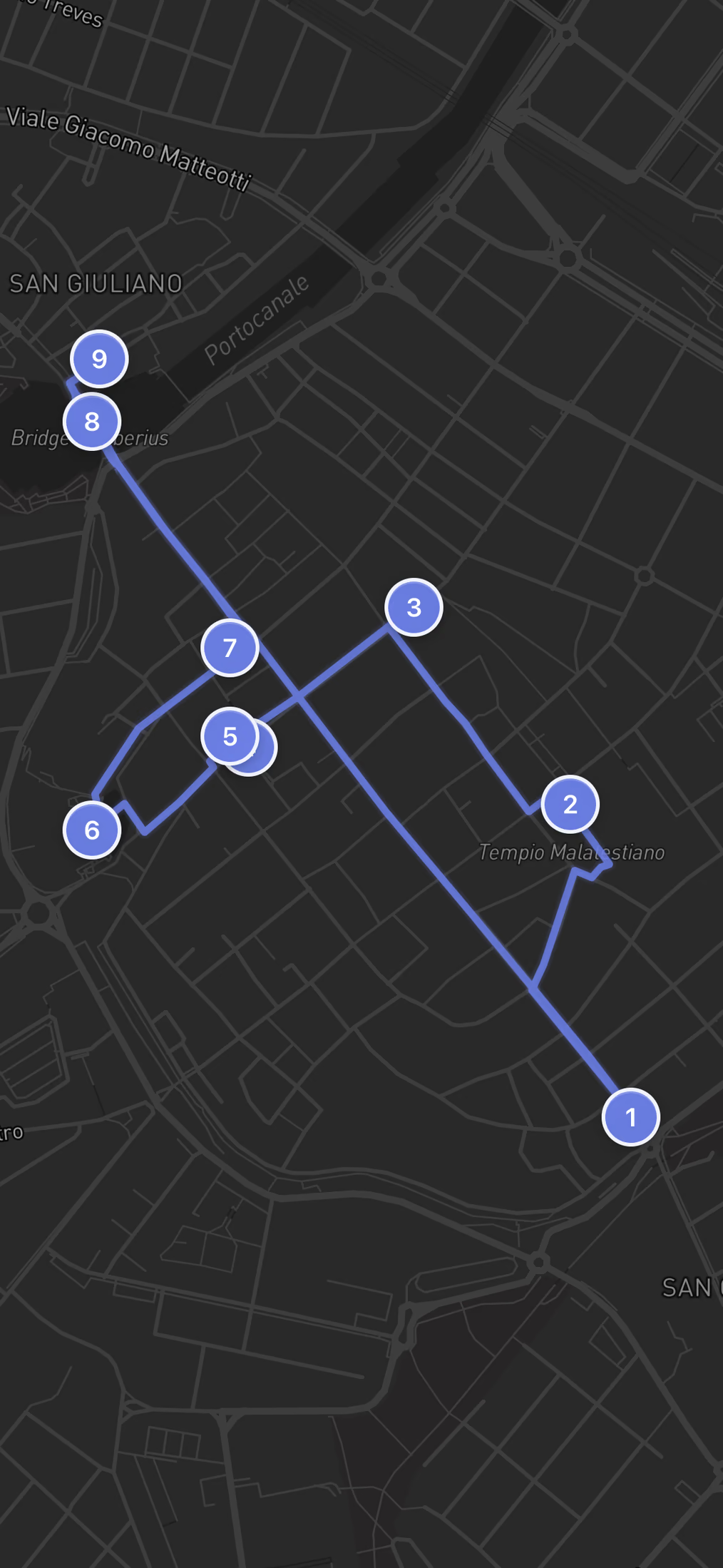
Walking tour route map of Rimini
Start This Tour Free

Why Walk Rimini? A Self-Guided Tour

Most people come to Rimini for the beach and never walk ten minutes inland. That is their mistake and your gain. The old town is small, flat, and packed with the kind of history that would draw crowds anywhere else: the oldest surviving Roman arch on earth, a Roman bridge still carrying traffic two thousand years later, an unfinished Renaissance cathedral designed by Alberti, and a Roman surgeon's house dug up under a city square. You can string all of it together on foot without ever needing a bus or a taxi.

This route runs the spine of the ancient city, the old Roman decumanus that is now Corso d'Augusto, from the Arch of Augustus in the south to the Tiberius Bridge in the north. It is a loop, so you finish where you started. The whole thing covers about 3 kilometers of walking, roughly 40 minutes of pure movement, but you will spend real time at the stops. Budget two to three hours.

Why walk it instead of wandering? Because the layout is genuinely Roman, a straight line between two gates, and once you understand that the city suddenly makes sense. The sights also chain together in a logical order, classical at both ends, medieval and Renaissance in the middle, Fellini's cinema pole in the western corner. Wander randomly and you will miss half of it.

The Route: 9 Stops

Swipe through images or scroll names below

Scroll to explore →
1. Arch of Augustus
2. Tempio Malatestiano
3. Domus del Chirurgo
4. La Vecchia Pescheria
5. Piazza Cavour
6. Castel Sismondo
7. Fellini Museum
8. Tiberius Bridge
9. Borgo San Giuliano

Route Map

Tap to load interactive map
AI Tourguide
Walk this exact route with a private AI guide.
Full GPS navigation, interactive stories, and a guide that answers all your questions. A private guide experience for just €5/hour.
Start This Tour

Your Rimini Walking Tour, Stop by Stop

  1. 1

    Arch of Augustus

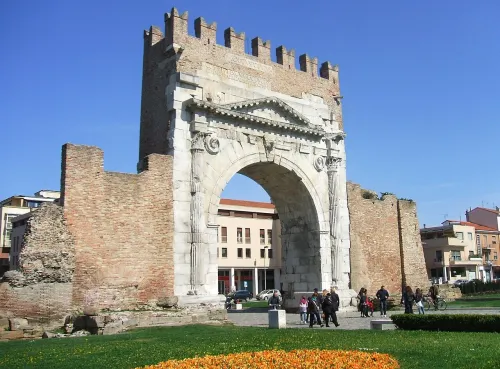
    Arch of Augustus in Rimini, stop 1 on the self-guided walking tour

    Start at the big one. The Arco d'Augusto is the oldest surviving Roman arch anywhere, built in 27 BC by decree of the Roman Senate to honor Augustus for restoring the Via Flaminia, the road that ran all the way back to Rome. Stand under it and you are standing at the exact southern gate of the ancient city, where the highway from Rome met the main street. It is open 24/7 and free, so there is no ticket and no queue, just a 2,000-year-old monument sitting in a traffic island. The honest verdict: five minutes is enough. Walk around it, look up at the medallions and the brick crenellations added in the Middle Ages, take the shot, move on. From here head straight up Corso d'Augusto, the dead-straight Roman main road. The Tempio is three minutes north on your left.
    Hours
    Open 24/7
    Price
    Free

    4 min walk to next stop

  2. 2

    Tempio Malatestiano

    Tempio Malatestiano in Rimini, stop 2 on the self-guided walking tour

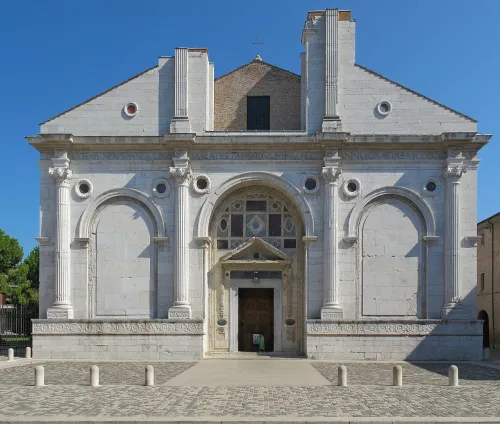
    A few minutes up the Corso, a strange marble facade stops you. This is Rimini's cathedral, but locals just call it the Duomo, and its design is one of the most important things in the Italian Quattrocento. Sigismondo Pandolfo Malatesta hired Leon Battista Alberti to wrap a medieval church in a classical Roman temple shell, with Piero della Francesca and Agostino di Duccio working inside. It was never finished, and you can see exactly where the money ran out: the upper facade just stops. Go in, it is worth it and it is free. Inside, look for Piero's fresco of Sigismondo kneeling and the carved chapels by di Duccio. Hours are tight: daily 8:30 to noon and 3:30 to 6:30 PM, so do not arrive at lunchtime. Back out, continue north and bear left toward Piazza Ferrari for the Roman house.

    Hours
    Daily: 8:30 AM – 12:00 PM, 3:30 – 6:30 PM
    Price
    Free

    3 min walk to next stop

  3. 3

    Domus del Chirurgo

    Domus del Chirurgo in Rimini, stop 3 on the self-guided walking tour

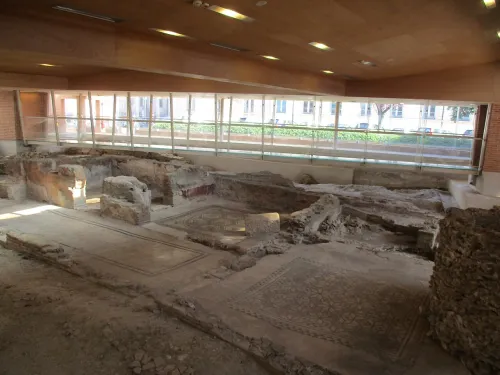
    After the Renaissance facade, the city peels back another layer. In Piazza Ferrari, under a modern glass-and-steel canopy, sits the excavated house of a Roman surgeon from the late 2nd century, dug up by accident in 1989. Inside they found mosaics, frescoes, and one of the most complete sets of Roman surgical instruments ever recovered. The actual tools are displayed nearby in the Museo della Città. Entry to the Domus is €7, and it is closed Mondays, open Tuesday to Sunday 10 to 1 and 4 to 7. The catwalks over the foundations make the layout easy to read. Worth the ticket if you like archaeology; if not, you can see plenty just looking down into the site from the square railing for free. Allow 30 to 40 minutes inside. From here, head west a couple of minutes toward the old fish market.

    Hours
    Mon: Closed | Tue-Sun: 10:00 AM – 1:00 PM, 4:00 – 7:00 PM
    Price
    €7

    3 min walk to next stop

  4. 4

    La Vecchia Pescheria

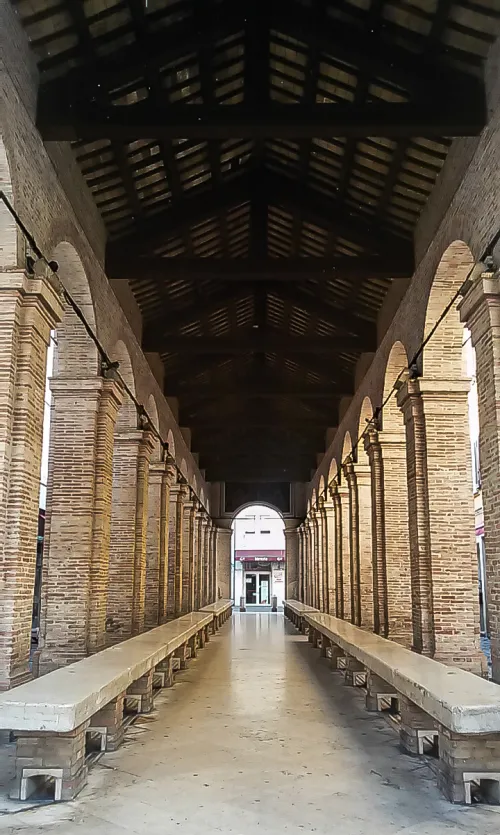
    La Vecchia Pescheria in Rimini, stop 4 on the self-guided walking tour

    Now the mood changes completely. The Vecchia Pescheria is the 18th-century old fish market, a covered loggia with stone selling slabs and dolphin-head spouts that once washed the day's catch. The fishmongers are long gone. These days the arcades fill with bars and the stone counters become standing tables for aperitivo, busiest from around 6 PM when the whole quarter turns into one big open-air drinks scene. It is free to walk through any time, day or night. This is the spot to clock for later: come back at dusk for a spritz at one of the bars under the arches. During the day it is quiet and you can actually see the architecture. The Pescheria opens directly onto Piazza Cavour, so you barely have to walk. Step through the arch into the square.

    Hours
    Open 24/7
    Price
    Free

    1 min walk to next stop

  5. 5

    Piazza Cavour

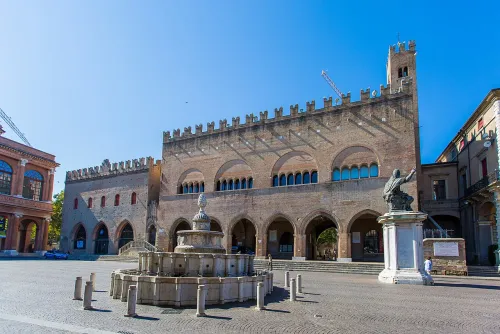
    Piazza Cavour in Rimini, stop 5 on the self-guided walking tour

    You are now in the living room of old Rimini. Piazza Cavour is the medieval main square, lined by the brick Palazzo dell'Arengo and Palazzo del Podestà, with the Pigna fountain in the middle, a pine-cone-topped fountain Leonardo da Vinci reportedly admired when he passed through. At the far end stands the restored Teatro Galli opera house. It is open and free, the natural place to sit down. Grab a bench or a cafe table and watch the town go about its business; this is where Rimini's residents actually hang out, not the beach crowd. If you only pause once on this walk, do it here. There is usually a small market or event going on. When you are ready, leave the square heading west toward the castle, a short walk down toward the Fellini cultural pole.

    Hours
    Open 24/7
    Price
    Free

    3 min walk to next stop

  6. 6

    Castel Sismondo

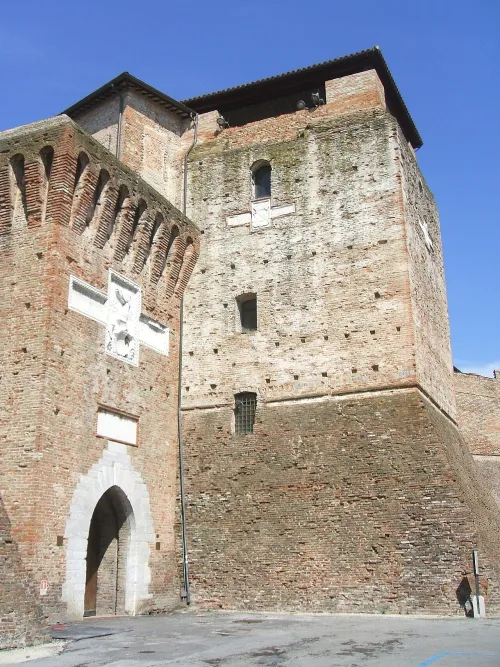
    Castel Sismondo in Rimini, stop 6 on the self-guided walking tour

    A blunt brick fortress rises ahead, all sloped walls and squat towers. Castel Sismondo was built in the 15th century by Sigismondo Pandolfo Malatesta, the same lord behind the Tempio, partly to his own design. What you see is only the central core; the outer ring of walls and the moat are gone. For decades it was a barracks and a prison. Today it is the main wing of the Fellini Museum. You can walk the exterior and the surrounding piazza for free, and entry to the castle section alone is just €2. It is closed Mondays, open Tuesday to Sunday 10 to 1 and 4 to 7. The honest call: the building is more impressive from outside than in, but at €2 the courtyard and ramparts are an easy yes. The Fellini Museum continues from here into the castle and across to Palazzo del Fulgor.

    Hours
    Mon: Closed | Tue-Sun: 10:00 AM – 1:00 PM, 4:00 – 7:00 PM
    Price
    €2

    3 min walk to next stop

  7. 7

    Fellini Museum

    Fellini Museum in Rimini, stop 7 on the self-guided walking tour

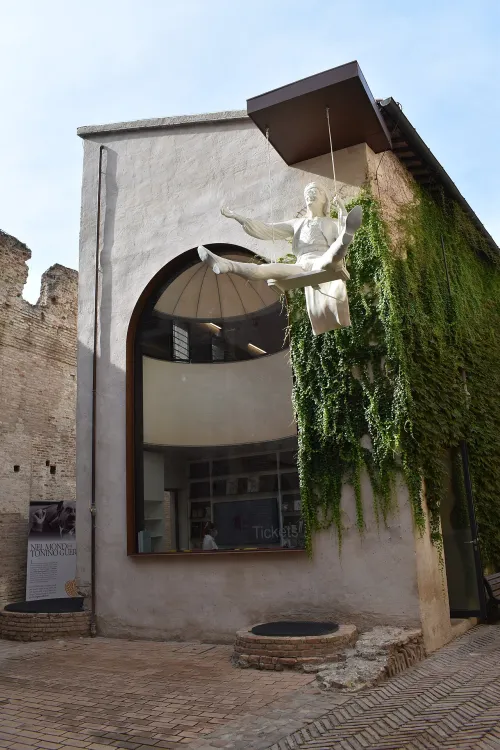
    Rimini's most famous son was the director Federico Fellini, and this is the museum built around him. It is not one building but a route: the Castel Sismondo wing, the square outside, and the Palazzo del Fulgor with the old Cinema Fulgor on the ground floor, the cinema young Fellini sneaked into. Inside it is immersive and dreamlike rather than a dusty display of props, full of projections, sound, and recreated sets from films like La Dolce Vita and Amarcord. The full ticket is €10, closed Mondays, open Tuesday to Sunday 10 AM to 7 PM. Worth it if you know even one of his films; if Fellini means nothing to you, skip the interior and just enjoy the piazza. Budget an hour or more to do it properly. Afterward, walk north toward the river. The Roman bridge is the last great monument.

    Hours
    Mon: Closed | Tue-Sun: 10:00 AM – 7:00 PM
    Price
    €10

    3 min walk to next stop

  8. 8

    Tiberius Bridge

    Tiberius Bridge in Rimini, stop 8 on the self-guided walking tour

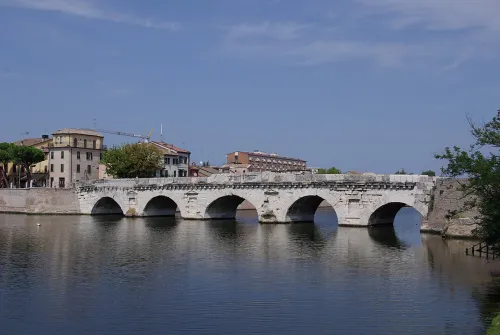
    The street opens onto water and there it is: five stone arches that have carried traffic since the 1st century AD. The Ponte di Tiberio, started under Augustus and finished under Tiberius, is one of only two Roman bridges still standing in Romagna, and it is still in use, which is the astonishing part. It marked the start of the Via Emilia heading northwest. Walk out onto it, free and open any time, and look back at the old town reflected in the Piazza sull'Acqua basin below, a low pool created so the bridge mirrors itself. This is the postcard view of Rimini. The riverside is also where you cross into the old fishermen's quarter. Note: a separate guided pumping-station visit nearby runs only Wednesday and Saturday evenings, but the bridge itself needs no ticket. Cross over into Borgo San Giuliano.

    Hours
    Mon-Tue: Closed | Wed: 6:00 – 8:00 PM | Thu-Fri: Closed | Sat: 6:00 – 8:00 PM | Sun: Closed
    Price
    Free

    2 min walk to next stop

  9. 9

    Borgo San Giuliano

    Borgo San Giuliano in Rimini, stop 9 on the self-guided walking tour

    Across the bridge the scale shrinks to a tangle of low, brightly painted houses. Borgo San Giuliano was the fishermen's quarter, poor and working-class for centuries, now the prettiest corner of Rimini. Wander the narrow lanes and you find murals on the walls everywhere, many of them scenes from Fellini's films, painted for the neighborhood's biennial festival. It is free and open, just streets, so let yourself get lost; the whole point is turning a corner into another splash of color. There are good trattorias here if you want lunch or dinner away from the tourist menus on the seafront. This is the finale, and it is the most photogenic stop on the route. When you are done, walk back across the Tiberius Bridge and follow Corso d'Augusto all the way south to close the loop at the Arch of Augustus where you began.

    Hours
    Open 24/7
    Price
    Free
AI Tourguide
Walk this exact route with a private AI guide.
Full GPS navigation, interactive stories, and a guide that answers all your questions. A private guide experience for just €5/hour.
Start This Tour

Self-Guided Tour vs. Group Tour in Rimini

Here is the honest math. Almost everything on this walk is free: the Arch, the Tempio, Piazza Cavour, the Pescheria, the Tiberius Bridge, and Borgo San Giuliano all cost nothing. The only paid stops are the Domus del Chirurgo at €7, Castel Sismondo at €2, and the full Fellini Museum at €10. Do all three interiors and you spend €19 per person, and even then a single guidebook page covers the context you need. For a self-guided walker, Rimini's old town is one of the cheapest serious history walks in Italy.

Guided walking tours of the centro storico do exist, usually run by local guides and often built around the Roman sites or the Fellini theme, typically in the €15 to €25 per person range for a two-hour group tour, more for a private guide. They are worth it on one condition: that you want the Roman archaeology explained properly, because the Domus and the bridge reward a real expert. If you mostly want to stroll, photograph the murals, and have an aperitivo at the Pescheria, a guide adds little.

The smart middle path: walk it yourself with this route, pay the €2 to get inside Castel Sismondo, and decide on the Domus and Fellini Museum based on your own interests rather than buying everything by default. That keeps the cost down and your day flexible.

Group Tour AI Self-Guided
Price €25–€50 per person €5/hour or €20 all-inclusive
Flexibility Fixed schedule Start anytime, skip stops
Languages 1–2 languages 11 languages
Pace Group pace Your own pace

How Long Does This Rimini Tour Take?

Our route covers 3.0 km with 9 stops and takes approximately 1.9 hours at a relaxed pace.

Pure walking is short, under 40 minutes for the full 3-kilometer loop on flat ground. The time goes into the stops. Move quickly and you can do the whole thing in two hours; do it properly with the Fellini Museum and the Domus del Chirurgo and you are looking at three to four. The two stops that genuinely eat time are the Fellini Museum, where an hour disappears fast inside the immersive rooms, and the Domus del Chirurgo, worth 30 to 40 minutes if you go in. Everything else is a five to fifteen minute pause.

For a proper break, Piazza Cavour is the obvious place: take a table at one of the cafes around the square or just sit on a bench by the Pigna fountain and watch the town. If you time the walk to end near dusk, save your break instead for La Vecchia Pescheria and have an aperitivo spritz under the arches when the whole quarter comes alive around 6 PM. Borgo San Giuliano is the other good pause point, with trattorias for a longer lunch before you loop back.

Tips for Walking in Rimini

AI Tourguide
Walk this exact route with a private AI guide.
Full GPS navigation, interactive stories, and a guide that answers all your questions. A private guide experience for just €5/hour.
Start This Tour

AI Audio Guide for This Tour

Standing under the Arch of Augustus or looking out over the Tiberius Bridge right now? Open the app and it will walk you stop by stop along the old Roman decumanus, with hours, ticket prices, and the next turn already mapped. No signal-hunting, no guessing which way Corso d'Augusto runs.

AI Audio Guide Stories, history and fun facts narrated as you walk. No earpiece rental needed.
GPS Navigation Turn-by-turn directions so you never get lost between stops.
Ask Anything Curious about a building you pass? Ask your AI guide on the spot.
11 Languages Switch language anytime. No separate tour needed.
Start This Tour Free

Common Questions

Yes, the old town is calm and safe day and night, with families and locals out late, especially around Piazza Cavour and the Pescheria. The usual caution applies near the train station and the beach strip after dark. Watch for pickpockets in summer crowds and ignore anyone pushing bracelets or roses near the Arch and bridge. There are no notable scams in the centro storico itself.
Plenty of this route works in the rain. The Domus del Chirurgo sits under a covered canopy, and the Fellini Museum across Castel Sismondo and Palazzo del Fulgor is entirely indoor and immersive, easily an hour or two out of the weather. The Tempio Malatestiano interior is free shelter, and the arcades of La Vecchia Pescheria keep you dry for a coffee or spritz. Save Borgo San Giuliano's open lanes for a clear spell.
Start mid-morning, around 9:30 to 10 AM, so you catch the Tempio Malatestiano before its midday closure and the museums on their morning opening. Then time the loop so you reach La Vecchia Pescheria and Borgo San Giuliano in the late afternoon, when the light is best for the Tiberius Bridge reflection and the Pescheria fills up for aperitivo. Midday is fine for the free outdoor monuments.
No booking needed. This self-guided tour is available anytime. Open the route on your phone and start walking. The AI audio guide works instantly, no reservation required.
The AI audio guide is available in 11 languages: English, German, French, Spanish, Italian, Japanese, Chinese, Portuguese, Danish, Norwegian, and Swedish.
Yes. Skip any stop, spend extra time at places you like, or start the route from any point. You can also ask the AI to suggest a shorter route.
AI Tourguide
Curated by AI Tourguide GPS-verified routes, reviewed and updated regularly.
Last verified June 2026