Self-Guided Walking Tour in Gubbio

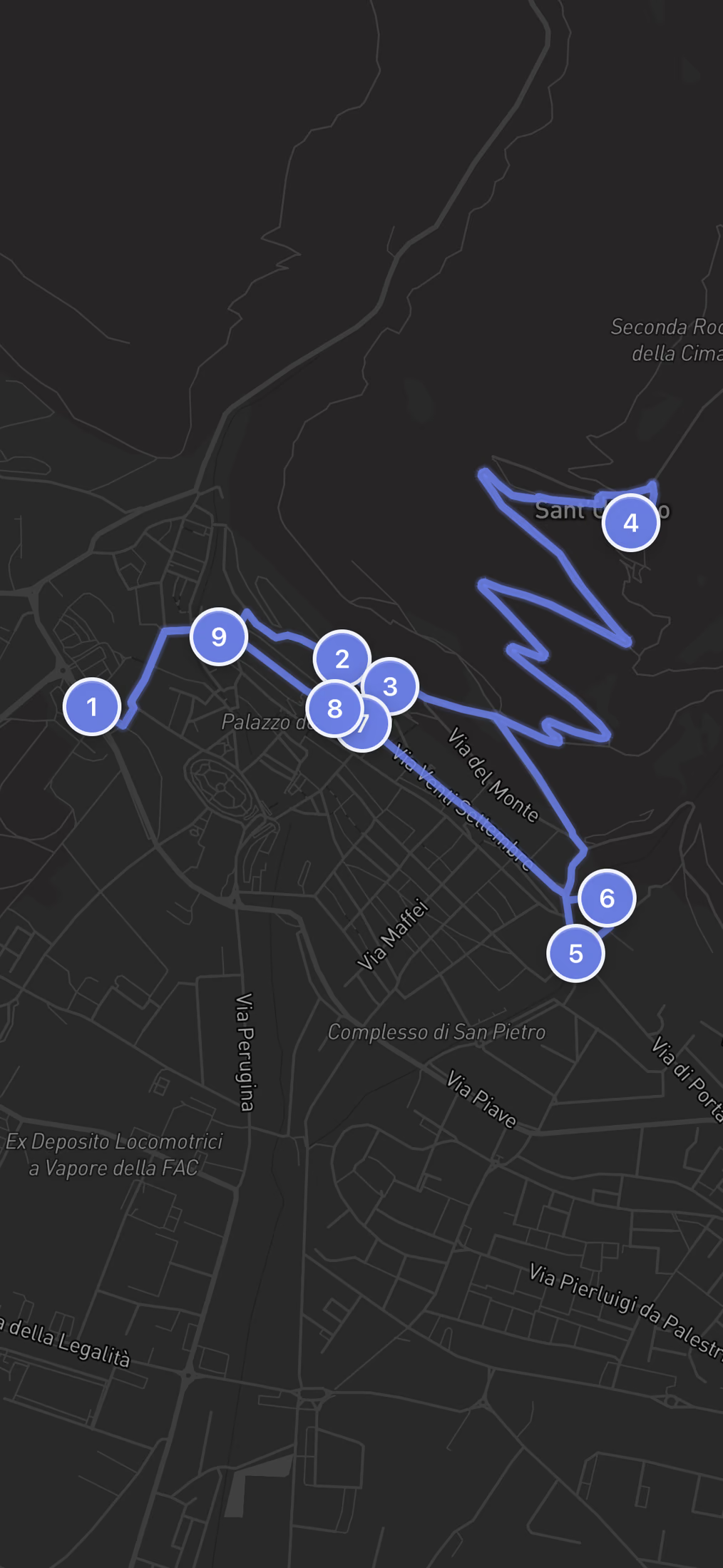
A 9-stop loop through the Umbrian hill town of Gubbio, from the Roman Theatre on the flat western edge up Monte Ingino to the Basilica di Sant'Ubaldo and back down through Piazza Grande to the Palazzo del Bargello. This page gives you the map, the walking time for every leg, real prices and hours, and shorter versions if you want less climbing.

9 Stops6.1 km~3 hours walking3 hours to a half day with stops
What you get with AI Tourguide
Full GPS navigationInteractive AI guidePersonalized to youWorks in your browser
Try this tour with Alex

Gubbio Walking Tour at a Glance

This route is built for anyone who wants Gubbio in the right order rather than the accidental one. It links all 9 stops, but every interior is optional: you can follow the whole loop for free and step inside only the palaces, museum or cable car that interest you. You set the pace, the map keeps you on line, and you decide at each door whether the ticket is worth it.

StartRoman Theatre of Gubbio (Teatro romano di Gubbio)
FinishPalazzo del Bargello
Route typeA loop that climbs east and north up Monte Ingino, then works back down and west through the upper town, so you finish a short walk from where you started with almost no backtracking.
Realistic timeThe walking alone is a little over an hour, but the gradient is slow and the stops pull at you, so budget about three hours for the loop with the palaces and cable car, or a half day if you linger at the top.
DifficultyModerate. It is 6.1 km on worn limestone with steep stepped lanes and cobbles, and a real climb up to the cathedral and basilica. Firm shoes with grip matter, and the stone turns slick when wet.
Cost to followThe outdoor route costs nothing. Paid interiors are the Roman Theatre at €3, Palazzo Ducale and Palazzo dei Consoli at €8 each, and the open-basket cable car at €7. Everything else is free.
Best for:

Travellers who like a hill town on foot, do not mind a climb, and want the panoramic high point and the hanging square without joining a group or fixing a schedule.

The Route

Free Walking Tour Map of Gubbio

9 stops6.1 kmabout 3 hours
Loading the interactive map…The complete walking route will appear here.
Want the route to guide you while you walk?Open the route with navigation and a personal guide for the history, stories and questions that matter to you.
Open route + AI guide

The 9 stops along this route

  1. Roman Theatre of Gubbio (Teatro romano di Gubbio) in Gubbio, stop 1 on the self-guided walking tour
    1Roman Theatre of Gubbio (Teatro romano di Gubbio)
  2. Palazzo Ducale in Gubbio, stop 2 on the self-guided walking tour
    2Palazzo Ducale
  3. Duomo of Gubbio (Duomo di Gubbio) in Gubbio, stop 3 on the self-guided walking tour
    3Duomo of Gubbio (Duomo di Gubbio)
  4. Basilica of Sant'Ubaldo (Basilica di Sant'Ubaldo) in Gubbio, stop 4 on the self-guided walking tour
    4Basilica of Sant'Ubaldo (Basilica di Sant'Ubaldo)
  5. Porta Romana in Gubbio, stop 5 on the self-guided walking tour
    5Porta Romana
  6. Funivia di Gubbio in Gubbio, stop 6 on the self-guided walking tour
    6Funivia di Gubbio
  7. Palazzo dei Consoli in Gubbio, stop 7 on the self-guided walking tour
    7Palazzo dei Consoli
  8. Piazza Grande in Gubbio, stop 8 on the self-guided walking tour
    8Piazza Grande
  9. Palazzo del Bargello in Gubbio, stop 9 on the self-guided walking tour
    9Palazzo del Bargello
  10. That's the complete route.

    If you want more than the map and text, add live navigation and a conversational AI guide while you walk.

    Open route + AI guide
    You made it
Stop 1 of 9
Swipe →

Your Gubbio Walking Tour, Stop by Stop

  1. 1

    Roman Theatre of Gubbio (Teatro romano di Gubbio)

    Roman Theatre of Gubbio (Teatro romano di Gubbio) in Gubbio, stop 1 on the self-guided walking tour

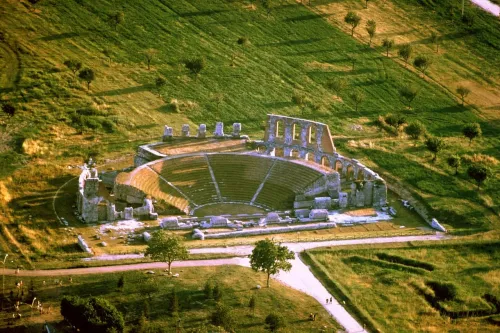
    Start here, on the grassy flat just below the highway SR298 before the town climbs. The Teatro Romano is a 1st-century ruin from ancient Iguvium, two tiers of limestone arches that once formed a semicircle of 27 arches and seated close to 6,000 people. What survives is the lower arcade and the stone bones of the seating, restored over the last two centuries. It is open and quiet, a good place to set your bearings before the streets get steep. Entry is €3 and the adjoining antiquarium museum displays finds dug up around Gubbio. Note the hours: closed Mondays, mornings only Tuesday and Friday (8:30 to 13:30), afternoons Wednesday and Thursday (14:10 to 19:30), and all day on weekends. In summer they still stage open-air performances on the old stage. From here, walk east and uphill toward the cathedral quarter.
    Hours
    Mon: Closed | Tue: 8:30 AM – 1:30 PM | Wed-Thu: 2:10 – 7:30 PM | Fri: 8:30 AM – 1:30 PM | Sat-Sun: 8:30 AM – 7:30 PM
    Price
    €3
  2. 2

    Palazzo Ducale

    Palazzo Ducale in Gubbio, stop 2 on the self-guided walking tour

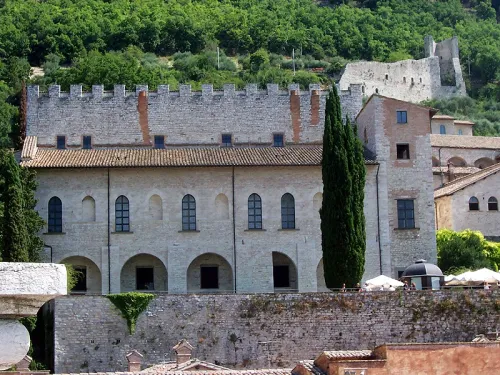
    The climb levels off at the top of the old town, and the ducal palace faces you across from the Duomo. Federico da Montefeltro, the great warlord-duke of Urbino, had it built in 1470 in Renaissance style on top of older medieval buildings, and it is also called the Corte Nuova. The pull here is the courtyard: a clean, arcaded Renaissance space that feels a world away from the rough stone lanes outside. Inside you get rooms with intarsia woodwork and views down over the rooftops. Entry is €8. Hours are 8:30 to 19:30 Tuesday through Sunday, and on Mondays it opens only in the afternoon, 14:00 to 19:30. Worth the ticket if you like Renaissance interiors; if you are short on time, the courtyard alone justifies a look. Step back outside and the cathedral is directly across the narrow street.

    Hours
    Mon: 2:00 – 7:30 PM | Tue-Sun: 8:30 AM – 7:30 PM
    Price
    €8
  3. 3

    Duomo of Gubbio (Duomo di Gubbio)

    Duomo of Gubbio (Duomo di Gubbio) in Gubbio, stop 3 on the self-guided walking tour

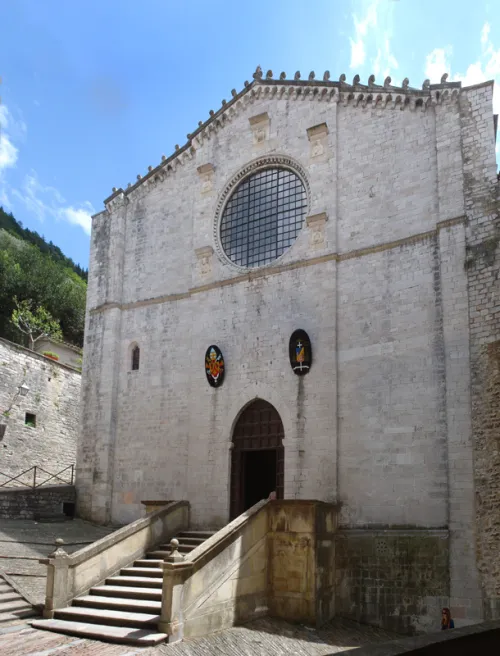
    Cross the lane and you are at the Duomo dei Santi Mariano e Giacomo, the mother church of the diocese, dedicated to two martyrs whose relics sit under the central altar. From outside it is plain, almost austere, set tight against the hillside with a simple pink-and-white facade. Step in for the single nave roofed by a run of stone arches that draw the eye straight to the altar, an unusual and quietly impressive bit of engineering. It is free and open daily, roughly 8:20 in the morning to 7:20 in the evening, so it makes an easy pause between the two ducal-quarter stops. A few minutes inside is plenty unless you want to study the side chapels. When you are done, leave the upper town and head up the hill toward the basilica, the steepest part of the walk.

    Hours
    Daily: 8:22 AM – 7:22 PM
    Price
    Free
  4. 4

    Basilica of Sant'Ubaldo (Basilica di Sant'Ubaldo)

    Basilica of Sant'Ubaldo (Basilica di Sant'Ubaldo) in Gubbio, stop 4 on the self-guided walking tour

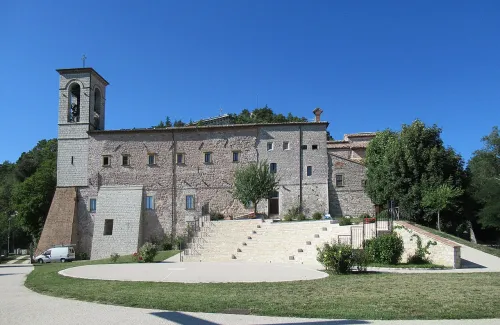
    This is the climb that earns the view. The basilica sits high on Monte Ingino, and the whole town and the green valley spread out below you. Inside lies the body of Sant'Ubaldo, Gubbio's patron saint, kept in a glass case above the main altar, and the three giant wooden Ceri, the towers that get raced up this same mountain every 15 May in the Corsa dei Ceri. It became a minor basilica in July 1919. The church itself is free and open daily 7:30 to 19:30. Most people reach it by the cable car rather than the footpath, which is the smart move given the gradient. Take your time up here, this is the panoramic high point of the day and the best photos in Gubbio. When you have had your fill, ride or walk back down toward Porta Romana.

    Hours
    Daily: 7:30 AM – 7:30 PM
    Price
    Free (cable car €7)
  5. 5

    Porta Romana

    Porta Romana in Gubbio, stop 5 on the self-guided walking tour

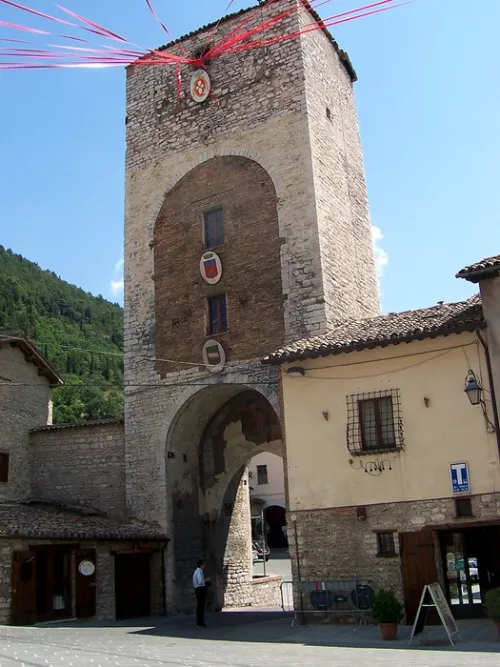
    Back down at the lower edge of the medieval core stands Porta Romana, a tall medieval town gate that marks the old boundary on the southeastern side. It is the kind of stop you would walk straight through without noticing on your own, which is a shame, because the gate is a handsome piece of stonework and frames the lane behind it nicely. It is free and standing open around the clock. Tucked inside the gate is a small ceramics museum, Gubbio being famous for its lustreware pottery, worth a glance if the door is open. Mostly this is a transition point: the funivia base station sits only about 100 meters away, so use this gate as your marker. From here it is a very short walk to the cable car.

    Hours
    Open 24/7
    Price
    Free
  6. 6

    Funivia di Gubbio

    Funivia di Gubbio in Gubbio, stop 6 on the self-guided walking tour

    The funivia is not your average cable car. These are open metal baskets, two people standing upright, clipped onto a moving cable that hauls you straight up the flank of Monte Ingino. There are no doors and no seats, just a low rail and the ground falling away beneath your feet. If you have a fear of heights, know that before you step in. For everyone else it is one of the best few minutes in Umbria, and the ride up to Sant'Ubaldo is the experience as much as the destination. A ticket is €7, and it runs daily 8:00 to 18:00, though check seasonal hours since it can close in bad weather or wind. If you rode up to the basilica earlier, this is where you came down. Either way, from the base it is back into the medieval streets toward the great square.

  7. 7

    Palazzo dei Consoli

    Palazzo dei Consoli in Gubbio, stop 7 on the self-guided walking tour

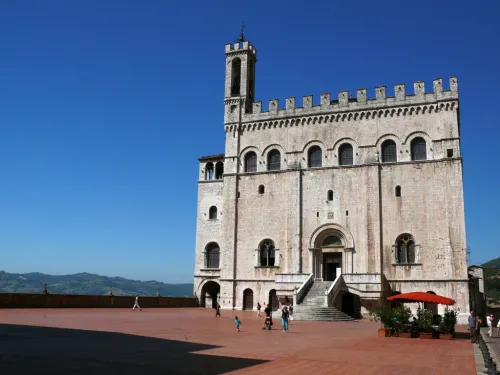
    Now the showpiece. The Palazzo dei Consoli rears up over Piazza Grande, one of the most imposing public palaces in all of Italy, a sheer wall of pale stone topped with battlements and a slim bell tower, reached by a fan-shaped flight of steps. It went up in the early 1300s as the seat of the town's governing consuls. Inside, the civic museum holds the Eugubine Tablets, seven bronze plaques inscribed in the ancient Umbrian language, the most important surviving text of that lost tongue. Entry is €8. Hours run 10:00 to 18:00 on weekends, and on weekdays it splits into 10:00 to 13:00 and 15:00 to 18:00, so dodge the midday closure. Climb to the loggia at the top for another valley view. Then step out onto the square itself, which is a stop in its own right.

    Hours
    Mon-Fri: 10:00 AM – 1:00 PM, 3:00 – 6:00 PM | Sat-Sun: 10:00 AM – 6:00 PM
    Price
    €8
  8. 8

    Piazza Grande

    Piazza Grande in Gubbio, stop 8 on the self-guided walking tour

    Walk out of the palace and onto the strangest square you will stand in this trip. Piazza Grande is not built on solid ground at all, it is suspended on a system of stone arches and vaults thrown out over the slope, a flat open terrace hanging above the valley. Lean on the far parapet and the rooftops of the lower town tumble away below you, with the Apennine hills beyond. It is free and open at all hours, which makes it the place to come back to at sunset when the stone goes gold. This is the heart of Gubbio, the spot the whole town was engineered around, and it costs nothing to simply stand here. From the square, drop down through the lanes toward the Gothic palace and its famous fountain.

  9. 9

    Palazzo del Bargello

    Palazzo del Bargello in Gubbio, stop 9 on the self-guided walking tour

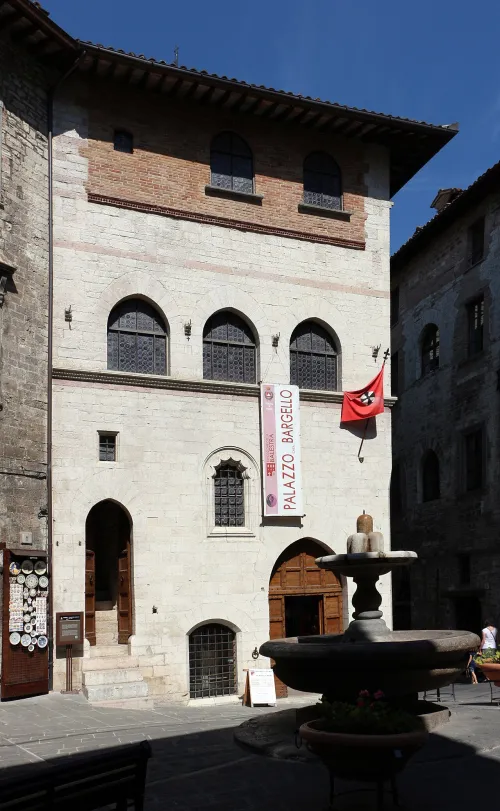
    Last stop, and a fitting one. The Palazzo del Bargello is a textbook piece of Gothic civic architecture, named for the Bargello, the medieval chief of police who by tradition lived here. In the little piazza in front of it bubbles the Fontana dei Matti, the Fountain of the Madmen, and this is the one bit of local tradition you should actually do: walk three times around the fountain and, by custom, you earn an honorary Gubbio citizenship as a certified matto, a madman. Locals will happily explain it. Both the palace and the fountain are free and always open, and because they sit barely 25 meters apart you take in the pair at a glance. It is a light, fun note to finish on before you loop back down toward the Roman theatre where you began.

    Hours
    Open 24/7
    Price
    Free

How Long Does This Walking Tour Really Take?

The pure walking time across the 6.1 km loop is only a little over an hour, but that is not how you will spend the day. Add the two palaces and the cable car and you are near three hours; give the basilica terrace and Piazza Grande the time they deserve and it stretches to a relaxed half day.

Budget about three hours for the full loop if you go into the palaces and ride the funivia, and closer to a half day if you linger at the top of Monte Ingino. The walking itself is only a little over an hour spread across the route, but the climb is slow and you will stop more than you plan to. The basilica and Piazza Grande are the two places to give real time: the basilica for the view and the saint's tomb, the square for simply standing on a terrace hung over the valley.

For a break, Piazza Grande is the obvious choice. There are a couple of cafes right on the hanging square where you can sit with a coffee and the whole valley in front of you. If you want something quieter, the steps below the Palazzo dei Consoli make a good perch in the morning sun. Save the square for late afternoon when the light turns the stone gold and the day-trippers thin out.

Full Route, Shorter Walk or Two-Day Version?

The loop is short but the climb is the whole difficulty, so here are three ways to walk it depending on your legs and your time. Every version uses the same stop numbers from the map on this page.

Short low route

Upper town only, skip the mountain

Stops 1, 2, 3, then straight to 7, 8, 9, roughly 1.5 to 2 hours

Cut the two longest legs, the 1930 m climb to the basilica and the 2200 m descent from it, which together are most of the day's effort. You lose the panorama from Sant'Ubaldo but keep the theatre, both ducal-quarter stops, Palazzo dei Consoli, the hanging Piazza Grande and the Bargello, all within the compact medieval core.

Two-part split

Upper town first, mountain second

Part one: stops 1, 2, 3, 7, 8, 9. Part two: cable car from stop 6 up to stop 4

For an easier day, do the flat and gently climbing core first (theatre, palaces, squares, Bargello), rest over lunch on Piazza Grande, then take the funivia (6) up to the Basilica di Sant'Ubaldo (4) for the view rather than walking the steep 1930 m footpath. Splits the one genuinely hard part off from the sightseeing.

You can walk it in reverse, from the Palazzo del Bargello down to the Roman Theatre, but the given direction is the better one. Climbing to the basilica early puts the hard gradient behind you while your legs are fresh and the morning light is on the town below, and it leaves Piazza Grande for late afternoon when the stone turns gold.

Is This Gubbio Walking Tour Right for You?

Gubbio is tiny and never as crowded as Assisi or Perugia, but it is a mountain town, so the fit is really about the climb. Here is who this walk suits and how to bend it if the gradient is a problem.

A good fit if you…

  • Walkers happy with a real uphill on stepped limestone lanes, rewarded by the best panorama in town from the basilica terrace.
  • People who want to decide interior by interior, paying only the €3, €7 and €8 tickets that appeal to them.
  • Anyone drawn to oddities: an open-basket cable car with no seats, a square suspended on stone arches over the valley, a fountain that makes you an honorary madman.
  • History travellers curious about the Eugubine Tablets, the 1st-century theatre and the Corsa dei Ceri that races up Monte Ingino every 15 May.

Adapt the route if you…

  • You would rather not climb: take the funivia both ways or skip the mountain entirely and stay in the upper town core.
  • You have vertigo: the open-basket cable car has no doors or seats, so walk the footpath or leave the basilica out.
  • It is raining: save the funivia and basilica for a clear spell and spend the time inside the cathedral, the two palaces and the ceramics museum by Porta Romana.
  • You are short on time: do the short low route, roughly 1.5 to 2 hours, and drop the two long legs up and down the mountain.

Tickets & Skip-the-Line in Gubbio

Gubbio has no timed-entry crush, so this is less about queues and more about hours and price. Buy tickets at each door as you go and plan around the midday closures. Here is what each paid stop costs and when it is open.

Roman Theatre of Gubbio (Teatro romano di Gubbio)€3 including the adjoining antiquarium. Closed Mondays; mornings only Tuesday and Friday (8:30 AM to 1:30 PM); afternoons Wednesday and Thursday (2:10 to 7:30 PM); all day Saturday and Sunday (8:30 AM to 7:30 PM). Check the museum site before a weekday visit. official ticket site ↗
Palazzo Ducale€8. Open 8:30 AM to 7:30 PM Tuesday through Sunday; on Mondays it opens only in the afternoon, 2:00 to 7:30 PM. The Renaissance courtyard alone is worth a look if you are short on time. official ticket site ↗
Palazzo dei Consoli€8 for the civic museum, home of the seven bronze Eugubine Tablets. Open 10:00 AM to 6:00 PM on weekends; on weekdays it splits into 10:00 AM to 1:00 PM and 3:00 to 6:00 PM, so dodge the midday closure.
Funivia di Gubbio€7 for the open-basket cable car up to Sant'Ubaldo. Runs daily 8:00 AM to 6:00 PM, but it can close in high wind or bad weather, so check on the day. No seats, no doors, not for anyone with vertigo.
Basilica of Sant'Ubaldo (Basilica di Sant'Ubaldo)The basilica itself is free and open daily 7:30 AM to 7:30 PM; the only cost of reaching it is the €7 cable car (or the free but steep footpath).
Everything elseThe Cathedral of Gubbio, Porta Romana, Piazza Grande and the Palazzo del Bargello are all free open spaces or free-entry churches, most of them accessible around the clock. No tickets needed.
Optional upgrade
+5
The same 9-stop route,
now with navigation and a guide.
Optional AI experience

You already have the route.
The AI guide brings it to life.

Standing in Piazza Grande with the valley dropping away below the parapet? Open AI Tourguide in your browser, nothing to install, and a voice guide walks the rest of the climb with you, from the Roman theatre up to the Palazzo Ducale and the cathedral, telling the story along the way and asking how far up Monte Ingino you want to go. A real conversation rather than a recording, shaped around your answers. Start with 100 free credits.

Livenavigation13languagesAnyquestionYourinterests
Open this route with the AI guide

Try it in your browser · No app or download required

Tips for Walking in Gubbio

  • Gubbio has no train station of its own. Come by bus from Perugia (about 70 minutes) or Fossato di Vico station (about 30 minutes by connecting bus), or drive and park at the Piazza 40 Martiri lots at the bottom of town near the Roman theatre, then walk up.
  • This is a hill town paved in worn limestone with steep stepped lanes and cobbles. Wear proper shoes with grip, not sandals. The stone gets slick when wet, and the gradient up to the cathedral and basilica is real.
  • Public toilets are scarce in the upper town. Use the facilities near the Piazza 40 Martiri car park at the bottom before you start the climb, or buy a coffee at a Piazza Grande cafe and use theirs.
  • For lunch, try a plate of local crescia (the flat Umbrian bread) with cured meats, or anything with truffle, which is a Gubbio specialty. A sit-down primo runs roughly €10 to €14 at a trattoria off Piazza Grande. A coffee at the bar is about €1.20.
  • The best photo is from the parapet of Piazza Grande, facing south over the lower-town rooftops and the valley, shot in late afternoon when the sun is low and the stone glows. For the town-from-above shot, take it from the basilica terrace mid-morning.

Why Walk This Route?

Gubbio is built into the side of Monte Ingino, so this walk is really a climb. You start on the flat western edge where the Romans left their theatre, then work your way up through stepped lanes the color of pale gray limestone until the whole town drops away beneath you. It is small enough to cross in twenty minutes if you rushed, but you will not want to rush. The streets fold back on each other, the squares hang on stone arches over the valley, and the best stuff is at the top.

This route is a loop, about 6.1 km of actual walking, and it is designed around one decision most people get wrong: when to go up the mountain. The basilica and the cable car sit high on Monte Ingino, away from the medieval core, and if you save them for last you will be tired and the light will be flat. So this walk takes you up early, while your legs are fresh and the morning sun is on the town below, then brings you back down through the great hanging square and the Gothic palaces. You see the postcard view before the crowds, then the architecture up close.

Gubbio gets day-trippers but never the crush of Assisi or Perugia, which is the whole point of coming here. Wander on your own and you will still get lost in the side lanes. Follow this order and you will not waste the climb.

Common Questions

Is Gubbio safe to walk around?

Yes, very. Gubbio is a small Umbrian hill town with low crime and no rough areas to avoid. The main hazards are physical: steep stepped lanes, slippery limestone when wet, and the open-basket cable car, which has no seats or doors and is not for anyone with vertigo. Watch your footing more than your wallet.

What if it rains during my Gubbio tour?

Plenty of this route works indoors. Duck into the cathedral (free), the civic museum inside Palazzo dei Consoli with the Eugubine Tablets (€8), the Renaissance rooms of Palazzo Ducale (€8), or the ceramics museum by Porta Romana. Save the funivia and the basilica for a clear spell, since the open cable car closes in high wind and the view is the whole point of the climb.

What's the best time of day for this walking tour?

Start by 9 in the morning. You climb to the basilica while your legs are fresh and the light is on the town below, and you reach the cable car before the day-trip buses arrive around midday. That also leaves Piazza Grande for late afternoon, when the low sun turns the hanging square gold and the crowds have gone.

Take this route with you

Open this exact tour with navigation and your personal AI guide.

Start GPS Navigation + AI Guide
AI Tourguide
Researched and curated by the AI Tourguide teamWe plan and quality-check every route, then research and verify the opening hours, prices, and practical tips for each stop along it.
▶ Open route with AI guideNavigation, stories and your questions