Self-Guided Walking Tour in Urbino

A tight loop through Urbino's brick hilltop center: 6 stops in under 2km, starting high at the Fortezza Albornoz for the postcard view of the twin towers and ending at the house where Raphael was born. The page gives you the map, the walking time for every leg, real prices and opening hours, and shorter versions.

6 Stops1.8 km~1 hours walking4–5 hours with stops
What you get with AI Tourguide
Full GPS navigationInteractive AI guidePersonalized to youWorks in your browser
Try this tour with Alex

Urbino Walking Tour at a Glance

This route is built for anyone who wants Urbino's famous palace plus the small painted oratories that day-trippers walk straight past, all on one compact loop. Every interior on the walk is optional: the streets, the walls and the viewpoint are free, and you decide at each door whether the ticket is worth it. Nothing here needs a guide or a fixed time.

StartFortezza Albornoz
FinishCasa Santi
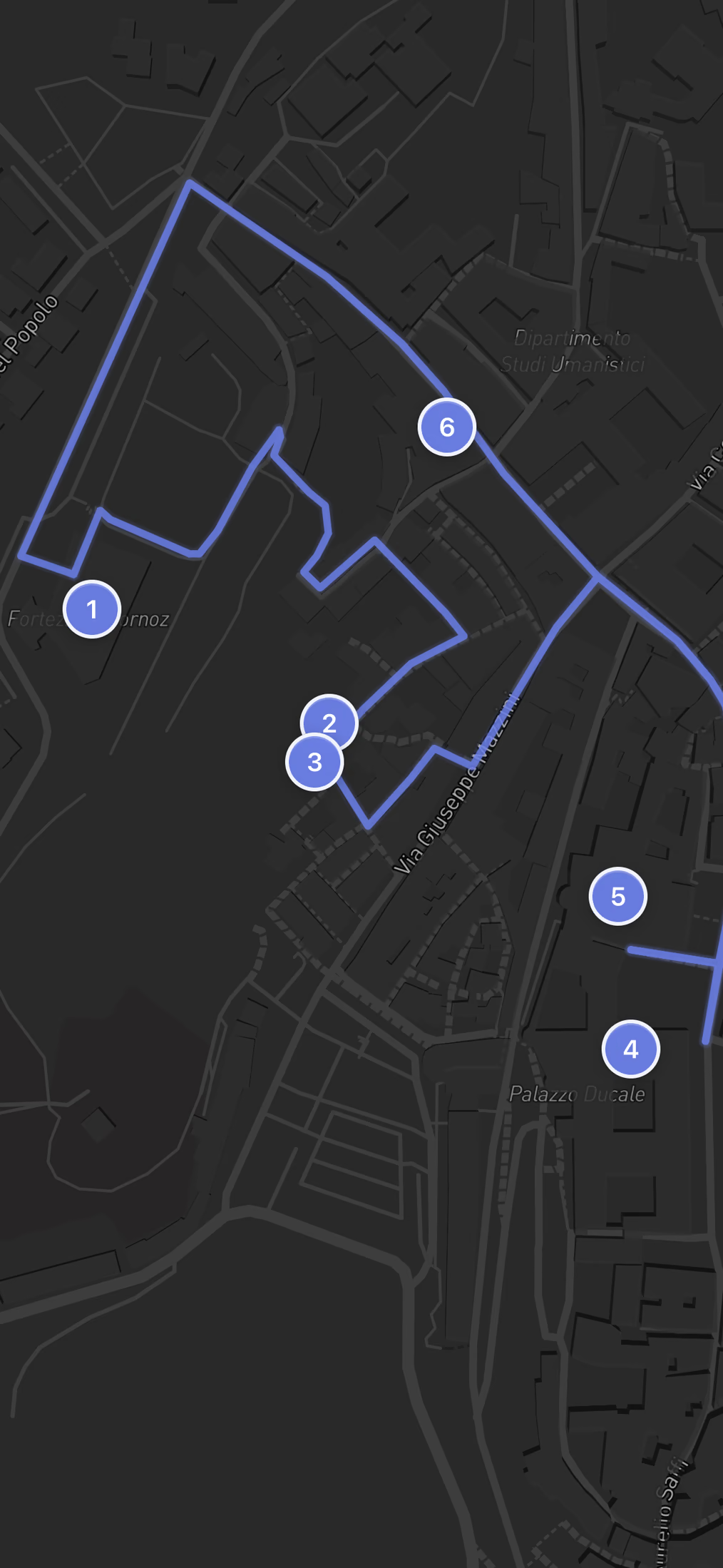
Route typeA tight loop, not a wander. You start high at the Fortezza Albornoz in the north, drop south-east through Via Barocci, reach the palace and cathedral on the same piazza, climb north to Raphael's house, then close the circle back at the fortress with almost no backtracking.
Realistic timeUnder 2km of actual walking, so the distance is nothing. Plan on 4 to 5 hours if you go inside everything, with the National Gallery alone eating 90 minutes to two hours. What tires you is the gradient, not the length.
DifficultyShort but steep. The whole loop is under 2km on pitched brick and worn stone that turns slick after rain, with the climbing broken into short bursts rather than one long slog. Flat shoes with grip strongly recommended.
Cost to followThe outdoor loop, the fortress and the cathedral are free. Paid interiors are the National Gallery at €12, the two oratories at €5 each, and Raphael's birthplace at €3.50, so around €27.50 buys every door on the walk.
Best for:

Travelers who want the Renaissance heavyweight, the Palazzo Ducale, without missing the quiet oratories and Raphael's house that make Urbino feel like a living town rather than one museum with a queue.

The Route

Free Walking Tour Map of Urbino

6 stops1.8 kmabout 1 hours
Loading the interactive map…The complete walking route will appear here.
Want the route to guide you while you walk?Open the route with navigation and a personal guide for the history, stories and questions that matter to you.
Open route + AI guide

The 6 stops along this route

  1. Fortezza Albornoz in Urbino, stop 1 on the self-guided walking tour
    1Fortezza Albornoz
  2. Oratory of St Joseph (Oratorio di San Giuseppe) in Urbino, stop 2 on the self-guided walking tour
    2Oratory of St Joseph (Oratorio di San Giuseppe)
  3. Oratory of Saint John the Baptist in Urbino, stop 3 on the self-guided walking tour
    3Oratory of Saint John the Baptist
  4. Galleria Nazionale delle Marche in Urbino, stop 4 on the self-guided walking tour
    4Galleria Nazionale delle Marche
  5. Cathedral of Urbino (Duomo di Urbino) in Urbino, stop 5 on the self-guided walking tour
    5Cathedral of Urbino (Duomo di Urbino)
  6. Casa Santi in Urbino, stop 6 on the self-guided walking tour
    6Casa Santi
  7. That's the complete route.

    If you want more than the map and text, add live navigation and a conversational AI guide while you walk.

    Open route + AI guide
    You made it
Stop 1 of 6
Swipe →

Your Urbino Walking Tour, Stop by Stop

  1. 1

    Fortezza Albornoz

    Fortezza Albornoz in Urbino, stop 1 on the self-guided walking tour

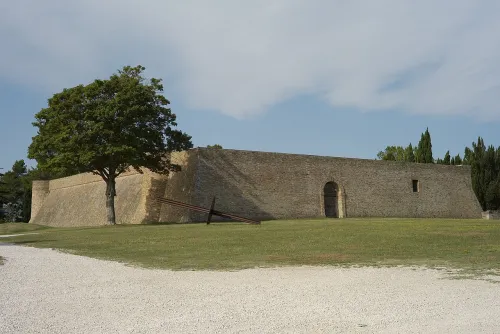
    Start at the top, because every other climb after this feels easier. The Fortezza is a 14th-century hilltop fortress, and you do not come for the walls so much as for what you see from the grass around them: the entire skyline of Urbino, with the two slim towers of the Palazzo Ducale rising over the brick rooftops. This is the photo everyone associates with the city. Entry to the fortress and the park around it is free. Opening hours are patchy and change by day, roughly 10:00 to 13:00 and 15:00 to 18:00 on weekends and Mondays, with Thursday and Friday closed, so treat the interior as a bonus and the viewpoint as the real reason you are here. The grassy slope is open and walkable any time. Catch your breath, get oriented, then head downhill on Via dei Maceri toward Via Barocci.
    Hours
    Mon: 10:00 AM – 1:00 PM, 3:00 – 6:00 PM | Tue: 10:00 AM – 12:00 AM | Wed: 12:00 – 10:00 AM | Thu-Fri: Closed | Sat-Sun: 10:00 AM – 1:00 PM, 3:00 – 6:00 PM
    Price
    Free
  2. 2

    Oratory of St Joseph (Oratorio di San Giuseppe)

    Oratory of St Joseph (Oratorio di San Giuseppe) in Urbino, stop 2 on the self-guided walking tour

    On Via Barocci the street narrows and you reach a plain door that gives almost nothing away. Inside is the reason to stop. The Oratorio di San Giuseppe is best known for a life-size nativity scene modeled in stucco by Federico Brandani in the 16th century, the figures so carefully made they look almost frozen rather than sculpted. It is a small room, ten minutes is plenty, but it is the kind of thing you would never guess from outside. Entry is €5, and it keeps simple daily hours of 10:00 to 13:00 and 15:00 to 18:00, so unlike the fortress you can rely on it being open in the afternoon. If you are buying tickets for both oratories, ask at the door whether there is a combined option, since they sit twenty meters apart. The next door down the same street is the second oratory.

    Hours
    Daily: 10:00 AM – 1:00 PM, 3:00 – 6:00 PM
    Price
    €5
  3. 3

    Oratory of Saint John the Baptist

    Oratory of Saint John the Baptist in Urbino, stop 3 on the self-guided walking tour

    Twenty meters along Via Barocci, the second oratory is the one to prioritize if you only have time for one. The Oratorio di San Giovanni Battista is covered floor to ceiling in a late-Gothic fresco cycle painted by the Salimbeni brothers around 1416, scenes from the life of Saint John in deep reds and golds that have barely faded. After the quiet stucco of the Joseph oratory, this room feels loud with color. It is genuinely one of the finest things in town and yet you will often have it to yourself. Entry is €5, same daily hours of 10:00 to 13:00 and 15:00 to 18:00. Bring a couple of euro coins for the light box if the room is dim, the frescoes deserve to be lit. From here it is a short downhill walk to the Palazzo Ducale, the building the whole city was built around.

  4. 4

    Galleria Nazionale delle Marche

    Galleria Nazionale delle Marche in Urbino, stop 4 on the self-guided walking tour

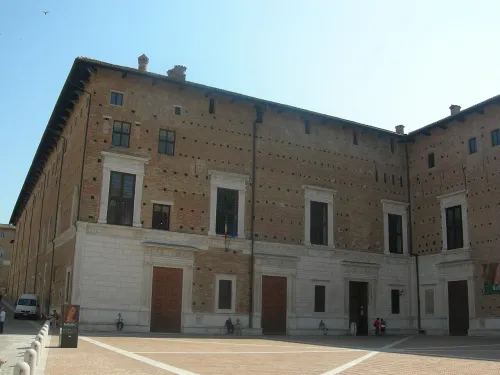
    The street opens and the Palazzo Ducale fills the view, the palace Federico da Montefeltro built in the 15th century to be a city in the shape of a palace. Inside it is the Galleria Nazionale delle Marche, and this is the one stop you do not skip. The collection holds two paintings by Piero della Francesca, work by Raphael, and Federico Barocci, plus the duke's famous studiolo with its trompe l'oeil inlaid wood. Give it at least 90 minutes; two hours is better. Entry is €12. It is closed Mondays and open Tuesday to Sunday, 8:30 to 19:15, so this is your one fixed point: plan the rest of the day around it being shut on Monday. Buy the ticket and walk the upper floor first while you still have energy for it. The cathedral shares the same piazza, just outside the palace doors.

    Hours
    Mon: Closed | Tue-Sun: 8:30 AM – 7:15 PM
    Price
    €12
  5. 5

    Cathedral of Urbino (Duomo di Urbino)

    Cathedral of Urbino (Duomo di Urbino) in Urbino, stop 5 on the self-guided walking tour

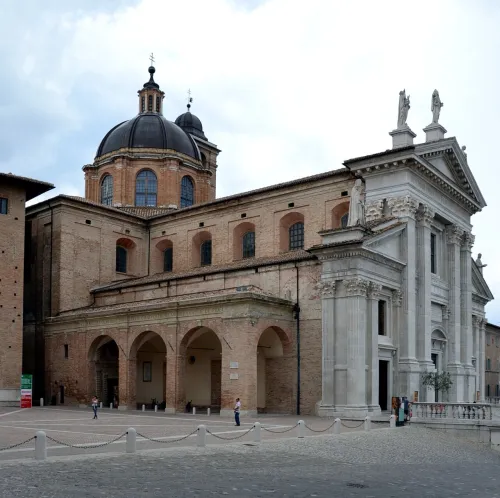
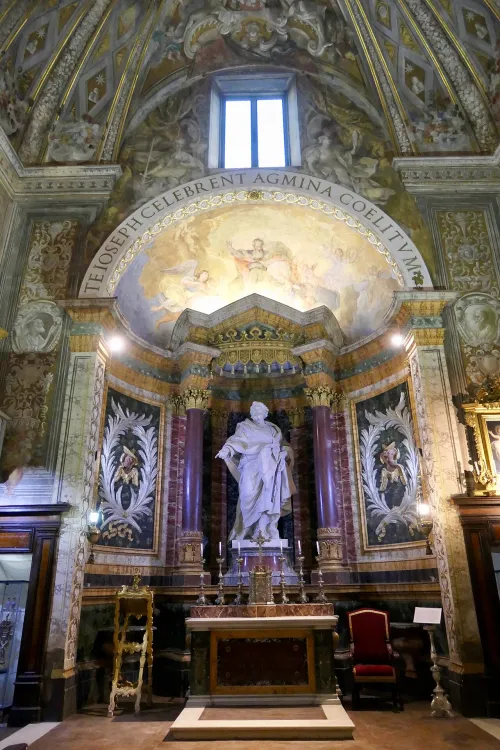
    Step out of the palace and the cathedral is right there on the same square, its pale neoclassical front a sharp change from all the brick you have been walking through. Santa Maria Assunta is the city's main church and a basilica minor, raised to that rank by Pope Pius XII in 1950. The current building is largely a rebuild after an earthquake flattened the older Renaissance cathedral in 1789, which is why the inside feels cooler and more orderly than its medieval neighbors. It runs 64.5m long and 50m high, big enough to swallow the noise of the piazza. Entry is free, open daily 9:00 to 18:30, so it is an easy ten-minute stop to cool down. Worth a look more for the contrast and the free shade than for must-see art. From the square, head uphill toward Via Raffaello.

    Hours
    Daily: 9:00 AM – 6:30 PM
    Price
    Free
  6. 6

    Casa Santi

    Casa Santi in Urbino, stop 6 on the self-guided walking tour

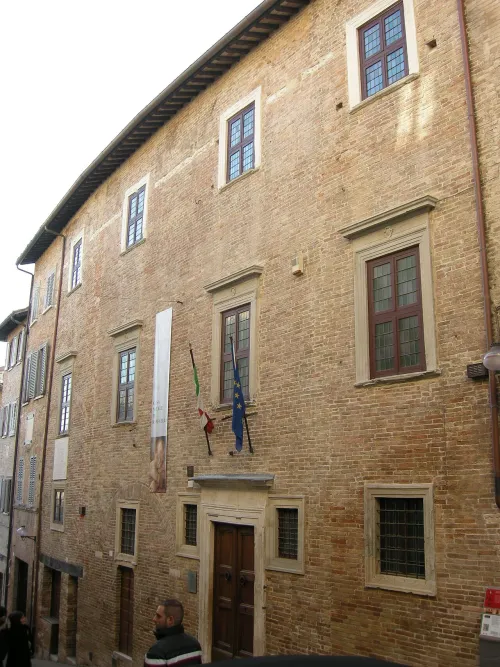
    The last climb takes you up Via Raffaello to a tall brick house with a modest plaque. This is Casa Santi, where Raphael was born in 1483, his father a painter at the Montefeltro court. The rooms are simple, restored to feel like a working artist's home rather than a grand museum, and there is an early fresco often attributed to the young Raphael himself. At €3.50 it is the cheapest ticket on the walk and the most personal stop, less about masterpieces than about standing where one of the great painters started. Open Monday to Saturday 9:00 to 12:30 and 15:00 to 18:30, Sundays with shorter afternoon hours, so an early start or a post-lunch visit both work. Thirty minutes covers it. From here the loop climbs back to the Fortezza Albornoz, closing the circle at the viewpoint where you began.

    Hours
    Mon-Sat: 9:00 AM – 12:30 PM, 3:00 – 6:30 PM | Sun: 10:00 AM – 12:30 PM, 3:00 – 5:30 PM
    Price
    €3.50

How Long Does This Walking Tour Really Take?

With under 2km to cover, pure walking is barely 30 minutes. Add the outdoor stops and the viewpoint and you're at roughly two hours; go inside the National Gallery, both oratories and Raphael's house and the day stretches to a full 4 to 5 hours. The gallery is where your time actually goes.

Allow a full half-day, four to five hours, if you go inside everything. The National Gallery alone eats 90 minutes to two hours and is the obvious place to spend your time; the two oratories and Raphael's house are ten to thirty minutes each. If you are tight on time, the minimum honest version is the fortress viewpoint, the San Giovanni oratory, and the palace, which you can do in about two and a half hours.

Break after the National Gallery, when your legs have done the worst of the climbing. Piazza della Repubblica, the small square below the palace where Via Raffaello and Via Veneto meet, is the natural pause point with several cafés and a couple of benches. Grab a coffee there before the final pull up to Raphael's house. If the weather is good, the grass at the Fortezza Albornoz at the end of the loop is the better place to sit, with the twin towers in front of you and far fewer people than the piazza.

Full Route, Shorter Walk or Two-Day Version?

Three ways to walk it, depending on how much climbing your legs want and whether the National Gallery's Monday closure is in play. The stop order below finishes the ascents in short bursts instead of one brutal pull, so the full version is easier than the map suggests.

The Highlights

Fortress, one oratory, palace and Raphael

Stops 1, 3, 4 and 6, about 3 hours

The honest short version. Keep the Fortezza viewpoint (stop 1), pick the San Giovanni oratory with its Salimbeni fresco cycle over the stucco of San Giuseppe (stop 3), give the National Gallery its 90 minutes (stop 4), then finish at Raphael's house (stop 6). Cuts one oratory and the cathedral, saving about €5 and 45 minutes.

The Easy Split

Two relaxed halves around a coffee

Stops 1 to 4 in the morning, break, then stops 5 and 6

For anyone pacing the hills. Do the fortress, oratories and gallery (stops 1 to 4) before lunch while your legs are fresh, then break at Piazza della Repubblica below the palace, where cafes and benches sit. Finish with the cathedral (stop 5) and the climb to Raphael's house (stop 6) after coffee. Splits the gradient neatly in two.

You can walk it in reverse from Raphael's birthplace to the Fortezza Albornoz, but the given direction is better: starting high at the fortress means you drop downhill toward the palace and take the climbs in short bursts, ending at the viewpoint for the warm late-afternoon light on the towers.

Is This Urbino Walking Tour Right for You?

This loop suits people who like their sightseeing dense and compact, where six real sights sit within five minutes of each other and the effort is vertical, not horizontal. It rewards curiosity about the Renaissance more than stamina.

A good fit if you…

  • Travelers who care about Renaissance painting: two Piero della Francesca panels, Raphael and Barocci all hang in one gallery
  • Anyone who wants the famous Palazzo Ducale plus the overlooked oratories, not just the postcard stop
  • Day-trippers with under 2km to walk who still want a genuinely full itinerary
  • Photographers chasing the twin-tower skyline shot from the fortress in late-afternoon light

Adapt the route if you…

  • You dislike steep, pitched streets: split the loop into two halves around a coffee break at Piazza della Repubblica
  • You're arriving on a Monday: the National Gallery is closed, so reshape the day around outdoor stops and the oratories
  • You're short on time: do just the fortress viewpoint, the San Giovanni oratory and the palace in about two and a half hours
  • It's raining: linger inside the gallery, oratories and Raphael's house, all roofed, and save the fortress viewpoint for a clearer spell

Tickets & Skip-the-Line in Urbino

Urbino's sights are small and rarely have real queues, so this is less about skipping lines than knowing what each door costs and when it is open. The one fixed point is the National Gallery: closed Mondays, so plan the whole day around it. The two oratories sit twenty meters apart, so ask about a combined ticket at the door.

Galleria Nazionale delle Marche€12 entry. Open Tuesday to Sunday 8:30 AM to 7:15 PM, closed Mondays. This is the one stop with fixed hours, so build the day around it. Give it at least 90 minutes; two hours is better for the studiolo and the two Piero della Francesca panels.
Oratory of St Joseph (Oratorio di San Giuseppe)€5 entry. Open daily 10:00 AM to 1:00 PM and 3:00 to 6:00 PM. Reliable afternoon hours, unlike the fortress. It sits twenty meters from the Saint John oratory, so ask at the door whether there is a combined ticket for both.
Oratory of Saint John the Baptist€5 entry. Same daily hours, 10:00 AM to 1:00 PM and 3:00 to 6:00 PM. If you only have time for one oratory, make it this one for the Salimbeni fresco cycle. Bring a couple of euro coins for the light box if the room is dim. official ticket site ↗
Casa Santi€3.50, the cheapest ticket on the walk. Open Monday to Saturday 9:00 AM to 12:30 PM and 3:00 to 6:30 PM, Sundays 10:00 AM to 12:30 PM and 3:00 to 5:30 PM. About 30 minutes covers it.
Everything elseThe Fortezza Albornoz and its park, Urbino Cathedral and the streets themselves are all free open spaces. The cathedral is open daily 9:00 AM to 6:30 PM; the fortress keeps patchy hours but the grassy viewpoint slope is walkable any time.
Optional upgrade
+2
The same 6-stop route,
now with navigation and a guide.
Optional AI experience

You already have the route.
The AI guide brings it to life.

Standing on the piazza below the Palazzo Ducale with the two towers above you? Open AI Tourguide right in your browser, no app and no download, and a voice guide walks the steep brick lanes with you to Raphael's birthplace and the Fortezza Albornoz, telling the story behind Federico's studiolo and the Piero della Francesca paintings, and asking what you are curious about so it can adapt as you climb. A real conversation, not a recording. Start with 100 free credits.

Livenavigation13languagesAnyquestionYourinterests
Open this route with the AI guide

Try it in your browser · No app or download required

Tips for Walking in Urbino

  • Urbino has no train station. The usual approach is a bus from Pesaro (around 50 to 55 minutes, roughly €3) that drops you at Borgo Mercatale below the walls. From there take the lift or the ramps up into the center rather than the steep stairs.
  • The streets are pitched brick and worn stone, steep in places and slick after rain. Wear flat shoes with grip. Heels and smooth soles are a genuinely bad idea here.
  • Public restrooms are scarce inside the walls. The cleanest reliable option is inside the National Gallery once you have your €12 ticket, so use them before you leave the palace.
  • Stop for a crescia sfogliata, the local flatbread split and filled with cured meats and cheese, from a small place on Via Raffaello on the climb to Raphael's house. Expect around €4 to €6 and eat it walking.
  • For the classic shot of the two towers, stand on the grass slope of the Fortezza Albornoz facing east toward the palace. Late afternoon light hits the brick face and warms it; midday flattens it.

Why Walk This Route?

Urbino is small, steep, and almost entirely made of warm brick, and that is exactly why you walk it instead of trying to drive it. The historic center sits on two hills inside Renaissance walls, the streets are narrow and often pitched at angles that would worry a cyclist, and cars are effectively useless once you are inside. Everything on this loop sits within a few hundred meters of everything else. The whole walking distance is under 2km. What makes it tiring is the gradient, not the length.

This route is a tight loop, not a wander. It starts high at the Fortezza Albornoz for the postcard view of the twin towers, drops down Via Barocci past two small painted oratories most day-trippers walk straight past, lands at the Palazzo Ducale and the National Gallery (the reason the town is a UNESCO site), passes the cathedral on the same square, climbs to the house where Raphael was born, then loops back up to the fortress. Doing it in this order means you finish the climbing in short bursts rather than one brutal slog.

Most people who come here see the palace and leave. That is a mistake. The two oratories on Via Barocci cost five euros each and contain some of the best small-scale fresco and stucco work in the Marche, and almost nobody is inside them. Walk this loop and you get the famous palace plus the things that make Urbino feel like a living town rather than one museum with a queue.

Common Questions

Is Urbino safe to walk around?

Very. It is a small university town with low crime, and the historic center is calm even after dark. The main hazards are physical, not human: steep pitched streets and worn paving that get slippery in rain. There are no notable scams. The biggest annoyance is that many small sights close in the early afternoon, so check hours rather than worrying about safety.

What if it rains during my Urbino tour?

This loop survives rain well because the best stops are indoors. Spend longer inside the National Gallery (the palace is huge and you can lose two hours easily), then do both oratories and Raphael's house, all roofed and a few steps apart on or near Via Barocci. The cathedral gives free shelter on the piazza. Save the Fortezza viewpoint for a clearer spell, since it is the only stop that is purely about the view.

What's the best time of day for this walking tour?

Start around 8:30 when the National Gallery opens (Tuesday to Sunday; it is closed Monday). Doing the palace first means you beat the day-trip coaches that arrive late morning, and you keep your energy for the climbs. The oratories and Raphael's house open by 9:00 or 10:00, so the order flows naturally. End at the Fortezza Albornoz in late afternoon for the warmest light on the towers.

Take this route with you

Open this exact tour with navigation and your personal AI guide.

Start GPS Navigation + AI Guide
AI Tourguide
Researched and curated by the AI Tourguide teamWe plan and quality-check every route, then research and verify the opening hours, prices, and practical tips for each stop along it.
▶ Open route with AI guideNavigation, stories and your questions