Self-Guided Walking Tour in Perugia

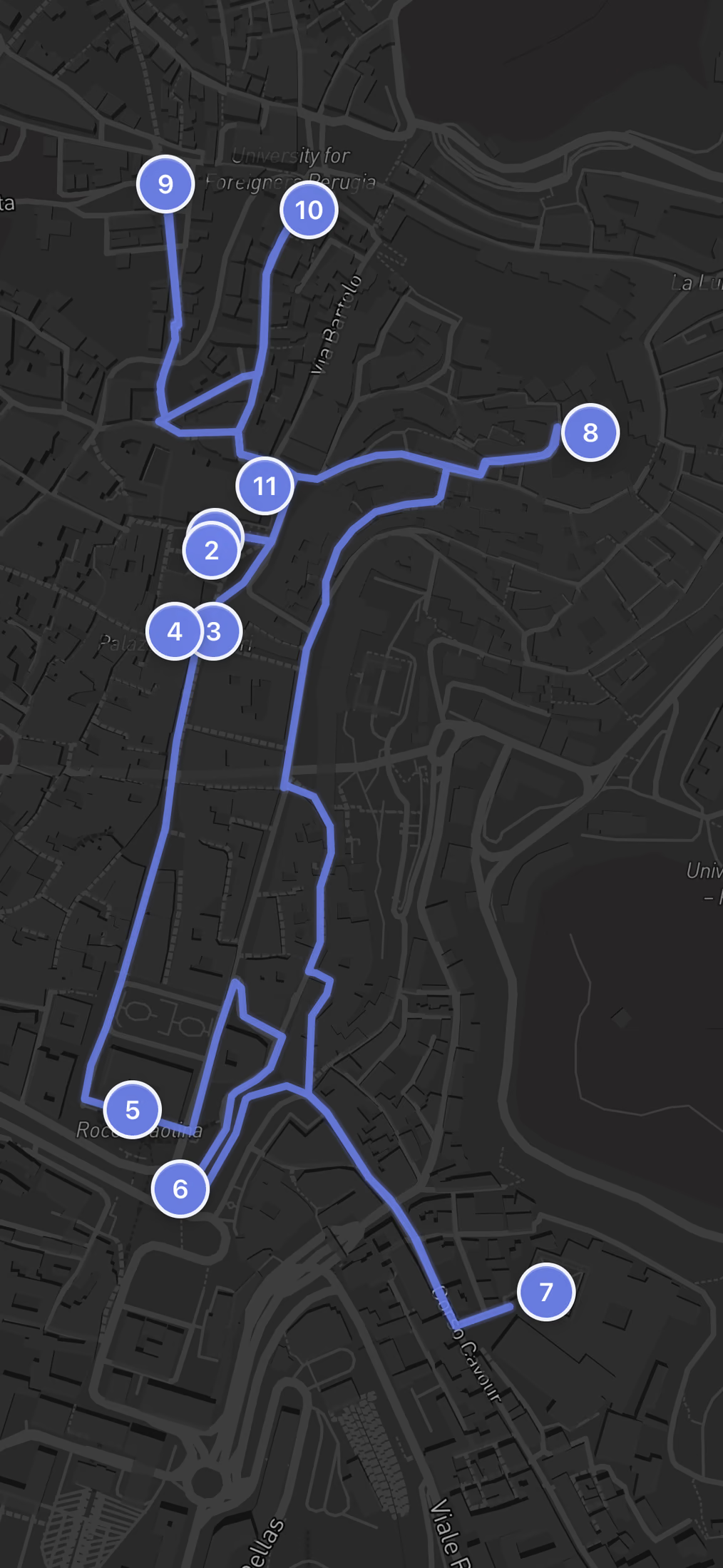
A compact loop through Perugia's hilltop center: 11 stops that start and end in Piazza IV Novembre, dropping south through the buried Rocca Paolina and the valley terrace before climbing back past the Etruscan gate. This page gives you the map, the walking time for every leg, and the real prices and hours for each museum.

11 Stops3.5 km~2 hours walking4–5 hours with the museums
What you get with AI Tourguide
Full GPS navigationInteractive AI guidePersonalized to youWorks in your browser
Try this tour with Alex

Perugia Walking Tour at a Glance

This route is built for walking Perugia's center on your own, at your own pace. It links the 11 stops that matter in a single loop, and every interior along the way is optional: you can walk the whole thing for free and still see the fountain, the buried fortress, the valley terrace, the aqueduct lane, and the Etruscan gate. The museums are there when you want them, not obligations.

StartPiazza IV Novembre
FinishSan Lorenzo (Chiesa di San Lorenzo)
Route typeA true loop, starting and ending in Piazza IV Novembre. You drop south to the Rocca Paolina and the terrace, swing east to the archaeology museum, then climb back north past the aqueduct lane and the Etruscan gate. No backtracking, and you finish where the cafes are.
Realistic timeAbout an hour of actual walking over 3.5 km, but plan a half day: two and a half hours if you keep to the free outdoor sights, four to five if you go inside the galleries.
DifficultyModerate. It is only 3.5 km, but Perugia is a hill town, so expect steep stone streets, staircases between levels, and the raised aqueduct footpath. The Rocca Paolina escalators do the biggest climb for you.
Cost to followThe outdoor loop is free. Interiors are your only cost: €8 for the National Gallery of Umbria, €4 for the Raphael chapel at San Severo, and €8 for the archaeology museum. Skip all three and you spend nothing.
Best for:

Anyone who wants the whole medieval center in a self-guided half day, is fine with hills and stairs, and would rather choose their own museum stops than follow a fixed group pace.

The Route

Free Walking Tour Map of Perugia

11 stops3.5 kmabout 2 hours
Loading the interactive map…The complete walking route will appear here.
Want the route to guide you while you walk?Open the route with navigation and a personal guide for the history, stories and questions that matter to you.
Open route + AI guide

The 11 stops along this route

  1. Piazza IV Novembre in Perugia, stop 1 on the self-guided walking tour
    1Piazza IV Novembre
  2. Fontana Maggiore in Perugia, stop 2 on the self-guided walking tour
    2Fontana Maggiore
  3. Palazzo dei Priori in Perugia, stop 3 on the self-guided walking tour
    3Palazzo dei Priori
  4. National Gallery of Umbria (Galleria nazionale dell'Umbria) in Perugia, stop 4 on the self-guided walking tour
    4National Gallery of Umbria (Galleria nazionale dell'Umbria)
  5. Rocca Paolina in Perugia, stop 5 on the self-guided walking tour
    5Rocca Paolina
  6. Giardini Carducci in Perugia, stop 6 on the self-guided walking tour
    6Giardini Carducci
  7. Museo archeologico nazionale dell'Umbria in Perugia, stop 7 on the self-guided walking tour
    7Museo archeologico nazionale dell'Umbria
  8. San Severo (Chiesa di San Severo) in Perugia, stop 8 on the self-guided walking tour
    8San Severo (Chiesa di San Severo)
  9. Missing required field: waypoints[8].image
    9Via dell'Acquedotto
  10. Etruscan Arch (Arco di Augusto) in Perugia, stop 10 on the self-guided walking tour
    10Etruscan Arch (Arco di Augusto)
  11. San Lorenzo (Chiesa di San Lorenzo) in Perugia, stop 11 on the self-guided walking tour
    11San Lorenzo (Chiesa di San Lorenzo)
  12. That's the complete route.

    If you want more than the map and text, add live navigation and a conversational AI guide while you walk.

    Open route + AI guide
    You made it
Stop 1 of 11
Swipe →

Your Perugia Walking Tour, Stop by Stop

  1. 1

    Piazza IV Novembre

    Piazza IV Novembre in Perugia, stop 1 on the self-guided walking tour

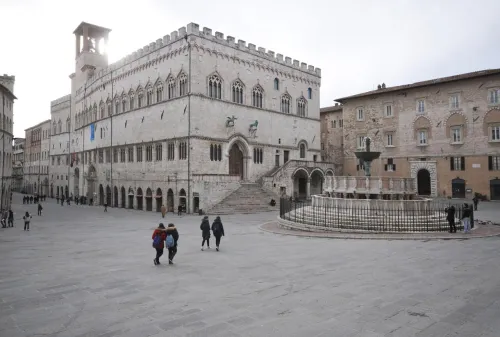
    Start here. Five medieval streets pour into this asymmetric square, the spot where the old Roman forum once stood and where the whole city still gathers. Stand with your back to the cathedral steps and you have the entire medieval center laid out in front of you: fountain in the middle, town hall on the right, duomo behind. It is open 24/7 and free, and it is the natural anchor for a loop because every other stop is downhill or a short climb from this point. In the evening the cathedral steps fill with students from one of Italy's oldest universities, sitting and talking until late. Come back at dusk to see it that way. For now, walk to the fountain in the center of the square.
    Hours
    Open 24/7
    Price
    Free
  2. 2

    Fontana Maggiore

    Fontana Maggiore in Perugia, stop 2 on the self-guided walking tour

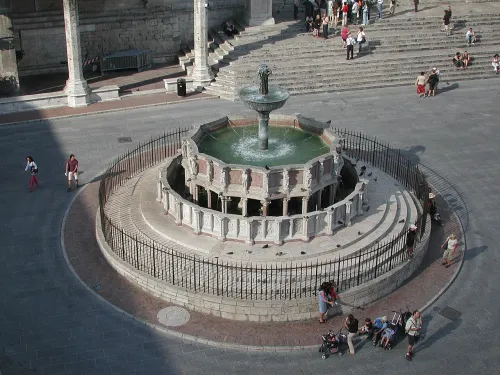
    A few steps and you are at the fountain, the symbol of the city and the reason this square is more than just open space. Nicola and Giovanni Pisano carved it in the 1270s, and the two stone basins are wrapped in panels showing the months, the labors of farm work, scenes from the Bible and Aesop, and the figures of the liberal arts. It is free and always visible, no ticket, no gate. Walk a full circle around it slowly: the carving on the lower basin reads almost like a calendar, one panel per month. Bring a guidebook or photograph the panels to decode them later, because there is no signage explaining the scenes. Then turn to the long Gothic building filling the south side of the square.

    Hours
    Open 24/7
    Price
    Free
  3. 3

    Palazzo dei Priori

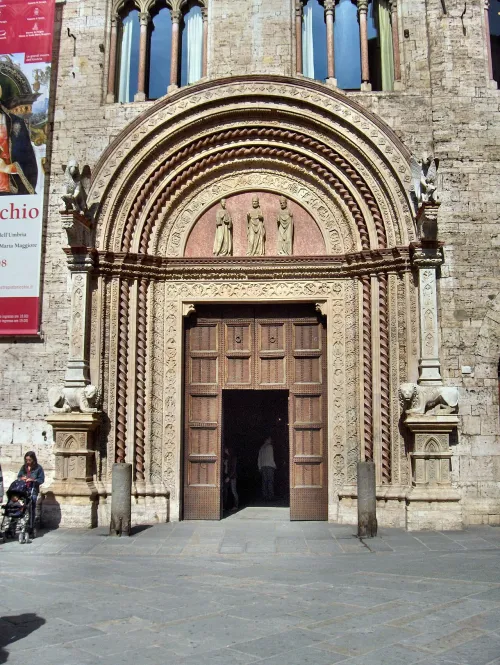
    Palazzo dei Priori in Perugia, stop 3 on the self-guided walking tour

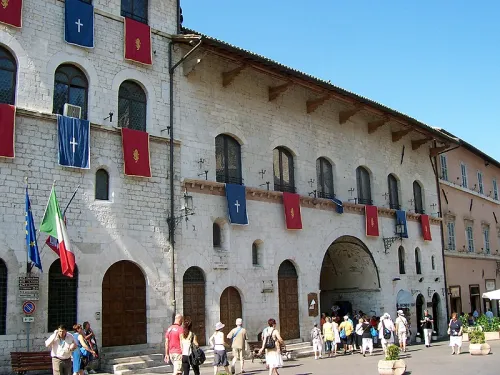
    The town hall dominates the square's flank, a wall of medieval Gothic stone with a bronze griffin and lion bracketed above the main portal. The famous fan-shaped staircase sweeps up to a side door. This was the seat of the city government for centuries and it is still partly civic offices today. Entry to the public rooms is free, but the hours are tight and it shuts on Tuesdays: open Monday and Wednesday through Sunday, roughly 9:00 AM to 1:00 PM and 3:00 to 7:00 PM, closed midday. Do not confuse the free civic rooms with the gallery inside, which is ticketed and entered separately. Climb the fan staircase for the photo even if you skip the interior, then head to the gallery entrance along the Corso Vannucci side.

    Hours
    Mon: 9:00 AM – 1:00 PM, 3:00 – 7:00 PM | Tue: Closed | Wed-Sun: 9:00 AM – 1:00 PM, 3:00 – 7:00 PM
    Price
    Free
  4. 5

    Rocca Paolina

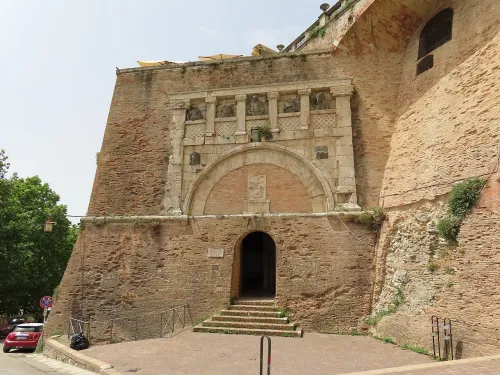
    Rocca Paolina in Perugia, stop 5 on the self-guided walking tour

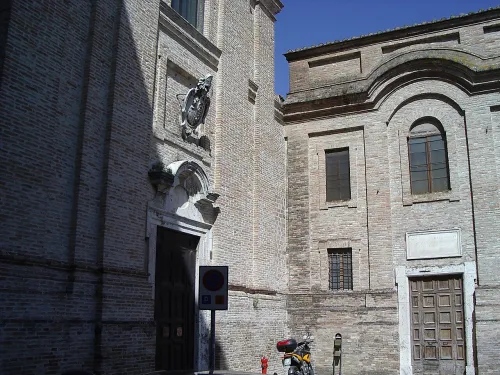
    Corso Vannucci ends at Piazza Italia, and there you step onto escalators that carry you down inside a buried fortress. The pope built the Rocca Paolina in the 1540s to crush the rebellious city, flattening an entire medieval quarter to do it. When the papacy fell the Perugians tore the fortress down, but the lower vaults survived, and the city later threaded escalators through them. So you ride down through a dark stone underworld of arched streets, doorways, and house walls from a neighborhood that has not seen daylight in 500 years. It is free and open daily, 7:00 AM to 8:00 PM, and it doubles as the main pedestrian link between the upper town and the lower bus terminal. Do not rush through it. At the bottom, double back and ride up to the terrace above.

    Hours
    Daily: 7:00 AM – 8:00 PM
    Price
    Free
  5. 6

    Giardini Carducci

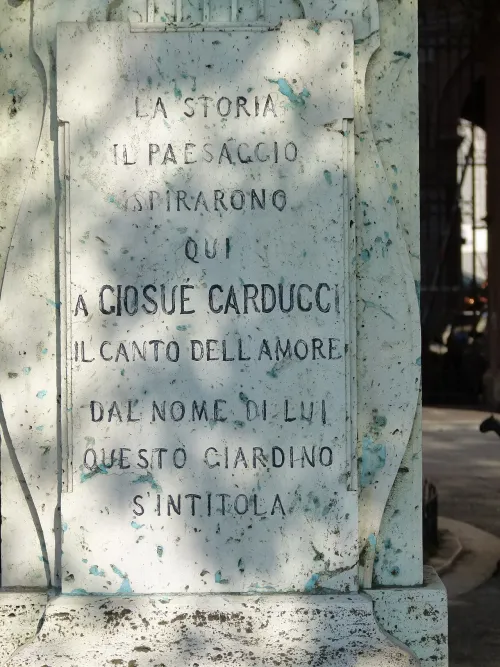
    Giardini Carducci in Perugia, stop 6 on the self-guided walking tour

    This is the view, and it sits directly on top of the fortress you just walked through. The garden terrace runs along the southern edge of the old town and drops away to the Umbrian valley: hills, farmland, and on a clear day the silhouette of Assisi across the plain. It is free and open around the clock. This is the bench stop, the place to sit for ten minutes halfway through the loop. Come late afternoon and the low sun lights the valley straight on; that is the best photo of the whole walk, taken facing south from the terrace railing. There is shade under the trees if you arrive midday in summer. When you have rested, walk east and downhill toward the San Domenico complex and its museum.

    Hours
    Open 24/7
    Price
    Free
  6. 7

    Museo archeologico nazionale dell'Umbria

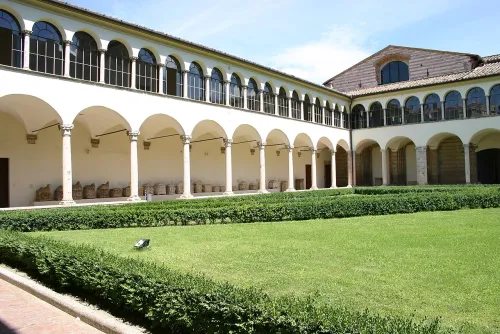
    Museo archeologico nazionale dell'Umbria in Perugia, stop 7 on the self-guided walking tour

    Set in the old cloisters of the San Domenico convent, this museum holds the Etruscan and Roman finds that explain why Perugia existed long before the medieval city you have been walking. The standout is the Cippus Perusinus, a stone carved with one of the longest Etruscan inscriptions ever found, plus rooms of bronzes, urns, and tomb goods. Admission is €8 and it is open daily, 8:30 AM to 7:00 PM. Honest verdict: if you already paid for the Umbria gallery and your legs are tiring, this one is skippable for a general visitor, though anyone curious about the Etruscans should go in. The cloister courtyard itself is worth a free peek even if you do not buy a ticket. From here you face the longest climb of the loop, back up and north toward the chapel.

    Hours
    Daily: 8:30 AM – 7:00 PM
    Price
    €8
  7. 8

    San Severo (Chiesa di San Severo)

    San Severo (Chiesa di San Severo) in Perugia, stop 8 on the self-guided walking tour

    The climb back up the ridge brings you to a small piazza at one of the highest points in the city, 493 meters up. The chapel here is tiny and easy to miss, but it holds the only fresco Raphael ever painted in Perugia, a Trinity with saints from around 1505, finished after his death by his old teacher Perugino. One wall, two masters, side by side. Entry is €4 and it is open Tuesday through Sunday, 10:00 AM to 1:30 PM and 2:30 to 6:00 PM, closed on Mondays and over the midday break. It takes ten minutes to see, so this is a quick, cheap, and genuinely rare stop. Check it is not a Monday before you climb up here. Then head north and west toward the old aqueduct lane.

    Hours
    Mon: Closed | Tue-Sun: 10:00 AM – 1:30 PM, 2:30 – 6:00 PM
    Price
    €4
  8. 9

    Via dell'Acquedotto

    Missing required field: waypoints[8].image

    This is the quietest stretch of the walk and one of the most atmospheric. The lane runs along the top of a medieval aqueduct that once carried water to the Fontana Maggiore. The channel is long gone, so now you walk a narrow raised footpath that bridges a ravine, with house fronts and rooftops dropping away on both sides and laundry strung between the windows. It is free, open all hours, and almost entirely free of tour groups. Walk it slowly and look down into the gaps between buildings. It feels like a private back route through the city, because it more or less is. The path delivers you near the old town's north edge, a short step from the Etruscan gate.

  9. 10

    Etruscan Arch (Arco di Augusto)

    Etruscan Arch (Arco di Augusto) in Perugia, stop 10 on the self-guided walking tour

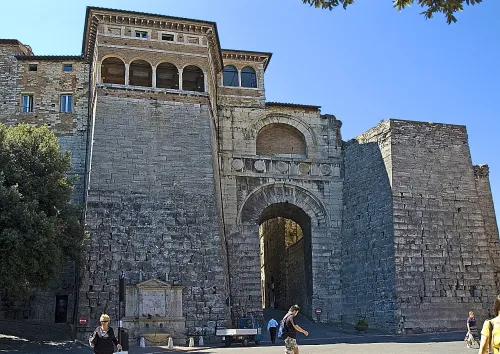
    Round the corner and the wall in front of you is older than the Roman Empire. The Etruscans built this gate in the third century BC, and Augustus rebuilt the upper section in 40 BC after he sacked the city, leaving an inscription that still reads AUGUSTA PERUSIA across the top. The massive lower blocks are the original Etruscan stonework. It is free and stands open in the street, the most complete of the seven ancient gates in the old walls. There is a small cafe terrace beside it where you can sit with a drink and look straight up at 2,300 years of stacked stone. From here the final leg climbs back up Via Ulisse Rocchi, the old Roman main street, toward the cathedral.

    Hours
    Open 24/7
    Price
    Free
  10. 11

    San Lorenzo (Chiesa di San Lorenzo)

    San Lorenzo (Chiesa di San Lorenzo) in Perugia, stop 11 on the self-guided walking tour

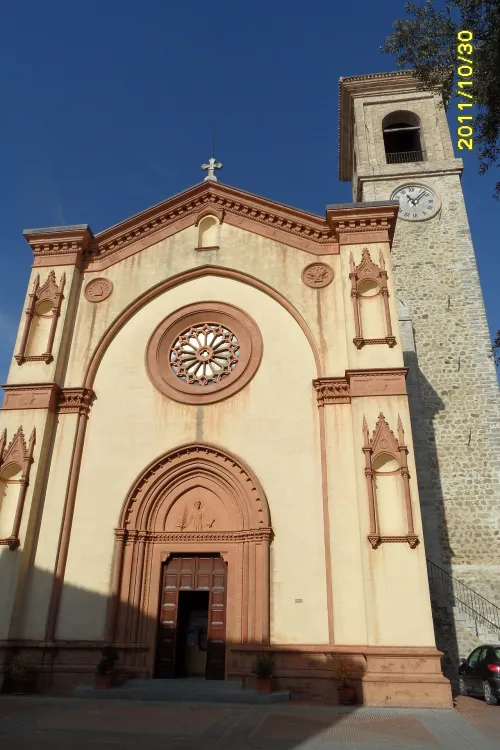
    The walk closes back at the square, where the duomo flanks the cathedral side of Piazza IV Novembre. The first thing you notice is that the facade is unfinished: bare brick where the marble was meant to go, never completed in 700 years. The Gothic interior is taller and plainer than you expect, and it holds works tied to Perugino's circle. Entry is free, with hours of 7:30 AM to 12:30 PM and 3:30 to 7:30 PM, closed over the long lunch like most of the city. The steps outside are where Perugia's students gather in the evening, so this is the spot to end the loop, sit down, and watch the square fill up. You are now back where you started, with the fountain and town hall in front of you.

    Hours
    Daily: 7:30 AM – 12:30 PM, 3:30 – 7:30 PM
    Price
    Free

How Long Does This Walking Tour Really Take?

The walking is about 3.5 km, roughly an hour of movement, but this is a half-day loop. Budget four to five hours with the museums, two and a half if you stick to the free outdoor sights. The National Gallery of Umbria is the biggest time sink and the one worth it: give it at least 90 minutes. The archaeology museum needs another hour if you go in.

The walking itself is about 3.5 km and takes roughly an hour of actual movement, but the loop is built for a half day. Plan on four to five hours if you go inside the museums, two and a half if you stick to the free outdoor sights and skip the ticketed interiors. The National Gallery of Umbria is the single biggest time sink and the one worth it: give it at least 90 minutes. The archaeology museum needs another hour if you go in.

The natural break is Giardini Carducci, the terrace garden on top of the Rocca Paolina, right at the middle of the loop. Sit on a bench there facing the valley before you tackle the climb to the archaeology museum and the chapel. For a coffee break, the cafes along Corso Vannucci between the gallery and the Rocca are the obvious choice, or the small terrace beside the Etruscan Arch near the end. If you want a slower day, split it: museums in the morning, the Etruscan and aqueduct half in the late afternoon when the light is best.

Full Route, Shorter Walk or Two-Day Version?

The full loop is 11 stops, but the hill and the museums make it easy to trim or split. Here are three ways to walk it depending on how much time and leg you have, using the real stop numbers and per-leg walking times from the route.

Short Version

Skip the archaeology detour, about 3 hours

Stops 1 to 6, then jump straight to stops 8 to 11, cutting the 920 m leg out to stop 7.

The archaeology museum (stop 7) sits off on its own and adds the longest single leg of the walk, 920 m out and a hard climb back. Cut it and you keep the fountain, the gallery, the Rocca Paolina, the terrace, the Raphael chapel, and the Etruscan gate, dropping close to an hour of walking and one ticket. This is the best trim for a shorter afternoon.

Two-Half Split

Break the loop at Giardini Carducci

Morning: stops 1 to 6 ending at the terrace. Late afternoon: stops 7 to 11 in the best light.

Do the top of the loop in the morning while the museums are quiet, rest at the Giardini Carducci terrace (stop 6), then come back for the archaeology museum, chapel, aqueduct lane, and Etruscan gate in the late afternoon when the low sun lights the valley and the old stone. Easiest on the legs and the best photos, spread over one relaxed day.

You can walk it either direction, but do it as mapped. Starting at Piazza IV Novembre lets you ride the Rocca Paolina escalators down rather than climbing the hill on foot, and it saves the valley terrace for the middle of the loop when you want a bench. Reverse it and you face the steep climbs the hard way.

Is This Perugia Walking Tour Right for You?

Perugia is one of the easiest Italian cities to do well on your own, but it is a genuine hill town, so the terrain decides more than the distance. Here is who this loop suits and how to bend it if that is not quite you.

A good fit if you…

  • Independent walkers who want the entire medieval center in a self-guided half day without a bus ride
  • Anyone comfortable with steep stone streets, staircases, and a raised aqueduct footpath
  • Art lovers who want the Umbria gallery's Perugino and Raphael rooms on their own timetable
  • Travelers who would rather pick two or three museum interiors than pay for a fixed guided walk

Adapt the route if you…

  • Stairs or steep gradients are hard for you: use the Rocca Paolina escalators for the climbs and skip the archaeology detour
  • You only have a couple of hours: take the short version and cut stop 7's long 920 m leg
  • You are traveling with kids or tiring legs: split the loop across a morning and a late afternoon with a rest at the terrace
  • You have no interest in museums: walk the outdoor stops only and spend nothing, the whole loop is free to follow

Tickets & Skip-the-Line in Perugia

Most of this loop is free open space, so tickets are only a factor at a handful of interiors. Here is what each paid stop costs, when it opens, and where to buy in advance. Watch the tight Italian midday closures more than any queue.

National Gallery of Umbria (Galleria nazionale dell'Umbria)Admission €8, open daily 8:30 AM to 7:30 PM, which makes it the rare Italian museum you can visit late in the afternoon without rushing. Give it at least 90 minutes. Buy or check tickets on the official site. official ticket site ↗
Museo archeologico nazionale dell'UmbriaAdmission €8, open daily 8:30 AM to 7:00 PM. Off the main loop and skippable for a general visitor, but a must for anyone curious about the Etruscans. Check hours and tickets on the official museum page. official ticket site ↗
San Severo (Chiesa di San Severo)Admission €4, open Tuesday to Sunday, 10:00 AM to 1:30 PM and 2:30 to 6:00 PM, closed Mondays and over the midday break. It holds the only Raphael fresco in Perugia and takes ten minutes to see. Buy the ticket at the door, and do not climb up on a Monday.
Palazzo dei PrioriThe public civic rooms are free, but the hours are tight and it closes on Tuesdays: open Monday and Wednesday to Sunday, roughly 9:00 AM to 1:00 PM and 3:00 to 7:00 PM, shut over midday. No booking needed. Do not confuse the free rooms with the ticketed gallery entered separately along Corso Vannucci.
Everything elseAll other stops on the loop are free open spaces with no ticket: Piazza IV Novembre, the Fontana Maggiore, the Rocca Paolina escalators (daily 7:00 AM to 8:00 PM), the Giardini Carducci terrace, the Via dell'Acquedotto aqueduct lane, the Etruscan Arch, and the Cathedral of San Lorenzo.
Optional upgrade
+7
The same 11-stop route,
now with navigation and a guide.
Optional AI experience

You already have the route.
The AI guide brings it to life.

Standing in Piazza IV Novembre by the Fontana Maggiore? Open AI Tourguide in your browser, no app and no download, and a voice guide walks the whole loop with you down through the buried Rocca Paolina and out to the valley terrace, greeting you, telling the story along the way, then asking what you want to see so you skip the wrong staircase and the backtracking. A real conversation, not a recording. Start with 100 free credits.

Livenavigation13languagesAnyquestionYourinterests
Open this route with the AI guide

Try it in your browser · No app or download required

Tips for Walking in Perugia

  • Arriving by car or train, park or stop at the lower town and ride the Rocca Paolina escalators up into the center for free, daily 7:00 AM to 8:00 PM. It is the painless way to skip the hill climb, and it doubles as stop 5 on this loop.
  • Wear real shoes, not sandals. The streets are stone, steep, and uneven, with staircases linking the town's levels and the raised aqueduct path along Via dell'Acquedotto. Smooth soles slip on the worn medieval paving, especially after rain.
  • Public restrooms are limited in the old town. The cleanest reliable option is inside the National Gallery of Umbria if you buy the €8 ticket, or use a cafe along Corso Vannucci where you buy a coffee first.
  • For food, Perugia is chocolate country. Grab a Baci or a slab of local chocolate from a shop on Corso Vannucci, and for lunch try a torta al testo, the regional flatbread stuffed with cured meats and greens, from a counter spot for a few euros.
  • Best photo: the south railing of Giardini Carducci in late afternoon, facing south over the valley toward Assisi, with the low sun lighting the hills straight on. Second best: the Etruscan Arch from the cafe terrace below, shot looking up.

Why Walk This Route?

Perugia sits on a hill, and that single fact shapes everything about walking it. The old town crowns a ridge, the modern city spreads in the valley below, and the medieval core is small, dense, and almost entirely pedestrian. You can cross the historic center in fifteen minutes, which means a half-day loop covers nearly every sight worth seeing without a single bus ride. The catch is the gradient. Streets tilt, stairs cut between levels, and the famous escalators inside an old papal fortress do some of the climbing for you.

This route is a loop that starts and ends in Piazza IV Novembre, the square where five medieval streets converge. From there you drop south to the buried Rocca Paolina and the valley-view terrace, swing east to the archaeology museum, then climb back north past Raphael's only Perugia fresco, the old aqueduct lane, and the 2,300-year-old Etruscan gate. Doing it as a loop means you never backtrack and you end where the cafes are.

The reason to follow a set order rather than wander is the hill itself. Random wandering in Perugia means climbing the same staircase three times. This sequence uses the escalators for the descent-and-return so your legs do less work, and it saves the best view for the middle, when you want a bench.

Common Questions

Is Perugia safe to walk around?

Yes, Perugia is a small, calm university city and the historic center is very safe to walk, day and evening. Petty pickpocketing can happen in the busiest squares and around the bus terminal in the lower town, so keep your bag zipped in crowds, but there is no aggressive scam scene. The student crowd on the cathedral steps at night is friendly, not threatening. The main hazard is genuinely the terrain: steep, dark stairs at night, so watch your footing.

What if it rains during my Perugia tour?

Perugia handles rain better than most hill towns because so much of this route is indoors or covered. Spend a wet hour or two in the National Gallery of Umbria (€8, open daily until 7:30 PM), then the Raphael chapel (€4), then the archaeology museum (€8). The Rocca Paolina escalators are fully covered and let you move between the upper and lower town without getting soaked. Save the aqueduct lane and Etruscan Arch for a dry spell.

What's the best time of day for this walking tour?

Start mid to late morning, around 10:00 AM, so the museums are open by the time you reach them. That timing also lands you at Giardini Carducci in the early-to-mid afternoon when the valley view is at its best, and finishes you back at the cathedral around early evening when the students gather on the steps. Avoid the 1:00 to 3:30 PM window for the ticketed interiors, since the cathedral, chapel, and town hall rooms all close over the long Italian lunch.

Take this route with you

Open this exact tour with navigation and your personal AI guide.

Start GPS Navigation + AI Guide
AI Tourguide
Researched and curated by the AI Tourguide teamWe plan and quality-check every route, then research and verify the opening hours, prices, and practical tips for each stop along it.
▶ Open route with AI guideNavigation, stories and your questions