Self-Guided Walking Tour in Siena

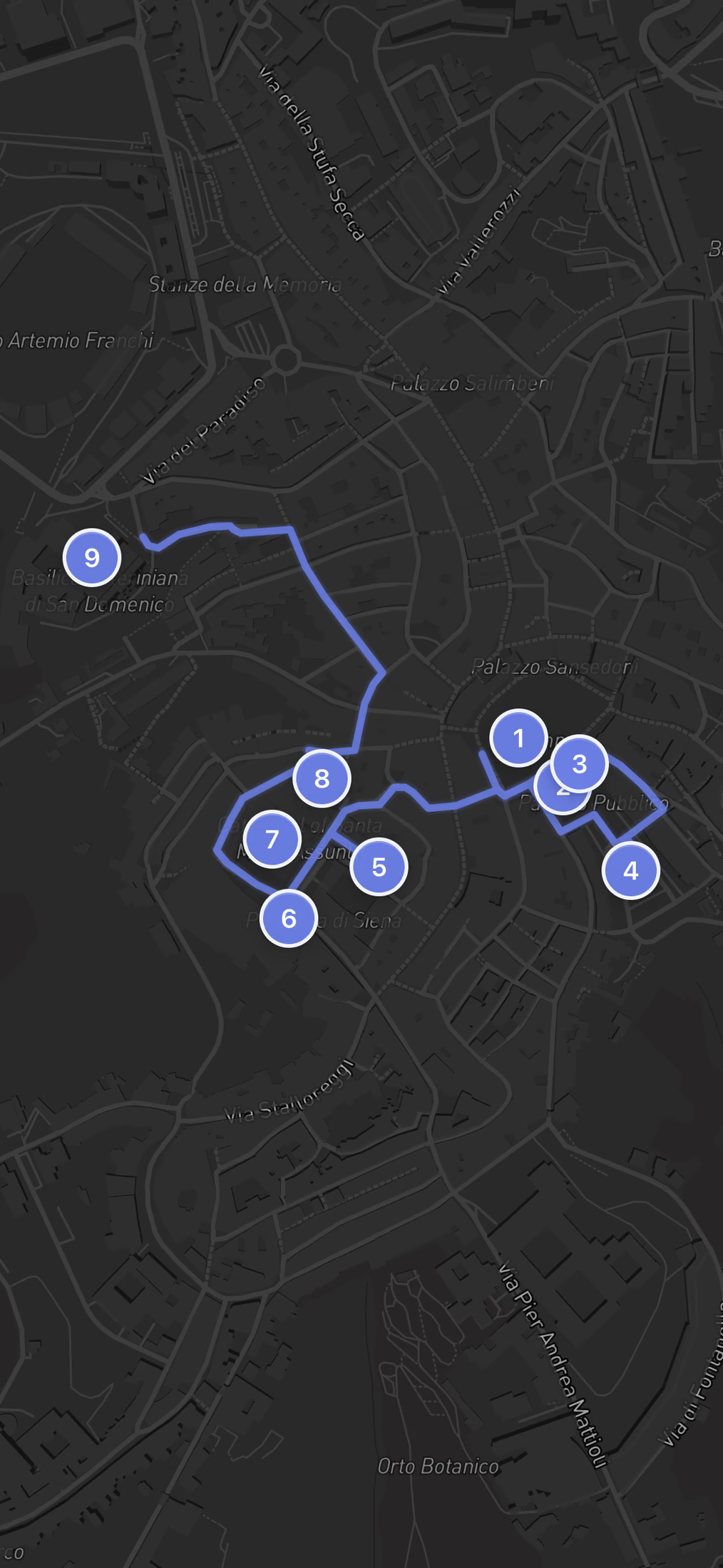
A compact self-guided loop through Siena's old town, from the shell-shaped Piazza del Campo up to the striped Duomo ridge and out to San Domenico, nine stops in under 1.5 km of walking. This page gives you the map, per-leg walking times, real ticket prices and opening hours, and shorter versions if you're tight on time.

9 Stops1.5 km~2 hours walking3–5 hours with stops
What you get with AI Tourguide
Full GPS navigationInteractive AI guidePersonalized to youWorks in your browser
Try this tour with Alex

Siena Walking Tour at a Glance

This route is built for anyone who wants to see Siena's two great poles, the civic one around the Campo and the religious one around the Duomo, in a logical order without doubling back or grinding up the wrong hills. Every interior is optional: the outdoor walk stands on its own, and you decide at each door whether the ticket is worth your time. You control the pace, the stops, and how deep you go.

StartPiazza del Campo
FinishBasilica of San Domenico (Basilica di San Domenico)
Route typeA near-straight point-to-point line running broadly west then north-west, from the Campo at the low point up to the cathedral ridge and out to San Domenico, with no real backtracking along the way.
Realistic timeWalking alone is barely 20 minutes across all nine stops. Add the outdoor squares and viewpoints and you're at two hours; do the major interiors and climbs and it becomes a comfortable half-day.
DifficultyEasy on distance, under 1.5 km total, but the terrain does the work. Every street in Siena either climbs or drops on medieval brick and stone, polished smooth and slick when wet, with a steady pull uphill from Piazza del Mercato to the Duomo.
Cost to followFollowing the outdoor route costs nothing. You only pay for the interiors you choose: Palazzo Pubblico €9, Torre del Mangia €10, the Facciatone €6, Santa Maria della Scala €9, Siena Cathedral €5 and the Baptistery €4. San Domenico is free.
Best for:

Travellers who want Siena's civic and sacred halves in one clean walk, on their own clock, choosing which frescoes, museums and tower climbs are worth the ticket and which to skip.

The Route

Free Walking Tour Map of Siena

9 stops1.5 kmabout 2 hours
Loading the interactive map…The complete walking route will appear here.
Want the route to guide you while you walk?Open the route with navigation and a personal guide for the history, stories and questions that matter to you.
Open route + AI guide

The 9 stops along this route

  1. Piazza del Campo in Siena, stop 1 on the self-guided walking tour
    1Piazza del Campo
  2. Palazzo Pubblico in Siena, stop 2 on the self-guided walking tour
    2Palazzo Pubblico
  3. Torre del Mangia in Siena, stop 3 on the self-guided walking tour
    3Torre del Mangia
  4. Piazza del Mercato in Siena, stop 4 on the self-guided walking tour
    4Piazza del Mercato
  5. Facciatone in Siena, stop 5 on the self-guided walking tour
    5Facciatone
  6. Santa Maria della Scala (Complesso museale di Santa Maria della Scala) in Siena, stop 6 on the self-guided walking tour
    6Santa Maria della Scala (Complesso museale di Santa Maria della Scala)
  7. Siena Cathedral (Duomo di Siena) in Siena, stop 7 on the self-guided walking tour
    7Siena Cathedral (Duomo di Siena)
  8. Battistero di San Giovanni in Siena, stop 8 on the self-guided walking tour
    8Battistero di San Giovanni
  9. Basilica of San Domenico (Basilica di San Domenico) in Siena, stop 9 on the self-guided walking tour
    9Basilica of San Domenico (Basilica di San Domenico)
  10. That's the complete route.

    If you want more than the map and text, add live navigation and a conversational AI guide while you walk.

    Open route + AI guide
    You made it
Stop 1 of 9
Swipe →

Your Siena Walking Tour, Stop by Stop

  1. 1

    Piazza del Campo

    Piazza del Campo in Siena, stop 1 on the self-guided walking tour

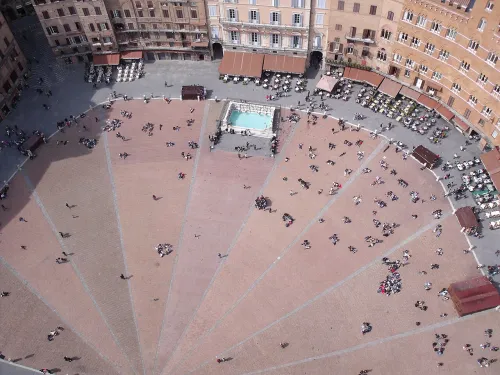
    You don't so much arrive at the Campo as fall into it. Every alley off the surrounding streets funnels downhill and spits you out onto the famous fan of red brick, nine paved segments sloping toward the Palazzo Pubblico like the inside of a shell. It is the main square of Siena and twice a year, in July and August, it becomes the track for the Palio horse race. By ancient agreement the square belongs to no single contrada, which is why it feels like neutral ground. It's open 24/7 and free, so this is your anchor point. Sit on the brick (people do, it's allowed), get your bearings, and note how the whole space tilts toward the town hall. Morning light is soft here; midday it bakes. From the lower edge, walk straight toward the tall Gothic building dominating the square.

    Hours
    Open 24/7
    Price
    Free
  2. 2

    Palazzo Pubblico

    Palazzo Pubblico in Siena, stop 2 on the self-guided walking tour

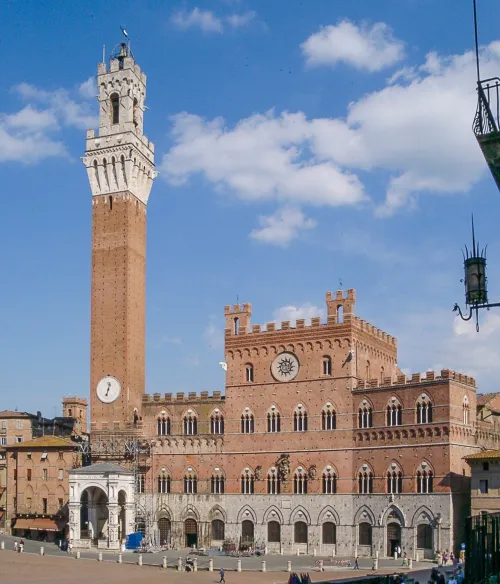
    The Gothic town hall closes off the bottom of the Campo, brick below, white stone above, slightly curved to follow the square. It was built between roughly 1297 and 1310 as the seat of the Republic of Siena's government, and it still houses the city administration. The reason to go inside is the Civic Museum (Museo Civico), specifically Ambrogio Lorenzetti's frescoes of the Allegory of Good and Bad Government, one of the most important secular paintings of the 14th century in Europe. There's also work by Simone Martini and Duccio. Entry is 9 euros, open daily 10:00 to 18:00. Honest verdict: if you only do one paid interior in Siena, this or the Duomo. The Lorenzetti room alone justifies the ticket. Budget 45 minutes. The tower entrance is in the same courtyard, just to the side.

    Hours
    Daily: 10:00 AM – 6:00 PM
    Price
    €9
  3. 3

    Torre del Mangia

    Torre del Mangia in Siena, stop 3 on the self-guided walking tour

    Crane your neck. The Torre del Mangia rises 88 meters straight out of the Palazzo Pubblico, a slim brick shaft with a white stone crown. It went up between 1338 and 1348, and it was deliberately built to reach the same height as the cathedral bell tower across town, the symbolism being that civic and church power should balance, neither overtopping the other. The climb is 10 euros, open daily 10:00 to 18:00, and it's about 300 steps up a tight spiral with no lift. The payoff is the best aerial view of the Campo's shell shape and the terracotta sea of roofs. Slots are capped and timed, so on busy days go first thing or you'll wait. If you're already paying for the Civic Museum, there's a combined ticket worth asking about at the counter. Skip it if stairs or tight spaces aren't your thing; the Facciatone later gives a similar panorama with less of a grind.

    Hours
    Daily: 10:00 AM – 6:00 PM
    Price
    €10
  4. 4

    Piazza del Mercato

    Piazza del Mercato in Siena, stop 4 on the self-guided walking tour

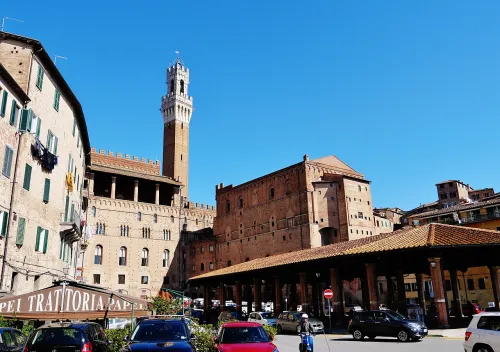
    Duck around the back of the Palazzo Pubblico and the crowds thin out fast. Piazza del Mercato is one of the largest open spaces in the old town and was historically the city market. Most people never make it here, which is exactly the point. The southern edge opens onto a broad terrace with a clear view down into the green valley below, where the old road of Porta Giustizia drops away past the former wash-houses. It's open 24/7 and free. This is your breather between the civic cluster you've just done and the cathedral cluster ahead. Lean on the railing, look back up at the bulk of the Palazzo and the tower you just photographed from below, and you'll understand how the town is stacked on its ridge. From here the lanes climb west toward the Duomo. It's a short pull uphill, so take it slow.

    Hours
    Open 24/7
    Price
    Free
  5. 5

    Facciatone

    Facciatone in Siena, stop 5 on the self-guided walking tour

    This wall is a monument to ambition that ran out of money and people. In the 1300s Siena started building a colossal new cathedral, the Duomo Nuovo, that would have dwarfed the existing one. Then the Black Death of 1348 gutted the city and the project was abandoned, leaving a single great facade wall standing in the air. That wall is the Facciatone, and you can climb a narrow internal staircase to a terrace right at the top. The reward is arguably the best rooftop panorama in Siena, level with the cathedral itself, looking out over the whole brick town. Entry is 6 euros via the OPA Si Pass, open daily 10:00 to 17:30. The final stretch is a cramped spiral with a metal walkway at the top, not for anyone uneasy about heights or narrow passages. Worth it for the view and the strange story behind it. The entrance is through the cathedral museum building.

  6. 6

    Santa Maria della Scala (Complesso museale di Santa Maria della Scala)

    Santa Maria della Scala (Complesso museale di Santa Maria della Scala) in Siena, stop 6 on the self-guided walking tour

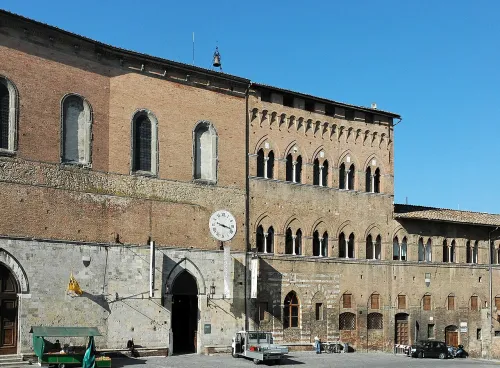
    Directly facing the cathedral across Piazza del Duomo sits a long, plain facade that hides one of the oldest and largest hospitals in Europe. Santa Maria della Scala took in pilgrims, the sick and abandoned children for roughly a thousand years before it became a museum complex. Inside it goes deep and strange: monumental frescoed halls, narrow corridors, and tunnels carved into the soft tufa rock, with a national archaeology museum down in the cellars. The highlight is the Pellegrinaio, the old pilgrims' ward, covered in the most important 15th-century Sienese fresco cycle, secular scenes of hospital life rather than saints. Entry is 9 euros, open daily 10:00 to 19:00. It's underrated and far less crowded than the Duomo opposite. Give it an hour if you like museums; 30 minutes if you're just here for the Pellegrinaio. Then cross the square to the striped giant.

    Hours
    Daily: 10:00 AM – 7:00 PM
    Price
    €9
  7. 7

    Siena Cathedral (Duomo di Siena)

    Siena Cathedral (Duomo di Siena) in Siena, stop 7 on the self-guided walking tour

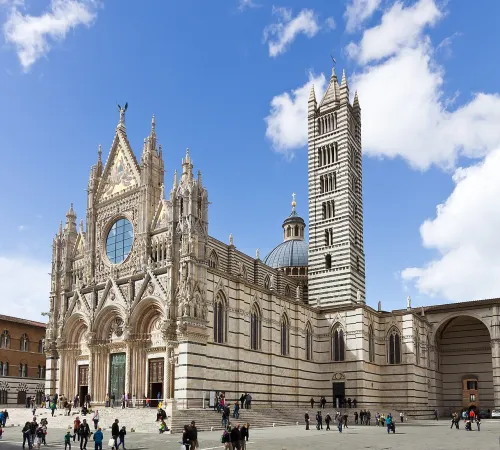
    Turn around and the Duomo hits you all at once: black and white striped marble, a facade crusted with sculpture, the whole thing built in the Italian Romanesque-Gothic style and counted among the finest churches of its kind in Italy. Inside, the striping continues up the columns, and underfoot is the famous inlaid marble floor, dozens of panels worked over centuries. Don't miss the Piccolomini Library off the left aisle, a small room with brilliantly preserved frescoes by Pinturicchio. Entry is 5 euros, open daily 10:00 to 19:00, though note the marble floor is fully uncovered only for limited periods each year, so check before you go if that's your reason for coming. This and the Civic Museum are the two interiors I'd never skip in Siena. Budget 45 minutes. The Baptistery is tucked below the choir, reached by the stairs just outside.

    Hours
    Daily: 10:00 AM – 7:00 PM
    Price
    €5
  8. 8

    Battistero di San Giovanni

    Battistero di San Giovanni in Siena, stop 8 on the self-guided walking tour

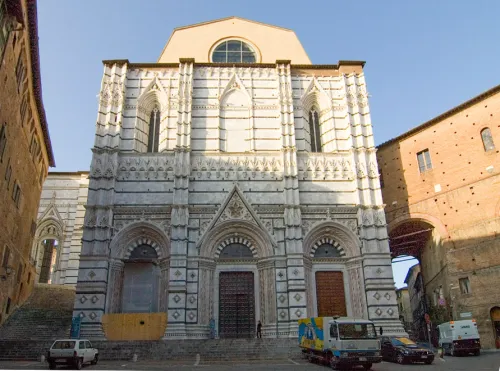
    Walk to the rear of the cathedral and down the San Giovanni stairs, and you find the Baptistery wedged directly beneath the choir of the Duomo, a clever bit of medieval engineering on a slope. It's a single richly painted Gothic room, and the centerpiece is the Renaissance baptismal font with bronze relief panels by Donatello and Lorenzo Ghiberti, two of the biggest names of the early 1400s. Entry is 4 euros, the cheapest of the cathedral-complex sites. Hours shift by season: roughly 10:30 to 17:30 in winter, 10:00 to 19:00 from April to October. It's small, so 15 to 20 minutes covers it. If you've bought the OPA Si Pass it's already included, so step in. If you're paying piecemeal and tight on time, this is the one to drop before the Duomo or Facciatone. From the foot of the stairs, head northwest toward the brick basilica on the next ridge.

    Hours
    Daily: 10:30 AM – 5:30 PM (Jan-Mar 2026), 10:00 AM – 7:00 PM (Apr-Oct 2026), 10:30 AM – 5:30 PM (Nov-Dec 2026)
    Price
    €4
  9. 9

    Basilica of San Domenico (Basilica di San Domenico)

    Basilica of San Domenico (Basilica di San Domenico) in Siena, stop 9 on the self-guided walking tour

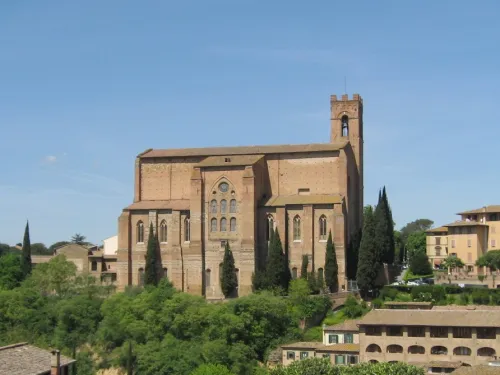
    The walk ends at a great barn of red brick on the northwest ridge, deliberately stripped back compared to everything you've just seen. San Domenico was built in the 13th century and enlarged in the 14th, and it's the spiritual home of St. Catherine of Siena. Her preserved head is kept here as a relic, in a Renaissance chapel frescoed by Sodoma and others. It's a national monument and, unlike the Duomo, free to enter. Open Monday to Saturday 7:30 to 18:30, Sundays from 8:45. The interior is vast, austere and usually quiet, a calm contrast after the cathedral crowds. The real bonus is outside: the terrace by the church gives the best long view back across the valley to the striped Duomo and the Torre del Mangia, the two towers you climbed or looked up at earlier, now lined up against the sky. A fitting place to end and exhale.

    Hours
    Mon-Sat: 7:30 AM – 6:30 PM | Sun: 8:45 AM – 6:30 PM
    Price
    Free

How Long Does This Walking Tour Really Take?

The distance is nothing, under 1.5 km, so your day is set by interiors and climbs, not walking. The Palazzo Pubblico frescoes and the Duomo with its Piccolomini Library run about 45 minutes each, and the Torre del Mangia and Facciatone climbs cost 30 to 45 minutes apiece with the queue. Three to four hours is a relaxed plan, five if you climb both towers and enter everything.

Walking time between all nine stops is barely 20 minutes total. The day fills up with interiors and climbs, not distance. The two stops that eat the most time are the Palazzo Pubblico Civic Museum (around 45 minutes for the Lorenzetti frescoes) and Siena Cathedral with its library (another 45). The two tower-style climbs, the Torre del Mangia and the Facciatone, each cost 30 to 45 minutes including the queue and the catch-your-breath at the top. Add Santa Maria della Scala if museums are your thing and you've built a full half-day. A realistic plan is three to four hours at a relaxed pace, or a packed five if you climb both towers and do every interior.

The natural break is the Campo itself, near the start. The cafes ringing the square charge a premium for the view, but a coffee standing at the bar inside is far cheaper than sitting outside. For a real rest later, Piazza del Mercato behind the Palazzo has a quiet terrace and a low wall to sit on with the valley in front of you, no waiter and no bill. Save your sit-down meal for after San Domenico, when the climbing is done.

Full Route, Shorter Walk or Two-Day Version?

The full route is short enough that most people do all nine stops, but Siena's tickets are split across two ticketing systems and the climbs add up, so here are three ways to run it depending on your time, your legs and your appetite for museums.

The Short Version

The highlights without the far ridge

Stops 1 to 7, Campo to Siena Cathedral, roughly 2 to 3 hours

Cut the two longest legs at either end. Skip the 430 m walk out to San Domenico (stop 9) and, if the climb is a bother, drop the Baptistery (stop 8). You still get both towers, both great fresco cycles and the cathedral, ending on the Duomo ridge rather than the far side of town.

The Easy Split

Two half-days at a gentle pace

Day one stops 1 to 4, day two stops 5 to 9, splitting at Piazza del Mercato

Break the walk at the natural seam. Day one does the civic cluster, the Campo, Palazzo Pubblico, the Mangia climb and the quiet Mercato terrace. Day two starts fresh with the uphill pull to the Facciatone and works through the whole cathedral complex to San Domenico. Ideal if the hills or the museum time are too much in one go.

You can run it backwards from San Domenico to the Campo, but the given direction is the easier one: it starts at the Campo, the lowest point in town, and saves the steepest pull for the middle rather than the finish. Ending at San Domenico also leaves you on the terrace with the best long view back to the Duomo and the Mangia tower.

Is This Siena Walking Tour Right for You?

This is a short walk on very uneven, sloping ground, dense with optional interiors. It suits some travellers perfectly and asks a bit of others, so here's who it's built for and how to bend it if the standard version doesn't fit.

A good fit if you…

  • Walkers happy with steep, uneven medieval paving over a short distance of under 1.5 km
  • Art and history travellers who want the Lorenzetti and Duomo frescoes explained rather than just glanced at
  • Independent visitors who'd rather pick their own interiors than pay for a fixed group tour
  • Anyone doing Siena as a day trip who needs a tight, logical route that hits both halves of the old town

Adapt the route if you…

  • Stairs or tight spaces are hard: skip the Torre del Mangia and the Facciatone, the terrace at San Domenico gives a fine long view for free
  • You're short on time: run the Short Version, stops 1 to 7, and end at the cathedral
  • The hills are too much in one push: use the Easy Split and break at Piazza del Mercato across two half-days
  • You mainly want squares and atmosphere over museums: walk the outdoor stops only and save the ticket money for a proper lunch

Tickets & Skip-the-Line in Siena

Siena's paid sights run on two separate ticketing systems: the Opera del Duomo covers the cathedral, Baptistery and Facciatone (the combined OPA Si Pass is worth it if you plan three or more), while the Palazzo Pubblico and its tower are a separate civic operation with their own combined ticket. Below are the entry prices, hours and official sites for each paid stop, plus a note on the free ones.

Palazzo Pubblico€9 for the Civic Museum, home to Lorenzetti's Good and Bad Government frescoes. Open daily 10:00 to 18:00. Ask at the counter about the combined civic ticket with the Torre del Mangia. Book or check times on the official site. official ticket site ↗
Torre del Mangia€10 to climb the 88 m tower, open daily 10:00 to 18:00. Slots are capped and timed, so on busy days go first thing. A combined ticket with the Civic Museum is worth asking about at the counter. official ticket site ↗
Facciatone€6 via the OPA Si Pass, open daily 10:00 to 17:30. Reached through the cathedral museum building; the final stretch is a cramped spiral, not for anyone uneasy about heights. Included if you hold the OPA Si Pass. official ticket site ↗
Santa Maria della Scala (Complesso museale di Santa Maria della Scala)€9 for the old pilgrims' hospital, now a deep museum complex with the frescoed Pellegrinaio ward and tunnels carved into the tufa. Open daily 10:00 to 19:00. Separate from both other ticket systems.
Siena Cathedral (Duomo di Siena)€5 for the striped Duomo, its inlaid marble floor and the Pinturicchio-frescoed Piccolomini Library. Open daily 10:00 to 19:00. The marble floor is fully uncovered only for limited periods each year, so check before you go. Covered by the OPA Si Pass. official ticket site ↗
Battistero di San Giovanni€4, the cheapest of the cathedral-complex sites, for the Gothic room with the Donatello and Ghiberti bronze font. Hours shift by season: 10:30 to 17:30 in winter (Jan to Mar and Nov to Dec 2026), 10:00 to 19:00 from April to October. Included in the OPA Si Pass.
Everything elsePiazza del Campo, Piazza del Mercato and the Basilica of San Domenico are all free, open spaces and a church, no ticket needed. The Campo is open 24/7; San Domenico is open Monday to Saturday 7:30 to 18:30 and Sundays from 8:45.
Optional upgrade
+5
The same 9-stop route,
now with navigation and a guide.
Optional AI experience

You already have the route.
The AI guide brings it to life.

Standing on the Campo, tilting downhill toward the Palazzo Pubblico? Open AI Tourguide in your browser, no app, no download, and a voice guide walks the whole climb with you, greeting you, telling the story up to the striped Duomo and out to the Facciatone view, then asking what you want to linger over and adapting between the squares. A real conversation built into the walk, not a recording. Start with 100 free credits.

Livenavigation13languagesAnyquestionYourinterests
Open this route with the AI guide

Try it in your browser · No app or download required

Tips for Walking in Siena

  • Siena has no train station in the center; the station sits downhill and you'll want the escalators or a bus up. Most visitors arrive by bus to Piazza Gramsci or by car to a perimeter parking garage. From either, walk in toward the Campo, which is the lowest point and the start of this route. Avoid driving into the historic center, it's a restricted ZTL zone with cameras and fines.
  • Wear proper shoes with grip. The whole town is medieval brick and stone laid on steep slopes, polished smooth by centuries of feet and slick when wet. The Campo itself tilts noticeably. Smooth-soled shoes and the tower staircases are a bad combination.
  • Public toilets are limited. The cleanest reliable option on this route is inside Santa Maria della Scala for ticket holders, and there are paid public restrooms near the Campo. Use the facilities at any museum you pay to enter rather than counting on finding one in the street.
  • For food, skip the view-priced cafes on the Campo and walk a couple of streets out. A panino with local cured meats or finocchiona runs about 5 to 7 euros at a small alimentari, and panforte, the dense Sienese fruit-and-nut cake, makes a cheap edible souvenir from any old bakery. Coffee at the bar costs roughly half what a seated table charges.
  • Best photo of the whole tour is from the top of the Torre del Mangia or the Facciatone, looking down. For the Campo's shell shape, climb the Mangia in the morning when the light rakes across the brick. For the classic postcard of the striped Duomo and the tower together, walk out to the terrace beside San Domenico in the late afternoon, when the brick glows warm.

Why Walk This Route?

Siena is built for walking and hostile to almost everything else. The old town sits on three ridges of red brick, cars are mostly banned from the center, and the whole place is small enough that you can cross it in twenty minutes. The catch is the gradients. Every street either climbs or drops, and the medieval paving has zero interest in your knees. This route keeps the worst of the hills to a minimum by working out from the Campo, the great shell-shaped square at the lowest point, then up to the cathedral ridge, and finishing at San Domenico for the view back across the rooftops.

Why this route over just wandering? Siena's two great poles, the civic one (Campo, Palazzo Pubblico, Torre del Mangia) and the religious one (Duomo, Baptistery, Santa Maria della Scala), are a five-minute walk apart but feel like two different cities. Doing them in order, with Piazza del Mercato and the Facciatone panorama as the link, lets you see how the medieval republic balanced earthly and heavenly power. The whole loop is under 1.5 km of actual walking.

A word on tickets: the cathedral complex and the civic museum are separate operations with separate passes. Don't expect one ticket to cover everything. I'll flag where the combined OPA Si Pass saves you money and where it doesn't.

Common Questions

Is Siena safe to walk around?

Yes, very. Siena is a small, calm Tuscan city with low crime and quiet streets even after dark. The main nuisance is the steep slick paving, not people. Watch your bag in the crowded Campo cafes during high season as you would anywhere touristy, but there's no area of the old town you need to avoid. Driving into the center is the real risk, with hidden ZTL cameras issuing fines to tourists who ignore the signs.

What if it rains during my Siena tour?

Siena rewards rain with empty interiors. Stack the indoor stops: the Civic Museum frescoes in the Palazzo Pubblico, the Duomo and its Piccolomini Library, and the deep tunnel-and-fresco complex of Santa Maria della Scala can fill hours without going back outside. The Baptistery is a quick covered stop too. Save the two open-air climbs, the Torre del Mangia and the Facciatone terrace, for when it clears, since the staircases get dangerously slippery and the views are the whole point.

What's the best time of day for this walking tour?

Start by 9:00 or 10:00 when interiors open. Early morning gives you the Campo before the day-trip coaches arrive and the softest light for the tower view. Crowds peak around midday when buses unload, so try to be inside a museum or up a tower then. Late afternoon is the other sweet spot, when the brick turns golden and the San Domenico terrace lights up for that final Duomo view. Avoid the dead heat of a summer midday on the exposed, shadeless Campo.

Take this route with you

Open this exact tour with navigation and your personal AI guide.

Start GPS Navigation + AI Guide
AI Tourguide
Researched and curated by the AI Tourguide teamWe plan and quality-check every route, then research and verify the opening hours, prices, and practical tips for each stop along it.
▶ Open route with AI guideNavigation, stories and your questions