Self-Guided Walking Tour in Cagliari

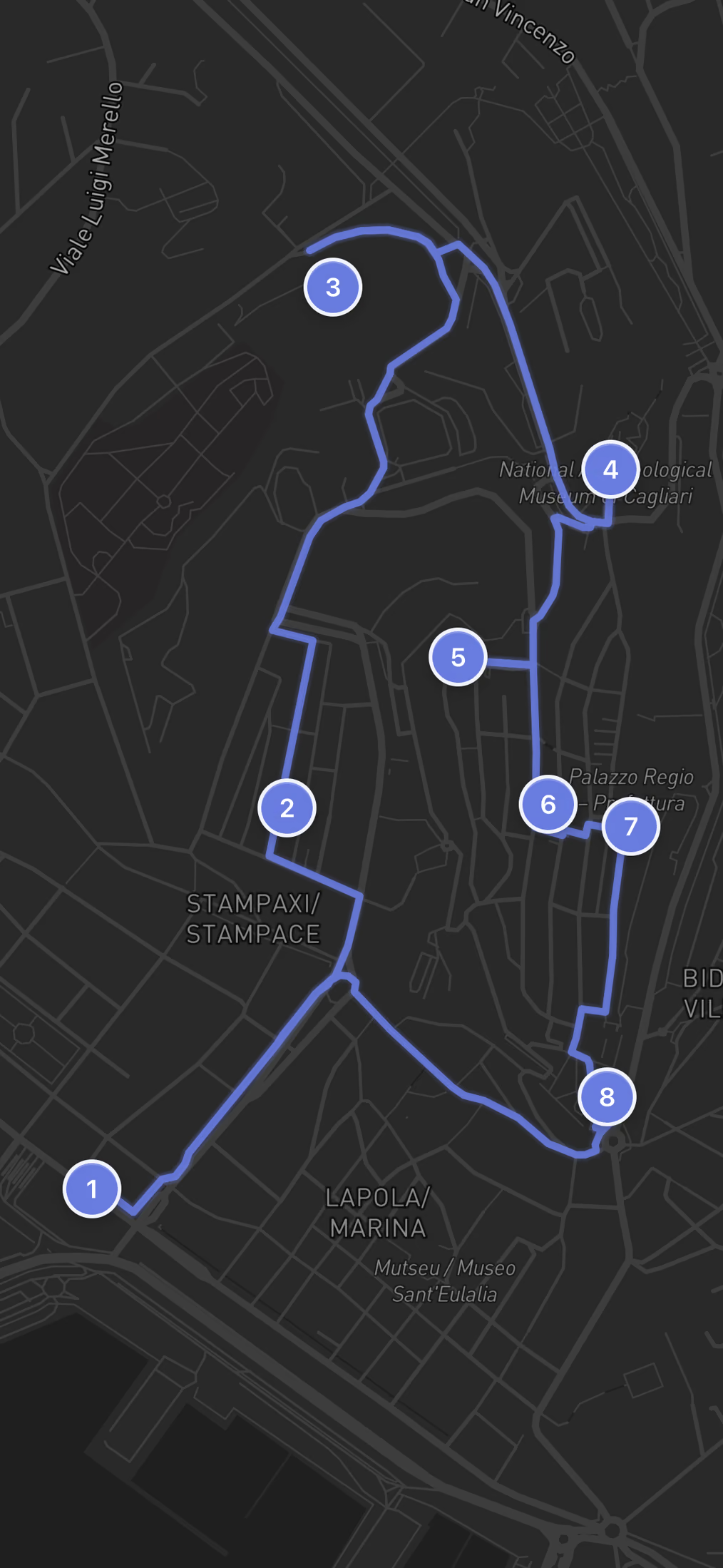
A 4.1 km loop through Cagliari's stacked old town, eight stops from the harbour arcade of Via Roma up through Stampace and Castello and back down the Bastione di Saint Remy. This page gives you the map, the walking time for every leg, real prices and hours for each paid interior, and shorter versions if you have less time.

8 Stops4.1 km~2 hours walking3–4 hours with stops
What you get with AI Tourguide
Full GPS navigationInteractive AI guidePersonalized to youWorks in your browser
Try this tour with Alex

Cagliari Walking Tour at a Glance

This route is designed for anyone who wants to understand Cagliari the way the city is actually built: in layers, up the side of a limestone hill. You start at sea level on Via Roma and climb through the old quarters to the walled crown of Castello, then descend. Every interior is optional. The whole loop works self-guided, at your own pace, and you decide which doors are worth the ticket.

StartVia Roma
FinishBastion Saint Remy (Bastione San Remy)
Route typeA compact loop that climbs north and north-east from the harbour to the top of the Castello hill, then curves back south to the start, so you gain the height once and coast back down without repeating the same streets.
Realistic timePure walking is only about an hour for the full 4.1 km, but a proper visit with the outdoor stops runs three to four hours, and longer if the National Archaeological Museum pulls you in.
DifficultyModerate. The distance is short at 4.1 km, but a good part of it is genuinely uphill on uneven limestone, cobbles and several flights of stairs, including the grand Saint Remy staircase.
Cost to followThe outdoor route is free to walk. The only paid interiors are the Roman Amphitheatre (5 euros), the Cripta di Santa Restituta (3 euros) and the National Archaeological Museum (10 euros), so under 20 euros covers all three.
Best for:

Travellers who like a short walk that builds to a payoff, mix history and views, and would rather earn the panorama from the top than stumble into it.

The Route

Free Walking Tour Map of Cagliari

8 stops4.1 kmabout 2 hours
Loading the interactive map…The complete walking route will appear here.
Want the route to guide you while you walk?Open the route with navigation and a personal guide for the history, stories and questions that matter to you.
Open route + AI guide

The 8 stops along this route

  1. Via Roma in Cagliari, stop 1 on the self-guided walking tour
    1Via Roma
  2. Santa Restituta (Chiesa di Santa Restituta) in Cagliari, stop 2 on the self-guided walking tour
    2Santa Restituta (Chiesa di Santa Restituta)
  3. Roman Amphitheatre of Cagliari (Anfiteatro romano di Cagliari) in Cagliari, stop 3 on the self-guided walking tour
    3Roman Amphitheatre of Cagliari (Anfiteatro romano di Cagliari)
  4. National Archaeological Museum of Cagliari (Museo archeologico nazionale di Cagliari) in Cagliari, stop 4 on the self-guided walking tour
    4National Archaeological Museum of Cagliari (Museo archeologico nazionale di Cagliari)
  5. Jewish Ghetto (Il Ghetto) in Cagliari, stop 5 on the self-guided walking tour
    5Jewish Ghetto (Il Ghetto)
  6. Castello in Cagliari, stop 6 on the self-guided walking tour
    6Castello
  7. Cagliari Cathedral (Cattedrale di Santa Maria Assunta e di Santa Cecilia) in Cagliari, stop 7 on the self-guided walking tour
    7Cagliari Cathedral (Cattedrale di Santa Maria Assunta e di Santa Cecilia)
  8. Bastion Saint Remy (Bastione San Remy) in Cagliari, stop 8 on the self-guided walking tour
    8Bastion Saint Remy (Bastione San Remy)
  9. That's the complete route.

    If you want more than the map and text, add live navigation and a conversational AI guide while you walk.

    Open route + AI guide
    You made it
Stop 1 of 8
Swipe →

Your Cagliari Walking Tour, Stop by Stop

  1. 1

    Via Roma

    Via Roma in Cagliari, stop 1 on the self-guided walking tour

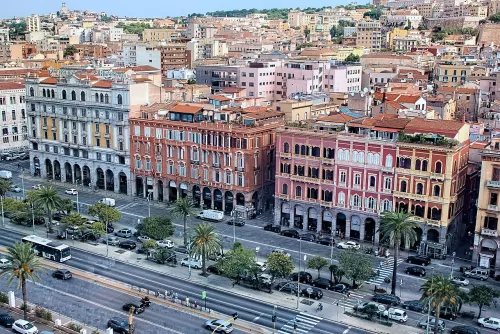
    Step off the boat or out of the station and this is the first thing Cagliari shows you: a long row of elegant porticoed buildings facing the harbour, the masts of the marina on one side, cafe tables under the arches on the other. Locals call streets like this a salotto, a living room of the city, and on a warm evening that is exactly how it feels. The arcade runs between largo Carlo Felice and viale Regina Margherita, marking the southern edge of the Marina quarter. It is free and open all hours, so there is no ticket logic here, just orientation. Grab a coffee standing at the bar (cheaper than sitting, the Italian way) and get your bearings before the climb begins. From here you head inland and uphill into Stampace. Aim for the narrow via Sant'Efisio.
    Hours
    Open 24/7
    Price
    Free
  2. 2

    Santa Restituta (Chiesa di Santa Restituta)

    Santa Restituta (Chiesa di Santa Restituta) in Cagliari, stop 2 on the self-guided walking tour

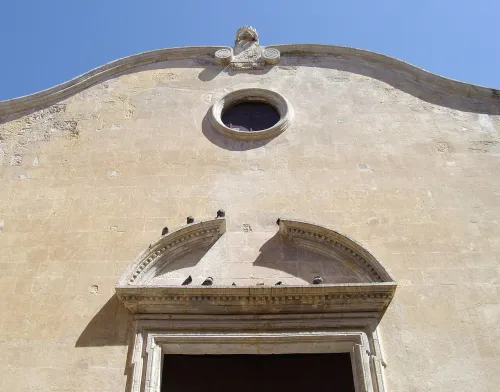
    Tucked up the tight via Sant'Efisio in the Stampace quarter, beside the parish church of Sant'Anna, this is a stop most visitors walk straight past, which is half its appeal. Behind an unassuming entrance is a rock-cut crypt carved into the living limestone, used as a place of worship since early-Christian times and, much later, as an air-raid shelter during the Second World War. It is small, cool and genuinely strange in the best way. Entry is 3 euros and it opens daily 10:00 to 13:00 and again 15:00 to 19:00, so plan around that long lunch closure. Honest verdict: if you are short on time or not big on underground churches, you can skip this one without guilt. If you have ten minutes and any curiosity, it is worth the few coins. Back outside, keep climbing north toward the open scar of the amphitheatre.

    Hours
    Daily: 10:00 AM – 1:00 PM, 3:00 – 7:00 PM
    Price
    €3
  3. 3

    Roman Amphitheatre of Cagliari (Anfiteatro romano di Cagliari)

    Roman Amphitheatre of Cagliari (Anfiteatro romano di Cagliari) in Cagliari, stop 3 on the self-guided walking tour

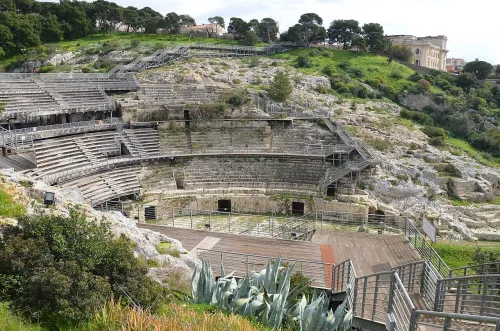
    The ground suddenly opens up and there it is, an oval bowl cut straight into the rock of the hillside. This is Cagliari's main Roman monument, built in the 2nd century when the city was Caralis, and the lower tiers of seating are quarried directly out of the limestone rather than constructed on top of it. It is not the Colosseum and it should not be sold to you as one, but standing in a 1,800-year-old arena with the city climbing the slopes around you is a real moment. Entry is 5 euros, open daily 10:00 to 13:00 and 15:00 to 19:00, so again mind that midday gap. Go in the morning when the stone is bright and the light hits the tiers. From here the climb gets steeper as you head up toward the Cittadella dei Musei and the top of the hill.

    Hours
    Daily: 10:00 AM – 1:00 PM, 3:00 – 7:00 PM
    Price
    €5
  4. 4

    National Archaeological Museum of Cagliari (Museo archeologico nazionale di Cagliari)

    National Archaeological Museum of Cagliari (Museo archeologico nazionale di Cagliari) in Cagliari, stop 4 on the self-guided walking tour

    At the very top of the climb, inside the Cittadella dei Musei, sits the best museum in Sardinia and the reason a lot of people come to Cagliari at all. The pull is the room of nuragic bronzes and, above all, the Giants of Mont'e Prama: enormous stone warriors and boxers carved roughly 3,000 years ago, some standing over two metres tall, found in pieces and painstakingly reassembled. Nothing else like them exists. The collection runs from prehistory through the Bronze Age to the Byzantine era. Tickets are 10 euros and it opens daily 08:30 to 19:30, generous hours that make this an easy rainy-day or midday anchor when the open-air sites are closed for lunch. Budget at least an hour, more if the Giants grab you. When you come out, walk back down into the medieval lanes, heading first for the old ramparts of the Ghetto.

    Hours
    Daily: 8:30 AM – 7:30 PM
    Price
    €10
  5. 5

    Jewish Ghetto (Il Ghetto)

    Jewish Ghetto (Il Ghetto) in Cagliari, stop 5 on the self-guided walking tour

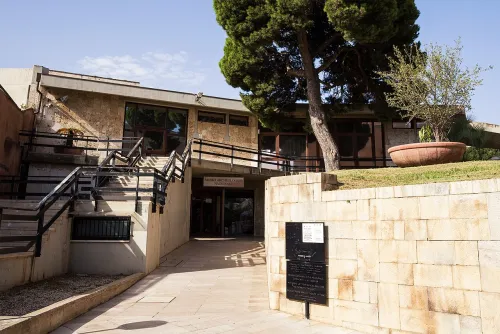
    On the Castello ramparts you reach what was the medieval Jewish quarter, now a free cultural centre built into the old fortifications. Sardinia's Jewish community lived here until the 1492 expulsion under Spanish rule, and the lanes still carry the name. Today the space hosts rotating art and history exhibitions, and the real draw, beyond whatever is on the walls, is the position: you are perched on the old walls with the city and the gulf spread out below. Entry is free, but the hours catch people out. It is closed Mondays, and open Tuesday to Sunday 10:00 to 13:00 and 17:00 to 20:00, with a long afternoon shutdown in between. If the doors happen to be locked, do not stress; the view from the ramparts outside is the best part and costs nothing. From here it is a short step deeper into the heart of Castello.

  6. 6

    Castello

    Castello in Cagliari, stop 6 on the self-guided walking tour

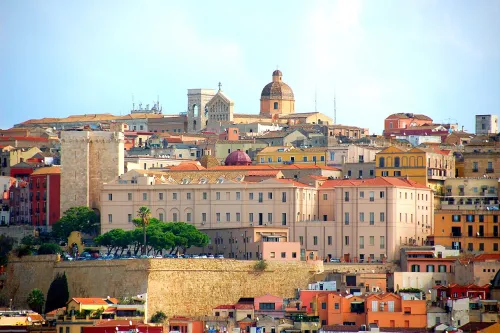
    This is the old city in the truest sense. Castello, Casteddu 'e Susu in Sardinian, sits on the limestone crown about a hundred metres above the sea, founded and walled by the Pisans in the 13th century. For seven centuries, under Pisan, Aragonese, Spanish, Austrian and finally Savoyard rule, this is where power lived: the noble palaces, the prefecture, the old royal palace on Piazza Palazzo, the university rectorate. You still enter through the original medieval gates set in the surviving walls. The pleasure here is not a single ticket, it is the wandering: tall ochre palazzi leaning over lanes so narrow the sky becomes a strip, washing lines, sudden small piazzas. It is free and always open. Take your time and let yourself get a little lost; the quarter is small enough that you cannot stay lost for long. Drift toward Piazza Palazzo, where the cathedral fills one side.

    Hours
    Open 24/7
    Price
    Free
  7. 7

    Cagliari Cathedral (Cattedrale di Santa Maria Assunta e di Santa Cecilia)

    Cagliari Cathedral (Cattedrale di Santa Maria Assunta e di Santa Cecilia) in Cagliari, stop 7 on the self-guided walking tour

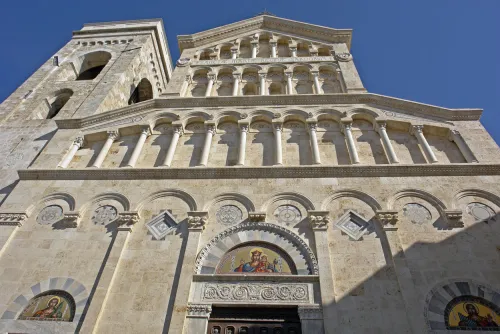
    Piazza Palazzo opens up and the cathedral of Santa Maria Assunta closes one whole side of it. The story is written on the building: begun in the 1200s in Pisan-Romanesque style, raised to cathedral rank in 1258, reworked in lavish Baroque through the 1600s and 1700s, then given its current neo-Romanesque facade in the 1930s, modelled deliberately on the Duomo of Pisa. When Cagliari was capital of the Kingdom of Sardinia, representatives of the parliament swore their oaths inside these walls. Step in: entry is free and it is open daily 09:00 to 20:00, so it is an easy add even on a tight schedule. The crypt below, carved with hundreds of saints, is the part people remember. Dress modestly, shoulders covered, as at any working church. When you leave, head south across the quarter toward the great white bastion and the finale.

    Hours
    Daily: 9:00 AM – 8:00 PM
    Price
    Free
  8. 8

    Bastion Saint Remy (Bastione San Remy)

    Bastion Saint Remy (Bastione San Remy) in Cagliari, stop 8 on the self-guided walking tour

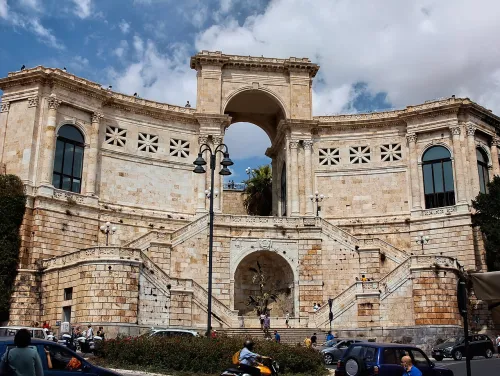
    You save the best for last on purpose. The Bastione di Saint Remy is a monumental white-limestone rampart and grand double staircase built into the old fortifications, named for the first Savoyard viceroy of Sardinia and now the postcard image of the city. Walk out onto the terrace and the whole gulf opens below you: rooftops, the port, the lagoons, the sea going hazy toward the horizon. This is the panorama you climbed for. It is free and open around the clock, which makes it the obvious sunset stop; come in the late afternoon and the light turns the stone gold. Then take the grand staircase down, the dramatic way to descend off the hill, which drops you toward Piazza Costituzione and the lower town. From there it is a flat, easy stroll back to Via Roma and a well-earned drink on the harbour where you started.

    Hours
    Open 24/7
    Price
    Free

How Long Does This Walking Tour Really Take?

Walking time alone is roughly an hour for the 4.1 km loop. Add the outdoor stops and the Castello lanes and you are at two to three hours; give the National Archaeological Museum its full hour or two and the day comfortably fills three to four hours.

Walking time is only about an hour for the full loop, but you will want roughly three to four hours to do it properly with stops. The National Archaeological Museum is the big time sink and deserves it: give it at least an hour, two if the Giants of Mont'e Prama pull you in. The amphitheatre and the cathedral are 20 to 30 minutes each. The Castello lanes are best done slowly with no agenda.

The natural place to break is at the top of the climb, after the museum, before you start the descent. Take ten minutes on the Bastione di Saint Remy terrace itself, where there is a cafe and plenty of low walls to sit on with the whole gulf in front of you. If you would rather break earlier, the cafes under the arches of Via Roma at the start are the classic spot for a stand-up espresso. Watch the long lunch closures: the amphitheatre, the crypt and the Ghetto all shut between roughly 13:00 and 15:00 or later, so do not arrive at those mid-afternoon expecting open doors.

Full Route, Shorter Walk or Two-Day Version?

The full route is eight stops in one climbing loop, but it splits cleanly if you have less time or less appetite for stairs. Here are three ways to walk it, using the real stop numbers and leg times from the map.

The Short Climb

Skip the crypt detour, keep the essentials

Stops 1, then 3 to 8, dropping the Cripta di Santa Restituta, roughly 3.5 km and about 2–2.5 hours.

Cut the Santa Restituta crypt (stop 2), the least central and most skippable of the interiors, and head straight up to the amphitheatre. You still get the museum, all of Castello, the cathedral and the bastion view. The tightest version that loses nothing essential.

The Easy Two-Part Split

Lower town one visit, hilltop another

Part one, stops 1 to 3 in the lower town; part two, stops 4 to 8 up in Castello, each about 1–1.5 hours.

Break the climb at the top of the amphitheatre. Do Via Roma and the Roman stops on one outing, then take the museum and the walled Castello quarter on another, arriving fresh for the hilltop. Ideal in summer heat or for anyone pacing the stairs.

You can walk it in reverse, starting at the Bastione di Saint Remy and ending on Via Roma, but the given direction is recommended: it saves the panorama for last and lets you climb once and descend once instead of grinding back up the hill at the end.

Is This Cagliari Walking Tour Right for You?

This is a short but vertical walk through a compact historic core. It suits some travellers perfectly and asks a little adaptation from others. Here is who it fits and how to adjust.

A good fit if you…

  • Walkers who like a route with a clear payoff, in this case the bastion panorama earned at the end of the climb
  • History travellers who want Roman, medieval, Spanish and Savoyard layers within a few hundred metres
  • Anyone arriving by ferry or train, since you land right at Via Roma where the loop begins
  • People who prefer a short distance, 4.1 km, over a sprawling all-day march across a big city

Adapt the route if you…

  • You have limited mobility or dislike stairs: the climb is genuine and the Saint Remy staircase is steep, so consider the two-part split or a taxi up to Castello
  • You are walking in summer midday: the exposed hilltop is brutally hot, so start mid-morning or break the loop in two
  • You are short on time: take the Short Climb version and drop the Santa Restituta crypt
  • You want to see the paid interiors: begin the climb before 13:00, because the amphitheatre and crypt shut for a long lunch until 15:00

Tickets & Skip-the-Line in Cagliari

Cagliari's old town has no real queue problem, so this is less about skipping lines and more about not arriving at a closed door. Three stops on the route charge admission, and two of them shut for a long lunch, so timing matters more than pre-booking. Here is what each paid interior costs and when to catch it.

National Archaeological Museum of Cagliari (Museo archeologico nazionale di Cagliari)10 euros. Open daily 8:30 AM to 7:30 PM, the most generous hours on the route, which makes it the reliable rainy-day or midday anchor when the open-air sites close for lunch. Budget at least an hour for the Giants of Mont'e Prama. official ticket site ↗
Roman Amphitheatre of Cagliari (Anfiteatro romano di Cagliari)5 euros. Open daily 10:00 AM to 1:00 PM and 3:00 to 7:00 PM, so mind the midday closure. Come in the morning when the stone is bright and the light hits the tiers cut into the rock. official ticket site ↗
Santa Restituta (Chiesa di Santa Restituta)3 euros. Open daily 10:00 AM to 1:00 PM and 3:00 to 7:00 PM, so plan around the long lunch closure. The most skippable interior if you are short on time, but a few coins for a rock-cut crypt if you have ten minutes.
Everything elseVia Roma, the Jewish Ghetto (Il Ghetto), the Castello District, Cagliari Cathedral and the Bastione di Saint Remy are all free open spaces or free-entry sites. Note the Ghetto is closed Mondays and shuts for a long afternoon break, but the rampart view outside costs nothing.
Optional upgrade
+4
The same 8-stop route,
now with navigation and a guide.
Optional AI experience

You already have the route.
The AI guide brings it to life.

Standing under the arches of Via Roma, or looking up at the white sweep of the Bastione di Saint Remy? Open AI Tourguide in your browser, no app and no download, and a voice guide walks you up through Stampace and Castello, greeting you, telling the story at the amphitheatre and museum and asking what you want to see so it shapes the climb around you. A real conversation, not a recording. Start with 100 free credits.

Livenavigation13languagesAnyquestionYourinterests
Open this route with the AI guide

Try it in your browser · No app or download required

Tips for Walking in Cagliari

  • Timing and arrival: if you come by ferry or train you land right at Via Roma, the start of the loop. Begin the climb before 13:00 so the amphitheatre and crypt are still open before their long lunch break (they reopen at 15:00).
  • Terrain and shoes: this is a genuine uphill walk on uneven limestone, cobbles and several flights of stairs, including the grand Saint Remy staircase. Wear proper closed shoes, not flat-soled sandals; the polished stone gets slippery after rain.
  • Restrooms: the National Archaeological Museum has clean public toilets and is open 08:30 to 19:30, making it the most reliable stop on the route. Use it while you are up at the Cittadella dei Musei.
  • Food and drink: order an espresso standing at the bar in a Via Roma cafe for around 1 to 1.50 euros rather than paying the table service surcharge. For lunch, the Marina quarter just behind Via Roma is full of seafood trattorias; look for fregola with clams.
  • Photo: the Bastione di Saint Remy terrace at the end, facing south over the port and gulf, is the signature shot. Come in late afternoon when the low sun turns the white limestone gold and lights up the rooftops below.

Why Walk This Route?

Cagliari is a city built in layers up the side of a limestone hill, and the only honest way to understand it is on foot. The historic core is tiny and stacked vertically: the port and its cafes sit at sea level, then the streets climb through medieval lanes until you reach the walled hilltop of Castello, where the cathedral, the museum and the best views all cluster within a few hundred metres of each other. Driving makes no sense here. Half the good stuff is up stairs and through pedestrian gates that no car will ever reach.

This route is a loop, which is the smart way to do it. You start on the porticoed waterfront of Via Roma, climb gradually through Stampace and the Roman ruins, top out at the museum and the medieval quarter, then come back down the great staircase of the Bastione di Saint Remy and land back where you began. About 4 km of walking, but a chunk of it is uphill, so it feels longer than the number suggests.

Why follow a set order instead of wandering? Because Cagliari rewards a climb that builds. Wander randomly and you will exhaust yourself going up and down the same hill three times. Do it in this sequence and you gain height once, see everything at the top, then coast back down to a coffee on the harbour. The payoff at the end, the panorama from the bastion, is the kind of view you want to earn rather than stumble into.

Common Questions

Is Cagliari safe to walk around?

Yes, very. Cagliari is one of the calmer Italian cities and this whole route runs through busy, well-trafficked areas in daylight. Normal city sense applies: watch your bag in the crowded cafe stretch of Via Roma and around the port, where pickpockets work busy tourist flows. The Castello lanes and Marina are fine to wander. There are no notable scams targeting walkers here, just the usual tourist-menu markups at a few harbourside spots.

What if it rains during my Cagliari tour?

You are well covered because the route's best indoor stop is also its biggest draw. The National Archaeological Museum (10 euros, open 08:30 to 19:30) can absorb an hour or more, and the cathedral is free and open daily 09:00 to 20:00. The Santa Restituta crypt is literally underground. Save the outdoor bastion view for a clear spell. The limestone stairs get slick when wet, so take the Saint Remy staircase slowly.

What's the best time of day for this walking tour?

Start mid-to-late morning, around 10:00, so the amphitheatre and crypt are open before the long lunch closures, and so you reach the Bastione di Saint Remy in the late afternoon. That way you finish on the bastion terrace as the sun drops and turns the gulf gold, then come down for an aperitivo on Via Roma. Summer midday is brutally hot on the exposed hilltop, so a morning start also keeps you out of the worst heat on the climb.

Take this route with you

Open this exact tour with navigation and your personal AI guide.

Start GPS Navigation + AI Guide
AI Tourguide
Researched and curated by the AI Tourguide teamWe plan and quality-check every route, then research and verify the opening hours, prices, and practical tips for each stop along it.
▶ Open route with AI guideNavigation, stories and your questions