Self-Guided Walking Tour in Catania

A 5km loop through Catania's lava-stone old town, 11 stops from Piazza del Duomo and its elephant up Via Etnea to Villa Bellini, then west to the Benedictine monastery and Castello Ursino, finishing loud inside La Pescheria. This page gives you the map, per-leg walking times, real prices and hours, and shorter versions.

11 Stops5.0 km~3 hours walking4–5 hours with stops
What you get with AI Tourguide
Full GPS navigationInteractive AI guidePersonalized to youWorks in your browser
Try this tour with Alex

Catania Walking Tour at a Glance

This route is built for anyone who wants to see the real Catania on foot without a group or a fixed schedule. It links 11 stops in one compact loop, and every interior is optional: you walk the squares, markets and streets for free and pay only for the few buildings you actually want to step inside. You decide the pace, the stops and the order.

StartPiazza del Duomo and Elephant Fountain
FinishFish market of Catania (Pescheria di Catania)
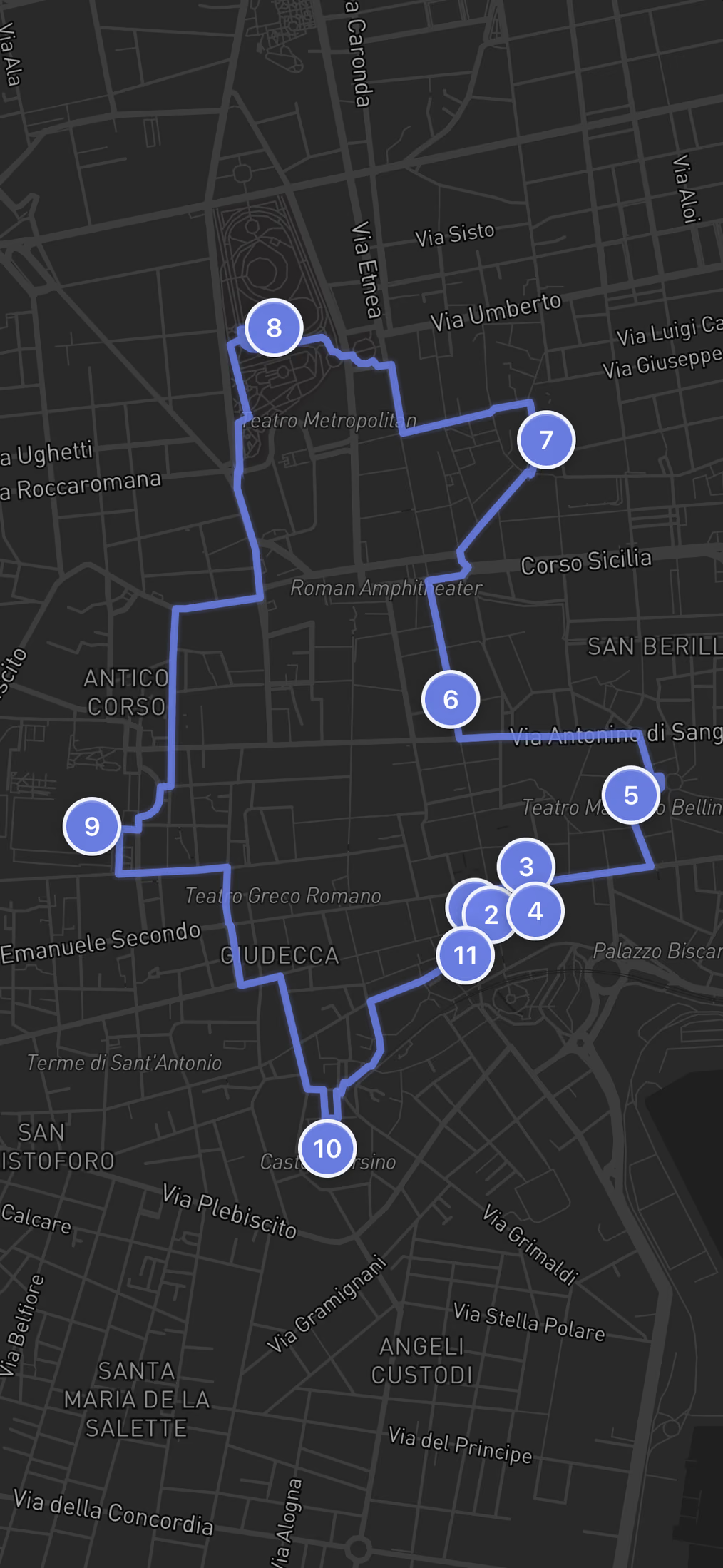
Route typeA closed loop, not a point-to-point line. It starts and ends at Piazza del Duomo, runs north up Via Etnea, then swings west and south through the monastery and castle before curling back to the fish market beside the square. Almost no backtracking, so you never repeat a street.
Realistic timeWalked briskly with no stops, the 5km loop takes under two hours. With a coffee and the interiors you choose, plan a comfortable half day of four to five hours from start to finish.
DifficultyEasy in effort, about 5km of flat to gently sloping streets, but the whole old town is paved in black lava cobbles that turn slick near the markets. A few interiors add stairs, most notably the narrow dome climb at Badia di Sant'Agata.
Cost to followThe outdoor route costs nothing: the squares, Via Etnea, both markets and Villa Bellini are all free. Paid interiors are optional, roughly €5 for the Terme Achilliane, €5 for the Badia dome, €6.50 for Teatro Massimo Bellini, €9 for the full monastery tour and €8 for Castello Ursino.
Best for:

Independent travellers who want dense, specific street-level detail, a compact walkable centre, and the freedom to skip any museum or church and just eat their way through the two markets instead.

The Route

Free Walking Tour Map of Catania

11 stops5.0 kmabout 3 hours
Loading the interactive map…The complete walking route will appear here.
Want the route to guide you while you walk?Open the route with navigation and a personal guide for the history, stories and questions that matter to you.
Open route + AI guide

The 11 stops along this route

  1. Piazza del Duomo and Elephant Fountain in Catania, stop 1 on the self-guided walking tour
    1Piazza del Duomo and Elephant Fountain
  2. Terme Achilliane in Catania, stop 2 on the self-guided walking tour
    2Terme Achilliane
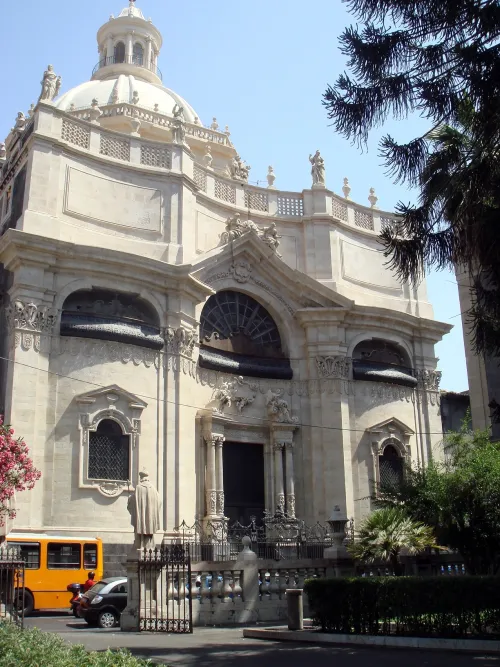
  3. Badia di Sant'Agata (Chiesa della Badia di Sant'Agata) in Catania, stop 3 on the self-guided walking tour
    3Badia di Sant'Agata (Chiesa della Badia di Sant'Agata)
  4. Catania Cathedral (Cattedrale di Sant'Agata) in Catania, stop 4 on the self-guided walking tour
    4Catania Cathedral (Cattedrale di Sant'Agata)
  5. Teatro Massimo Bellini (Teatro Massimo Vincenzo Bellini) in Catania, stop 5 on the self-guided walking tour
    5Teatro Massimo Bellini (Teatro Massimo Vincenzo Bellini)
  6. Via Etnea in Catania, stop 6 on the self-guided walking tour
    6Via Etnea
  7. Fera 'o Luni in Catania, stop 7 on the self-guided walking tour
    7Fera 'o Luni
  8. Giardino Bellini in Catania, stop 8 on the self-guided walking tour
    8Giardino Bellini
  9. Benedictine Monastery of San Nicolò l'Arena in Catania, stop 9 on the self-guided walking tour
    9Benedictine Monastery of San Nicolò l'Arena
  10. Castello Ursino in Catania, stop 10 on the self-guided walking tour
    10Castello Ursino
  11. Fish market of Catania (Pescheria di Catania) in Catania, stop 11 on the self-guided walking tour
    11Fish market of Catania (Pescheria di Catania)
  12. That's the complete route.

    If you want more than the map and text, add live navigation and a conversational AI guide while you walk.

    Open route + AI guide
    You made it
Stop 1 of 11
Swipe →

Your Catania Walking Tour, Stop by Stop

  1. 1

    Piazza del Duomo and Elephant Fountain

    Piazza del Duomo and Elephant Fountain in Catania, stop 1 on the self-guided walking tour

    Start in the middle of it all. The square is open 24/7 and free, ringed by black-and-white Baroque facades, and in the centre stands the Liotru: a small Roman elephant carved from lava with an Egyptian obelisk on its back. It is the city's emblem and Catanians treat it with real affection. Stand near the fountain and you get the full sweep: the cathedral to your right, the elephant ahead, the via Etnea opening to the north. This is your orientation point and your finish line, so take a minute here. Mornings before 10am the square is calm and the light hits the facades cleanly. By midday it fills with tour groups and the cafe terraces. Do not buy anything from the men selling roses or bracelets around the fountain. A polite no and keep walking is all you need.
  2. 2

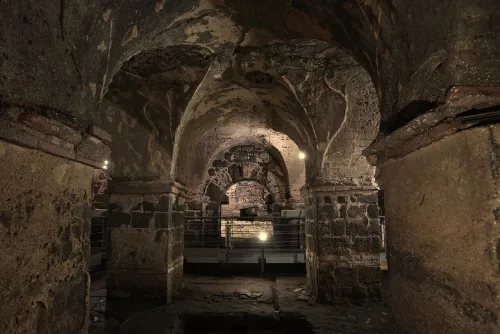
    Terme Achilliane

    Terme Achilliane in Catania, stop 2 on the self-guided walking tour

    Most people walk straight past this without knowing it exists, which is exactly why it is worth doing. To the right of the cathedral facade, a ramp drops down into late-Roman thermal baths from the 4th to 5th century, sitting directly under the square you just crossed. You enter through a barrel-vaulted corridor built into the cathedral foundations and come out in a cool, damp, dimly lit ancient chamber. Entry is 5 euros through the Diocesan Museum. Hours are tight and split: roughly 9am to 1pm most days, with afternoon openings only on Tuesday and Thursday (3pm to 5:30pm), so come in the morning to be safe. It takes ten minutes inside. Not a blockbuster, but a genuine ancient layer hidden beneath the Baroque, and the temperature drop alone is a relief in summer.

    Hours
    Mon: 9:00 AM – 1:00 PM | Tue: 9:00 AM – 1:00 PM, 3:00 – 5:30 PM | Wed: 9:00 AM – 1:00 PM | Thu: 9:00 AM – 1:00 PM, 3:00 – 5:30 PM | Fri: 10:00 AM – 1:00 PM | Sat: 9:00 AM – 12:30 PM | Sun: 10:00 AM – 12:30 PM
    Price
    €5
  3. 3

    Badia di Sant'Agata (Chiesa della Badia di Sant'Agata)

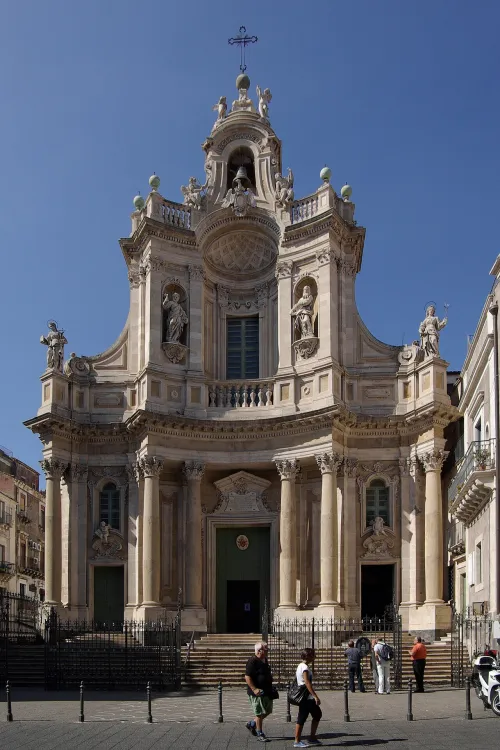
    Badia di Sant'Agata (Chiesa della Badia di Sant'Agata) in Catania, stop 3 on the self-guided walking tour

    Step back up to street level and walk a few metres along Via Vittorio Emanuele II to this Vaccarini church, finished in the late Baroque style and tied to the cult of Sant'Agata. The real reason to pay the 5-euro entry is not the interior but the climb: a dome terrace gives you a panorama over the rooftops of the old town with Etna behind. It is one of the better viewpoints in the centre and far less mobbed than you would expect. Open daily, generally 9:30am onward, later on weekends (until 8pm Sunday). The stairs are narrow and there is no lift, so skip it if knees are a problem. If the climb is open when you arrive, do it now while your legs are fresh rather than at the end of the loop.

    Hours
    Mon: 9:30 AM – 12:30 PM, 3:00 – 7:00 PM | Tue-Sat: 9:30 AM – 7:00 PM | Sun: 9:30 AM – 8:00 PM
    Price
    €5
  4. 4

    Catania Cathedral (Cattedrale di Sant'Agata)

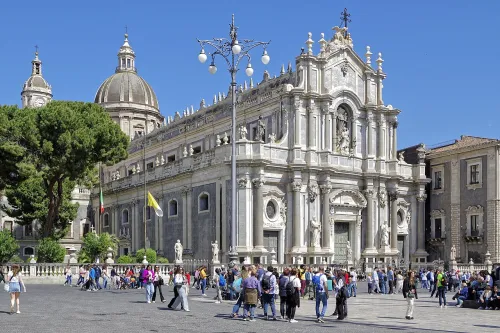
    Catania Cathedral (Cattedrale di Sant'Agata) in Catania, stop 4 on the self-guided walking tour

    Back on the square, the Duomo is the obvious anchor and it is free to enter. The facade mixes Norman bones, Baroque flourish and a Neoclassical front, the layers of a building knocked down and rebuilt after earthquakes more than once. Inside, look for the tomb of Vincenzo Bellini, the composer born here, near the entrance. This is the spiritual centre of the Sant'Agata cult, and if you happen to be in Catania in early February for her feast, the whole city shuts down around it. Open mornings 7:15am to 12:30pm and afternoons 4pm to 7pm, with a long lunch closure, so time your visit around that gap. Dress modestly, shoulders covered, as it is an active church. Fifteen minutes is enough unless a service is on.

    Hours
    Mon-Sat: 7:15 AM – 12:30 PM, 4:00 – 7:00 PM | Sun: 7:45 AM – 12:30 PM, 4:00 – 7:00 PM
    Price
    Free
  5. 5

    Teatro Massimo Bellini (Teatro Massimo Vincenzo Bellini)

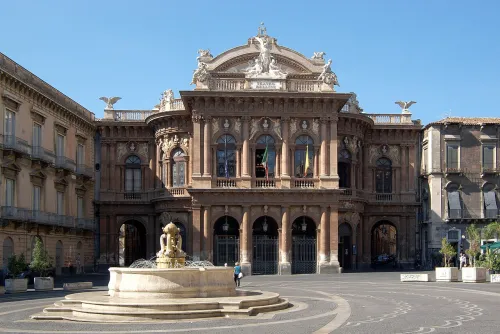
    Teatro Massimo Bellini (Teatro Massimo Vincenzo Bellini) in Catania, stop 5 on the self-guided walking tour

    Head northeast off the square and the streets open onto a smaller piazza dominated by Catania's opera house, named for Bellini. The tenor Beniamino Gigli once called it the best-sounding theatre in the world, and the acoustics are still the draw. The facade alone is worth the short detour, but the interior is the point: a horseshoe of red and gold tiers. You can tour it for 6.50 euros, Tuesday to Saturday only, between 9:30am and 1pm. It is closed Monday and Sunday, so if those are your days, just admire the outside and move on. The piazza itself has a few decent cafes if you want a first coffee. Catch an evening performance if your dates line up; otherwise the morning tour is a calm 30 minutes.

    Hours
    Mon: Closed | Tue-Sat: 9:30 AM – 1:00 PM | Sun: Closed
    Price
    €6.50
  6. 6

    Via Etnea

    Via Etnea in Catania, stop 6 on the self-guided walking tour

    Now you join the spine. Via Etnea runs arrow-straight for about 3km from Piazza del Duomo north toward the volcano, and on a clear day Etna sits at the end of it like a backdrop someone painted in. This is where Catania shops, strolls and people-watches, lined with Baroque palaces, churches and historic cafes. It is pedestrianised in stretches and busy from morning until the evening passeggiata. You only walk the southern portion of it on this loop, heading north toward the park. Stop at one of the old pasticcerie for a granita, the local breakfast: almond or pistachio, served with a brioche to dunk. Expect to pay a couple of euros standing at the bar, more if you sit. Resist the urge to walk the full 3km; the good stretch is the first kilometre.

    Hours
    Daily: 9:00 AM – 8:00 PM
    Price
    Free
  7. 7

    Fera 'o Luni

    Fera 'o Luni in Catania, stop 7 on the self-guided walking tour

    Just off Via Etnea on Piazza Carlo Alberto, the everyday street market spreads out: fruit, vegetables, cheese, clothes, household junk, the lot. This is where locals actually shop, the workaday counterpart to the famous fish market you will hit later. It runs Monday to Friday mornings (roughly 9am to 1pm) and all day Saturday until 7pm, and it is closed Sunday, so plan around that. Entry is free, obviously. Walk through, taste a piece of fruit a vendor offers, watch the haggling. It is less of a tourist spectacle than La Pescheria and more of a real one. Keep your bag in front of you in the crush, standard market sense. If it is a Sunday and the stalls are gone, do not wait around; the square is just a square then, and the park ahead is the better stop.

  8. 8

    Giardino Bellini

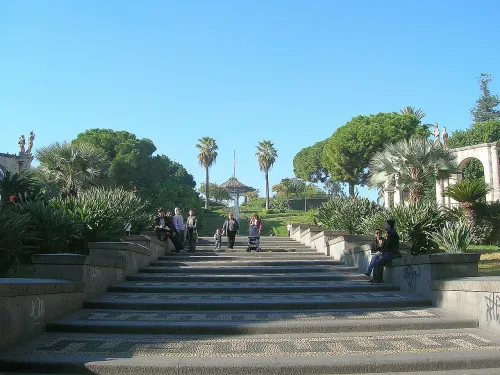
    Giardino Bellini in Catania, stop 8 on the self-guided walking tour

    After the noise of the market, this is where you breathe out. Villa Bellini is one of Catania's oldest public gardens, locals just call it 'a Villa, and it climbs in terraces off Via Etnea with palm-lined paths, a bandstand, ponds and flowerbeds. From the upper terraces you get the view back down the corso with Etna over the rooftops, which is the reason this loop ends its northern leg here rather than circling straight back. It is open daily from 6am to 10pm and free. Find a bench in the shade, this is the natural halfway rest of the walk. Families, joggers and old men playing cards fill it in the late afternoon. Grab a gelato from a kiosk and take the higher path for the best volcano sightline before you turn back south.

    Hours
    Daily: 6:00 AM – 10:00 PM
    Price
    Free
  9. 9

    Benedictine Monastery of San Nicolò l'Arena

    Benedictine Monastery of San Nicolò l'Arena in Catania, stop 9 on the self-guided walking tour

    Cut west from the park and the scale of this place is hard to take in: one of the largest Benedictine monasteries in Europe, a UNESCO-listed Baroque giant now run by the university's humanities faculty. Students stream through cloisters that would dignify a palace. You can wander parts of the courtyards and the attached church for free, but the proper guided visit, which gets you into the lava-floor kitchens, the cloisters and the rooftop, costs 9 euros and runs daily 9:30am to 5:00pm. Take the tour if you have an hour; the building was rebuilt on top of a lava flow from the 1669 eruption and you can see the black rock under the floor. If you are short on time, even ten minutes in the main cloister gives you the sense of the place. This is the architectural high point west of Via Etnea.

  10. 10

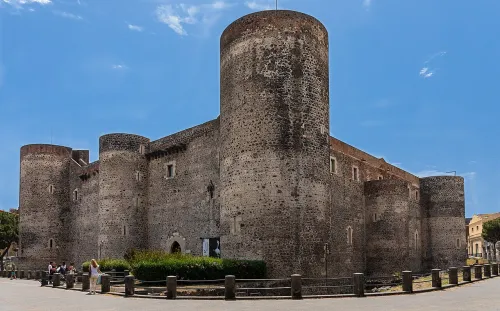
    Castello Ursino

    Castello Ursino in Catania, stop 10 on the self-guided walking tour

    Walk south and the streets get rougher and more lived-in before you reach this squat dark fortress sitting oddly in the middle of a residential quarter. Frederick II built it in the 13th century on the seafront, but the 1669 lava flow filled in the harbour and left it stranded inland, which is why it now stands surrounded by buildings rather than water. It served as the seat of the Sicilian parliament during the Vespers and is now the civic museum, holding the Biscari and Benedictine collections. Entry is 8 euros, open daily 9am to 7pm. The courtyard and walls are the best part; the museum inside is solid rather than essential. If museums tire you, just circle the exterior to feel the bulk of the lava-stone walls and save the ticket. This is the southern anchor of the old town.

    Hours
    Daily: 9:00 AM – 7:00 PM
    Price
    €8
  11. 11

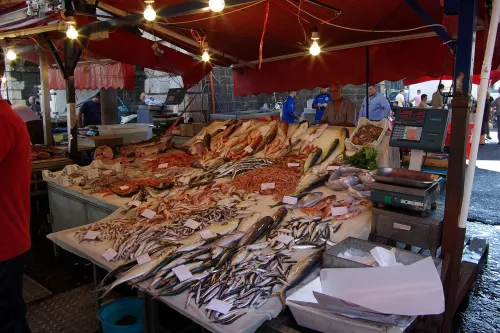
    Fish market of Catania (Pescheria di Catania)

    Fish market of Catania (Pescheria di Catania) in Catania, stop 11 on the self-guided walking tour

    Finish loud. Tucked into the arches behind the Duomo, Catania's centuries-old fish market is the best free show in the city. You hear it before you see it: vendors bellowing prices, knives on chopping blocks, water sluicing over stone, swordfish heads on display and buckets of sea urchins and clams. It has been here since at least the early 1800s, in a tunnel cut under the old Charles V walls. Go in the morning, it runs roughly 7am to 2pm and is closed Sunday, with Wednesday wrapping up earlier around 1pm, so the energy fades by lunch. Entry is free. Walk through slowly, watch your footing on the wet lava cobbles, and do not be shy about the smell. Grab a plate of fried fish or a fresh sea-urchin tasting from one of the stalls. Then step back up to the Duomo square where you started, by the elephant.

    Hours
    Mon-Tue: 7:00 AM – 2:00 PM | Wed: 7:00 AM – 1:00 PM | Thu-Sat: 7:00 AM – 2:00 PM | Sun: Closed
    Price
    Free

How Long Does This Walking Tour Really Take?

The pure walking is under two hours across 5km, but the stops decide your day. The Benedictine monastery swallows a full hour on the guided tour and Castello Ursino about 45 minutes inside, while the square, Via Etnea and both markets are walk-throughs you linger in as long as you like.

Walked briskly with no stops, the loop is about 5km and takes under two hours. Realistically, with interiors and a coffee, give it a half day, four to five hours. The stops that eat time are the Benedictine monastery (a full hour if you take the guided tour) and Castello Ursino (45 minutes inside the museum). The markets, the square and Via Etnea are walk-throughs, however long you let yourself linger.

Build your break into Villa Bellini, which is the natural midpoint. Find a bench on the upper terrace, eat a gelato, and look back down Via Etnea toward Etna before you carry on. If you want a sit-down coffee instead, the historic cafes on Via Etnea near Piazza Stesicoro do a proper granita-and-brioche for a few euros. End at La Pescheria around late morning when it is still in full swing, then collapse at a terrace on Piazza del Duomo with a beer.

Full Route, Shorter Walk or Two-Day Version?

The full loop is the default, but the per-leg distances let you trim it cleanly. Below are three ways to walk it depending on how much time and energy you have, all starting from Piazza del Duomo.

The Short Core

The central highlights without the long western legs

Stops 1 to 8, then back to 11, about 3km, two to three hours

Cuts the two longest legs, the 1160m walk to the monastery and the 860m to the castle. You keep the cathedral cluster, the opera house, Via Etnea, both markets and Villa Bellini, then drop straight back to La Pescheria. Ideal if you have only a morning or want to keep the walking light.

The Two-Part Split

Old town first, monastery and castle later

Day one stops 1 to 8 and 11; day two stops 9 and 10, easy half-days

Split at Villa Bellini, the natural midpoint. Do the cathedral square, Via Etnea, the markets and park on one visit, then return fresh for the Benedictine monastery and Castello Ursino, which each reward an unhurried hour. Good if you dislike the 14-minute march west or are travelling with children.

You can run the loop in reverse, starting at La Pescheria and ending back at Piazza del Duomo, and the walking works either way. The recommended direction is chosen so you hit both food markets while they are still busy in the morning and finish beside the elephant fountain where you began.

Is This Catania Walking Tour Right for You?

This is a compact, market-heavy city walk on hard lava stone. It suits some travellers perfectly and asks others to adapt a little, so here is who it fits and how to adjust it.

A good fit if you…

  • Walkers comfortable with about 5km on flat cobbled streets over a half day
  • Food-curious visitors who want both the Fera 'o Luni street market and the La Pescheria fish market in one loop
  • Independent travellers who prefer choosing their own interiors over a fixed guided timetable
  • Anyone who wants a tight centre where nearly everything sits within a 20-minute walk of one square

Adapt the route if you…

  • You have knee or mobility issues: skip the narrow dome climb at Badia di Sant'Agata and the monastery stairs
  • You are short on time: use the Short Core version and drop the monastery and castle legs
  • You dislike crowds and noise: come before 10am for calm squares and quieter markets
  • You are travelling on a Sunday: both markets are closed, so reorder around the churches, park and castle instead

Tickets & Skip-the-Line in Catania

Most of this loop is free open space, so there is almost nothing to pre-book. A handful of interiors charge admission, and the practical points below are the hours and prices that actually catch people out. Where a stop has an official website, buy or check there rather than through a reseller.

Terme Achilliane€5 through the Diocesan Museum. Hours are tight and split: roughly 9:00 AM to 1:00 PM most days, with afternoon openings (3:00 to 5:30 PM) only on Tuesday and Thursday, so come in the morning to be safe. official ticket site ↗
Badia di Sant'Agata (Chiesa della Badia di Sant'Agata)€5 for the dome-terrace climb. Open daily from 9:30 AM, later on weekends (until 8:00 PM Sunday). Narrow stairs and no lift, so skip it if knees are a problem. official ticket site ↗
Teatro Massimo Bellini (Teatro Massimo Vincenzo Bellini)€6.50 for the interior tour, Tuesday to Saturday only, 9:30 AM to 1:00 PM. Closed Monday and Sunday, so on those days just admire the facade. official ticket site ↗
Benedictine Monastery of San Nicolo l'ArenaThe courtyards and church are free; the full guided visit into the lava-floor kitchens, cloisters and rooftop is €9, daily 9:30 AM to 5:00 PM. Worth the hour if you have it.
Castello Ursino€8 for the civic museum, open daily 9:00 AM to 7:00 PM. The courtyard and lava-stone walls are the best part; circle the exterior for free if museums tire you. official ticket site ↗
Everything elsePiazza del Duomo, the Cathedral of Saint Agatha, Via Etnea, Fera 'o Luni, Villa Bellini and La Pescheria are all free open spaces with no ticket needed. Note the two markets close Sunday and wind down by early afternoon.
Optional upgrade
+7
The same 11-stop route,
now with navigation and a guide.
Optional AI experience

You already have the route.
The AI guide brings it to life.

Standing by the lava-stone elephant in Piazza del Duomo right now? Open AI Tourguide in your browser, no app and no download, and a voice guide walks the whole loop with you, greeting you, telling the story from the underground Roman baths to the fish market and Via Etnea and asking what you want to see so it adapts as you go. A real conversation, not a recording. Start with 100 free credits.

Livenavigation13languagesAnyquestionYourinterests
Open this route with the AI guide

Try it in your browser · No app or download required

Tips for Walking in Catania

  • Start by 9am from Piazza del Duomo. The fish market (La Pescheria) and Fera 'o Luni both wind down by early afternoon and close Sunday, so an early start is the difference between seeing them alive or seeing empty stalls. From the airport, the Alibus runs to the centre in about 20 minutes.
  • Wear flat shoes with grip. The whole old town is paved in black lava cobbles, often wet and slick around the markets, and the dome and monastery stairs are uneven stone. No heels, no smooth soles.
  • Public toilets are scarce. Use the facilities inside the Benedictine monastery if you take the tour, or buy a coffee at a Via Etnea cafe and use theirs. Do not count on the markets having anything usable.
  • For breakfast, get a granita with brioche at one of the historic pasticcerie on Via Etnea: almond or pistachio, a couple of euros standing at the bar. At La Pescheria, try a plate of fried fish or fresh sea urchin straight from a stall.
  • Best photo is from the upper terrace of Villa Bellini in the late afternoon, facing south down Via Etnea with Etna behind you in golden light. For the elephant fountain, shoot early morning before the crowds fill Piazza del Duomo.

Why Walk This Route?

Catania is a black city. The whole centre is built from lava, hauled down off Etna after the volcano and the 1693 earthquake flattened the place. The result is a Baroque old town in dark grey stone, dense and compact, and almost everything worth seeing sits within a 20-minute walk of one square. That square, Piazza del Duomo, is where this route starts and ends. You do not need buses or a car. You need decent shoes and a tolerance for noise.

This loop is roughly 5km of actual walking and it threads the real Catania, not a sanitised version. It runs from the cathedral and its lava-stone elephant up the long straight spine of Via Etnea to the city's biggest park, then doubles back west to the gigantic Benedictine monastery and the Swabian castle, and finishes inside the fish market, which is the loudest and best thing in town. The order matters. Doing it as a loop means you hit the two food markets at the right moments and end near where you started, by the elephant.

Wandering Catania at random works, but you will miss the underground Roman baths hidden under the Duomo, you will not know the monastery courtyards are open to anyone, and you will probably skip the fish market because it looks like chaos. Follow this and you get all of it in the right sequence, with the right things to skip.

Common Questions

Is Catania safe to walk around?

Yes, the old town and this whole route are fine to walk by day. Catania has a reputation for petty theft, so keep your phone and wallet secure in the market crush at La Pescheria and Fera 'o Luni, where pickpockets work the crowds. The rose and bracelet sellers around the elephant fountain are a nuisance, not a danger; a firm no is enough. After dark the area around the station and some side streets feel rougher, so stick to Via Etnea and the main squares at night.

What if it rains during my Catania tour?

Plenty on this route is indoor or covered. The Cathedral of Saint Agatha is free and dry, the Terme Achilliane are literally underground, and both Castello Ursino and the Benedictine monastery give you an hour each under a roof. La Pescheria runs in covered arches and keeps going in light rain. Skip Villa Bellini and the dome terrace at Badia di Sant'Agata in heavy rain, and duck into a Via Etnea cafe for a granita while it passes.

What's the best time of day for this walking tour?

Start around 9am. The two food markets are at full pitch in the morning and close by early afternoon, the cathedral is open before its long lunch break, and the light on the black-and-white Baroque facades is best before midday. Save Villa Bellini for the late-afternoon stretch when the volcano view down Via Etnea is at its best and locals fill the park.

Take this route with you

Open this exact tour with navigation and your personal AI guide.

Start GPS Navigation + AI Guide
AI Tourguide
Researched and curated by the AI Tourguide teamWe plan and quality-check every route, then research and verify the opening hours, prices, and practical tips for each stop along it.
▶ Open route with AI guideNavigation, stories and your questions