Best Time to Visit Bratislava
Month-by-month weather, crowds and prices, plus a full calendar of festivals and events worth planning a trip around.
Best monthsMay, Sep
CheapestJan, Feb, Mar, Nov
AvoidJan
BusiestJul, Aug
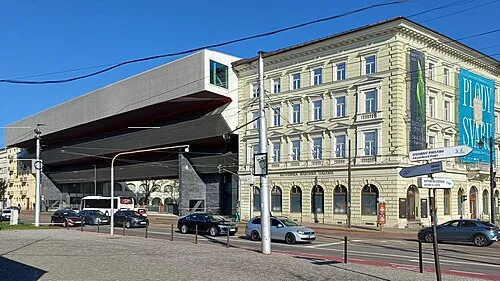
When is the best time to visit Bratislava?
Come in May or September. May gives you the year's best walking weather at 20°C and the City Days festival, September brings warm 22°C days, far fewer people than August and the start of the Music Festival. July and August are hottest and busiest, January is the cheapest at roughly 64 euros a night but cold and grey.
Start our tool and find your best time to visit Bratislava
Your perfect month
Free · ~30 seconds
or tap a month directly
What matters to you?
And this?
Best overall: May, Sep. May and September are the real answer: 20 to 22°C, the Old Town and Danube promenade fully open, and either spring blossom or the start of autumn's classical-music season. May runs the priciest hotels of the year, so September is the smarter pick if cost matters.
Best value: Apr, Oct, Nov. April, October and late November give you mild walking weather, 25 to 40 percent off the May rates, and far thinner crowds than summer. October still has festivals (Jazz Days, the Music Festival) while costing a third less than spring.
Avoid: Jan. January is the month to skip unless you only care about price. The markets ended on 3 January, days are barely nine hours long, skies are grey at 0 to 5°C, and the cultural calendar is close to empty. The cheap 64 euro rooms are the one redeeming feature.
- January: Tough month, 4°C. This is the one month you walk the Old Town without dodging a single tour group. It is genuinely cold and the energy is low, post-holiday and pre-spring, but if you want the city stripped back to locals and silence, January delivers exactly that and almost nothing else.
- February: Good time, 7°C. February is real-city Bratislava in winter mode, no show put on for tourists. The Fašiangy carnival weekend is the one afternoon you see locals visibly let loose in the squares, costumes and all, before the city settles back into Lenten quiet.
- March: Great time, 12°C. March is the last genuinely quiet month before spring fills the squares. The weather is a gamble and the mood is transitional, but you still get the castle, the Old Town and a riverside walk almost to yourself. That window closes fast in April, so use it.
- April: Great time, 16°C. April is when the city wakes up and it feels like a reward after the grey months. Outside the Easter weekend it is still affordable and uncrowded, with blossom on the riverbanks and terraces reopening. It is the smart shoulder pick before May prices kick in.
- May: Good time, 20°C. Everyone calls May the sweet spot, and the weather earns it, but it is no secret: this is peak season with peak prices. The City Days festival and full terraces make it genuinely lively rather than overrun, so come anyway, just book early and expect company at every sight.
- June: Good time, 26°C. June is the tipping point where Bratislava shifts into full summer mode. Midday can be hot and busy, but the redeeming feature is the long evening: 9pm light, riverside bars open, and the city genuinely coming alive once the heat eases off.
- July: Good time, 28°C. July is hot and crowded, and midday in the Old Town is a write-off. But the Coronation Days weekend transforms the centre into a costumed historical spectacle, and the long, balmy evenings along the Danube are the city at its summer best. Plan around the heat and it pays off.
- August: Good time, 27°C. August is the peak of the peak, hot and packed, but it never feels deserted the way Mediterranean cities do in summer. The festival energy and lakeside swimming give it a real buzz. Just accept the heat and the crowds, or aim for the cooler edges of the day.
- September: Great time, 22°C. September is the local secret that actually delivers: summer warmth without the summer crush. Restaurants feel intimate again, the light turns golden over the castle, and the Music Festival adds sophistication. For couples and value-seekers, this beats May on every count but the calendar's prestige.
- October: Great time, 16°C. October is the underrated value month: real festivals, fall colour, and prices well below spring. It is cooler and the evenings draw in, but a crisp golden afternoon walking the Old Town and the riverside, with a jazz set in the evening, is hard to beat for the money.
- November: Good time, 10°C. Early-to-mid November is the year's other deep-quiet window, grey and flat but genuinely cheap and empty. From 27 November the city flips: the Christmas markets open and the squares come alive. Time your visit to either side depending on whether you want solitude or sparkle.
- December: Tough month, 5°C. December is Bratislava at its most festive: compact, walkable markets with real charm and none of the scale-overload of bigger cities. The catch is the day-tripper crowds and the dead-stop closures on 24 to 26 December, when much of the city beyond the markets shuts down.
Bratislava weather by month
HighLowRainfall
Jan4°
Feb7°
Mar12°
Apr16°
May20°
Jun26°
Jul28°
Aug27°
Sep22°
Oct16°
Nov10°
Dec5°
| Month | Temp | Rain | Sun | Crowds | Prices | Highlight |
|---|---|---|---|---|---|---|
| Jan | 4° / -2° | 39mm · 10 rainy days | 4.4 h/day | ●○○○○ | ●○○○○ | Christmas Markets |
| Feb | 7° / 0° | 37mm · 9 rainy days | 6.3 h/day | ●○○○○ | ●○○○○ | Carnival Festivities |
| Mar | 12° / 2° | 25mm · 6 rainy days | 8.6 h/day | ●●○○○ | ●○○○○ | |
| Apr | 16° / 6° | 43mm · 9 rainy days | 10.1 h/day | ●●●○○ | ●●○○○ | |
| May | 20° / 11° | 74mm · 12 rainy days | 10.6 h/day | ●●●●○ | ●●●○○ | Bratislava City Days |
| Jun | 26° / 16° | 59mm · 10 rainy days | 12.9 h/day | ●●●●○ | ●●●○○ | Viva Musica! Festival |
| Jul | 28° / 18° | 57mm · 10 rainy days | 12.5 h/day | ●●●●○ | ●●●○○ | Viva Musica! Festival |
| Aug | 27° / 17° | 69mm · 9 rainy days | 11.4 h/day | ●●●●● | ●●●○○ | Viva Musica! Festival |
| Sep | 22° / 13° | 75mm · 9 rainy days | 9.4 h/day | ●●●○○ | ●●○○○ | Bratislava Music Festival |
| Oct | 16° / 8° | 56mm · 9 rainy days | 6.9 h/day | ●●●○○ | ●●○○○ | Bratislava Music Festival |
| Nov | 10° / 4° | 50mm · 9 rainy days | 4.8 h/day | ●●○○○ | ●○○○○ | Christmas Markets |
| Dec | 5° / 0° | 50mm · 10 rainy days | 4.1 h/day | ●●●○○ | ●●○○○ | Christmas Markets |
How we score this: weather = long-run climate normals (Open-Meteo), crowds & prices = relative season read, events checked yearly against official dates.
Best time to visit Bratislava: weather, prices & crowds
Best months for good weather
May, Jun, Sep
May and September are the comfortable sweet spot: 20 to 22°C, long evenings, and the Old Town walkable all day without the airless 28°C afternoons of high summer.
Quietest months to avoid the crowds
Jan, Feb, Mar, Nov
January through March and early November are genuinely quiet: no festivals, no day-tripper coaches from Vienna, and you can stand alone on the castle terrace at sunset.
Cheapest time to visit Bratislava
Jan, Feb, Mar
January is the cheapest month at around 64 euros a night, roughly 30 percent below summer, with February and March still 20 to 35 percent under the May peak.
Best time for festivals and events
Jul, Dec
Late July brings the free Coronation Days reenactment of a Habsburg crowning through the Old Town, and from late November the Hlavné Námestie Christmas market runs daily 10am to 10pm with mulled wine and gingerbread.
How many days do you need in Bratislava?
Two days is the comfortable choice for Bratislava. The compact Old Town and castle can be covered in one determined day, but a second gives you room to linger on the Danube promenade, explore the galleries and catch an evening at a riverside terrace rather than rushing between sights.

One day
Old Town and castle in a single loop
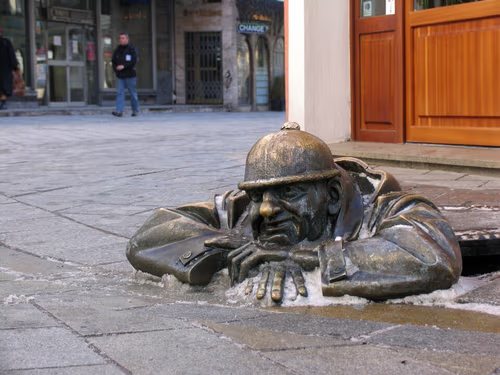
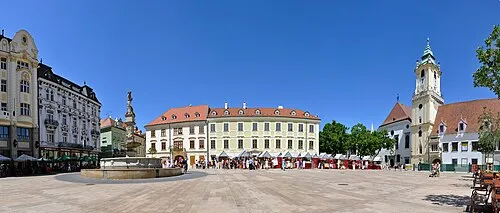
Start at the Slovak National Gallery on the Danube embankment, then follow the medieval walls to St. Martin's Cathedral and climb to Bratislava Castle for a three-country view over Slovakia, Austria and Hungary. Loop back through the Old Town via Michael's Gate, the Main Square with the Cumil statue peeking from his manhole at the corner of Panska and Rybarska Brana, and finish on Hviezdoslav Square. The self-guided Bratislava walking tour covers all 10 stops across 6.2 km in around 2.8 hours, leaving the afternoon free for a cafe stop at the Primate's Palace courtyard.
Two daysRecommended
Galleries, the Blue Church and a slow Danube evening
Use the second day for what the first one skipped: the Art Nouveau Blue Church on Bezrucova Street, the Slovak National Gallery's permanent collection, and the Grassalkovich Palace gardens. By late afternoon walk the Danube embankment south toward the UFO Bridge, grab a table at one of the riverside bars that open from late May, and watch the castle light up at dusk. Two days lets the city breathe instead of feeling like a checklist.
Three days
Devín Castle day trip and a concert night
A third day is best spent out of the city centre. Bus 29 from the Old Town takes you to Devín Castle in under 30 minutes, a ruined clifftop fortress at the Slovak-Austrian border with river views that reward the journey. Back in the city, the evening is the point: the Bratislava Music Festival (late September to mid-October) or a Viva Musica! concert (late May to August) at the Reduta gives the trip a cultural anchor that shorter visits miss.
Four days or more
Wine country, festivals and a deeper Slovak mood
Four or more days opens the Small Carpathians wine region just north of the city: the villages of Modra and Pezinok are reachable in under an hour and their wine cellars are open to visitors, especially during the September harvest. In summer, the Zlaté Piesky lake southeast of the city adds outdoor swimming to the mix. Festival timing makes a big difference at this length: Coronation Days in late July or the Uprising Festival at the lakeside in late August gives the trip a centrepiece that pure sightseeing cannot match.
Best time to visit Bratislava by traveller type
Same city, different trip. Here's the month that fits how you're travelling.
🧭
Best time to visit Bratislava for the first time
MaySep
May or September: the textbook best-overall answer, with 20 to 22°C, every sight open, and the City Days festival or the Music Festival adding atmosphere to a first visit.
❤️
Best time to visit Bratislava for couples
MaySepOct
May for spring blossom and 9pm sunsets along the Danube, or September into early October for warm golden evenings, intimate restaurants and the classical Music Festival.
💶
Best time to visit Bratislava on a budget
JanFebMar
January through March are the cheapest stretch, with rooms 20 to 35 percent below peak and free year-round events like the Old Town's Fašiangy carnival in February.
🍝
Best time to visit Bratislava for food and wine
MaySepDec
May and June for the Saturday farmers' markets piled with strawberries and asparagus, September and October for the Slovak wine harvest, or December for medovina honey wine and gingerbread at the Christmas markets.
Worst time to visit Bratislava
January is the month most visitors should skip. The Christmas markets close on 3 January, leaving the main squares feeling hollow, and the cultural calendar runs close to empty through the rest of the month. Daytime highs sit near 4°C with grey skies and barely nine hours of daylight, making outdoor sightseeing genuinely uncomfortable rather than just chilly. Early to mid November shares the same flat energy before the markets open on 27 November.
Still worth it for January works well for budget travellers who want the city essentially to themselves: hotel rates hit their year-low at around 64 euros a night, the castle terraces are deserted, and bryndzové halušky and goulash in a warm Old Town pub are their own reward.
Go instead in May, September, when Bratislava is at its best.
Best time for a tour of Bratislava
Bratislava is a compact city built for walking, and the calendar decides whether the 6.2 km loop is a joy or a slog. The sweet spots are May, September, and early October, when highs sit around 20 to 22 °C and the steep cobbled climb up to Bratislava Castle and the run past St. Martin's Cathedral feels easy rather than punishing. Spring and autumn also mean smaller crowds, so you can actually photograph Cumil, the little bronze Man at Work peeking out of his manhole, without queueing behind a stag party. High summer is the catch: July and August push 27 to 28 °C, and the open expanse of Hlavne Namestie and the riverside near Hviezdoslav Square offer almost no shade by midday. Winter is the hard end, January barely scrapes 4 °C with lows near minus 2, ten rainy days, and the light gone by late afternoon, though the empty squares have their own quiet charm. Watch May too: it is the wettest month at twelve rain days, so pack a layer.
The beauty of doing this on foot with AI Tourguide is that the climate sets your hour, not an operator's timetable. It runs entirely in your browser, no app and no download, so on a baking August day you can start your Bratislava tour at eight in the morning, climb to the castle while the stone is still cool, and pause for coffee on Main Square before the heat lands. A voice-first guide leads the whole way, tells you the story behind Michael's Gate, asks what you want to see next, and adapts the route to your pace. You keep full control while it talks with you, the way a 200 € private guide would, minus the fixed departure.


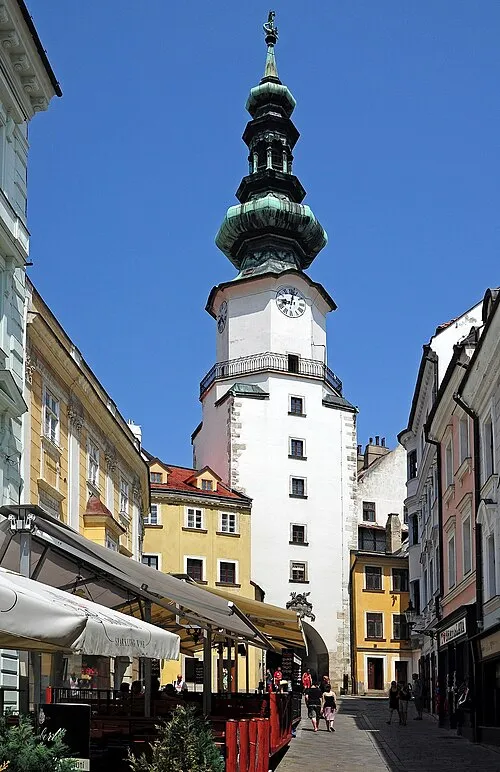 +6
+6All 10 stops are already on the map.
You just press start.
You just press start.
 AI Tourguide
You just read the route.
Now walk it with a guide in your ear.
Press start wherever you are, even hundreds of kilometres from Bratislava, and the guide begins telling its stories right away. In the city, pick any of the 10 stops to start from: it leads you there, then talks with you the whole route, asking, listening, remembering, and shaping the tour around your answers.
10stops6.2km2.8hours11languages
▶Start the tour freeFree to start · Runs in your browser · No app, no download
Bratislava events and festivals calendar
Annual highlights worth timing a trip around, listed month by month.
February
🎭 CarnivalCarnival Festivities Fašiangy
Feb 7 ~
the Saturday before Lent, usually February
The pre-Lenten carnival fills the Old Town with masked processions, costumes and singing groups on the Saturday before Ash Wednesday, typically in February.
May
🎉 FestivalBratislava City Days Bratislavské dni
May 23–25
late May
A multi-day street festival in the Old Town with free concerts, folk performances, craft demonstrations and historical reenactments.
🎵 MusicViva Musica! Festival
May 28 – Aug 6
late May to early August
A summer-long series of classical and contemporary concerts with world premieres and renowned international artists across multiple venues.
July
🎉 FestivalCoronation Days Korunovácia
Jul 24–26
late July
A weekend reenactment of a Maria Theresa coronation, with knight tournaments, royal processions from the castle to the main square and guided historical walks.
August
🎵 MusicLovestream Festival
Aug 7–9
early August
A multi-genre festival with major international headliners across recent editions, from Robbie Williams to OneRepublic and Post Malone.
🎵 MusicUprising Festival
Aug 28–29
late August
Europe's largest reggae and urban music festival, with 100-plus artists across seven stages of roots reggae, dancehall and drum and bass at the Zlaté Piesky lakeside.
September
🎵 MusicBratislava Music Festival Bratislavský hudobný festival
Sep 23 – Oct 11
late September into October
A prestige autumn festival of classical, contemporary and symphonic concerts opening in late September with special programmes and world-class soloists at the Reduta, running into mid-October.
October
🎵 MusicBratislava Jazz Days Bratislavské jazzové dni
Oct 23–25
late October
A three-day international jazz festival with showcases across multiple venues over a single weekend in late October, one of Central Europe's longest-running jazz events.
November
🎄 Christmas marketChristmas Markets Vianočné trhy
Nov 27 – Jan 3
late November to early January
Markets on Hlavné Námestie, Primaciálne Námestie and Franciscan Square run daily 10am to 10pm with decorations, mulled wine, gifts and local crafts.
Insider tips for visiting Bratislava
The rules buried in forums, in one place.
- Book hotels four to six weeks ahead for the May and June peaks. By August, last-minute availability collapses by more than 80 percent as summer holidays and festivals stack up.
- From 10am to 2pm in summer the pedestrian streets of the Old Town are a tourist crush. Climb to Bratislava Castle and its gardens, or slip into side streets like Laurinská and Židovská in the afternoon when the coaches thin out.
- At the Christmas markets (late November to 3 January), arrive Tuesday to Thursday between 10 and 11am for parking and walkable space. From 23 to 25 December and around New Year, Vienna and Budapest day-trippers push the squares past 50,000 people a day.
- Most museums close on Mondays, the standard Central European pattern. Check each one before you build a Monday itinerary, since the exceptions are not consistent.
- Tickets for the Bratislava Music Festival (late September into October) grow scarce three weeks out. The Reduta box office sells them on weekday afternoons from noon to 6pm.
- Time your photos for the golden hour, roughly 6 to 7am or 6 to 7pm year-round, when the castle and Hlavné Námestie glow without the harsh midday shadows.
- A single transit ride is about 0.80 euros and valid for 60 minutes, a day pass around 4.70 euros, covering buses, trams and trolleybuses. There is no separate tourist-fare trap to avoid.
- The Danube embankment bars open from late May to September. In the April and October shoulder they often run weekends only, so don't count on a riverside evening drink outside the warm months.
Public holidays in Bratislava
On these dates many shops and offices close, transport thins out, and sights can be mobbed or shut. Plan around them.
| Date | Holiday | What closes |
|---|---|---|
| Jan 1 | New Year's Day | Banks and government offices close and streets are quiet in the early morning. Most shops and sights open later, and restaurants stay busy with holiday diners. |
| Jan 6 | Epiphany | Limited impact: some schools close but tourist sights stay open. The Christmas market on Hlavné Námestie has just wrapped up, on 3 January. |
| Apr 3 | Good Friday | Public holiday opening a four-day Easter break: churches fill, some shops close, eateries stay open. Restaurants get heavily booked through the weekend. |
| Apr 7 | Easter Monday | Public holiday closing the Easter break. Many family-run places shut, restaurants are packed and best reserved ahead. Castle and Old Town draw spring visitors. |
| May 1 | Labour Day | Public holiday: shops close but outdoor markets and street celebrations run. Falls in the busy, expensive May peak, so book accommodation early. |
| Jul 5 | St. Cyril and Methodius Day | National holiday honouring the patron saints. It lands on a Sunday, so churches and sights stay open as usual and the impact on a visit is minimal. |
| Aug 29 | Slovak National Uprising Anniversary | National holiday with parades and memorials. Shops and banks close but eateries stay open. It coincides with the Uprising Festival the same weekend. |
| Sep 1 | Constitution Day | National holiday with limited government services. Most shops and sights stay open, so the day has little effect on sightseeing. |
| Nov 1 | All Saints' Day | Public holiday: locals visit cemeteries and many shops close, with banks and offices also off on 2 November. Restaurants stay open and the city is quiet. |
| Nov 17 | Struggle for Freedom and Democracy Day | National holiday marking the 1989 revolution, with memorial ceremonies. Sights stay open, falling just before the Christmas markets begin on 27 November. |
| Dec 24 | Christmas Eve | Public holiday: most shops close after noon and restaurants close around 2 to 3pm for family gatherings, opening a four-day Christmas break. |
| Dec 25 | Christmas Day | Public holiday: virtually everything closes apart from emergency services. The Christmas market on the main squares is one of the few things still running. |
| Dec 26 | Boxing Day | Public holiday and a family day: shops stay closed. The Christmas market continues, drawing day-trippers from Vienna and Budapest through the holiday week. |
Bratislava month by month
January in Bratislava
High4°C / 39°F
Low-2°C
Rain39mm / 10 rainy days
Sun4.4 h/day
Daylight9 h/day
Humidity82%
Crowds●○○○○Prices●○○○○
January is Bratislava at its quietest and cheapest. Daytime highs sit near 4°C and skies stay grey, with about ten days of light rain or snow and barely nine hours of daylight. The Christmas market closed on 3 January, so the squares feel hollow and the cultural calendar runs close to empty. The upside is real solitude: castle terraces and Old Town lanes you can have to yourself, and the lowest hotel rates you will find all year.
The vibe This is the one month you walk the Old Town without dodging a single tour group. It is genuinely cold and the energy is low, post-holiday and pre-spring, but if you want the city stripped back to locals and silence, January delivers exactly that and almost nothing else.
Don't miss Thermal baths and indoor pools stay open through winter, the warm escape locals use. The castle terrace at dusk, lit and almost empty, is the month's quiet reward.
Crowd drivers Nothing drives crowds once Epiphany passes on 6 January: no markets, no festivals, no Vienna day-trip coaches.
In season Hearty Slovak winter cooking is the move: bryndzové halušky (sheep-cheese dumplings) and goulash in a warm Old Town pub beat sightseeing in the cold.
Heads up 1 and 6 January are holidays with banks and many shops shut. Most museums close on Mondays year-round.
Cheapest month of the year: rooms around 64 euros a night, roughly 30 percent below summer.
February in Bratislava
High7°C / 45°F
Low0°C
Rain37mm / 9 rainy days
Sun6.3 h/day
Daylight10 h/day
Humidity77%
Crowds●○○○○Prices●○○○○
February stays cold, with highs around 7°C and short, often grey days. Crowds are still at their winter minimum and prices sit 20 to 35 percent below peak. The one burst of life is Fašiangy, the pre-Lenten carnival, with masked processions and singing groups through the Old Town on the Saturday before Lent. Otherwise this is a slow, honest, unperformed Bratislava with no seasonal markup and no queues anywhere.
The vibe February is real-city Bratislava in winter mode, no show put on for tourists. The Fašiangy carnival weekend is the one afternoon you see locals visibly let loose in the squares, costumes and all, before the city settles back into Lenten quiet.
Don't miss Catch the masked Fašiangy processions on carnival Saturday in the Old Town, the last big street celebration before Lent. Indoor thermal baths remain the cosy winter alternative.
Crowd drivers Only the Fašiangy carnival weekend pulls extra visitors, mostly families, and even that stays far below peak season.
In season Carnival means fried dough: šišky (Slovak doughnuts) and other Fašiangy pastries appear at bakeries and market stalls through the week.
Heads up No public-holiday closures this month, but museums keep their usual Monday closing day.
Low season: 20 to 35 percent below the May peak, with a mild spike on Carnival weekend.
Events this month
🎭 CarnivalCarnival Festivities Fašiangy
Feb 7 ~
the Saturday before Lent, usually February
The pre-Lenten carnival fills the Old Town with masked processions, costumes and singing groups on the Saturday before Ash Wednesday, typically in February. Dates shift each year with the Easter calendar.
It is the last big street celebration before Lent and the one winter weekend you see locals let loose, a lively, family-friendly burst in an otherwise quiet month.
March in Bratislava
High12°C / 53°F
Low2°C
Rain25mm / 6 rainy days
Sun8.6 h/day
Daylight12 h/day
Humidity68%
Crowds●●○○○Prices●○○○○
March is the unpredictable hinge between winter and spring, with highs climbing toward 11°C and only about six rainy days, the driest stretch of the year. Crowds stay modest and prices low. The weather swings day to day, from crisp sun to cold grey, so pack layers. School holidays start ramping up across Europe toward the Easter break, but the city itself is still calm and the markets and terraces have not yet filled.
The vibe March is the last genuinely quiet month before spring fills the squares. The weather is a gamble and the mood is transitional, but you still get the castle, the Old Town and a riverside walk almost to yourself. That window closes fast in April, so use it.
Don't miss With the year's fewest rainy days, March is prime for a long Danube embankment walk and a day trip out to Devín Castle as the surrounding hills start to green up.
Crowd drivers European school holidays ramp toward the early-April Easter break, but the surge has not hit the city yet.
In season The first spring produce reaches the Saturday markets near the main square, the early turn from heavy winter fare toward fresh greens.
Heads up No public holidays this month; museums keep their Monday closures.
Still 20 to 35 percent below peak; rates begin nudging up if Easter approaches in early April.
April in Bratislava
High16°C / 61°F
Low6°C
Rain43mm / 9 rainy days
Sun10.1 h/day
Daylight14 h/day
Humidity64%
Crowds●●●○○Prices●●○○○
April brings spring properly to Bratislava: highs around 16°C, blossom starting in the parks and along the riverbanks, and longer 13 to 14 hour days. Crowds pick up over the four-day Easter break (Good Friday 3 April to Easter Monday 7 April), when family-run places close and restaurants book out. Outside the holiday weekend it stays pleasantly manageable, a good-value alternative to the May peak with much of the same fresh, open-air feel.
The vibe April is when the city wakes up and it feels like a reward after the grey months. Outside the Easter weekend it is still affordable and uncrowded, with blossom on the riverbanks and terraces reopening. It is the smart shoulder pick before May prices kick in.
Don't miss Spring blossom opens along the Danube and in the city parks. Exploring Bratislava Castle and its gardens over Easter means shorter waits than the coming summer crush.
Crowd drivers The Easter break (3 to 7 April) and the school holidays around it across much of Europe drive the month's one real crowd spike.
In season Easter brings traditional Slovak fare: smoked ham, horseradish and braided sweet bread on family tables and at holiday menus around the city.
Heads up Good Friday (3 April) and Easter Monday (7 April) are holidays: many shops and family restaurants close, so reserve ahead for the weekend.
Moderate rise, 10 to 15 percent above winter, with an Easter-weekend spike (3 to 7 April).

May in Bratislava
High20°C / 68°F
Low11°C
Rain74mm / 12 rainy days
Sun10.6 h/day
Daylight15 h/day
Humidity67%
Crowds●●●●○Prices●●●○○
May is widely the best month to visit: 20°C highs, perfect walking weather, blossom everywhere and over 15 hours of daylight. It is also the single busiest month for tourists and the most expensive, with European spring breaks and EU school holidays overlapping. The City Days street festival fills the Old Town late in the month, and the Viva Musica! Festival opens on 28 May. Showers come as short 12-day bursts, not all-day rain, so an umbrella covers you.
The vibe Everyone calls May the sweet spot, and the weather earns it, but it is no secret: this is peak season with peak prices. The City Days festival and full terraces make it genuinely lively rather than overrun, so come anyway, just book early and expect company at every sight.
Don't miss Late-May City Days bring free concerts, folk performances and historical reenactments to the Old Town. From 28 May the Viva Musica! Festival opens a summer-long run of classical and contemporary concerts.
Crowd drivers European spring breaks, EU school holidays and the City Days festival all land at once, making May the busiest tourist month of the year.
In season Strawberries and asparagus pile up at the Saturday farmers' markets near the main square, and castle restaurants roll out spring menus.
Heads up Labour Day (1 May) closes shops, though outdoor markets and street celebrations run.
Most expensive month: hotel rates run about 137 percent above winter, averaging near 443 euros at the top end.
Events this month
🎵 MusicViva Musica! Festival
May 28 – Aug 6
late May to early August
A summer-long series of classical and contemporary concerts with world premieres and renowned international artists across multiple venues.
It threads exceptional music right through peak season, so almost any summer visit can be built around a high-calibre concert night.
🎉 FestivalBratislava City Days Bratislavské dni
May 23–25
late May
A multi-day street festival in the Old Town with free concerts, folk performances, craft demonstrations and historical reenactments.
Free street food, live music and no cover charge make it an easy, family-friendly way to feel the city at its liveliest in peak spring.

June in Bratislava
High26°C / 78°F
Low16°C
Rain59mm / 10 rainy days
Sun12.9 h/day
Daylight16 h/day
Humidity64%
Crowds●●●●○Prices●●●○○
June kicks off summer warm and bright, with highs around 26°C, the year's longest days at 16 hours and the Danube warming toward swimmable. Many European school holidays begin, so crowds stay high. It is hot but not punishing, rarely topping 32°C, with riverside parks and shaded Old Town lanes for relief. The long evenings are the draw: sunset near 9pm and the Danube embankment bars in full summer swing.
The vibe June is the tipping point where Bratislava shifts into full summer mode. Midday can be hot and busy, but the redeeming feature is the long evening: 9pm light, riverside bars open, and the city genuinely coming alive once the heat eases off.
Don't miss The Danube embankment bars and terraces are in full swing, and Zlaté Piesky lake becomes swimmable as the water nears 18°C, the local summer escape just south of the city.
Crowd drivers School breaks across many EU countries start, and the summer-kickoff weather keeps hotel demand and prices high.
In season Peak strawberry and early-summer produce season fills the markets, the best window for the Thursday and Saturday farmers' stalls near the main square.
Heads up No major public-holiday closures this month; museums keep their Monday closing day.
Peak rates hold, roughly 30 to 40 percent above the January to February low.
Events this month
🎵 MusicViva Musica! Festival
May 28 – Aug 6
late May to early August
A summer-long series of classical and contemporary concerts with world premieres and renowned international artists across multiple venues.
It threads exceptional music right through peak season, so almost any summer visit can be built around a high-calibre concert night.
July in Bratislava
High28°C / 82°F
Low18°C
Rain57mm / 10 rainy days
Sun12.5 h/day
Daylight16 h/day
Humidity61%
Crowds●●●●○Prices●●●○○
July is the warmest month, with 27 to 30°C afternoons and worldwide school holidays packing the Old Town. The pedestrian streets are a tourist crush from 10am to 2pm, so the trick is to walk early, from 6 to 9am, or in the cooler evening. The highlight is the free Coronation Days festival (24 to 26 July), reenacting a Maria Theresa crowning with knight tournaments and royal processions from the castle to the main square. Showers are brief afternoon bursts, not washouts.
The vibe July is hot and crowded, and midday in the Old Town is a write-off. But the Coronation Days weekend transforms the centre into a costumed historical spectacle, and the long, balmy evenings along the Danube are the city at its summer best. Plan around the heat and it pays off.
Don't miss Coronation Days (24 to 26 July) is the month's signature event: a Habsburg coronation reenactment with knights and processions through the centre. Zlaté Piesky lake hits its swimmable best at around 21°C.
Crowd drivers Worldwide summer school holidays peak, and the Coronation Days festival (24 to 26 July) brings a weekend surge to the Old Town.
In season Gelato and cold drinks are survival gear in the heat. Riverside terraces serve grilled fare and chilled Slovak white wines through the long evenings.
Heads up St. Cyril and Methodius Day (5 July) falls on a Sunday, so it barely affects opening hours. Streets around the main square and castle are restricted during Coronation Days (24 to 26 July).
Sustained high prices, 30 to 40 percent above low season, with a spike on Coronation Days weekend.
Events this month
🎉 FestivalCoronation Days Korunovácia
Jul 24–26
late July
A weekend reenactment of a Maria Theresa coronation, with knight tournaments, royal processions from the castle to the main square and guided historical walks.
It is one of Europe's most ambitious ruler-coronation reenactments and free to watch, a full-weekend immersion that families and history lovers adore.
🎵 MusicViva Musica! Festival
May 28 – Aug 6
late May to early August
A summer-long series of classical and contemporary concerts with world premieres and renowned international artists across multiple venues.
It threads exceptional music right through peak season, so almost any summer visit can be built around a high-calibre concert night.
August in Bratislava
High27°C / 80°F
Low17°C
Rain69mm / 9 rainy days
Sun11.4 h/day
Daylight14 h/day
Humidity66%
Crowds●●●●●Prices●●●○○
August is the single busiest month, with summer holidays at their worldwide peak and highs topping 30°C. Crowds fill the Old Town and lake swimming at Zlaté Piesky hits its season high. Two big music festivals anchor the month: Lovestream (7 to 9 August) with international headliners, and the Uprising reggae festival (28 to 29 August) at the lakeside. Unlike southern Europe, the city does not empty out in August: locals take holidays, but Bratislava stays fully alive.
The vibe August is the peak of the peak, hot and packed, but it never feels deserted the way Mediterranean cities do in summer. The festival energy and lakeside swimming give it a real buzz. Just accept the heat and the crowds, or aim for the cooler edges of the day.
Don't miss Lovestream (7 to 9 August) brings major international headliners, and the lakeside Uprising reggae festival (28 to 29 August) is one of Europe's largest. Zlaté Piesky lake swimming peaks at a comfortable 21 to 22°C.
Crowd drivers Summer holidays peak across every country at once, and the Lovestream and Uprising festivals draw festival crowds on their weekends.
In season Festival food stalls and lakeside grills run all month, and late-summer produce keeps the farmers' markets stocked despite the staff-holiday lull at some restaurants.
Heads up The Slovak National Uprising Anniversary (29 August) closes shops and banks; eateries stay open. A few restaurants take staff-vacation closures mid-month.
High demand holds; the Lovestream and Uprising festivals push rooms up sharply on their weekends.
Events this month
🎵 MusicLovestream Festival
Aug 7–9
early August
A multi-genre festival with major international headliners across recent editions, from Robbie Williams to OneRepublic and Post Malone.
It draws the biggest international names of any Bratislava summer event, a marquee weekend for a major-headliner festival fix.
🎵 MusicUprising Festival
Aug 28–29
late August
Europe's largest reggae and urban music festival, with 100-plus artists across seven stages of roots reggae, dancehall and drum and bass at the Zlaté Piesky lakeside.
Its Peace, Love, Unity message and lakeside setting make it a standout summer escape, the highlight for reggae and urban-music fans.

September in Bratislava
High22°C / 71°F
Low13°C
Rain75mm / 9 rainy days
Sun9.4 h/day
Daylight13 h/day
Humidity71%
Crowds●●●○○Prices●●○○○
September is the alternative best month and the smarter-value pick. Warm summer feel lingers at 22°C, but the August crowds clear out once schools restart on 1 September. Light is golden, evenings are still warm, and the prestigious Bratislava Music Festival opens on 23 September. Prices fall 20 to 25 percent from peak. The first three weeks are the calmest, with summer warmth holding before the festival draws culture crowds late in the month.
The vibe September is the local secret that actually delivers: summer warmth without the summer crush. Restaurants feel intimate again, the light turns golden over the castle, and the Music Festival adds sophistication. For couples and value-seekers, this beats May on every count but the calendar's prestige.
Don't miss The Bratislava Music Festival opens 23 September with world-class soloists at the Reduta. Early autumn colour begins along the Danube embankment and out at Devín Castle.
Crowd drivers Schools restart on 1 September, emptying out family tourists, while the Bratislava Music Festival from 23 September draws a culture crowd late in the month.
In season The Slovak wine harvest gets going, with autumn mushrooms and harvest dishes on menus and food-pairing dinners around the Music Festival.
Heads up Constitution Day (1 September) brings limited government services but most shops and sights stay open.
Rates drop 20 to 25 percent from the August level, the best value-to-weather balance of the year.
Events this month
🎵 MusicBratislava Music Festival Bratislavský hudobný festival
Sep 23 – Oct 11
late September into October
A prestige autumn festival of classical, contemporary and symphonic concerts opening in late September with special programmes and world-class soloists at the Reduta, running into mid-October.
It is the city's prestige cultural event, adding real sophistication to an autumn visit, with tickets best secured weeks ahead at the Reduta box office.

October in Bratislava
High16°C / 61°F
Low8°C
Rain56mm / 9 rainy days
Sun6.9 h/day
Daylight11 h/day
Humidity79%
Crowds●●●○○Prices●●○○○
October is crisp and colourful, with highs of 10 to 16°C and autumn foliage glowing in the parks and along the Danube. Crowds are moderate and prices a third below spring, making it one of the year's best-value months. The cultural calendar stays rich: the Bratislava Music Festival runs into mid-month and Jazz Days (23 to 25 October) draw weekend crowds. Pack a warm layer for the cooler evenings, but the daytime walking is excellent.
The vibe October is the underrated value month: real festivals, fall colour, and prices well below spring. It is cooler and the evenings draw in, but a crisp golden afternoon walking the Old Town and the riverside, with a jazz set in the evening, is hard to beat for the money.
Don't miss Autumn foliage peaks in the parks and along the Danube, with Devín Castle a colourful day trip. Bratislava Jazz Days (23 to 25 October) fills venues across the city for a weekend.
Crowd drivers The Music Festival's tail and the Jazz Days weekend (23 to 25 October) draw culture crowds mid-month, otherwise the city is quiet.
In season Wine-harvest season continues with new Slovak wines, and autumn mushroom and game dishes appear on menus across the Old Town.
Heads up No public holidays fall this month; museums keep their Monday closures. Riverside bars may switch to weekend-only hours.
Moderate, about 15 percent above winter; strong shoulder value at roughly a third below May.
Events this month
🎵 MusicBratislava Jazz Days Bratislavské jazzové dni
Oct 23–25
late October
A three-day international jazz festival with showcases across multiple venues over a single weekend in late October, one of Central Europe's longest-running jazz events.
It is the autumn highlight for jazz lovers and a strong reason to time an October weekend, when the city is otherwise quiet and good value.
🎵 MusicBratislava Music Festival Bratislavský hudobný festival
Sep 23 – Oct 11
late September into October
A prestige autumn festival of classical, contemporary and symphonic concerts opening in late September with special programmes and world-class soloists at the Reduta, running into mid-October.
It is the city's prestige cultural event, adding real sophistication to an autumn visit, with tickets best secured weeks ahead at the Reduta box office.
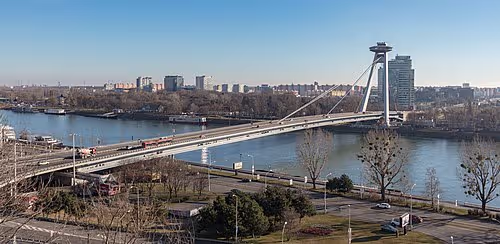
November in Bratislava
High10°C / 50°F
Low4°C
Rain50mm / 9 rainy days
Sun4.8 h/day
Daylight9 h/day
Humidity84%
Crowds●●○○○Prices●○○○○
November is the transition into winter: highs of 5 to 10°C, increasingly grey skies and early 4:30pm dusk. Early in the month the cultural calendar is flat and crowds are thin, so prices stay low. Everything changes on 27 November, when the Christmas market opens on the main squares and family weekend trips pick up. The first three weeks are among the cheapest, quietest times to visit, ideal if you want the city to yourself before the festive rush.
The vibe Early-to-mid November is the year's other deep-quiet window, grey and flat but genuinely cheap and empty. From 27 November the city flips: the Christmas markets open and the squares come alive. Time your visit to either side depending on whether you want solitude or sparkle.
Don't miss From 27 November the Hlavné Námestie and Primaciálne Námestie Christmas markets open, running daily 10am to 10pm with mulled wine, crafts and gifts through to 3 January.
Crowd drivers Black Friday deals and the Christmas market opening on 27 November lift late-month visits; the first three weeks stay quiet.
In season Once the markets open, medovina honey wine, roasted chestnuts and traditional gingerbread appear on the stalls across the central squares.
Heads up Struggle for Freedom and Democracy Day (17 November) is a holiday, though sights stay open. All Saints' related closures fall on 1 to 2 November.
20 to 35 percent below peak; a Black Friday boost and a market-driven spike from 27 November.
Events this month
🎄 Christmas marketChristmas Markets Vianočné trhy
Nov 27 – Jan 3
late November to early January
Markets on Hlavné Námestie, Primaciálne Námestie and Franciscan Square run daily 10am to 10pm with decorations, mulled wine, gifts and local crafts.
Compact, walkable and genuinely charming, they are a day-tripper magnet from Vienna and Budapest and the reason to brave a December visit.
December in Bratislava
High5°C / 41°F
Low0°C
Rain50mm / 10 rainy days
Sun4.1 h/day
Daylight8 h/day
Humidity85%
Crowds●●●○○Prices●●○○○
December revolves around the Christmas markets, running daily 10am to 10pm on the main squares through to 3 January. Cold and often wet at around 5°C with the shortest days of the year, the city still draws huge day-tripper crowds from Vienna and Budapest for mulled wine and crafts. Hotels fill around the four-day Christmas break (24 to 26 December), while early December is calmer. Visit the markets on a weekday morning to enjoy them before the holiday mobs arrive.
The vibe December is Bratislava at its most festive: compact, walkable markets with real charm and none of the scale-overload of bigger cities. The catch is the day-tripper crowds and the dead-stop closures on 24 to 26 December, when much of the city beyond the markets shuts down.
Don't miss The Christmas markets on Hlavné Námestie, Primaciálne Námestie and Franciscan Square run daily 10am to 10pm with mulled wine, gingerbread and local crafts, magical for families.
Crowd drivers The Christmas markets pull massive day-tripper crowds from Vienna and Budapest, peaking around 23 to 25 December and New Year.
In season Market season means medovina honey wine, roasted chestnuts, gingerbread and seasonal Slovak game dishes across the central squares.
Heads up Christmas Eve (24 December) closes shops after noon and restaurants by mid-afternoon; Christmas Day (25) and Boxing Day (26) shut almost everything except the markets.
Mid-month market spike fills hotels; the Christmas-break days (24 to 26 December) push rates up.
Events this month
🎄 Christmas marketChristmas Markets Vianočné trhy
Nov 27 – Jan 3
late November to early January
Markets on Hlavné Námestie, Primaciálne Námestie and Franciscan Square run daily 10am to 10pm with decorations, mulled wine, gifts and local crafts.
Compact, walkable and genuinely charming, they are a day-tripper magnet from Vienna and Budapest and the reason to brave a December visit.
Frequently asked questions
What is the best time to visit Bratislava?
May and September are the best overall. May brings 20°C, spring blossom and the City Days festival, while September keeps warm 22°C days with far fewer people than August once schools restart on 1 September. September is the better value, running 20 to 25 percent cheaper than peak summer while the weather still feels like summer.
What is the cheapest month to visit Bratislava?
January is the cheapest, with rooms around 64 euros a night, roughly 30 percent below summer. February and March stay 20 to 35 percent under the May peak. The trade-off is cold 0 to 7°C weather, grey skies and an almost empty cultural calendar once the Christmas market closes on 3 January.
What is the worst time to visit Bratislava?
January is the month most people should skip unless price is the only concern. The markets have ended, daylight is barely nine hours, skies are grey at 0 to 5°C, and there is almost nothing on the cultural calendar. Early-to-mid November is similarly flat, before the Christmas markets open on 27 November.
When are the Bratislava Christmas markets?
The Christmas markets run from 27 November to 3 January, open daily 10am to 10pm on Hlavné Námestie, Primaciálne Námestie and Franciscan Square. For walkable space, go on a weekday morning between 10 and 11am. From 23 to 25 December and around New Year, day-trippers from Vienna and Budapest can push the squares past 50,000 people.
What is the busiest month in Bratislava?
August is the single busiest month, with worldwide summer holidays at their peak and two big festivals, Lovestream (7 to 9 August) and the Uprising reggae festival (28 to 29 August). Highs top 30°C and lake swimming at Zlaté Piesky peaks. May is a close second, driven by spring breaks and the City Days festival.
How many days do you need in Bratislava?
Two days is enough to see the compact Old Town, Bratislava Castle and the Danube promenade at a relaxed pace. Add a third day for a trip out to Devín Castle or the Zlaté Piesky lake in summer. Many visitors come as a day trip from Vienna, just an hour away, but an overnight lets you enjoy the evenings.
Is Bratislava good to visit in winter?
December is worth it for the Christmas markets, which are compact and charming and run daily 10am to 10pm to 3 January. Beyond the markets, winter is cold at around 5°C, grey and short on daylight, with much closed on 24 to 26 December. January and February are the quietest and cheapest but offer little beyond solitude and low prices.
What is the weather like in Bratislava in summer?
Summer is warm to hot. June averages 26°C, July peaks at 27 to 30°C and August stays near 27°C, rarely topping 32°C. Showers come as short afternoon bursts, not all-day rain. The Old Town gets airless from 10am to 2pm, so walk early or in the cooler evening, and cool off at Zlaté Piesky lake.
When is the best time to visit Bratislava for good weather without the crowds?
September is the answer. Warm 22°C summer feel lingers, but the August crowds clear once schools restart on 1 September, and prices fall 20 to 25 percent. The first three weeks are calmest before the Bratislava Music Festival opens on 23 September. Late April and October are cooler alternatives with similar quiet and even lower prices.

Any month, any day: your guide is already there
Whatever date you pick, a private human guide gets pricier and harder to book on weekends, holidays and in peak season. Our live AI guide, the one that walks with you and answers anything you ask out loud, works the opposite way.
One flat price, every day
No holiday, weekend, night or peak-season surcharge. A private guide in Bratislava runs well over 100 euro for a half day, and more on holidays. Ours stays the same.
Available the moment you want it
Start at midnight or at dawn, on Christmas, in the snow, in the August heat. No sold-out high season, no booking weeks ahead.
Your pace, no meter running
Pause for a long lunch, restart after dark, repeat a stop. The tour simply waits for you.
Free to try, a fraction of the cost
Test it for free, then a transparent flat price that undercuts any private guide, in every season.
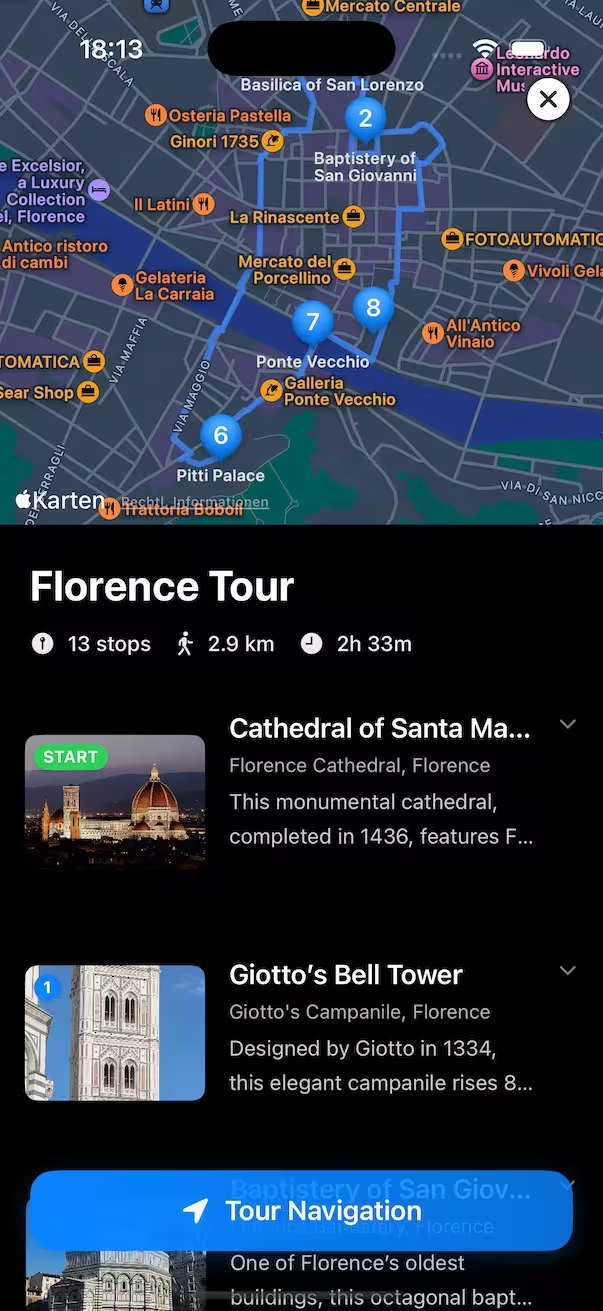
The classic Bratislava tour: 10 stops, 6.2 km, about 3 h on foot
Your live AI guide and the self-guided Bratislava route, together in your browser.