Best Time to Visit Dubrovnik
Month-by-month weather, crowds and prices, plus a full calendar of festivals and events worth planning a trip around.
Best monthsMay, Oct
CheapestJan, Feb, Nov
AvoidJul, Aug
BusiestJul, Aug
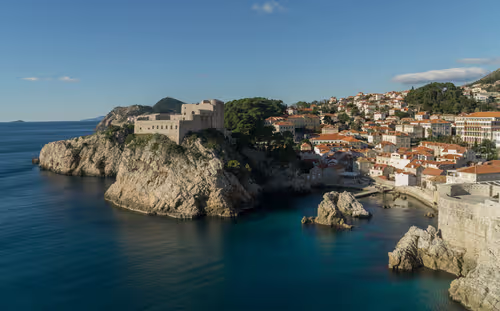
When is the best time to visit Dubrovnik?
Come in May or October. May gives you 21°C, a swimmable sea at 20-21°C and full opening hours before the high-season crush. October pairs the Good Food Festival with a still-warm 21°C sea, near-empty walls and prices 30-40% under summer. July and August mean 30°C-plus heat and up to 15,000 daily visitors.
Start our tool and find your best time to visit Dubrovnik
Your perfect month
Free · ~30 seconds
or tap a month directly
What matters to you?
And this?
Best overall: . October, first half: the consensus best month. The sea still holds 21°C, the Good Food Festival runs 5-18 October, the cruise crowds have thinned, and rooms cost 30-40% less than in summer. May is the spring twin, ideal weather and every sight open, just book ahead because everyone else knows it too.
Best value: . January and February: rooms from 80-120 euros, the walls at 15 euros instead of 35, no crowds, and the free Feast of St. Blaise on 3 February as a genuine local highlight. Mild at 10-13°C, rarely freezing, the trade being short winter wall hours of 10:00 to 15:00.
Avoid: . July and August: peak prices (rooms 250-350 euros), wall queues up to 90 minutes, up to 15,000 daily visitors in an Old Town built for 4,000, and shadeless 30-33°C heat on the walls at midday.
- January: Good time, 11°C. This is the one month the Old Town belongs to the people who live in it. No cruise ships, no wall queue, café tables half-full of locals rather than tour groups. The clear, soft winter light is the best of the year for architecture photography. Grey rainy spells are the price, and at these prices it is a fair one.
- February: Great time, 13°C. February is honest, off-duty Dubrovnik. The St. Blaise celebration on the 3rd is the one day you see the city visibly come alive on its own terms, with relics, period costume and the Libertas banner raised at Orlando's Column. No tourist kitsch, no seasonal markup, just the real place in winter.
- March: Great time, 14°C. March is the last genuinely quiet month before spring fills the city. The Old Town wakes up, terrace tables reappear, the cafés along the Stradun warm in the sun, yet you still walk the walls without a soul ahead of you. That window closes fast, so use it.
- April: Great time, 17°C. April is lovely and increasingly busy. The cruise season is properly under way, Easter pilgrims and short-break crowds arrive, and you will start to queue at the walls on the busy days. Outside the Easter and marathon weekends it still feels manageable, with spring greenery on Mount Srđ and warm sun on the rooftops.
- May: Great time, 22°C. Everyone calls May a shoulder-season secret. It stopped being one years ago. This is full cruise season, the walls draw a steady mid-morning queue, and hotel rates have noticed. But the weather is genuinely the best balance of the year, warm without the punishing heat, so come anyway, just walk the walls at 08:00 and book ahead.
- June: Good time, 26°C. June is the tipping point, when Dubrovnik shifts from busy-but-workable into full summer mode. By the second half the walls bake, the queues lengthen and the cruise crowds own the Stradun by day. But the warm 23°C sea and the long golden evenings redeem it, and the early-June window still has a foot in the gentler shoulder season.
- July: Tough month, 29°C. July is for people who genuinely don't mind queuing in 30-plus heat and paying the year's top prices to do it. Midday on the walls is brutal and the Stradun is a slow river of people. But the Dubrovnik Summer Festival staging theatre and concerts against the floodlit walls after dark is a completely different city, and that part is worth it.
- August: Tough month, 30°C. August is not romantic-empty Dubrovnik, it is survival-mode Dubrovnik. The heat is not photogenic, it is physically draining, and the Old Town is a wall-to-wall crush of international visitors and cruise passengers. If you must come, do the walls before 08:30, swim through the middle of the day, and save the sights for the cooler evening.
- September: Good time, 25°C. September is the month savvy travellers actually want. The brutal heat softens, the sea is at its warmest all year, and from around the 20th the Old Town suddenly breathes again as the families go home. The light turns gold on the limestone, and you can finally walk the Stradun at a human pace.
- October: Great time, 21°C. October is the month that quietly beats the famous ones. The sea is still warm, the heat is gone, the Good Food Festival turns dinner into the trip's highlight, and the walls are nearly empty. Watch for the occasional multi-day Jugo storm, but on a clear October morning the Old Town in golden autumn light, almost to yourself, is Dubrovnik at its best.
- November: Great time, 17°C. November is the deepest off-season, raw and rain-washed, and that is exactly the appeal for some. You walk the empty walls for 15 euros, the Old Town is all locals, and when the Winter Festival lights flick on at the end of the month the Stradun becomes one of the most atmospheric streets in Europe, with almost nobody on it.
- December: Good time, 13°C. December is two cities in one. For most of the month it is a hushed, rain-softened off-season town with 15-euro walls and the Winter Festival glowing on the Stradun. Then New Year's Eve turns the same street into one of Europe's most talked-about countdowns, 20,000 people, fireworks over the Adria and baroque facades for a backdrop, all of it free.
Dubrovnik weather by month
HighLowRainfall
Jan11°
Feb13°
Mar14°
Apr17°
May22°
Jun26°
Jul29°
Aug30°
Sep25°
Oct21°
Nov17°
Dec13°
| Month | Temp | Rain | Sun | Crowds | Prices | Highlight |
|---|---|---|---|---|---|---|
| Jan | 11° / 4° | 197mm · 13 rainy days | 6.4 h/day | ●○○○○ | ●○○○○ | Epiphany |
| Feb | 13° / 6° | 152mm · 11 rainy days | 7.7 h/day | ●○○○○ | ●○○○○ | Feast of St. Blaise (Day of Dubrovnik) |
| Mar | 14° / 7° | 151mm · 11 rainy days | 9.2 h/day | ●●○○○ | ●●○○○ | |
| Apr | 17° / 10° | 115mm · 11 rainy days | 10.6 h/day | ●●●○○ | ●●●○○ | Easter |
| May | 22° / 14° | 101mm · 10 rainy days | 11.8 h/day | ●●●○○ | ●●●○○ | Labour Day |
| Jun | 26° / 19° | 60mm · 7 rainy days | 13.2 h/day | ●●●●○ | ●●●●○ | Corpus Christi |
| Jul | 29° / 21° | 41mm · 4 rainy days | 13.7 h/day | ●●●●● | ●●●●● | Dubrovnik Summer Festival |
| Aug | 30° / 22° | 44mm · 5 rainy days | 13.0 h/day | ●●●●● | ●●●●● | Dubrovnik Summer Festival |
| Sep | 25° / 18° | 134mm · 8 rainy days | 10.7 h/day | ●●●●○ | ●●●●○ | |
| Oct | 21° / 14° | 180mm · 10 rainy days | 9.1 h/day | ●●●○○ | ●●○○○ | Dubrovnik Good Food Festival |
| Nov | 17° / 10° | 292mm · 14 rainy days | 6.4 h/day | ●○○○○ | ●○○○○ | Dubrovnik Winter Festival |
| Dec | 13° / 6° | 208mm · 12 rainy days | 6.2 h/day | ●●○○○ | ●●○○○ | Dubrovnik Winter Festival |
How we score this: weather = long-run climate normals (Open-Meteo), crowds & prices = relative season read, events checked yearly against official dates.
Best time to visit Dubrovnik: weather, prices & crowds
Best months for good weather
June and September deliver the most reliable warmth: highs around 25-26°C, a sea at 23-24°C, and long daylight without the worst of the midday heat that flattens July and August.
Quietest months to avoid the crowds
January, February and November empty the Old Town right out. The walls have no queue at all, the Stradun belongs to locals, and you photograph the rooftops with nobody in the frame.
Cheapest time to visit Dubrovnik
January and February are the cheapest months: hotel rooms from 80-120 euros a night, up to 60% below the summer peak, and the city-walls ticket drops to 15 euros instead of the 35 euros charged in summer.
Best time for festivals and events
Mid-July to late August brings the Dubrovnik Summer Festival, 47 nights of open-air theatre and classical concerts staged against the historic walls and squares, the cultural high point of the southern Adriatic.
How many days do you need in Dubrovnik?
Two full days is the right call for Dubrovnik. The walled Old Town is tiny enough to cross in minutes, so a single day covers the walls and the Stradun, but a second day gives you space to reach the cable car, the islands and the swimming coves without feeling rushed.

One day
The walls, the Stradun, the essentials
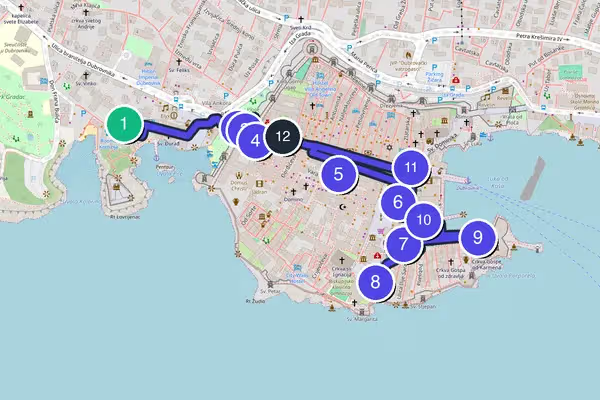
Start at the Pile Gate the moment it opens, walk the full city-walls circuit before the cruise ships arrive, then drop to Onofrio's Large Fountain and stroll the Stradun to the Church of St. Blaise and the Rector's Palace. A self-guided Dubrovnik walking tour strings 12 stops across just 2.0 km in around 2.1 hours, from Fort Lovrijenac to the Franciscan Monastery pharmacy, covering everything the Old Town owes you in a single morning.
Two daysRecommended
Cable car, Lokrum, and a swim
Use the second day to climb out of the walls. Take the Srđ cable car (412 m) for the panorama the Old Town cannot give you, then catch the first Lokrum ferry from the Old Port to the island's peacock-filled botanical garden and its coves. Finish the afternoon off the rocks below Fort Lovrijenac or at Banje beach. Two days is the minimum that leaves you unhurried.
Three days
Day trips and Dalmatian table
A third day opens the excursion options: the Pelješac peninsula for Plavac Mali wine tasting and Ston oysters (about an hour by car), or a short bus to Cavtat for a quieter harbour walk. If you time the trip for early October, the Good Food Festival fills this day naturally, with special menus at 40 restaurants and the communal Stradun table in the evening.
Four days or more
The islands and the hinterland
Four days or more lets you island-hop: the Elaphiti Islands (Sipan, Lopud, Kolocep) are reachable on a morning boat excursion from the Old Port, each with its own village and swimming bay. The Konavle valley south of the city rewards a half-day for its watermills, horses and local konobas. By this point you have moved well beyond the tourist circuit and into the slower, resident-facing side of the region.
Best time to visit Dubrovnik by traveller type
Same city, different trip. Here's the month that fits how you're travelling.
🧭
Best time to visit Dubrovnik for the first time
May or October: ideal 21°C weather, a swimmable sea, every attraction open and cruise ships active but not yet overwhelming, with rooms 40-50% below the July peak.
❤️
Best time to visit Dubrovnik for couples
Early October: golden autumn light on the walls and rooftops, a sea still warm enough to swim, the Good Food Festival for romantic dinners, and an almost-empty Stradun at dawn for photos without the crowds.
💶
Best time to visit Dubrovnik on a budget
January or February: the lowest hotel rates of the year, the walls at 15 euros, the Rector's Palace at 15 euros, and a free St. Blaise procession on 3 February.
🍝
Best time to visit Dubrovnik for food and wine
5-18 October for the Dubrovnik Good Food Festival: 40 restaurants with special menus, wine workshops, the communal Stradun table, and Dalmatian cooking (black risotto, grilled scampi, Pelješac Plavac Mali) at its seasonal peak.
Worst time to visit Dubrovnik
July and August are the months most worth avoiding. The Old Town was built for around 4,000 people yet absorbs up to 15,000 visitors a day at peak, roughly 27 tourists per resident on the busiest dates. The city walls have zero shade and bake under a south-facing sun that regularly hits 30 to 33°C, with a recorded extreme of 38.4°C in August. Hotel rates run 250 to 350 euros a night, and the wall queue can reach 90 minutes before you even enter.
Still worth it for If the Dubrovnik Summer Festival is the reason you are coming, the 47 nights of open-air theatre and classical concerts against the floodlit walls are genuinely worth the trade-off. Come armed with pre-booked tickets, a 08:00 alarm for the walls and a midday plan built around swimming rather than sightseeing.
Go instead in May, October, when Dubrovnik is at its best.
Best time for a tour of Dubrovnik
Dubrovnik is a city you walk in full sun, and the Old Town's pale limestone throws the heat straight back at you, so the month you choose changes everything. May and early June are the sweet spot: highs around 21 to 26 °C, only seven to ten rainy days, and light that lasts late enough to climb the Dubrovnik City Walls in the cooler hours. July and August are punishing, with highs near 29 to 30 °C and almost no shade along the Stradun or on the exposed circuit of the walls, and crowds peak as cruise passengers flood Pile Gate by mid-morning. September is the quiet hero, still 25 °C and the sea warm, the crowds thinning. The shoulders of October and April stay mild at 17 to 21 °C, though rain picks up to ten or eleven wet days. Winter is genuinely calm and cheap, but January barely reaches 11 °C with thirteen rainy days, and the Jesuit Stairs and Fort Lovrijenac feel bleak under grey skies.
The real luxury here is choosing your own hour, and that is exactly what AI Tourguide gives you: it runs entirely in your browser with no app or download, a voice-first guide that leads the whole loop, tells the stories behind the walls and the Rector's Palace, asks you questions and remembers your answers as you go. On a scorching August day you can start your Dubrovnik tour at first light, tracing the Stradun while it is still cool and almost empty, then duck into the Franciscan Monastery before the cruise crowds arrive. No fixed departure, no group to keep pace with, just the climate deciding when you set off.

 +8
+8All 12 stops are already on the map.
You just press start.
You just press start.
 AI Tourguide
You just read the route.
Now walk it with a guide in your ear.
Press start wherever you are, even hundreds of kilometres from Dubrovnik, and the guide begins telling its stories right away. In the city, pick any of the 12 stops to start from: it leads you there, then talks with you the whole route, asking, listening, remembering, and shaping the tour around your answers.
12stops2.0km2.1hours11languages
▶Start the tour freeFree to start · Runs in your browser · No app, no download
Dubrovnik events and festivals calendar
Annual highlights worth timing a trip around, listed month by month.
January
🇮 HolidayEpiphany Sveta tri kralja
Jan 6
6 January (fixed); marks the end of the Winter Festival season.
A public holiday closing the Christmas and Winter Festival period, with church masses across the Old Town and the last of the festive markets winding down.
February
⛪ ReligiousFeast of St. Blaise (Day of Dubrovnik) Festa Svetog Vlaha
Feb 2–3
Always 2-3 February (fixed); main procession on 3 February.
Dubrovnik's patron-saint festival, on the UNESCO Intangible Cultural Heritage list since 2009.
April
⛪ ReligiousEaster Uskrs
Apr 3–6 ~
Moveable spring feast; dates shift each year with the lunar calendar, spanning Good Friday to Easter Monday.
Holy Week brings solemn processions to the Old Town churches and a Croatian national holiday.
🏃 SportDubrovnik Half Marathon and Run the Wall Dubrovnik polumaraton i Utrka zidinama
Apr 26 ~
Late April, typically the last Sunday of the month.
An AIMS-certified half marathon starting and finishing on the Stradun, paired with the 1,940 m Run the Wall race, 1,080 steps along the city walls, capped at 100 participants.
May
🇮 HolidayLabour Day Praznik rada
May 1
1 May (fixed); a long-weekend travel rush across the region.
A national holiday that triggers a long-weekend influx from Croatia, Germany, Austria and Bosnia, filling restaurants and pushing hotel rates up for the weekend.
June
🇮 HolidayCorpus Christi Tijelovo
Jun 4 ~
Moveable, 60 days after Easter; falls on a Thursday in late May or early June depending on the year.
A Croatian public holiday with church processions in the Old Town; some museums run shortened hours.
July
🎉 FestivalDubrovnik Summer Festival Dubrovačke ljetne igre
Jul 10 – Aug 25
Mid-July to late August, spanning 47 nights of open-air performances.
Over 70 programmes of theatre, classical music, dance and folklore staged open-air at historic squares and the city walls.
August
🇮 HolidayVictory Day and Defenders' Day Dan pobjede i domovinske zahvalnosti
Aug 5
5 August (fixed); falls in the middle of the high-season peak.
A national holiday with commemorations and some shop closures, landing in the heart of the busiest weeks of the year.
October
🍷 Food and wineDubrovnik Good Food Festival
Oct 5–18
Two weeks in early-to-mid October, typically running from the first week through the third week of the month.
The city's gastronomy fortnight, with around 40 top restaurants serving special menus, the communal Dubrovnik Table laid out on the Stradun, wine tastings, beer nights, street food, live music and workshops, including a wine-and-paint session from 18:00 on 16 October.
November
🎄 Christmas marketDubrovnik Winter Festival Dubrovački zimski festival
Nov 29 – Jan 3 ~
Late November to early January, opening around the last weekend of November and running through Epiphany.
An Advent market across the Stradun and Luža Square with an ice rink, a cabrio-bus, a Christmas train, open-air concerts, theatre shows and creative workshops.
December
🎉 FestivalNew Year's Eve Concert on the Stradun Doček Nove godine na Stradunu
Dec 31
31 December from 21:00; midnight countdown and fireworks.
A free open-air concert on the Stradun from 21:00, with fireworks over the Adriatic and a midnight countdown.
Insider tips for visiting Dubrovnik
The rules buried in forums, in one place.
- Walk the city walls at 08:00 the moment the Pile Gate entrance opens. For the first 60 minutes the queue is effectively zero. From 10:00 in the cruise months of June to September it builds to 60-90 minutes. Buy tickets on the official site (shop.citywallsdubrovnik.hr), not from third-party skip-the-line resellers who often hand them over at the far end of town.
- Avoid the Old Town between 10:00 and 16:00 in summer. The two daily cruise ships dock with a minimum 8-hour stay, most passengers reach the centre by 09:00-10:00 and head back around 15:00-16:00. Finish the walls by 08:00, take breakfast at 10:00, and you are out ahead of the worst of it.
- Visit the Rector's Palace on a Tuesday morning. Monday is its weekly closing day, so it opens fresh and barely visited at 09:00 on Tuesday. Note the other museum closing days too: the Maritime Museum shuts on Wednesdays, the Ethnographic Museum in the Rupe granary on Tuesdays.
- Take the first Lokrum ferry of the morning from the Old Port. In July and August the afternoon wait can hit 40 minutes. The early boat means almost no queue and more island time before the day's heat. The ferry runs only from roughly April to October, with no service December to March when the island is closed.
- Combine the winter wall discount with the Winter Festival. From November to late February the walls cost just 15 euros instead of 35, and the Dubrovnik Winter Festival fills the Stradun with concerts and markets from late November. It is the best-value, best-atmosphere window of the whole year.
- Photograph the Old Town from Mount Srđ at 08:00-09:00. The Srđ cable car (412 m) has ideal light and empty gondolas in the early morning, against the 14:00-16:00 rush. For sunset, ride up 30-40 minutes before, when the walls glow orange-gold.
- Arrive on the Stradun by 19:00 for the New Year's Eve concert. The free open-air show starts at 21:00, but the spots with a clear view of the stage by the Sponza Palace fill from around 19:00. Come after 21:00 and you watch on screens at the Old Town's edge. A December evening here is 8-10°C, so dress warm.
- Skip the marathon weekend (26 April) unless you are running. The Stradun is closed for the race from around 08:00 and hotels run 15-20% above normal April rates. Either book early for it or shift to the following weekend.
Public holidays in Dubrovnik
On these dates many shops and offices close, transport thins out, and sights can be mobbed or shut. Plan around them.
| Date | Holiday | What closes |
|---|---|---|
| Jan 1 | New Year's Day | Almost everything closed, including the Rector's Palace and the museums. The city walls open on a shortened post-New-Year schedule. |
| Jan 6 | Epiphany | Public holiday marking the end of the Winter Festival. Masses held; museums may be closed or on shortened hours. Very quiet, prices at their lowest. |
| Feb 3 | Feast of St. Blaise (Day of Dubrovnik) | The city's biggest local holy day. Free morning procession with relics, costumes and the Libertas banner; the most authentic winter date, with little tourist presence. |
| Apr 3 | Good Friday | Solemn processions in the Old Town; some restaurants closed. The start of the Easter long-weekend influx from Germany, Austria and the UK. |
| Apr 5 | Easter Sunday | National holiday, churches full, raised tourist numbers and hotel occupancy across the Easter weekend. |
| Apr 6 | Easter Monday | Public holiday; many shops and museums closed or on shortened hours. |
| May 1 | Labour Day | Public holiday and a long-weekend rush from Croatia, Germany, Austria and Bosnia. Restaurants full and hotels pricier for the weekend, so book early. |
| May 30 | Statehood Day | National holiday, but it falls on a Saturday in 2026 so the practical effect on visitors is minimal. Flags up across the city. |
| Jun 4 | Corpus Christi | Public holiday with processions; museums may run shortened hours. A weekday holiday just before the summer surge, with little real impact on tourism. |
| Aug 5 | Victory Day and Defenders' Day | National holiday with commemorations, some shops closed. Falls in the middle of the high-season peak; the walls stay open. |
| Aug 15 | Assumption of Mary | Religious and state holiday with masses; falls on a Saturday in 2026, in the heart of the busiest weeks of the year. |
| Dec 25 | Christmas Day | The one day a year the city walls are officially closed. Museums shut, Christmas masses held across the Old Town. |
| Dec 26 | St. Stephen's Day | Public holiday, quiet, with some shops open. The Winter Festival continues on the Stradun. |
Dubrovnik month by month
January in Dubrovnik
High11°C / 52°F
Low4°C
Rain197mm / 13 rainy days
Sun6.4 h/day
Daylight10 h/day
Humidity72%
Crowds●○○○○Prices●○○○○
January is Dubrovnik at its emptiest and cheapest. Daytime highs sit around 11°C, nights drop to about 5°C, and frost is rare. It is also the wettest stretch of the year (197mm over roughly 13 days), with the occasional multi-day Jugo storm rolling in off the sea. The walls run short winter hours, 10:00 to 15:00, but you walk them with no queue and pay just 15 euros.
The vibe This is the one month the Old Town belongs to the people who live in it. No cruise ships, no wall queue, café tables half-full of locals rather than tour groups. The clear, soft winter light is the best of the year for architecture photography. Grey rainy spells are the price, and at these prices it is a fair one.
Don't miss The Winter Festival runs on the Stradun until early January, with an ice rink and open-air concerts. Inside the walls, the Rector's Palace and the Franciscan monastery pharmacy are yours to wander almost alone. The Lokrum ferry is suspended until spring.
Crowd drivers The deepest low season: no cruise ships and only a handful of city-break travellers. The quietest visitor pressure of the entire year.
In season Cold-season Dalmatian comfort food is at its best: slow-braised pašticada with gnocchi, and fresh oysters trucked up from the Ston beds an hour north.
Heads up Lokrum island and its ferry are closed until April. The walls run winter hours (10:00-15:00); 1 and 6 January are holidays with most museums shut.
Cheapest month of the year; hotels from 80-120 euros, up to 60% below summer; walls only 15 euros.
Events this month
🎄 Christmas marketDubrovnik Winter Festival Dubrovački zimski festival
Nov 29 – Jan 3 ~
Late November to early January, opening around the last weekend of November and running through Epiphany.
An Advent market across the Stradun and Luža Square with an ice rink, a cabrio-bus, a Christmas train, open-air concerts, theatre shows and creative workshops. New Year's Eve draws around 20,000 people for a fireworks countdown on the Stradun.
It lights up the Old Town at exactly the moment everything else is cheapest, and the Stradun under festival lights with a 15-euro walls ticket is the city's best winter value.
🇮 HolidayEpiphany Sveta tri kralja
Jan 6
6 January (fixed); marks the end of the Winter Festival season.
A public holiday closing the Christmas and Winter Festival period, with church masses across the Old Town and the last of the festive markets winding down.
The quietest, cheapest moment of the year to have the walls and museums almost entirely to yourself before the spring build-up begins.
February in Dubrovnik
High13°C / 55°F
Low6°C
Rain152mm / 11 rainy days
Sun7.7 h/day
Daylight11 h/day
Humidity72%
Crowds●○○○○Prices●○○○○
February stays quiet and cheap, milder than January at around 13°C by day, though still damp with about 11 rainy days. The big date is 3 February, the Feast of St. Blaise, Dubrovnik's patron saint, which fills the Old Town with locals for a procession but draws almost no foreign tourists. The walls keep their 15-euro winter rate and short 10:00-15:00 hours through the end of the month.
The vibe February is honest, off-duty Dubrovnik. The St. Blaise celebration on the 3rd is the one day you see the city visibly come alive on its own terms, with relics, period costume and the Libertas banner raised at Orlando's Column. No tourist kitsch, no seasonal markup, just the real place in winter.
Don't miss The St. Blaise procession on 3 February, a UNESCO intangible-heritage tradition, is the standout, and it is free. The walls are empty enough to linger on every bastion, and the winter ticket is still just 15 euros.
Crowd drivers St. Blaise brings a brief, mostly local crowd on 2-3 February. Cruise ships have not yet returned, so visitor pressure stays at its winter floor.
In season Carnival fritters (kroštule and fritule) appear in the bakeries in the run-up to Lent, dusted in sugar and best eaten warm off the Stradun.
Heads up The walls keep winter hours (10:00-15:00) and the 15-euro rate until the end of February. Lokrum and its ferry remain closed.
Still the low season; rooms from 80-120 euros, walls at the 15-euro winter rate until the end of the month.
Events this month
⛪ ReligiousFeast of St. Blaise (Day of Dubrovnik) Festa Svetog Vlaha
Feb 2–3
Always 2-3 February (fixed); main procession on 3 February.
Dubrovnik's patron-saint festival, on the UNESCO Intangible Cultural Heritage list since 2009. A colourful procession carries the saint's relics through the Old Town in period costume, with the Festanjuli guard and Trombunjeri firing ceremonial guns, and the Libertas banner raised at Orlando's Column. Doves are released on 2 February.
It is Dubrovnik's most alive winter date, authentic and free of tourist kitsch, and the Stradun procession on 3 February costs nothing to watch.
March in Dubrovnik
High14°C / 58°F
Low7°C
Rain151mm / 11 rainy days
Sun9.2 h/day
Daylight12 h/day
Humidity68%
Crowds●●○○○Prices●●○○○
March is early spring: highs climb toward 15°C, the days lengthen, and the first cruise ships start to stir. With Easter arriving in early spring, March itself stays calm before the holiday influx. The sea is still a cold 15°C, too brisk for swimming, but the light is bright and clear and the walls are crowd-free. The walls return to long hours and the summer ticket price as the month opens.
The vibe March is the last genuinely quiet month before spring fills the city. The Old Town wakes up, terrace tables reappear, the cafés along the Stradun warm in the sun, yet you still walk the walls without a soul ahead of you. That window closes fast, so use it.
Don't miss The Lokrum ferry typically resumes around the start of April, so a late-March visit still has the island closed but the walls and the Rector's Palace gloriously empty. Cable-car rides up Mount Srđ are at their clearest in the crisp spring air.
Crowd drivers The cruise season is just beginning to ramp. Easter falling in early April keeps March itself quiet, the calm before the spring influx.
In season Wild asparagus (šparoge) appears on the hillsides and on trattoria menus, folded into frittata or simmered with local eggs, a fleeting early-spring Dalmatian treat.
Prices edge up; the walls move from the 15-euro winter rate to the summer rate at the start of the month.
April in Dubrovnik
High17°C / 63°F
Low10°C
Rain115mm / 11 rainy days
Sun10.6 h/day
Daylight13 h/day
Humidity68%
Crowds●●●○○Prices●●●○○
April brings real spring warmth, highs near 17°C, with up to 11 rainy days still possible. Two dates drive the crowds: the Easter long weekend on 5-6 April pulls short-break travellers from across Europe, and the Dubrovnik Half Marathon on 26 April closes the Stradun from early morning. The sea is a bracing 17°C, swimmable only for the bold. Prices stay well under summer outside those two weekends.
The vibe April is lovely and increasingly busy. The cruise season is properly under way, Easter pilgrims and short-break crowds arrive, and you will start to queue at the walls on the busy days. Outside the Easter and marathon weekends it still feels manageable, with spring greenery on Mount Srđ and warm sun on the rooftops.
Don't miss The Lokrum ferry is back in service, so the island day trip and its peacocks and botanical garden reopen. On 26 April, even non-runners find the Run the Wall race, 1,080 steps up the city walls, an extraordinary spectacle to watch.
Crowd drivers Easter weekend short-breakers from Germany, Austria and the UK, the half-marathon weekend on 26 April, and a steadily building cruise-ship season.
In season The first soparnik and spring greens reach the Gundulić Square market, alongside early artichokes from the Konavle fields south of the city.
Heads up The Stradun closes from around 08:00 on 26 April for the half marathon. Otherwise the walls return to summer hours, 08:00-18:30.
Hotels around 100-150 euros, well below summer; the marathon weekend (26 April) pushes rates 15-20% higher.
Events this month
⛪ ReligiousEaster Uskrs
Apr 3–6 ~
Moveable spring feast; dates shift each year with the lunar calendar, spanning Good Friday to Easter Monday.
Holy Week brings solemn processions to the Old Town churches and a Croatian national holiday. Hotel occupancy and short-break arrivals from Germany, Austria and the UK rise sharply across the long weekend.
A genuine local religious tradition, but a weekend to avoid if you are chasing quiet: it is the spring's first real tourist surge.
🏃 SportDubrovnik Half Marathon and Run the Wall Dubrovnik polumaraton i Utrka zidinama
Apr 26 ~
Late April, typically the last Sunday of the month.
An AIMS-certified half marathon starting and finishing on the Stradun, paired with the 1,940 m Run the Wall race, 1,080 steps along the city walls, capped at 100 participants.
Even for non-runners the Run the Wall up the ramparts is an extraordinary spectacle, though the Stradun closes from around 08:00 and hotels run 15-20% above normal April rates.
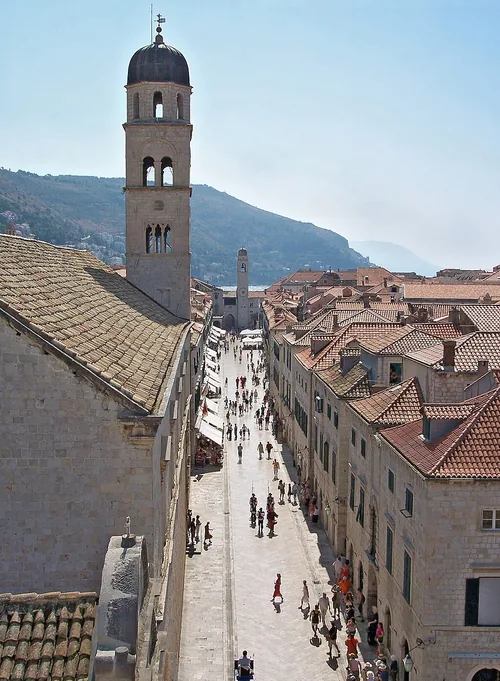
May in Dubrovnik
High22°C / 71°F
Low14°C
Rain101mm / 10 rainy days
Sun11.8 h/day
Daylight15 h/day
Humidity72%
Crowds●●●○○Prices●●●○○
May is the spring sweet spot most regulars name. Highs reach a comfortable 21°C, the sea warms to 20-21°C and turns swimmable for the hardy, and every attraction is open on full summer hours. The cruise season is in full swing and the UK and northern-European half-term holidays add to the flow, so the walls fill from mid-morning, but it is nowhere near the July crush. Pleasant, bright and still affordable.
The vibe Everyone calls May a shoulder-season secret. It stopped being one years ago. This is full cruise season, the walls draw a steady mid-morning queue, and hotel rates have noticed. But the weather is genuinely the best balance of the year, warm without the punishing heat, so come anyway, just walk the walls at 08:00 and book ahead.
Don't miss First swims of the season off the Banje beach and the rocks below Fort Lovrijenac, with the sea at 20-21°C. The Lokrum island ferry runs frequently, and the long daylight makes a late-afternoon cable-car sunset easy to fit in.
Crowd drivers Cruise season at full strength, plus UK and northern-European Whitsun half-term holidays. Walls back up from around 10:00.
In season Peak season for fresh scampi (škampi) from the northern Adriatic and the first locally caught sardines, grilled simply with olive oil and lemon.
Hotels around 120-160 euros, roughly 25-30% above April but 40-50% below the July peak.
Events this month
🇮 HolidayLabour Day Praznik rada
May 1
1 May (fixed); a long-weekend travel rush across the region.
A national holiday that triggers a long-weekend influx from Croatia, Germany, Austria and Bosnia, filling restaurants and pushing hotel rates up for the weekend.
Worth knowing if you are pricing a May trip: book early, because the 1 May weekend is the month's busiest and dearest stretch.

June in Dubrovnik
High26°C / 79°F
Low19°C
Rain60mm / 7 rainy days
Sun13.2 h/day
Daylight15 h/day
Humidity71%
Crowds●●●●○Prices●●●●○
June opens the high season. Highs hit 26°C, the sea reaches a lovely 23°C, and daylight stretches past 15 hours. School holidays begin (Germany from mid-June, Austria earlier), the two daily cruise ships are running at full tilt with around 4,000 passengers, and the wall queues build from 10:00. The first half of the month is the better window, before prices and crowds hit their summer ceiling. Rain is rare now, just 60mm over about 7 days.
The vibe June is the tipping point, when Dubrovnik shifts from busy-but-workable into full summer mode. By the second half the walls bake, the queues lengthen and the cruise crowds own the Stradun by day. But the warm 23°C sea and the long golden evenings redeem it, and the early-June window still has a foot in the gentler shoulder season.
Don't miss Prime swimming season opens with a 23°C sea and long evenings for an after-dinner dip. The Lokrum ferry runs all day, and the late-setting sun makes the Srđ cable car a sunset ritual. Sea-kayaking trips around the walls and out to Lokrum hit their stride.
Crowd drivers European school holidays beginning, cruise season at high intensity (two ships, around 4,000 passengers a day), and wall queues from 10:00.
In season Cherries and the first figs arrive from the Konavle valley, and the oyster-and-mussel season from Ston is at its early-summer best.
Hotels jump to 180-250 euros, occupancy above 90%; the walls ticket is now the full 35 euros.
Events this month
🇮 HolidayCorpus Christi Tijelovo
Jun 4 ~
Moveable, 60 days after Easter; falls on a Thursday in late May or early June depending on the year.
A Croatian public holiday with church processions in the Old Town; some museums run shortened hours. It falls just before the summer surge.
A low-impact weekday holiday: worth noting for museum hours, but it barely dents the early-June rhythm.
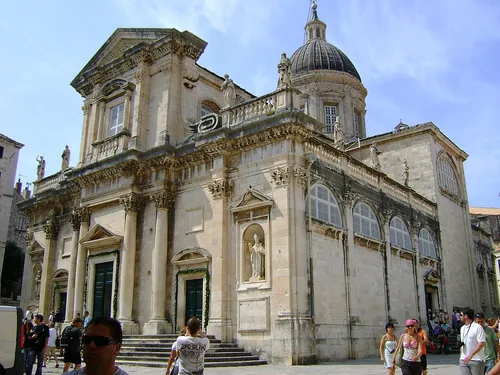
July in Dubrovnik
High29°C / 85°F
Low21°C
Rain41mm / 4 rainy days
Sun13.7 h/day
Daylight15 h/day
Humidity64%
Crowds●●●●●Prices●●●●●
July is Dubrovnik at full intensity. Highs average 29°C with regular spikes to 30-33°C, and the city walls, a shadeless south-facing stone terrace, become a genuine sunstroke risk between 11:00 and 16:00. Tourist numbers peak, with up to 15,000 people a day squeezing into an Old Town built for around 4,000. The walls run their full 08:00-18:30 hours, but the unticketed queue can reach 90 minutes. It is also the driest month, just 41mm over about 4 days.
The vibe July is for people who genuinely don't mind queuing in 30-plus heat and paying the year's top prices to do it. Midday on the walls is brutal and the Stradun is a slow river of people. But the Dubrovnik Summer Festival staging theatre and concerts against the floodlit walls after dark is a completely different city, and that part is worth it.
Don't miss The Dubrovnik Summer Festival (from 10 July) stages open-air theatre and classical concerts at historic sites across the Old Town, the cultural highlight of the year. The sea is at an ideal 25-26°C. Walk the walls at 08:00 sharp or skip the midday hours entirely.
Crowd drivers Every major European school system on summer break at once, plus US visitors, cruise-ship peak, and the densest flight schedule of the year.
In season Peak season for grilled fresh fish and chilled Pošip and Grk whites from the nearby Pelješac peninsula and Korčula island, best drunk at sunset.
Heads up No seasonal closures, but the midday heat (11:00-16:00) effectively closes the shadeless walls to comfortable walking.
Year's highest prices; Old Town hotels 250-350 euros and up, the Hilton Imperial above 500 euros.
Events this month
🎉 FestivalDubrovnik Summer Festival Dubrovačke ljetne igre
Jul 10 – Aug 25
Mid-July to late August, spanning 47 nights of open-air performances.
Over 70 programmes of theatre, classical music, dance and folklore staged open-air at historic squares and the city walls. The festival typically spans Shakespeare, Croatian drama and Ibsen alongside orchestral concerts by internationally renowned soloists, opening before St. Blaise's Church.
It is the cultural high point of the southeastern Adriatic, with a setting no theatre can match, though you pay high-season prices and walk into peak crowds to be there.
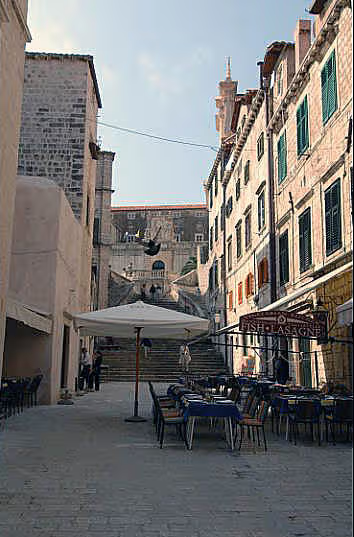
August in Dubrovnik
High30°C / 85°F
Low22°C
Rain44mm / 5 rainy days
Sun13.0 h/day
Daylight14 h/day
Humidity66%
Crowds●●●●●Prices●●●●●
August matches July for heat, crowds and cost. Highs average 30°C, the record stands at 38.4°C, and the sea peaks at a warm 26°C. School holidays across Europe and the US overlap, the cruise season is at its ceiling, and the walls stay mobbed all day, with a record 8,864 people counted on the walls alone in a single 11-hour stretch one August. The Summer Festival runs until the 25th and the country's Victory Day on the 5th adds to the buzz.
The vibe August is not romantic-empty Dubrovnik, it is survival-mode Dubrovnik. The heat is not photogenic, it is physically draining, and the Old Town is a wall-to-wall crush of international visitors and cruise passengers. If you must come, do the walls before 08:30, swim through the middle of the day, and save the sights for the cooler evening.
Don't miss The Summer Festival continues through 25 August, with closing-week performances against the walls. The 26°C sea is at its warmest of the year, so build the day around swimming off Banje beach or a Lokrum cove and keep sightseeing to the cool early and late hours.
Crowd drivers All of Europe and the US on holiday at once, the cruise season at its absolute peak, and Victory Day on 5 August adding a holiday crowd.
In season Tomatoes, figs and watermelon are at their peak at the Gundulić Square market, and the sea-urchin and grilled-octopus season is in full swing along the coast.
Heads up No fixed closures, but as in July the shadeless walls are effectively off-limits in the 11:00-16:00 heat.
Identical to July, the joint-most-expensive month; Old Town rooms 250-350 euros and beyond.
Events this month
🎉 FestivalDubrovnik Summer Festival Dubrovačke ljetne igre
Jul 10 – Aug 25
Mid-July to late August, spanning 47 nights of open-air performances.
Over 70 programmes of theatre, classical music, dance and folklore staged open-air at historic squares and the city walls. The festival typically spans Shakespeare, Croatian drama and Ibsen alongside orchestral concerts by internationally renowned soloists, opening before St. Blaise's Church.
It is the cultural high point of the southeastern Adriatic, with a setting no theatre can match, though you pay high-season prices and walk into peak crowds to be there.
🇮 HolidayVictory Day and Defenders' Day Dan pobjede i domovinske zahvalnosti
Aug 5
5 August (fixed); falls in the middle of the high-season peak.
A national holiday with commemorations and some shop closures, landing in the heart of the busiest weeks of the year. The city walls stay open.
Useful to know if you are in town in early August, but with little practical effect on a visitor's plans beyond the odd closed shop.

September in Dubrovnik
High25°C / 78°F
Low18°C
Rain134mm / 8 rainy days
Sun10.7 h/day
Daylight12 h/day
Humidity69%
Crowds●●●●○Prices●●●●○
September is the gentler twin of summer. Highs settle at a pleasant 25°C and the sea hits its yearly best of 24°C, warmer than it was in June. The first half stays busy and pricey, but once the German and Austrian school year resumes in mid-September the crowds drop noticeably and the wall wait falls to 15-20 minutes. Rain returns a little (134mm over about 8 days), often as short showers rather than all-day cloud.
The vibe September is the month savvy travellers actually want. The brutal heat softens, the sea is at its warmest all year, and from around the 20th the Old Town suddenly breathes again as the families go home. The light turns gold on the limestone, and you can finally walk the Stradun at a human pace.
Don't miss The warmest sea of the year at 24°C makes September the best swimming month, off Lokrum or the rocks below the walls. Late-month wall walks come with a 15-20 minute wait at most and the season's softest light for rooftop photography.
Crowd drivers School term resuming in Germany and Austria from mid-September drives a sharp drop after the 20th; cruise season still active in the first half.
In season Grape and early-olive harvest season on the Pelješac peninsula, with new-vintage Plavac Mali reds and fresh-pressed oil appearing in the konobas.
Hotels around 180-220 euros; prices hold high until roughly 20 September, then ease as the school year starts.

October in Dubrovnik
High21°C / 70°F
Low14°C
Rain180mm / 10 rainy days
Sun9.1 h/day
Daylight11 h/day
Humidity75%
Crowds●●●○○Prices●●○○○
October is the consensus best month alongside May. Highs hold at a mild 21°C, the sea is still a swimmable 21°C, and the cruise crowds thin sharply. The Good Food Festival runs 5-18 October, the autumn rains begin (180mm over about 10 days), and prices fall 30-40% below summer. The walls keep their long summer hours until the end of the month, but with a fraction of the August queue.
The vibe October is the month that quietly beats the famous ones. The sea is still warm, the heat is gone, the Good Food Festival turns dinner into the trip's highlight, and the walls are nearly empty. Watch for the occasional multi-day Jugo storm, but on a clear October morning the Old Town in golden autumn light, almost to yourself, is Dubrovnik at its best.
Don't miss The Dubrovnik Good Food Festival (5-18 October) puts special menus in 40 restaurants, plus wine workshops and the communal Stradun table. The sea is still swimmable at 21°C, the autumn light is the warmest of the year, and the walls are blissfully uncrowded.
Crowd drivers School holidays over, cruise season winding down fast. The Good Food Festival (5-18 October) brings a foodie crowd but no high-season crush.
In season The festival fortnight is the foodie peak: black cuttlefish risotto, grilled scampi, and Pelješac Plavac Mali at the heart of the autumn Dalmatian table.
Heads up The Lokrum ferry winds down toward the end of the month before its winter suspension. Jugo storms can cancel the Lokrum crossing for a day or two.
Hotels around 100-160 euros, 30-40% below the summer peak; the best price-to-quality window of the year.
Events this month
🍷 Food and wineDubrovnik Good Food Festival
Oct 5–18
Two weeks in early-to-mid October, typically running from the first week through the third week of the month.
The city's gastronomy fortnight, with around 40 top restaurants serving special menus, the communal Dubrovnik Table laid out on the Stradun, wine tastings, beer nights, street food, live music and workshops, including a wine-and-paint session from 18:00 on 16 October.
It is the single best reason to time a trip for October: mild weather, a still-swimmable 21°C sea, and prices 30-40% below summer make it the ideal foodie window.
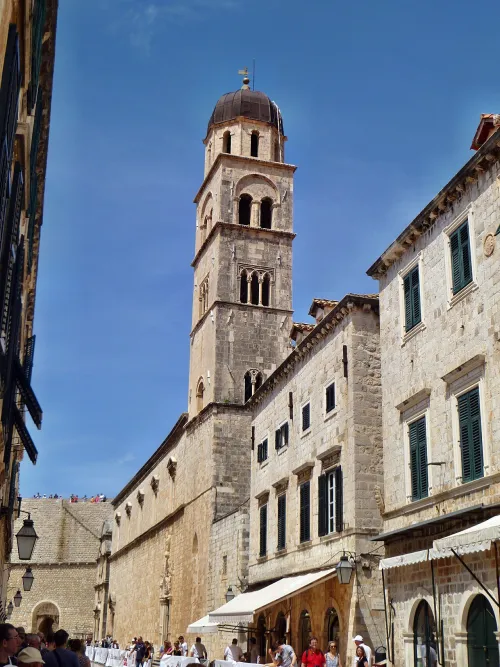
November in Dubrovnik
High17°C / 63°F
Low10°C
Rain292mm / 14 rainy days
Sun6.4 h/day
Daylight10 h/day
Humidity77%
Crowds●○○○○Prices●○○○○
November is the quietest month of the year for the sights and the wettest, with around 292mm of rain over about 14 days and the chance of multi-day Jugo storms. Highs cool to 17°C. The walls switch to their 15-euro winter rate and short 10:00-15:00 hours from the 1st. The Winter Festival opens around 29 November, lighting up the Stradun just as the city otherwise hibernates. The Lokrum ferry stops for the season.
The vibe November is the deepest off-season, raw and rain-washed, and that is exactly the appeal for some. You walk the empty walls for 15 euros, the Old Town is all locals, and when the Winter Festival lights flick on at the end of the month the Stradun becomes one of the most atmospheric streets in Europe, with almost nobody on it.
Don't miss The Winter Festival opens around 29 November with markets, an ice rink and concerts on the Stradun. The Mediterranean rains turn the Srđ hillside and the Konavle hinterland vivid green, and the empty walls cost just 15 euros.
Crowd drivers The quietest month for attractions: cruise ships gone, no school holidays, just a handful of off-season travellers.
In season Oyster and mussel season from the Ston beds is at its cold-water best, and the new olive oil from the autumn harvest is on every konoba table.
Heads up Lokrum island and its ferry close for winter. The walls move to winter hours (10:00-15:00) and the 15-euro rate from 1 November.
Hotels from 80-100 euros; from 1 November the walls drop to the 15-euro winter rate.
Events this month
🎄 Christmas marketDubrovnik Winter Festival Dubrovački zimski festival
Nov 29 – Jan 3 ~
Late November to early January, opening around the last weekend of November and running through Epiphany.
An Advent market across the Stradun and Luža Square with an ice rink, a cabrio-bus, a Christmas train, open-air concerts, theatre shows and creative workshops. New Year's Eve draws around 20,000 people for a fireworks countdown on the Stradun.
It lights up the Old Town at exactly the moment everything else is cheapest, and the Stradun under festival lights with a 15-euro walls ticket is the city's best winter value.

December in Dubrovnik
High13°C / 56°F
Low6°C
Rain208mm / 12 rainy days
Sun6.2 h/day
Daylight9 h/day
Humidity74%
Crowds●●○○○Prices●●○○○
December is quiet and festive. Highs cool to 13°C, rain is frequent (208mm over about 12 days), and daylight is at its shortest near 9 hours. The Dubrovnik Winter Festival runs the length of the month, with markets and concerts on the Stradun, and New Year's Eve draws around 20,000 people to a free open-air concert under the baroque facades. Prices stay low except for a sharp spike over Christmas and New Year. The walls are closed on Christmas Day, the only day all year.
The vibe December is two cities in one. For most of the month it is a hushed, rain-softened off-season town with 15-euro walls and the Winter Festival glowing on the Stradun. Then New Year's Eve turns the same street into one of Europe's most talked-about countdowns, 20,000 people, fireworks over the Adria and baroque facades for a backdrop, all of it free.
Don't miss The Winter Festival fills December with markets, a cabrio-bus, an ice rink and open-air concerts. The free New Year's Eve concert on the Stradun (from 21:00) with fireworks over the sea is one of Europe's most cited countdowns, but arrive by 19:00 for a stage view.
Crowd drivers Quiet for most of the month, then a sharp spike over Christmas and especially New Year's Eve, which alone draws around 20,000 to the Stradun.
In season Festive Dalmatian baking takes over: arancini (candied orange peel), kontonjata quince paste, and the fritule fritters sold warm at the Winter Festival stalls.
Heads up The city walls are closed on 25 December, the only official closing day of the year. Museums shut for Christmas; the Lokrum ferry remains suspended. Walls otherwise on winter hours (10:00-15:00).
December hotels average around 90-130 euros, but the New Year weekend spikes to summer levels; walls 15 euros.
Events this month
🎄 Christmas marketDubrovnik Winter Festival Dubrovački zimski festival
Nov 29 – Jan 3 ~
Late November to early January, opening around the last weekend of November and running through Epiphany.
An Advent market across the Stradun and Luža Square with an ice rink, a cabrio-bus, a Christmas train, open-air concerts, theatre shows and creative workshops. New Year's Eve draws around 20,000 people for a fireworks countdown on the Stradun.
It lights up the Old Town at exactly the moment everything else is cheapest, and the Stradun under festival lights with a 15-euro walls ticket is the city's best winter value.
🎉 FestivalNew Year's Eve Concert on the Stradun Doček Nove godine na Stradunu
Dec 31
31 December from 21:00; midnight countdown and fireworks.
A free open-air concert on the Stradun from 21:00, with fireworks over the Adriatic and a midnight countdown. It draws around 20,000 people, set against the street's baroque facades.
One of the most talked-about New Year spots in Europe, and entirely free, but arrive by 19:00 for a view of the stage rather than the overflow screens.
Frequently asked questions
What is the best time to visit Dubrovnik?
May and October are the consensus best months. May brings 21°C days, a swimmable 20-21°C sea and full opening hours before the high-season crush. October pairs the Good Food Festival (5-18 October) with a still-warm 21°C sea, near-empty walls and prices 30-40% below summer. Both avoid the 30-plus heat and crowds of July and August.
What are the cheapest months to visit Dubrovnik?
January and February are the cheapest, with hotel rooms from 80-120 euros a night, up to 60% below the summer peak. The city-walls ticket also drops to 15 euros instead of the summer 35, and the Rector's Palace is 15 euros. The trade-off is short winter wall hours (10:00-15:00), cool 10-13°C days and frequent rain.
When should I avoid visiting Dubrovnik?
July and August are the months most worth avoiding. The Old Town, built for around 4,000 people, takes up to 15,000 visitors a day, roughly 27 tourists per resident at peak. Highs hit 30-33°C with no shade on the walls, hotel rooms run 250-350 euros, and the unticketed wall queue can reach 90 minutes.
Can you swim in the sea in Dubrovnik, and in which months?
Yes. The Adriatic is comfortably swimmable from June to October. June reaches 23°C, July and August peak at 25-26°C, and September is the warmest of all at 24°C. October still holds 21°C. May at 20-21°C suits the hardy, while April (17°C) and the winter months (14-16°C) are bracing to cold.
Is October a good time to visit Dubrovnik?
October is one of the two best months. Days stay mild at 21°C, the sea is still swimmable at 21°C, and the cruise crowds thin sharply. The Good Food Festival runs 5-18 October and prices fall 30-40% below summer. The catch is more rain (around 180mm over 10 days) and the occasional multi-day Jugo storm.
How hot does Dubrovnik get in summer?
July and August average highs of 29-30°C, with regular heatwave spikes to 30-33°C and a record 38.4°C set in August. The city walls are a shadeless, south-facing stone terrace, so midday between 11:00 and 16:00 carries a real sunstroke risk. Walk the walls at 08:00 or after 18:00, when it is several degrees cooler.
Are the Dubrovnik city walls ever closed?
The walls close just one day a year, on 25 December. Otherwise they run summer hours of 08:00-18:30 (last entry 17:30) from April to October, and winter hours of 10:00-15:00 from November to March. The winter ticket is 15 euros against 35 in summer. Walk them at 08:00 to beat the cruise-day queues.
When is the Dubrovnik Summer Festival?
The Dubrovnik Summer Festival runs from 10 July to 25 August in 2026, 47 nights of open-air theatre, classical music, dance and folklore at historic squares and the city walls. It is the cultural highlight of the southern Adriatic, but it coincides with peak heat, peak prices and the busiest crowds, so book tickets and rooms well ahead.
How many days do I need in Dubrovnik?
Two full days cover the essentials: the city walls, the Rector's Palace, the Franciscan monastery pharmacy and the Stradun on day one, plus the Srđ cable car and a Lokrum island trip on day two. A third day lets you swim, take a Pelješac wine or Ston oyster excursion, or day-trip to Cavtat without rushing.
Is Dubrovnik worth visiting in winter?
Yes, for value and atmosphere. From November to February the walls cost 15 euros, hotels start near 80 euros, and you have the Old Town almost to yourself. The Winter Festival lights the Stradun from late November, the free St. Blaise procession falls on 3 February, and New Year's Eve draws 20,000 to a fireworks concert. Expect cool, often rainy days and short winter sight hours.

Any month, any day: your guide is already there
Whatever date you pick, a private human guide gets pricier and harder to book on weekends, holidays and in peak season. Our live AI guide, the one that walks with you and answers anything you ask out loud, works the opposite way.
One flat price, every day
No holiday, weekend, night or peak-season surcharge. A private guide in Dubrovnik runs well over 100 euro for a half day, and more on holidays. Ours stays the same.
Available the moment you want it
Start at midnight or at dawn, on Christmas, in the snow, in the August heat. No sold-out high season, no booking weeks ahead.
Your pace, no meter running
Pause for a long lunch, restart after dark, repeat a stop. The tour simply waits for you.
Free to try, a fraction of the cost
Test it for free, then a transparent flat price that undercuts any private guide, in every season.
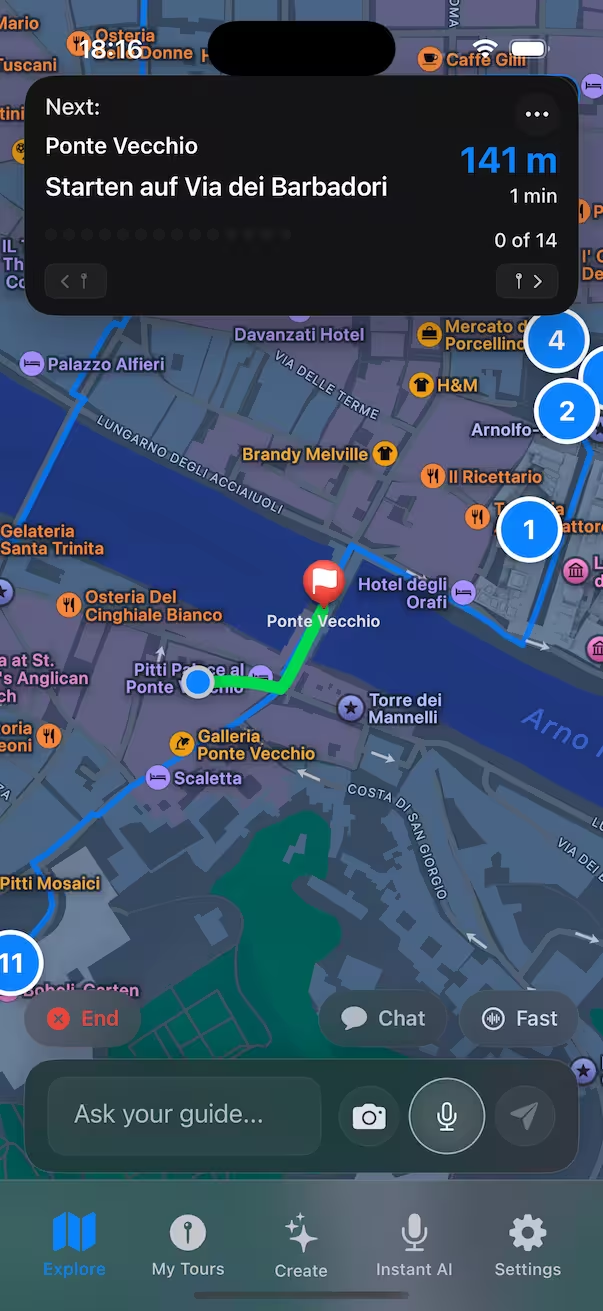
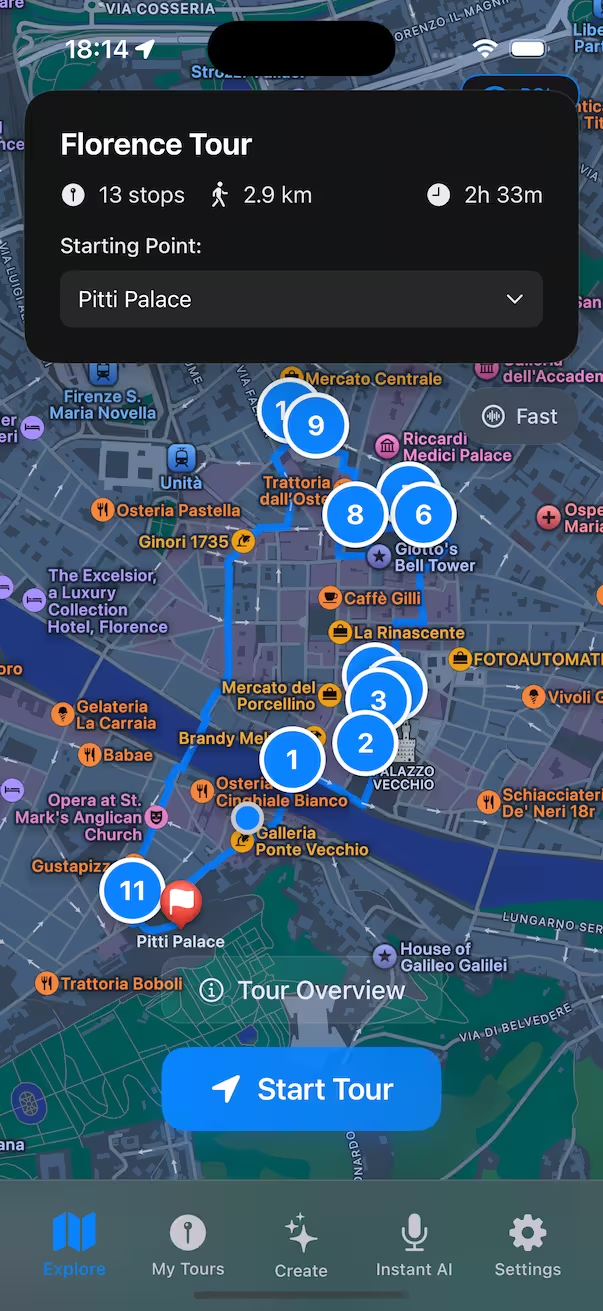
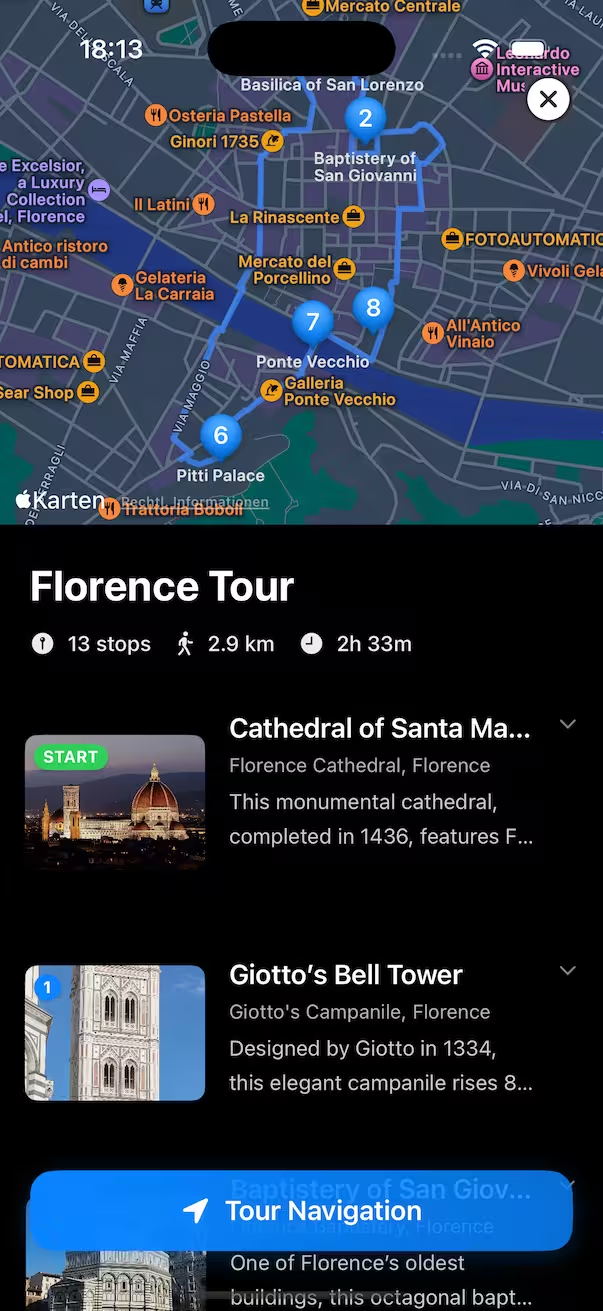
The classic Dubrovnik tour: 12 stops, 2.0 km, about 2 h on foot
Your live AI guide and the self-guided Dubrovnik route, together in your browser.